Sudha Solutions

Categories
AEO Optimization AI Overview General SEO

How to Build an AI-First Marketing Strategy in 2026

You published a blog post last month. It was well-written, well-researched, and ticked every SEO box you knew about. Then you checked your traffic and wondered why nothing moved. 

Here is what is probably happening: your content is being read by AI, summarised for users, and never clicked on. The user got their answer. You got nothing. 

This is the reality of content marketing in 2026, where brands investing in SEO expert services and AEO services must optimize not just for clicks, but for AI-driven visibility. And if your strategy has not caught up to it yet, you are losing ground to competitors who have. 

This post will walk you through what an AI-first marketing strategy actually looks like, why both SEO and AEO now need to sit in your plan together, and the practical steps to get started. 

What is AI-first marketing?  

AI-first marketing is a strategy that combines SEO, AEO, and content optimization to ensure your brand is discoverable, extractable, and citable across traditional search engines and AI-powered answer platforms. 

First, What has Actually Changed? 

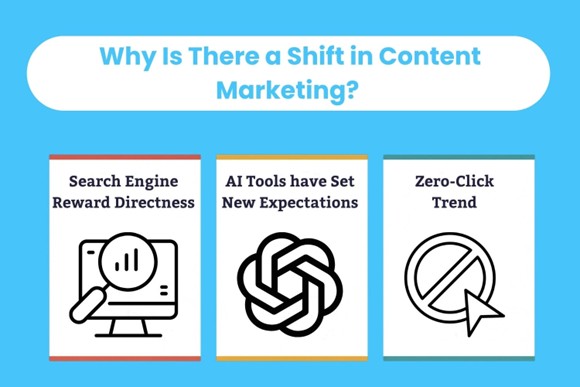
This zero-click shift is reshaping search engine optimization services into a broader AI-first strategy 

Not long ago, ranking on page one of Google meant traffic. People saw your link, clicked it, and landed on your site. That chain still exists, but it is breaking. 

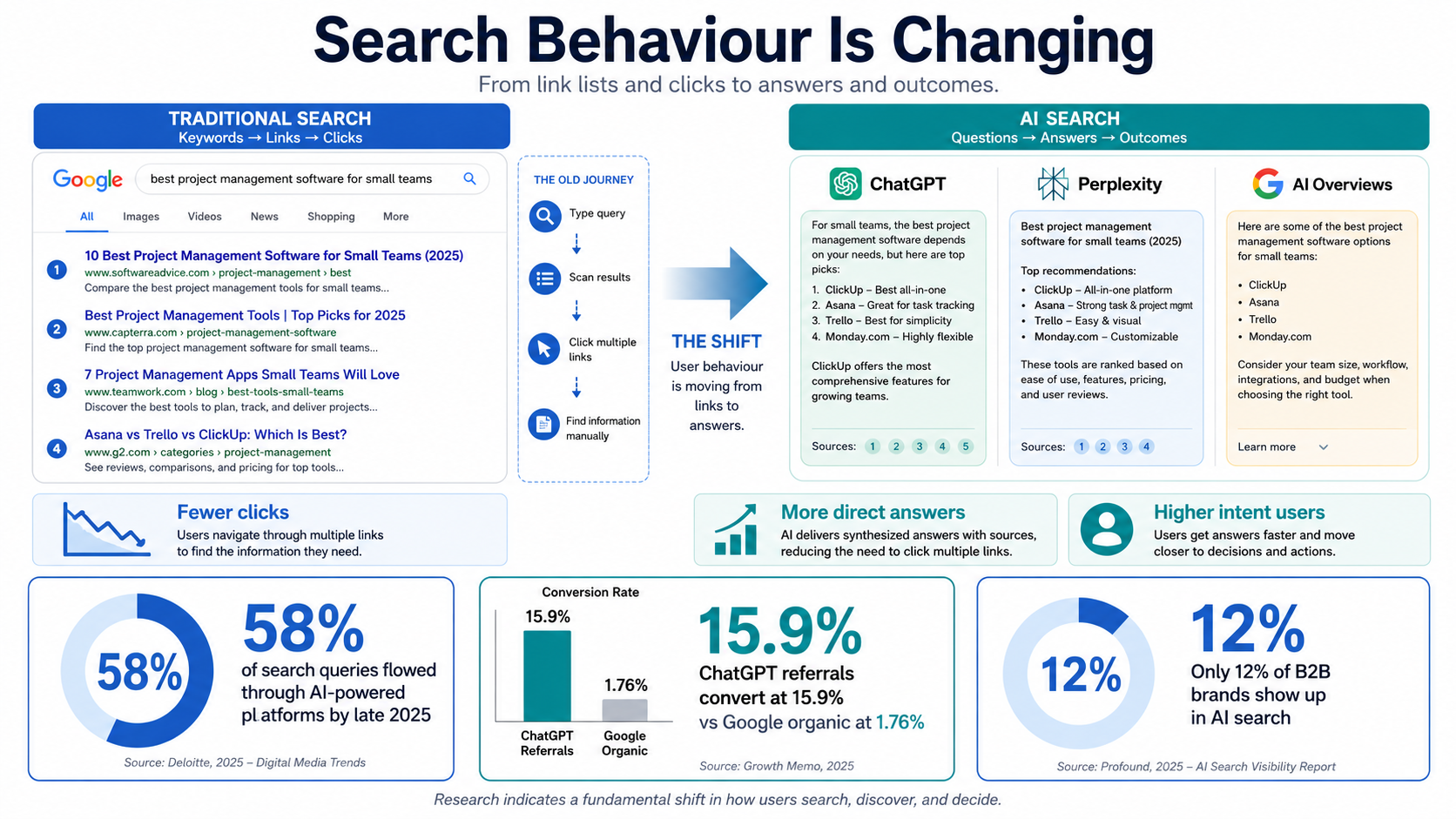
According to Search Engine Journal zero-click searches jumped from 56% in 2024 to 69% in 2025. That means nearly 7 out of 10 Google searches now end without anyone visiting a website. Add to that Google AI Overviews, ChatGPT Search, and Perplexity, all of which answer questions directly, and you start to see the problem. 

But here is the flip side: those AI engines have to cite someone. They are pulling information from somewhere, and that somewhere could be your content. 

That is where AEO comes in. 

What is AEO and why does it matter? 

For businesses adapting early, answer engine optimization is becoming as essential as traditional SEO. 

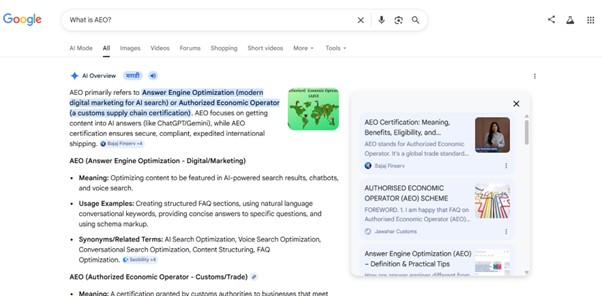
what is aeo and why does it matter

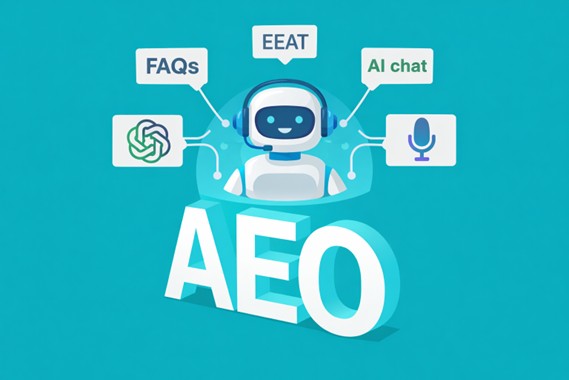
AEO stands for Answer Engine Optimization. Where SEO helps your content rank in search results, AEO helps your content get cited as the answer inside AI tools like ChatGPT, Google AI Overviews, and Perplexity.

Think of it this way: SEO gets you on the shelf. AEO gets you recommended by the shop assistant.

At HubSpot, traffic from AEO converted at 3x the rate of other sources, because users who arrive after an AI recommendation already trust the source they were sent to. The intent is higher; the scepticism is lower.

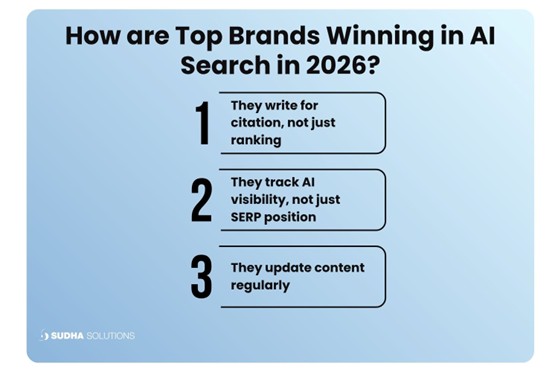
The brands winning in 2026 are doing both. This is why SEO and AEO now function best as integrated layers of a modern visibility strategy. They are building content that ranks in traditional search AND gets picked up by AI as the most credible answer.

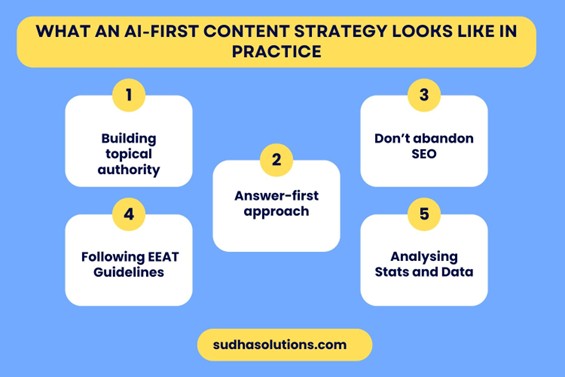
What an AI-First Content Strategy Looks Like in Practice

What an AI-first content strategy looks like in practice

1. Build Topical Authority, not Just Individual Posts

A strong AI-first marketing strategy relies on content ecosystems, not isolated blog posts.

A structured topical authority framework built through pillar pages and clusters significantly improves both rankings and AI citations.

AI engines do not favour brands that wrote one good article on a topic. They favour brands that clearly own a subject area.

If you run a SaaS HR platform, you should not just have a blog post on “how to write a performance review.” You should have a full cluster of content covering reviews, feedback frameworks, one-on-ones, goal setting, and everything in between, all internally linked, all pointing back to a central pillar page.

This tells both Google and AI models: this brand is the authority here.

2. Write Every Piece so the Answer Comes First

This is where answer-led content becomes critical, helping AI systems extract and trust your information faster.

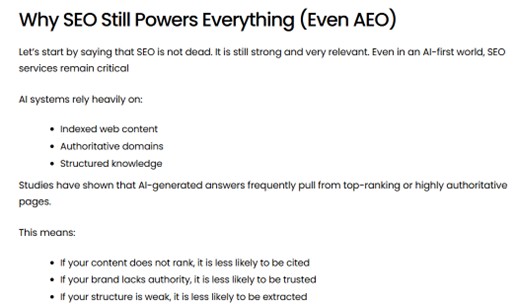
seo still power everything

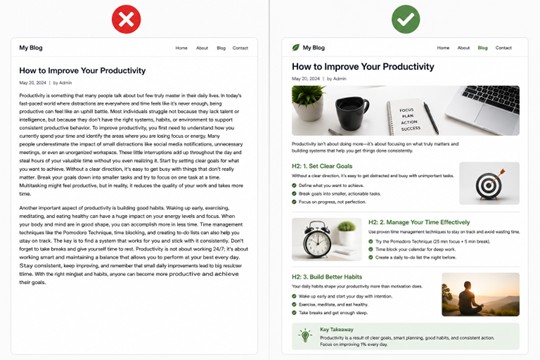
AI systems scan your content looking for a clear, direct response to a question. If your article spends the first three paragraphs warming up before getting to the point, you will be skipped.

The format that works:

  • Start with a 40 to 60 word paragraph that answers the question directly
  • Use subheadings that are themselves complete questions (“What is topical authority?” not just “Topical authority”)
  • Add an FAQ section at the bottom covering related questions your audience is actually searching for

This structure serves your human reader and gives AI a clean block of text it can quote.

3. Make your Expertise Visible, not just Implied

Effective AI content optimization now requires explicit credibility signals that AI systems can verify.

A strong AI citation strategy depends on visible expertise, third-party trust signals, and content clarity.

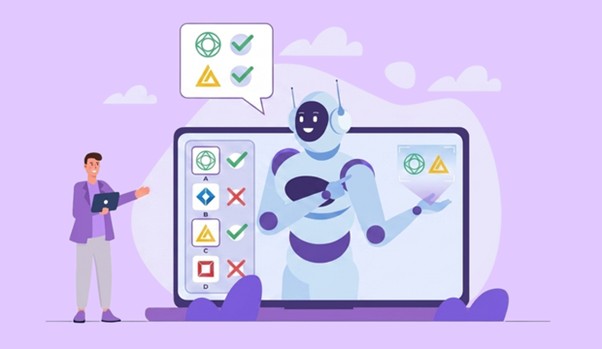
AI citations

Google and AI models are trained to look for E-E-A-T signals: Experience, Expertise, Authoritativeness, and Trustworthiness. This is no longer a nice-to-have. It is a ranking and citation requirement.

Practical ways to build this into your content:

  • Every article should have a real author with a bio, credentials, and a LinkedIn link
  • Cite primary sources and original data wherever possible. AI models prefer content that references verifiable evidence over opinion pieces
  • Earn mentions on other credible sites. Being cited by an industry publication is one of the strongest trust signals you can send to an LLM

A useful example: Semrush published an original study on AI Overviews in early 2025. That single piece of research now gets cited by ChatGPT almost every time someone asks about the topic. One well-researched, data-backed post can generate more long-term AI visibility than fifty generic “tips” articles.

4. Do not Abandon Traditional SEO

Your SEO strategy 2026 should still prioritize crawlability, technical performance, and search intent while layering AEO on top.

It might be tempting to pivot entirely to AI optimisation. But this is not possible, yet.

Google still handles the vast majority of searches. Core Web Vitals, backlinks, site structure, and keyword strategy still matter. The brands that will dominate in 2026 treat SEO and AEO as two layers of the same strategy, not competing approaches.

Build the technical foundation with SEO. Make the content citation-ready with AEO. Run both simultaneously.

5. Measure the Right Things

Modern brand mention tracking across AI ecosystems is now essential for measuring visibility beyond traditional traffic.

brand mention tracking

Your analytics need to evolve alongside your strategy. Organic clicks are no longer the only signal that your content is working.

Watch for:

  • AI Overview appearances in Google Search Console
  • Direct traffic lifts (often a sign users found you via AI and came back directly)
  • Brand mention tracking across Perplexity, ChatGPT, and AI Overviews
  • Lead quality from AI-referred traffic, not just volume

The Window to Act is Still Open, but Not for Long

Brands that built dedicated AEO strategies in early 2025 are now capturing 3.4x (340%) more answer engine traffic now than those who waited. That gap will only widen.

Most businesses are still writing content the way they did in 2020. That creates a genuine opportunity for brands willing to restructure their approach now, before the space becomes as competitive as traditional SEO.

The good news is you do not have to start from scratch. If you already have a content library, a lot of it can be restructured and updated to work harder in AI-era search. The bones are often already there.

Where to Start this Week

If you want to begin moving in this direction, here is a simple first step: pick your five most important existing articles and run them through this checklist.

  • Does each article open with a direct, quotable answer in the first paragraph?
  • Does each article have a clear author with visible credentials?
  • Does each article include an FAQ section with question-formatted subheadings?
  • Is each article internally linked to related content on the same topic?
  • Is there FAQ Page or Article schema markup on the page?

If the answer to most of those is no, you have a clear starting point.

An AI-first content strategy is not about throwing out what you know. It is about building on it for the way search works today.

Want to create an AI-First Marketing Strategy in 2026?

We at Sudha Solutions have helped multiple brands get visibility on AI. We follow a effective template, which is loved by AI, helping your brand get mentioned by AI. Visit Sudha Solutions Today.

Frequently Asked Questions

Why are zero-click searches increasing?

AI-generated summaries, featured snippets, and answer engines are providing users direct answers without requiring website clicks.

Can existing content be optimized for AI search?

Yes, updating structure, adding FAQs, schema, and clearer answers can improve AI citation potential significantly.

How do I know if my content is being picked up by AI tools like ChatGPT or Google AI Overviews?

You can track this by monitoring brand mentions in AI-generated responses, checking Google Search Console for AI Overview impressions, and observing increases in direct traffic. These signals often indicate your content is being referenced even if clicks are low.

Should businesses invest more in AEO or traditional SEO right now?

It is not an either-or decision. SEO builds discoverability, while AEO drives credibility and conversions. Businesses that integrate both strategies tend to see stronger long-term performance across search and AI platforms.

What type of content performs best for AI-driven search engines?

Content that is structured, concise, and answer-focused performs best. This includes clear definitions, step-by-step explanations, data-backed insights, and well-organised FAQs that directly match user queries.

How often should existing content be updated for AI relevance?

High-performing or strategic content should be reviewed every 3–6 months. Updates should focus on adding clearer answers, improving structure, strengthening internal links, and incorporating recent data or trends.

Can smaller brands compete with large websites in AI search results?

Yes. AI engines prioritise clarity, authority, and relevance over brand size. A well-structured, niche-focused content strategy can outperform larger competitors if it demonstrates expertise and depth.

Categories
AEO Optimization AI Overview General SEO

How AI Decides Which Brands to Cite (And Why Most Don’t Make It)

Are you outranked by worse content? Or even after following all the winning rules of writing content, you’re invisible to AI?

You’ve followed every SEO rule.
You’ve written long-form content.
You’ve optimised keywords, added backlinks, and improved readability.

And yet… competitors with seemingly weaker content show up in AI answers and you don’t.

Don’t worry, this is not because your content quality is not up to par.
It’s more likely because your content is structured for traditional search engines and not LLMs.

Today, platforms like ChatGPT, Google Gemini, and Perplexity AI have not only replaced the traditional Google searches but have become the primary search engine of 44% users.

And these platforms don’t rank results; they select and cite them.

That means you’re not competing for rank anymore. You’re competing for selection.

And here is exactly how your brand can dominate AI visibility in 2026 and beyond.

TL; DR

Ranking #1 no longer guarantees traffic or visibility. AI engines prioritise content they can easily extract, verify, and trust. To get cited, brands must combine AEO with SEO; focusing on structure, entity clarity, and consistent presence across third-party platforms.

Why Ranking #1 No Longer Guarantees Visibility

Marketers, did you know? For every 100 clicks a #1 ranking once earned, AI Overviews can now cut that by ~35–58 clicks. The rest are absorbed by AI-generated summaries that answer the user’s query without them ever needing to visit your website.

Organic click-through rates on queries with AI Overviews dropped a staggering 61% between June 2024 and September 2025, falling from 1.76% to just 0.61%. Pew Research found that when an AI summary is present, users are about half as likely to click a link at all.

McKinsey has framed this shift bluntly, describing AI search experiences as the “new front door to the internet.” Their consumer survey data shows that roughly half of consumers already prefer AI-augmented search or assistants for complex decisions.

The irony is this: Semrush data shows that ChatGPT primarily cites pages ranking in positions 21 and beyond in traditional organic search about 90% of the time.

This means:

  • Even if you rank #1 on Google, AI may ignore you
  • Lower-ranked but better-structured content gets cited

The rules have changed. Ranking is no longer the goal. Being selected in AI answers is.

What is AEO (Answer Engine Optimization) and Why It Matters Now

What is AEO (Answer Engine Optimization)

Answer Engine Optimization (AEO) is the practice of structuring and enhancing your content so that AI-powered search platforms (AIO, ChatGPT, Perplexity, etc) select it as a cited source when generating answers.

Unlike traditional SEO, which optimises for ranked links on a results page, AEO targets the retrieval layer: the moment an LLM selects which sources to pull into its answer generation.

The content must be easy to retrieve, understand, extract from, and attribute.

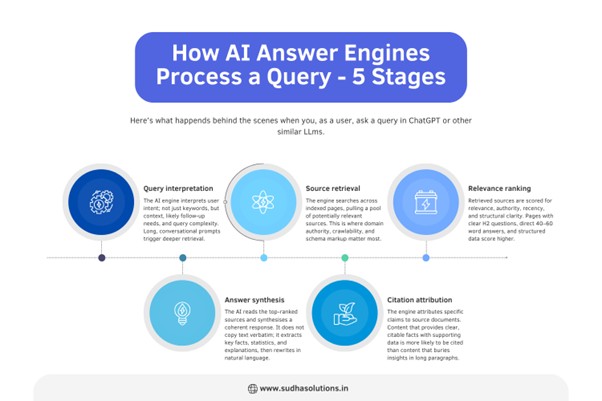
How AI Answer engine

The market has already recognised AEO’s importance. 42% of B2B content marketers report reallocating budget from traditional SEO content to AEO-optimised content. And 98% of CMOs say they are investing in AEO this year.

The bottom line?

  • SEO drives the organic traffic that pays the bills today.
  • AEO builds the brand authority that protects your visibility as AI search grows.

And you need both, but AEO is where the early-mover advantage lies right now.

Comparison: Why One Brand Gets Cited and Another Doesn’t

BRAND A – Gets Cited

BRAND B – Gets Ignored

FAQ schema on every key page No structured schema on any page
Comparison pages with structured tables Long paragraphs, no direct answer blocks
40–60 word direct answers under each H2 Case studies locked in PDFs, not HTML
Updated profiles on review platforms Review platforms empty or outdated
Active in reddit threads with genuine advice No community presence on forums
Original research published and widely cited No original data or research published
Notable press mentions No external media mentions in 12+ months
Content distributed across 8+ publications Content only published on own domain


Takeaway:
The difference is rarely about content quality. It’s almost always about content structuredistribution, and discoverability signals. Brand B might actually have better content but AI can’t extract, attribute, or verify it.

Why Do Some Brands Appear More Often in AI Recommendations?

This is the question at the centre of every marketing strategy conversation in 2026.

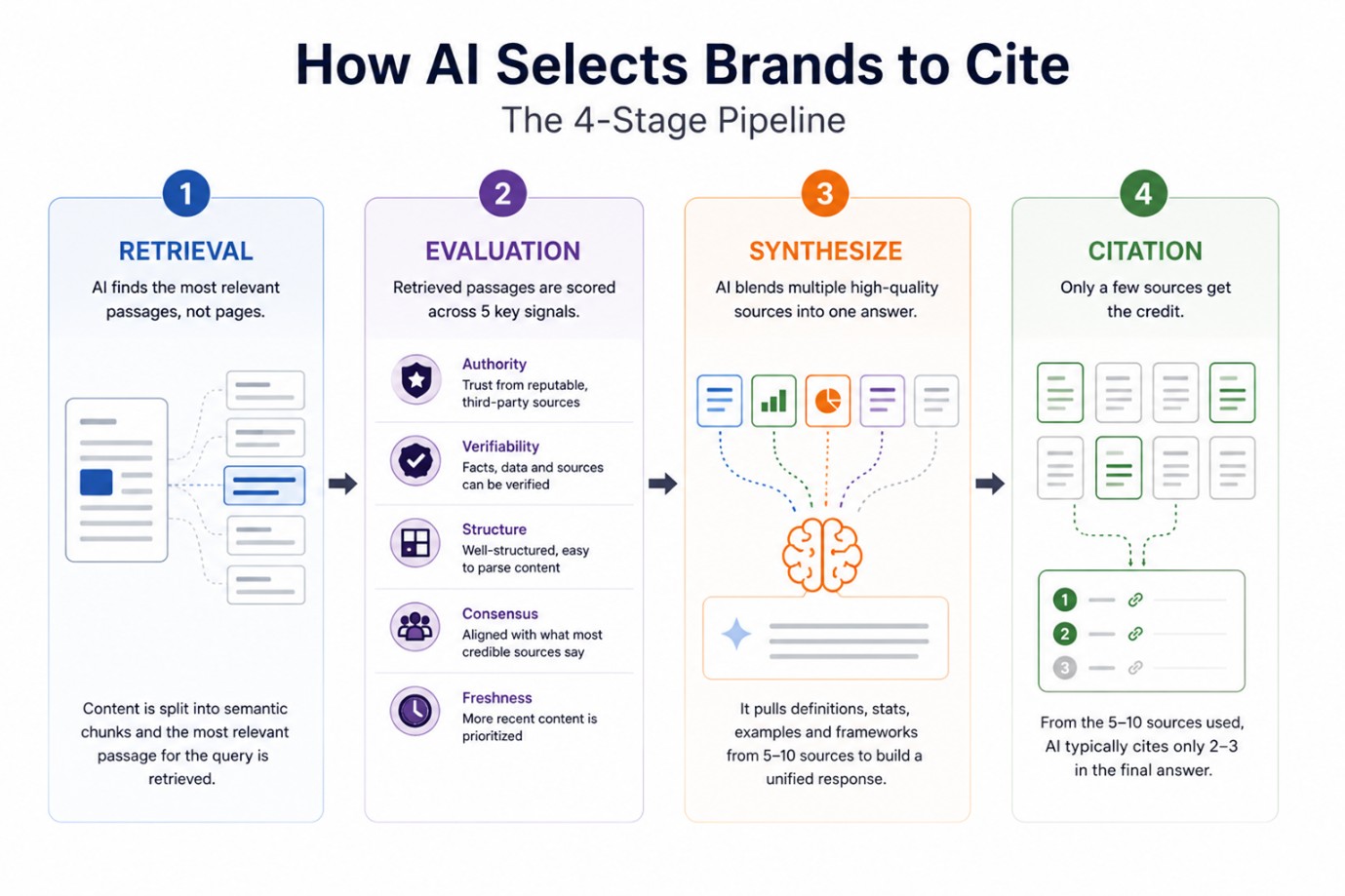
AI systems follow a 3-stage pipeline: Retrieve → Evaluate → Synthesize → Cite

Let’s break down each layer with deeper insights, research, and real examples.

Stage 1: Retrieval

AI breaks your content into semantic chunks and retrieves the most relevant passage not the most relevant page. The unit of competition is no longer your article. It’s the best paragraph on the internet for that specific question.

This means query-intent match matters more than keywords. A page targeting “AI SEO tips” won’t be retrieved for “why is my content not showing in AI answers” even if it covers the same ground.

Stage 2: Evaluation

Retrieved passages are then scored across five signals:

  • Authority: AI is “overwhelmingly biased toward earned media and authoritative third-party sources.” Mentions in news sites, research papers, and industry blogs outweigh owned content every time.
  • Verifiability: Only half of AI-generated statements are fully supported by citations today. AI actively avoids content it can’t verify. No data, no citation.
  • Structure: AI isn’t reading; it’s only parsing. Pages with structured formats and schema markup are 30–40% more likely to be cited. Question-based headings with 50–120 word answer blocks are the target format.
  • Consensus: AI compares sources and trusts repetition. If ten sites say the same thing, confidence is high. If only yours says it, it may be ignored entirely. Being right isn’t enough; you need to be aligned with the ecosystem.
  • Freshness: A blog updated in 2026 will consistently out-prioritise the same content last touched in 2023.

Stage 3: Synthesize

AI doesn’t pick one winner. It blends 5–10 sources into a single unified response; pulling a definition from one site, a statistic from another, a framework from a third. The goal isn’t to be the only source cited. It’s to be included in the blend.

Stage 4: Citation

Even after synthesis, AI cites only 2–3 sources from the 5–10 it used internally. ChatGPT only cites 15% of the pages it retrieves. Citations are concentrated among a small set of high-visibility domains that pass authority checks faster and appear more consistently across the retrieval pool.

There is also a documented big-brand bias marketers talk about: AI systems systematically prefer established, widely-referenced domains. Smaller brands need stronger signals, not just better content.

You’ll learn more on this in our other blog: It’s Not Popularity: How AI Decides Which Brands Deserve Visibility

So, the best content doesn’t win. The most usable, trusted, structured, and verifiable content wins; distributed widely enough that AI encounters it, recognises it, and has the confidence to attribute it.

Why Most Brands Fail to Get Cited By AI?

Why Most Brands Fail to Get Cited By AI

1. No structured schema markup

Brands must have a full Organization schema including sameAs properties, founder, and contactPoint. Without it, the AI is essentially “guessing” who you are and what you do. This is the single most fixable technical gap.

2. Content buried in PDFs

Most B2B expertise are invisible to AI because it resides in non-HTML formats. White papers, case studies, and research locked in PDFs are computationally expensive for AI to parse and often ignored entirely.

3. Optimised for keywords, not questions

Traditional SEO content is structured around keywords. AI engines are structured around questions and direct answers. Content that doesn’t mirror how users actually ask questions in ChatGPT or Perplexity won’t be retrieved for those queries.

4. High authority, low citations

Studies show that brands with strong domain authority but minimal recent mentions in news, Wikipedia, and industry sources perform poorly. AI treats them as “old guard” rather than “currently relevant.” Freshness of brand mentions matters.

5. Zero community presence

Domains with millions of brand mentions on Quora and Reddit have roughly 4× higher chances of being cited than those with minimal activity. Brands that exist only on their own website are invisible to the community validation layer AI engines prize.

6. Unclear site navigation hierarchy

If brands fail to use SiteNavigationElement schema, it’s difficult for AI agents to understand the hierarchy of a site’s services. If AI can’t navigate your site like a user can, it defaults to ignoring it.

How to Optimise Your Content for AI Citations: Checklist You Can Actually Follow

Structured Data (Core Extraction Layer)

  1. Organisation schema with sameAs links (socials, Wikipedia, Wikidata; entity grounding)
  2. FAQPage schema on key pages (top extraction source after TL;DR blocks)
  3. Article + Author (Person) schema (clear authorship + credibility signals)
  4. Review / Product schema (if applicable) (ratings + trust metadata for AI summaries)

Answer-First Content (Primary Citation Layer)

  1. TL;DR (40–60 words) at top (most frequently extracted block)
  2. Question-based H2s (real queries) (“What is…”, “How to…”, “Why does…”)
  3. Direct answer under each H2 (40–60 words) (before any explanation)
  4. Short paragraphs (2–4 sentences max) (improves extraction + readability)
  1. No fluff introductions (immediate answer delivery only)

Content Structure (Parsing + Clarity Layer)

  1. Clear hierarchy (H1 → H2 → H3 + clean formatting) (helps AI chunk content correctly)
  2. Tables / bullets for comparisons & steps (AI prefers structured blocks)
  3. Statistics + data clearly presented (numbers = high citation probability)

Credibility & Authority (Trust Layer)

  1. Cited sources + original data points (external validation + uniqueness)
  2. Author credibility + publication dates visible (E-E-A-T signals for LLMs)
  3. Balanced, transparent content (include limitations, methods, or alternatives)

Related read: How to Optimize for AI-Powered Search: Strategies for Google, ChatGPT & Perplexity

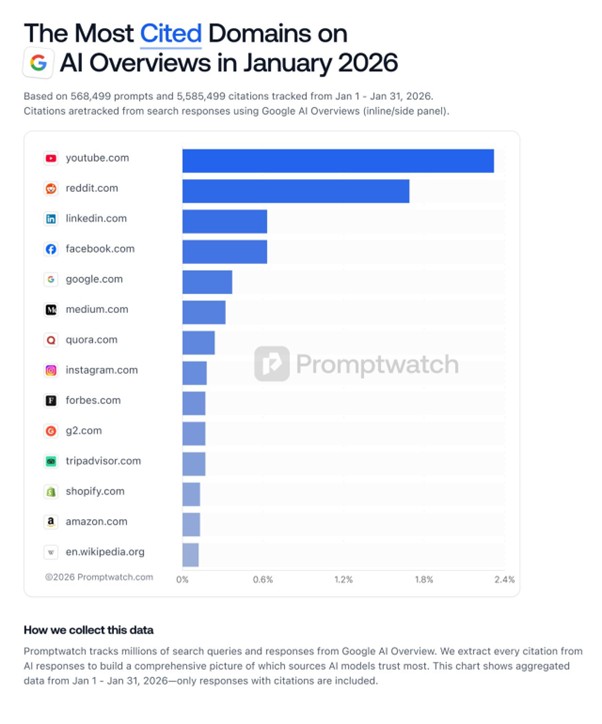
Why Reddit Is Suddenly Dominating AI Citations

Why Reddit Is Suddenly Dominating AI Citations

Source: Promptwatch

If you haven’t taken Reddit seriously as a marketing channel, 2026 is the year that changes. Reddit has emerged as one of the most consistently cited domains across major AI platforms and understanding why reveals something important about how AI thinks.

  1. Authentic experience over marketing copy

AI platforms are constantly asked “What’s the best X?” or “Should I use Y?” These are opinion-seeking queries that require real human experiences. Reddit is the largest repository of authentic human opinions on the internet; something corporate landing pages cannot replicate.

  1. Built-in quality signals via upvotes

Reddit’s upvote system provides a quality signal AI systems can leverage. A comment with 200 upvotes is statistically more likely to contain accurate, useful information than a random blog post and AI models appear to weight this accordingly.

  1. Google’s $60M licensing deal

Did you know, Google’s annual licensing agreement gives it access to Reddit’s content for AI training and retrieval, reinforcing Reddit’s position in AI Overviews and AI Mode? This deal also formed strong citation signals for other generative AI models.

  1. Structured disagreement; something AI values

Reddit threads contain structured disagreement with multiple perspectives and diverse viewpoints, thanks to authentic human-led opinions. AI engines need this to build balanced answers, and it’s rare on polished brand websites where every piece of content is positively framed.

What this Means for Your Brand?

Reddit citations aren’t just available to consumer brands. Authentic participation in niche subreddits with genuine answers to real questions, not promotional content is now a measurable component of AI visibility strategy.

Think of it as community PR, not advertising. The prompts that currently drive Reddit citations are exactly the prompts your potential customers are asking. Tap into that.

Wondering how you can optimise AEO for Reddit and Quora? We have the perfect how-to guide for you – How to Optimize for AEO: Ranking Reddit & Quora Content in AI Search

Final Thoughts

AI search has already shifted from ranking to selection. AI platforms are selecting 2–5 sources to synthesise into answers that 44% of searchers now accept as their final destination; no click required, no scroll needed.

If your brand isn’t cited, the issue isn’t content quality. It’s structure, authority, and distribution.

The solution is not replacing SEO, but layering AEO + GEO:

  • Structure content for extraction (direct answers, schema)
  • Build entity clarity and authority
  • Expand presence across trusted platforms

More on these in our blog – AEO/GEO Optimization Strategy: Best Practices, Tools, and How it Differs from Classic SEO

Your goal? To make your content easy for AI to retrieve, understand, and cite.

At Sudha Solutions, we execute this end-to-end right from schema and restructuring to community strategy to AI visibility tracking, so your brand gets selected in AI engines and not just ranked.

Contact us today if you want us to audit your current AI citation visibility, identify exactly why you’re being skipped, and build a prioritised AEO roadmap tailored to your brand

Frequently Asked Questions

Why is my brand not appearing in ChatGPT even though I rank on Google?

Because ChatGPT does not rank pages; it selects sources. If your content lacks clear answers, structured formatting, schema, and strong external mentions, it won’t be cited even if it ranks #1 on Google.

Do I still need traditional SEO if I’m investing in AEO?

Yes. SEO helps you get discovered and indexed, while AEO makes your content extractable and citable. You need both working together.

Should I prioritise ChatGPT, Google AI Overviews, or Perplexity for AEO?

  • ChatGPT: easier entry, doesn’t rely heavily on rankings
  • Google AI Overviews: strongly tied to top 10 rankings
  • Perplexity: favors research content and sources like Reddit

One AEO structure works across all. So, we recommend optimising for all three simultaneously. 

How long does it take to start appearing in AI citations after making AEO changes?

Expect early mentions in 2–4 months if you fix structure and schema quickly. Consistent visibility across platforms usually takes 6–12 months.

How do I measure my brand’s AI citation performance?

Track:

  • How often your brand is mentioned in AI answers
  • Which pages get cited
  • Your share of citations vs competitors
    Tools like Semrush AI Visibility or manual prompt tracking can help.


Categories
AEO Optimization AI Overview General SEO GEO Optimization

AI SEO in 2026: The Complete Guide to Getting Your Brand Found in AI Search

Search has fundamentally changed. Right now, 2 billion people are using Google AI Overviews every month. 60% of all Google searches end without a single click to any website. And when someone asks ChatGPT “What are the best skincare brands in India?” your brand either appears in the answer, or it doesn’t exist.

This is not a future problem. It is happening today. This guide tells you exactly what to do about it.

In This Guide

  • What Is Actually Changing in Search Right Now
  • What Is AI Visibility? Why It Replaces Rankings
  • Our Original Study: Indian Brands in AI Search
  • How AI Decides What to Cite
  • Google AI Overviews vs. ChatGPT vs. Perplexity vs. Gemini
  • How to Write Content That Gets Cited in AI Search
  • Brand Mentions, Reddit & Off-Site Signals
  • How to Measure Your AI Visibility
  • Which Industries Are Most and Least Affected
  • Your 90-Day AI SEO Action Plan
  • Frequently Asked Questions

1. What Is Actually Changing in Search Right Now

AI-powered platforms such as Google AI Overviews, ChatGPT, and Perplexity are increasingly answering user queries directly, often without directing traffic to websites. In fact, nearly 60% of searches now end without a click. As a result, brands must shift their focus from simply ranking on search engines to being cited within these AI-generated responses.

This is where Answer Engine Optimization (AEO) plays a critical role in ensuring visibility for modern brands in evolving search ecosystems. For over two decades, the goal of SEO was simple: rank on the first page of Google. Get the click. Drive traffic. That model is now fractured.

In 2024, Google introduced AI Overviews in the United States. In March 2025, they expanded to Europe. By early 2026, AI Overviews appear on approximately 25% of all Google searches, and that number is growing every month. At the same time, ChatGPT processes more than 1 billion queries per day and has become the fifth most visited website on the planet.

The result? A parallel search economy has emerged alongside Google; one that operates on completely different rules.
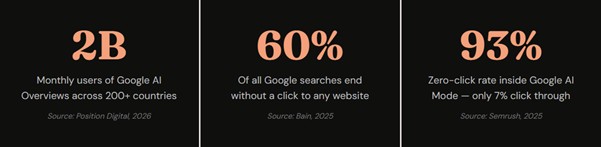
Google AI Overviews

What this tells us is straightforward: your Google ranking is delivering less traffic than it did two years ago even if the ranking itself hasn’t changed. The problem isn’t your SEO. It’s that the search results page has been redesigned around AI.

“The statistics tell a clear story: search behaviour is fragmenting. Visibility inside AI-generated answers is becoming just as important as ranking and most teams don’t yet have a framework for measuring it.” Victor Karpenko, CEO – SeoProfy, March 2026

The good news: traditional SEO is not dead. Google still processes an estimated 8.5 billion searches per day and sends dramatically more traffic than all AI search engines combined. What’s changed is the layer on top of it and your strategy needs to address both through a combination of SEO expert services and AI visibility strategies.

Also Read: AIO vs. SEO vs. AEO: An Honest Guide for Small Businesses in 2026

2. What Is AI Visibility? Why It Replaces Rankings as Your Key Metric

AI Visibility is a metric that measures how often your brand is cited, mentioned, or recommended when users ask AI systems questions in your category.

Unlike keyword rankings, it does not appear in Google Search Console. It must be tracked separately and it is fast becoming the most important metric in digital marketing. Brands investing in AI visibility and AEO strategies are already seeing higher conversion-driven traffic

Here is the core shift that most SEO teams have not yet processed.

When someone searches on Google, they see a list of links. Your rank determines whether they click you. Traffic is measurable. Attribution is relatively clear.

When someone searches on ChatGPT or through Google AI Overviews, they get an answer. Your brand either appears in that answer, or it doesn’t. There is no rank. There is only cited or not cited. And the new data on why this matters is startling.

AI traffic converts at 14.2%, compared to Google’s organic traffic at 2.8%. That is a 5x difference in conversion rate per visit. The traffic is smaller in volume, but it is dramatically higher in quality. Someone who clicks through to your brand from an AI-generated answer has already been pre-qualified by the AI. They have been told, in effect, that you are the answer to their question.
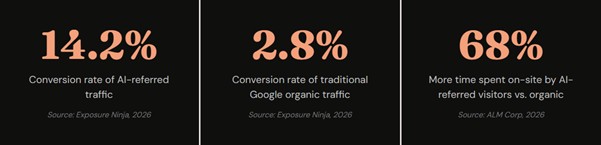
AI Visibility

The Problem: AI Visibility Is Invisible to Traditional Tools

Google Search Console tracks impressions and clicks from Google Search. It does not track whether your brand appeared in an AI Overview answer. It certainly does not track whether ChatGPT recommended you 10,000 times this week.

Only 22% of marketers are actively tracking AI visibility and traffic today. Which means 78% of marketing teams are operating blind to a channel that converts at five times the rate of their primary traffic source. This is why businesses are shifting toward integrated SEO and AEO services to track and improve visibility

Also Read: What Is AEO? Why Your Business Is Invisible to ChatGPT in 2026

3. Our Original Study: Indian Brands in AI Search
Indian Brands in AI Search

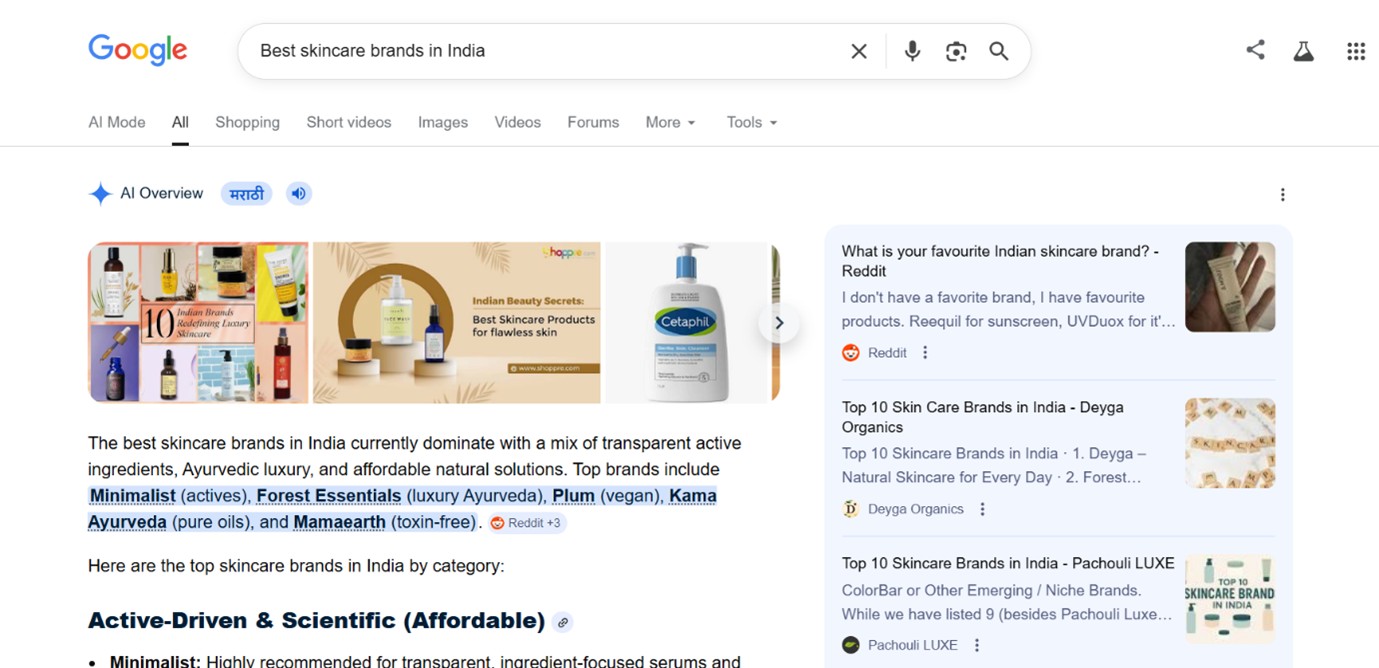
To understand exactly how AI search treats Indian brands, we conducted our own audit. We ran the query “Best skincare brands in India” across four major AI platforms simultaneously in March 2026 and documented which brands appeared, which were cited as sources, and what each AI said about them.

Here is what the Google AI Overview showed:

See screenshot above: Google AI Overview for “Best skincare brands in India” prominently cited Minimalist, Plum, Forest Essentials, Kama Ayurveda, Mamaearth, and Reequil – with Reddit listed as the primary source. Brands not mentioned in this answer are, for all intent and purpose, invisible to that user.

Study Results: “Best Skincare Brands in India” Across 4 AI Platforms

Methodology: Query run in March 2026. Brands tracked for citation, mention in AI answer body, and source attribution. Results represent a single-run snapshot (AI responses vary per query).

Brand Google AI Overviews ChatGPT Perplexity Gemini
Minimalist ✓ Cited ✓ Cited ✗ Not cited ✓ Cited
Plum ✓ Cited ✓ Cited ✗ Not cited ✗ Not cited
Mamaearth ✓ Cited ✓ Cited ✓ Cited ✗ Not cited
Forest Essentials ✓ Cited ✓ Cited ✓ Cited ✓ Cited
Reequil ✓ Cited ✗ Not cited ✓ Cited ✗ Not cited
Kama Ayurveda ✓ Cited ✓ Cited ✓ Cited ✓ Cited
The Derma Co. ✗ Not cited ✓ Cited ✗ Not cited ✗ Not cited

 Key finding:

  • Forest Essentials and Kama Ayurveda appear across all 4 platforms; achieving a perfect AI visibility score.
  • Minimalist, despite strong performance on Google AI Overviews and ChatGPT, drops off entirely on Perplexity.
  • Plum, once considered a benchmark for AI visibility, is now absent on both Perplexity and Gemini.
  • The Derma Co. remains largely invisible, appearing on only one platform despite strong traditional SEO; a clear illustration of the AI visibility gap in action.

What This Study Reveals

The brands that appear consistently across AI platforms share three things: structured content that answers specific questions, strong brand mentions across review sites, Reddit, and third-party publications, and a content presence built around ingredient claims and category comparisons; exactly the type of content AI models are trained to cite. This aligns with how content marketing and SEO strategies need to evolve for AI search

The brands that are invisible across AI platforms are not necessarily worse products. They simply have not optimised for how AI finds and cites brands. That is entirely fixable and the rest of this guide shows you how.

We recommend you run this same audit for your own category and your own brand. The process is simple: run your top 10 customer search queries across ChatGPT, Perplexity, Google AI Overviews, and Gemini. Document where your brand appears and where it doesn’t. That data becomes your AI SEO starting point.

4. How AI Decides What to Cite

AI systems prioritise content that is structured clearly, uses definite language, contains specific data points, and is referenced across multiple trusted third-party sources. Traditional ranking factors like keyword density matter far less than content depth, entity density, and off-site brand mentions.

Understanding AI citation logic is the single most important insight in this entire guide. It is also where most SEO strategy fails especially when brands lack structured implementation of AEO services for AI-driven search visibility.

The 5 Factors AI Uses to Decide What to Cite

Factor 1: Content Placement Within the Article

Research from Growth Memo (February 2026) reveals a striking pattern: 44.2% of all LLM citations come from the first 30% of an article. The middle section accounts for 31.1%, and the conclusion only 24.7%. This has a direct implication for how you structure content: your most citable insights must appear in your introduction not buried in section five.

Factor 2: Definite Language and Specific Claims

ChatGPT demonstrably favours content that uses definite language rather than hedged or vague statements. The same research found it prefers content with a high entity density, a question mark in the text (indicating it answers a real question), a balanced mix of facts and opinions, and simple sentence structures. In practice: write “Minimalist’s 10% Niacinamide serum reduces hyperpigmentation in 4 weeks” rather than “some serums may help with hyperpigmentation over time.”

Factor 3: Domain Authority and Brand Mentions Off-Site

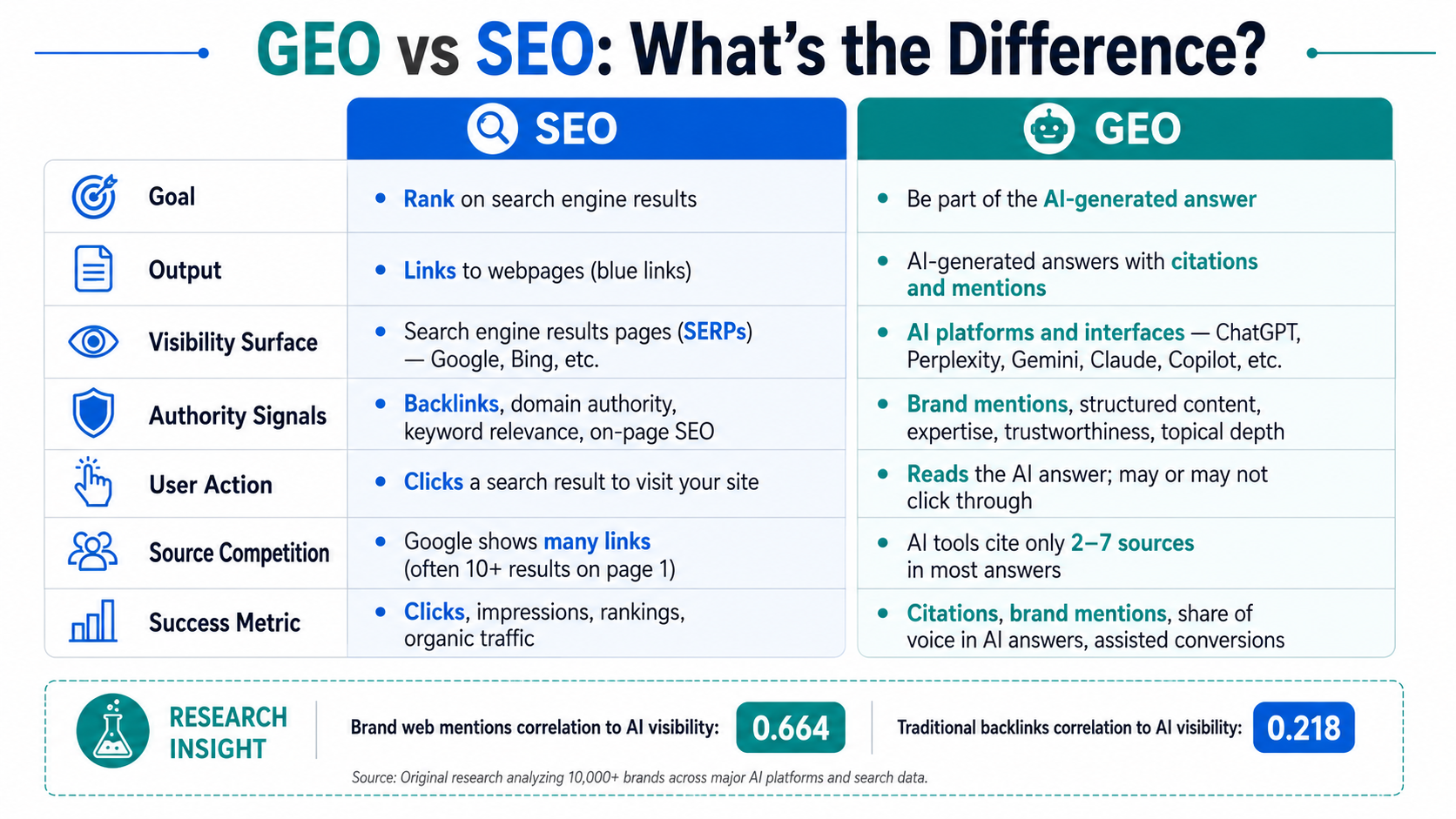
SE Ranking’s study of 2.3 million pages found that high-traffic sites earn 3x more AI citations than low-traffic ones, with domain traffic as the strongest predictive factor. But here is the counterintuitive finding: branded web mentions (being talked about on third-party sites) correlate more strongly with AI Overviews appearances (correlation: 0.664) than backlinks alone (correlation: 0.218).

Factor 4: Content That Loads Quickly and Is Accessible to AI Crawlers

Technical accessibility matters more in AI SEO than many realise. Research shows that 46% of ChatGPT bot visits begin in “reading mode” a plain HTML version with no images, CSS, JavaScript, or schema markup. That means your content needs to be readable and complete even when stripped of all design elements.

Factor 5: Structure That Answers Questions Directly

AI Overviews appear in 99.9% of informational keywords, and 57.9% of question-based queries trigger an AI Overview. Content structured around direct questions and immediate answers is therefore far more likely to be cited than content structured as narrative prose.

The citation formula: Write the direct answer first. Back it with a specific statistic. Use plain, confident language. Structure it under a question-phrased heading. Make sure your brand is mentioned positively in multiple places across the web and not just on your own site.

Also Read: How to Optimise Your Website for Google AI Overviews

5. Google AI Overviews vs. ChatGPT vs. Perplexity vs. Gemini: What’s Different

Each AI platform has distinct citation behaviour. Optimising for all four requires understanding their differences not treating them as interchangeable.

Platform Monthly Users Zero-Click Rate Top Citation Sources Best For
Google AI Overviews 2 billion 43% Top 10 Google rankings, Reddit, YouTube, Wikipedia Informational queries; discovery at scale
Google AI Mode 100M (US+India) 93% Different from AI Overviews. Only 13.7% URL overlap Deep research, complex comparisons
ChatGPT ~1B weekly ~80% Fresh content favoured; high-traffic domains; Reddit Product research, brand comparisons, recommendations
Perplexity 45M active Lower – cites heavily Reddit (46% of citations), YouTube, Gartner Research-intent queries; B2B, finance, tech
Gemini 1.1B monthly visits Variable Google ecosystem, YouTube, authoritative publishers Integrated into Google Workspace searches

The Key Insight on Platform Differences

AI Overviews and AI Mode, both Google products, only share 13.7% of their citation sources. This means you cannot optimise for one and assume the other is covered. The same brand can see citation volumes differ by 615x between Grok and Claude. Multi-platform tracking is now foundational.

ChatGPT accounts for 87.4% of all AI-driven website referral traffic and is where most brands should focus first. But Perplexity, despite a smaller user base, is heavily skewed toward senior professionals – 30% of its users are in senior leadership roles, 65% in high-income white-collar professions. For B2B brands, Perplexity visibility may be more commercially valuable than ChatGPT volume.

6. How to Write Content That Gets Cited in AI Search

AI cites content that directly answers questions in structured, skimmable formats with clear headings, specific data, and definite language. These formats are a core part of modern SEO and AEO content strategies. Prioritise depth, readability, and original insight over keyword density. The intro section is the most important – 44.2% of citations come from the first third of an article.

The 8 Rules of AI-Citable Content

  1. Lead with the answer, not the context. Structure every section as: Question → Direct answer in 40–60 words → Expanded explanation. This “answer box” format is what AI Overviews pull from most frequently.
  1. Use H2s phrased as questions. “How Do You Get Cited in AI Overviews?” outperforms “AI Overview Citation Tips” because it mirrors how users actually ask questions.
  2. Be specific and declarative. Replace “AI can improve your visibility” with “Brands that implement GEO strategies capture 3.4x more organic traffic than those that don’t.” Definite claims, real numbers.
  3. Add a FAQ section with schema markup. FAQ schema is one of the fastest routes to appearing in AI Overviews. Each question-and-answer pair is a potential citation moment.
  4. Cite your sources explicitly. Content that references credible, named sources (Ahrefs, Semrush, Pew Research) is treated as more authoritative by AI systems than content with no attribution.
  5. Make it technically accessible. Ensure your content renders cleanly in plain HTML. Use fast page load times. No content should be locked behind JavaScript rendering that AI crawlers cannot access.
  6. Include original data or insight. AI models prioritise content outside their training data; meaning fresh, original findings get cited precisely because they add something the AI doesn’t already know.
  7. Update regularly and date-stamp visibly. ChatGPT has a demonstrable preference for fresh, recently updated content. Add “Last Updated: March 2026” prominently and actually update the statistics every quarter.

Content Formats That AI Cites Most

Based on Superlines’ analysis of AI citation patterns, 8 of the top 10 most-cited URLs across AI platforms are “Best X” listicles and comparison formats. The content types that earn the most AI citations in 2026 are:

Content Format AI Citation Frequency Why It Works
“Best of” listicles Very High Directly answers recommendation queries
Comparison guides (X vs Y) Very High Structured format; clear decision logic
In-depth how-to guides High Step-by-step = easy to extract and cite
Definitions and explainers High Informational intent dominates AI Overviews
Original data/research Highest long-term Primary source = most citable across all platforms
Keyword-stuffed thin content Very Low AI actively deprioritises low-depth content

Also Read: WordPress SEO & AEO: How to Optimise Your CMS in 2026

7. Brand Mentions, Reddit & Off-Site Signals That Drive AI Visibility

AI doesn’t just crawl your website; it trains on and cites the entire web. Brand mentions on Reddit, YouTube, LinkedIn, and third-party review sites are now among the strongest signals for AI visibility. Brands that build consistent presence across these channels earn dramatically more citations than brands with only strong on-site SEO.

This is the off-site layer most SEO strategies have not yet incorporated, and it is arguably the most important structural shift in how AI decides what to recommend.

Why Reddit Has Become a Critical AI Signal

Google AI Overviews cite Reddit in approximately 21% of cases. Perplexity cites Reddit in nearly 46% of its responses. Wikipedia, YouTube, and Reddit are consistently among the top three cited domains across Google’s AI Mode.

This is not accidental. Reddit discussions are conversational, specific, experience-driven, and publicly available. AI models use Reddit to find “ground truth,” meaning what real people actually say about a product or brand, not what the brand says about itself. The screenshot shows this directly: the Google AI Overview for Indian skincare brands explicitly cited Reddit as its primary source.
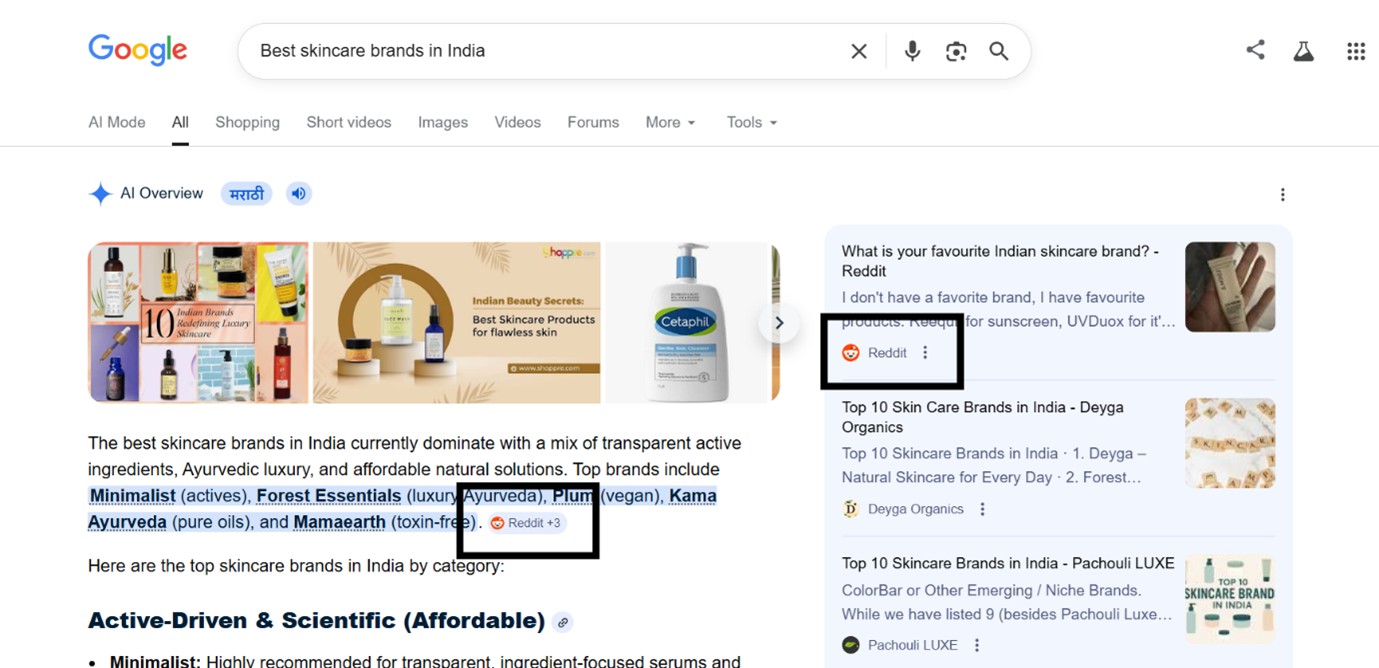
AI models use Reddit

The practical implication: if your brand is being discussed positively on relevant subreddits, AI is more likely to cite those conversations when answering questions in your category. If you are absent from Reddit discussions, you are absent from a significant portion of AI training and retrieval data.

The Full Off-Site Signal Hierarchy

Platform / Signal AI Citation Impact Why It Matters
Reddit mentions Very High Most cited UGC source; 5.7M mentions across LLMs
YouTube videos Very High Top correlated factor with AI brand visibility (Ahrefs)
LinkedIn content High (B2B) Most cited domain for professional queries across all major AI platforms
G2 / Trustpilot reviews High G2 is the most cited software review platform across ChatGPT, Perplexity, and AI Overviews
News and editorial mentions High Earned media distribution can increase AI citations by up to 325%
Brand website Moderate Foundation – necessary but not sufficient for AI visibility

“Reddit has become one of the most influential data sources shaping AI-generated answers in 2026. It is not a ranking factor in the traditional sense; it is a comprehension factor. It teaches generative systems how real users understand products, industries, and decisions.” Simona Jasiukaitis, Editoria Agency – Medium, November 2025

How to Build AI-Visible Off-Site Presence

Participate authentically in relevant subreddits. For D2C and consumer brands: r/IndianSkincareAddicts, r/IndianBeautyDeals, r/Fitness, r/IndianFood – wherever your customers discuss your category. The goal is not promotion. It is helpful, specific contributions that naturally mention your brand in context.

Build your YouTube presence around “best of” and comparison queries. YouTube is the second most cited domain in Google AI Mode. A well-structured video answering “Minimalist vs Plum: which works for oily skin?” creates an AI-citable asset across multiple platforms simultaneously.

Earn editorial mentions through digital PR. AI cites from the web it trusts. Getting your brand mentioned in established Indian publications, YourStory, The Ken, Economic Times Brand Equity, builds the kind of citation authority that compounds over time.

8. How to Measure Your AI Visibility

AI visibility is measured by tracking how often and where your brand is cited across AI platforms for your target queries.

Start with a manual audit: run your top 10 customer queries across ChatGPT, Perplexity, Google AI Overviews, and Gemini. Document your appearances. This is your baseline. Then track it monthly.

Step 1: The Manual AI Audit (Free, Do It Today)

Take your top 10 search queries – the questions your customers actually ask when looking for what you sell. Run each one across four AI platforms: ChatGPT, Google AI Overviews, Perplexity, and Gemini. For each query, record: Does your brand name appear? Are you cited as a source? Are competitors appearing where you are not? This is your AI Visibility baseline, and it costs nothing but time.

Step 2: Track AI Referral Traffic in GA4

AI referral traffic is trackable. In Google Analytics 4, filter your referral traffic source by domain for: chat.openai.com, perplexity.ai, gemini.google.com, and copilot.microsoft.com. AI referral traffic currently accounts for approximately 1.08% of all website traffic globally; small in volume, but growing at roughly 1% month over month and converting at dramatically higher rates than organic search.

Step 3: Tools for Scale

For brands that need systematic tracking across multiple AI platforms, dedicated GEO tools are now available. Semrush’s AI Visibility Toolkit, Profound, Peec AI, and BrightEdge’s Generative Parser all offer multi-platform tracking. These tools measure your “AI Share of Voice”, the percentage of times your brand is mentioned within AI-generated responses for your target topic cluster, and surface gaps where competitors are winning AI citations that you are losing.

Pro tip: The most valuable thing to track is not your absolute AI visibility score; it is your momentum. Similarweb’s 2026 AI Brand Visibility Index found that brands with a declining AI visibility index, even those still ranked highly, were in structurally weakening positions. Direction matters more than current position.

Industry Deep Dive: AEO for Healthcare, Real Estate & E-Commerce: What’s Different in 2026

9. Which Industries Are Most and Least Affected by AI Search

AI Overviews do not affect all categories equally. Ahrefs’ analysis of November 2025 shows stark differences between industries.

Industry AI Overview Share Implication
🔬 Science 43.6% Most searches answered by AI – critical to optimise now
🏥 Health 43.0% High impact; trust signals (E-E-A-T) essential
🐾 Pets & Animals 36.8% Strong AI presence in product and care queries
👥 People & Society 35.3% Informational queries heavily dominated by AI answers
📰 News 15.1% Moderate; freshness is key signal
⚽ Sports 14.8% Less AI-dominated; traditional rankings still drive traffic
🏠 Real Estate 5.8% Lower AI Overview rate; local intent protects traffic
🛍️ Shopping 3.2% Lowest AI impact – users need to click to purchase

The reason shopping has the lowest AI Overview rate is instructive: users cannot complete a purchase inside an AI answer. They must click through to a website. This creates a natural floor on AI’s ability to eliminate click-through for transactional queries. If your business is primarily transactional, AI search poses less immediate traffic risk but brand visibility in AI recommendations still matters at the top of the funnel.

Sector Guide: AEO for Healthcare, Real Estate & E-Commerce: What’s Different in 2026

10. Your 90-Day AI SEO Action Plan

Begin authentic participation (the 90/10 rule: 90% value, 10% brand mention). Identify three publication targets for earned media. Begin digital PR outreach specifically for AI-cited publications.

Month 2: Create Your “Best Of” and Comparison Content

Publish at least two pieces in the formats AI cites most: a “Best [Category] in India 2026” guide, and a head-to-head comparison of your product against a competitor. These are your highest-probability AI citation assets.

Month 3: Technical AI SEO Audit

Ensure AI crawlers can access your content (check robots.txt, llms.txt if applicable). Add JSON-LD Article schema and FAQ schema to all key pages. Verify page speed scores. Ensure content renders in plain HTML without JavaScript dependency.

Month 3: Repeat Audit and Measure Movement

Rerun your Week 1 AI visibility audit with the same 10 queries. Compare. Track AI referral traffic growth in GA4. Identify which content changes drove AI appearances. Double down on what worked.


If your brand is not appearing in AI-generated answers yet, it’s time to invest in SEO and AEO services designed for AI-driven search visibility

Frequently Asked Questions

Is SEO dead because of AI search?

No. Google still processes 8.5 billion searches per day and sends far more traffic than all AI platforms combined. Traditional SEO remains essential but it is no longer sufficient. The brands winning in 2026 layer AI visibility (GEO) on top of a solid traditional SEO foundation, not instead of it.

What is the difference between SEO, AEO, and GEO?

SEO (Search Engine Optimisation) optimises for ranking in traditional search results. AEO (Answer Engine Optimisation) optimises for appearing in direct answer features like featured snippets and AI Overviews. GEO (Generative Engine Optimisation) optimises for being cited in AI-generated answers from ChatGPT, Perplexity, and Gemini. In 2026, the most effective strategies address all three.

How do I check if my brand appears in AI search results?

The simplest method is manual: run your top 10 customer queries across ChatGPT, Google AI Overviews, Perplexity, and Gemini, and document your brand’s appearance. For systematic tracking, tools like Semrush’s AI Visibility Toolkit, Profound, and Peec AI offer automated multi-platform monitoring.

Does AI search send traffic to websites?

Yes, but less than traditional search. Only approximately 1% of AI searches result in a referral click to a website, compared to 40% of Google searches. However, AI-referred traffic converts at 14.2% compared to 2.8% for Google organic traffic making it approximately five times more valuable per session.

How important is Reddit for AI SEO?

Critically important. Google AI Overviews cite Reddit in approximately 21% of cases, and Perplexity cites Reddit in 46% of its responses. Reddit is the most cited UGC source across all major AI models, with 5.7 million mentions in LLM outputs. Authentic, helpful brand participation in relevant subreddits directly influences how AI describes your brand.

How long does it take to see results from AI SEO?

Structural content changes such as restructuring articles with direct answers, adding FAQ schema and improving readability can influence AI citations within 4–8 weeks. Off-site signals like Reddit presence and earned media take longer to compound, typically 3–6 months. AI SEO is not a quick fix; it is a compounding strategy.

Do I need to optimise differently for each AI platform?

Yes. Google AI Overviews and AI Mode share only 13.7% of their citation sources and both differ significantly from ChatGPT and Perplexity citation patterns. Core principles (clear structure, direct answers, authoritative off-site mentions) work across all platforms, but each platform has distinct source preferences that reward platform-specific optimisation.

Which Indian industries are most affected by AI search in 2026?

Health and wellness, D2C skincare and beauty, financial services, and education are the Indian sectors most significantly affected. These categories generate high volumes of informational queries; exactly the queries where AI Overviews dominate. Shopping and real estate are less affected, as transactional intent still drives users to click through to websites.

What content format is most likely to get cited by AI?

“Best of” listicles and comparison guides are the most consistently cited formats across AI platforms. In-depth how-to guides, explainer articles, and original research also perform strongly. The most important structural element is front-loading the direct answer; 44.2% of all LLM citations come from the first 30% of an article.

Should I use AI tools to write content for AI SEO?

AI tools are valuable for research, outlining, and drafting but purely AI-generated content rarely ranks on page one of Google or gets consistently cited in AI answers. The highest-performing AI SEO content combines AI-assisted research and structure with human expertise, original experience, and genuine E-E-A-T signals that no AI can manufacture.

Categories
AEO Optimization AI Overview General SEO

AIO vs SEO vs AEO: An Honest Guide for US Small Businesses in 2026

The Rules of Search Have Changed. Have You?

If you built your website traffic on SEO a few years ago and things feel a little… off lately, you’re not imagining it. The way people search for businesses, products, and answers has shifted drastically and in 2026 your brand can no longer ignore it. To stay competitive, many businesses are now investing in structured SEO strategies and AI visibility optimization services.

Google still processes roughly 8.5 billion searches every day meaning the audience is there but how they search, and how they find you, is a different story. Nearly 60% of all Google searches are now “zero-click”, meaning users get their answer right on the results page and never visit your website at all.

So where does that leave your small business?

In this guide, we will explain you in simple terms about SEO, AEO, and AIO which will help you understand how you can make your business visible in the AI era.

SEO vs. AEO vs. AIO: Basic Definitions

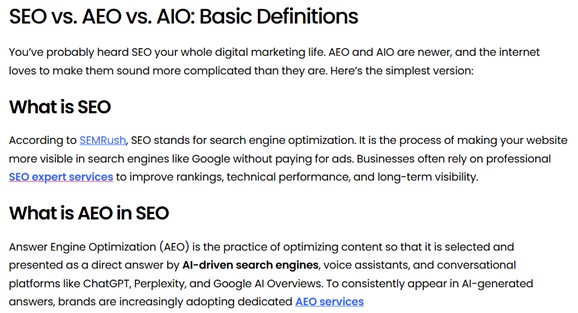
You’ve probably heard SEO your whole digital marketing life. AEO and AIO are newer, and the internet loves to make them sound more complicated than they are. Here’s the simplest version:

What is SEO

According to SEMRush, SEO stands for search engine optimization. It is the process of making your website more visible in search engines like Google without paying for ads. Businesses often rely on professional SEO expert services to improve rankings, technical performance, and long-term visibility.

What is AEO in SEO

Answer Engine Optimization (AEO) is the practice of optimizing content so that it is selected and presented as a direct answer by AI-driven search engines, voice assistants, and conversational platforms like ChatGPT, Perplexity, and Google AI Overviews. To consistently appear in AI-generated answers, brands are increasingly adopting dedicated AEO services

What is AIO in SEO

Artificial Intelligence Optimization (AIO) is the practice of structuring digital content so it can be efficiently crawled, interpreted, and referenced by AI models such as ChatGPT, Gemini, and AI-powered search engines.

Think of it this way:

  • SEO gets you discovered.
  • AEO gets you selected.
  • AIO gets you cited.

SEO in 2026: Still Essential, But No Longer Enough

Organic Keyword Ranking for SEO 2026

Let’s be clear: SEO isn’t dead. Anyone telling you this is trying to sell you something. Your website still needs clean structure, relevant keywords, fast load times, mobile optimisation, and local SEO if you serve a specific area.

What has changed is that SEO alone is no longer enough.

Google’s algorithm in 2026 heavily rewards E-E-A-T (Experience, Expertise, Authoritativeness, and Trustworthiness). That means thin content, keyword stuffing, and link schemes are losing their value fast.

What works now is genuinely helpful, well-organized content written by someone who clearly knows what they’re talking about.

For small businesses, the honest SEO priority list looks like this:

  • Keep your Google Business Profile updated (critical for local search)
  • Make sure your site loads fast on mobile
  • Write content that actually answers your customers’ real questions
  • Build a handful of quality backlinks from local or industry sources

“SEO is the base layer. But it’s no longer the ONLY layer.”

If you want to understand how this shift impacts modern visibility, read our detailed guide on SEO vs AEO and how they work together in 2026.

AEO: Writing to Be the Answer, Not Just the Link

AEO Ranking for Sudha Solutions

Here’s where many small business owners are leaving traffic on the table without realising it.

According to a study by Ahrefs’ featured snippets — those direct answer boxes at the top of Google — now appear on over 12% of all search queries. Voice assistants pull almost exclusively from these.

If your competitor’s page answers a question more clearly than yours, they get read aloud to potential customers while your page sits quietly on page one.

Here’s the fix

The First 40–60 Words Rule

Whenever you address a question in your content, give a clear, direct answer in the first 40–60 words before going into detail. Search engines and AI systems are scanning for that crisp, usable response. If you bury your answer three paragraphs deep, you’re invisible to these systems.

Here’s a practical example. If you run a plumbing business in Austin, instead of a generic “About Our Services” page, consider a FAQ-style blog post: “How much does it cost to fix a leaking pipe in Austin?”  and answer it directly in the first two sentences.

SEO optimizes for rankings. AEO optimizes for selection.

Also Read: What is AEO? Why Your Business is Invisible to ChatGPT in 2026

AIO: Getting AI to Trust (and Cite) Your Business

AIO ranking for sudha solutions

This is the frontier, and if you get ahead of it now, you’ll have a meaningful advantage.

When someone asks ChatGPT or Google’s AI Overview, “What’s the best HVAC company in Charlotte, NC?” how does the AI decide what to say?

It pulls from sources it deems credible, consistent, and well-structured across the web. That means your job is to become that source. This is where structured AEO and AI optimization services play a critical role in helping brands get cited across AI platforms

A few practical ways to build AIO-readiness:

Schema markup is now non-negotiable: Schema is code added to your website that tells search engines (and AI systems) exactly what your business does, where you’re located, what your hours are, and more. If you haven’t implemented schema yet, this is your highest-leverage technical move right now.

Consistency across the web builds AI trust: Make sure your business name, address, phone number, and description are identical on your website, Google Business Profile, Yelp, Facebook, industry directories. AI systems cross-reference these signals to judge credibility.

Earn mentions, not just links: Being cited in local news, industry blogs, or community websites tells AI that real sources recognize your business as legitimate.

Brand visibility in AI tools like ChatGPT and Claude is becoming just as critical as search ranking.

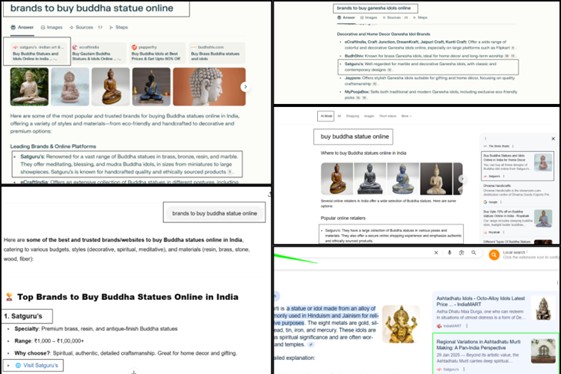
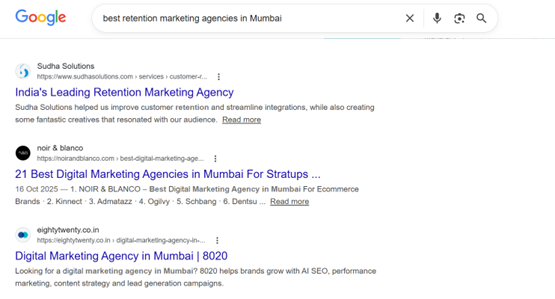
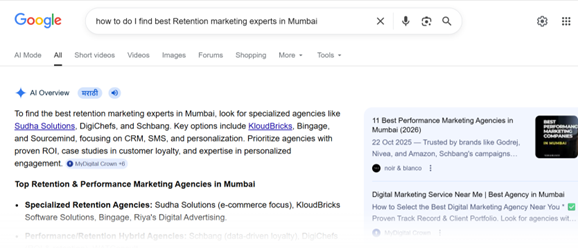
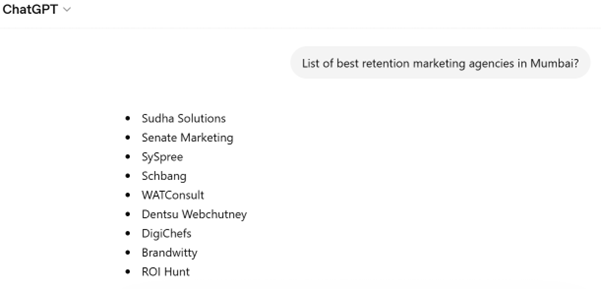
If you closely look at all the 3 examples, Sudha Solutions is ranking 1st in Google ranking while also being mentioned in AI overview and AI listicle. This should be the goal for your brand as well.

Do You Really Need All Three?

Here’s the honest take by our digital marketing expert: “In a nutshell, it’s all just SEO with very negligible differences.” And there’s real truth to that. If you write genuinely helpful content, keep your site technically clean, build real authority, and answer questions clearly, you’re already doing SEO, AEO, and AIO simultaneously.

The acronyms are different. The underlying mission remains the same: be the most helpful, credible, and clear source for your customers’ questions.

That said, being intentional about each layer does make a difference, especially for small businesses competing in crowded local markets.

Your 2026 Action Plan

Here’s a realistic starting point:

This month (SEO hygiene)

  • Audit and update your Google Business Profile
  • Check that your site loads in under 3 seconds on mobile
  • Make sure your NAP (Name, Address, Phone) is consistent everywhere online

Next 60 days (AEO layer)

  • Rewrite your top 3–5 service or product pages in a Q&A format
  • Apply the 40–60-word rule: lead every section with a direct answer
  • Add an FAQ section to your homepage or key landing pages

Ongoing (AIO foundation)

  • Add or update schema markup
  • Start building mentions: local press, guest posts, community sponsorships

Create one piece of genuinely authoritative content per month in your niche

Brief Summary

Aspect SEO AEO AIO
Primary Goal Rank higher on search engines Become the direct answer to a query Get cited and used by AI models
Focus Keywords, backlinks, rankings User intent and direct answers Structured, machine-readable content
Output Website links (SERP listings) Featured snippets, voice answers, AI summaries AI-generated responses (ChatGPT, Gemini, etc.)
Content Style Long-form, keyword-rich Concise, clear, question-based Context-rich, structured, semantically strong
Optimization Method On-page SEO, backlinks, technical SEO FAQs, schema, snippet optimization Entity building, structured data, topical authority
User Interaction Click-driven Zero-click or minimal-click No-click, AI-consumed
Success Metric Rankings, traffic, CTR Featured snippet wins, visibility Citations, mentions in AI responses
Dependency Search engine algorithms Search + AI answer engines AI models and LLM understanding

Also Read: AEO/GEO Optimization Strategy: Best Practices, Tools, and How it Differs from Traditional SEO

The Bottom Line

You don’t have to choose between SEO, AEO, and AIO, you have to evolve. The small businesses that thrive in the next few years won’t be the ones who mastered one acronym. They’ll be the ones who understood that search is changing and adapted before their competitors did.

The audience is still out there, searching every single day. The question is how your customers can find your brand before they find your competitors.

Want to optimise your website for AI visibility? Contact us at Sudha Solutions.

We have helped numerous brands rank on both Google and AI platforms. Here is the data for one of our clients:

Satguru’s is a Mumbai-based e-commerce brand that sells God idols and home decor items. When they contacted us, their biggest challenge was to compete with the likes of Amazon and Flipkart for same similar products.

Our SEO + AEO strategy helped them not only rank above Amazon but also helped them appear on AI platforms like ChatGPT. These were the results

  • 900% increase in organic sessions
  • 273% increase in AI visibility
  • 2x increase in top 3 keywords

Want similar numbers for your brand? Get on a call with us TODAY.

FAQs

Is SEO still relevant in 2026?
Yes, SEO remains essential as it forms the foundation for visibility, indexing, and discoverability across search platforms. However, it now works alongside AEO and AIO to ensure content is not just found but also selected and cited by AI systems.

How do AI search engines like ChatGPT rank websites?
AI engines don’t rank websites in the traditional sense; they prioritize content that is clear, authoritative, and contextually relevant. They select and synthesize information based on credibility, structure, and how well it answers the user’s query.

What is the future of SEO in the AI era?
SEO is evolving from keyword-focused optimization to intent-driven, entity-based, and AI-friendly content strategies. The future lies in creating content that can rank, answer, and be cited across both search engines and AI platforms.

Should businesses focus on SEO or AEO?
Businesses should not choose between SEO and AEO but integrate both into their strategy. SEO drives discovery, while AEO ensures your content becomes the answer users see first.

Categories
AI Overview

How to Optimize Your Website for Google AI Overviews (Step-by-Step)

How Do You Optimize for Google AI Overviews?

To optimise for Google AI Overviews, businesses should create direct answer-focused content, implement structured schema markup, improve EEAT signals, use AI-friendly formatting, and build comprehensive topical authority.

In 2026, ranking high on Google is hardly considered an achievement.

With the rollout of Google AI Overviews, users are increasingly getting direct and summarized responses at the top of search results.

According to SEMrush, AI-generated results now appear in a significant share of informational queries, reshaping how visibility works in search.

This creates a new reality for brands. Ranking first does not guarantee visibility anymore because Google AI Overviews increasingly prioritise extractable, AI-friendly answers over traditional organic positions. If your content is not selected for AI-generated search results, your brand is effectively invisible in modern search experiences.

The good news is that this is not random. Google’s AI follows clear patterns when selecting content.

In this guide, you will learn exactly how to optimise your website for Google AI Overviews using a practical, execution-focused framework.

What Are Google AI Overviews and How Do They Work?

Businesses investing in AI search optimisation are restructuring content specifically for AI extraction and citation.

Google AI Overviews and How Do They Work

Google AI Overviews are AI-generated summaries that appear at the top of search results. They combine information from multiple sources to provide a direct answer to a user’s query.

Optimising content for this extraction process often requires AEO services that focus on structuring answer-ready content for AI systems

Unlike traditional search results, these overviews do not simply rank pages. They extract and synthesise content.

According to guidance from Google Search Central, Google prioritises content that is:

  • Clear and directly answers the query
  • Structured and easy to extract
  • Trustworthy and backed by credible sources

In simple terms, Google is no longer just indexing pages. It is interpreting and selecting answers.

Why Optimising for AI Overviews Is Critical in 2026

Rise of Zero-Click Searches

Users are increasingly getting answers without clicking through to websites. This trend has been growing for years and is accelerating with AI-generated summaries.

For marketers, this means visibility must shift from clicks to presence within answers.

This has also sparked major industry discussions around whether AI Overviews will kill SEO traffic or simply redefine how search visibility works.

AI Visibility vs Traditional Rankings

AI Overviews do not always pull from top-ranking pages. A study by Semrush shows less than 3 of the URLs from the organic top 10 repeated in the AI Overview

This creates an opportunity. Even if you are not ranking first, you can still be featured if your content is better structured and more useful.

The shift from clicks to citations is fundamentally changing search behaviour, especially in the debate around AI Overview vs organic search visibility in 2026.

What Experts Are Saying

SEO experts have consistently highlighted that content most likely to be picked by AI includes:

  • Data-backed insights
  • Clear explanations
  • Comparisons and structured formats

This aligns with what AI systems are designed to do: extract reliable, easy-to-understand information.

How Google Chooses Content for AI Overviews

These signals now form the foundation of modern AI Overview SEO strategies. Google’s AI does not randomly pick content. Even though there is no rigid rulebook, we have noticed patterns that has helped us cite our brands in the overview.

Key Signals That Influence Selection

  • Direct answers to user queries
  • Structured formatting with clear headings
  • EEAT signals (Experience, Expertise, Authoritativeness, Trustworthiness)
  • Topical depth and coverage
  • External references and citations

One important concept highlighted by SEMrush is that AI extracts self-contained passages. This means each section of your content should make sense on its own.

Step-by-Step Guide to Optimise for Google AI Overviews

Step 1: Add Clear, Direct Answers Across Key Website Pages

Ensure that important pages such as service pages, product pages, landing pages, and FAQs provide clear, concise answers to user queries early within the content.

Example:

FAQ section

Having FAQ section is the best way to answer questions that are very common as long as your answers are precise

Instead of long introductions, clearly explain what the page is about and the value it provides within the first few lines.

Many brands implement this effectively by working with AEO experts who specialise in structuring content for AI-driven search visibility.

Professional AEO services help businesses optimise website structure, answer formatting, schema implementation, and AI citation readiness across all major search platforms.

This helps Google identify and extract your content for AI-generated summaries.

Step 2: Structure Website Content for Easy AI Interpretation

A strong AI-friendly content structure improves both user readability and AI extraction capability. Organise content across your website so it is easy to scan and understand.

Best practices:

  • Use clear H2 and H3 headings across all pages
  • Break content into short, readable sections
  • Ensure each section focuses on one specific intent

Think of each section as an independent content block that can be extracted and shown as an answer.

Example:

retention marketing services

Using cards format as mentioned in the images, improve readability for both humans and AI. 

Step 3: Map Content to Real User Queries Across Pages

Your website should reflect how users actually search.

This can be implemented through:

  • FAQ sections on service and product pages
  • Dedicated sections answering common queries
  • Support or knowledge base content

Examples:

  • What is [your service]?
  • How does [your product] work?
  • What are the benefits of [solution]?

This improves alignment with AI-driven search queries.

Example:

Real User Queries Across Pages

Step 4: Implement Structured Data (Schema) Across the Website

Proper schema markup for AI search helps Google better understand context, relationships, and answer intent. Structured data helps Google better understand your content and its context.

Key schema types to implement:

  • FAQ schema
  • HowTo schema
  • Article schema
  • Product schema (for e-commerce)

Google recommends structured data to enhance how content is interpreted and displayed in search results.

To ensure proper crawlability and structured implementation, businesses often rely on technical SEO services as the foundation for AI visibility.

Step 5: Strengthen EEAT Signals Across Your Website

Strong EEAT for AI search increases the likelihood of being cited in AI-generated summaries and answer engines.

1. Showcase Brand Credibility Clearly

Your website should immediately establish trust.

Include:

  • Clear company positioning
  • Years of experience or expertise
  • Client logos or industries served
  • Certifications, partnerships, or recognitions

This helps Google and users understand that your business is a credible source.

Showcase Brand Credibility Clearly

2. Build Trust Through Proof and Transparency

Instead of relying on external links, website pages should demonstrate credibility through:

  • Testimonials and case studies
  • Real results or outcomes
  • Transparent service explanations
  • Clear contact and company information

These signals are critical for both users and search engines.testimonials

3. Support Key Claims with Verifiable Information

If you include statistics or strong claims:

  • Ensure they are accurate
  • Mention the source where relevant (especially in blogs or resource sections)

On core pages, focus more on:

  • Real examples
  • Practical outcomes
  • Measurable impact

4. Demonstrate Real Expertise in Content

Your content should reflect actual knowledge, not generic writing.

This can be done through:

  • Detailed explanations of your process
  • Unique insights or frameworks
  • Clear breakdowns of how your service works

AI systems are more likely to surface content that shows depth and real-world understanding.

what your brand needs

Step 6: Build Comprehensive Topic Coverage Across the Website

AI systems prefer websites that cover a topic in depth.

Instead of relying on a single page, build:

  • Core service or pillar pages
  • Supporting blogs
  • FAQs and resource sections

This creates a complete content ecosystem around your topic.

Step 7: Use Structured Formats Across Pages

Improve clarity and extraction by using:

  • Bullet points
  • Numbered steps
  • Comparison tables (especially for product/service pages)

structured format

These formats are easier for AI systems to interpret and display.

Step 8: Make Your Content Citable

Brands focusing on AI citation strategy are seeing stronger visibility inside AI-generated answers even without holding the #1 organic ranking. AI prefers content that can be referenced.

To achieve this:

  • Include original insights
  • Add data-backed statements
  • Avoid generic writing

The more unique and useful your content is, the more likely it is to be cited.

Step 9: Optimise for Conversational Search

Users interact with AI differently than traditional search.

Focus on:

  • Natural language
  • Long-tail queries
  • Conversational tone

This aligns your content with how users ask questions.

Common Mistakes to Avoid in AI Overview Optimisation

  • Writing for keywords instead of answers
  • Using long, unstructured paragraphs
  • Publishing generic AI-generated content
  • Ignoring structured data

Website Content vs Blog Content for AI Overview Optimisation

Website content also includes blogs, but blog optimisation has some differences. Both are equally important.

Aspect Website Content Blog Content
Primary Goal Conversions, lead generation, clarity of offering Traffic, education, topical authority
Content Intent Transactional + commercial intent Informational + exploratory intent
Answer Placement Clear value proposition and key answers at the top of the page Direct answers to specific questions in each section
Content Structure Section-based (features, benefits, FAQs, use cases) Question-driven, article-style with multiple subtopics
Headings Style Benefit-driven and solution-oriented (e.g., “Why Choose Our AEO Services”) Question-based (e.g., “What is AI Overview?”)
Use of FAQs Embedded FAQs to address objections and queries Dedicated FAQ sections + interwoven Q&A content
Use of Lists & Tables Used for clarity (pricing, features, comparisons) Used for explanation, summaries, and snippet targeting
EEAT Signals Strong brand credibility, testimonials, trust badges Author expertise, citations, external references
AI Overview Opportunity High for commercial queries and brand mentions High for informational queries and definitions


Conclusion

Google AI Overviews are changing how search visibility works.

The focus is no longer just on rankings. It is on being selected as the answer.

By structuring your content, strengthening EEAT signals, and aligning with how AI systems interpret information, you can position your website to appear where it matters most.

If your goal is not just traffic, but visibility inside answers, this shift is not optional.

Want your brand to be cited on Google Overview? Contact us at Sudha Solutions

We have worked with multiple brands across different industries and helped them rank on Google overview as well as other AI platforms. We follow a specific set of rules that have helped us get results for all our clients and you can be the next. Contact us TODAY!

FAQs

Can a website be optimised for AI Overviews?

Yes, websites can be optimised by structuring content clearly, answering queries directly, and building strong EEAT signals. AI systems prioritise content that is easy to extract and trustworthy.

Does AI Overviews reduce website traffic?

It can reduce clicks for informational queries but increases brand visibility. Being featured in AI answers can drive higher-quality, intent-driven traffic.

What type of content gets featured in AI answers?

Content that is clear, structured, data-backed, and authoritative is most likely to be featured. Lists, definitions, and well-organized explanations perform best.

How is AEO different from SEO?

SEO focuses on ranking pages, while AEO focuses on being selected as a direct answer by AI systems. Both work together but serve different goals.

Categories
AI Overview

Common Custom Software Mistakes (Solved by AI Tools)

Nowadays, most brands have a customised software. It is flexible, aligns with business requirement and gives a unique identity to the brand. But this advantage comes with a cost. 

When initial decisions are rushed the same software that was meant to enable growth quietly and give your brand an identity becomes a constraint. 

The challenge is no longer just building software that works. The real question is whether the system is designed to evolve. Automation, intelligent features, and AI-driven insights demand a different level of discipline. 

Many projects fail to reach that stage not because of ambition, but because of avoidable mistakes made early on. In this blog, we will look at the most common custom software mistakes and how modern AI tools can help prevent them. 

Why Custom Software Projects Fail 

Custom software often fails not because of poor development, but because of rushed early decisions. 

Common mistakes include: 

  • Building features without clear business outcomes 
  • Vague requirements and uncontrolled scope 
  • Treating AI and security as add-ons instead of core capabilities 
  • Accumulating technical debt and delaying testing 
  • Poor communication and treating launch as the finish line 

When used correctly, AI tools help teams: 

  • Clarify requirements and priorities early 
  • Detect risks, security gaps, and code issues sooner 
  • Improve testing, documentation, and ongoing maintenance 
  • Build systems that can adapt to automation and intelligent features 

The real goal isn’t software that simply works today, but software designed to scale, evolve, and stay relevant tomorrow.

8 Common Custom Software Mistakes and How AI Can Solve Them 

1. Building Software Without a Clear Business Outcome

One of the most common mistakes is starting development with a feature list instead of a business objective. Teams often know what they want to build, but not what success actually looks like. 

For example, companies investing in SEO services often struggle to measure impact if their custom software lacks structured analytics, clean data architecture, or scalable content management capabilities. 

This leads to software that technically functions but fails to deliver measurable value or even reflect companies’ identity.  

Common symptoms 

  • Cool and trendy features that are rarely used 
  • Dashboards that do not inform decisions 
  • Automation that adds complexity instead of efficiency 

How AI tools help 

AI-driven analytics and discovery tools can: 

  • Analyse existing workflows to identify real bottlenecks 
  • Highlight patterns in usage and operational data 
  • Support clearer prioritisation before development begins 

AI does not define strategy, but it helps validate assumptions early and reduces guesswork. 

2. Vague Requirements and Uncontrolled Scope 

Starting development without well-defined requirements is one of the fastest ways to derail a project. Ambiguity leads to frequent changes, conflicting expectations, and budget overruns. 

This problem becomes more expensive in enterprise environments where multiple stakeholders are involved. 

What usually goes wrong 

  • Requirements are captured informally 
  • Edge cases are missed 
  • Decisions are documented late or not at all 

How AI tools help 

AI-assisted requirement tools can: 

  • Convert stakeholder discussions into structured documentation 
  • Detect conflicting or unclear requirements 
  • Summarise decisions and changes consistently over time 

This improves clarity without adding process overhead. 

3. Treating AI as a Feature Instead of a Capability

AI can’t be an afterthought. Trying to integrate AI later in the development stage is not ideal. This often results in fragile integrations or features that are difficult to scale. 

The mistake is not using AI. The mistake is not designing for it. 

Examples 

  • Data pipelines not designed for future learning or automation 
  • Rigid architectures that cannot support intelligent workflows 
  • Manual processes that should have been automated from the start 

This becomes especially limiting for brands scaling content marketing services or structured blog writing services, where automation, tagging systems, and search visibility depend on clean architecture. 

As AI researcher Andrej Karpathy (director of AI at Tesla and co-founder of OpenAI) has often pointed out, AI works best as a copilot. It augments human decision-making rather than replacing it. Software architecture needs to reflect that mindset. 

As AI becomes more integrated into search experiences, businesses must also consider how automation impacts digital visibility. We recently explored this in detail in our article on whether AI Overviews will kill SEO traffic. 

4. Treating Security as a Final Checklist 

Security issues rarely come from a single failure. They emerge from small oversights that compound over time. 

When security is addressed only at the end of development, the fixes are reactive, expensive, and risky. 

According to research published by IBM on the cost of data breaches, the impact of late-stage security failures extends far beyond technical recovery. It affects trust, compliance, and long-term operational stability. 

How AI tools help 

AI-powered security tools can: 

  • Scan code continuously for vulnerabilities 
  • Detect unusual system behaviour in real time 
  • Surface risks earlier in the development lifecycle 

This supports a security by design approach instead of patch-based fixes. 

5. Accumulating Technical Debt Too Early 

Technical debt is often introduced unintentionally. Tight deadlines, unclear ownership, or inconsistent standards gradually reduce code quality. 

Over time, even small changes become risky. 

Common indicators 

  • Poor documentation 
  • Inconsistent coding standards 
  • Increasing time to implement minor updates 

How AI tools help 

AI-assisted code review and documentation tools: 

  • Flag maintainability issues early 
  • Suggest refactoring opportunities 
  • Automatically generate clear documentation from code 

GitHub’s research on AI assisted development shows that these tools are most effective when used to support disciplined engineering, not replace it. 

6. Weak Testing and Late Validation 

Testing is often deprioritised in favour of speed. This usually leads to bugs surfacing late, when fixes are more disruptive. 

Why this becomes a problem 

  • Bugs affect multiple systems 
  • Releases are delayed 
  • Confidence in the system drops 

How AI tools help 

AI driven testing tools can: 

  • Generate test cases based on code changes 
  • Prioritise high risk areas automatically 
  • Reduce regression testing effort 

This allows teams to move faster without compromising stability. 

7. Communication Gaps and Misalignment 

Even strong engineering teams struggle when communication is fragmented. In corporate environments, this is a common failure point. 

Typical issues 

  • Stakeholders receive inconsistent updates 
  • Decisions are made in isolation 
  • Teams work with outdated information 

How AI tools help 

AI assisted project management tools can: 

  • Summarise meetings and decisions 
  • Highlight delivery risks early 
  • Provide consistent visibility across teams 

This improves alignment without increasing reporting overhead. 

8. Treating Launch as the Finish Line

Custom software is not a one-time delivery. It is a living system that needs ongoing attention. 

For brands running aggressive performance marketing campaigns, software instability or delayed data reporting can significantly increase acquisition costs and reduce ROI. 

When maintenance and evolution are ignored, software becomes obsolete quickly. 

Common consequences 

  • Performance issues under increased load 
  • Compatibility problems with new systems 
  • Delayed adoption of automation and AI features 

AI powered monitoring and predictive maintenance tools help teams detect issues before they escalate. This supports long term stability and scalability. 

Conclusion 

Most custom software failures are not caused by lack of skill or effort. They are the result of early decisions that limit flexibility and increase risk over time. 

AI tools offer a powerful advantage when used correctly. They improve visibility, reduce manual effort, and support better decision making across planning, development, and maintenance. 

For brands, the goal is not to build software that simply works today. It is to build systems that are ready for automation, intelligent features, and growth tomorrow. 

If you want to develop a custom software for your brand that scales with time, you should check out Sudha Solutions. We have a team of experienced developers and AI experts that will develop software that align with your business ideas. Our software are not just aesthetically pleasing but also functional, easy to navigate, efficient, and user-centric. Contact us today. 

Frequently Asked Questions

1. Why do so many custom software projects struggle after launch? 

Most issues surface after launch because early decisions prioritise speed over scalability. Architecture, documentation, and processes that seem “good enough” initially often cannot support growth, integrations, or automation later. 

2. Is custom software always riskier than using off-the-shelf tools? 

Not necessarily. Custom software becomes risky when it lacks long-term planning. When designed with scalability, security, and evolution in mind, custom systems can outperform off-the-shelf tools in flexibility and ROI. 

3. Do small and mid-sized businesses really need AI in their software?

AI is not mandatory for every product, but AI-assisted tools can significantly improve planning, testing, documentation, and monitoring even for smaller teams. The benefit is efficiency and foresight, not complexity. 

Categories
AI Overview

From Rankings to Responses: Why Search Visibility in 2026 Is About Being the Answer

For over two decades, search visibility followed a familiar logic:
rank higher > get more clicks > drive traffic > convert users. 

That logic is no longer reliable. Search in 2026 is no longer about where you rank. It is about whether you are chosen as the answer. 

Across Google, AI Overviews, large language models, and conversational interfaces, search behaviour is shifting from exploration to resolution. Users are no longer scanning ten blue links. They are asking complete questions and expecting complete answers, instantly. 

Businesses adapting to this shift often work with teams offering SEO expert services to transition from ranking-focused strategies to answer-driven visibility models.

At Sudha Solutions, we believe this marks the most fundamental shift in search since the introduction of PageRank. And it demands a different way of thinking about SEO altogether. 

This article explains: 

  • Why rankings alone no longer define visibility 
  • How AI-driven search engines decide who gets surfaced 
  • What “answer readiness” really means in 2026 
  • How businesses and SEO professionals must adapt now 

This is not a prediction built on hype. It is a synthesis of platform changes, industry data, and how modern retrieval systems actually work. 

The Quiet Collapse of Click-Based Visibility 

Search engines are still sending traffic. But they are sending far less of it. Multiple independent studies now confirm what most practitioners are already seeing in analytics dashboards. 

Key findings from the industry data behind zero-click search: 

The implication is not that SEO is dying. The implication is that visibility is being decoupled from traffic. A brand can now: 

  • Influence decisions 
  • Shape understanding 
  • Build authority 

…without ever receiving a click. 

Why Search Engines Are Becoming Answer Engines

To understand where SEO is heading to, we must understand how AI is searching, retrieving, and presenting information. 

From Indexing Pages to Synthesising Knowledge 

Traditional Search  Modern Search 
Indexed documents  Retrieves multiple sources 
Ranked them using signals  Evaluate credibility and relevance 
Let users extract meaning themselves  Synthesis a response 
  Presents a single, confident answer 

This shift is powered by retrieval-augmented generation (RAG), a system where language models pull from trusted sources before generating responses. In this system, your content is no longer competing for a click. It is competing for AI citations. 

Visibility in 2026: Being Cited vs Being Clicked 

Google rankings are not enough in 2026. Your ranking does not automatically translate to AI citations. What matters today is: 

  • Being quoted in an AI Overview 
  • Being referenced in a conversational response 
  • Being recalled when a follow-up question is asked 

This is a fundamentally different type of visibility. 

Traditional SEO vs Answer-Driven Visibility 

Traditional SEO  Answer-Driven SEO 
Rankings-focused  Retrieval-focused 
Optimised for CTR  Optimised for inclusion 
Keyword-first  Question-first 
Page authority  Entity & topic authority 
Traffic as success  Influence as success 

The winners in this environment are not the loudest brands. Rather brands that are clearest and most reliable. 

The Answer Readiness Model 

The Answer Model

At Sudha Solutions, our content is a perfect balance of SEO optimisation and answer readiness. When both work in unison, brands grow.  

Answer readiness answers one question: 

If an AI system had to explain a topic to its user, would it trust your content? 

The 5 Pillars of Answer Readiness 

Pillar  What AI systems look for 
Topical depth  Coverage beyond surface definitions 
Structural clarity  Clean headings, lists, tables 
Evidence & sourcing  Data, studies, verifiable claims 
Consistency  Same position across pages 
Authority signals  Author expertise, brand credibility 

This is where EEAT stops being a guideline and becomes a retrieval requirement. 

Why EEAT Now Directly Impacts AI Visibility 

Google never introduced EEAT for writers. It introduced EEAT for evaluation systems. Many organizations strengthen EEAT signals by partnering with content marketing experts who build authority-driven editorial ecosystems across platforms

Large language models and AI checks this before considering your content: 

  • Is this accurate? 
  • Is this widely accepted? 
  • Is this safe to present a as fact? 

EEAT provides those signals. 

What Actually Strengthens EEAT in 2026 

  • First-hand explanations, not summaries 
  • Clear author attribution and expertise 
  • Consistent viewpoints across the site 
  • Alignment with external authoritative sources 
  • Absence of sensational or speculative claims 

This is why thin content, paraphrased blogs, and generic SEO pages are systematically excluded from AI responses. 

Content That Gets Chosen vs Content That Gets Ignored 

Producing structured, authoritative resources at scale often requires collaboration with expert blog writing specialists who understand how AI systems interpret content clarity and evidence.

Content That Gets Chosen vs Content That Gets Ignored

Answer engines do not “read” content the way humans do. They check it for clarity, completeness, and confidence. An information dense content which is not structured properly or does not follow EEAT guidelines will not interest AI platforms. 

Characteristics of Content that gets Surfaced 

  • Explicit answers to specific questions 
  • Definitions written in neutral, authoritative language 
  • Use of tables to compare concepts 
  • Logical progression from basics to nuance 
  • Absence of fluff or filler paragraphs 

Content that gets Ignored 

  • Vague introductions 
  • Over-optimised keyword stuffing 
  • Buzzword-heavy explanations 
  • Opinionated claims without evidence 

This is why modern SEO content must feel closer to reference material than marketing copy. 

Measuring Success When Clicks Decline 

For multiple years, traffic and ranking were the metrics we relied on to measure success; however, we are going through a period of transition. This has also led to a shift in how we measure success. 

New metrics that Actually Matter 

Metric  Why it matters 
AI citation presence  Indicates retrieval trust 
Branded search growth  Shows influence, not clicks 
Assisted conversions  Users return later 
Sales cycle shortening  Answers reduce friction 
SERP dominance  Visibility across formats 

SEO teams must now report on influence, not just acquisition. 

Why This Shift Benefits High-Quality Brands 

This transition is a blessing in disguise for genuine brands as it disproportionately rewards: 

  • Specialists over generalists 
  • Experts over aggregators 
  • Brands with conviction over content farms 

For founders and businesses, this is good news. 

Answer engines favour: 

  • Clear positioning 
  • Narrow expertise 
  • Demonstrable experience 

You do not need thousands of pages. You need the right ones, built to be referenced. 

How Sudha Solutions Approaches SEO in an Answer-First World

Since the start of transition from traditional SEO to AI-led modern SEO, our SEO and content team have tried different approaches to find the best strategy to get quoted by AI. Our process no longer starts with just keywords. Our teams combine technical optimization and editorial strategy through integrated SEO expert services designed for AI-driven search ecosystems.

It starts with: 

  • What questions users ask before buying 
  • What confusion exists in the market 
  • What misinformation needs correcting 

Then we build content that: 

  • Resolves uncertainty 
  • Establishes trust 
  • Can be confidently reused by AI systems 

This is why our SEO strategies focus on durable visibility, not temporary rankings. 

The Future: Search as a Conversation, Not a Destination 

Search is becoming: 

  • Continuous 
  • Contextual 
  • Conversational 

Users ask one question, then refine it. Only sources that remain consistent and credible survive that conversation. 

By 2026, the brands that win will not be those who chased algorithms. They will be those who became the reference point. 

Final Thoughts 

SEO in 2026 is no longer about chasing rankings. It is about earning the right to be trusted as the answer. Brands that understand this shift early will not just survive algorithm updates. They will shape how their industry is understood. 

If this article changed how you think about search, explore our other insights. This is only one part of a much larger transformation. 

Frequently Asked Questions

What is Answer Engine Optimisation (AEO)? 

AEO is the practice of structuring content so it can be directly retrieved and cited by AI-powered search engines and assistants, rather than only ranked as a clickable result.  

Does SEO still matter if users do not click?

Yes. SEO now influences decisions earlier in the funnel, shaping perception and trust even without immediate traffic. 

How do I know if my content appears in AI responses?

Monitor branded search growth, SERP features, AI Overviews, and assisted conversion paths rather than only organic clicks. 

Are long-form blogs still relevant? 

Yes, if they follow EEAT guidelines. This includes clear structure, trust factor by experts, some real-life examples or case studies, and question based H2s with clear answers and no fluff. 

Categories
AI Overview

It’s Not Popularity: How AI Decides Which Brands Deserve Visibility

Search is no longer the only front door to the internet. Today, millions of people discover tools, products, services, and companies through AI search engines like ChatGPT, Claude, Gemini, Perplexity, and AI Overviews in Google Search. These systems summarise, recommend, and explain, and in doing so, they choose which brands are worth mentioning. And that’s where frustration begins. 

Marketers, founders, and SEOs often ask: 

  • Why does AI always mention the same brands? 
  • Why are smaller or newer companies ignored, even when they’re objectively good? 
  • Is AI biased toward big brands? 

The common assumption is popularity. But that’s not quite right. AI visibility is not driven by hype, ad spend, or even classic SEO alone. It’s driven by data representation, entity confidence, and statistical certainty.

Here we break down how AI systems decide which brands deserve visibility, why some brands are consistently surfaced while others remain invisible and what this shift means for SEO, marketing, and brand building going forward. 

Quick Takeaway for Busy Readers 

AI systems tend to cite brands that: 

  • Have strong third-party corroboration (press, reviews, Wikipedia, industry sites)
  • Are easy to retrieve and parse (indexable pages, clean structure, clear entities)
  • Minimize hallucination risk (consistent facts across many sources)
  • Already appears in high-ranking pages for the query class 

For Google AI Overviews specifically, Ahrefs found that 76.10% of AI Overview citations come from pages ranking in the top 10 organic results. 

The Biggest Misconception: “AI Mentions Popular Brands”


AI Brand Mentions

At first glance, AI tools may feel like they “pick favourites.” You ask a question, and the same brands show up again and again, while equally capable competitors are invisible. 

But that still feels intuitive, isn’t it? If a brand is widely known, AI would naturally mention it, right? Not quite. 

AI doesn’t “select” brands like a human does. Instead, it decides based on statistical patterns in data: 

  • How often a brand appears in authoritative contexts 
  • How consistently it’s described online, and 
  • Whether the model recognises it with confidence. 

At a fundamental level, many AI tools don’t search the web in real time. Instead, they generate responses based on patterns learned during training and then may supplement those with retrieval from indexed sources. 

This means AI doesn’t favour popular brands, it only mentions brands that exist clearly and consistently in its “data universe.”

What the Data Shows: Brand Mentions Beat Traditional SEO 

Here’s what data reveals about how AI picks sources: 

1) AI Overviews strongly overlap with top Google results 

Ahrefs analysed 1.9 million citations from 1 million AI Overviews and found that 76% of citations came from pages in the top 10 organic results. Businesses strengthening their organic visibility often rely on SEO expert services to ensure their pages remain discoverable and eligible for AI citation sources.”

That has two implications: 

  • If you are not visible in search, you are often not even in the candidate set. 
  • Traditional SEO still feeds AI visibility, especially for Google AI Overviews.
     

2) Top Brands Capture Most AI Citations 

  • The Top 50 brands account for nearly 28.9% of all AI citations. 
  • 26% of brands have zero mentions in AI Overview results. 
  • AI systems often use encyclopedic or forum sources like Wikipedia and Reddit with high frequency. 

This clearly indicates a visibility winner-takes-most pattern. Not because big brands are inherently superior, but because they are well-represented in training and retrieval data.
 

3) Source Diversity Matters

Building Brand Authority

A brand appearing only on its own website isn’t enough. AI engines value third-party mentions like independent discussions on industry sites, comparison articles, user forums, and news. Nearly 6.5x more AI citations come from third-party sources than from self-hosted content. 

Together, this data suggests that AI visibility is less about outperforming competitors and more about being consistently recognised across the web.

AI Doesn’t Rank Brands. It Recognises Them 

What’s really happening here is not a new version of SEO. It’s a different system entirely. AI visibility behaves far more like knowledge graph inclusion than traditional search rankings. 

Large language models (LLM) don’t think in terms of “best page wins.” They organise information as entities and relationships.

  • Brands become entities. 
  • Topics become nodes. 
  • Mentions, descriptions, and repeated associations become edges connecting them. 

The stronger and more consistent these connections are, the safer it is for AI to reference that brand. And this is why co-occurrence matters so much. 

When a brand repeatedly appears near the same concepts, problems, and solutions across independent sources, it becomes anchored in the model’s internal knowledge structure. From an AI’s perspective, mentioning such a brand isn’t a recommendation; it’s a factual completion. 

Understand that: 

Ranking determines whether content is discoverable.
>And, entity inclusion determines whether a brand is quotable. 

And because AI systems are fundamentally risk-averse, they default to entities that already exist clearly within this knowledge graph: brands that are well-defined, consistently described, and corroborated across the wider web. 

And this is why many brands that rank well still fail to appear in AI answers. They rank as pages, but they don’t exist as entities. 

The Two Pillars of AI Brand Visibility

Pillars of AI Brand Visibility

1) Training-Based Knowledge (Internal Memory)

Large language models such as ChatGPT are trained on vast collections (precisely, 570GB of datasets) of publicly available text: websites, articles, documentation, forums, encyclopedias, and books. 

During training, the model learns: 

  • Which words commonly appear together 
  • Which entities are repeatedly mentioned in reliable contexts 
  • How concepts, brands, and categories relate to one another 

If a brand appears frequently and consistently in high-quality contexts, the model forms a stable internal representation of that brand. If a brand appears rarely, inconsistently, or only on its own website, the representation is weak or non-existent. 

In practical terms: 

If the model hasn’t seen enough credible mentions of a brand, it cannot confidently mention it later. Researchers call this problem the Existence Gap,” where brands absent from training data remain invisible to AI outputs.

2) Retrieval-Based Knowledge (Live or Indexed Sources)

Many AI systems use retrieval-augmented generation (RAG), pulling content from search indexes and selected sources in real time. 

These systems look for: 

  • Well-structured content (which AI can interpret easily) 
  • Clear entity identification (WHOIS data, consistent brand name usage, schema markup) 
  • Third-party credibility (trusted publications, industry sites) 
  • Context-specific relevance (how strongly a brand is associated with the user’s query) 

When these signals are strong and clear, brands become eligible for selection. However, if the signals are weak or inconsistent, AI often skips them entirely.

What Does AI Actually Look for In Your Brand Content?

Through many studies, a clear pattern has emerged. AI visibility correlates strongest with brand legitimacy signals, not marketing signals. 

These signals consistently appear across multiple independent studies: 


primary signals AI uses to decide brand visibilityBut notice what’s missing from the list? 

  • Keyword density 
  • Posting frequency 
  • Social engagement metrics 

Those still matter but indirectly. They are no longer decisive. 

Entity Authority: The Foundation Most Brands Ignore 

Entity confidence answers a simple question: 

“Are we sure this brand is real, distinct, and stable?” 

AI gains confidence when a brand: 

  • Is mentioned consistently with the same name 
  • Has a clear category association 
  • Appears across multiple independent sources 
  • Is described similarly in different contexts 

Inconsistent branding, such as variations in name, positioning, or description, weakens entity confidence. 

From an AI’s perspective, uncertainty is a risk. And risk is better avoided. 

Contextual Relevance: How Brand Associations are Built 

AI doesn’t just track whether a brand is mentioned, it tracks where and why. A brand mentioned repeatedly in discussions about a specific topic becomes statistically tied to that topic. 

You might’ve noticed the pattern: 

  • whenever “secure phones” are discussed Apple surfaces. 
  • Whenever, CRM Platforms are discussed Hubspot is mentioned. 

These associations are built through cooccurrence, meaning, how often a brand appears near certain keywords, concepts, and questions. So, if a brand is rarely discussed in meaningful topical contexts, AI has no reason to surface it. 

Brand Mentions Have the Strongest Correlation

In a study of over 75,000 brands, one factor stands out clearly: 

Visibility Factor  Correlation with AI Mentions 
Branded Web Mentions  0.6644 
Branded Anchors (anchor text links)  0.527 
Branded Search Volume  0.392 
Domain Authority  0.137 
Backlinks  0.056 

Source: AI Brand Visibility Studies (useomnia.com) 

In short, 

  • Brand mentions correlate more strongly with AI visibility than backlinks 
  • The context of the mention matters more than the source’s raw authority 

AI cares more about brand mentions in context than traditional SEO metrics like backlinks or domain authority. Brands that show up across authoritative conversations and not just ranking pages, win visibility. 

E-E-A-T Is Not a Guideline. It’s a Filtering System

EEAT: Publishing research-driven articles through expert blog writing helps demonstrate the experience, expertise, and trust signals that AI systems prioritise. 

But AI evaluates EEAT differently. 

How AI Interprets EEAT Signals 

  • Experience: Is the brand discussed by real users and practitioners? 
  • Expertise: Is the brand associated with technical or indepth explanations? 
  • Authority: Do reputable sources reference the brand? 
  • Trust: Is the information consistent across sources? 

Brands That Win AI Visibility Do This Well: 

  • Attribute content to real experts 
  • Publish first-hand experience 
  • Reference primary sources 
  • Maintain historical consistency 
  • Avoid exaggerated claims 

This is not about “optimising for Google,” it’s about being safe for AI to quote.

Why Many “SEO-Successful” Brands Are Becoming Invisible 

Here’s the uncomfortable truth: 

Many brands that mastered SEO between 2015–2022 optimised for exploitation, not credibility. 

They: 

  • Scaled content faster than expertise 
  • Optimised keywords instead of knowledge 
  • Prioritised volume over clarity 

AI systems answer this with irrelevance. They ignore you. If AI cannot confidently summarise what you stand for, it simply chooses someone else over you. This is because AI visibility is no longer a ranking outcome. It’s an editorial decision. 

AI behaves like a conservative editor asking: 

  • Is this claim consistent with the wider knowledge base?
  • Does referencing this brand reduce or increase uncertainty?

Brands that lose visibility behave like: 

  • Content farms 
  • Growth hackers 
  • Overextended platforms 

Brands that win visibility behave like: 

  • Reference works 
  • Trusted advisors 
  • Domain specialists 

In an AI-first ecosystem, visibility isn’t earned by publishing more, it’s earned by being clear, consistent, and safe to reference.

How Brands Can Increase AI Visibility?
1. Narrow Your Narrative

Define what you are known for, not everything you sell. 

2. Structure Your Content

Content Structure

AI engines struggle with chaos. The more structured, clear and consistent your content is, the higher the chances of AI picking your brand. 

  • Avoid overly creative copywriting that obscures meaning 
  • Clear H1-H2 Tags 
  • Simple Question-style Headings 
  • Perfect balance of long-detailed paragraphs and scannable bullet pointers 

AI loves content that’s easy to skim, summarise, and reuse. Organizations aiming to improve AI readability often invest in expert blog writing services to ensure their content is clearly structured for both search engines and generative AI systems.

3. Invest in Attribution

Make expertise visible: 

  • Authors 
  • Credentials 
  • Case studies 

First-party research

4. Engineer Consistency

Your About page, PR quotes, profiles, and content should sound like the same organisation.

5. Earn Mentions

Prioritise being referenced in: 

  • Editorial mentions 
  • Industry comparisons 
  • Community discussions 
  • Reviews and case studies 

6. Diversify Across Contexts and Platforms

Being cited on a blog, a YouTube review, and a Wikipedia page dramatically increases the chance AI draws from your brand. 

7. Measure the Right Thing

Track: 

  • AI mentions 
  • Citation frequency 
  • Brand sentiment in generated answers 

Traffic alone is no longer a sufficient signal.

Final Thoughts 

AI doesn’t “choose” brands the way humans do. It calculates probability, forming links between topics and entities based on evidence in training data and indexed sources. 

So, while popularity helps, it’s not the root factor. Instead: 

  • AI prefers brands with strong data representation 
  • Consistent, contextual mentions matter more than links 
  • Authority is built through third-party visibility 
  • Structured, unambiguous information helps AI understand your brand 

To succeed in the AI era, marketers must evolve beyond classic SEO and embrace GEO, optimising not just for rankings, but for recognition in the neural fabric of AI systems. 

If you want a deeper breakdown of how GEO and AEO work in practice, including strategies, tools, and how they differ from classic SEO, read our detailed guide on AEO & GEO optimization. 

At Sudha Solutions, our content marketing experts help brands strengthen entity authority, earn credible mentions, and improve AI-driven visibility. Is your brand struggling with AI citations, too? Get in touch with us today! 


Categories
AEO Optimization AI Overview GEO Optimization

AEO/GEO Optimization Strategy: Best Practices, Tools, and How It Differs from Classic SEO

Search engines have not been the same since the reliance shifted to AI platforms. While the previous guidelines may help with ranking, it might not be translated into traffic generation. SEO is still very much relevant; however, it’s no longer the whole playbook.

Now, Answer Engine Optimization (AEO) and Generative Engine Optimization (GEO) are the new frontiers in search optimization and implementing them requires a shift in strategy; away from keywords and toward intent, context, and clarity.

As AI Overview continues to redefine search, optimizing for how machines understand content is just as important as optimizing for how people find it.

Consider this guide, a handbook for your future AEO and GEO practices. It explores best practices, tools, and strategies for AEO and GEO. Get ready to optimize for the future of search.

Here’s a TL;DR If You’re Pressed on Time

Here we explain how AEO and GEO differ from classic SEO & how to optimize for AI-driven search experiences.

Answer Engine Optimization targets direct, conversational answers for voice assistants using clarity and schema, while Generative Engine Optimization prepares adaptable, context-rich content that generative AI can expand. Both prioritize user intent, context, and local relevance over traditional keyword/link tactics.

You’ll find best practices, tools, local strategies, schema and image optimization, AI Overviews, KPIs, challenges, and future trends.

Understanding AEO and GEO: Definitions and Core Concepts

At the heart of digital evolution are AEO and GEO optimization. Both are pivotal for modern search engine strategies.

But what exactly do they entail?

AEO, or Answer Engine Optimization, is all about showing up when people ask questions out loud. Voice assistants like Siri, Google Assistant, Alexa skip the search results entirely and jump straight to an answer.

To win here, your content has to be clear, contextual, and genuinely helpful, because you’re competing to be the answer, not just one of ten blue links.

Then there’s Generative Engine Optimization (GEO). This is where things get really interesting. AI-driven platforms don’t just retrieve content; they generate it. That means your content needs to be structured in a way AI can understand, remix, and expand on while still keeping your message intact.

Both AEO and GEO demand a mindset shift. Instead of obsessing over keywords and backlinks, the focus moves to intent, context, and usefulness. It’s less about gaming the system and more about aligning with how people and machines actually think.

Understanding these strategies involves grasping their unique elements. Here is a quick breakdown:

AI response strategy

The importance of these approaches grows as AI becomes more integrated. Digital assistants and AI platforms are reshaping how users search. They demand more refined content from websites.

AEO and GEO focus heavily on user interactions. They use contextual data to provide more personalized experiences. This enhances user satisfaction and conversion rates.

Understanding these strategies means recognizing their role in AI and digital evolution. Both are crucial for marketers aiming to stay competitive in this AI-driven era.

SEO vs AEO vs GEO: Key Differences and Overlaps

SEO vs AEO vs GEO

In today’s digital world, understanding SEO, GEO, and AEO is critical. Each has a distinct role, yet they overlap in important ways.

SEO, or Search Engine Optimization, is the foundation. It focuses on keywords, backlinks, and site structure. Its primary goal is to improve site visibility in search engine results.

Answer Engine Optimization (AEO) shifts the focus from keywords to content context. It prioritizes answering direct user queries. This optimization targets voice search and digital assistants.

GEO, on the other hand, caters to AI platforms. These platforms generate content based on user input. Adapting content for these engines is key.

Both AEO and GEO deviate from classic SEO in their approach. They emphasize personalized content and user intent over traditional metrics.

Here’s how they overlap and differ:

  • Overlap:
    • All aim to enhance visibility.
    • Improve user satisfaction.
    • Focus on search engine algorithms.
  • Differences:
    • SEO: Keywords and links are crucial.
    • AEO: Direct response optimization.
    • GEO: Content adaptability for AI.

So, while they share common goals, each method serves a unique purpose. Recognizing these differences enhances AEO SEO strategy effectiveness. Optimizing for various engines results in broader reach and improved engagement.

Why AEO/GEO Matters in the Age of AI-Driven Search

There are three main factors that underscore the importance of AEO and GEO:

  • The rise of voice search
  • The growing presence of AI in everyday life
  • The demand for personalized content.

Together, these shifts mean traditional SEO alone just isn’t enough anymore.

For businesses, adapting is no longer optional. AEO and GEO help ensure your content stays visible as AI-driven search continues to evolve. Embracing these strategies is how brands stay relevant in a search landscape that’s already moved beyond keywords and links.

Core Principles of Answer Engine Optimization (AEO)

Answer Engine Optimization (AEO)

Answer Engine Optimization (AEO) services are changing the way people interact with search. Instead of scrolling through results, users now expect AI-driven assistants to deliver fast, accurate answers, especially through voice search. AEO is all about making sure your content is the one those assistants choose.

Key principles of AEO include:

  1. Understanding User Intent: Anticipate the questions users ask. This means looking beyond keywords and digging into behavior, context, and intent.
  2. Clarity and Brevity: Short, well-structured answers improve usability. Content should be easy to understand and quick to consume.
  3. Schema Markup Usage: Structured data helps AI systems understand the context of your content and surface it more accurately.

Natural language processing still plays a big role in AEO, but it doesn’t have to be complicated. Writing the way people naturally speak, using simple words and direct sentences makes it easier for digital assistants to interpret and deliver your content correctly.

Relevance matters just as much. Content needs to be timely, accurate, and aligned with the situation or question at hand. When those pieces come together, AEO helps your content become the answer users hear first and not just another result they never see.

Generative Engine Optimization (GEO): Adapting for AI Content Creation

Generative Engine Optimization (GEO) is the next big step in digital marketing. Instead of optimizing content only for rankings, GEO focuses on how AI platforms generate content in response to user input and how your content supports that process.

Why GEO matters
AI models like GPT don’t just retrieve information. They interpret context, combine ideas, and generate new content. To stay visible, your content must be easy for AI to understand, adapt, and build upon.

Core principles of GEO

  • Flexible structure: Create modular content that AI can modify or expand without losing clarity.
  • Strong context: Provide clear, accurate foundations so AI can generate reliable and relevant outputs.
  • Layered information: Organize content so AI can pull both high-level insights and deeper details when needed.
  • Multiple perspectives: Including varied angles helps AI generate more balanced and useful responses.

GEO works best when AI is treated as a collaborator, not just a tool. By refining your inputs and learning from AI-generated outputs, brands can improve visibility, engagement, and long-term relevance in AI-driven search environments.

AEO Best Practices: How to Optimize for Answer Engines

Answer Engine Optimization (AEO) aims to provide clear, direct answers to user queries, particularly for platforms like Google Assistant and Siri. This makes understanding user intent crucial.

Key practices for effective AEO include:

  • Using Natural Language: Write in a way that mirrors everyday speech. This aligns well with how people typically pose queries to answer engines.
  • Formatting for Clarity: Structure content with headings, bullet points, and concise paragraphs. This helps answer engines parse and present content efficiently.

Search engines increasingly rely on structured data to interpret content better. Applying schema markup enhances your content’s contextual visibility.

Implementing the FAQ schema can further improve your chances of being featured. This structured approach helps answer engines quickly identify and rank relevant content.

Consider these action points for a stronger AEO:

  1. Identify User Intent: Conduct thorough research to pinpoint what users are truly seeking when they query your key topics.
  2. Continuous Content Updates: Keep content fresh. Regular updates align with evolving search engine algorithms and answer engine requirements.

It’s also helpful to utilize available tools and platforms. Google’s Structured Data Testing Tool can ensure your schema markup is accurate and effective.

AEO Best Practices

GEO Best Practices: Strategies for Generative Engines and AI Platforms

Generative Engine Optimization (GEO) caters to AI platforms that create content, necessitating dynamic strategies. Focus on making your content adaptable and engaging for these generative engines.

To optimize effectively, ensure your content is both flexible and informative. AI platforms thrive on data that’s easy to modify and expand.

Key strategies for successful GEO include:

  • Keyword Contextualization: Go beyond basic keywords. Understand and predict how AI might interpret and use these keywords in diverse contexts.
  • Rich Metadata Utilization: Employ extensive metadata to provide AI with a deeper understanding of content nuances and applicability.

Use structured data formats like JSON-LD for better interoperability. This format helps generative engines better comprehend and interact with your content structures.

Two vital aspects to consider in GEO include:

  • Contextual Clarity: Keep the context clear and consistent, making it easier for AI to repurpose content into various formats or purposes.
  • Interactive Elements: Integrate interactive media or dynamic content that can enhance AI-driven user experiences.

Regularly updating your content is essential in GEO. Dynamic content aligns well with generative engines’ evolving learning patterns and content creation methodologies.

Action steps for effective GEO include:

Here’s how adding different content formats and elements can help you implement GEO


Adding quotes +41%
Statistics +30%
Adding inline citations +30%
Improving readability +22%
Using domain specific terms +21%
Using simple language +15%
Authoritative voice +11%
Keyword Stuffing -9%

GEO Best Practices

Local Search Strategies for AEO/GEO

Local search strategies are vital in the AEO/GEO framework. They ensure that users find location-specific content when needed. The focus should be on optimizing for both general AI and local nuances.

Local Search Strategies for AEO and GEO

Start with the basics

Ensure your business is listed on local directories. Platforms like Google My Business are crucial for local visibility. Maintain accurate and updated information.

Use local language naturally

Include geographic keywords in a way that feels organic. City names, neighborhoods, and phrases like “near me” help connect your content to local intent without sounding forced.

Core strategies for local optimization:

  • Localized Content: Produce articles and blog posts that focus on local events or attractions.
  • Local Backlinks: Engage with local organizations or businesses to build backlinks.
  • Community Engagement: Participate in local forums and social media groups to increase your presence.

Don’t overlook mobile

Most local searches happen on mobile devices. A fast, mobile-friendly site is essential for both user experience and AI-driven results.

Add location-based schema

Using geographic schema markup helps AI engines clearly understand your location, improving how and when your content appears in local responses.

When local signals are clear and consistent, AEO and GEO systems are far more likely to surface your content at the exact moment users need it.

Schema Markup for AI Search: FAQ, How-To, and More

Schema markup is crucial for AEO and GEO. It helps search engines understand your content more deeply.

There are several key types of schema markup to consider:

  • FAQ Schema: Utilizes a list of questions and answers. This is ideal for direct responses in search.
  • How-To Schema: Provides step-by-step instructions, perfect for tasks that users frequently ask about. Let’s understand this in detail

How-To schema can enhance content discoverability. It makes it simple for AI to present your content as featured snippets. Detailed and accurate instructions are vital.

In addition, other helpful schemas include:

  • Product Schema: Displays product information such as price and availability.
  • Article Schema: Enhances article content for better ranking.

To implement schema markup, use tools like Google’s Structured Data Markup Helper. This tool can streamline the process. Ensure your schema is valid by checking with the Structured Data Testing Tool.

Schema markup improves AI algorithm comprehension of your site. This aligns your content with user queries effectively. With schema, you prepare for future AI advancements, strengthening your digital strategy.

Image SEO for AI Search: Optimizing Visual Content

Image SEO for AI Search

Visual content plays a critical role in search visibility. Optimizing images for AI search enhances how your visuals appear in results. This requires specific strategies to ensure images are properly indexed and relevant.

AI platforms rely on more than just image quality. They assess context, which includes alt text and file names. These elements help AI understand what your images represent, improving their search accuracy.

Consider these methods to optimize images for AI:

  1. Descriptive Alt Text: Use relevant keywords naturally in alt text. This explains the image content to search engines.
  2. File Names: Rename image files with descriptive names, avoiding generic terms like “image1.jpg.”
  3. Contextual Relevance: Ensure images align contextually with the surrounding text.
  4. File Type and Size. Compress images to improve load times without sacrificing quality. Fast-loading images contribute positively to user experience and SEO.
  5. Use ImageObject Schema: Structured data can enhance your image SEO. The ImageObject schema informs search engines further about image specifics, such as license or creator.

Incorporating these strategies aids AI in recognizing and displaying images more effectively. This boosts visibility in image search results, benefitting overall content reach. By optimizing images for AI, you adapt proactively to emerging search trends.

Google AI Overviews and AI Overviews Optimization

Google AI Overviews and AI Overviews Optimization

In the realm of AI-driven search, how Google AI Overviews differ from organic results. These summaries provide users with concise and relevant information. They aim to answer queries quickly and precisely, often appearing at the top of search results.

Optimizing for these Overviews involves crafting content that’s easily digestible. Your aim should be to deliver key points effectively, satisfying user intent with speed and accuracy. This requires an understanding of how AI processes and displays content.

Focus on these optimization techniques for AI Overviews:

  • Concise Content: Ensure your content is to the point, emphasizing clarity.
  • Key Phrases: Use relevant phrases that match common user queries.
  • Structured Layouts: Consider using lists or bullet points that simplify information scanning.

To further enhance visibility in AI Overviews, prioritize enriching content contextually. This involves using supportive data elements like images or infographics that summarize complex ideas.

Tools and Platforms for AEO/GEO Optimization

Tools for AEO and GEO Optimization


Optimizing for AEO and GEO requires the right tools and platforms. These help enhance efficiency and effectiveness. They enable you to better understand both engine behaviors and user intent.

A variety of tools are available to streamline your AEO/GEO efforts:

  • Google’s Structured Data Testing Tool: Verifies schema markup accuracy.
  • SEMrush: Offers insights into keyword performance and search engine visibility.
  • AnswerThePublic: Identifies common questions users ask, aiding answer engine optimization.

Generative engines also require a unique set of tools that cater to AI-driven content:

  • OpenAI’s GPT models: Assist in creating AI-friendly text content.
  • MarketMuse: Enhances content strategy by analyzing topic coverage and optimizing AI-readiness.
  • Content Harmony: Focuses on content performance against AI criteria.

Each platform adds a layer of proficiency to your strategy. Google Search Console, for example, provides insights into search performance and engagement metrics. These insights are invaluable for measuring strategy effectiveness and guiding adjustments.

Measuring Success: Metrics and KPIs for AEO/GEO

Tracking the success of AEO and GEO strategies requires specific metrics. It’s crucial to focus on how these impact your digital presence and AI engagement.

Key performance indicators (KPIs) provide a detailed look at your progress. They offer insights into the effectiveness of your optimization efforts.

Essential metrics to monitor include:

  • Visibility: Evaluate how often your content appears in AI-generated answers.
  • Engagement Rates: Assess user interaction with AI-enhanced content.
  • Conversion Rate: Identify how well optimized content leads to desired actions.
  • Bounce Rate: Understand if users find your content relevant and engaging.

Measuring these KPIs consistently can reveal strengths and weaknesses. It helps refine strategies and adapt to evolving search dynamics. By focusing on these metrics, you align more closely with user expectations and AI developments.

Common AEO/GEO Challenges and How to Overcome Them

How to optimize AEO and GEO

AEO and GEO present unique challenges that diverge from classic SEO. Understanding these hurdles is key to optimizing effectively for AI platforms.

One common issue is adapting to rapidly changing AI algorithms. These updates can affect visibility and ranking. Staying informed about AI trends and making proactive adjustments is crucial.

Another challenge is ensuring content fits user intent. Unlike traditional SEO, AEO and GEO require deep comprehension of user queries and context. Misaligned content can reduce performance in answer and generative engines.

Here are some typical challenges and solutions:

  • Frequent AI algorithm changes: Stay updated through AI-focused forums and resources
  • Misalignment with user intent: Conduct regular audience analysis to refine content strategies.
  • Technical implementation of schema: Use tools like Google’s Structured Data Testing Tool to verify and correct.

Overcoming these challenges improves content engagement and optimization. Consistent adaptation and learning are vital in this fast-paced AI landscape. Embrace these strategies to enhance your visibility and effectiveness in AEO and GEO environments.

Future Trends: The Evolving Landscape of AEO/GEO

  • AEO and GEO are evolving rapidly as AI technologies advance.
  • Generative AI tools now create high-quality content with minimal human input, enabling faster content scaling.
  • Voice search is growing, making conversational and natural language optimization
  • Marketers must shift content strategies to match how people speak, not just type.

Key trends to watch:

  • Deeper AI integration across digital marketing tools
  • Rapid growth of voice search and conversational queries
  • More advanced AI-driven content creation systems
  • Personalization is becoming central, with AI delivering tailored content based on user behavior.
  • Brands need dynamic, adaptive content strategies to serve diverse audiences.
  • Agility and innovation will be critical to stay relevant in the AEO and GEO landscape.

Final Thoughts

To thrive in AI-driven search environments, a sustainable AEO/GEO strategy is essential. This involves understanding evolving technologies and user needs. Adapting swiftly can provide a competitive edge in this dynamic landscape.

Key elements of a sustainable strategy include:

  • Continuous learning and adaptation.
  • Effective use of data-driven insights.
  • Collaboration between content creators and tech specialists.

By focusing on these elements, businesses can remain relevant and effective. A proactive approach ensures content remains visible and impactful in AI-dominated search ecosystems. Building resilience and adaptability into your strategy is key to future success.

We at Sudha Solutions have helped multiple top e-commerce brands rank on both Google and AI platforms. If you’re ready to future-proof your visibility across search and generative engines, let’s talk.


Categories
AI Overview General SEO

AI Overviews vs. Organic Results: How to Future-Proof Your Content Pipeline

At Sudha Solutions, we’ve always believed in staying ahead of the digital curve. But even we’ll admit, the search landscape is evolving faster than ever. 

If you’ve noticed Google serving AI-generated summaries above the usual list of blue links, you’ve seen the latest disruptor: AI Overviews. They’re reshaping how users interact with search results and how we, as content creators and marketers, must think about visibility. 

So, how do we adapt? How do we make sure our content still performs in this AI-first search world? Let’s explore what’s changing, why understanding the difference between AI Overviews and organic search matters, and how we’re future proofing our content pipeline to keep driving results for our clients and ourselves. 

Google AI Overviews vs Organic Search: What’s Really Changing?
Google AI Overview

Imagine you search “how to optimize FAQ content for AI search” and instead of seeing a list of blue links, what you first see is a concise summary generated by an AI, maybe with a few links at the bottom. 

That’s what we mean by an “AI Overview”. Search engines (primarily Google) are increasingly giving users direct, machine-generated answers at the top of the page. 

These AI Overviews differ from classic organic listings in two fundamental ways: 

  • They appear above the #1 organic link (so traditional rankings don’t have the same visibility). 
  • Users get answers without clicking, leading to fewer visits even for high-ranking pages. 
  • Sources cited in AI Overviews aren’t always the same as top-ranking pages, which means traditional SEO alone no longer guarantees visibility. 

Recent studies show that when AI Overviews appear, organic click-through rates drop by 50%; a significant hit for brands relying solely on search traffic. 

At Sudha Solutions, we see this as both a challenge and an opportunity. Because while AI may reduce clicks, it also rewards trusted, well-structured, expert-backed content by citing them in its summaries. 

How AI Overviews Impact Organic Traffic 

It is evident that organic traffic is the lifeblood of many brands. But the rise of AI Overviews is reshaping that flow. 

It is noticed that informational queries like how to optimize search engine results are most likely to trigger AI Overviews. For these queries, visibility often comes from being cited by AI, not just ranked high. In other words, ranking #1 doesn’t guarantee clicks anymore. 

A Semrush report shows that nearly 25.6% of Desktop Searches and 17.3% of Mobile Searches get no clicks! 

Google search CTRs Google search CTRs

For us at Sudha Solutions, this realisation changed how we measure results. We now look beyond traditional ranking metrics to include: 

  • AI Overview mentions or citations (is our content being referenced in the summary?) 
  • Zero-click impressions (how many users see our content through summaries even if they don’t click?) 
  • Engagement and conversions (because quality traffic still wins over quantity). 

The bottom line: SEO isn’t dead, it’s just evolving. And we’re evolving with it. 

How We’re Future-Proofing Our Content Pipeline 

We’ve overhauled our content workflow to thrive in this hybrid world of AI and organic search. Here’s how we do it: 

1. Lead with the Answer

Each blog, guide, or article now starts with a clear, concise “mini summary” (think ~50-75 words) of the key answer or insight. This “answer-first” structure is user-friendly and AI-friendly, too. Search engines prefer pulling short, well-phrased summaries when generating AI Overviews. 

2. Use Question-Based Headings & Long-Tail Queries

Question-Based Headings & Long-Tail QueriesWe’ve started building content around user questions instead of just keywords. Headings like “What Is Generative Engine Optimization?” or How to Get Content Featured in AI Overviews? make it easier for both readers and AI systems to understand our intent and position us for inclusion in summaries and featured snippets. 

3. Strengthen E-E-A-T Signals

 E-E-A-T Signals EEAT guidelines: Experience, Expertise, Authority, and Trust are content 101. We make sure every piece of content includes: 

  • Team credentials and bios (“At Sudha Solutions our lead SEO strategist has 10 years of experience…”) 
  • First-hand insights from our campaigns and client work 
  • Credible data sources and citations 

Because what the AI systems (and search engines) are favouring is not just any answer but trustworthy answers. 

4. Implement Structured Data / Schema 

Whenever appropriate (FAQ, How-To, Article), we use schema markup so that search engines can better understand our content. This increases chances of being pulled into an AI Overview or featured snippet environment. 

5. Build Topical Authority

topical Authority

Instead of single blog posts here and there, we group content into clusters or themes (e.g., “AI in SEO,” “Generative Search Strategies,” or “SEO and AEO”). Over time, this builds Sudha Solutions as an authority in the space. And this type of authority helps in being chosen as a citation for AI generated summaries. 

6. Monitor the Metrics

We’ve redefined success metrics to focus on visibility and trust: 

  • Which queries trigger AI Overviews (via tools or SERP-feature tracking).  
  • Is our brand appearing in “related answers” sections? 
  • Traffic vs click-through when overviews appear vs when they don’t. 

This helps us stay agile and data-driven, adjusting our pipeline as search evolves. 

Mini Case Study: A Peak into Our AI Success Story 

 Last quarter, we updated an existing blog for one of our clients: originally, it was structured with a generic overview and then deep content. We reworked it: added a “Key Takeaway” summary at the top, reframed headings as user-questions, added expert quotes and data, and applied FAQ schema at the end. 

And the result? For that query set, we observed that while the organic ranking stayed roughly the same, the click-through rate improved significantly for queries that also triggered AI Summary features. 

 Also Read: Will AI Overviews Kill SEO Traffic? 

Key Takeaways for Your Own Content Strategy 

If you’re serious about staying visible in 2025 and beyond, here’s where to start: 

  • Audit your top-performing pages: check if they trigger AI Overviews and if your content is being cited. 
  • Add concise, answer-first summaries at the top of each article. 
  • Use question-based subheads and structured data to make your content easier to parse. 
  • Double down on E-E-A-T: showcase experience, cite sources, and give expert insights. 
  • Build clusters, not islands: interlink related posts to signal depth and authority. 
  • Track AI presence metrics alongside rankings and clicks. 

At Sudha Solutions, these steps are now core to how we build and maintain content pipelines for clients, ensuring that every piece is ready for both search engines and AI models. 

Final Thoughts 

Search is evolving fast. The rise of AI Overviews challenges many of our long-standing habits around organic SEO. But it also opens up new opportunities for brands who move from chasing rankings to providing authoritative answers that machines trust and users appreciate. 

At Sudha Solutions, we’re all-in on this shift. If you’re ready to evolve your content pipeline, reduce reliance on “top10 blue links”, and become a reference in the space, we’re here to help guide the journey. Let’s adapt, lean into this future, and make sure your content doesn’t just rank; it resonates, gets cited, and drives real value. Reach out to us at Sudha Solutions.