




For most of the last decade, brands chased rankings page by page, keyword by keyword. It worked, but the search landscape has fundamentally changed. Google’s December 2025 core update made one thing unmistakably clear: thin, disconnected content is no longer awarded.
And the sites relying on mass-produced or superficially optimised articles saw traffic drops of 85-95%. Meanwhile, sites with structured topical authority saw stability or outright growth.
Today, success depends on topical authority SEO and structured content systems, not isolated blog posts.
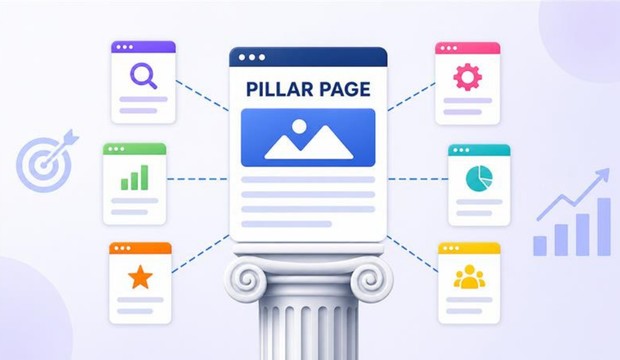
This is where a pillar page SEO strategy combined with a content cluster strategy, becomes essential.
They assess:
- How deeply a domain understands a subject
- The coherence of its internal structure
- The genuine signals of E-E-A-T (Experience, Expertise, Authoritativeness, Trustworthiness)
And a pillar page SEO strategy is precisely designed to satisfy all three simultaneously.
At Sudha Solutions, we’ve moved beyond fragmented content creation into a structured content cluster approach that reflects how modern algorithms and modern readers actually navigate information.
Here’s everything on what a pillar page SEO strategy is and why you need one today!
Key Takeaways of this article:
- Pillar pages act as central hubs that organise your entire content strategy.
- The content cluster approach improves rankings by building semantic relevance.
- Google’s algorithm increasingly rewards topical authority over isolated keywords.
- Strong internal linking structures enhance crawlability and user experience.
- A systematic framework is essential to scale pillar-based SEO effectively.
What Is a Pillar Page in SEO?
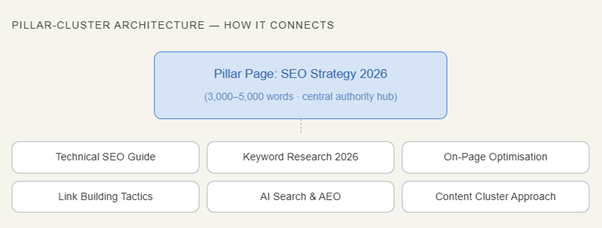
A pillar page in SEO is a comprehensive, authoritative page that covers a broad topic in depth while linking to multiple related subtopics (cluster content). These clusters then link back to the pillar, forming a tightly connected ecosystem.
Think of the pillar page as the trunk of a tree: stable, central, load-bearing. The cluster content is the branches: narrower, more specific, but drawing and distributing authority from the trunk in both directions.
The key components of a pillar page strategy SEO in 2026:
| Component | Purpose | 2026 benchmark |
| Pillar page | Broad topic overview, central authority hub | 3,000-5,000 words |
| Cluster content | Deep-dives on specific subtopics | 10-30 supporting pages per pillar |
| Internal linking | Distributes PageRank, signals relationships | Bidirectional, descriptive anchor text |
| Keyword mapping | Aligns search intent, prevents cannibalisation | One primary intent per page |
| Original data | Earns citations, strengthens E-E-A-T | Case studies, stats, first-hand insight |
Types of Pillar Pages:
- 10x Content Pillars (Ultimate Guide): Deep, comprehensive guides designed to outperform competitors.
- Resource Hub Pillars: Collections of tools, templates, and references.
- Service/Product Pillars: Conversion-focused pages aligned with business offerings.
All in all, the topic cluster model helps search engines understand your site architecture and see you as an authority on specific topics.
If you want to see what an ideal pillar page looks like, here’s one we’ve written on – AEO /GEO Optimization Strategy: Best Practices, Tools, and How It Differs from Classic SEO
Why Pillar Pages Matter More Than Ever in 2026?
Search engines have evolved from simple keyword matching to understanding context, relationships, and depth of expertise. Today, Google evaluates how well a site covers a topic holistically, how its content is structured, and whether it demonstrates genuine E-E-A-T.
This shift was reinforced by Google’s March 2026 core update, which favours topical depth, coherence, and original value while penalising thin, disconnected content.
The introduction of the “Information Gain” factor further rewards content that adds unique insights rather than repeating what already exists.
Pillar page strategies directly align with these changes.
By organising content into structured clusters:
- Topical authority increases through comprehensive coverage
- Indexing improves as internal links guide search engines
- User experience strengthens with seamless navigation across related topics
Sites that have adapted fastest post-update are consolidating content into clusters and prioritising depth over breadth. In 2026, covering one topic comprehensively consistently outperforms covering many topics superficially.
Does the Pillar Page and Content Cluster Approach Actually Improve SEO Rankings?
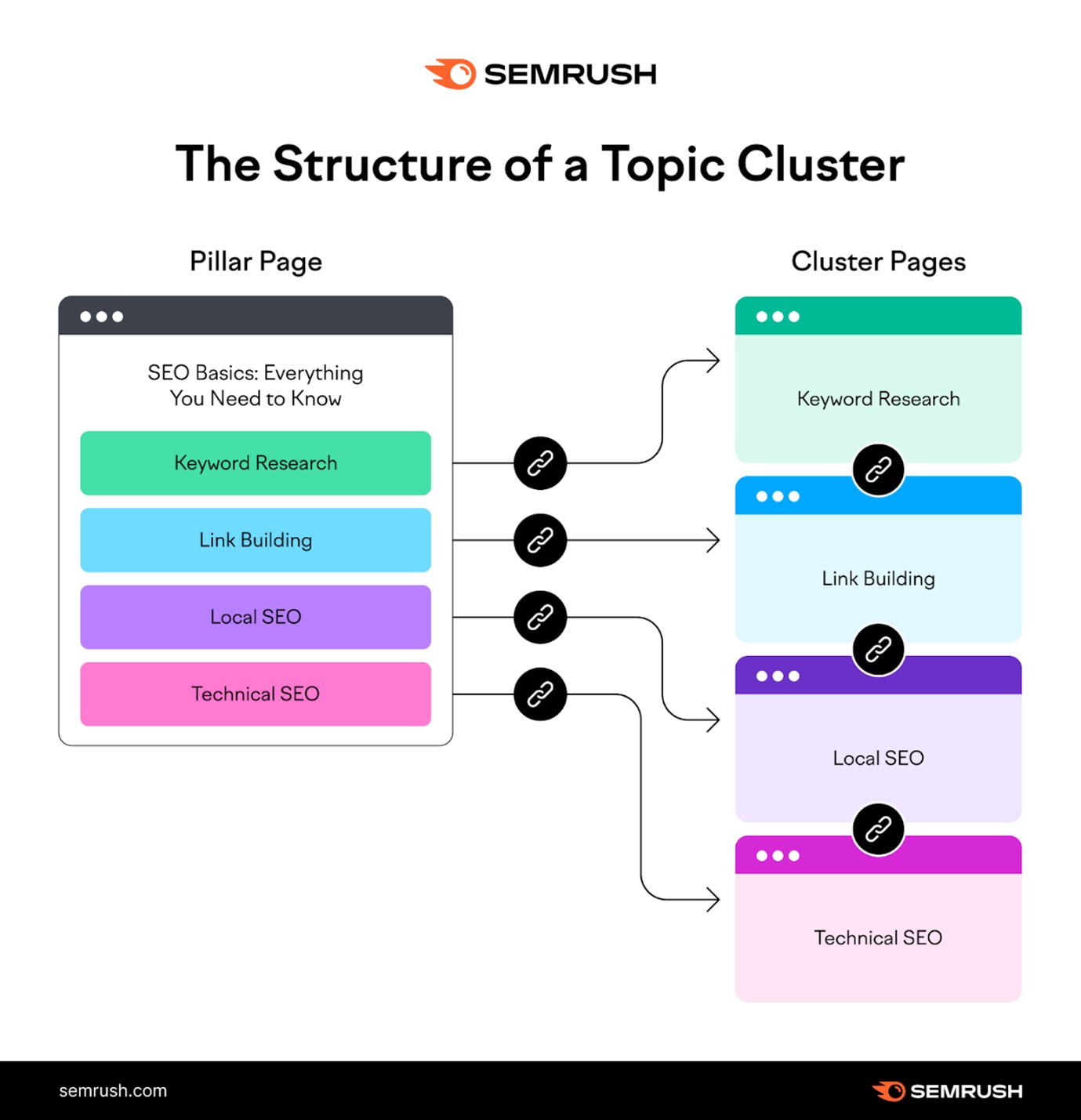
The content cluster approach works in 2026 because it aligns directly with how modern search engines evaluate content through topical authority, internal linking, and semantic relevance rather than isolated keywords.
A pillar page acts as a comprehensive resource on a broad topic, while cluster pages explore related subtopics and link back to the main page. This creates a structured content ecosystem that signals expertise and depth.
Why does it improve SEO rankings?
- Topical authority: Covering a subject end-to-end increases trust signal
- Internal linking: Distributes authority across pages and improves crawlability
- Search intent coverage: Captures multiple variations of user queries
- Content hierarchy: Helps search engines understand relationships between topics
Example: Scattered vs Structured Content
| Approach | Outcome |
| Publishing unrelated blog posts on marketing topics | Weak topical signals, inconsistent rankings |
| Building a pillar page (“Content Marketing”) with interlinked cluster content | Strong authority, improved rankings across multiple keywords |
This difference matters because search engines prioritise clarity and depth. A structured cluster tells Google: this site doesn’t just mention a topic; it owns it.
How Does Pillar Page Structure Help with AI Search Tools Like ChatGPT and Perplexity?
Unlike traditional search engines that just rank pages, answer engines such as ChatGPT and Perplexity AI extract, interpret, and synthesise information.
Pillar pages are inherently optimised for this behaviour.
A Yext AI Citation Study analysing 6.8 million citations across ChatGPT, Gemini, and Perplexity found that topic clusters receive 3.2x more AI citations than standalone posts.
Why pillar pages are preferred by AI systems
When multiple sources can answer a query, AI tools prioritise pages that deliver a complete, self-contained response with minimal fragmentation.
In practical terms, they favour content that:
- Is easy to extract from (clear headings and sections)
- Maintains context (depth reduces ambiguity)
- Shows relationships (internal links connect concepts)
- Answers fully (one page covers multiple related queries)
Instead of evaluating individual factors like “depth” or “structure” in isolation, AI systems effectively assess:
“Can this page answer the query completely and reliably on its own?”
And pillar pages are more likely to meet this threshold because they combine structured layout, broad coverage, and contextual linking.
If you’re wondering why ChatGPT prefers some brands over others, we have just the right article for you. Read here.
How to Build a Pillar-Cluster Ecosystem?
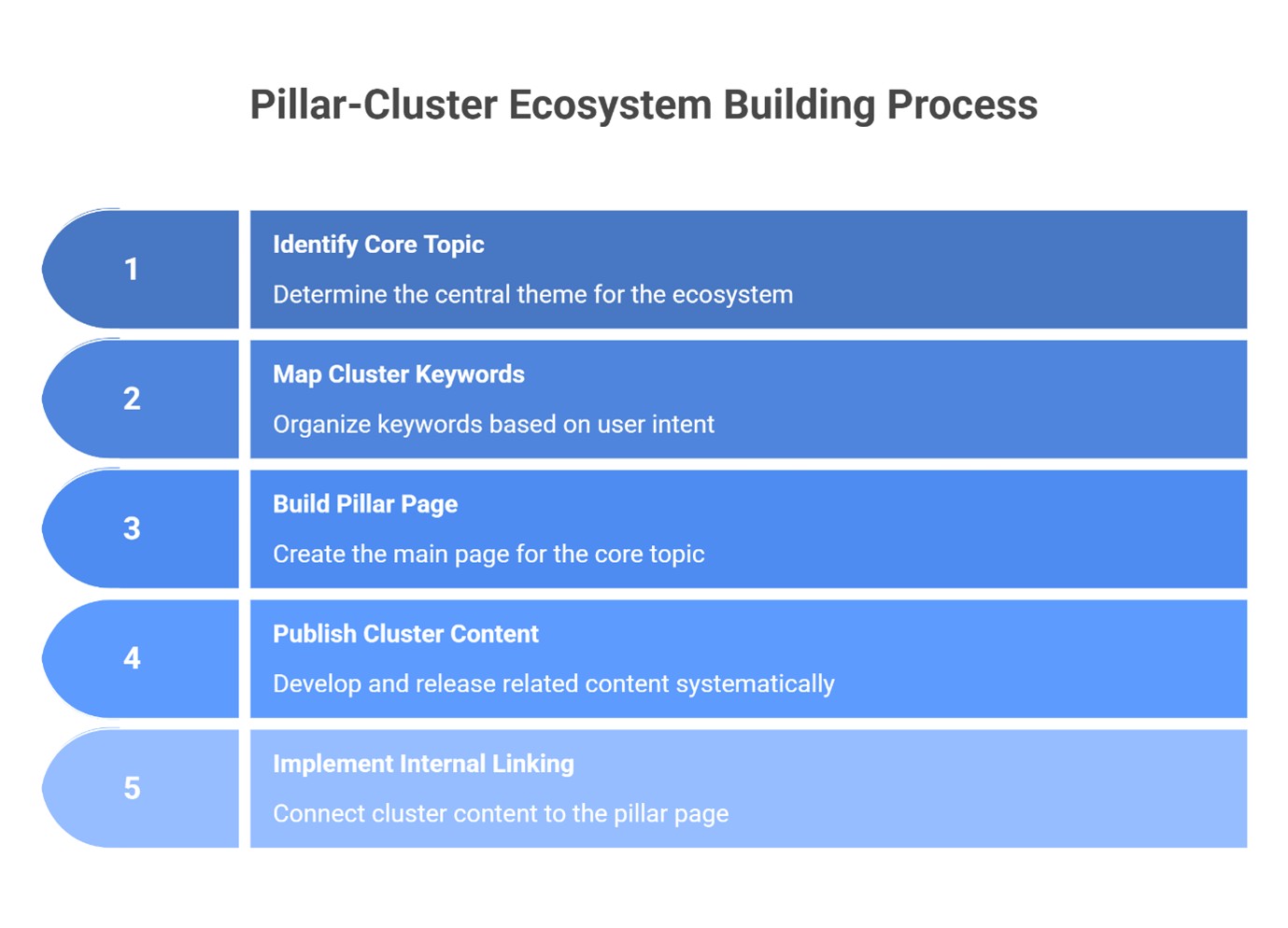
Step 1: Identify a core topic
Start with a subject that is broad enough to support 15-30 subtopics but specific enough to be meaningful to your audience. “Marketing” is too broad. “SEO strategy for SaaS companies” is a workable pillar topic.
Step 2: Map cluster keywords by intent
Break the pillar topic into subtopics, each with a distinct search intent. Avoid keyword cannibalisation. It is one of the most common and most damaging mistakes in content strategy. Every cluster page should have a unique angle.
Step 3: Build the pillar page first
The pillar page is the blueprint. Write it comprehensively, structure it with a clear H2/H3 hierarchy, and include placeholder internal links where cluster content will eventually live. This gives your editorial calendar a structural backbone.
Step 4: Publish cluster content systematically
Thin cluster pages do more harm than good. If a cluster article doesn’t go deeper than the pillar section it supports, it creates keyword cannibalisation instead of authority. Each cluster page should fully satisfy a specific search intent and link back to the pillar using clear, descriptive anchor text.
Step 5: Implement strategic internal linking
Internal linking holds the entire model together. Every cluster page should link to the pillar with keyword-focused anchor text, while the pillar links out to each cluster. Cross-linking related clusters strengthens the semantic structure and reinforces topical authority for both search engines and AI systems.
Pages buried at a crawl depth of 4 or more receive 9x less SEO traffic than those at depths 1-3. Structure matters as much as content.
How long does it take to see results from a pillar page strategy?
| Months 1-3 | Foundation: Long-tail cluster pages begin picking up ranking signals. Pillar page gets indexed and starts building authority. |
| Months 4-6 | Inflection: Rankings jump from page 3-5 to page 2. Cluster pages start reinforcing each other’s authority through internal equity flow. |
| Months 7-12 | Compounding: Page-one rankings solidify. Sites sustaining cluster publishing for 12+ months see 40% higher organic traffic than comparable single-page strategies. |
| 12+ Months | Dominance: New content within the cluster ranks faster. The compounding effect of topical authority means each new page benefits from the entire ecosystem’s credibility. |
What are the Most Common Pillar Page Mistakes?
- Treating the pillar as a long blog post without structural or architectural intent.
- Weak or inconsistent internal linking.
- Keyword cannibalisation: multiple cluster pages competing for the same query, fragmenting authority.
- Publishing thin cluster pages that don’t cover their subtopic.
- Ignoring search intent: optimising for keywords rather than the underlying question.
- Failing to update content quarterly.
- Choosing pillar topics based solely on search volume without assessing competitive SERP winnability.
- Siloing the pillar page behind a login or gating it; ungated content is mandatory for crawlability.
How Does Sudha Solutions Implement Pillar Page Strategy | The S.C.A.L.E. Framework
At Sudha Solutions, we engineer scalable content systems. Our S.C.A.L.E. framework provides the structure for every pillar-cluster engagement we execute, and it’s the same architecture we’ve built our own content strategy on.
1. Structure: We define a clear pillar-cluster architecture based on business goals.
2. Cluster: We create high-intent, search-driven supporting content.
3. Authority: We enrich every piece with original data, expert insight, and first-hand experience to satisfy E-E-A-T.
4. Link: We build bidirectional internal linking systems to maximise SEO impact.
5. Evolve: We continuously optimise based on GSC, performance data, algorithm updates, and emerging content gaps.
Our approach ensures that every piece of content contributes to a larger goal: building authority, not just traffic.
Final Thoughts
SEO in 2026 rewards structure, depth, and consistency, not scattered content. A pillar page strategy SEO 2026 turns your website into a system that compounds authority over time, rather than chasing short-term rankings.
Start by identifying one core topic your business wants to own. Build a comprehensive pillar page, map 10–15 supporting cluster topics and implement clear internal linking. Then publish consistently and refine based on performance data.
At Sudha Solutions, we help brands move beyond basic SEO and build scalable growth systems through:
- SEO Expert Services for authority and rankings
- AEO Services for AI visibility and answer-driven traffic
If you want to build a content ecosystem that ranks, scales, and gets cited — we can help you design and execute it end-to-end.
If you want to accelerate this process, Sudha Solutions can help you design and execute a scalable pillar-cluster strategy tailored to your business goals.
Frequently Asked Questions
What is a pillar page in SEO?
A pillar page is a comprehensive content hub that covers a broad topic and links to related subtopics.
How is a pillar page different from a blog post?
A pillar page targets a broad topic, while blog posts focus on specific aspects of that topic.
Does the content cluster approach improve rankings?
Yes. It enhances topical authority, internal linking, and overall SEO performance.
How long should a pillar page be?
Typically, between 3000-5000 words, depending on topic complexity.
How long does it take to see results?
Most websites see improvements within 3-6 months when executed consistently.