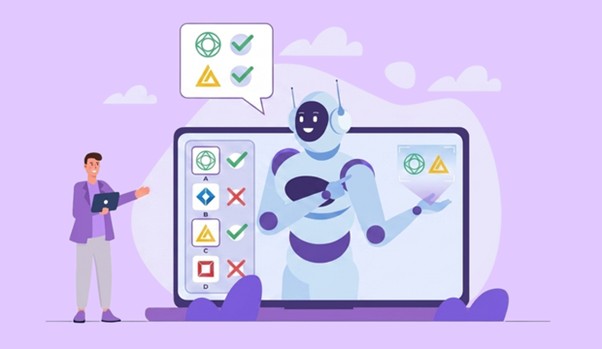




Are you outranked by worse content? Or even after following all the winning rules of writing content, you’re invisible to AI?
You’ve followed every SEO rule.
You’ve written long-form content.
You’ve optimised keywords, added backlinks, and improved readability.
And yet… competitors with seemingly weaker content show up in AI answers and you don’t.
Don’t worry, this is not because your content quality is not up to par.
It’s more likely because your content is structured for traditional search engines and not LLMs.
Today, platforms like ChatGPT, Google Gemini, and Perplexity AI have not only replaced the traditional Google searches but have become the primary search engine of 44% users.
And these platforms don’t rank results; they select and cite them.
That means you’re not competing for rank anymore. You’re competing for selection.
And here is exactly how your brand can dominate AI visibility in 2026 and beyond.
TL; DR
Ranking #1 no longer guarantees traffic or visibility. AI engines prioritise content they can easily extract, verify, and trust. To get cited, brands must combine AEO with SEO; focusing on structure, entity clarity, and consistent presence across third-party platforms.
Why Ranking #1 No Longer Guarantees Visibility
Marketers, did you know? For every 100 clicks a #1 ranking once earned, AI Overviews can now cut that by ~35–58 clicks. The rest are absorbed by AI-generated summaries that answer the user’s query without them ever needing to visit your website.
Organic click-through rates on queries with AI Overviews dropped a staggering 61% between June 2024 and September 2025, falling from 1.76% to just 0.61%. Pew Research found that when an AI summary is present, users are about half as likely to click a link at all.
McKinsey has framed this shift bluntly, describing AI search experiences as the “new front door to the internet.” Their consumer survey data shows that roughly half of consumers already prefer AI-augmented search or assistants for complex decisions.
The irony is this: Semrush data shows that ChatGPT primarily cites pages ranking in positions 21 and beyond in traditional organic search about 90% of the time.
This means:
- Even if you rank #1 on Google, AI may ignore you
- Lower-ranked but better-structured content gets cited
The rules have changed. Ranking is no longer the goal. Being selected in AI answers is.
What is AEO (Answer Engine Optimization) and Why It Matters Now
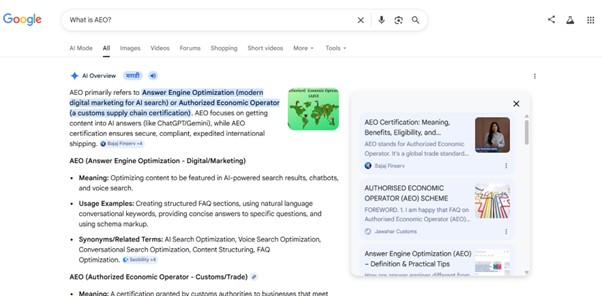
Answer Engine Optimization (AEO) is the practice of structuring and enhancing your content so that AI-powered search platforms (AIO, ChatGPT, Perplexity, etc) select it as a cited source when generating answers.
Unlike traditional SEO, which optimises for ranked links on a results page, AEO targets the retrieval layer: the moment an LLM selects which sources to pull into its answer generation.
The content must be easy to retrieve, understand, extract from, and attribute.
The market has already recognised AEO’s importance. 42% of B2B content marketers report reallocating budget from traditional SEO content to AEO-optimised content. And 98% of CMOs say they are investing in AEO this year.
The bottom line?
- SEO drives the organic traffic that pays the bills today.
- AEO builds the brand authority that protects your visibility as AI search grows.
And you need both, but AEO is where the early-mover advantage lies right now.
Comparison: Why One Brand Gets Cited and Another Doesn’t
|
BRAND A – Gets Cited |
BRAND B – Gets Ignored |
| FAQ schema on every key page | No structured schema on any page |
| Comparison pages with structured tables | Long paragraphs, no direct answer blocks |
| 40–60 word direct answers under each H2 | Case studies locked in PDFs, not HTML |
| Updated profiles on review platforms | Review platforms empty or outdated |
| Active in reddit threads with genuine advice | No community presence on forums |
| Original research published and widely cited | No original data or research published |
| Notable press mentions | No external media mentions in 12+ months |
| Content distributed across 8+ publications | Content only published on own domain |
Takeaway: The difference is rarely about content quality. It’s almost always about content structure, distribution, and discoverability signals. Brand B might actually have better content but AI can’t extract, attribute, or verify it.
Why Do Some Brands Appear More Often in AI Recommendations?
This is the question at the centre of every marketing strategy conversation in 2026.
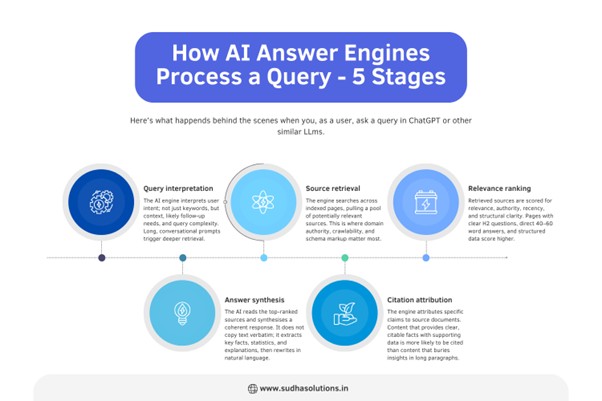
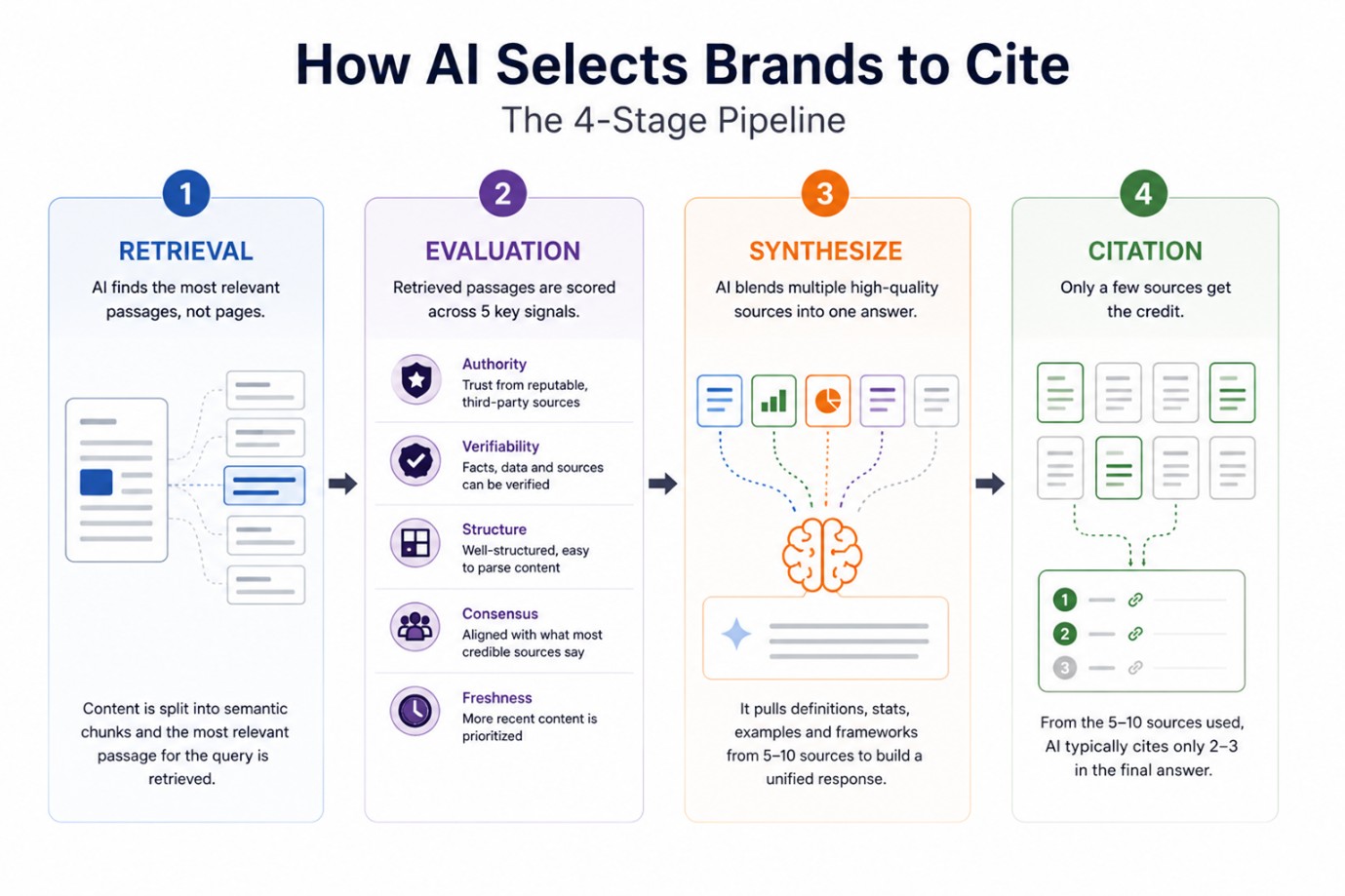
AI systems follow a 3-stage pipeline: Retrieve → Evaluate → Synthesize → Cite
Let’s break down each layer with deeper insights, research, and real examples.
Stage 1: Retrieval
AI breaks your content into semantic chunks and retrieves the most relevant passage not the most relevant page. The unit of competition is no longer your article. It’s the best paragraph on the internet for that specific question.
This means query-intent match matters more than keywords. A page targeting “AI SEO tips” won’t be retrieved for “why is my content not showing in AI answers” even if it covers the same ground.
Stage 2: Evaluation
Retrieved passages are then scored across five signals:
- Authority: AI is “overwhelmingly biased toward earned media and authoritative third-party sources.” Mentions in news sites, research papers, and industry blogs outweigh owned content every time.
- Verifiability: Only half of AI-generated statements are fully supported by citations today. AI actively avoids content it can’t verify. No data, no citation.
- Structure: AI isn’t reading; it’s only parsing. Pages with structured formats and schema markup are 30–40% more likely to be cited. Question-based headings with 50–120 word answer blocks are the target format.
- Consensus: AI compares sources and trusts repetition. If ten sites say the same thing, confidence is high. If only yours says it, it may be ignored entirely. Being right isn’t enough; you need to be aligned with the ecosystem.
- Freshness: A blog updated in 2026 will consistently out-prioritise the same content last touched in 2023.
Stage 3: Synthesize
AI doesn’t pick one winner. It blends 5–10 sources into a single unified response; pulling a definition from one site, a statistic from another, a framework from a third. The goal isn’t to be the only source cited. It’s to be included in the blend.
Stage 4: Citation
Even after synthesis, AI cites only 2–3 sources from the 5–10 it used internally. ChatGPT only cites 15% of the pages it retrieves. Citations are concentrated among a small set of high-visibility domains that pass authority checks faster and appear more consistently across the retrieval pool.
There is also a documented big-brand bias marketers talk about: AI systems systematically prefer established, widely-referenced domains. Smaller brands need stronger signals, not just better content.
You’ll learn more on this in our other blog: It’s Not Popularity: How AI Decides Which Brands Deserve Visibility
So, the best content doesn’t win. The most usable, trusted, structured, and verifiable content wins; distributed widely enough that AI encounters it, recognises it, and has the confidence to attribute it.
Why Most Brands Fail to Get Cited By AI?
1. No structured schema markup
Brands must have a full Organization schema including sameAs properties, founder, and contactPoint. Without it, the AI is essentially “guessing” who you are and what you do. This is the single most fixable technical gap.
2. Content buried in PDFs
Most B2B expertise are invisible to AI because it resides in non-HTML formats. White papers, case studies, and research locked in PDFs are computationally expensive for AI to parse and often ignored entirely.
3. Optimised for keywords, not questions
Traditional SEO content is structured around keywords. AI engines are structured around questions and direct answers. Content that doesn’t mirror how users actually ask questions in ChatGPT or Perplexity won’t be retrieved for those queries.
4. High authority, low citations
Studies show that brands with strong domain authority but minimal recent mentions in news, Wikipedia, and industry sources perform poorly. AI treats them as “old guard” rather than “currently relevant.” Freshness of brand mentions matters.
5. Zero community presence
Domains with millions of brand mentions on Quora and Reddit have roughly 4× higher chances of being cited than those with minimal activity. Brands that exist only on their own website are invisible to the community validation layer AI engines prize.
6. Unclear site navigation hierarchy
If brands fail to use SiteNavigationElement schema, it’s difficult for AI agents to understand the hierarchy of a site’s services. If AI can’t navigate your site like a user can, it defaults to ignoring it.
How to Optimise Your Content for AI Citations: Checklist You Can Actually Follow
Structured Data (Core Extraction Layer)
- Organisation schema with sameAs links (socials, Wikipedia, Wikidata; entity grounding)
- FAQPage schema on key pages (top extraction source after TL;DR blocks)
- Article + Author (Person) schema (clear authorship + credibility signals)
- Review / Product schema (if applicable) (ratings + trust metadata for AI summaries)
Answer-First Content (Primary Citation Layer)
- TL;DR (40–60 words) at top (most frequently extracted block)
- Question-based H2s (real queries) (“What is…”, “How to…”, “Why does…”)
- Direct answer under each H2 (40–60 words) (before any explanation)
- Short paragraphs (2–4 sentences max) (improves extraction + readability)
- No fluff introductions (immediate answer delivery only)
Content Structure (Parsing + Clarity Layer)
- Clear hierarchy (H1 → H2 → H3 + clean formatting) (helps AI chunk content correctly)
- Tables / bullets for comparisons & steps (AI prefers structured blocks)
- Statistics + data clearly presented (numbers = high citation probability)
Credibility & Authority (Trust Layer)
- Cited sources + original data points (external validation + uniqueness)
- Author credibility + publication dates visible (E-E-A-T signals for LLMs)
- Balanced, transparent content (include limitations, methods, or alternatives)
Related read: How to Optimize for AI-Powered Search: Strategies for Google, ChatGPT & Perplexity
Why Reddit Is Suddenly Dominating AI Citations
Source: Promptwatch
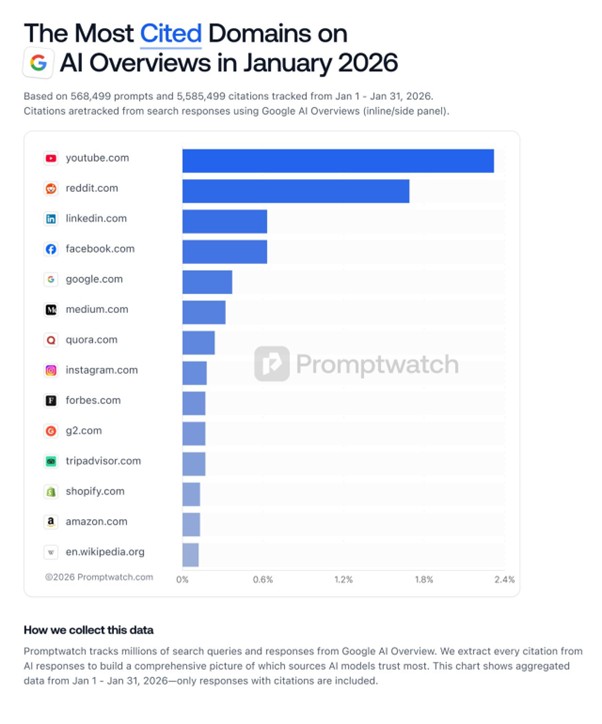
If you haven’t taken Reddit seriously as a marketing channel, 2026 is the year that changes. Reddit has emerged as one of the most consistently cited domains across major AI platforms and understanding why reveals something important about how AI thinks.
- Authentic experience over marketing copy
AI platforms are constantly asked “What’s the best X?” or “Should I use Y?” These are opinion-seeking queries that require real human experiences. Reddit is the largest repository of authentic human opinions on the internet; something corporate landing pages cannot replicate.
- Built-in quality signals via upvotes
Reddit’s upvote system provides a quality signal AI systems can leverage. A comment with 200 upvotes is statistically more likely to contain accurate, useful information than a random blog post and AI models appear to weight this accordingly.
- Google’s $60M licensing deal
Did you know, Google’s annual licensing agreement gives it access to Reddit’s content for AI training and retrieval, reinforcing Reddit’s position in AI Overviews and AI Mode? This deal also formed strong citation signals for other generative AI models.
- Structured disagreement; something AI values
Reddit threads contain structured disagreement with multiple perspectives and diverse viewpoints, thanks to authentic human-led opinions. AI engines need this to build balanced answers, and it’s rare on polished brand websites where every piece of content is positively framed.
What this Means for Your Brand?
Reddit citations aren’t just available to consumer brands. Authentic participation in niche subreddits with genuine answers to real questions, not promotional content is now a measurable component of AI visibility strategy.
Think of it as community PR, not advertising. The prompts that currently drive Reddit citations are exactly the prompts your potential customers are asking. Tap into that.
Wondering how you can optimise AEO for Reddit and Quora? We have the perfect how-to guide for you – How to Optimize for AEO: Ranking Reddit & Quora Content in AI Search
Final Thoughts
AI search has already shifted from ranking to selection. AI platforms are selecting 2–5 sources to synthesise into answers that 44% of searchers now accept as their final destination; no click required, no scroll needed.
If your brand isn’t cited, the issue isn’t content quality. It’s structure, authority, and distribution.
The solution is not replacing SEO, but layering AEO + GEO:
- Structure content for extraction (direct answers, schema)
- Build entity clarity and authority
- Expand presence across trusted platforms
More on these in our blog – AEO/GEO Optimization Strategy: Best Practices, Tools, and How it Differs from Classic SEO
Your goal? To make your content easy for AI to retrieve, understand, and cite.
At Sudha Solutions, we execute this end-to-end right from schema and restructuring to community strategy to AI visibility tracking, so your brand gets selected in AI engines and not just ranked.
Contact us today if you want us to audit your current AI citation visibility, identify exactly why you’re being skipped, and build a prioritised AEO roadmap tailored to your brand.
Frequently Asked Questions
Why is my brand not appearing in ChatGPT even though I rank on Google?
Because ChatGPT does not rank pages; it selects sources. If your content lacks clear answers, structured formatting, schema, and strong external mentions, it won’t be cited even if it ranks #1 on Google.
Do I still need traditional SEO if I’m investing in AEO?
Yes. SEO helps you get discovered and indexed, while AEO makes your content extractable and citable. You need both working together.
Should I prioritise ChatGPT, Google AI Overviews, or Perplexity for AEO?
- ChatGPT: easier entry, doesn’t rely heavily on rankings
- Google AI Overviews: strongly tied to top 10 rankings
- Perplexity: favors research content and sources like Reddit
One AEO structure works across all. So, we recommend optimising for all three simultaneously.
How long does it take to start appearing in AI citations after making AEO changes?
Expect early mentions in 2–4 months if you fix structure and schema quickly. Consistent visibility across platforms usually takes 6–12 months.
How do I measure my brand’s AI citation performance?
Track:
- How often your brand is mentioned in AI answers
- Which pages get cited
- Your share of citations vs competitors
Tools like Semrush AI Visibility or manual prompt tracking can help.