
Sudha Solutions

Categories
AEO Optimization AI Overview General SEO

Answer-Led Content: Why Traditional Blogging No Longer Works in 2026

There is a quiet but significant shift happening in digital publishing, and businesses investing in SEO expert services, content marketing experts, and expert blog writing are already seeing how answer-first content is replacing outdated blogging models. But if you have been publishing content for your business for a while now, you may have already felt it: the sense that what once worked no longer does, and that the rules have changed.

This piece is about understanding that shift, why it is happening, and what it means for your business.

The Way People Search Has Changed

This shift is why AEO services and AI search optimization are becoming critical extensions of traditional SEO.

Think about how you search for information today versus five years ago. The odds are you are no longer typing two or three keywords and scrolling through blue links. You are:

  • Typing full questions into Google
  • Asking your phone out loud
  • Getting AI-generated summaries before you even click on anything

This is not anecdotal. In 2024, 59.7% of EU Google searches and 58.5% of US Google searches resulted in zero clicks, meaning users found what they needed directly on the search results page without visiting a single website. For every 1,000 searches on Google in the United States, only 360 clicks reach an external website.

Search engines have quietly transformed from directories that pointed people to content into answer engines that deliver content directly. This is exactly why answer engine optimization is becoming essential for brands that want visibility beyond traditional rankings. Google’s AI Overviews, voice search, knowledge panels, and featured snippets have collectively rewritten what it means to be “found online.”

What this means for your blog:

  • Readers arrive with a specific question already in mind
  • They expect an answer quickly, in plain language
  • Blogs that open with long preambles before getting to the point are not just outdated, they are functionally invisible

What Answer-Led Content Actually Means

At its core, answer-led content reflects a smarter blog writing service approach, one that prioritises search intent, clarity, and conversion.
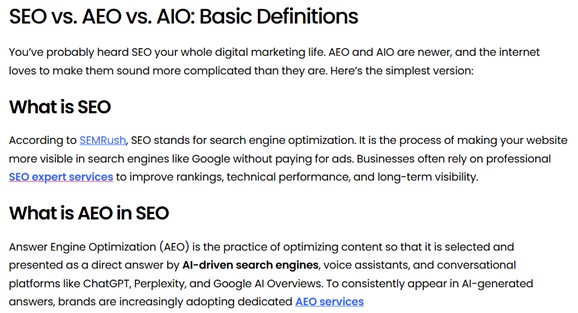
SEO vs AEO vs AIO

Answer-led content is not a format or a template. It is a philosophy rooted in one simple idea: the reader’s time matters more than the writer’s comfort.

Traditional blogging was built around a narrative structure:

  • Set the scene
  • Explore the topic broadly
  • Arrive at something useful, eventually

Answer-led content flips that structure entirely:

  • Lead with the most important information first
  • Build context and depth around it
  • Design for how people actually read online

And how do people read online? According to a statistic blog post by S Q Magazine 73% of readers skim blog posts, while only 27% read them fully. Answer-led content is built for the skimmer, without short-changing the reader who wants depth.

Why this matters for your business:

  • A reader who finds your answer immediately earns you trust
  • A reader who must hunt for the answer leaves, and usually does not come back

Why Is There a Shift in Content Marketing?

For brands investing in strategic content marketing, this means content must now rank, engage, and qualify for AI-generated answers simultaneously.
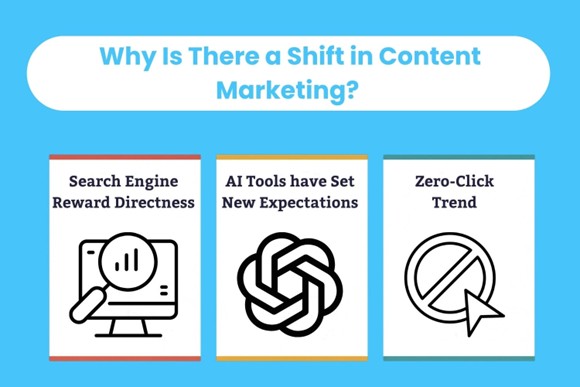
Why Is There a Shift in Content Marketing

Three things converged to create the current content environment:

1. Search engines began rewarding directness

  • Google has spent years refining its ability to separate content that answers a query from content that merely contains the right keywords
  • Content structured around clear, specific answers consistently earns better placement, including featured snippet positions at the very top of the page

2. AI tools have recalibrated reader expectations

  • When someone can ask ChatGPT a question and receive a concise answer in seconds, their tolerance for content that buries the lead shrinks considerably
  • This is not a threat to good content. It is a filter that removes mediocre content from consideration

3. Zero-click behaviour is now the norm, not the exception

  • The majority of searches now end without a click to any website
  • Readers who do click have already passed through AI summaries and featured snippets
  • They are coming to you for something those could not provide: nuance, specificity, or a perspective grounded in real experience

The businesses that recognized this early and restructured their content accordingly have built meaningful advantages in visibility and credibility. Those still publishing in the old mold are quietly losing ground.

The Problem with How Most Blogs Are Still Written

Visit almost any business blog today and you will find a familiar pattern:

  1. A broad opening observation about the topic
  2. An explanation of what the article will cover
  3. A slow circle toward something useful
  4. By the 400-word mark, the reader who came with a specific question has already left

This structure was not designed for readers. It was designed for search engine crawlers in an era when word count and keyword density drove rankings. That era is over, but the habits it created have persisted.

The consequences for businesses are real:

  • According to a study, after 7 minutes of reading time, engagement on most websites falls off sharply, and reading time tends to drop below 10 seconds if your post takes 14 minutes or more to finish.
  • A slow-starting blog post does not just fail to engage, it actively signals readers to look elsewhere
  • Content padded with vague generalisations makes your business look like it does not have much to say, but knows it needs to publish something

Readers can sense this, even if they cannot articulate exactly why they clicked away.

What Good Answer-Led Content Looks Like
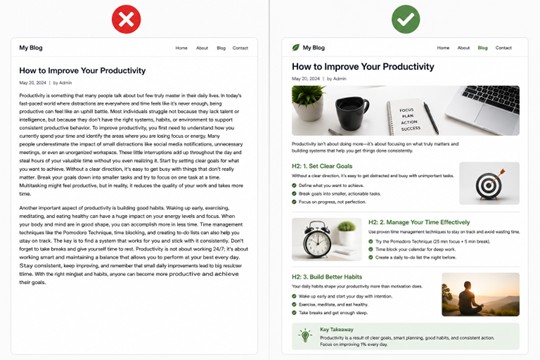
What Good Answer-Led Content Looks Like

The clearest way to understand this is through contrast.

Old approach: An influencer talking about how to increase productivity in a blog with no formatting, spending a lot of time on unnecessary paragraphs and jargons.

New approach: The same blog opens with a direct answer, clear inforgragics and answers that are easy to skim through.

The hallmarks of good answer-led content:

  • Leads with the answer: Context can be built later.
  • Matches format to the question: Not every topic need 1,500 words; a comparison question warrants a structured comparison, not a long essay
  • Uses headings and structure: This helps readers to scan and still walk away informed. A strong SEO content strategy often uses pillar pages and topic clusters to make content easier for both users and AI systems to understand.
  • Prioritise specificity over volume: a 600-word post that answers one question precisely outperforms a 2,000-word post that gestures at ten questions without resolving any of them
  • Demonstrates expertise: Your expertise should be demonstrated by your knowledge in the field and not the wordcount of the blog

Why This Matters for Your Business Specifically

Your blog is often the first meaningful encounter a potential client has with your business. Not your homepage, which tends to be polished and promotional. Your blog, where someone lands when they have a real question and want a real answer.

What a well-structured blog communicates to a reader:

  • We understand your problem
  • We know what we are talking about
  • We are not going to waste your time

That is a powerful first impression, and it is one that answer-led content delivers consistently.

Consider this example: A financial advisory firm whose blog consistently answers specific questions their target clients are already searching:

  • “Do I need a will if I have a small business?”
  • “How much should I set aside for taxes as a freelancer?”
  • “When should I start thinking about succession planning?”

Each of those posts is a low-pressure introduction to the firm’s expertise. No sales pitch required. The content earns trust simply by being genuinely useful.

The compounding effect:

  • A single well-structured post can attract readers and generate enquiries for years.
  • The most effective content that ranks also connects readers naturally to conversion-focused assets.
  • It does not require ongoing promotion to keep working
  • Compare that to a promotional post with a short shelf life, and the case for this approach becomes straightforward


The SEO Payoff

At its core, SEO has always been about one thing: demonstrating to search engines that your content is the most useful result for a given query. Answer-led content does this structurally.

Businesses using SEO blog writing services structured around EEAT and answer-led frameworks are significantly better positioned for featured snippets and AI overviews.

How it earns better search placement:

  • Directly addresses a specific question
  • Uses clear headings that signal structure to search engines
  • Provides specific information rather than vague observations
  • Aligns with what Google is trying to serve its users

Google’s E-E-A-T framework rewards content that is:

  • Written by people with genuine knowledge and real-world experience
  • Published on sites that have earned credibility over time
  • Specific, informed, and direct, not fluffy or generalist

The AI Overview dimension: Research by SEMrush found that 91.3% of queries triggering Google’s AI Overviews are informational in nature, which is precisely the kind of content most business blogs publish. Being cited in those overviews is the new version of ranking on page one, and it rewards the same qualities: clarity, specificity, and genuine expertise.

Increasing AI citations now depends not just on rankings, but also on structured expertise and wider brand trust signals.

Where Human Voice and Storytelling Still Matter

Human Voice and Storytelling Still Matter

Answer-led does not mean robotic. In fact, the opposite is true.

What AI-generated content can do:

  • Summarise
  • Define
  • List
  • Produce competent, interchangeable content at scale

What it cannot do:

  • Bring a genuine point of view
  • Draw on lived professional experience
  • Make unexpected connections that come from years of thinking about a problem
  • Create the kind of content that makes a reader feel like they are in conversation with someone who truly understands their situation

The best content strategy today is not a choice between answering clearly and writing with humanity. The future of content for AI search lies in combining extractable answers with genuine human expertise. It is both.

  • Answer the question first
  • Then add the insight, the nuance, or the example that only you can offer
  • That combination is what earns a loyal reader, not just a satisfied one

Conclusion

The content landscape has not just shifted. It has restructured, and the restructuring is not temporary.

Today’s readers are:

  • More informed than ever
  • More impatient than ever
  • Already passing through layers of AI-generated answers before they reach your content

They are not looking for an introduction to a topic. They are looking for the specific thing those other sources could not give them: real expertise, expressed clearly, by a business that understands their situation.

The blogs that will drive real business results are the ones that:

  • Answer the reader’s actual question, not a broader version of it
  • Demonstrate expertise through specificity, not word count
  • Combine clear structure with a distinct human voice
  • Treat the reader’s time as their most valuable asset

For businesses thinking seriously about their content strategy, the question to ask is simple: does your blog serve your reader, or your word count? The answer to that question will increasingly determine whether your content earns you clients or quietly fades from view.

Want your content to rank and get cited by AI?

Contact us at Sudha Solutions. We follow a fixed content writing format, that has helped several of our brand rank on both Google overview and AI platforms like ChatGPT and Perplexity.

Example: Satguru’s.

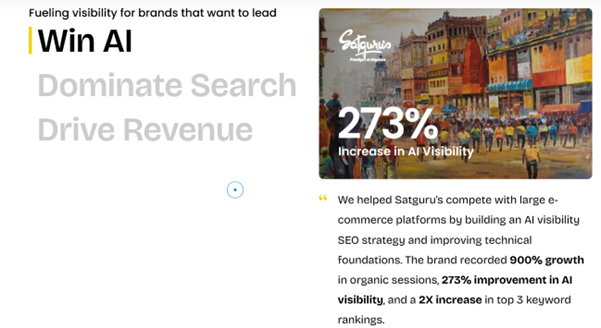
We worked with Satguru’s a home decor brand based in Mumbai. We implemented a full content marketing strategy combining expert blog writing, SEO expert services, and AEO services, resulting in a 273% increase in AI visibility that included:

  • Writing new blogs
  • Optimising already published blogs with relevant keywords
  • Adding relevant FAQs
  • Optimising website content

This significantly boosted their AI citation. They witnessed a staggering 273% increase in AI visibility.
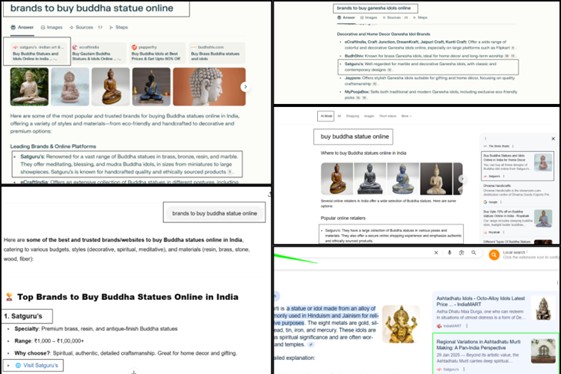
AI visibility in search engine

Contact us TODAY to optimise your content marketing strategy.

Frequently Asked Questions

What is answer-led content?

Answer-led content is a content strategy that prioritises answering a user’s question immediately, clearly, and structurally before expanding into broader context, improving SEO, AEO, and user trust.

Why is traditional blogging becoming less effective?

Traditional blogs often start with long introductions and delay the main answer. With AI summaries, featured snippets, and zero-click searches, users expect immediate value. If they do not find it quickly, they leave.

How does answer-led content improve SEO?

Answer-led content aligns with search engine priorities by:

  • Directly addressing user queries
  • Improving chances of featured snippets
  • Increasing dwell time and engagement
  • Matching AI Overview requirements

This makes it more likely to rank and get cited.

What are zero-click searches?

Zero-click searches happen when users find their answers directly on search engine results pages without clicking on any website. This is now the majority of searches, making it crucial for content to be concise and structured.

How should I structure an answer-led blog?

A strong answer-led blog should:

  • Start with a clear, direct answer
  • Use headings for easy scanning
  • Keep paragraphs short and specific
  • Add depth only after addressing the main question

Categories
AEO Optimization General SEO

You Have Customers. You Have Revenue. So Why Does Growth Feel This Hard?

You didn’t get here by accident. You built something real, but scaling now requires more than founder instinct. It requires a structured go-to-market strategy, supported by SEO expert services, performance marketing services, and systems that consistently generate qualified growth.

You built something people actually wanted. You closed your first deals. Hit your first million. Maybe your second or third. And for a while, it felt like things were working.

But lately? It’s different.

You’re doing more, more outreach, more campaigns, more hiring, and the results aren’t keeping up. Deals are taking longer. Your team is stretched. And somewhere in the back of your mind, there’s a question you haven’t said out loud yet:

Are we doing this right?

That question is worth taking seriously. Because at the stage you’re at, somewhere between proving the idea and actually scaling the business, the way you go to market matters more than almost anything else.

Here’s What Nobody Tells You When You Cross $1M ARR

The thing that got you here was probably you.

Your relationships. Your hustle. Your ability to explain the product better than anyone else and convince people to take a chance on it. That’s real, and it worked.

But it doesn’t scale.

You can’t be in every sales conversation. You can’t personally follow up with every lead. And the customers who found you early, the ones who were already half-convinced before they even spoke to you, aren’t the ones coming in now.

The new pipeline is colder. Slower. More skeptical. And your team is trying to sell to them the same way you sold to the early ones – which is why it’s not working.

This isn’t a team problem. It’s a system problem. And the system is called your go-to-market.


What “Go-To-Market” Actually Means (Without the Jargon)

Today, effective go-to-market execution often combines content marketing strategy, professional UI UX design, and lead generation strategy to ensure every customer touchpoint reinforces trust.

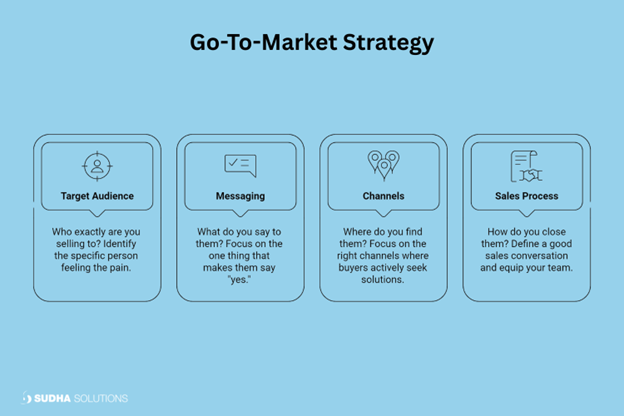
Strip away all the buzzwords and a go-to-market strategy answers four simple questions:

Who exactly are you selling to? Not “businesses with 50–500 employees.” That’s not specific enough. Who is the actual person feeling the actual pain your product solves – and what’s happening in their world right now that makes them ready to buy?

What do you say to them? Not a list of features. Not a category claim. What’s the one thing that makes someone think “yes, this is exactly what I’ve been looking for” – and are you actually saying that, clearly, everywhere they encounter you?

In 2026, that visibility increasingly depends on answer engine optimization, ensuring your brand is not only discoverable in search, but also trusted enough to be cited by AI assistants.

Where do you find them? Not every channel. The right channel. Where does your buyer go when they’re actively trying to solve this problem? That’s where you should be. Everywhere else is noise.

How do you close them? What does a good sales conversation look like? What does a bad one look like? Does your team know the difference – and do they have the tools to run it well without you in the room?

If you have clear, honest answers to all four; great. Most companies at your stage don’t. And that gap is quietly costing them.

The Signs Your Go-To-Market Is Leaking

You don’t always know it’s broken. It shows up in smaller ways.

  1. Leads come in, but they don’t convert the way early customers did. Your first buyers already believed in the problem. They were easy. The ones coming in now need more convincing; and your funnel wasn’t built for that.
  2. Your sales team is busy, but the pipeline doesn’t show it. This usually means messaging. When what you say is vague, every salesperson compensates differently. One over-explains. One discounts. One just talks more. None of it is consistent, and none of it scales.
  3. Marketing and sales aren’t really aligned. They’re in the same company, maybe even the same room. But marketing is building one thing and sales is saying something different. Leads come in that sales doesn’t trust. Sales closes deals that marketing didn’t plan for. And both teams feel like the other one doesn’t get it.
  4. You’re everywhere, but nothing is compounding. Google. Events. Cold email. A newsletter. It’s a lot of activity. Without structural systems like a pillar page SEO strategy, even strong marketing activity can remain fragmented instead of compounding authority over time. But if none of it is connected, if there’s no common thread pulling someone from “I found you” to “I’m ready to buy”, you’re spending energy without building momentum.
  5. Deals are taking longer than they used to. Sometimes this is the market. But often it’s that your buyers need more reassurance before they commit, and you’re not giving it to them between conversations.

If two or more of these sound familiar, your go-to-market needs work.

What Fixing It Actually Looks Like

You don’t need to rebuild everything. You need to find where it’s breaking and fix that first.

1.    Start with who you’re really selling to

Go back to your best customers – the ones who stuck around, paid on time, maybe even sent you referrals. What do they have in common?

Not just their industry or company size. Go deeper. What was going wrong in their business before they found you? Who made the decision to buy? How long did it take them?

That pattern is more valuable than any market research report. It tells you exactly who you should be targeting – and just as importantly, who you should stop spending time on.

2.    Then look at what you’re saying

This is where content marketing experts become critical, aligning your website, sales narrative, and brand positioning into one strategic growth message.

In practice, this often means building content that ranks and converts, messaging that not only attracts the right audience but also moves them toward a decision.

Ask three people on your sales team this question: “Why do customers choose us over other options?”

If you get three different answers, that’s your problem right there. Because if your own team can’t articulate it clearly and consistently, imagine what it sounds like to a buyer who’s also talking to your competitors.

Clear messaging doesn’t mean a better tagline. It means everyone, your website, your sales team, your proposals, your follow-up emails, is saying the same thing. A thing that’s true, specific, and actually matters to the person reading it.

3.    Then fix your channels

Whether through performance marketing agency execution, seo services in mumbai, or AI-first discoverability, channel depth matters more than channel quantity.

The bigger question is whether your current mix reflects the right balance of performance marketing vs content marketing, so you’re not just generating traffic but building sustainable pipeline momentum. Deeper presence on the right channels usually is.

The right channel is wherever your buyer goes when they’re actively looking to solve the problem you solve. If you don’t know where that is, ask your best customers how they found you. The answer is usually in that conversation.

4.    Then build a sales process that works without you

Document what a good sales conversation looks like. What questions get asked. What objections come up. What a good fit looks and sounds like versus a bad one.

When that knowledge lives only in your head, your team is guessing. When it’s written down and practised, it becomes a system – and systems scale in a way that individuals don’t.

The Honest Truth About This Stage

Scaling from $1M to $10M ARR is genuinely hard. Not because the market isn’t there, and not because your product isn’t good enough.

It’s hard because the rules change.

What got you to $1M, speed, instinct, founder energy, starts working against you as you try to grow. You need structure now. That structure increasingly includes a strong brand authority strategy, where how your business is discussed across search, AI, and digital ecosystems directly impacts growth. Not the kind that slows you down, but the kind that lets other people carry the weight alongside you.

The founders who get through this stage well aren’t the ones with the biggest budgets or the most aggressive targets. They’re the ones who got honest, early, about what was actually breaking; and fixed it at the root instead of patching over it.

Where Sudha Solutions Comes In

We work with founders at exactly this stage; businesses that have proven the idea and are now trying to scale it properly.

What we do is full-funnel: strategy and execution together. Because a great strategy that nobody executes is just a document. And execution without strategy is just expensive trial and error.

We help you figure out what’s breaking, build the system to fix it, and run it with you; so growth stops feeling like something that happens to you and starts feeling like something you’re in control of.

If this piece made you think about your own business, we’d love to hear what you’re working through.

[Let’s talk →]

Just a real conversation about where you are and what might help.

Frequently Asked Questions


What is a go-to-market strategy?

A go-to-market strategy is a clear plan for who you’re selling to, what you’re saying to them, where you reach them, and how you convert them into customers in a way that can scale beyond the founder.

How do you know if your go-to-market strategy is broken?

You’ll usually see signs like declining conversion rates, longer sales cycles, inconsistent messaging across your team, and growing effort that doesn’t translate into proportional revenue.

Why are my leads not converting like they used to?

Because early customers were already problem-aware and easier to convince, while newer leads are colder, more skeptical, and require clearer positioning, stronger messaging, and more structured nurturing.

How do I define my ideal customer profile (ICP) more precisely?

Look at your best existing customers and identify shared patterns in their problems, buying triggers, decision-makers, and outcomes, then focus your efforts on finding more of those specific profiles.

How do I align marketing and sales teams effectively?

Alignment comes from shared definitions of the ideal customer, consistent messaging, agreed qualification criteria, and regular feedback loops so both teams work toward the same revenue outcomes instead of separate goals.


Categories
Content Strategy General SEO

Content That Ranks vs. Content That Converts: Why You Need Both

You’ve spent months publishing blog posts as part of your content marketing strategy. Traffic is climbing, your SEO expert services are driving rankings, and Google is rewarding you with page-one visibility. 

And then you look at your leads dashboard. 

Nothing. 

Or maybe it’s the opposite. You have a beautifully written services page that explains exactly what you do, why you’re different, and why clients should work with you. The people who find it love it. The problem? Almost no one finds it. 

Both situations are more common than most businesses admit. And both come down to the same misunderstanding: Ranking and converting are not the same goal, but they need each other. 

Let’s break down what each type of content actually does, why treating them as separate work is quietly costing your business, and how to connect them into something that works from end to end. 

What Is “Content That Ranks”? 

What Is "Content That Ranks"?

Content that ranks is built for search engines and the people using them. Its primary job is to be found. 

This is where seo services in mumbai and strategic search engine optimization services play a critical role helping businesses create discoverable assets that generate sustainable organic traffic growth. 

When someone types “how to reduce employee turnover” or “best project management tools for small teams” into Google, they’re not looking for a sales pitch. They want information. Content that ranks meets them there. It answers their question clearly, earns their attention, and builds familiarity with your brand. 

This type of content typically includes: 

  • Informational blog posts: “What is [topic]”, “How does [process] work”, “X ways to [solve a problem]” 
  • Industry guides and explainers: Long-form resources that cover a subject in depth 
  • Statistics roundups and research summaries: Content that earns links because it’s genuinely useful as a reference 
  • Tutorials and how-to content: Step-by-step walkthroughs of a specific task 

This is also where a strong pillar page SEO strategy becomes powerful, allowing brands to build topical authority instead of publishing disconnected blogs. 

The SEO mechanics behind it, such as keyword research, internal linking, page structure, and backlinks, exist to help this content get discovered. But the content itself wins or loses based on how well it serves the reader’s intent. 

A useful way to think about it: Ranking content is a lighthouse. It doesn’t close the deal. It gets people to your website. 

What Is “Content That Converts”? 

Content that converts is built for decisions. Its job is to take someone who already knows they have a problem and help them choose you as the solution. 

This is where content marketing experts and conversion-led content marketing services become essential, because traffic alone does not build revenue unless content is designed to drive decisions. 

This is the content your sales team wishes existed. It speaks directly to the doubts, comparisons, and questions that come up right before someone commits. 

This type of content typically includes: 

  • Service and product pages: What you offer, who it’s for, and what makes it different 
  • Case studies: Real client results told as a story 
  • Comparison pages: How you stack up against competitors 
  • Proof pages: Social proof that reduces risk in the buyer’s mind 
  • Sales emails and nurture sequences: One-to-one persuasion at scale 

The mechanics here are different too. Think clear value propositions, specific outcomes, strong calls to action, and trust signals like client logos or accreditations. 

Why Most Businesses Treat These as Two Different Things (And Why That’s a Problem) 

Here’s what typically happens. 

Many brands invest in SEO without a structured content marketing strategy, while others build persuasive pages without discoverability—creating a disconnect between rankings and revenue. 

The marketing team focuses on SEO. They publish regularly, traffic grows, and they celebrate the wins in monthly reports. Meanwhile, the website’s service pages were written three years ago by someone who’s no longer at the company. The case studies section has two entries. The main CTA is “Contact Us.” 

On the other side, some businesses invest heavily in a polished website. Every page is beautifully designed and persuasively written. But there’s no blog, no educational content, and no reason for Google (or anyone else) to send new visitors there. The only people who see it are the ones who already know to look. 

Both teams are doing real work. But neither is building a system. 

  Content That Ranks  Content That Converts 
Primary goal  Get discovered by new audiences  Turn interested visitors into leads or clients 
Reader mindset  “I have a question or a problem”  “I’m comparing options or ready to decide” 
Typical format  Blog posts, guides, tutorials  Service pages, case studies, comparison pages 
Success metric  Organic traffic, rankings, time on page  Conversion rate, leads, demo requests 
When it fails alone  Visitors arrive but don’t take action  Great page, but no one sees it 

The table above makes the gap obvious. Each type of content has a job it’s genuinely good at. The mistake is expecting one to do the other’s job. 

Also Read: Performance Marketing vs Content Marketing: Where Should a D2C Brand Invest First 

The Real Issue: Intent 

The reason high traffic doesn’t always lead to conversions comes down to one word, and that word is intent. 

Every person who lands on your content is at a different stage of their decision. Someone reading “what is content marketing” is curious. They’re learning. They’re nowhere near ready to hire an agency. Someone reading “content marketing agency for B2B SaaS” is actively looking. They want options. 

This is the difference between informational intent and commercial intent, and it should shape everything: the format of the content, the language, the CTA, and where it links. 

Here’s a simple way to map it: 

Funnel stage  What the reader wants  Content type  Right CTA 
Top (Awareness)  To understand a problem or topic  Blog posts, guides  Download a free resource, read a related post 
Middle (Consideration)  To compare options and evaluate solutions  Case studies, comparison posts  Book a call, get a sample 
Bottom (Decision)  To choose and commit  Service pages, testimonials, pricing  Start now, request a proposal 

Most content lives at the top of this table and never connects to the bottom. That’s where the revenue gap hides. 

What “Connected Content” Actually Looks Like 

What "Connected Content" Actually Looks Like

A true seo content strategy connects ranking content with conversion-focused assets through strategic internal linking, building a complete lead generation content system. 

Here’s a real-world example of how these two types of content work together when they’re treated as a system rather than separate tasks. 

The chain: 

  1. A business owner searches “how to improve my company’s online visibility.” They find a well-written blog post that answers the question thoroughly and ranks on page one. That’s ranking content doing its job.
  2. Halfway through the post, there’s a natural mention: “If you’re a service business trying to grow organic traffic without a full-time content team, here’s how we helped a logistics company triple their blog traffic in 8 months.” That links to a case study.
  3. The case study is specific. It names the challenge, walks through the approach, and shares the results. At the end, it says: “Want to see if this approach would work for your business? Let’s talk.” That’s a CTA that matches where the reader is right now.
  4. The reader books a discovery call. 

No hard sell. No disconnected experience. Just a clear path from a search query to a conversation. 

That’s what connected content looks like. Each piece does one job well and hands the reader to the next piece naturally. 

The Mistakes That Break the Chain 

Even when businesses have both ranking content and conversion content, they often break the connection in one of these ways. 

  1. Generic CTAs at the end of every post

“Want to learn more? Contact us.” This tells the reader nothing. A CTA should reflect where the reader is in their thinking. An educational post about content strategy should link to a relevant case study, not a generic contact form. 

  1. No internal linking strategy

Your top-performing blog post gets thousands of visits a month. Your best case study has been seen by 47 people, all of whom you personally sent the link to. These two pieces of content have never met. A single contextual link from one to the other could change that. 

  1. Measuring ranking content only on traffic

If your monthly report only shows sessions and page views for blog posts, you’re missing the full picture. Blog content that contributes to a conversion three weeks later won’t show up in last-click attribution. When you track assisted conversions, you’ll often find that your “lowest performing” posts are doing more work than you realised. 

  1. Writing for the algorithm, not the reader

Ranking content written to hit a keyword density or satisfy a content brief, but not to actually help the reader, won’t convert even when someone reads it all the way through. The quality of the content is part of the conversion path. 

What E-E-A-T Has to Do With This 

Strong strategic content marketing supports E-E-A-T by combining expertise-driven blog content with trust-building service pages. 

Google’s quality guidelines use a framework called E-E-A-T: Experience, Expertise, Authoritativeness, and Trustworthiness. It was designed to evaluate the credibility of content, but it’s also a useful lens for thinking about whether your content does both jobs well. 

In 2026, this authority model extends beyond traditional SEO into a broader SEO + AEO + GEO strategy, where discoverability, extractability, and AI visibility all work together. 

Here’s why it matters for ranking and converting: 

Experience means your content reflects first-hand knowledge, not just researched summaries. A case study written from your own client work signals experience. A blog post that shares a genuine lesson from a campaign you ran signals experience. Readers and Google can both tell the difference. 

What E-E-A-T Has to Do With This 
 Expertise means the depth and accuracy of what you share. If your content answers the question a reader actually has, not a watered-down version of it, it earns time on page, return visits, and links. These are the signals that build authority over time. 

how content strategy works

Source 

Authoritativeness means being a recognised voice in your space. This comes from consistent publishing, earning mentions and links from credible sources, and having a clear point of view rather than covering every topic shallowly. 

Active brand mention monitoring also plays a critical role here, helping brands understand where they are being discussed, cited, and trusted across both search engines and AI platforms.
 

What E-E-A-T Has to Do With This 

Trustworthiness is what makes someone act. Real client names. Specific numbers. An actual human behind the content. A privacy policy and a professional design. These aren’t extras. They’re part of what converts a reader into an enquiry. 

Content that genuinely meets the E-E-A-T standard tends to rank better and convert better. Because what Google rewards and what buyers respond to are, at their core, the same thing: content that’s clearly written by someone who knows what they’re talking about, and has the proof to back it up. 

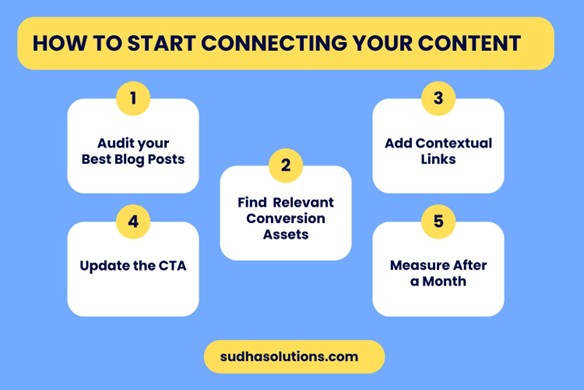
How to Start Connecting Your Content 

How to Start Connecting Your Content

You don’t need to rebuild your entire content strategy. Start with one fix that has an immediate impact. 

Step 1: Audit your highest-traffic blog post. Where does a reader go when they finish it? If the answer is “back to Google,” you have a leaking funnel. That post is earning attention you’re not capturing. 

Step 2: Find the most relevant conversion asset you already have. A case study, a comparison page, a service page. Something that takes a reader a step closer to working with you. 

Step 3: Add one contextual internal link. Not a banner. Not a sidebar widget. A sentence in the body of the post that says, in plain language, “here’s the next relevant thing for someone who found this useful.” 

Step 4: Update the CTA. Match it to where the reader actually is. If the post is educational, the CTA should offer something educational, like a related guide, a free template, or a relevant case study. Save the direct pitch for the pages where the reader has already self-selected. 

Step 5: Measure over 30 days. Look at assisted conversions, not just traffic. Did more people reach your service pages from that post? Did any of them convert? 

That’s one post, one link, one updated CTA. It’s not a strategy overhaul. It’s a proof of concept. Once you see it work, you do it again. 

Final Thougths 

Ranking and converting aren’t competing priorities. They’re two parts of the same job. 

Content that ranks without converting is a cost centre dressed up as a marketing win. Content that converts without ranking is a well-kept secret. Neither one alone builds a business. 

The brands that get this right aren’t publishing more. They’re publishing with intention. Every piece of content knows its job, knows where it sits in the reader’s journey, and knows where to hand off to the next piece. 

If your content strategy is built around one or the other right now, you’re not failing. You just have half the system. The other half is closer than you think. 

At Sudha Solutions, our seo expert services and content marketing experts work together to build systems that drive both visibility and conversions. 

From seo services in mumbai to strategic content marketing services, we help businesses create content that ranks, converts, and compounds long-term growth. 

Frequently Asked Questions

How do you turn blog traffic into actual leads?

Turning blog traffic into leads requires strategic internal linking, relevant CTAs, and guiding users to high-intent pages like case studies or service pages instead of generic contact forms.

What is the biggest mistake in content marketing strategies?

The biggest mistake is treating SEO content and sales content as separate efforts, instead of building a connected journey that moves users from awareness to decision.

How important are CTAs in blog content?

CTAs are critical. A well-placed, context-driven CTA can significantly improve conversions, while generic CTAs often fail to engage readers or move them forward.

Can informational content directly generate sales?

Not usually. Informational content builds trust and attracts traffic, but it needs to be connected to conversion-focused content to influence purchasing decisions.

How often should you update your existing blog content?

High-performing blogs should be reviewed every 3–6 months to improve internal links, update CTAs, and align with current search intent and business goals.

Categories
AEO Optimization General SEO

How to Build a Content Marketing Engine with a Small Team

Small marketing teams in 2026 face a brutal paradox: the expectation to post daily on social media, publish long-form articles, grow a newsletter, optimise for both Google and AI search engines, and still find time to track what’s actually working, all with two or three people wearing five hats each.

The brutal truth? Most small teams don’t fail because they lack creativity or budget. They fail because they lack a system. Building a structured content marketing engine; one that turns small, consistent effort into compounding visibility; is now an absolute must-have for B2B brands. In 2026, it’s the single biggest lever a lean team can pull.

And this guide is your blueprint to achieve that.

Key Takeaways

  • Content marketing generates 3x more leads than outbound at 62% lower cost.
  • A documented strategy alone produces 3x more leads per dollar than undocumented content activity.
  • 94% of marketers use AI in content creation; small teams save 1+ hour per task on average.
  • The #1 2026 content question isn’t “what to publish”, it’s what to create, expand, consolidate, or retire.
  • Repurposing one piece of content into multiple formats is how lean teams compete with 10x larger competitors.
  • Teams that track revenue attribution (not just traffic) receive 3.1x higher budget increases from leadership.
  • Short-form video delivers the highest ROI of any content format; blogs remain top-5 for ROI and planned investment.

Why Content Marketing Is Your Highest-Leverage Bet in 2026

Before building the engine, you need to believe in the engine. The numbers make a compelling case.

  • 3x More leads than outbound marketing, at 62% lower cost – Demand Metric, 2026
  • The average return for every $1 spent on content marketing is $7.65 SQ Magazine, 2025
  • The average SEO ROI, compounding over 3 years – Averi / FirstPageSage, 2026
  • 23% Small businesses are more likely to see ROI from blog posts than average – HubSpot State of Marketing, 2026

Unlike paid ads, which stop generating leads the moment you stop spending, content is a compounding asset. A well-optimised blog post published today will still drive organic traffic in 2028. That’s a fundamentally different economics model, and it disproportionately favours teams who commit early and stay consistent.

“CMOs are judged more on what the actual business outcomes are not on how much is produced.”

– Robert Rose, Chief Strategy Advisor, Content Marketing Institute

As a small team, you don’t need to out-publish the enterprise. You simply need to out-strategise them.

Build Your Lean Content Strategy First (Before You Create Anything)

Did you know? Teams with a documented content strategy generate 3x more leads per dollar spent than those without one. Yet, sadly, only 47% of B2B marketers and 37% of B2C marketers have written theirs down.

Your documented strategy should be a living 1-2-page reference that defines:

  • Define a Narrow, High-Value B2B Audience

Instead of “marketing managers.” Try: “Priya, 34, Head of Marketing at a 40-person B2B SaaS company, under pressure to prove pipeline contribution, reads LinkedIn at 7am and prefers quick tactical frameworks over theory.”

  • Set Revenue-Tied SMART Goals

Not “increase traffic.” Instead: “Generate 120 qualified inbound leads per month by Q3 via organic search and email, measured through pipeline attribution in the CRM.”

  • Focus on the “Big 5” Buyer Questions

Cost/pricing, comparisons vs. competitors, problems your product solves, reviews from real users, and “best of” lists in your category. These 5 topics drive the highest purchase intent traffic, according to IMPACT’s Endless Customers research.

  • Audit and Optimise Existing Content Quarterly

The central content question in 2026 is no longer “what should we publish next?”, it’s knowing what to create, expand, consolidate, or retire based on performance data. Years of blogging often produce mixed-quality archives. Pruning underperformers boosts your entire domain’s authority.

Do you know about the virality trap?

If your primary goal is “go viral,” stop. Viral moments rarely translate into long-term B2B sales. They spike interest but don’t push through the pipeline. The solution? Always anchor every piece of content to an outcome you can compound over 12-36 months.

The Small Content Team Structure That Actually Works

The average content marketing team in 54% of B2B companies is just 2-5 people. And 42% of B2C marketers say one person handles all content types. If that’s you, you’re not behind. You just need to structure roles cleanly.

Core Role #1: Content Manager / Strategist

  • Publish 3+ pieces/week, focused on buyer questions
  • Interview internal subject matter experts
  • Manage email marketing + workflows
  • Own analytics, attribution, and reporting
  • Oversee AEO + GEO optimization

Core Role #2: Video & Visual Generalist

  • Produce short-form video for Reels, LinkedIn, YouTube Shorts
  • Create visual assets (carousels, infographics)
  • Repurpose long-form content into video scripts
  • Manage Canva brand kit and visual templates

You don’t need to hire both on day one. Start with one generalist, build the system, then bring in a video specialist once content velocity demands it.

For the rest? Build a contributor ecosystem: freelance writers who understand your niche, a designer on retainer for 5 hours/month, and crucially internal voices. Your customer success rep has real user stories. Your product manager knows what’s shipping next quarter. Micro-collaboration keeps content rooted in business reality, not marketing imagination.

Well said by Jay Acunzo, Content Marketing Strategist & Author, “Actually talk to your customers. Use the language that they use. Talk about the things they talk about. Never feed salad to a lion.”

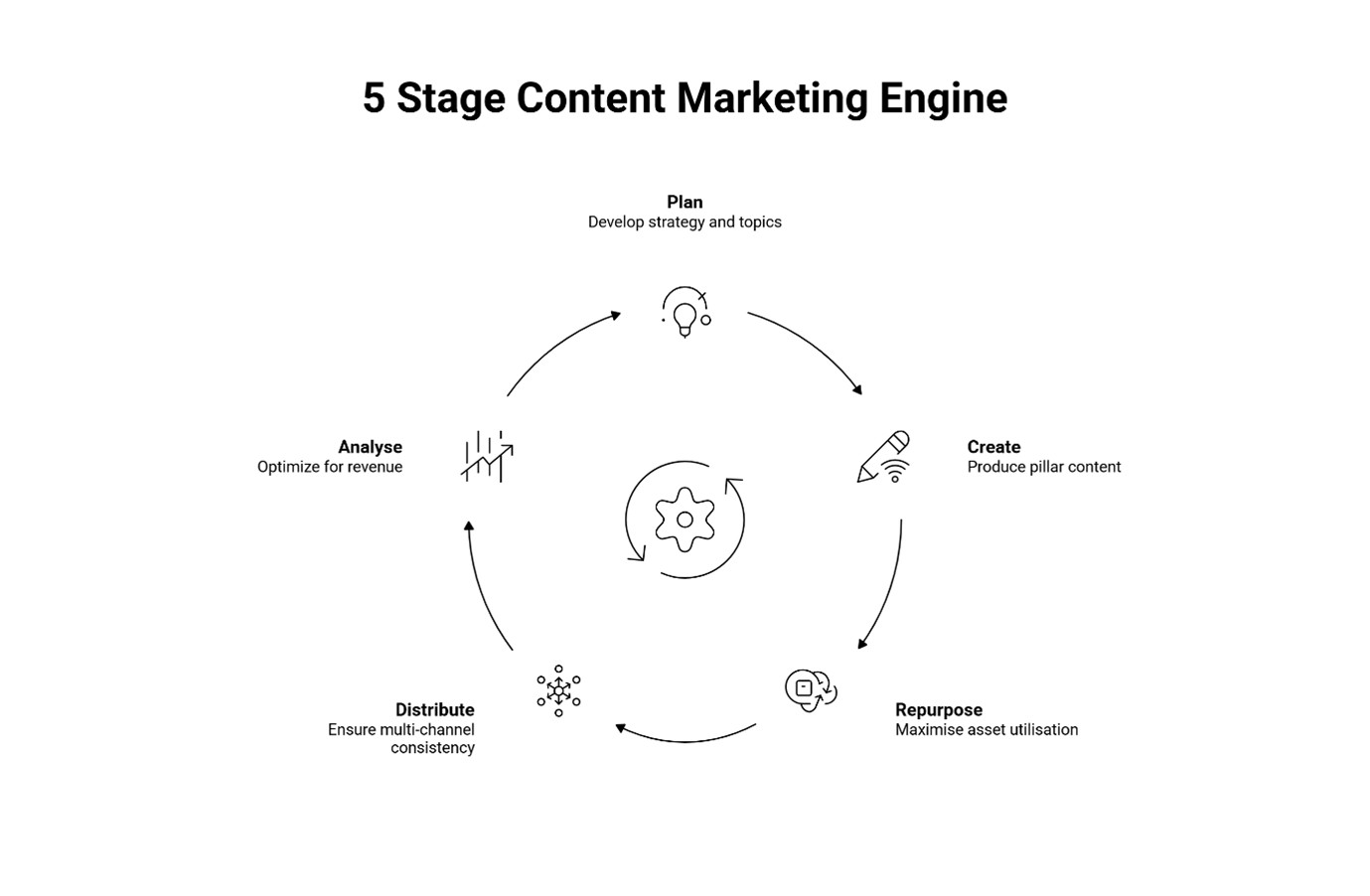
The 5-Stage Content Marketing Engine for Lean B2B Teams

Most small teams don’t fail because they lack creativity but because they operate reactively. The brands winning in 2026 treat content as a repeatable production system, not a series of one-off projects.

5 stage content marketing engine

The Repurposing Multiplier

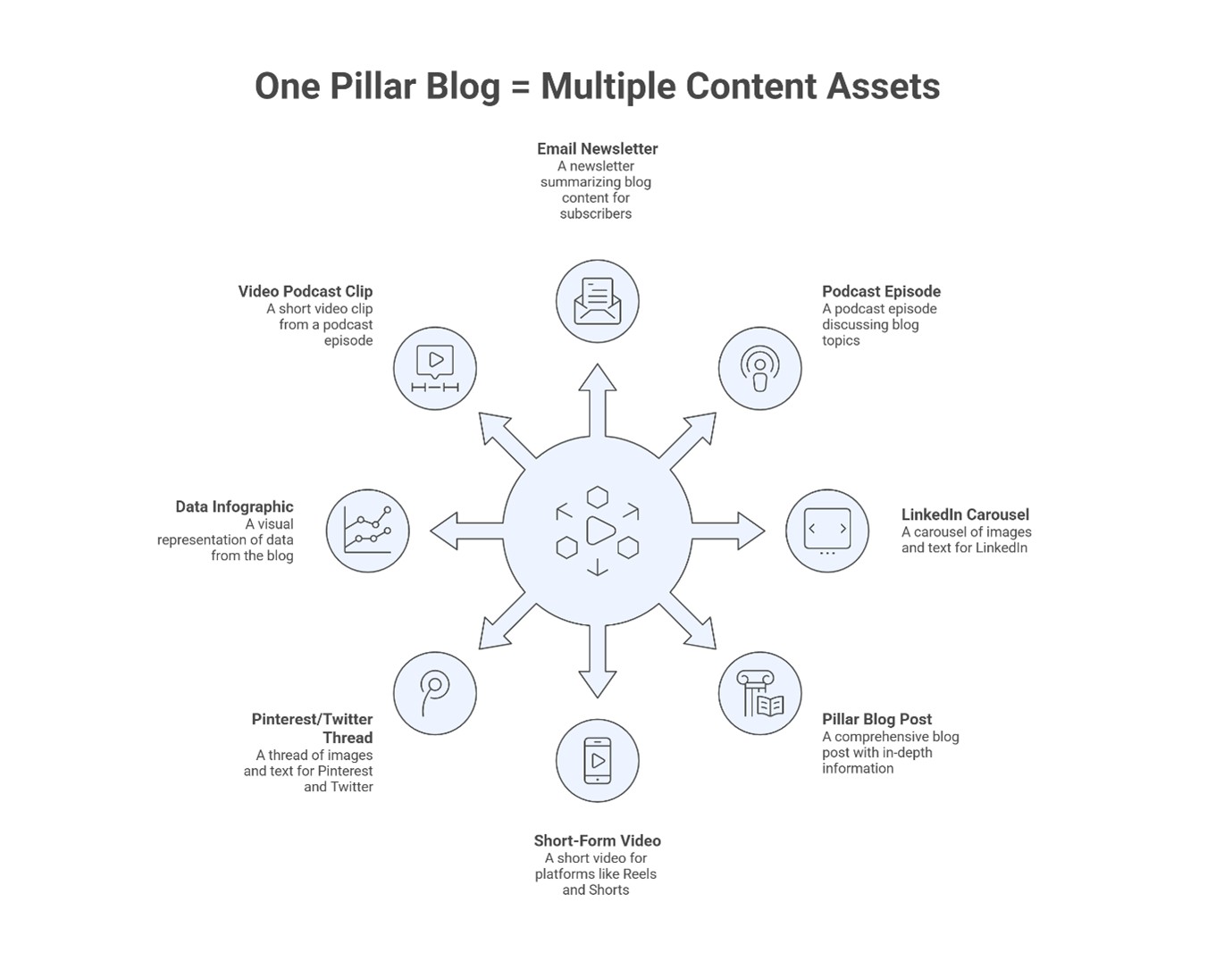
This is the highest-leverage habit for a lean content team. One strong pillar piece: say, a 2,000-word guide, can power an entire week of content across every channel your audience touches.

one pillar blog

A consistent, lower-volume publishing schedule beats irregular publishing bursts every time. Long gaps erode audience loyalty and algorithmic momentum. Aim for steady over spectacular.

How Small Teams Should Use AI in Content Marketing

  • 80% of marketers plan to use AI in content creation in 2026 – HubSpot State of Marketing, 2026
  • 68% of businesses report higher content ROI since incorporating AI – DemandSage, 2026
  • 86% of marketers say AI saves more than 1 hour on creative tasks – HubSpot, 2026

Think of AI as scaffolding: it supports the build, but the design is still yours.

Use it to remove the grunt work including:

  • first drafts
  • outline structures
  • SEO briefs
  • email subject line variants
  • social post reformats

and invest your human hours in the irreplaceable parts such as

  • original insight
  • case studies
  • brand voice
  • strategic judgment
  • and real-world examples

…no AI can source.

Fun fact: 67% of content marketers use AI tools daily, but only 19% track AI-specific KPIs. The teams closing this measurement gap see 2.4x better content ROI. Don’t just adopt AI; audit what it’s actually doing for your outputs.

If you want to learn how to track your brand mentions across AI and the internet, we’ve just the perfect guide for you.

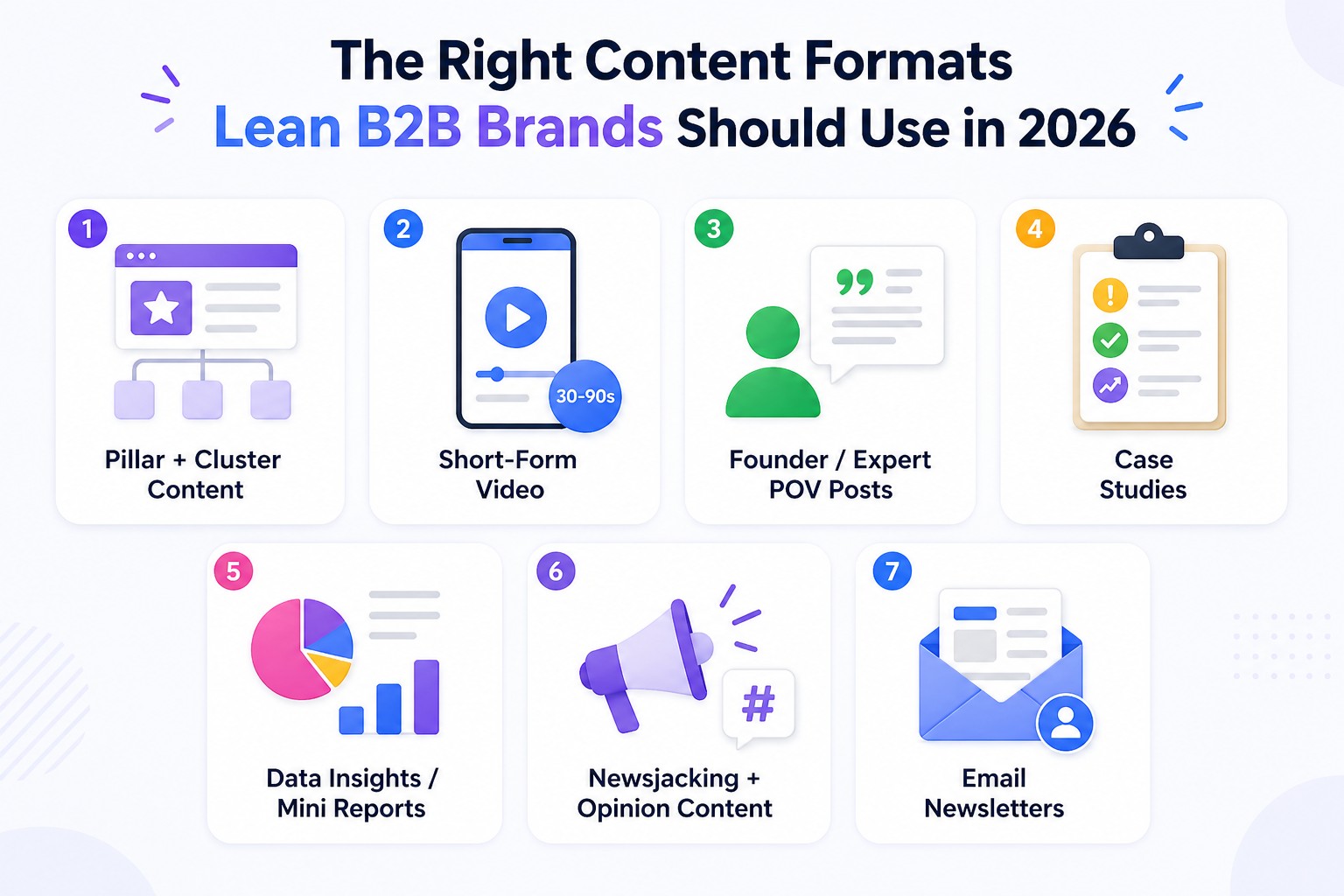
The Right Content Formats Lean B2B Brands Should Use in 2026

A lean B2B content strategy in 2026 focuses on high-impact, reusable formats rather than volume.

Right Content Formats Lean B2B Brands Should Use in 2026

  1. Pillar + Cluster Content:
    Build one in-depth “pillar” page supported by 8-10 related articles. This structure improves discoverability in AI-driven search and establishes authority. Update regularly instead of constantly creating new pieces.
  2. Short-Form Video:
    30-90 second videos are the primary distribution channel. Record one long video and repurpose it into multiple clips for platforms like LinkedIn and YouTube Shorts. Prioritise clear, insight-driven messaging.
  3. Founder/Expert POV Posts:
    Text-based posts from individuals outperform brand content. Share opinions, lessons, and real data to build trust and visibility.
  4. Case Studies:
    Essential for conversions. Use a simple format: problem → solution → measurable results. Repurpose each case study into multiple formats like carousels and videos.
  5. Data Insights / Mini Reports:
    Short, insight-rich reports (not long PDFs) attract attention and backlinks. Even small datasets work if the conclusions are sharp.
  6. Newsjacking + Opinion content:
    React quickly to industry trends on LinkedIn or X (formerly Twitter) with original, opinionated perspectives. Speed and relevance drive engagement.
  7. Email Newsletters:
    A core owned channel for distribution and retention. Share curated insights, original thinking, and key content weekly. Newsletters build direct audience access, reduce reliance on algorithms, and reinforce authority.

The Key Shift to Understand In 2026:

  • Distribution > creation
  • Personality > brand
  • Proof > promises
  • Speed + consistency > perfection

The Content Marketing Tool Stack for Small Teams in 2026

Category Recommended Tool(s) Why It Earns Its Place
Analytics Google Analytics 4 Foundational traffic and conversion data
Visuals Canva Pro (~$15/mo) Brand kit, AI features, templates (designer not needed)
AI Writing Claude / ChatGPT / Jasper Drafts, repurposing, briefs, email variants
SEO Research Semrush or Ahrefs One competitive tool + Search Console is sufficient for most small teams
Editorial Planning Notion or Trello Content calendar, briefs, and workflow templates
Social Scheduling Buffer or Later Automate publishing; reclaim time for creation
Email Marketing Beehiiv or Mailchimp Build and own your subscriber list
Behaviour Analytics Hotjar Scroll maps reveal where content loses readers

Measure ROI the Right Way

87% of content teams track traffic. Only 31% track revenue attribution.

That gap is why so many content marketers struggle to justify budget increases and why the teams that close it receive higher budget increases from leadership.

The formula is simple:

(Revenue Generated – Total Investment) ÷ Total Investment x 100 = Content ROI.

The challenge is accurately defining “total investment”. Include everything from team hours, tool costs, and freelancer fees, not just distribution spend. Many teams undercount this and overstate ROI, which erodes executive trust when results don’t match projections.

Review results monthly, adjust your content calendar quarterly, and never optimise based on single-datapoint anomalies. Content ROI often peaks after 24-36 months, so stay onboard.

Conclusion: Build the Engine, Then Let It Run

A content marketing engine has to be assembled piece by piece. And this guide will help you do it right. Because, only when done right, it becomes your brand’s most durable competitive asset.

In 2026, the divide isn’t between big-budget brands and scrappy startups. It’s between brands that treat content as an asset and those that treat it as a task. The former compounds. The latter exhausts.

  • Start with one documented strategy.
  • Build one repeatable workflow.
  • Choose one primary format.
  • Then systematically expand.

The engine starts small. The returns compound.

The system is clear. Execution is the hard part.
If you want a team that’s already done the heavy lifting, we’re ready when you are.

Frequently Asked Questions

How do I start content marketing with a team of 1–2 people?

Start content marketing with a 1–2 person team by focusing on one platform, one audience, and a simple weekly publishing system built around high-value, reusable content.

How much should a small business spend on content marketing in 2026?

A small business in 2026 typically spends about 5–10% of its marketing budget on content, scaling based on revenue, goals, and how central content is to growth.

How do you measure content marketing ROI for a small team?

Measure content marketing ROI by tracking a few core metrics such as traffic, leads, conversions, and revenue, and linking them to specific pieces of content using analytics tools.

Is content marketing still effective in 2026 with AI-generated content everywhere?

Yes, content marketing is still effective in 2026, but only when it emphasizes originality, expertise, and human insight rather than generic AI-generated output.

What’s the difference between SEO and GEO, and do small teams need both in 2026?

SEO focuses on ranking in traditional search engines, while GEO (Generative Engine Optimization) focuses on visibility in AI-generated answers, and small teams should prioritize SEO first while gradually adapting content for GEO.

How do you repurpose content without it feeling repetitive to your audience?

Repurpose content effectively by changing format, angle, or audience context such as turning a blog into short videos, infographics, or email insights, so it feels fresh rather than repetitive.