
Sudha Solutions

Categories
AI Overview LLMS

LLM SEO for B2B Brands: What It Is and Why It Can’t Wait

B2B buying has always been complex. Multiple stakeholders, long cycles, extensive research — that part hasn’t changed. What has changed, faster than most marketing teams have caught up to, is where that research begins. 

Two years ago, 68% of buyers told TrustRadius that generative AI had no impact on their purchase process. Today, according to 6sense’s 2025 global study of nearly 4,000 B2B buyers, 94% use large language models at some point during a software purchase journey. That’s not a gradual shift. That’s a market transformation happening faster than most organisations are equipped to respond to. 

LLM SEO — sometimes called GEO, AEO, or LLMO depending on who’s writing about it — is the discipline that addresses this directly. It’s the practice of structuring content, building authority, and establishing brand presence in ways that make AI systems like ChatGPT, Perplexity, Claude, and Gemini cite and recommend a brand when B2B buyers ask questions about their category. 

This article explains what that means specifically for B2B companies, why the B2B buying journey makes this more urgent than it is for consumer brands, and what an effective strategy actually involves.

Why B2B Is the Highest-Stakes Context for LLM Visibility 
Why B2B Is the Highest-Stakes Context for LLM Visibility

LLM SEO matters for any business trying to get found online. But for B2B companies, the stakes are particularly high — because of what the data shows about how B2B buying decisions actually form. 

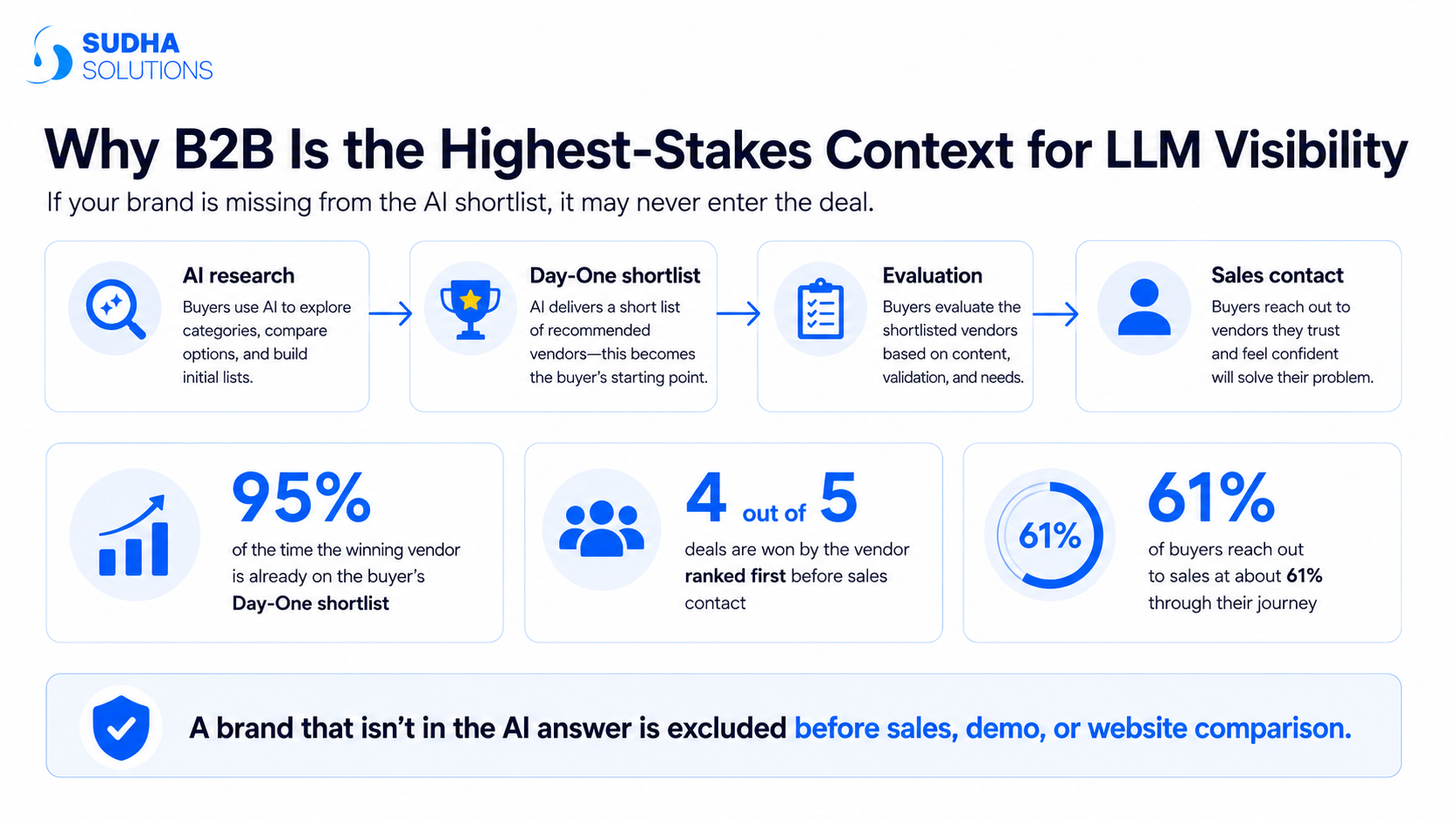
According to 6sense’s 2025 Buyer Experience Report, 95% of the time the winning vendor is already on the buyer’s Day One shortlist. Four out of five deals are won by the vendor the buyer ranked first before they ever contacted sales. And buyers don’t reach out until they are approximately 61% through their journey — arriving with AI-driven research, pre-ranked shortlists, and a decision process that is largely formed before a sales conversation begins. 

That shortlist formation — the moment when a buyer decides which vendors are worth evaluating — is happening increasingly inside AI tools. The discovery and shortlisting phase has migrated almost entirely inside the LLM interface, as Forrester’s 2025 B2B Buying Study described it. Buyers ask ChatGPT which vendors solve their problem, get a curated list of three to five options, and use that list as the foundation for everything that follows. 

A brand that isn’t in that AI answer isn’t just losing a ranking. It’s being excluded from the decision entirely — before a sales team, a website, or a product demo ever enters the picture. 

This is the core reason LLM SEO is not optional for B2B companies in 2026. Businesses investing in SEO expert services for B2B AI visibility are increasingly adapting their search strategies for AI-driven buyer journeys. 

The Buying Group Dimension 
Buying Group Dimension 

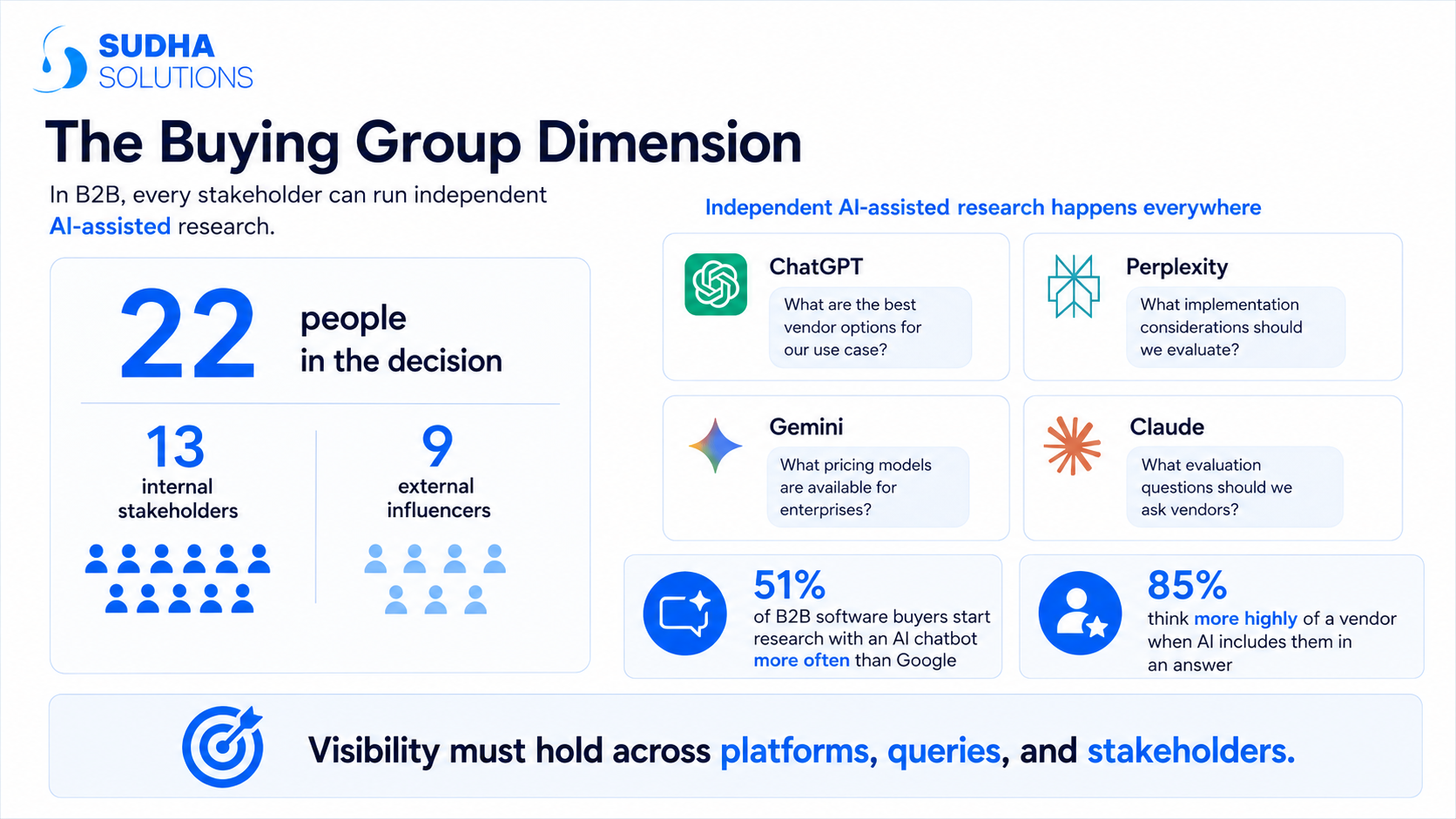
B2B deals in 2026 involve an average of 22 people in the decision — 13 internal stakeholders and 9 external influencers, according to Forrester’s State of Business Buying 2026. Each of those people is potentially conducting independent AI-assisted research. 

This creates a compounding effect. One stakeholder might ask ChatGPT about vendor options in the category. Another might ask Perplexity about implementation considerations. A third might ask Gemini about pricing models. If a brand doesn’t appear consistently across those queries and across those platforms, its presence in the buying group’s collective understanding degrades with each additional stakeholder who searches independently. 

51% of B2B software buyers now start their research with an AI chatbot more often than with Google, according to G2’s April 2026 data. And 85% of buyers say they think more highly of a software vendor when AI includes them in an answer. The inverse is also true — being absent when peers appear sends a quiet negative signal about credibility and category standing, even if no one in the buying group verbalises it. 

What Makes LLM SEO Different for B2B
What Makes LLM SEO Different for B2B

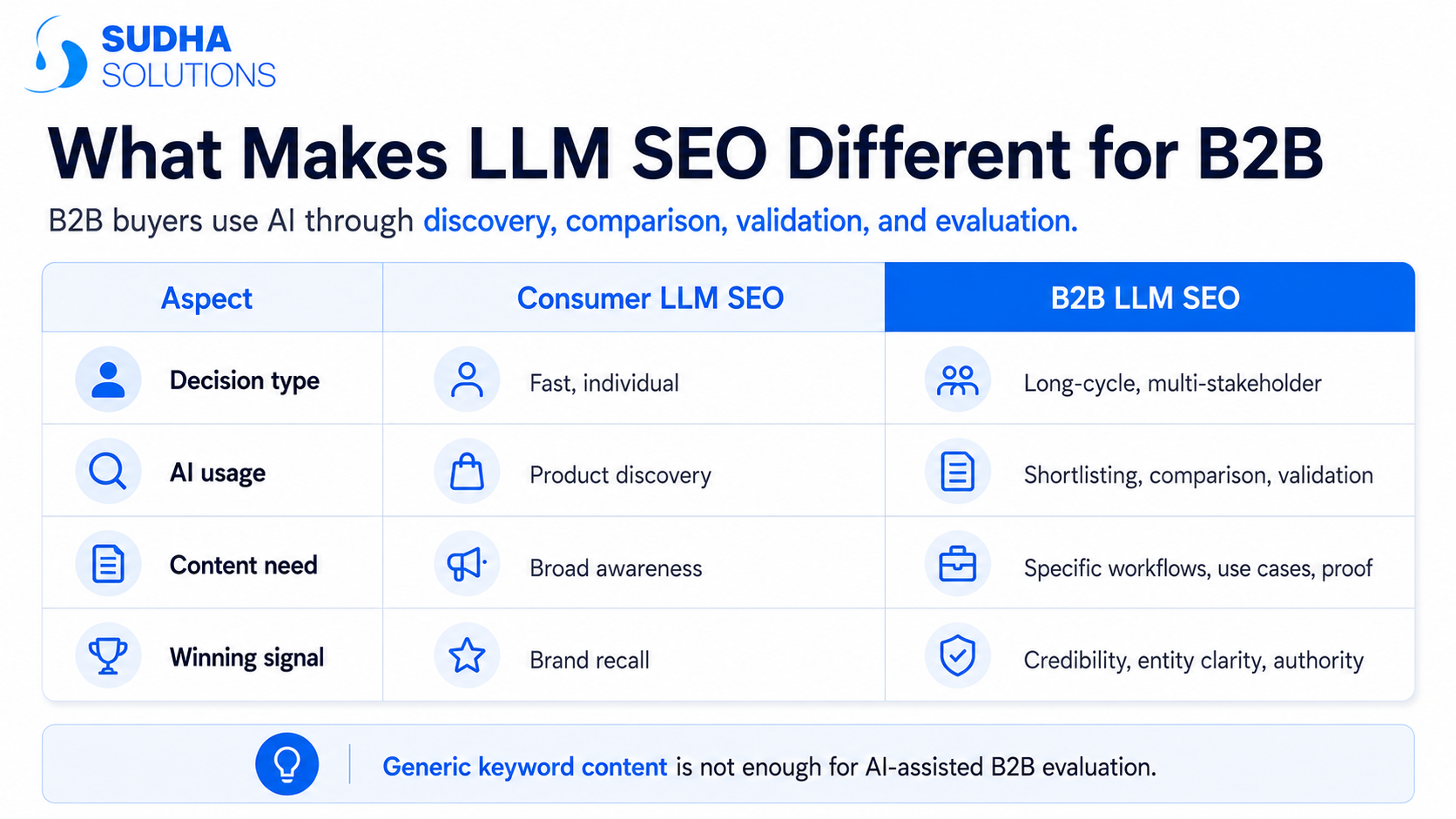
Consumer-facing LLM SEO is largely about brand awareness at scale — getting a product mentioned when individuals are making low-complexity decisions quickly. B2B LLM SEO operates differently because the buyer behaviour is different. 

B2B buyers use AI tools not just for discovery but throughout the evaluation process. 6sense’s 2025 Buyer Experience Report found AI features present in 89% of B2B purchases — at shortlisting, at comparative evaluation, at review validation, and at the drafting of evaluation questions. This means a B2B brand needs to be visible and credible at multiple points in the AI-assisted journey, not just the first query. 

The content requirements follow from this. B2B buyers using AI tend to ask more complex, scenario-based questions than consumer buyers: “What are the best platforms for [specific workflow] for a company of our size and industry?” “What do analysts say about [vendor category]?” “What are the known limitations of [competitor]?” The brands that appear in these answers have content — and third-party coverage — that addresses these specific questions with specificity and depth. 

Generic content built for keyword rankings doesn’t serve this well. Buyers arriving via AI recommendations have already completed the initial discovery phase and are in active evaluation mode. The content they find on a brand’s site needs to match that intent — detailed, evidence-based, credible. 

The Four Pillars of a B2B LLM SEO Strategy 

1. Topical Authority Through Depth, Not Volume 

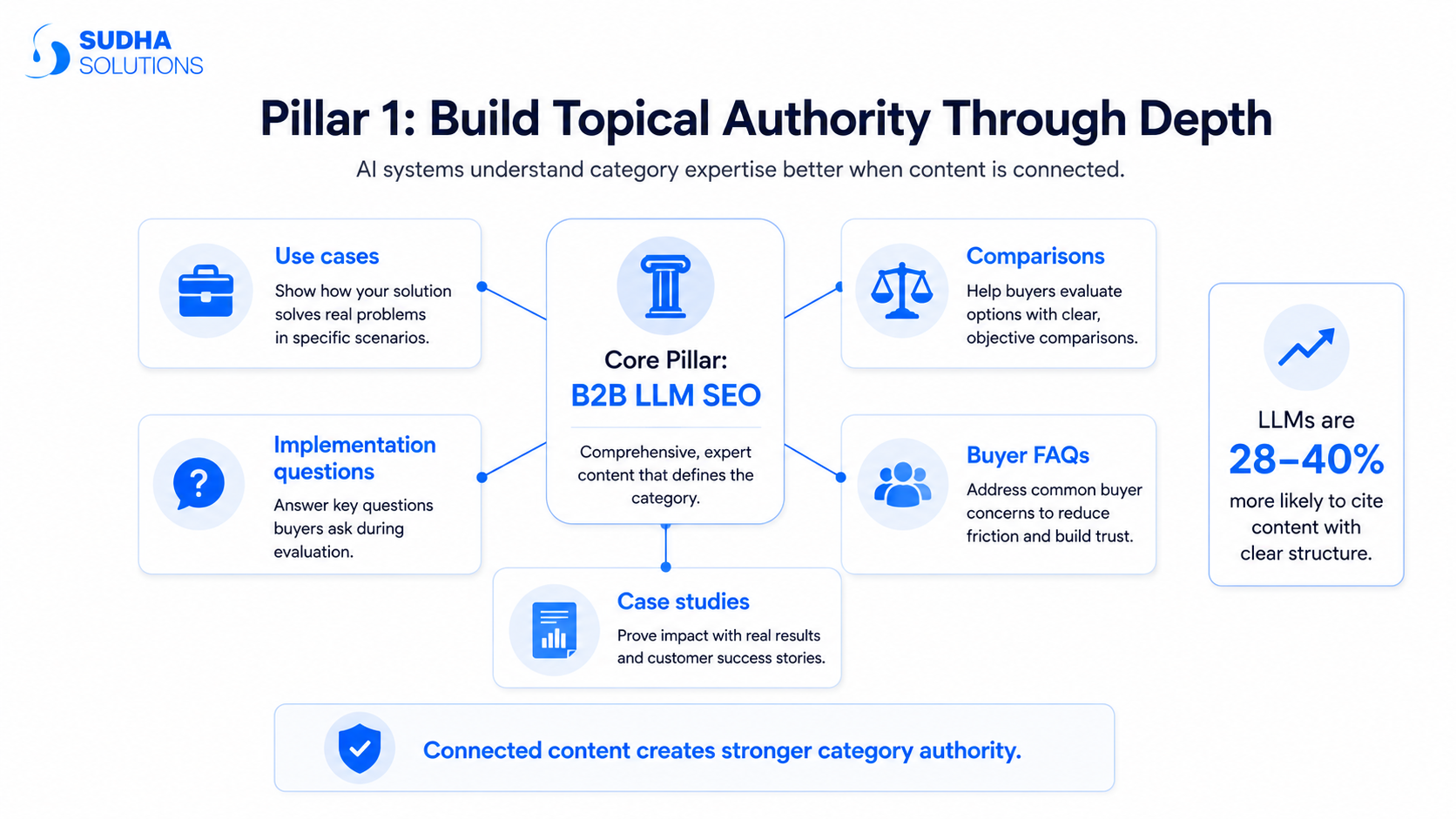
AI systems evaluate B2B brands partly by how consistently and comprehensively their content covers a subject. A single well-ranked article doesn’t establish category authority in the way that a body of interconnected content does. 
Topical Authority Through Depth, Not Volume

This is why the pillar-cluster content model introduced in What is GEO? A Beginner’s Guide is so directly relevant to B2B LLM SEO. A brand that has a central pillar on its core service area, surrounded by cluster articles covering specific sub-topics, case studies, use cases, and implementation questions, looks fundamentally different to an AI system than a brand with sparse, isolated content — even if the individual articles are technically of similar quality. 

LLMs are 28 to 40% more likely to cite content with clear structural signals: proper heading hierarchy, defined sections, and answer-first formatting, according to research compiled by McKinsey in their September 2025 CMO Survey data. The structure communicates what the content is about as much as the content itself does.

2. Earned Authority Signals Built for AI 

Traditional B2B SEO invested heavily in backlinks as the primary authority signal. LLM SEO requires a different kind of earned presence. 

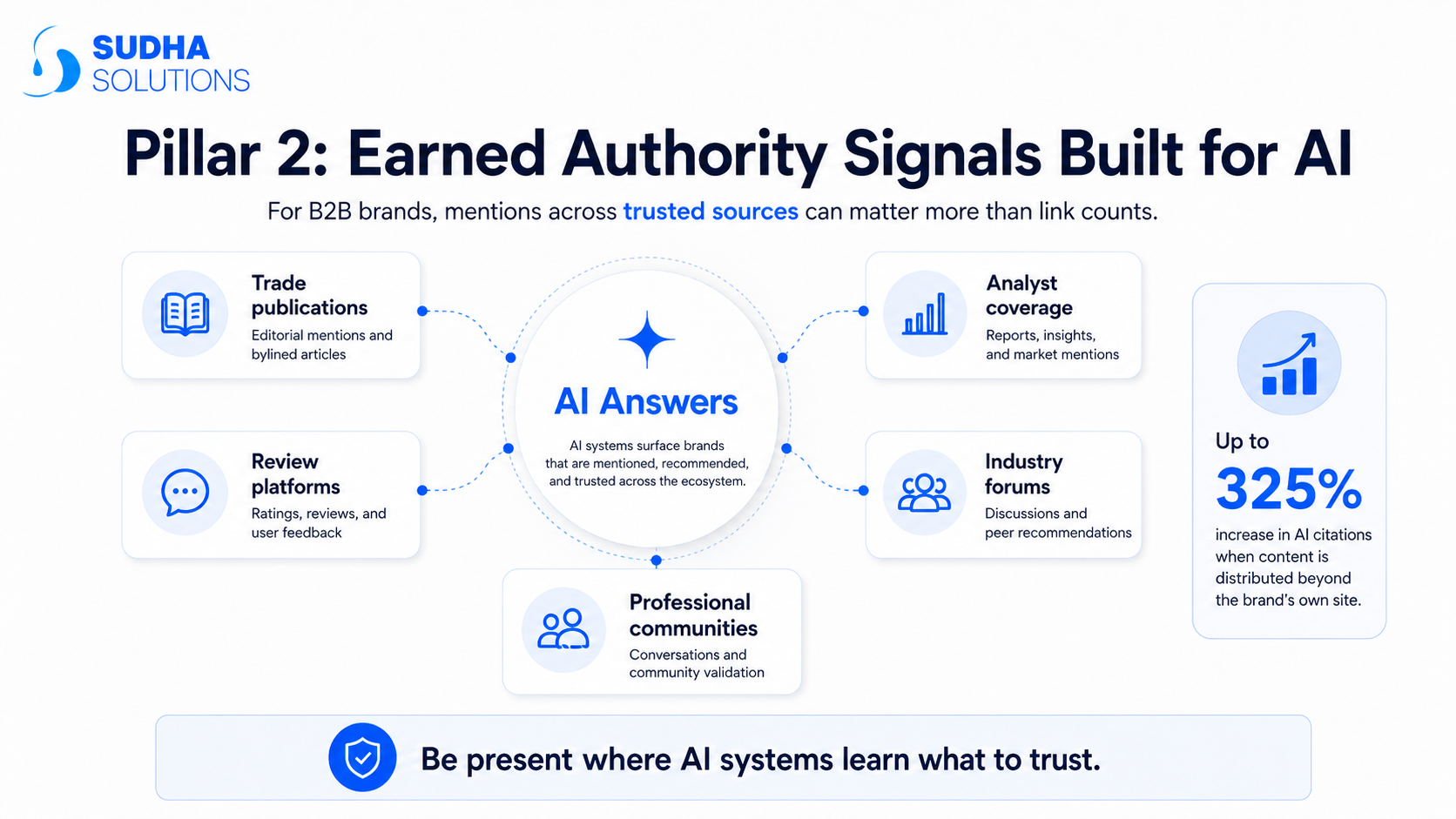
Brand mentions across the open web — in trade publications, analyst coverage, industry forums, and niche media — carry far more weight in AI citation decisions than link counts. Distributing content to a wide range of publications can increase AI citations by up to 325% compared to publishing only on a brand’s own site, according to Stacker’s December 2025 research. 
Earned Authority Signals Built for AI 

For B2B companies, the most effective earned media targets are the specific publications, communities, and analyst platforms that AI systems have learned to associate with their category. Industry trade publications in B2B software, services, and technology are cited disproportionately. Analyst firm coverage, third-party review platforms, and professional community discussions carry strong citation signals. These aren’t new channels for B2B marketing — but the strategic rationale for investing in them has changed. 

It used to be about reaching buyers directly. Now it’s equally about being present in the sources AI systems draw on when buyers ask for recommendations.

3. Entity Clarity Across the Web 

In B2B, where buyers are evaluating vendors they may never have heard of before, the way AI describes a brand shapes initial impressions more than any other early touchpoint. 

LLMs don’t just retrieve content — they build internal models of what brands are, what problems they solve, and how credible they appear. A brand with inconsistent positioning across its website, LinkedIn profile, Crunchbase entry, G2 listing, and third-party coverage creates an ambiguous entity model. AI systems, like cautious buyers, default to clearer alternatives when they encounter ambiguity. 
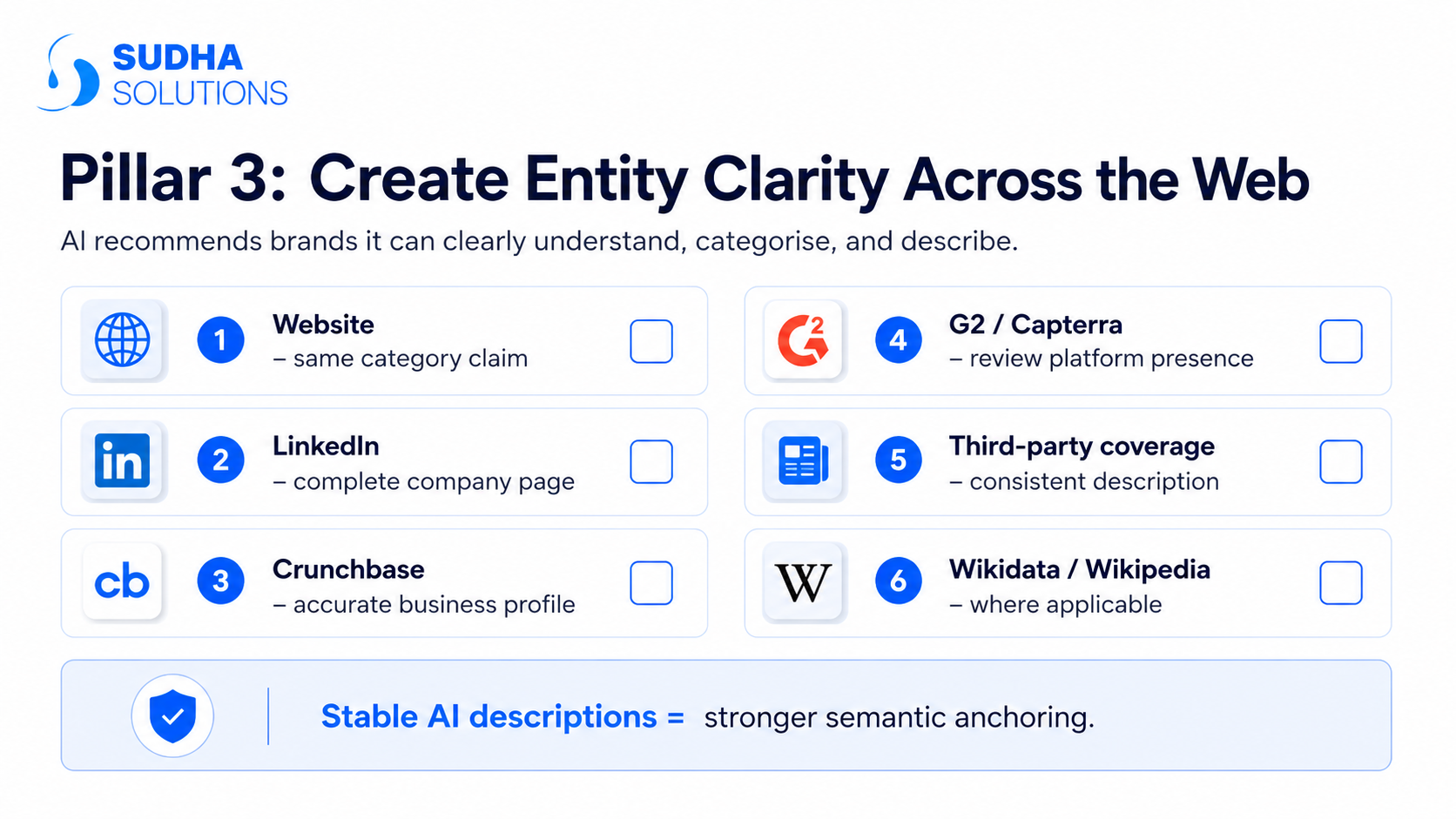
Entity Clarity Across the Web

Entity clarity for B2B means: a consistent, specific description of what the company does and who it serves — not a generic “we help businesses grow” positioning, but a precise category claim that AI can use to match the brand to relevant queries. That positioning needs to appear consistently across every platform where the brand has a presence. 

Search Engine Land’s December 2025 analysis of B2B brand visibility in LLMs found that AI brand signal stability — the consistency of a brand’s presence and positioning across LLM outputs over time — is becoming a core visibility metric alongside traditional share of voice and keyword rankings. Brands whose AI descriptions fluctuate sharply have fragile entity models. Brands with stable, consistent descriptions across platforms have strong semantic anchoring — the model reliably knows which category they belong to.

4. Technical Foundations That Don’t Block AI Access 

Modern LLM-powered search ranking systems increasingly rely on crawlability, structured data, and AI-friendly content rendering. The most consistent finding across LLM SEO research is that a significant proportion of B2B websites create their own barriers to AI visibility through technical configuration. 

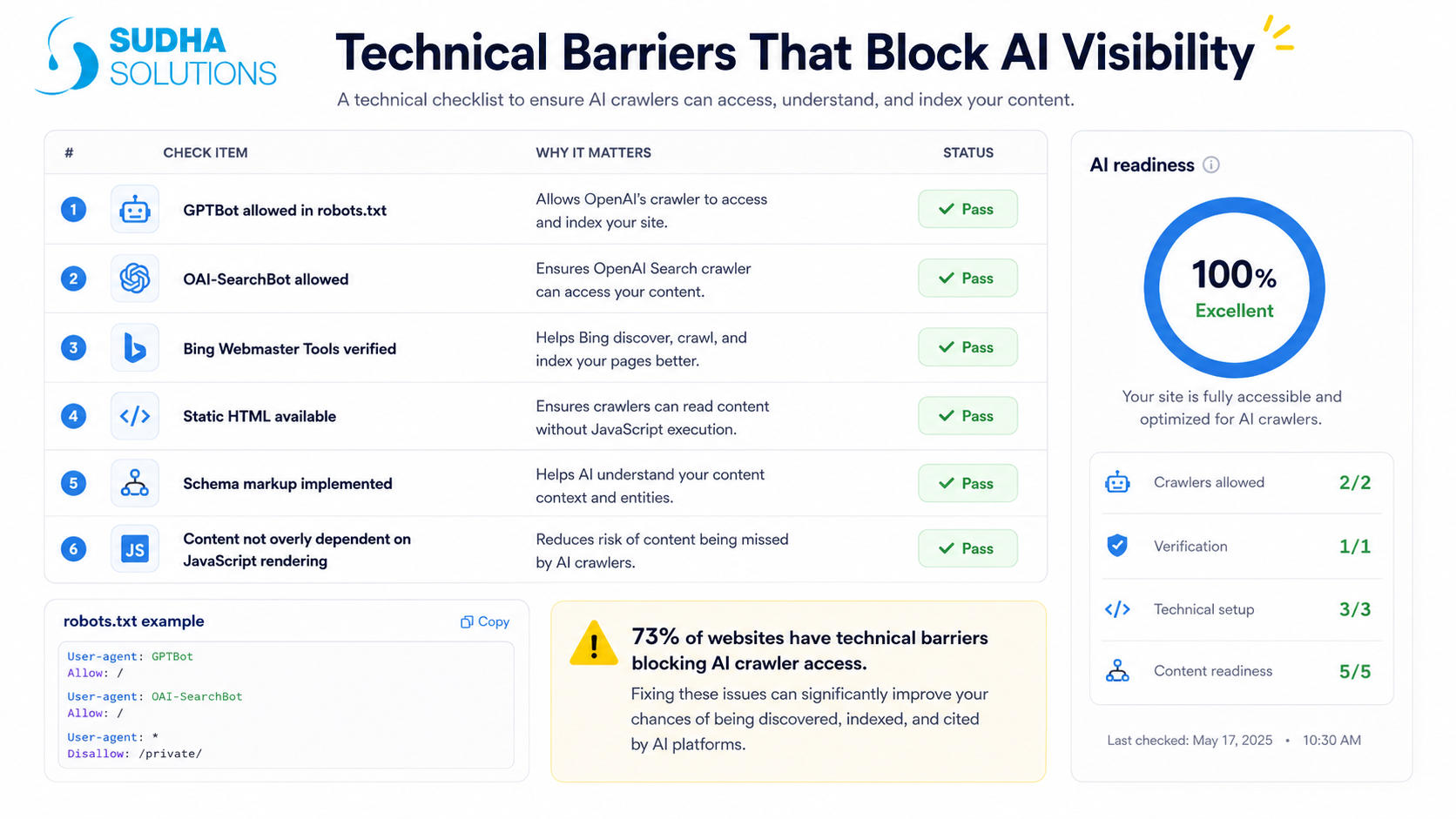
73% of websites have technical barriers that block AI crawler access, according to OtterlyAI’s 2026 research. For B2B companies with complex, JavaScript-heavy websites built to impress human visitors, this is a particularly common problem. AI parsing success for static HTML runs at 94%; for JavaScript-rendered content, it drops to 23%. 
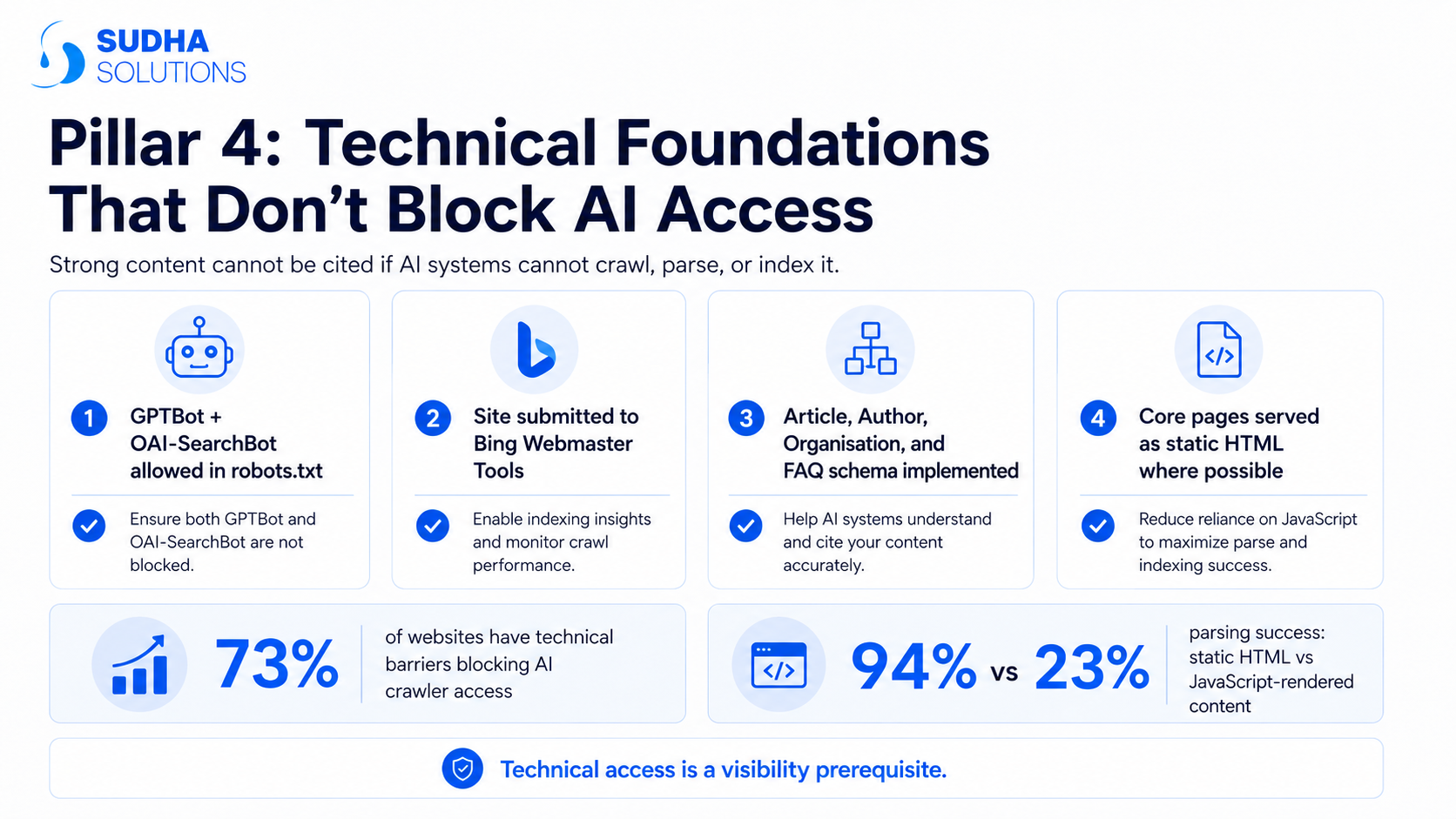
Technical Foundations That Don't Block AI Access 

The practical checklist is straightforward but requires deliberate attention. GPTBot and OAI-SearchBot allowed in robots.txt. Site submitted to Bing Webmaster Tools. Article, Author, Organisation, and FAQ schema implemented. Core pages served as static HTML wherever possible. These changes don’t require a website rebuild — but they do require someone to check them and fix them, which most B2B marketing teams haven’t prioritised yet.

The LLM Perception Drift Problem 

One aspect of LLM SEO that’s specific to how AI systems work deserves particular attention for B2B brands. 

AI models are retrained periodically. When a model retrains, its internal representations of brands can shift, sometimes significantly. Research from Evertune tracking the project management software space between September and October 2025 found meaningful changes in how AI described major enterprise brands within just one month. Tools like Atlassian surged in AI visibility while others posted notable drops, without any apparent corresponding change in those brands’ actual web presence. 

Search Engine Land’s December 2025 analysis described this as “LLM perception drift” — the dynamic and measurable shifts in AI brand perception as models evolve and retraining cycles accelerate. By 2026, AI brand signal stability is solidifying as a new visibility metric that sits alongside traditional share of voice and keyword rankings. 

For B2B brands, this means LLM SEO isn’t a set-and-forget exercise. It requires ongoing monitoring of how the brand appears across AI platforms — using the audit process described in How to Audit Your ChatGPT Visibility — so that perception drift is caught and addressed before it affects buyer consideration.  

Where to Start in Practice 

The first practical step is understanding where the brand currently stands across the four major AI platforms — ChatGPT, Perplexity, Gemini, and Claude — using the audit process outlined in the previous article in this series. 
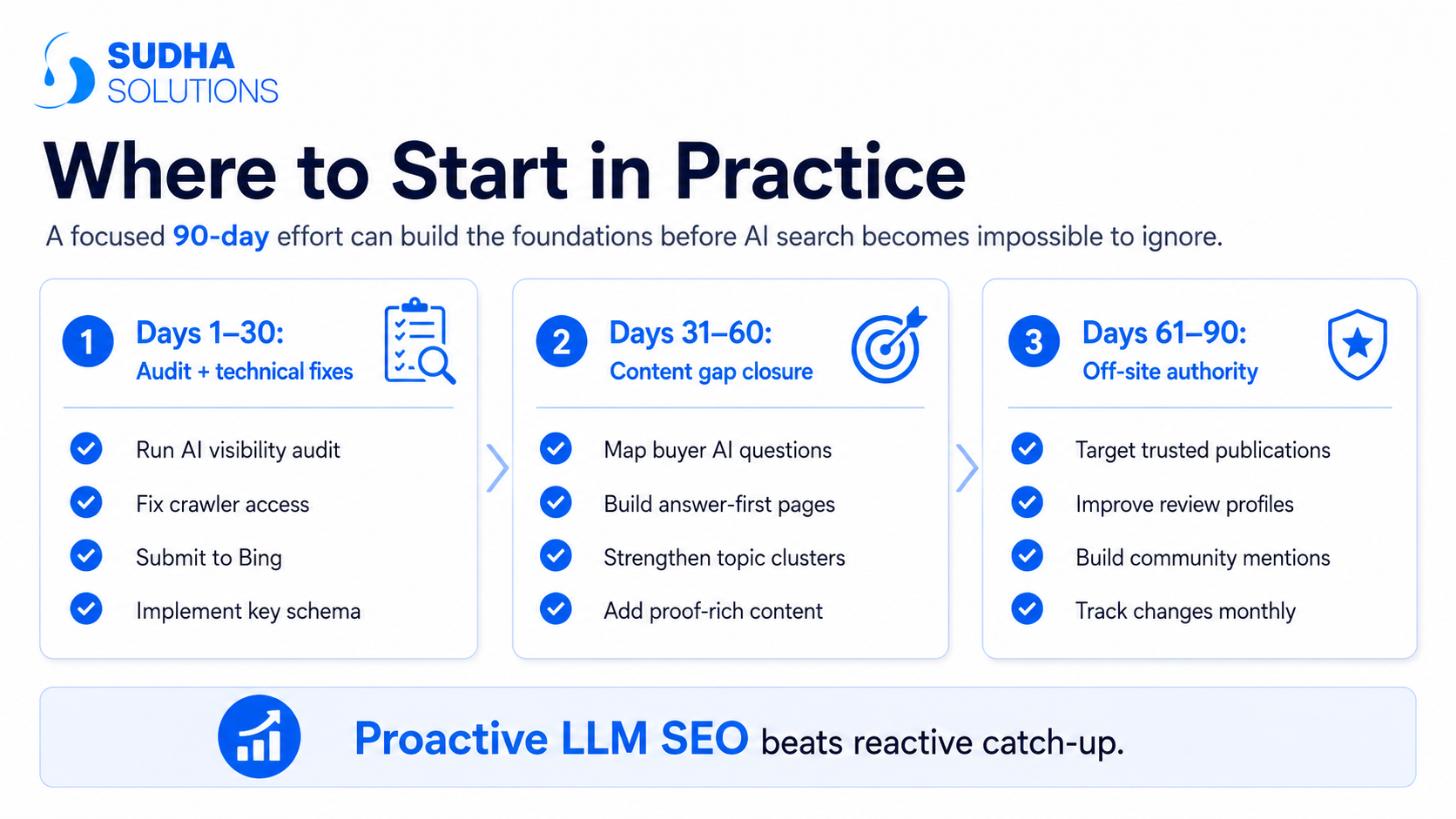
Where to Start in Practice 

The second is a content gap analysis: Companies implementing AI-powered answer engine optimization can better align content with AI-assisted buyer research behavior. Mapping the questions B2B buyers in the category are asking AI systems against the content the brand currently has. Where buyers are asking questions the brand’s content doesn’t answer, those are the highest-priority content investments. 

The third is an off-site presence audit: identifying the specific publications, review platforms, and community forums that AI systems draw on when answering category queries, and assessing where the brand is and isn’t represented. 

The businesses gaining the most ground started building LLM visibility 12 to 18 months ago. An experienced AI-powered SEO agency can help organizations improve AI citation visibility and long-term generative search performance. But a focused 90-day effort — starting with technical fixes, the highest-priority content gaps, and the most impactful off-site presence targets — still creates real competitive advantage. The worst move, as the data consistently shows, is waiting for AI search to become undeniable before acting. 

IDC projects companies will spend up to 5 times more on LLM optimization than traditional SEO by 2029. The investment is coming regardless. The question is whether it happens proactively or reactively. 

Sudha Solutions helps businesses build visibility in AI search through content strategy, GEO, and digital marketing. Based in India, working with brands globally. 

Frequently Asked Questions 

Why is LLM SEO important for B2B companies?

LLM SEO is important because B2B buyers increasingly use AI tools like ChatGPT and Perplexity during vendor research, shortlist creation, and purchase evaluation.

What is the difference between SEO and LLM SEO?

Traditional SEO focuses on Google rankings, while LLM SEO focuses on improving visibility inside AI-generated answers and conversational search experiences.

How can B2B brands improve ChatGPT visibility?

B2B brands can improve ChatGPT visibility through entity SEO, GEO optimization, structured content, earned media coverage, and AI-friendly technical SEO.

What are the best platforms for AI search optimization?

Businesses should optimize for ChatGPT, Gemini, Perplexity, Claude, and Google AI Overviews because each platform influences AI-assisted buyer journeys differently.

Does technical SEO affect AI search visibility?

Yes. Crawlability, schema markup, Bing indexing, and AI crawler accessibility significantly impact AI search discoverability and citation visibility.

Categories
AI Overview LLMS

Why Most B2B Brands Are Invisible in AI Search (And How to Fix It)

There’s a buyer researching your category right now. They’ve opened ChatGPT, typed in something like “what’s the best solution for [problem your business solves],” and they’re reading the answer. 

Your brand almost certainly isn’t in it. 

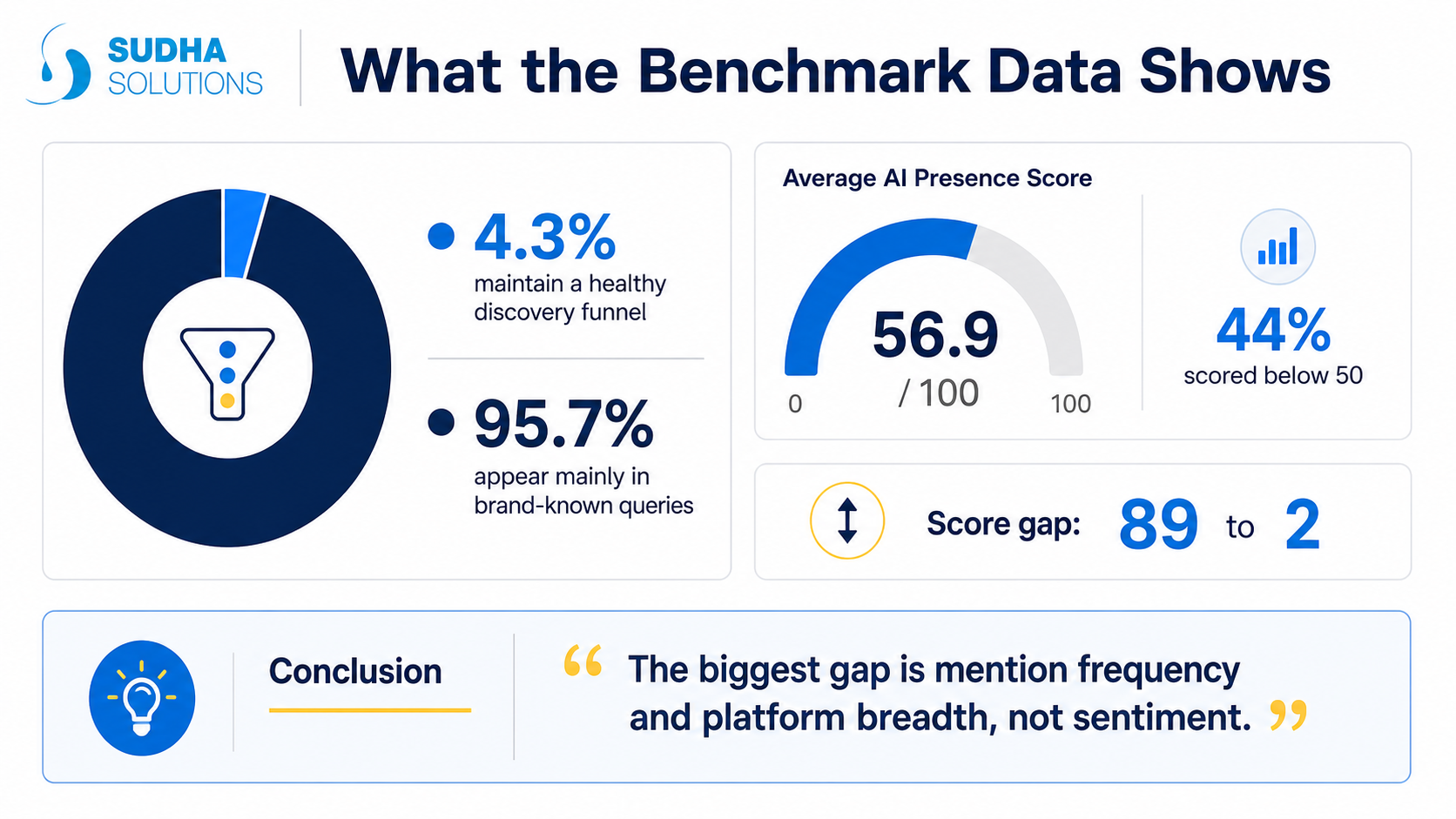
That’s not a guess. A 2026 study by 2X, a B2B go-to-market research organisation, analysed 70 B2B companies across generative AI platforms and found that only 4.3% of companies maintain a healthy discovery funnel – meaning their brands appear in early-stage buyer questions. The remaining 95.7% appear primarily in queries where buyers already know the company name. They’re invisible during the moment buyers are actually forming shortlists. (Demand Gen Report, April 2026) 

That number is worth sitting with. 95.7% of B2B companies; not small, underfunded, or poorly marketed ones. Companies with active marketing teams, established websites, and real budgets. Invisible, right when it matters most. 

This article looks at why that’s happening and what actually fixes it. 

The Scale of What’s Changed 

The Scale of What's Changed

Before getting into the why, it helps to understand just how fast this shift has happened. 

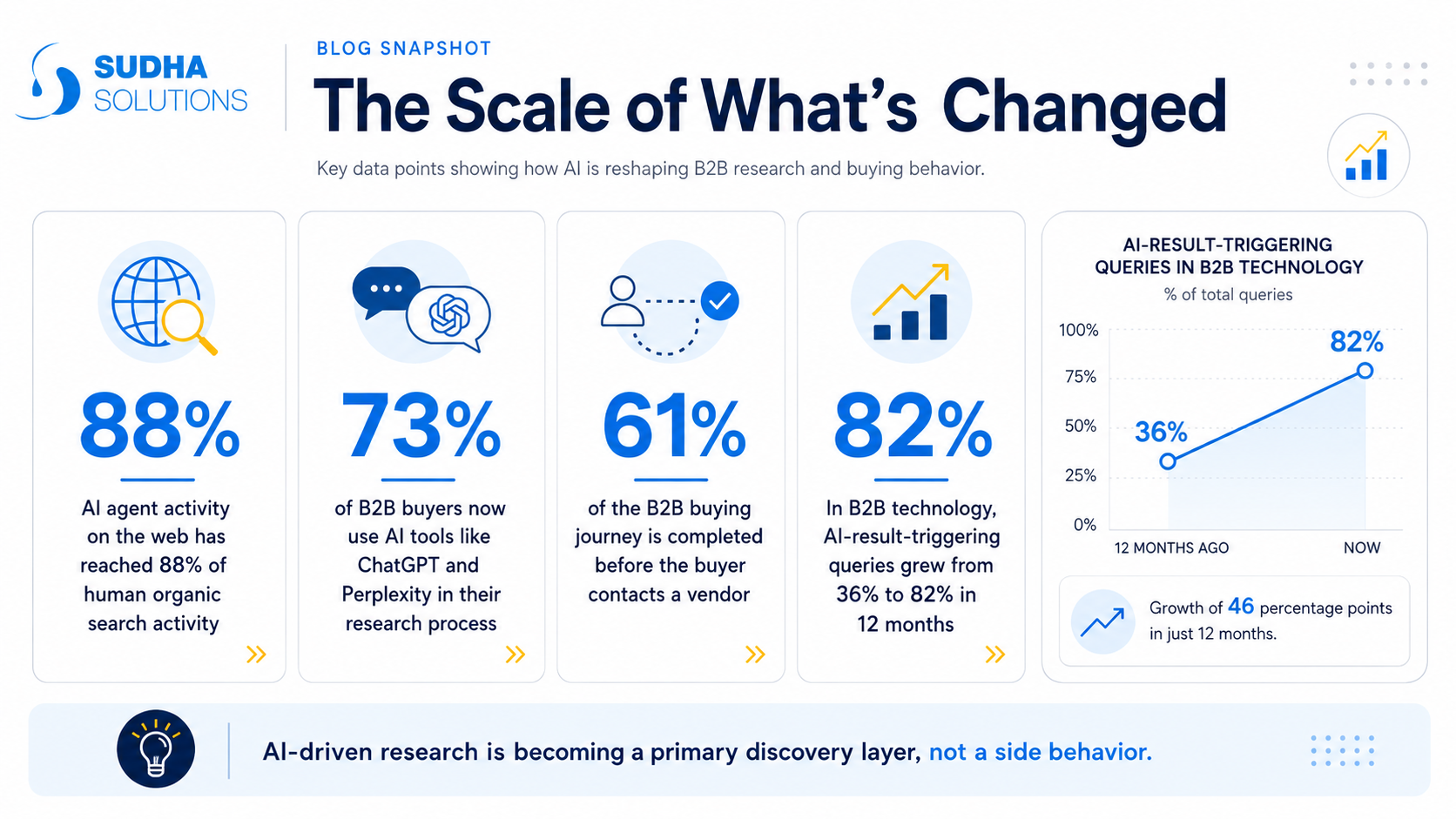
AI agent activity on the web has now reached 88% of human organic search activity, according to BrightEdge’s April 2026 data. Based on current growth trends, BrightEdge projects that AI agent activity will surpass human-driven search entirely by the end of 2026. (BrightEdge, April 2026) 

For B2B specifically, 73% of buyers now use AI tools like ChatGPT and Perplexity in their research process, based on a multi-source analysis of 680 million citations published in April 2026. And Forrester’s research found that 61% of the B2B buying journey now completes before the buyer ever contacts a vendor; a figure that keeps climbing as AI tools provide synthesised comparisons that previously required hours of independent research. 

In B2B technology specifically, the shift has been dramatic. Queries in that category that triggered AI search results grew from 36% to 82% in just twelve months, between February 2025 and February 2026, according to BrightEdge’s Generative Parser data published in Search Engine Journal. 

The pace is not slowing down. Businesses partnering with an experienced AI search optimization agency are adapting faster to changes in AI-driven search behavior. 

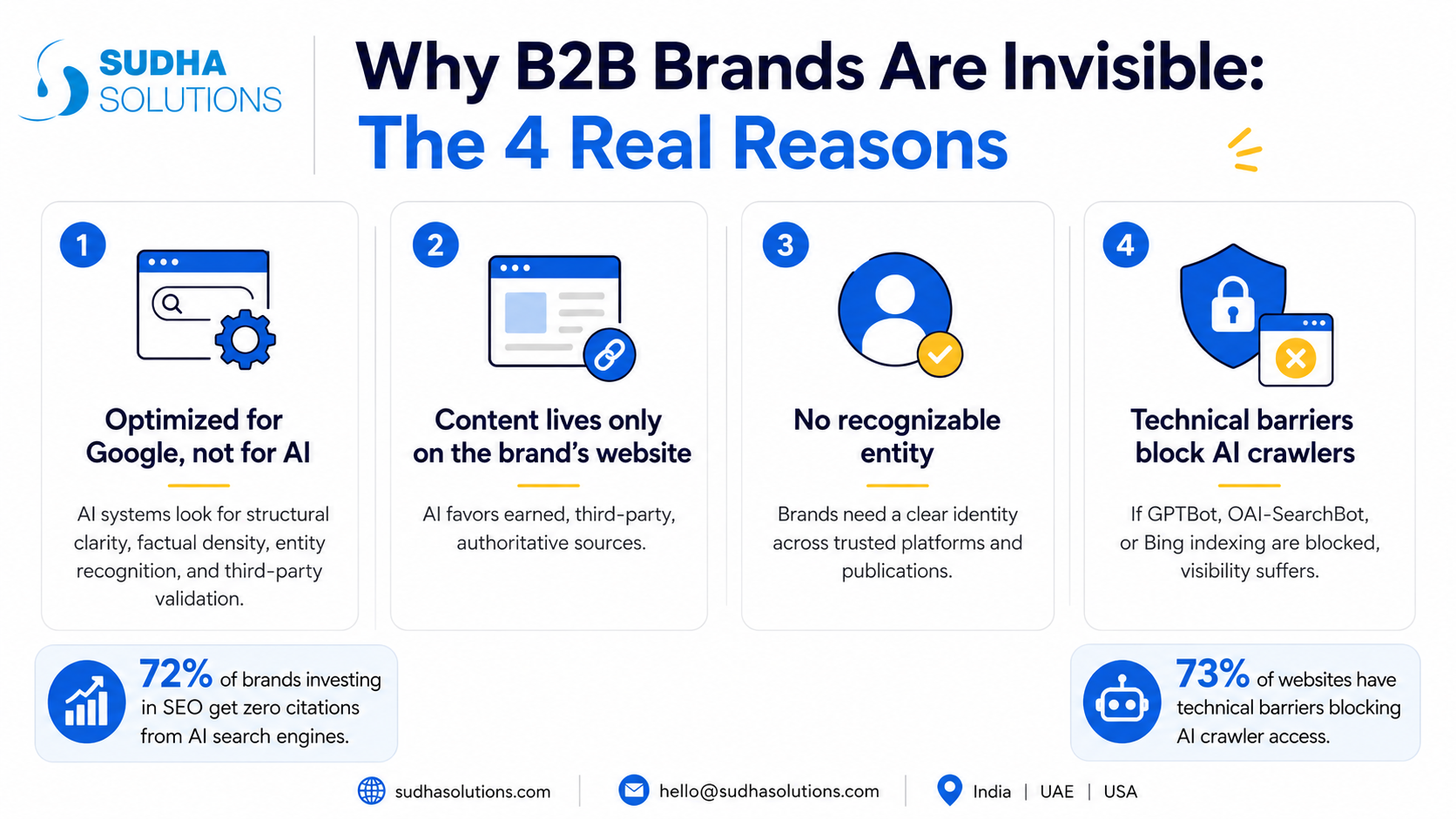
Why B2B Brands Are Invisible – The Four Real Reasons 

Why B2B Brands Are Invisible - The Four Real Reasons

Most B2B companies assume that if their website ranks on Google, they’re covered. The data says otherwise. Only 17% of AI search citations come from content ranking in the traditional top 10 organic results, according to BrightEdge’s February 2026 research. The other 83% pull from content that ranks lower — or from entirely different sources that Google ranking doesn’t predict at all. 

Here are the four most common reasons B2B brands don’t show up in AI search. 

  1. They’re Optimized for Google, Not for AI 

They're Optimized for Google, Not for AI

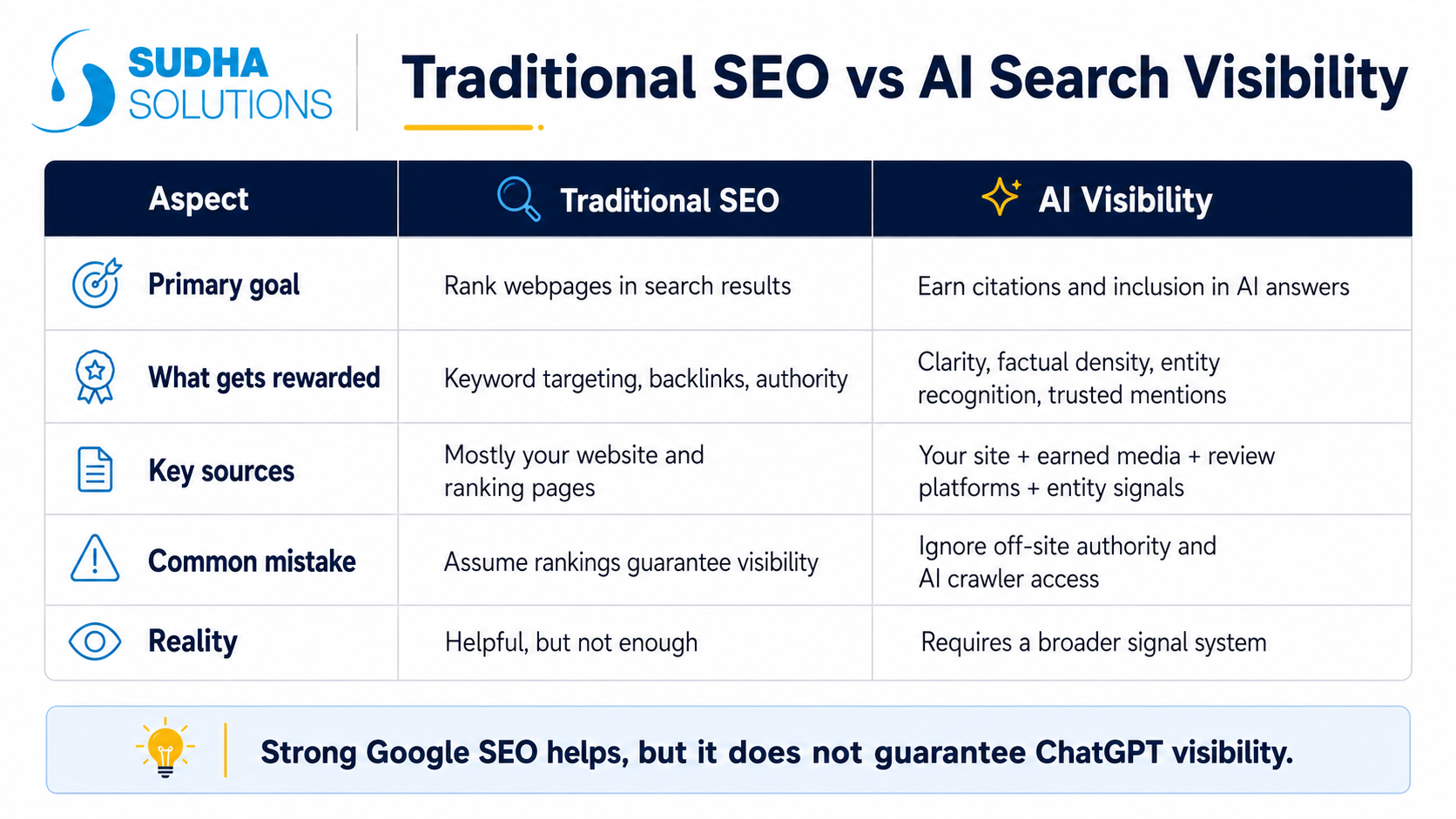
Traditional SEO and AI visibility require different things. Traditional SEO rewards keyword optimization, backlink volume, and page authority signals that Google’s algorithm is built to read. AI search systems evaluate content differently – This is why many companies are now investing in answer engine optimization services to improve visibility across ChatGPT, Gemini, and AI Overviews. They look for structural clarity, factual density, earned third-party mentions, and entity recognition across the web. 

72% of brands actively investing in SEO receive zero citations from AI search engines, according to BrightEdge research. That means most brands are building the wrong foundation entirely, and not even realising it. 

Google rankings are still a contributing factor – pages ranking in position one on Google are cited more frequently by ChatGPT than pages outside the top 20. But 44% of B2B brands with strong Google rankings have no ChatGPT visibility at all. Strong Google SEO creates a signal. It doesn’t guarantee a citation. 

  1. Their Content Lives Only on Their Own Website

Their Content Lives Only on Their Own Website

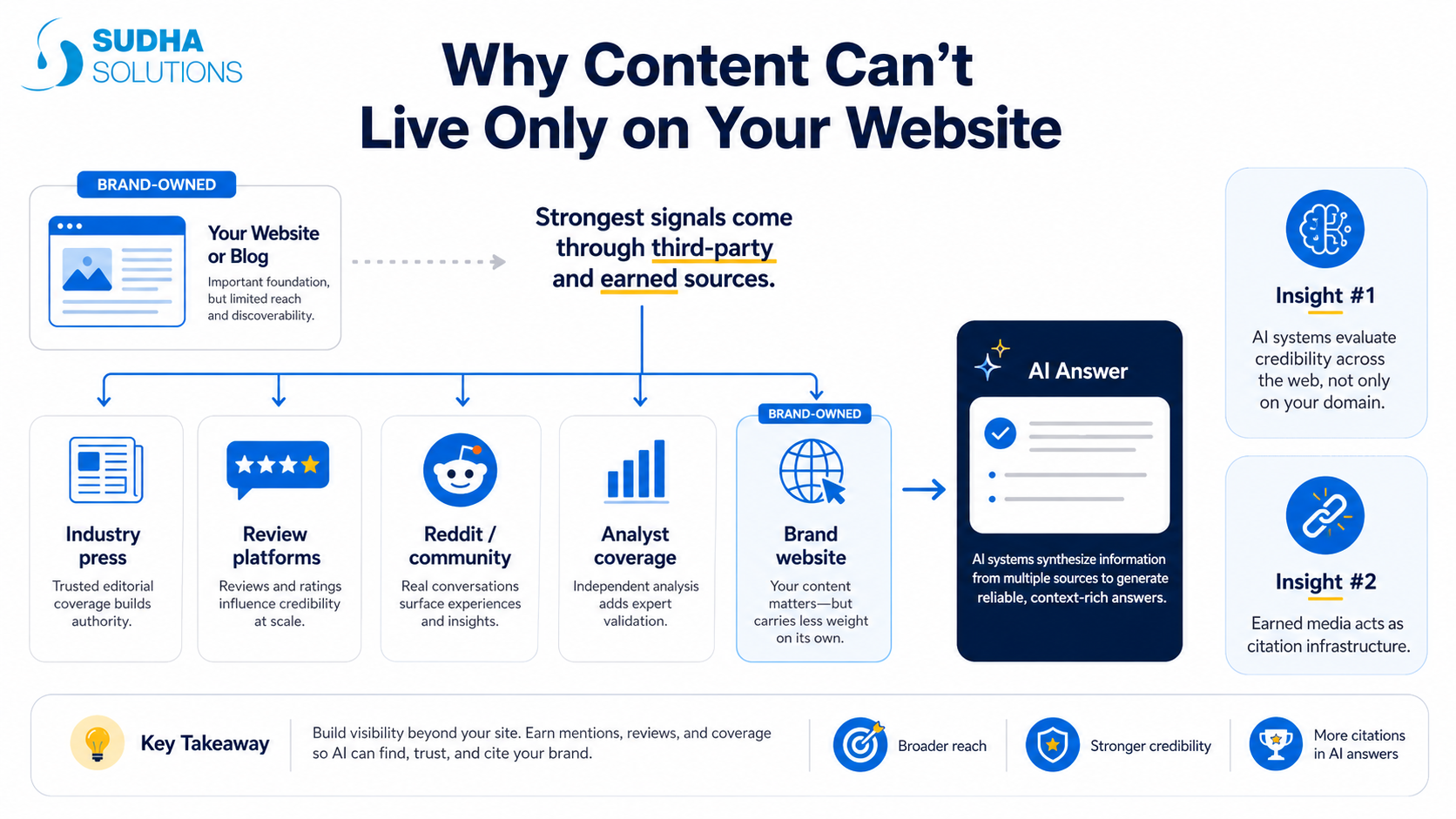
This is the single biggest structural mistake most B2B brands make. AI systems evaluate credibility by looking across the entire web, not just at a brand’s own domain. 

Research from the University of Toronto, published in September 2025, found that AI search exhibits a systematic and overwhelming bias toward earned media, third-party, authoritative sources, over brand-owned content. Social media content was almost entirely absent from AI answers. The contrast with Google’s more balanced citation mix was described as stark. 

A brand whose expertise exists exclusively on its own blog is, from an AI system’s perspective, a brand that has not yet been validated by anyone else. 

  1. They Haven’t Built a RecognisableEntity 

They Haven't Built a Recognisable Entity

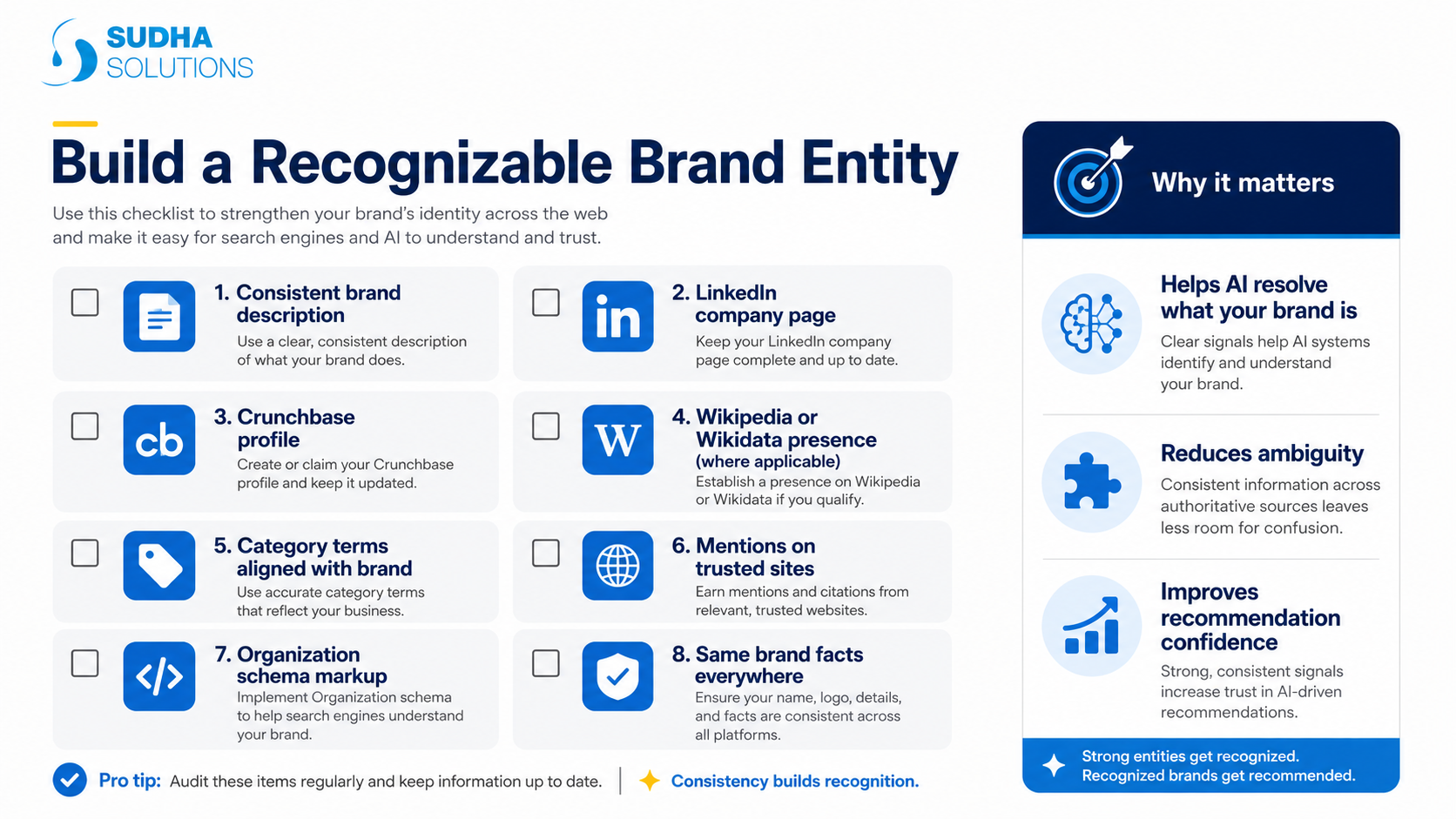
AI systems don’t just retrieve pages. They build internal representations, called entity models, of what a brand is, what it does, and how credible it appears across independent sources. If the AI can’t cleanly resolve a brand’s identity from multiple third-party references, the brand doesn’t get confidently recommended regardless of how good its products are. 

A brand that exists only on its own domain, without third-party coverage from publishers AI engines recognise as credible, is effectively absent from the citation layer regardless of its domain authority or search rankings. 

Entity clarity requires more than a well-written About page. It requires consistent, coherent presence across the platforms and publications that AI systems have learned to trust. 

  1. They Have Technical Barriers Blocking AI Crawlers

They Have Technical Barriers Blocking AI Crawlers

Even when a brand has strong content and some earned media presence, it often fails a basic technical test: AI crawlers can’t access the site properly. 

73% of websites have technical barriers that block AI crawler access, according to the OtterlyAI 2026 AI Citations Report. This includes sites that block GPTBot or OAI-SearchBot via robots.txt, sites that rely heavily on JavaScript rendering (which AI systems parse at far lower rates than static HTML), and sites that haven’t been submitted to Bing Webmaster Tools – the index ChatGPT’s browsing mode actually runs on. 

Brands that fix these technical barriers immediately remove a handicap that’s entirely self-inflicted. 

What the Benchmark Data Shows 

What the Benchmark Data Shows

The gap between the most and least visible B2B brands in AI search is enormous – and it’s not driven by brand size or marketing budget. 

A benchmark study by DerivateX, published in April 2026, analysed 50 B2B SaaS companies across ChatGPT, Perplexity, Claude, and Gemini, running 1,400 buyer-intent prompts. The average AI Presence Score across all companies was 56.9 out of 100, and 44% scored below 50. The gap between the highest-scoring brand (89 out of 100) and the lowest (2 out of 100) was 87 points; despite both operating in established categories with active marketing teams. (Demand Gen Report, April 2026) 

The study also found that the visibility gap is driven entirely by mention frequency and platform breadth; not by how AI perceives the brand once mentioned. Sentiment scores were nearly uniform across companies. The brands at the bottom aren’t being poorly rated. They’re simply not being mentioned at all. 

Why This Problem Compounds Over Time 

Here’s what makes AI invisibility more serious than a temporary SEO dip: the brands showing up in AI answers today are building a structural advantage that becomes harder to displace as time goes on. 

AI systems build entity models from accumulated signals across training data and live web retrieval. Brands that have been consistently mentioned, covered, reviewed, and cited across the web are more deeply embedded in those models than brands just starting to build their presence. The gap between a brand that started building AI visibility in 2024 and one starting in 2026 is meaningful – and it grows every quarter. 

95% of the time, the winning vendor was already on the buyer’s Day-One shortlist, according to 6sense’s 2025 Buyer Experience Report. And increasingly, that shortlist is being formed inside AI tools, before the buyer ever visits a website. 

The brands that aren’t in the AI answer aren’t losing late in the sales process. They’re never entering it. 

What the Fix Actually Looks Like 

What the Fix Actually Looks Like

The good news is that AI visibility isn’t determined by factors that only large enterprises can access. The brands winning in AI search aren’t always the biggest or the best-funded. They’re the ones that have built the right signals deliberately. 

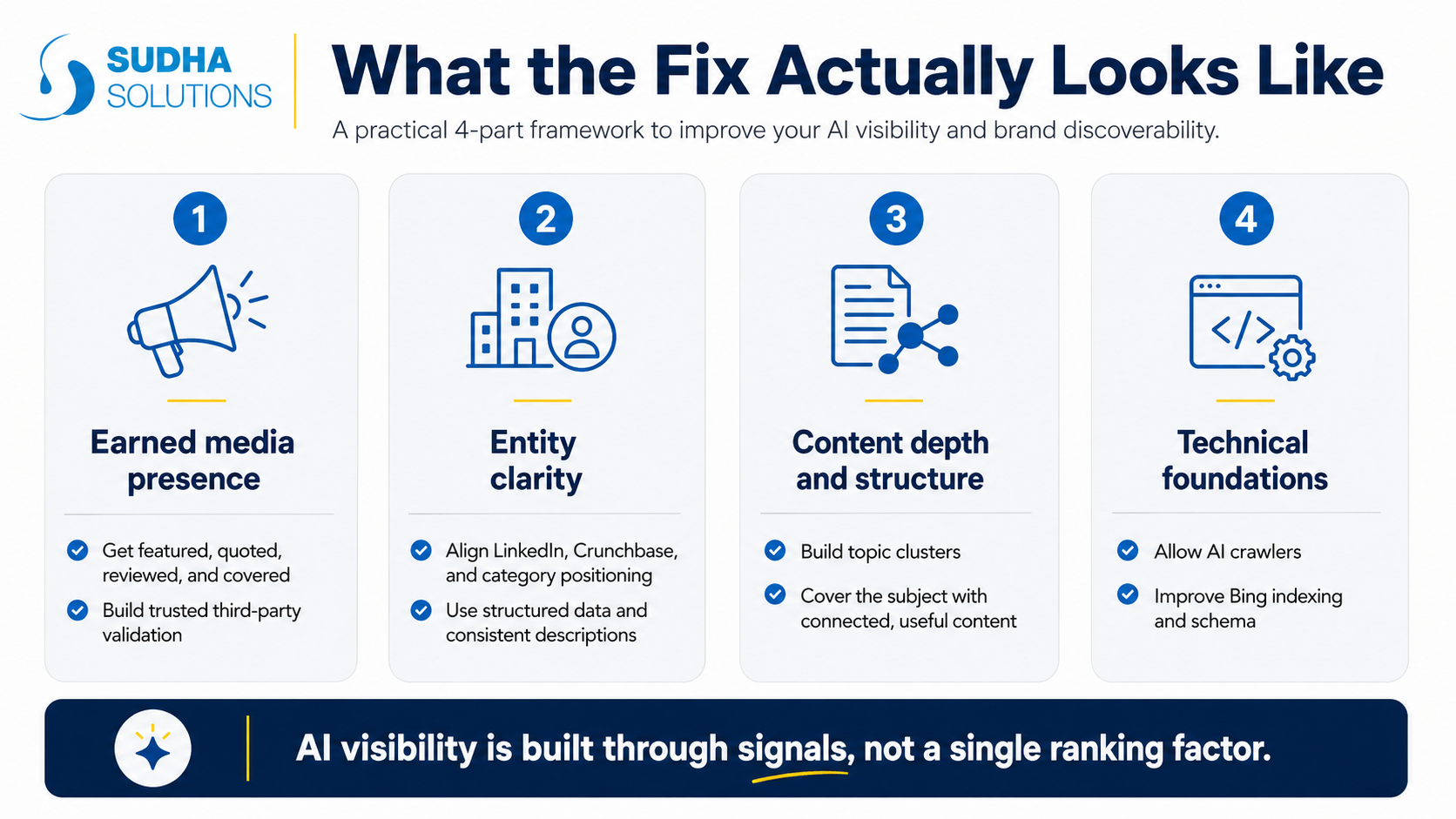
The fix works across four areas. 

Earned media presence. Getting featured, quoted, reviewed, and covered in third-party publications that AI systems trust. Industry trade publications, niche media, analyst coverage – these create the external validation that AI systems use to assess credibility. This isn’t traditional PR for the sake of brand awareness. It’s citation infrastructure. 

Entity clarity. Making the brand’s identity legible and consistent across the web. This means Wikipedia or Wikidata presence where applicable, complete profiles on Crunchbase and LinkedIn, consistent category positioning across every platform, and structured data on the brand’s own site that clearly communicates what the company is and does. 

Content depth and structure. Building a body of content that demonstrates genuine topical authority – not a handful of broad posts, but a connected cluster of content that covers a subject comprehensively. The pillar-cluster content model described in the ‘How to Get Your Brand Cited by ChatGPT’ blog in this series is directly relevant here. AI systems evaluate brands based on the depth and consistency of their published knowledge, not just individual pages. Businesses exploring how large language models affect SEO are increasingly investing in entity-driven content strategies. 

Technical foundations. Fixing the access problems that prevent AI crawlers from reading the site at all. Strong SEO expert services for AI search visibility help businesses improve Bing indexing, schema implementation, and AI crawler accessibility. Verifying on Bing Webmaster Tools, allowing GPTBot and OAI-SearchBot, implementing Article, Author, and FAQ schema, and ensuring content is served as static HTML rather than relying on JavaScript rendering. 

None of these are quick wins. But the first and third items on this list can show measurable progress within weeks, while the longer-term work on entity and earned media builds the durable advantage. 

One More Shift Worth Understanding 

The audience for this problem is broader than most B2B marketers currently realise. AI search isn’t just a marketing concern – it’s a sales pipeline concern. 

Buyers referred from AI search tools spend up to 3x more time on-page than visitors from traditional search, according to Forrester research reported by Digital Commerce 360. And 80% of ChatGPT users use the tool for work-related queries – high-intent, business decision-making searches, not casual browsing. 

The buyer asking ChatGPT about solutions in a category is not a curious researcher. They’re likely actively evaluating options and shortlisting vendors. Being in that answer, or not being in it, isn’t a branding question. It’s a revenue question. 

The next article in this series, ChatGPT vs Google: Where Should Your Business Focus in 2026?, tackles the strategic question of how to allocate between the two channels because the answer is more nuanced than most people expect. 

This article is part of Sudha Solutions’ ChatGPT Optimization series. Read the full series: 

Sudha Solutions helps businesses build visibility in AI search through content strategy, GEO, and digital marketing. Based in India, working with brands globally. 


Frequently Asked Questions

Why do B2B brands fail to appear in ChatGPT answers?

B2B brands often fail to appear in ChatGPT answers because AI systems prioritize entity authority, third-party validation, structured content, and AI crawlability over traditional keyword rankings.

What is AI search optimization for B2B companies?

AI search optimization helps B2B companies improve visibility across AI platforms like ChatGPT, Gemini, Claude, and Google AI Overviews through structured content and entity authority.

How does GEO differ from traditional SEO?

GEO focuses on optimizing brands for AI-generated answers and citations, while traditional SEO primarily focuses on ranking webpages in search engine result pages.

Why is earned media important for AI visibility?

AI systems rely heavily on trusted third-party mentions and authoritative publications to determine which brands deserve citation visibility.

How can companies improve AI search discoverability?

Businesses can improve AI discoverability through GEO optimization, AI-focused technical SEO, structured content, entity building, and off-site authority signals.

Categories
AI Overview GEO Optimization LLMS

What is Generative Engine Optimization (GEO)? A Beginner’s Guide

Let us ask you something. When was the last time you searched for something on Google and actually clicked on one of the links?

Chances are, you’re doing it less than you used to. And there’s a reason for that. More and more people are just typing their questions directly into ChatGPT, Perplexity, or Google’s AI Overview and getting a full answer right there. No links. No scrolling. No clicking.

This changes everything for businesses trying to get found online.

If you’ve been hearing the term “Generative Engine Optimization” (GEO) lately and wondering what it actually means, and whether you need to care about it, this guide is for you.

First, Let’s Talk About What’s Changing

First, Let's Talk About What's Changing

For the past 20 years, getting found online meant one thing: rank on Google. You’d optimize your content for keywords, build backlinks, and hope to land somewhere on the first page. That was the game. And it still matters. Don’t let anyone tell you SEO is dead.

But something significant has shifted in the last two years.

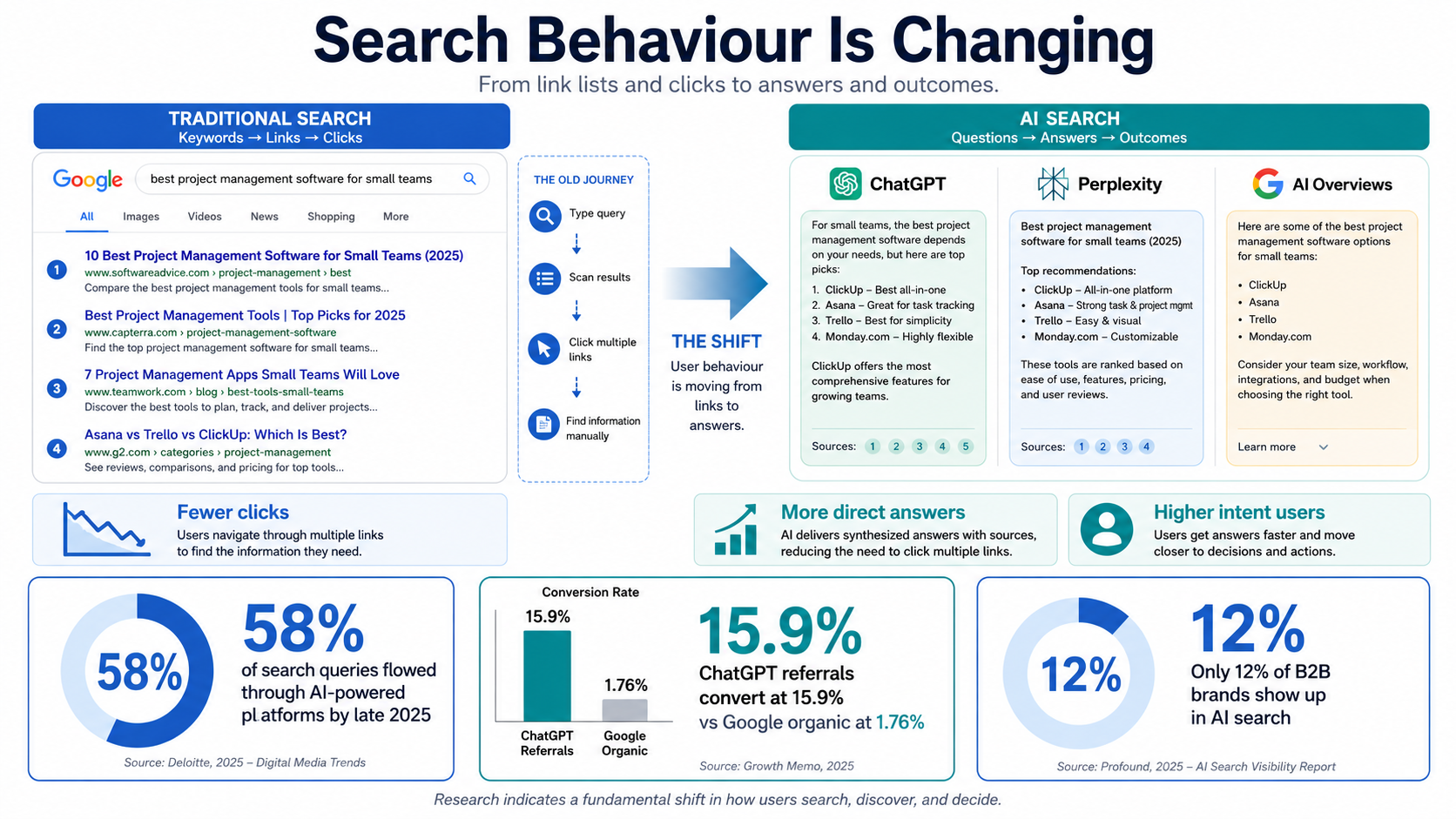
By late 2025, roughly 58% of all search queries were flowing through AI-powered platforms like ChatGPT, Google AI Overviews, and Perplexity. That’s not a small trend. That’s a genuine change in how people find information. And for businesses, it’s a signal worth paying attention to. Businesses investing in SEO services for AI Overview rankings are already adapting their visibility strategies for AI-powered search platforms.

Here’s the part that should really get your attention. ChatGPT referrals convert at around 15.9%, compared to Google organic’s 1.76%. That’s nearly a 9x difference. The people coming from AI search aren’t just browsing. They’re ready to act.

But there’s a catch. Only 12% of B2B brands actually show up when buyers search their category inside these AI tools. The other 88% are completely invisible, not because their product isn’t good, but because nobody optimized their content for how AI thinks.

That’s exactly what GEO is trying to solve.

So, What is Generative Engine Optimization?

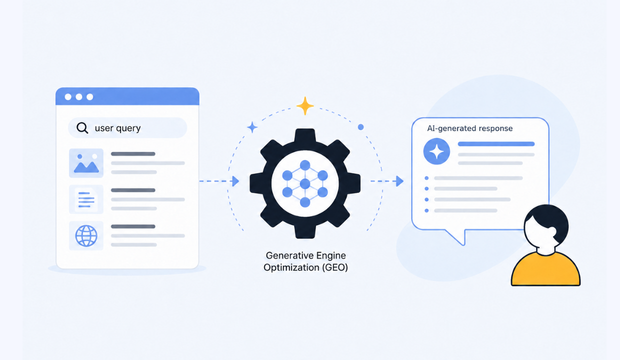
Generative Engine Optimization (GEO) is the practice of structuring and positioning your content so that AI tools like ChatGPT, Perplexity, Google Gemini, and Claude cite, mention, or recommend your brand when someone asks a relevant question.

Think of it this way. When someone types “what’s the best accounting software for small businesses” into ChatGPT, the AI doesn’t show a list of links. It just answers. It picks a few brands, explains why they’re a good fit, and maybe links to them. The brands that appear in that answer? They earned that spot because their content was built in a way that AI systems could trust, understand, and surface.

That’s GEO in action. Many businesses are now combining GEO with answer engine optimization services to improve visibility across ChatGPT, Google AI Overviews, and Perplexity.

It’s not replacing SEO. It’s extending it into a new channel; one that’s growing fast and rewarding brands that understand how it works.

GEO vs. SEO – What’s Actually Different?

GEO vs. SEO - What's Actually Different?

You might be wondering whether this is just SEO with a new name. It’s not, and here’s why.

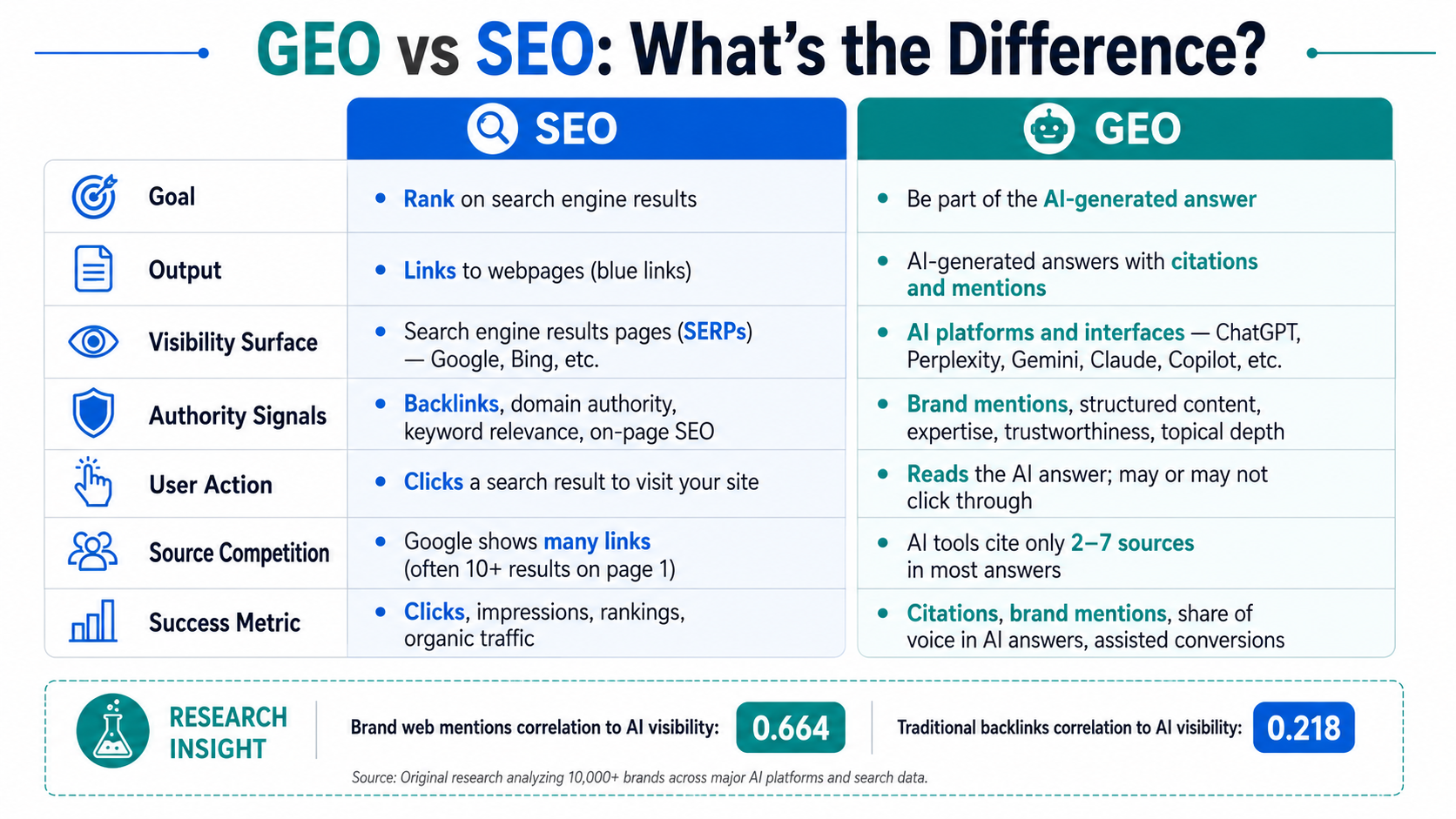
Traditional SEO is about ranking your web pages on a search engine results page. You optimize for keywords, earn backlinks, and compete for position one through ten on Google. The goal is to get a click. A user sees your link, clicks it, and lands on your site.

GEO works differently. Understanding the difference between SEO and GEO is essential for brands adapting to AI-generated search experiences. AI tools don’t show you a list of pages to choose from. They synthesize information from multiple sources and give you one answer. Your goal isn’t to get a click. It’s to be part of the answer.

This changes what you optimize for. In SEO, backlinks were the biggest authority signal. In GEO, brand mentions matter more. A study by Ahrefs found that the correlation between brand web mentions and AI visibility is 0.664; while traditional backlinks sit at just 0.218. That’s a meaningful gap.

Another key difference: AI tools cite far fewer sources than Google does. Google shows you ten blue links per search. AI tools typically reference just 2 to 7 domains per response. The competition for those slots is fierce, and the brands winning them aren’t always the ones with the highest domain authority. They’re the ones whose content is clear, structured, trustworthy, and genuinely useful.

Why This Matters Especially for B2B Brands

If you’re selling a product or service to other businesses, you need to know this: 90% of B2B buyers now use AI tools during their purchasing journey. And a large portion of them start their research inside ChatGPT or a similar platform rather than Google.

This is happening before they ever visit your website. They’re asking AI, “What are the best options for X?” or “Which company should I use for Y?” and AI is giving them a shortlist. If your brand isn’t on that list, you don’t get a second chance. You were never even considered.

The decision-making window has compressed. What used to take days of research now takes minutes of conversation with an AI. The brands that show up in those minutes earn disproportionate mindshare – and eventually, revenue.

How Does AI Decide What to Cite?

This is the question everyone wants answered, and honestly, there’s no single definitive formula. But research is starting to paint a clear picture.

Content quality and structure matter a lot. AI systems don’t read content the way humans browse websites. They scan for clarity, directness, and factual accuracy. Content that answers questions in plain, structured language is far more likely to be cited. Pages with clear headings are 2.8 times more likely to earn citations in AI search results.

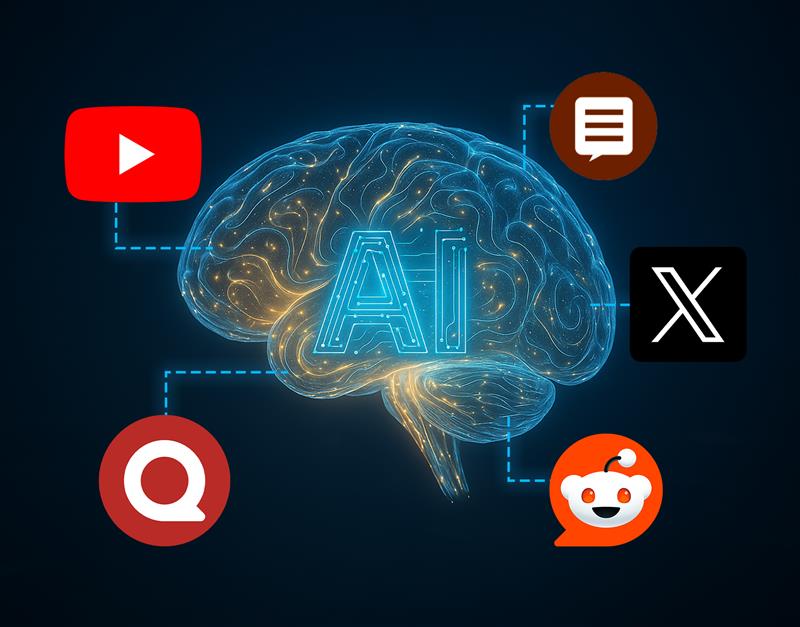
Brand mentions across the web are huge. The more your brand is talked about on third-party platforms, Reddit, Quora, YouTube, industry publications, the more signals AI systems have that you’re a legitimate, authoritative source. YouTube mentions specifically showed the strongest single correlation to AI visibility in recent research.

Third-party validation counts. For B2B brands especially, being listed on platforms like G2, Capterra, or Trustpilot makes a real difference. Domains with profiles on these platforms have a 3x higher chance of being cited by ChatGPT. It’s not about the number of reviews. It’s about being recognized by platforms that AI systems treat as trusted validators.

Content freshness plays a role too. AI tools prefer recent, up-to-date information. Regularly refreshing your key pages signals relevance and keeps you in contention.

We go much deeper on this in our article on How ChatGPT Decides Which Sources to Cite. If you’re curious about the specific mechanics, that’s a good place to start.

The Core Components of a GEO Strategy


GEO isn’t a single tactic. It’s a way of thinking about your entire content presence. Here’s what it covers, at a high level.

  1. Topical authority. You want AI to see you as a reliable expert on a specific subject. That means publishing a consistent body of content around a topic, not one great article, but many interconnected pieces that together show depth and breadth of knowledge.
  2. Content structure. Your content needs to be easy for AI to understand. Clear headings, direct answers near the top of articles, factual accuracy, and logical flow all contribute to whether an AI will choose to cite you.
  3. Off-site presence. Your website alone isn’t enough. Your brand needs to show up in conversations happening on other platforms – in forums, review sites, YouTube, podcasts, and publications your audience already reads.
  4. Technical foundations. This is the part most people overlook. If AI crawlers can’t properly access and understand your site, none of the content work matters. Clean site structure, schema markup, and proper indexing all feed into this.
  5. Measurement. You can’t improve what you don’t track. And right now, as of late 2025, only 16% of brands are systematically tracking their AI search performance. That gap is an opportunity. We cover exactly how to do this in our guide on How to Audit Your ChatGPT Visibility.

A Practical Way to Think About It

Here’s how we would frame GEO for anyone just getting started.

Imagine a highly trusted advisor that your ideal customer talks to before making any big decision. That advisor has read a huge amount of content from across the internet and remembers what it found reliable, credible, and helpful. When your customer asks for a recommendation, the advisor mentions the brands it knows well and trusts.

Your job with GEO is to become one of those trusted brands in the advisor’s memory. You do that by being genuinely present, consistently useful, and clearly credible across the internet – not just on your own website.

It’s not unlike how word-of-mouth worked before the internet. The brands people heard about the most, in the most trusted contexts, were the ones that got recommended. GEO is word-of-mouth at scale, filtered through AI. Businesses working with an experienced AI search visibility agency are often able to build stronger brand authority across emerging AI discovery platforms.

What GEO Doesn’t Mean

It’s worth clearing up a common misconception here.

GEO is not about tricking AI systems. You won’t find a loophole or a shortcut that suddenly makes ChatGPT recommend you. AI tools are increasingly good at identifying content that’s been stuffed with keywords or written primarily to manipulate an algorithm rather than genuinely help a reader.

The brands that win in GEO are the ones that would have earned recommendations the old-fashioned way too by being genuinely good at what they do and building a credible presence around it. GEO just formalizes that into a strategy.

Where to Go From Here

If you’re new to this topic, here’s our honest suggestion: don’t try to do everything at once.

Start by understanding where your brand currently stands in AI search. Ask ChatGPT and Perplexity a few questions that your ideal customer would ask. See if you come up. If you don’t, that’s your baseline. And that’s okay – most brands don’t, yet.

Then, work through the sub-topics in this cluster to build your understanding and your strategy piece by piece.

Here’s what we cover across this topic area: 

GEO is still early. The brands that take it seriously now will have a significant head start over competitors who wait until it becomes obvious. And if you’d like help thinking through what a GEO strategy looks like for your specific business, that’s exactly what we do at Sudha Solutions. Get in touch and let’s talk.

Sudha Solutions helps businesses build visibility in AI search through content strategy, GEO, and digital marketing. Based in India, working with brands globally.

Frequently Asked Questions

Why is GEO important for businesses in 2026?

As more users rely on AI tools instead of traditional search engines, GEO helps businesses improve visibility inside AI-generated search experiences.

How do AI platforms decide which brands to cite?

AI systems prioritize structured content, topical authority, brand mentions, trusted third-party references, and clear factual information.

What are GEO optimization services?

GEO optimization services help businesses improve AI visibility through content structuring, authority building, technical optimization, and AI-focused search strategies.

Can GEO replace traditional SEO?

No. GEO complements traditional SEO by expanding visibility into AI-powered search and generative answer engines.

Categories
General SEO LLMS

SEO Meets LLMs: How Search Algorithms Learn, Rank, and Generate Answers

Search used to be about finding links. Now it is about getting an answer you can act on. That shift is not because Google redesigned the results page. It is because large language models, or LLMs, changed how information is understood, ranked, and delivered.   

For years, SEO teams played a known game. Get crawled. Get indexed. Earn backlinks. Be relevant to the keywords. Appear in the top ten. Now we are in the next shift. Users are not always being handed a list of blue links. In many cases they are being given a synthesized, conversational answer. In this blog, we will talk about LLMs in SEO, how our search engines learn and generate conversational answers.  

How LLMs Learn to Talk About your Category 

LLMsLet’s start with what are LLMs. 

LLMs pr Large Language Models are trained on huge text datasets. Think trillions of tokens from websites, books, documentation, forums, product pages, Q&A content, and more. The core task during training is very simple to describe. Predict the next word. Then the next. Then the next. Repeating this task at a massive scale teaches the model patterns in how humans explain ideas, argue, recommend, compare, and answer.  

Knowing how LLM works is important. It does not just memorize isolated facts the way a spreadsheet does. It learns statistical structure. It sees how experts talk about “cross-border payment compliance” or “sustainability claims in fashion sourcing” or “how to improve Core Web Vitals for eCommerce SEO,” and then it learns how those ideas tend to be framed. So, when the model answers, it is not quoting. It is generating a likely and useful continuation.  

How AI-Powered Search Ranks What to Trust  

Here is what most people misunderstand. AI-generated answers are not created in a vacuum. When you ask an AI system a question like “What is the best way for LLM optimization in search results?”, the model does not instantly start typing from pure memory. First, it retrieves. Then, it generates.  

This pattern is known as retrieval augmented generation (RAG). The system first pulls information from search engine results, knowledge bases, policy docs, product pages, or any other trusted source. Only after it has pulled in those candidate sources does the model start writing the answer.  

The content they and AI models trust are usually ones with good SEO ranking. Content pieces that are up to date, well structured, and have FAQs, tables, and price breakdowns are given priority.  

What Happens When an AI System Answers  

After retrieval, the model begins synthesis. It looks at the retrieved sources, scores them for relevance, freshness, and confidence, and then composes a final narrative-style answer. A recent arXiv analysis of generative search describes how these systems score for citability, which is the likelihood that the system can safely attribute a claim to a given source. That is why AI search-style answers often include source callouts or language like “according to.”  

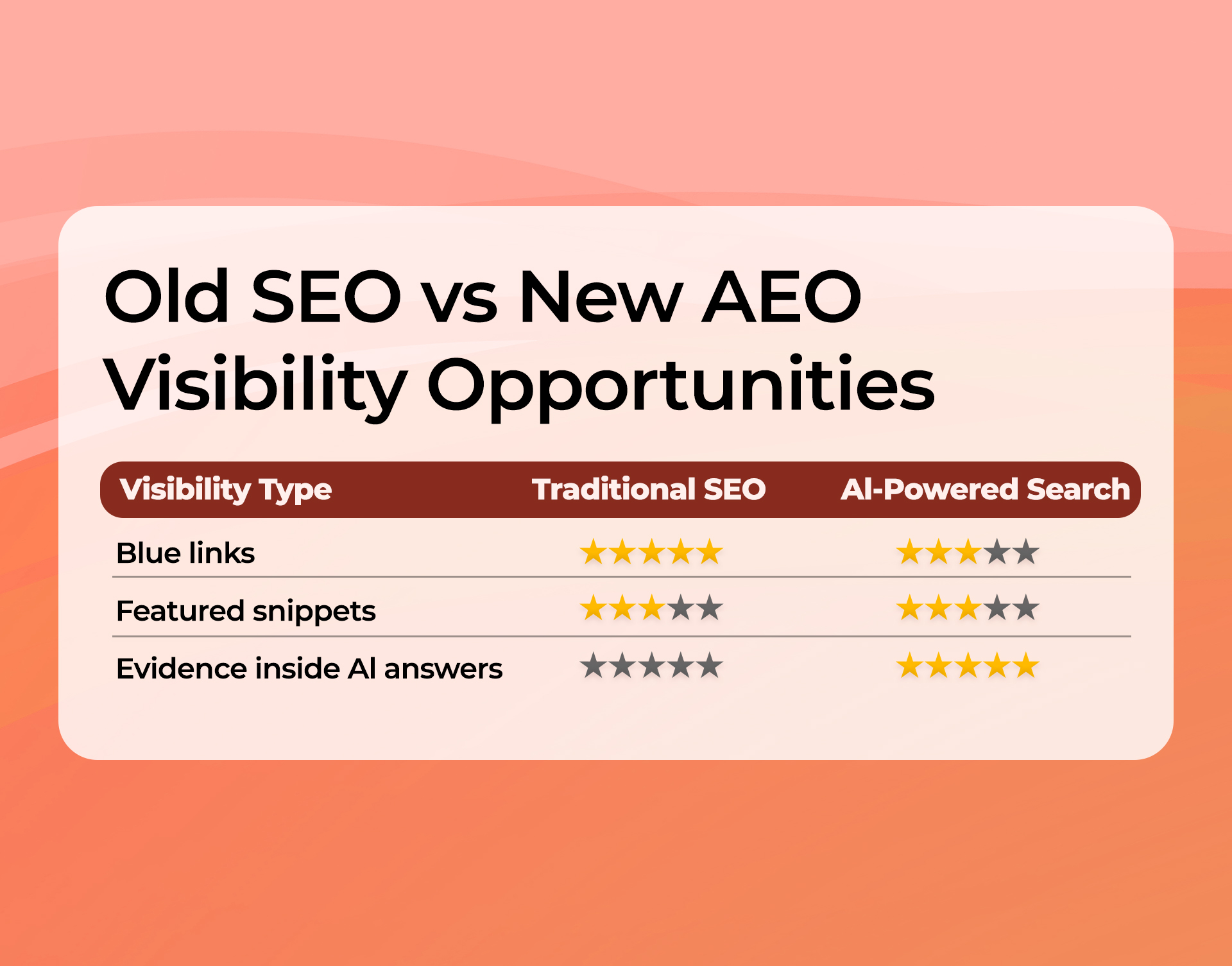
For brands, this is the real takeaway. Visibility is not limited to the blue links section anymore. Visibility now includes being used as evidence inside the answer itself. If the AI answer cites you or uses your language, you are winning mindshare before the click.  

Old seo vs new seoHow LLM-Based Ranking Reshapes SEO Strategy 

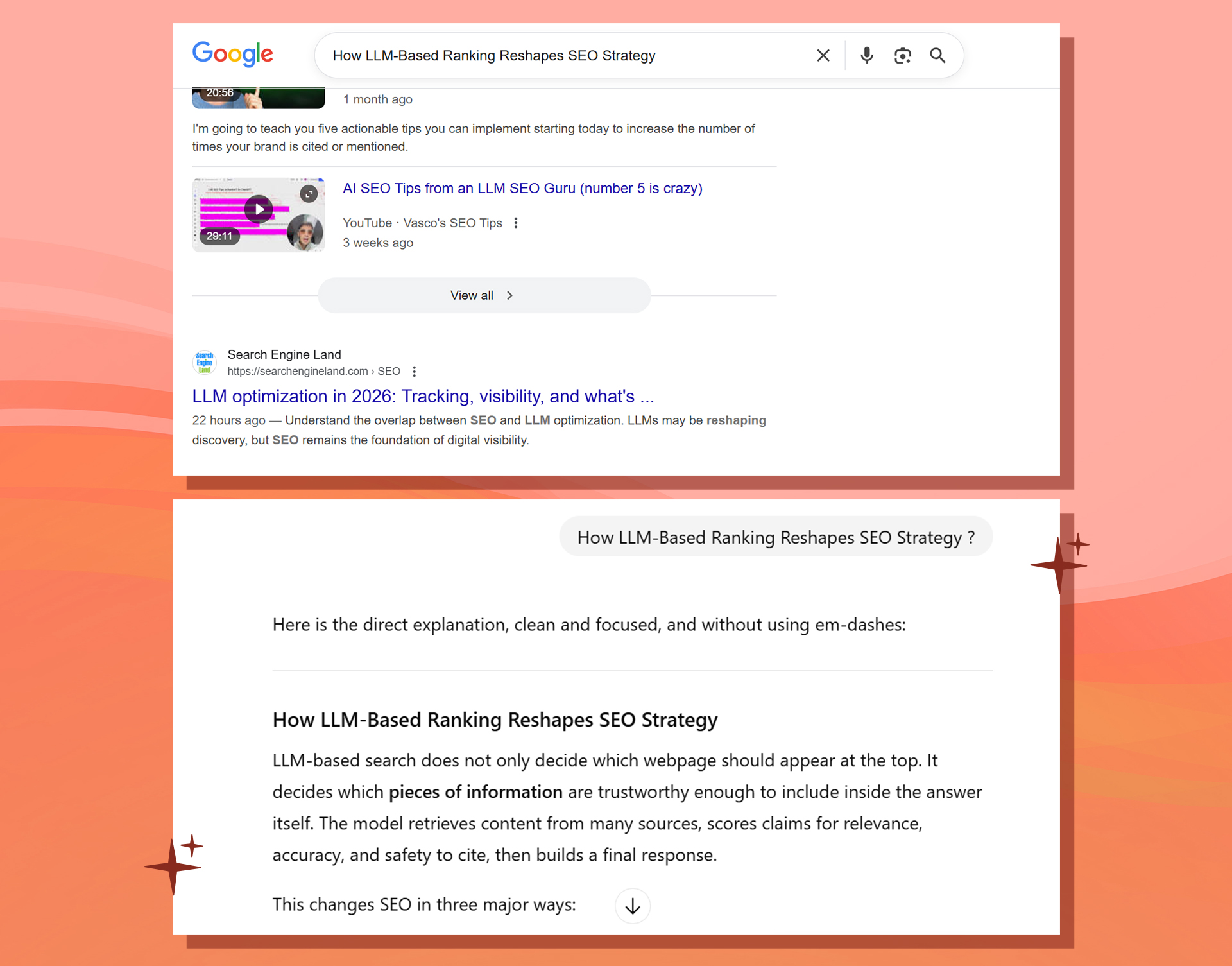
how LLM rankings reshape seo strategy

Search optimization used to focus on one outcome: visibility on Google’s first page. That goal is still valid, but the path to it is now shared with AI systems that evaluate far more than backlinks and keywords. The rise of answer-first search means that visibility can come in two ways: ranking as a source and appearing as a cited reference inside an AI-generated summary.  

This change creates a new layer of competition. Content is no longer fighting only for clicks. It is fighting for inclusion inside the models that shape what users read and trust. A 2025 analysis published on arXiv explains that modern ranking pipelines now blend retrieval, confidence scoring, and summarization to determine which passages appear inside generated answers. That blend favors clarity, context, and structural precision.  

This means the new SEO strategy must evolve into what specialists call Answer Engine Optimization (AEO) and Generative Engine Optimization (GEO).  

Building an LLM-Friendly Content Ecosystem 

LLM-Friendly Content Ecosystem

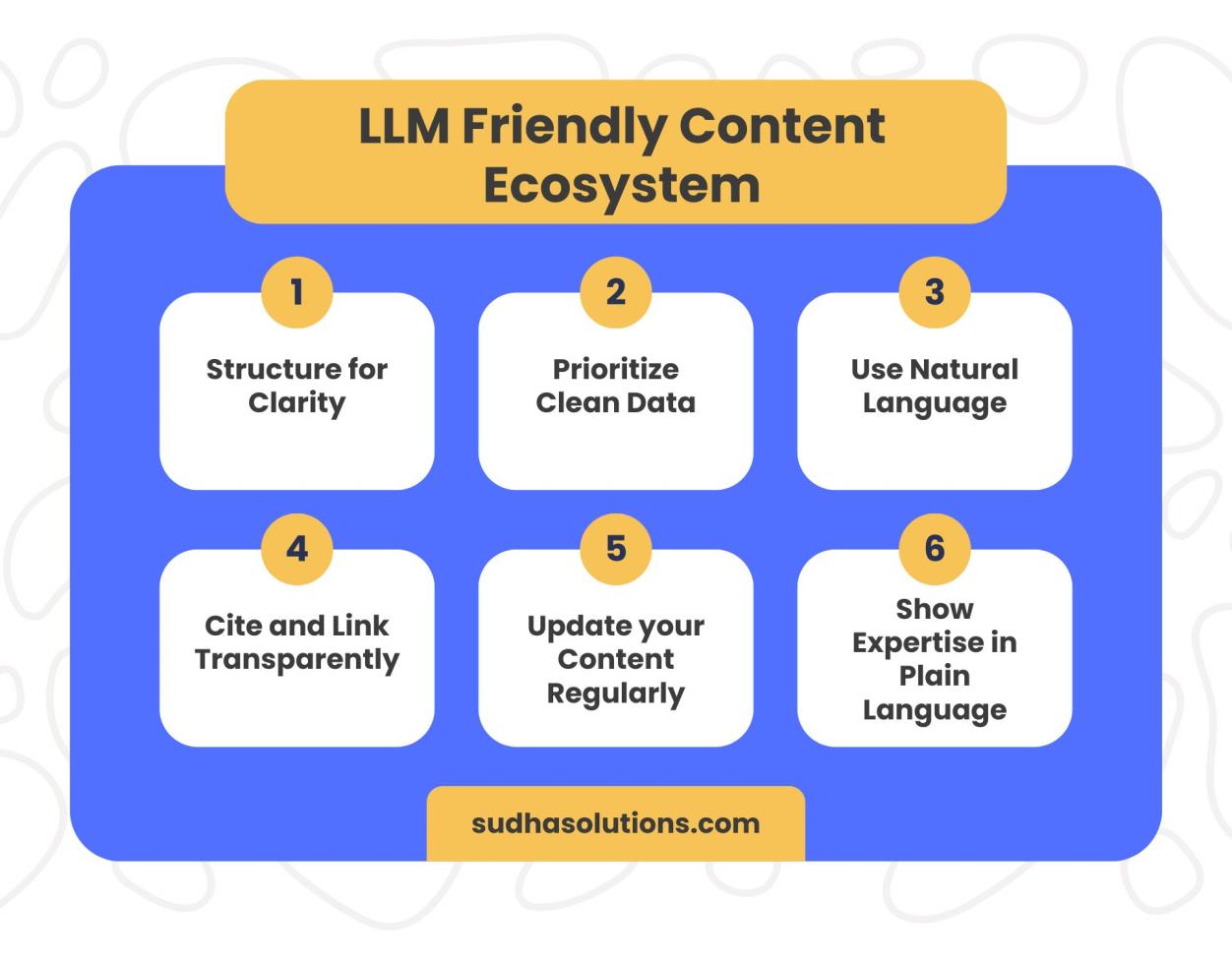
Now that we know how LLMs generate answers in search, let’s understand how you can incorporate LLM friendly features in your content. The following principles emerge from multiple SEO + AI studies and align closely with Google’s own guidance.  

Structure for clarity   

Use logical headings, question-style subheads, and short introductory answers. These help retrieval systems map your page sections to specific user intents.  

Prioritize clean data  

Schema markup, FAQ blocks, and product metadata allow AI systems to parse relationships without guessing. Structured data is the new sitemap.  

Write with semantic depth  

Include variations of related terms, not just primary keywords. LLMs work through embeddings that connect related ideas. When your content reflects natural language variety, it earns stronger semantic signals.  

Cite and link transparently  

Outbound citations to credible sources increase the model’s confidence score. AI models show a measurable bias toward pages that provide supporting evidence.  

Refresh frequently  

Freshness is a trust signal. Both search crawlers and AI retrievers favor recently updated pages because recency suggests reliability.  

Show expertise in plain language  

LLMs value explainability. When an expert’s knowledge is expressed in clear, direct terms, it becomes easier to reuse and quote inside generated output.  

Measuring Performance in the New Landscape 

Traditional metrics like impressions and click-through rates still matter, but they no longer tell the whole story. Visibility now includes presence in AI-generated results, summarized citations, and conversational mentions.  

Here are practical indicators to monitor:  

  • Citation frequency: How often your domain appears as a source in AI summaries or answer boxes. 
  • Semantic coverage: The range of related queries for which your content appears in generative search results.    
  • Engagement depth: Time on page and scroll depth remain relevant because they signal that users value the content models are quoting. 
  • Brand recall in generated answers: Track whether your brand name appears inside generated responses on platforms like Perplexity or ChatGPT when your topic is queried.  

These signals reveal whether your brand is being recognized as an authoritative contributor inside the AI knowledge graph, not just the organic SERP.  

The Changing Mindset for Brands 

For brands, this transformation is less about tactics and more about mindset. SEO can no longer be treated as a mechanical checklist. It is an evolving system of influence inside a network of intelligent models.  

Brands need to ensure that their teams approach content as structured knowledge assets rather than marketing copy. They must coordinate SEO, content, and data teams to maintain alignment between technical markup, brand narrative, and audience search intent.   

The brands that succeed in this environment will be the ones that treat every article, product page, and insight as something a machine can understand, not just a human can read.  

Conclusion 

Search and AI are converging into a single ecosystem where learning, ranking, and answering happen together. LLMs are not replacing SEO. They are redefining what optimization means. Authority now extends beyond backlinks into semantics, clarity, and consistency.  

If your content can help an AI system explain something clearly, it can help your audience understand it too. That alignment between human readability and machine interpretability is where the next decade of digital visibility will be won. 

Want your brand to appear on AI platforms like ChatGPT, Perplexity, and Grok? We at Sudha Solutions have a proven plan that has helped multiple brands rank on both Google Overview AI platforms.  

Our experienced team of SEO and content marketing experts ensures your brand becomes the preferred source that AI systems retrieve, score, and cite in their answers. From strategic content optimization to citation-driven authority building, we help you win visibility where users make decisions. Contact us Today