




B2B buying has always been complex. Multiple stakeholders, long cycles, extensive research — that part hasn’t changed. What has changed, faster than most marketing teams have caught up to, is where that research begins.
Two years ago, 68% of buyers told TrustRadius that generative AI had no impact on their purchase process. Today, according to 6sense’s 2025 global study of nearly 4,000 B2B buyers, 94% use large language models at some point during a software purchase journey. That’s not a gradual shift. That’s a market transformation happening faster than most organisations are equipped to respond to.
LLM SEO — sometimes called GEO, AEO, or LLMO depending on who’s writing about it — is the discipline that addresses this directly. It’s the practice of structuring content, building authority, and establishing brand presence in ways that make AI systems like ChatGPT, Perplexity, Claude, and Gemini cite and recommend a brand when B2B buyers ask questions about their category.
This article explains what that means specifically for B2B companies, why the B2B buying journey makes this more urgent than it is for consumer brands, and what an effective strategy actually involves.
Why B2B Is the Highest-Stakes Context for LLM Visibility
LLM SEO matters for any business trying to get found online. But for B2B companies, the stakes are particularly high — because of what the data shows about how B2B buying decisions actually form.
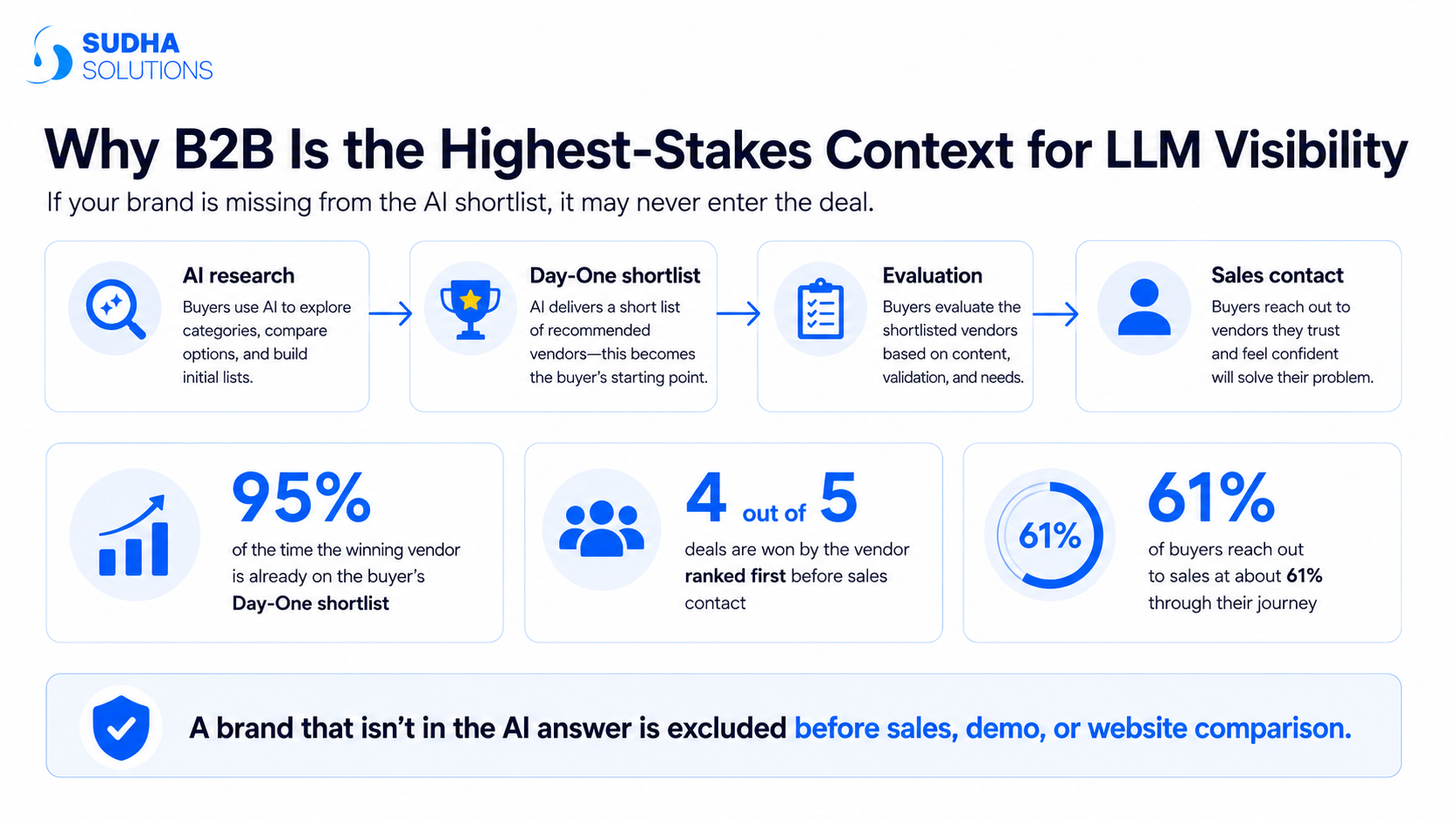
According to 6sense’s 2025 Buyer Experience Report, 95% of the time the winning vendor is already on the buyer’s Day One shortlist. Four out of five deals are won by the vendor the buyer ranked first before they ever contacted sales. And buyers don’t reach out until they are approximately 61% through their journey — arriving with AI-driven research, pre-ranked shortlists, and a decision process that is largely formed before a sales conversation begins.
That shortlist formation — the moment when a buyer decides which vendors are worth evaluating — is happening increasingly inside AI tools. The discovery and shortlisting phase has migrated almost entirely inside the LLM interface, as Forrester’s 2025 B2B Buying Study described it. Buyers ask ChatGPT which vendors solve their problem, get a curated list of three to five options, and use that list as the foundation for everything that follows.
A brand that isn’t in that AI answer isn’t just losing a ranking. It’s being excluded from the decision entirely — before a sales team, a website, or a product demo ever enters the picture.
This is the core reason LLM SEO is not optional for B2B companies in 2026. Businesses investing in SEO expert services for B2B AI visibility are increasingly adapting their search strategies for AI-driven buyer journeys.
The Buying Group Dimension
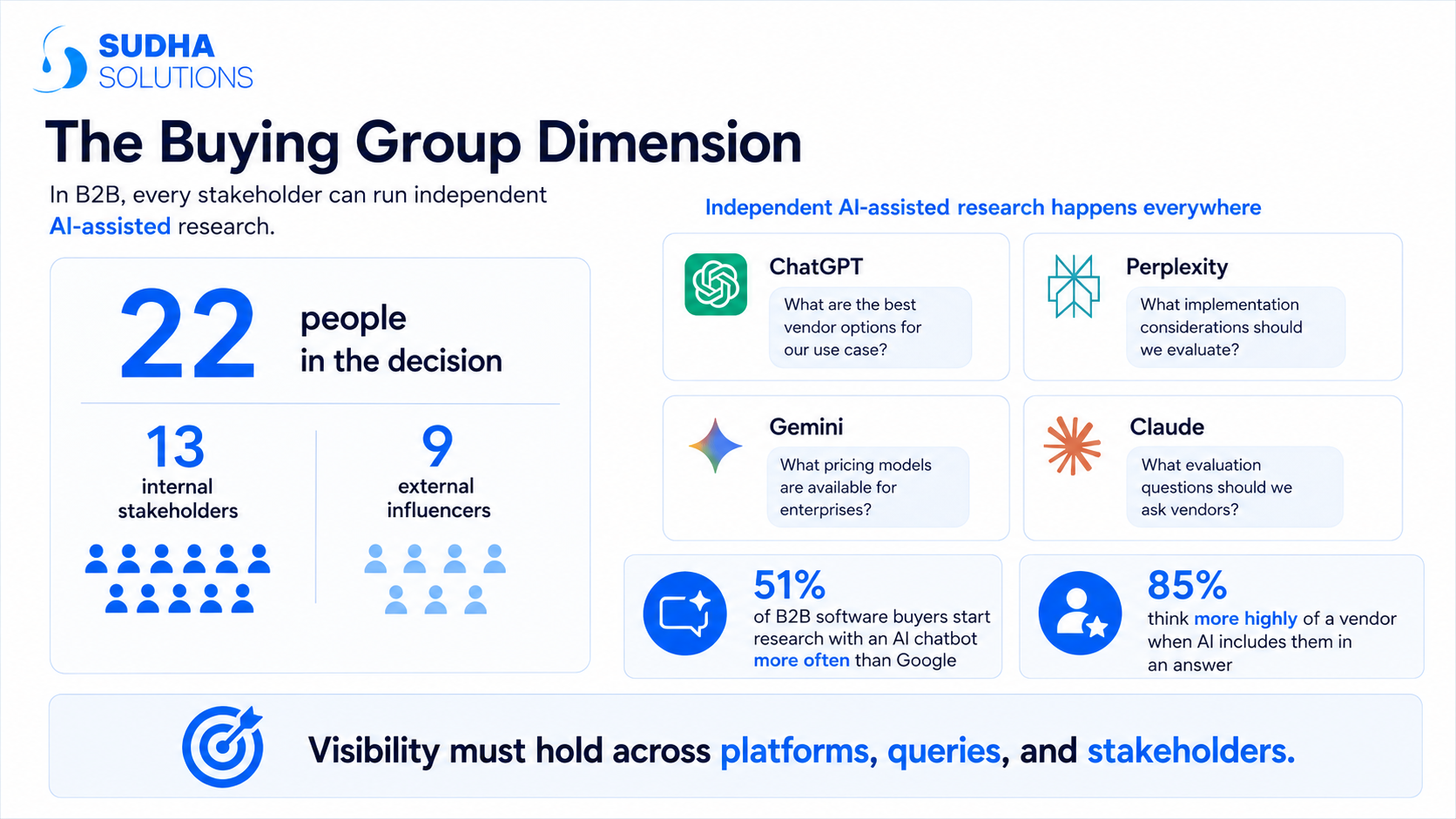
B2B deals in 2026 involve an average of 22 people in the decision — 13 internal stakeholders and 9 external influencers, according to Forrester’s State of Business Buying 2026. Each of those people is potentially conducting independent AI-assisted research.
This creates a compounding effect. One stakeholder might ask ChatGPT about vendor options in the category. Another might ask Perplexity about implementation considerations. A third might ask Gemini about pricing models. If a brand doesn’t appear consistently across those queries and across those platforms, its presence in the buying group’s collective understanding degrades with each additional stakeholder who searches independently.
51% of B2B software buyers now start their research with an AI chatbot more often than with Google, according to G2’s April 2026 data. And 85% of buyers say they think more highly of a software vendor when AI includes them in an answer. The inverse is also true — being absent when peers appear sends a quiet negative signal about credibility and category standing, even if no one in the buying group verbalises it.
What Makes LLM SEO Different for B2B
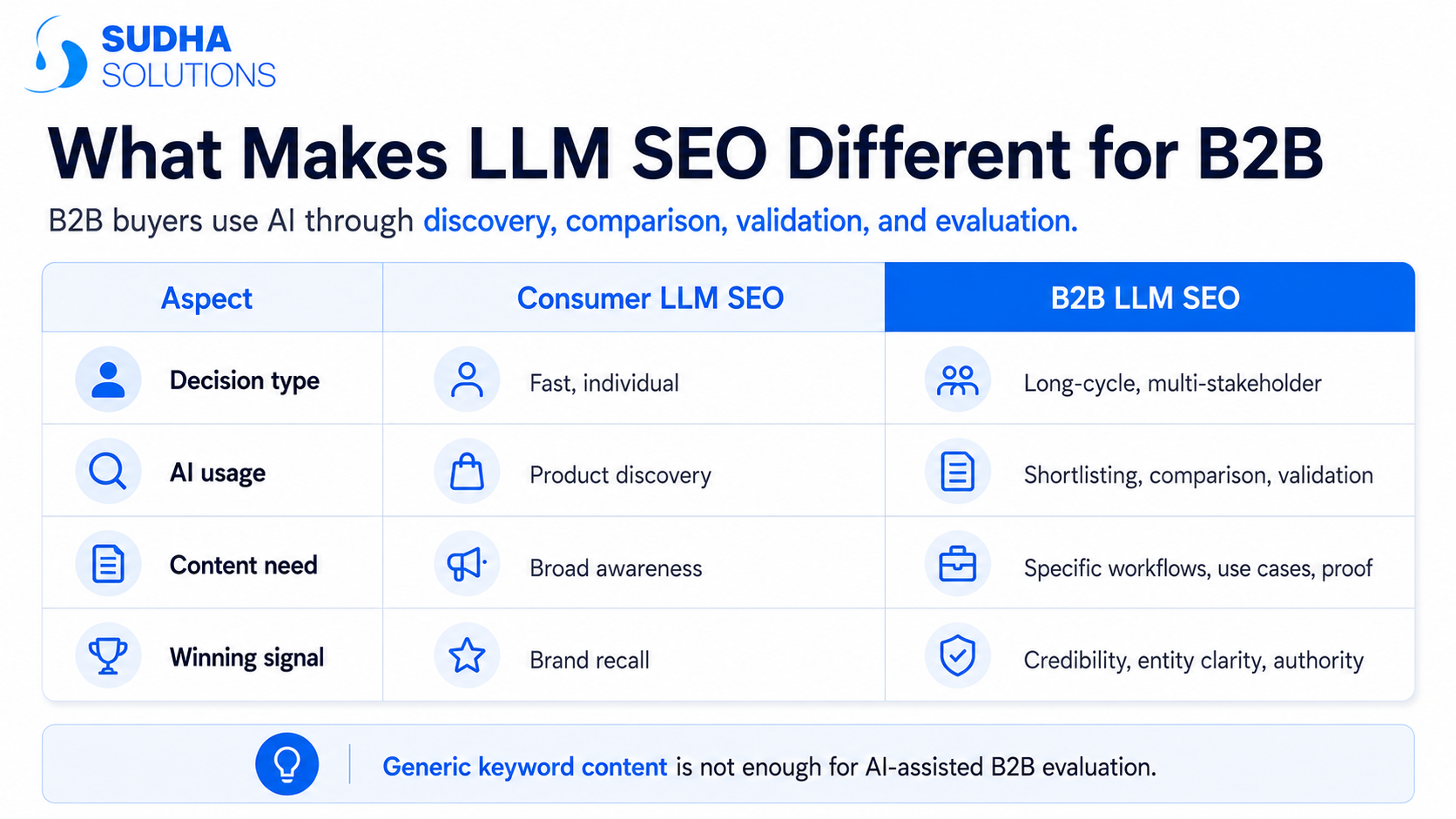
Consumer-facing LLM SEO is largely about brand awareness at scale — getting a product mentioned when individuals are making low-complexity decisions quickly. B2B LLM SEO operates differently because the buyer behaviour is different.
B2B buyers use AI tools not just for discovery but throughout the evaluation process. 6sense’s 2025 Buyer Experience Report found AI features present in 89% of B2B purchases — at shortlisting, at comparative evaluation, at review validation, and at the drafting of evaluation questions. This means a B2B brand needs to be visible and credible at multiple points in the AI-assisted journey, not just the first query.
The content requirements follow from this. B2B buyers using AI tend to ask more complex, scenario-based questions than consumer buyers: “What are the best platforms for [specific workflow] for a company of our size and industry?” “What do analysts say about [vendor category]?” “What are the known limitations of [competitor]?” The brands that appear in these answers have content — and third-party coverage — that addresses these specific questions with specificity and depth.
Generic content built for keyword rankings doesn’t serve this well. Buyers arriving via AI recommendations have already completed the initial discovery phase and are in active evaluation mode. The content they find on a brand’s site needs to match that intent — detailed, evidence-based, credible.
The Four Pillars of a B2B LLM SEO Strategy
1. Topical Authority Through Depth, Not Volume
AI systems evaluate B2B brands partly by how consistently and comprehensively their content covers a subject. A single well-ranked article doesn’t establish category authority in the way that a body of interconnected content does.
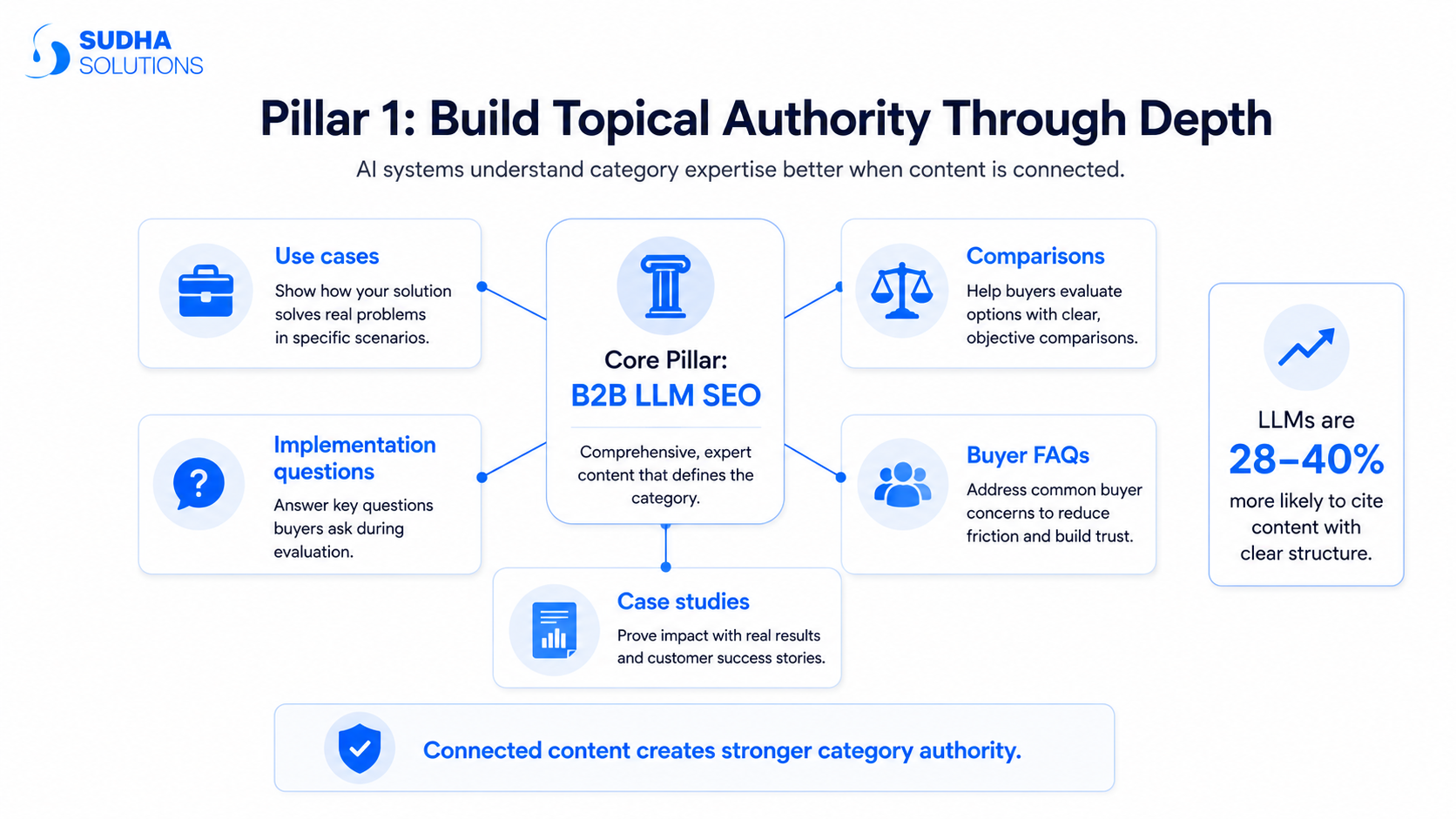
This is why the pillar-cluster content model introduced in What is GEO? A Beginner’s Guide is so directly relevant to B2B LLM SEO. A brand that has a central pillar on its core service area, surrounded by cluster articles covering specific sub-topics, case studies, use cases, and implementation questions, looks fundamentally different to an AI system than a brand with sparse, isolated content — even if the individual articles are technically of similar quality.
LLMs are 28 to 40% more likely to cite content with clear structural signals: proper heading hierarchy, defined sections, and answer-first formatting, according to research compiled by McKinsey in their September 2025 CMO Survey data. The structure communicates what the content is about as much as the content itself does.
2. Earned Authority Signals Built for AI
Traditional B2B SEO invested heavily in backlinks as the primary authority signal. LLM SEO requires a different kind of earned presence.
Brand mentions across the open web — in trade publications, analyst coverage, industry forums, and niche media — carry far more weight in AI citation decisions than link counts. Distributing content to a wide range of publications can increase AI citations by up to 325% compared to publishing only on a brand’s own site, according to Stacker’s December 2025 research.
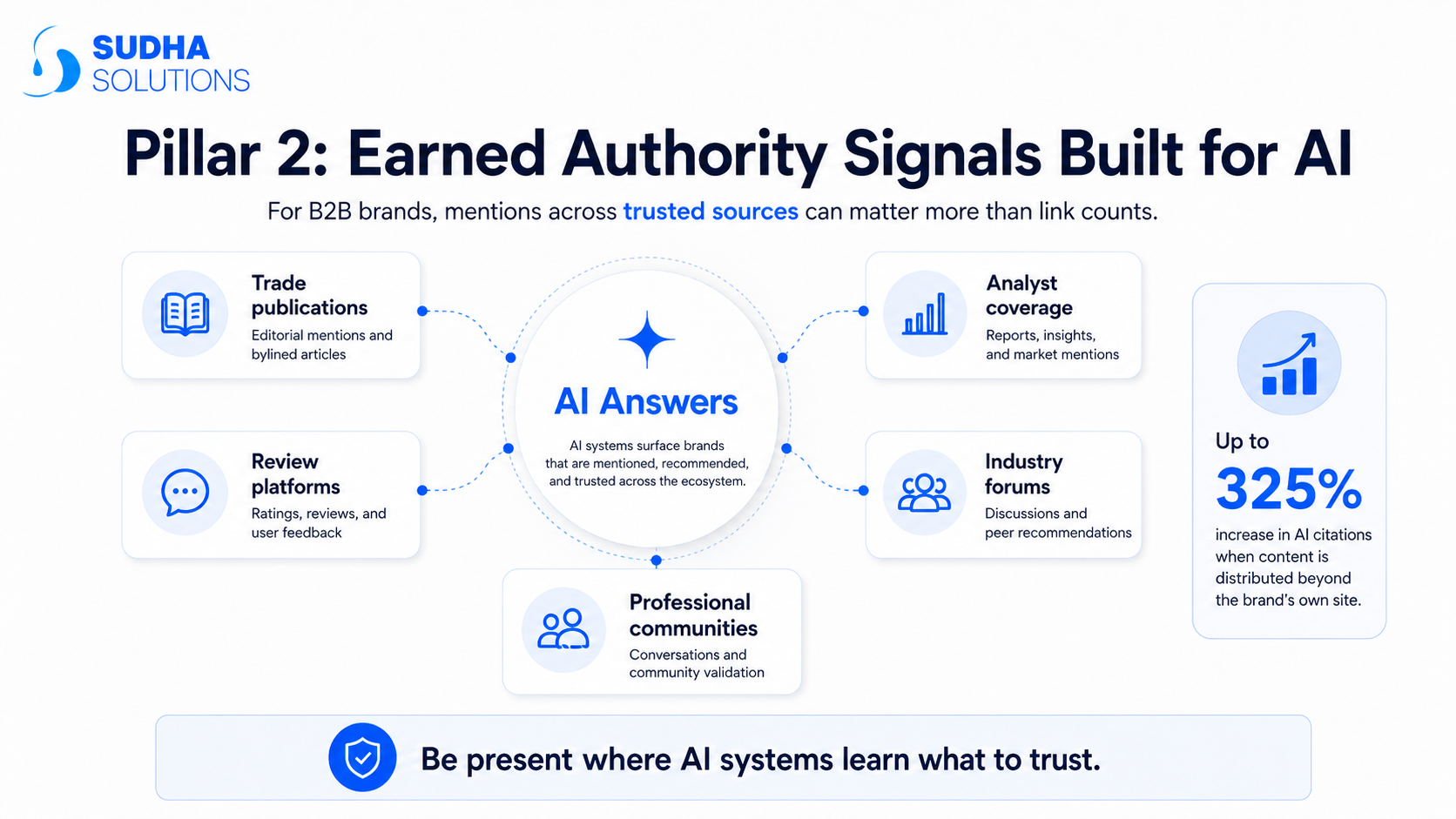
For B2B companies, the most effective earned media targets are the specific publications, communities, and analyst platforms that AI systems have learned to associate with their category. Industry trade publications in B2B software, services, and technology are cited disproportionately. Analyst firm coverage, third-party review platforms, and professional community discussions carry strong citation signals. These aren’t new channels for B2B marketing — but the strategic rationale for investing in them has changed.
It used to be about reaching buyers directly. Now it’s equally about being present in the sources AI systems draw on when buyers ask for recommendations.
3. Entity Clarity Across the Web
In B2B, where buyers are evaluating vendors they may never have heard of before, the way AI describes a brand shapes initial impressions more than any other early touchpoint.
LLMs don’t just retrieve content — they build internal models of what brands are, what problems they solve, and how credible they appear. A brand with inconsistent positioning across its website, LinkedIn profile, Crunchbase entry, G2 listing, and third-party coverage creates an ambiguous entity model. AI systems, like cautious buyers, default to clearer alternatives when they encounter ambiguity.
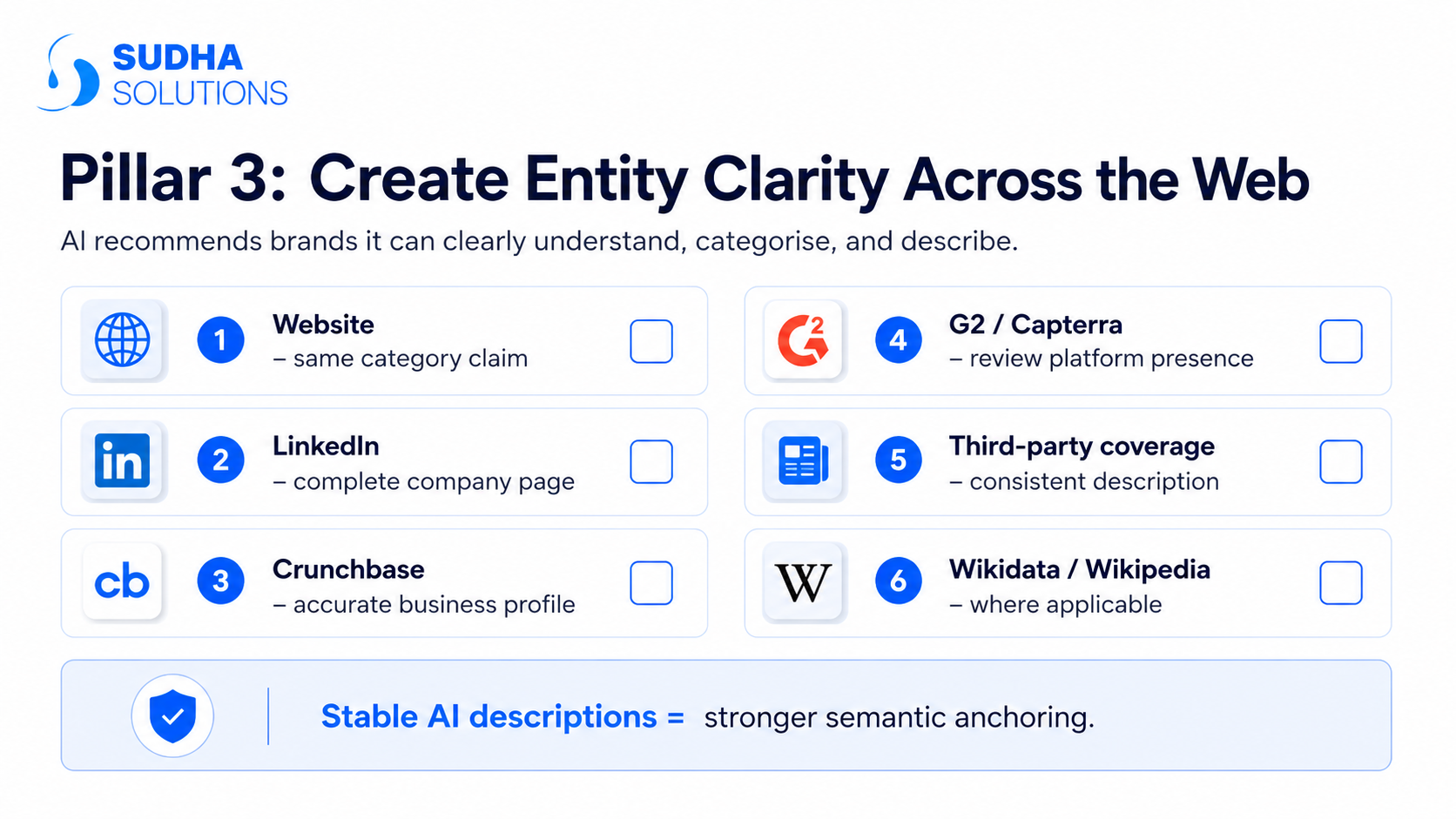
Entity clarity for B2B means: a consistent, specific description of what the company does and who it serves — not a generic “we help businesses grow” positioning, but a precise category claim that AI can use to match the brand to relevant queries. That positioning needs to appear consistently across every platform where the brand has a presence.
Search Engine Land’s December 2025 analysis of B2B brand visibility in LLMs found that AI brand signal stability — the consistency of a brand’s presence and positioning across LLM outputs over time — is becoming a core visibility metric alongside traditional share of voice and keyword rankings. Brands whose AI descriptions fluctuate sharply have fragile entity models. Brands with stable, consistent descriptions across platforms have strong semantic anchoring — the model reliably knows which category they belong to.
4. Technical Foundations That Don’t Block AI Access
Modern LLM-powered search ranking systems increasingly rely on crawlability, structured data, and AI-friendly content rendering. The most consistent finding across LLM SEO research is that a significant proportion of B2B websites create their own barriers to AI visibility through technical configuration.
73% of websites have technical barriers that block AI crawler access, according to OtterlyAI’s 2026 research. For B2B companies with complex, JavaScript-heavy websites built to impress human visitors, this is a particularly common problem. AI parsing success for static HTML runs at 94%; for JavaScript-rendered content, it drops to 23%.
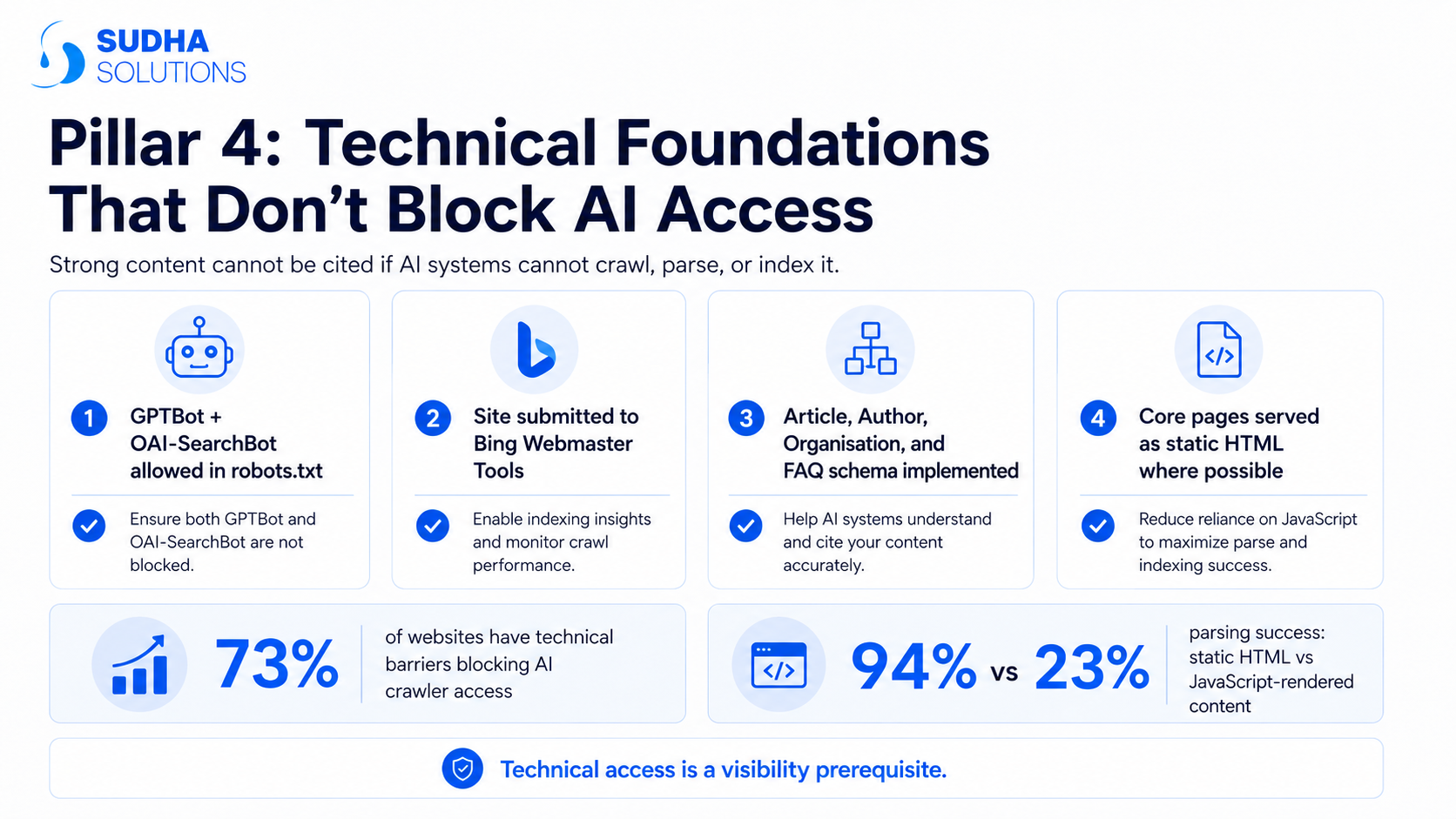
The practical checklist is straightforward but requires deliberate attention. GPTBot and OAI-SearchBot allowed in robots.txt. Site submitted to Bing Webmaster Tools. Article, Author, Organisation, and FAQ schema implemented. Core pages served as static HTML wherever possible. These changes don’t require a website rebuild — but they do require someone to check them and fix them, which most B2B marketing teams haven’t prioritised yet.
The LLM Perception Drift Problem
One aspect of LLM SEO that’s specific to how AI systems work deserves particular attention for B2B brands.
AI models are retrained periodically. When a model retrains, its internal representations of brands can shift, sometimes significantly. Research from Evertune tracking the project management software space between September and October 2025 found meaningful changes in how AI described major enterprise brands within just one month. Tools like Atlassian surged in AI visibility while others posted notable drops, without any apparent corresponding change in those brands’ actual web presence.
Search Engine Land’s December 2025 analysis described this as “LLM perception drift” — the dynamic and measurable shifts in AI brand perception as models evolve and retraining cycles accelerate. By 2026, AI brand signal stability is solidifying as a new visibility metric that sits alongside traditional share of voice and keyword rankings.
For B2B brands, this means LLM SEO isn’t a set-and-forget exercise. It requires ongoing monitoring of how the brand appears across AI platforms — using the audit process described in How to Audit Your ChatGPT Visibility — so that perception drift is caught and addressed before it affects buyer consideration.
Where to Start in Practice
The first practical step is understanding where the brand currently stands across the four major AI platforms — ChatGPT, Perplexity, Gemini, and Claude — using the audit process outlined in the previous article in this series.
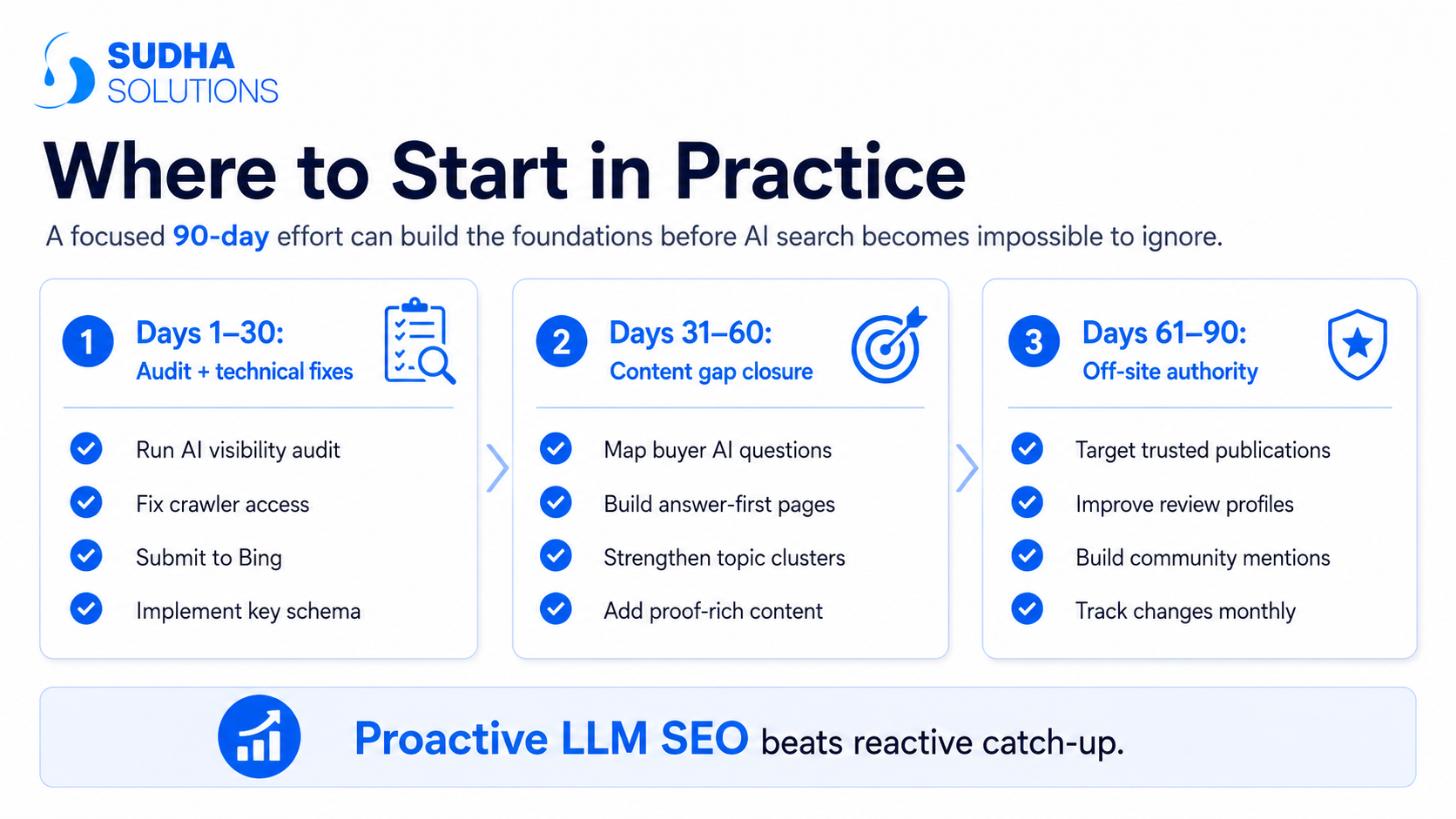
The second is a content gap analysis: Companies implementing AI-powered answer engine optimization can better align content with AI-assisted buyer research behavior. Mapping the questions B2B buyers in the category are asking AI systems against the content the brand currently has. Where buyers are asking questions the brand’s content doesn’t answer, those are the highest-priority content investments.
The third is an off-site presence audit: identifying the specific publications, review platforms, and community forums that AI systems draw on when answering category queries, and assessing where the brand is and isn’t represented.
The businesses gaining the most ground started building LLM visibility 12 to 18 months ago. An experienced AI-powered SEO agency can help organizations improve AI citation visibility and long-term generative search performance. But a focused 90-day effort — starting with technical fixes, the highest-priority content gaps, and the most impactful off-site presence targets — still creates real competitive advantage. The worst move, as the data consistently shows, is waiting for AI search to become undeniable before acting.
IDC projects companies will spend up to 5 times more on LLM optimization than traditional SEO by 2029. The investment is coming regardless. The question is whether it happens proactively or reactively.
Sudha Solutions helps businesses build visibility in AI search through content strategy, GEO, and digital marketing. Based in India, working with brands globally.
Frequently Asked Questions
Why is LLM SEO important for B2B companies?
LLM SEO is important because B2B buyers increasingly use AI tools like ChatGPT and Perplexity during vendor research, shortlist creation, and purchase evaluation.
What is the difference between SEO and LLM SEO?
Traditional SEO focuses on Google rankings, while LLM SEO focuses on improving visibility inside AI-generated answers and conversational search experiences.
How can B2B brands improve ChatGPT visibility?
B2B brands can improve ChatGPT visibility through entity SEO, GEO optimization, structured content, earned media coverage, and AI-friendly technical SEO.
What are the best platforms for AI search optimization?
Businesses should optimize for ChatGPT, Gemini, Perplexity, Claude, and Google AI Overviews because each platform influences AI-assisted buyer journeys differently.
Does technical SEO affect AI search visibility?
Yes. Crawlability, schema markup, Bing indexing, and AI crawler accessibility significantly impact AI search discoverability and citation visibility.