





You published a blog post last month. It was well-written, well-researched, and ticked every SEO box you knew about. Then you checked your traffic and wondered why nothing moved.
Here is what is probably happening: your content is being read by AI, summarised for users, and never clicked on. The user got their answer. You got nothing.
This is the reality of content marketing in 2026, where brands investing in SEO expert services and AEO services must optimize not just for clicks, but for AI-driven visibility. And if your strategy has not caught up to it yet, you are losing ground to competitors who have.
This post will walk you through what an AI-first marketing strategy actually looks like, why both SEO and AEO now need to sit in your plan together, and the practical steps to get started.
What is AI-first marketing?
AI-first marketing is a strategy that combines SEO, AEO, and content optimization to ensure your brand is discoverable, extractable, and citable across traditional search engines and AI-powered answer platforms.
First, What has Actually Changed?
This zero-click shift is reshaping search engine optimization services into a broader AI-first strategy
Not long ago, ranking on page one of Google meant traffic. People saw your link, clicked it, and landed on your site. That chain still exists, but it is breaking.
According to Search Engine Journal zero-click searches jumped from 56% in 2024 to 69% in 2025. That means nearly 7 out of 10 Google searches now end without anyone visiting a website. Add to that Google AI Overviews, ChatGPT Search, and Perplexity, all of which answer questions directly, and you start to see the problem.
But here is the flip side: those AI engines have to cite someone. They are pulling information from somewhere, and that somewhere could be your content.
That is where AEO comes in.
What is AEO and why does it matter?
For businesses adapting early, answer engine optimization is becoming as essential as traditional SEO.
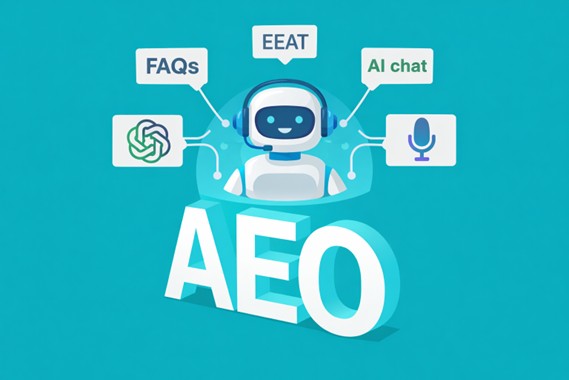
AEO stands for Answer Engine Optimization. Where SEO helps your content rank in search results, AEO helps your content get cited as the answer inside AI tools like ChatGPT, Google AI Overviews, and Perplexity.
Think of it this way: SEO gets you on the shelf. AEO gets you recommended by the shop assistant.
At HubSpot, traffic from AEO converted at 3x the rate of other sources, because users who arrive after an AI recommendation already trust the source they were sent to. The intent is higher; the scepticism is lower.
The brands winning in 2026 are doing both. This is why SEO and AEO now function best as integrated layers of a modern visibility strategy. They are building content that ranks in traditional search AND gets picked up by AI as the most credible answer.
What an AI-First Content Strategy Looks Like in Practice
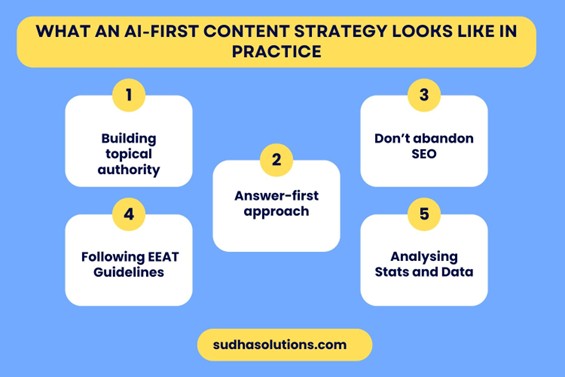
1. Build Topical Authority, not Just Individual Posts
A strong AI-first marketing strategy relies on content ecosystems, not isolated blog posts.
A structured topical authority framework built through pillar pages and clusters significantly improves both rankings and AI citations.
AI engines do not favour brands that wrote one good article on a topic. They favour brands that clearly own a subject area.
If you run a SaaS HR platform, you should not just have a blog post on “how to write a performance review.” You should have a full cluster of content covering reviews, feedback frameworks, one-on-ones, goal setting, and everything in between, all internally linked, all pointing back to a central pillar page.
This tells both Google and AI models: this brand is the authority here.
2. Write Every Piece so the Answer Comes First
This is where answer-led content becomes critical, helping AI systems extract and trust your information faster.
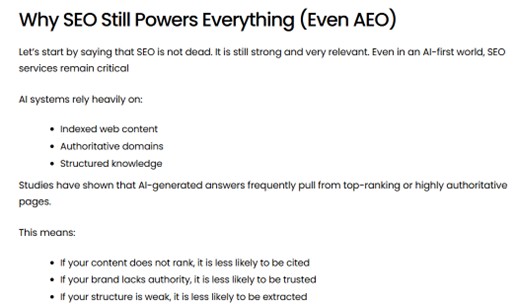
AI systems scan your content looking for a clear, direct response to a question. If your article spends the first three paragraphs warming up before getting to the point, you will be skipped.
The format that works:
- Start with a 40 to 60 word paragraph that answers the question directly
- Use subheadings that are themselves complete questions (“What is topical authority?” not just “Topical authority”)
- Add an FAQ section at the bottom covering related questions your audience is actually searching for
This structure serves your human reader and gives AI a clean block of text it can quote.
3. Make your Expertise Visible, not just Implied
Effective AI content optimization now requires explicit credibility signals that AI systems can verify.
A strong AI citation strategy depends on visible expertise, third-party trust signals, and content clarity.
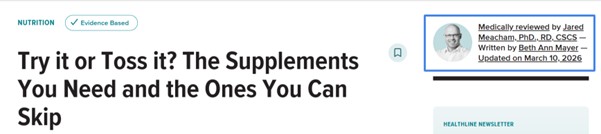
Google and AI models are trained to look for E-E-A-T signals: Experience, Expertise, Authoritativeness, and Trustworthiness. This is no longer a nice-to-have. It is a ranking and citation requirement.
Practical ways to build this into your content:
- Every article should have a real author with a bio, credentials, and a LinkedIn link
- Cite primary sources and original data wherever possible. AI models prefer content that references verifiable evidence over opinion pieces
- Earn mentions on other credible sites. Being cited by an industry publication is one of the strongest trust signals you can send to an LLM
A useful example: Semrush published an original study on AI Overviews in early 2025. That single piece of research now gets cited by ChatGPT almost every time someone asks about the topic. One well-researched, data-backed post can generate more long-term AI visibility than fifty generic “tips” articles.
4. Do not Abandon Traditional SEO
Your SEO strategy 2026 should still prioritize crawlability, technical performance, and search intent while layering AEO on top.
It might be tempting to pivot entirely to AI optimisation. But this is not possible, yet.
Google still handles the vast majority of searches. Core Web Vitals, backlinks, site structure, and keyword strategy still matter. The brands that will dominate in 2026 treat SEO and AEO as two layers of the same strategy, not competing approaches.
Build the technical foundation with SEO. Make the content citation-ready with AEO. Run both simultaneously.
5. Measure the Right Things
Modern brand mention tracking across AI ecosystems is now essential for measuring visibility beyond traditional traffic.

Your analytics need to evolve alongside your strategy. Organic clicks are no longer the only signal that your content is working.
Watch for:
- AI Overview appearances in Google Search Console
- Direct traffic lifts (often a sign users found you via AI and came back directly)
- Brand mention tracking across Perplexity, ChatGPT, and AI Overviews
- Lead quality from AI-referred traffic, not just volume
The Window to Act is Still Open, but Not for Long
Brands that built dedicated AEO strategies in early 2025 are now capturing 3.4x (340%) more answer engine traffic now than those who waited. That gap will only widen.
Most businesses are still writing content the way they did in 2020. That creates a genuine opportunity for brands willing to restructure their approach now, before the space becomes as competitive as traditional SEO.
The good news is you do not have to start from scratch. If you already have a content library, a lot of it can be restructured and updated to work harder in AI-era search. The bones are often already there.
Where to Start this Week
If you want to begin moving in this direction, here is a simple first step: pick your five most important existing articles and run them through this checklist.
- Does each article open with a direct, quotable answer in the first paragraph?
- Does each article have a clear author with visible credentials?
- Does each article include an FAQ section with question-formatted subheadings?
- Is each article internally linked to related content on the same topic?
- Is there FAQ Page or Article schema markup on the page?
If the answer to most of those is no, you have a clear starting point.
An AI-first content strategy is not about throwing out what you know. It is about building on it for the way search works today.
Want to create an AI-First Marketing Strategy in 2026?
We at Sudha Solutions have helped multiple brands get visibility on AI. We follow a effective template, which is loved by AI, helping your brand get mentioned by AI. Visit Sudha Solutions Today.
Frequently Asked Questions
Why are zero-click searches increasing?
AI-generated summaries, featured snippets, and answer engines are providing users direct answers without requiring website clicks.
Can existing content be optimized for AI search?
Yes, updating structure, adding FAQs, schema, and clearer answers can improve AI citation potential significantly.
How do I know if my content is being picked up by AI tools like ChatGPT or Google AI Overviews?
You can track this by monitoring brand mentions in AI-generated responses, checking Google Search Console for AI Overview impressions, and observing increases in direct traffic. These signals often indicate your content is being referenced even if clicks are low.
Should businesses invest more in AEO or traditional SEO right now?
It is not an either-or decision. SEO builds discoverability, while AEO drives credibility and conversions. Businesses that integrate both strategies tend to see stronger long-term performance across search and AI platforms.
What type of content performs best for AI-driven search engines?
Content that is structured, concise, and answer-focused performs best. This includes clear definitions, step-by-step explanations, data-backed insights, and well-organised FAQs that directly match user queries.
How often should existing content be updated for AI relevance?
High-performing or strategic content should be reviewed every 3–6 months. Updates should focus on adding clearer answers, improving structure, strengthening internal links, and incorporating recent data or trends.
Can smaller brands compete with large websites in AI search results?
Yes. AI engines prioritise clarity, authority, and relevance over brand size. A well-structured, niche-focused content strategy can outperform larger competitors if it demonstrates expertise and depth.