Sudha Solutions

Categories
Content Strategy Link Building

Are You Spending Money on Backlinks and Still Not Ranking?

Here’s What Most Businesses Get Wrong About SEO Authority (And How to Fix It) 

You’ve heard it before: “Backlinks are everything in SEO.” So your team buys a few. Rankings barely move. You buy more. Budget climbs. Results stay flat or worse, Google quietly penalises you and three months of work disappears overnight. 

Sound familiar? 

And you’re not wrong to invest in backlinks. You’re just investing in the wrong mix at the wrong stage of your domain’s growth. 

At Sudha Solutions, we’ve worked across industries and domain authority (DA) ranges to find the answer to a question every growth-focused business is really asking: How do we build SEO authority that compounds without gambling on Google penalties? 

The Real Problem Isn’t Paid or Organic. It’s Proportion. 

A strong backlink strategy works best when it is supported by a clear content and SEO structure

Here’s what no one tells you upfront: paid backlinking and organic backlinking are not enemies. They’re tools; and like any tool, the outcome depends on how, when, and how much you use them. 

The mistake most businesses make is treating link building as a single switch: either pay for links aggressively, or spend months on content marketing and wait. Neither extreme works. 

What works is a calibrated, stage-appropriate blend – one that shifts as your domain authority grows. 

First, Let’s Define the Playing Field 

Paid backlinking means acquiring links by paying website owners, publishers, or agencies to place a hyperlink back to your domain. This includes sponsored posts, niche edits, paid guest articles, and private blog network (PBN) links. 

Speed? Yes. Anchor text control? Yes. Risk? Significant — Google’s guidelines explicitly prohibit paying for links that pass PageRank. Sites that violate this face ranking demotions, manual penalties, and in serious cases, deindexing. 

Organic off-page backlinking means earning links without direct payment through content marketing, digital PR, journalist outreach (HARO/Connectively), broken link building, resource page inclusion, brand mention reclamation, and strategic relationship building. 

Slower? Yes. Riskier? No. More durable and compounding in value over time? Absolutely. 

Domain Authority (DA) is the Moz metric, scored 0 to 100 on a logarithmic scale, that predicts how well a website will rank on search engine results pages (SERPs). Moving from DA 20 to DA 30 is very different from moving from DA 60 to DA 70. The rules change as you climb. 

The Framework That Actually Works: Match Your Strategy to Your DA Stage 

This is where most SEO advice falls short – it treats all websites the same. Your domain’s authority level should directly determine your paid-to-organic ratio. 

Here’s the framework Sudha Solutions uses: 

DA 0-15: New Sites  

New sites have a cold-start problem. Minimal content, no referring domains, and little search engine trust. The temptation is to buy your way to visibility. Resist it, but don’t ignore paid entirely. 

Recommended mix: 30-40% paid / 60-70% organic 

At this stage, a handful of links from DA 30–50 sites creates meaningful movement. Use paid placements sparingly and deliberately; primarily niche edits and guest posts on mid-authority sites. Simultaneously, invest in HARO/Connectively responses, foundational content assets, and community engagement to build your organic baseline. 

The goal is momentum, not dependency. 

DA 15-35: Growing Sites 

Your site is appearing for long-tail keywords. You have some traction. This is where the decision about your link strategy has the most long-term consequences. 

Recommended mix: 25-30% paid / 70-75% organic 

Double down on content that earns links naturally. Launch your first digital PR campaign. Activate broken link building. Use paid placements surgically, to target specific competitive gaps, not as a volume play. 

Anchor text diversity matters enormously here. Uniform, over-optimised anchor text from paid placements is a red flag for Google’s algorithms. 

DA 35-60: Established Sites 

This also strengthens your brand’s visibility across AI-driven search platforms, where authority signals matter as much as rankings. You’re a recognised player in your niche. You rank for competitive mid-tail terms. The priority now shifts completely: it’s not about volume, it’s about quality and staying clean. 

Recommended mix: 15-20% paid / 80-85% organic 

The cost of a Google penalty at this DA level is severe – potentially years of equity wiped out. Paid link activity should be limited to premium, high-authority sources (DA 60+) with genuine editorial context. Think advertorials in reputable industry media, not bulk placements. 

Your primary investment should be scaling digital PR, commissioning original research, and building thought leadership content that attracts links on its own. 

DA 60+: High-Authority Sites 

At this level, your brand generates links naturally through media mentions, partnerships, and industry events. Paid backlinking has a very limited role here. 

Recommended mix: 5-10% paid / 90-95% organic 

Any misstep with paid links at this DA could mean catastrophic ranking losses. The only defensible paid activity is premium advertorials in top-tier media (think major industry journals or nationally recognised publications) that function as brand marketing, not just link acquisition. 

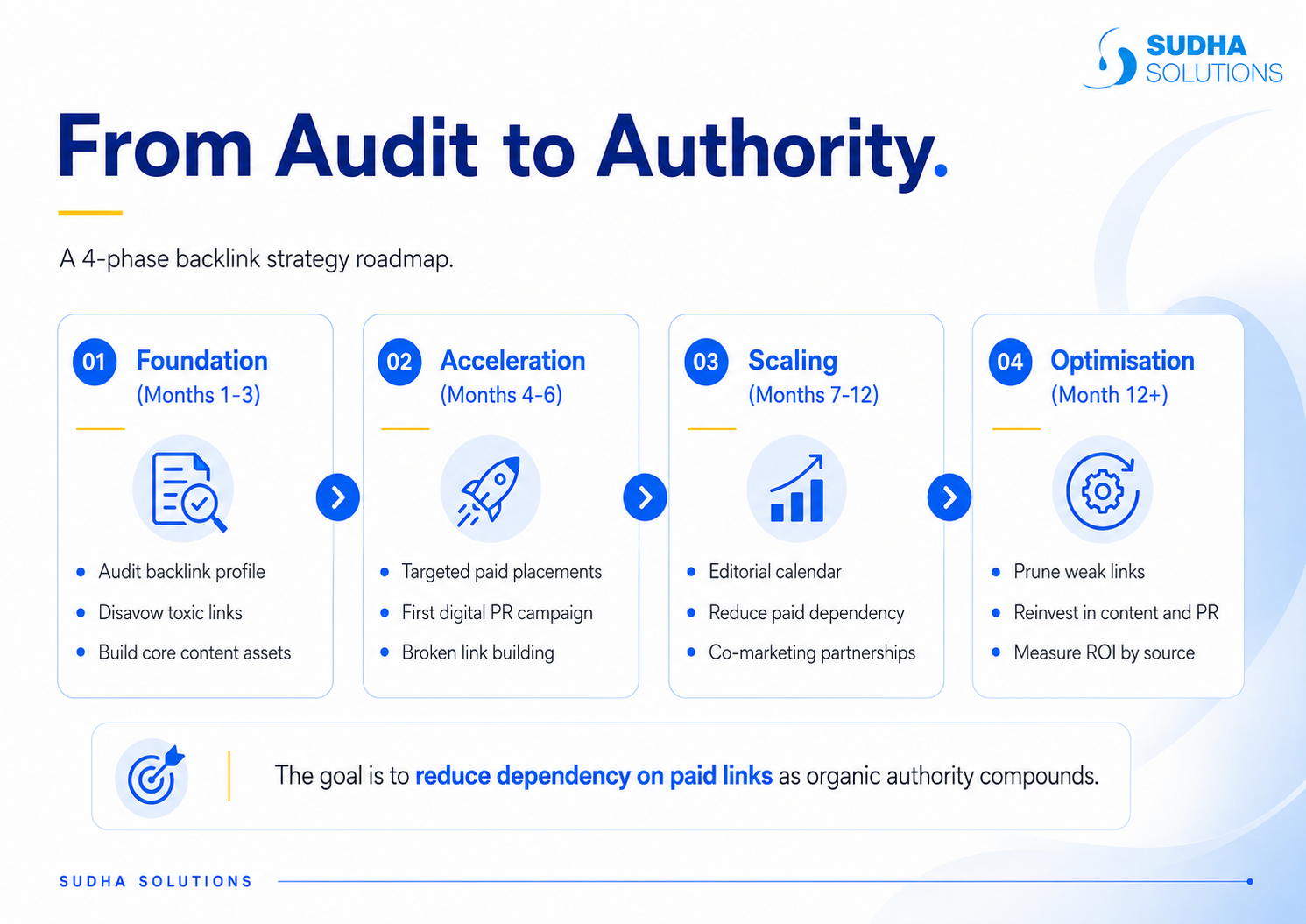
The Strategic Roadmap: From Audit to Authority 

From Audit to Authority

Getting from where you are to where you want to be requires a phased approach – not a spray-and-pray campaign. 

Phase 1 – Foundation (Months 1-3): Audit your current backlink profile. Identify and disavow toxic links. Set baseline metrics: DA, referring domains, organic traffic. Begin building content assets around your top 5–10 target keywords. Start HARO engagement. 

Phase 2 – Acceleration (Months 4-6): Deploy targeted paid placements to fill competitive keyword gaps. Launch your first digital PR campaign – ideally built around original data or research your audience will reference. Activate broken link building campaigns. 

Phase 3 – Scaling (Months 7-12): Build a dedicated editorial calendar. Reduce paid link dependency as organic compounds. Pursue strategic co-marketing partnerships for high-authority link opportunities. 

Phase 4 – Optimisation (Month 12+): Audit and prune expired or low-quality paid links. Reinvest those savings into content and PR. Target DA 70+ links exclusively through organic strategies. Measure ROI per link source and reallocate accordingly. 

What to Measure (So You Know It’s Working)

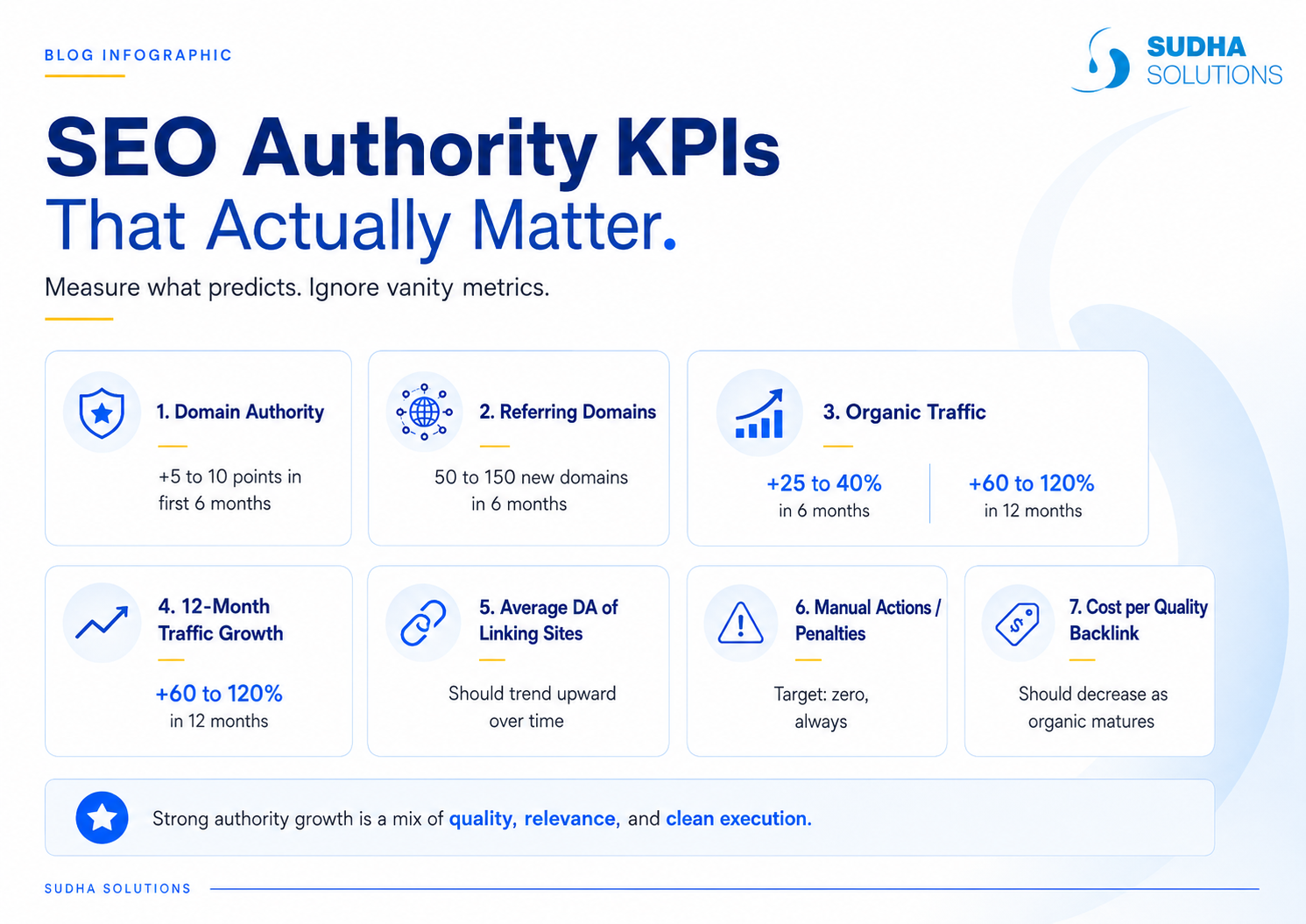
SEO Authority KPI

Vanity metrics won’t tell you the full story. These are the KPIs that matter: 

  • Domain Authority – target +5 to 10 points in the first six months 
  • Referring Domains – 50 to 150 new domains in six months is a healthy benchmark 
  • Organic Traffic – aim for 25–40% growth in six months, 60–120% in twelve 
  • Average DA of Linking Sites – should trend upward over time 
  • Manual Actions / Penalties – should remain at zero, always 
  • Cost per Quality Backlink – should decrease as organic activity matures 

The Bottom Line 

The organisations that win the long game in SEO are those that build authority through genuine value creation; content that earns links, brands that attract mentions, strategies that compound rather than rent results. 

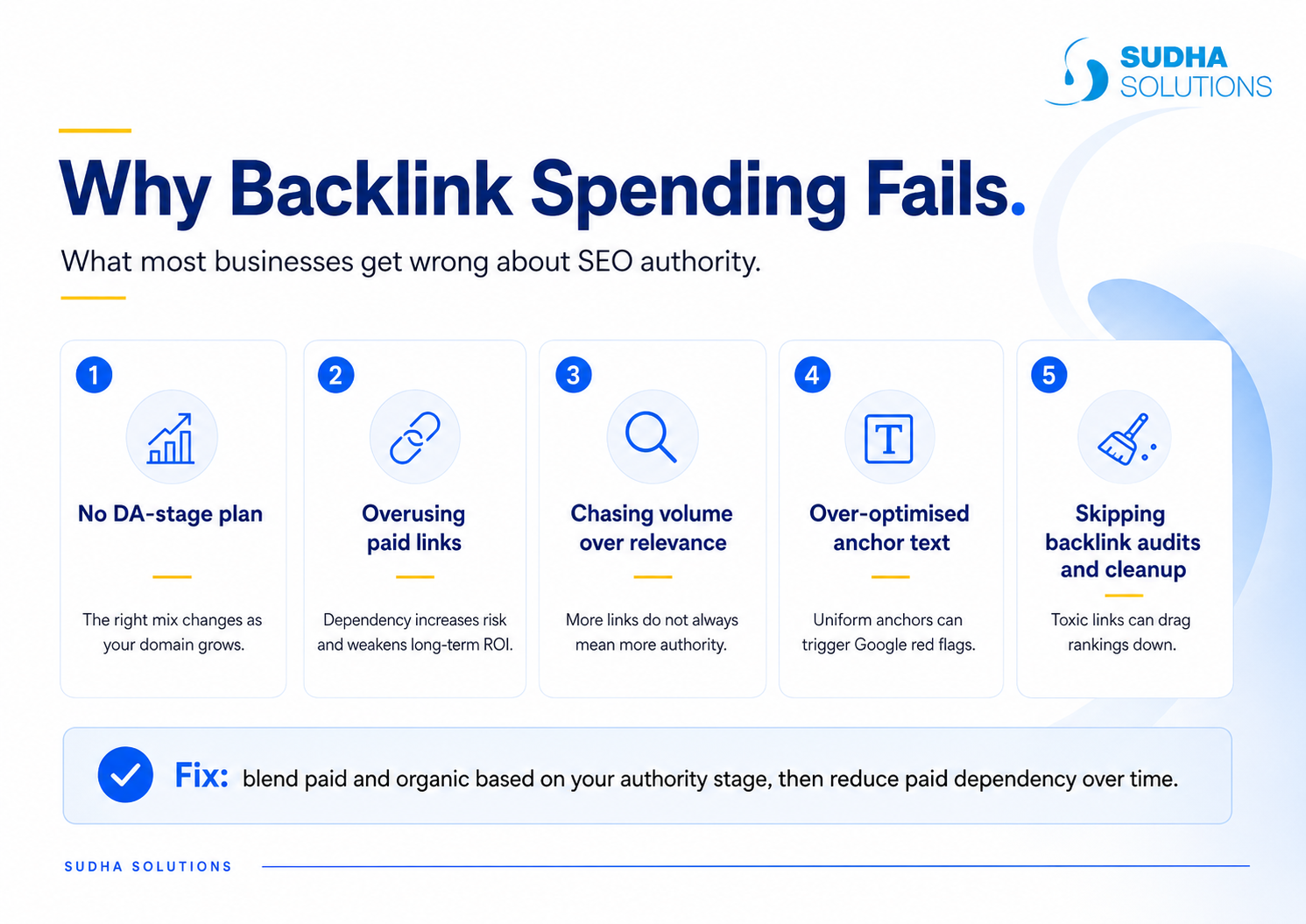
why backlink spending fails

Paid backlinking is a legitimate tactical tool. But it should operate with a defined exit timeline, a shrinking allocation, and never as a substitute for the harder, more rewarding work of earning authority. 

Ready to Build SEO Authority That Lasts? 

At Sudha Solutions, we design and execute link-building strategies calibrated to your exact DA stage, niche, and growth objectives. Whether you’re launching a new domain or protecting a high-authority site, we’ll help you find the right blend, and the right partners, to build ranking power that compounds. 

Get in touch with Sudha Solutions → 

Want the full strategic framework, including detailed DA-stage ratio tables, KPI benchmarks, and our complete implementation roadmap? Download our whitepaper: Paid vs. Organic Backlinking – The Strategic Decision-Maker’s Guide. 

Categories
AEO Optimization AI Overview Content Strategy Ecommerce General SEO

Why Acquisition Without Retention is a Losing Game

Acquisition without retention is a losing game because rising customer acquisition costs, low first-purchase profitability, and increasing churn mean businesses cannot recover their marketing spend unless customers return and generate long-term value. Retention drives profitability, improves conversion rates, and enables sustainable growth through higher customer lifetime value (CLV).

This is why a structured retention marketing strategy has become essential for brands looking to scale sustainably instead of constantly replacing churned customers.

For years, growth meant one thing: acquiring more customers. But in 2026, brands relying only on customer acquisition strategy without customer retention marketing are discovering that scale without retention is structurally unsustainable.

More traffic. More installs. More leads. More spend.

But by 2026, that playbook is breaking.

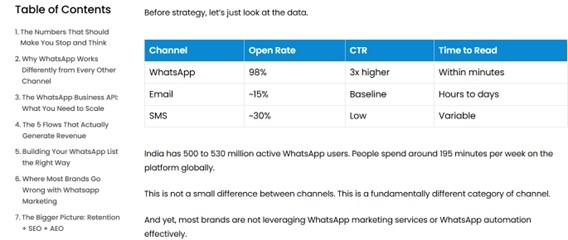
  • Acquiring a new customer is 5–25x more expensive than retaining one
  • A 5% increase in retention can boost profits by 25–95%
  • 65% of revenue typically comes from existing customers
  • Yet ~80% of budgets still go to acquisition

Brands still behave as if acquisition alone creates growth.

The truth is, it doesn’t.

What brands are actually doing is continuously replacing lost customers with new ones that too at an increasing cost.

And that’s not growth; that’s a leak disguised as scale.

The real shift brands should accept is: Retention is no longer a support function. It is the growth engine.

This guide explains why customer acquisition without retention fails and how to fix it using CLV, churn analysis, and retention-first strategy.

Key Takeaways

  • Acquisition without retention creates a leaky growth system
  • Retention determines whether CAC is justified or wasted
  • Most churn happens in the first 30–60 days, not long-term
  • Activation > acquisition in driving retention
  • LTV is often miscalculated; time-to-value matters more
  • Not all customers are worth retaining; focus on high-LTV cohorts
  • The best acquisition channels are those that bring users who stay
  • Retention is driven by habit formation, not satisfaction
  • Growth without retention is a treadmill, not a flywheel


Core Problem: The “Leaky Bucket” Economy

Core Problem: The “Leaky Bucket” Economy

Without lifecycle systems like email retention marketing, SMS marketing services, and WhatsApp marketing solutions, acquisition becomes an increasingly expensive replacement cycle.

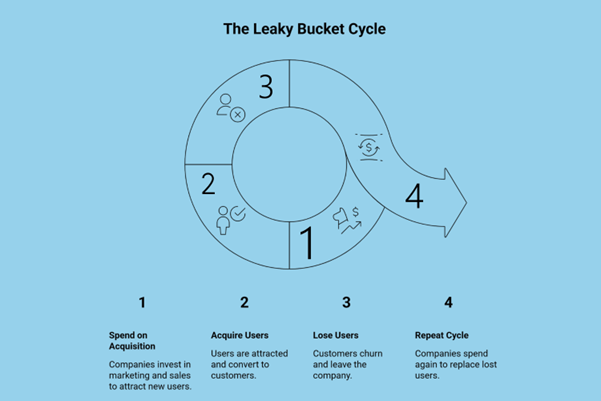
Most companies operate like this:

Spend → Acquire → Lose → Repeat

This is what marketers call the leaky bucket problem.

  • You pay for users (ads, content, sales)
  • They convert once
  • They disappear
  • You spend again to replace them

Research from Demandsage, and compiled retention data show that companies generate 65% of their revenue from existing customers, yet 44% of businesses still prioritise acquisition over retention and a stunning 18% say they prioritise retention at all. The majority are, quite literally, running to stand still.

What makes this particularly dangerous in 2026 is that the cost of running the faucet has become exponentially more expensive. The CAC (Customer Acquisition Cost) landscape has fundamentally changed and most marketing plans haven’t caught up.

What Customer Acquisition Really Costs in 2026?

Here is what most acquisition-heavy playbooks obscure: the stated Customer Acquisition Cost (CAC) is almost never true.

A sustainable customer acquisition strategy must now balance immediate paid growth with retention systems that protect CAC efficiency.

It typically includes:

  • Media spend
  • Campaign costs
  • Lead generation

But excludes:

  • Sales team overhead
  • Onboarding and implementation costs
  • Discounts and first-purchase incentives
  • Failed conversions and drop-offs
  • Re-acquisition of churned users

When you apply full-cost accounting to CAC, the numbers shift dramatically.

According to a 2023 analysis by Hashtag Paid, the acquisition-to-retention cost ratio ranges from 3x to 25x, depending on:

  • Business model
  • Industry
  • Customer segment
  • GTM motion

B2B SaaS typically falls in the 5–10x range, but even that can be misleading without retention context.

The commonly cited “5x” figure traces back to a 1990 Harvard Business Review paper on credit card and insurance data, built on pre-internet data. And most teams are still making modern decisions using such outdated economic assumptions.

According to First Page Sage Industry CAC Data, the average cost to retain a customer is $35 versus $702 to acquire one. The retention cost is nearly 95% cheaper. Yet only a handful of SaaS companies prioritise it.

Why Retention Compounds Where Acquisition Doesn’t

“Increasing customer retention rates by just 5% increases profits by 25% to 95%.”

  • Frederick Reichheld, Bain & Company

The mechanics that drive this are rarely explained clearly. Here is how we think about them at Sudha Solutions:

1. Existing customers spend 67% more

Returning customers have already resolved purchase anxiety. Bain & Company research shows they spend 67% more on average per transaction than first-time buyers.

2. 60–70% vs 5–20% sell-through

Forrester data shows the probability of selling to an existing customer is 60–70%. For a new prospect, it’s 5–20%. The point? Your best leads are already in your CRM, leverage them.

3. Referred customers have 16% higher LTV

McKinsey case study data shows referred customers are 37% more likely to stay and carry 16% higher lifetime value, which thereby minimises future CAC.

4. Retention-focused firms grow 2.5x faster

Artisan Strategies 2026 benchmark: retention-focused companies grow revenue 2.5x faster than acquisition-first peers while spending 30% less on marketing.

Understanding CLV: Why Your Best Customer Is Already on Your List

Understanding CLV: Why Your Best Customer Is Already on Your List

At Sudha Solutions, customer lifetime value optimization begins with integrating retention channels like email, SMS, and WhatsApp into one measurable lifecycle. Customer Lifetime Value (CLV) is the single metric that unifies acquisition and retention into a coherent strategy. At its simplest:

CLV = Average Order Value × Purchase Frequency × Customer Lifespan.

McKinsey’s research on CLV shows that companies with higher customer lifetime values experience, on average, 38% faster revenue growth and 30% higher enterprise valuations than competitors. That’s the difference between a business that attracts strategic acquirers and one that doesn’t.

Yet only 42% of companies can accurately measure CLV, despite 89% agreeing it’s crucial for brand loyalty, says Criteo.

This is the critical gap: businesses acknowledge the importance of lifetime value in theory, but haven’t built the systems to track, model, or optimise for it in practice.

At Sudha Solutions, we see this repeatedly in client audits: teams celebrating a record CAC month while their 90-day repeat purchase rate has quietly achieved a new low. The acquisition metric looks great on the slide deck. The business is slowly dying. The fix isn’t better acquisition but retention infrastructure that didn’t exist before.

Churn Rates by Industry: Where Businesses are Actually Bleeding Money

Churn rate for every business varies. That’s why understanding your industry baseline is the first step in knowing whether your retention problem is structural or operational.

The CustomerGauge State of B2B Account Experience report provides the most reliable cross-industry churn benchmarks available today. Here’s what gist is:

Industry Annual B2B Churn Rate
Energy / Utilities 11%
IT Services 12%
Software (SaaS) 14%
Financial Services 19%
Professional Services 27%
Telecom 31%
Manufacturing 35%
Logistics 40%

In the B2C space, the picture gets starker. Global retail churn sits near 37%. U.S. hospitality and restaurant businesses average 45% churn. The average social media app loses over 90% of users within 24 months.

How to Build a Retention-First Strategy That Enhances Your Acquisition Efforts

Here’s the part most brands miss:

Retention-first is not anti-acquisition. It makes acquisition cheaper, stronger, and scalable.

When retention improves:

  • Customers stay longer → LTV increases
  • They refer others → organic acquisition rises
  • CAC drops → you can reinvest more aggressively

That’s the flywheel. Most teams never build it because they treat retention and acquisition as separate.

1. Use Retention Data to Sharpen Acquisition Targeting

Your best acquisition strategy is hidden in your retained cohorts.

Instead of guessing who to target, look at the customers who stayed the longest, spent more, and recommended you. See what they had in common when they first found you: where they came from, what message or offer worked, and how they started using your product.

This is what cohort-based CLV modelling exists to do. When you know that customers acquired via SEO-driven organic content have a 14-month average LTV versus 6 months for paid social, your acquisition budget allocation changes completely.

This is why organic customer acquisition often produces stronger long-term LTV than many short-term paid channels.

In short: use what you learn from loyal customers to improve how you find new ones.

2. Make Onboarding the Bridge Between Acquisition and Retention

Strong onboarding often combines ecommerce email marketing solutions, sms retention campaigns, and whatsapp customer engagement to accelerate time-to-value.

The gap between “acquired” and “retained” is almost always an onboarding gap. A customer who completes a strong onboarding sequence is more likely to stay, spend more, and recommend you. That means each acquired customer is worth more in downstream revenue.

This is where ecommerce email marketing solutions become critical, helping brands engineer onboarding, nurture, and lifecycle sequences that increase long-term retention.

The retention-first framing reframes onboarding as a revenue event, not a support function. Wen onboarding gets the attention it deserves, customers reach their “aha moment” faster, embed the product into their workflow more deeply, and become the kind of buyer who sends their colleagues your way.

3. Let Retention Metrics Govern Acquisition Spend

Brands using SEO expert services for long-term acquisition and retention-led lifecycle systems often outperform acquisition-only competitors on both CAC efficiency and LTV.

Don’t judge channels only by cost per lead or sign-up. Those numbers ignore what happens next. A cheaper channel isn’t better if most of those customers leave quickly. A more expensive channel can be worth it if those customers stick around.

Track how long customers stay (after 30, 60, and 90 days) for each channel. This simple shift often shows that a big chunk of your budget is going to low-quality customers.

Move that spend to channels that bring people who stay longer. You’ll get better results without increasing your budget.

4. Build Social Proof from Retained Customers

Don’t rely only on feedback from new customers. Stories, reviews, and case studies from people who’ve stayed 18+ months are far more convincing. They show your product actually works over time, which builds trust and helps new buyers decide faster.

Make it a habit to collect and share experiences from your longest-standing customers. This creates a powerful, lasting asset that ads can’t match and it keeps getting stronger over time. This is the retention-first strategy’s most underrated acquisition benefit, and it’s almost never deliberately engineered.

The SS Retention Framework: Audit → Anchor → Activate

At Sudha Solutions, we’ve distilled effective retention strategy into 3 sequential phases. This isn’t a content strategy or a loyalty programme but a structural audit and rebuild of how your business relates to existing customers.

The SS Retention Architecture: 3 Phases

Phase 01: Audit

  • Calculate true CAC (full-cost)
  • Map churn by cohort & source
  • Measure CLV vs. CAC ratio
  • Identify first 90-day drop-off
  • Survey churned customers

Phase 02: Anchor

  • Rebuild onboarding as 90-day arc
  • Identify & invest in top 20% accounts
  • Build early churn signal model
  • Create proactive support triggers
  • Map emotional loyalty touchpoints


Phase 03: Activate

  • Deploy personalised lifecycle flows
  • Launch referral with LTV incentives
  • Build cross-sell cadence
  • Align CAC/CLV in one dashboard
  • Set 5% retention improvement target

This often includes WhatsApp marketing solutions that automate cart recovery, post-purchase engagement, and repeat purchase journeys.

Final Thoughts

Acquisition gets you customers. Retention determines whether you have a business. The brands that will dominate the next five years are not those that find the lowest-cost acquisition channel; it’s those that have built a system where customers stay, spend more, and bring others with them.

In 2026, the leaky bucket is getting more expensive to fill every quarter. Digital ad costs are up. Signal fidelity is down. Competition is intensifying. The only sustainable advantage in that environment is a customer base that doesn’t want to leave.

At Sudha Solutions, we believe the question for every marketing team right now isn’t “how do we get more customers?” I’’s “why are the customers we already have leaving and what would it take to make them stay forever?”

Answer that question with data, and the rest of your growth strategy writes itself.

Frequently Asked Questions

What is the difference between customer acquisition and customer retention?

Customer acquisition is about bringing in new customers, while customer retention focuses on keeping them coming back. Acquisition fills the funnel, but retention determines whether that growth actually sustains.

Why is customer retention more important than acquisition?

Customer retention is more important than acquisition because retaining customers costs significantly less, increases customer lifetime value, improves profitability, and creates sustainable long-term growth.

What is a good customer churn rate?

A good churn rate varies by industry, but for SaaS, anything under 10–15% annually is considered healthy. Higher churn usually indicates gaps in onboarding, product value, or customer experience.

How do you calculate customer lifetime value (CLV)?

Customer lifetime value is calculated by multiplying average order value, purchase frequency, and customer lifespan. It shows how much revenue a business can expect from a customer over time.

How can businesses improve customer retention?

Retention improves when businesses help customers see value quickly, stay engaged, and build consistent usage habits. Strong onboarding, personalized communication, and ongoing value delivery are key drivers.

Categories
Content Strategy General SEO

Content That Ranks vs. Content That Converts: Why You Need Both

You’ve spent months publishing blog posts as part of your content marketing strategy. Traffic is climbing, your SEO expert services are driving rankings, and Google is rewarding you with page-one visibility. 

And then you look at your leads dashboard. 

Nothing. 

Or maybe it’s the opposite. You have a beautifully written services page that explains exactly what you do, why you’re different, and why clients should work with you. The people who find it love it. The problem? Almost no one finds it. 

Both situations are more common than most businesses admit. And both come down to the same misunderstanding: Ranking and converting are not the same goal, but they need each other. 

Let’s break down what each type of content actually does, why treating them as separate work is quietly costing your business, and how to connect them into something that works from end to end. 

What Is “Content That Ranks”? 

What Is "Content That Ranks"?

Content that ranks is built for search engines and the people using them. Its primary job is to be found. 

This is where seo services in mumbai and strategic search engine optimization services play a critical role helping businesses create discoverable assets that generate sustainable organic traffic growth. 

When someone types “how to reduce employee turnover” or “best project management tools for small teams” into Google, they’re not looking for a sales pitch. They want information. Content that ranks meets them there. It answers their question clearly, earns their attention, and builds familiarity with your brand. 

This type of content typically includes: 

  • Informational blog posts: “What is [topic]”, “How does [process] work”, “X ways to [solve a problem]” 
  • Industry guides and explainers: Long-form resources that cover a subject in depth 
  • Statistics roundups and research summaries: Content that earns links because it’s genuinely useful as a reference 
  • Tutorials and how-to content: Step-by-step walkthroughs of a specific task 

This is also where a strong pillar page SEO strategy becomes powerful, allowing brands to build topical authority instead of publishing disconnected blogs. 

The SEO mechanics behind it, such as keyword research, internal linking, page structure, and backlinks, exist to help this content get discovered. But the content itself wins or loses based on how well it serves the reader’s intent. 

A useful way to think about it: Ranking content is a lighthouse. It doesn’t close the deal. It gets people to your website. 

What Is “Content That Converts”? 

Content that converts is built for decisions. Its job is to take someone who already knows they have a problem and help them choose you as the solution. 

This is where content marketing experts and conversion-led content marketing services become essential, because traffic alone does not build revenue unless content is designed to drive decisions. 

This is the content your sales team wishes existed. It speaks directly to the doubts, comparisons, and questions that come up right before someone commits. 

This type of content typically includes: 

  • Service and product pages: What you offer, who it’s for, and what makes it different 
  • Case studies: Real client results told as a story 
  • Comparison pages: How you stack up against competitors 
  • Proof pages: Social proof that reduces risk in the buyer’s mind 
  • Sales emails and nurture sequences: One-to-one persuasion at scale 

The mechanics here are different too. Think clear value propositions, specific outcomes, strong calls to action, and trust signals like client logos or accreditations. 

Why Most Businesses Treat These as Two Different Things (And Why That’s a Problem) 

Here’s what typically happens. 

Many brands invest in SEO without a structured content marketing strategy, while others build persuasive pages without discoverability—creating a disconnect between rankings and revenue. 

The marketing team focuses on SEO. They publish regularly, traffic grows, and they celebrate the wins in monthly reports. Meanwhile, the website’s service pages were written three years ago by someone who’s no longer at the company. The case studies section has two entries. The main CTA is “Contact Us.” 

On the other side, some businesses invest heavily in a polished website. Every page is beautifully designed and persuasively written. But there’s no blog, no educational content, and no reason for Google (or anyone else) to send new visitors there. The only people who see it are the ones who already know to look. 

Both teams are doing real work. But neither is building a system. 

  Content That Ranks  Content That Converts 
Primary goal  Get discovered by new audiences  Turn interested visitors into leads or clients 
Reader mindset  “I have a question or a problem”  “I’m comparing options or ready to decide” 
Typical format  Blog posts, guides, tutorials  Service pages, case studies, comparison pages 
Success metric  Organic traffic, rankings, time on page  Conversion rate, leads, demo requests 
When it fails alone  Visitors arrive but don’t take action  Great page, but no one sees it 

The table above makes the gap obvious. Each type of content has a job it’s genuinely good at. The mistake is expecting one to do the other’s job. 

Also Read: Performance Marketing vs Content Marketing: Where Should a D2C Brand Invest First 

The Real Issue: Intent 

The reason high traffic doesn’t always lead to conversions comes down to one word, and that word is intent. 

Every person who lands on your content is at a different stage of their decision. Someone reading “what is content marketing” is curious. They’re learning. They’re nowhere near ready to hire an agency. Someone reading “content marketing agency for B2B SaaS” is actively looking. They want options. 

This is the difference between informational intent and commercial intent, and it should shape everything: the format of the content, the language, the CTA, and where it links. 

Here’s a simple way to map it: 

Funnel stage  What the reader wants  Content type  Right CTA 
Top (Awareness)  To understand a problem or topic  Blog posts, guides  Download a free resource, read a related post 
Middle (Consideration)  To compare options and evaluate solutions  Case studies, comparison posts  Book a call, get a sample 
Bottom (Decision)  To choose and commit  Service pages, testimonials, pricing  Start now, request a proposal 

Most content lives at the top of this table and never connects to the bottom. That’s where the revenue gap hides. 

What “Connected Content” Actually Looks Like 

What "Connected Content" Actually Looks Like

A true seo content strategy connects ranking content with conversion-focused assets through strategic internal linking, building a complete lead generation content system. 

Here’s a real-world example of how these two types of content work together when they’re treated as a system rather than separate tasks. 

The chain: 

  1. A business owner searches “how to improve my company’s online visibility.” They find a well-written blog post that answers the question thoroughly and ranks on page one. That’s ranking content doing its job.
  2. Halfway through the post, there’s a natural mention: “If you’re a service business trying to grow organic traffic without a full-time content team, here’s how we helped a logistics company triple their blog traffic in 8 months.” That links to a case study.
  3. The case study is specific. It names the challenge, walks through the approach, and shares the results. At the end, it says: “Want to see if this approach would work for your business? Let’s talk.” That’s a CTA that matches where the reader is right now.
  4. The reader books a discovery call. 

No hard sell. No disconnected experience. Just a clear path from a search query to a conversation. 

That’s what connected content looks like. Each piece does one job well and hands the reader to the next piece naturally. 

The Mistakes That Break the Chain 

Even when businesses have both ranking content and conversion content, they often break the connection in one of these ways. 

  1. Generic CTAs at the end of every post

“Want to learn more? Contact us.” This tells the reader nothing. A CTA should reflect where the reader is in their thinking. An educational post about content strategy should link to a relevant case study, not a generic contact form. 

  1. No internal linking strategy

Your top-performing blog post gets thousands of visits a month. Your best case study has been seen by 47 people, all of whom you personally sent the link to. These two pieces of content have never met. A single contextual link from one to the other could change that. 

  1. Measuring ranking content only on traffic

If your monthly report only shows sessions and page views for blog posts, you’re missing the full picture. Blog content that contributes to a conversion three weeks later won’t show up in last-click attribution. When you track assisted conversions, you’ll often find that your “lowest performing” posts are doing more work than you realised. 

  1. Writing for the algorithm, not the reader

Ranking content written to hit a keyword density or satisfy a content brief, but not to actually help the reader, won’t convert even when someone reads it all the way through. The quality of the content is part of the conversion path. 

What E-E-A-T Has to Do With This 

Strong strategic content marketing supports E-E-A-T by combining expertise-driven blog content with trust-building service pages. 

Google’s quality guidelines use a framework called E-E-A-T: Experience, Expertise, Authoritativeness, and Trustworthiness. It was designed to evaluate the credibility of content, but it’s also a useful lens for thinking about whether your content does both jobs well. 

In 2026, this authority model extends beyond traditional SEO into a broader SEO + AEO + GEO strategy, where discoverability, extractability, and AI visibility all work together. 

Here’s why it matters for ranking and converting: 

Experience means your content reflects first-hand knowledge, not just researched summaries. A case study written from your own client work signals experience. A blog post that shares a genuine lesson from a campaign you ran signals experience. Readers and Google can both tell the difference. 

What E-E-A-T Has to Do With This 
 Expertise means the depth and accuracy of what you share. If your content answers the question a reader actually has, not a watered-down version of it, it earns time on page, return visits, and links. These are the signals that build authority over time. 

how content strategy works

Source 

Authoritativeness means being a recognised voice in your space. This comes from consistent publishing, earning mentions and links from credible sources, and having a clear point of view rather than covering every topic shallowly. 

Active brand mention monitoring also plays a critical role here, helping brands understand where they are being discussed, cited, and trusted across both search engines and AI platforms.
 

What E-E-A-T Has to Do With This 

Trustworthiness is what makes someone act. Real client names. Specific numbers. An actual human behind the content. A privacy policy and a professional design. These aren’t extras. They’re part of what converts a reader into an enquiry. 

Content that genuinely meets the E-E-A-T standard tends to rank better and convert better. Because what Google rewards and what buyers respond to are, at their core, the same thing: content that’s clearly written by someone who knows what they’re talking about, and has the proof to back it up. 

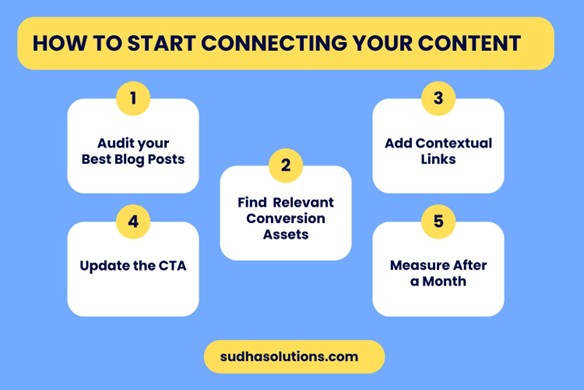
How to Start Connecting Your Content 

How to Start Connecting Your Content

You don’t need to rebuild your entire content strategy. Start with one fix that has an immediate impact. 

Step 1: Audit your highest-traffic blog post. Where does a reader go when they finish it? If the answer is “back to Google,” you have a leaking funnel. That post is earning attention you’re not capturing. 

Step 2: Find the most relevant conversion asset you already have. A case study, a comparison page, a service page. Something that takes a reader a step closer to working with you. 

Step 3: Add one contextual internal link. Not a banner. Not a sidebar widget. A sentence in the body of the post that says, in plain language, “here’s the next relevant thing for someone who found this useful.” 

Step 4: Update the CTA. Match it to where the reader actually is. If the post is educational, the CTA should offer something educational, like a related guide, a free template, or a relevant case study. Save the direct pitch for the pages where the reader has already self-selected. 

Step 5: Measure over 30 days. Look at assisted conversions, not just traffic. Did more people reach your service pages from that post? Did any of them convert? 

That’s one post, one link, one updated CTA. It’s not a strategy overhaul. It’s a proof of concept. Once you see it work, you do it again. 

Final Thougths 

Ranking and converting aren’t competing priorities. They’re two parts of the same job. 

Content that ranks without converting is a cost centre dressed up as a marketing win. Content that converts without ranking is a well-kept secret. Neither one alone builds a business. 

The brands that get this right aren’t publishing more. They’re publishing with intention. Every piece of content knows its job, knows where it sits in the reader’s journey, and knows where to hand off to the next piece. 

If your content strategy is built around one or the other right now, you’re not failing. You just have half the system. The other half is closer than you think. 

At Sudha Solutions, our seo expert services and content marketing experts work together to build systems that drive both visibility and conversions. 

From seo services in mumbai to strategic content marketing services, we help businesses create content that ranks, converts, and compounds long-term growth. 

Frequently Asked Questions

How do you turn blog traffic into actual leads?

Turning blog traffic into leads requires strategic internal linking, relevant CTAs, and guiding users to high-intent pages like case studies or service pages instead of generic contact forms.

What is the biggest mistake in content marketing strategies?

The biggest mistake is treating SEO content and sales content as separate efforts, instead of building a connected journey that moves users from awareness to decision.

How important are CTAs in blog content?

CTAs are critical. A well-placed, context-driven CTA can significantly improve conversions, while generic CTAs often fail to engage readers or move them forward.

Can informational content directly generate sales?

Not usually. Informational content builds trust and attracts traffic, but it needs to be connected to conversion-focused content to influence purchasing decisions.

How often should you update your existing blog content?

High-performing blogs should be reviewed every 3–6 months to improve internal links, update CTAs, and align with current search intent and business goals.

Categories
Content Strategy General SEO

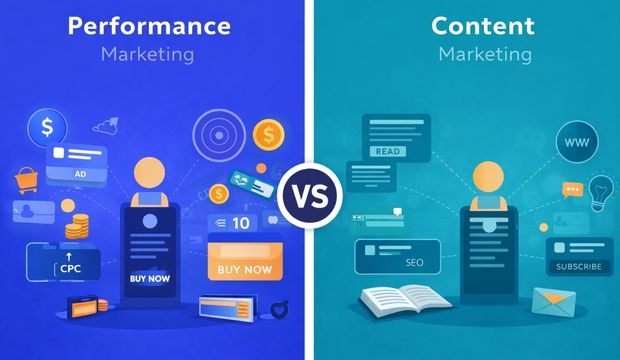
Performance Marketing vs Content Marketing: Where Should a D2C Brand Invest First

Every growth marketer at a D2C brand has faced this conversation. The founder wants customers every day. The finance team wants CAC to go down. And marketers are sitting in the middle trying to decide: do we pour budget into Meta and Google through a performance marketing agency, or invest in long-term content marketing solutions that compound over time?

On one side, performance marketing promises quick wins through launch campaigns on platforms like Google Ads or Instagram and start driving measurable sales almost instantly.

On the other, content marketing focuses on creating blogs, videos, and organic channels that compound over time, building trust and reducing your dependence on paid ads.

The honest answer isn’t a channel. It’s a sequence.

In this blog, we’ll break down both approaches in detail and help you decide where your D2C brand should invest first.

First, Let’s Understand What Each Channel Actually Does

Before comparing the two, it helps to be precise about what you’re actually buying when you invest in each.

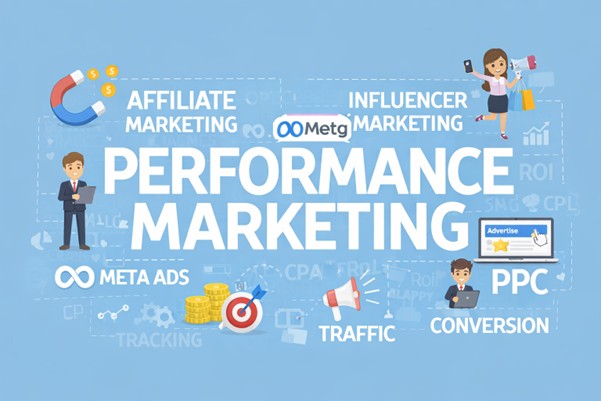
Performance marketing is any channel where you pay for a measurable outcome. Meta Ads, Google Ads, affiliate programs, paid influencer partnerships. The feedback loop is tight. You spend, you track, you optimize. The moment the budget stops, the results stop too.

Content marketing is the long game. SEO, blogs, organic social, email newsletters, YouTube, UGC programs. The feedback loop is slow, but the asset lives on. A well-ranking article written today keeps generating leads two years from now without an additional dollar spent.

Neither is inherently better. They solve different problems at different stages of a brand’s life.

The D2C Growth Problem: You’re Paying More, Getting Less

The D2C market is genuinely one of the most exciting spaces in retail. Global Insight Services projects the global D2C market to grow from about $225.5 billion in 2024 to $880.1 billion by 2034. But entering that growth race has never been more expensive.

The average ecommerce CAC sits between $68 and $84, and that number has climbed roughly 40% in just the last two years. It’s not just a macro trend; it’s structural. Google’s ad costs have been rising steadily, with CPCs up 12.88% year-over-year in 2025 and 87% of industries seeing increases. Overall ROAS declined 10.03% in 2025, meaning brands are paying more and getting less back.

Customer acquisition costs have increased 60% over the past five years a compound problem that every growth marketer now has to build a strategy around.

The implication is clear: a pure performance marketing playbook is no longer a sustainable foundation for a D2C brand. It’s a starting point, not a long-term moat.

What is Performance Marketing

What is Performance Marketing

Performance marketing is the fastest way to answer one simple question. Will people buy this?

Most brands today rely on specialised performance marketing services or a dedicated performance marketing agency to manage campaigns, optimise creatives, and scale revenue efficiently.

It includes channels like Meta Ads, Google Ads, influencer collaborations, and marketplace promotions. The goal is straightforward. Drive traffic, generate conversions, and track return on investment in real time.

For founders, this is often the first lever to pull.

Why it works

  • You can generate traffic instantly
  • You can test multiple creatives and offers quickly
  • You get clear data on what works and what doesn’t

When it works best

  • You already have product-market fit
  • Your website converts well
  • Your messaging is sharp and differentiated

Performance marketing gives you speed. But it comes with a catch. The moment you stop spending; the growth stops too.

A brand like Dollar Shave Club built its early customer base almost entirely through viral performance-style content and paid amplification. The famous launch video was a performance asset first, not a long-form content play. It drove immediate conversions at scale.

Although, the structural risk of leaning entirely on performance marketing is well-documented. According to an article by Amra and Elma, over-investing in performance advertising can dip your ROI by 20–50%, while a balanced mix of brand-building and performance advertising can increase ROI by 25–100%.

That’s not an argument to abandon performance marketing. It’s an argument to treat it as a discovery and validation engine, not your entire growth strategy.

What is Content Marketing (Beyond Just Posting)

What is Content Marketing

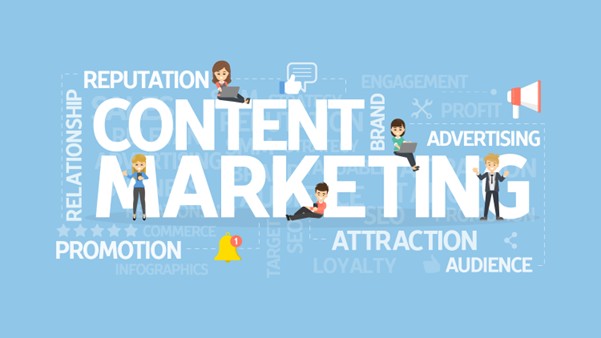
Content marketing is not about posting on Instagram or writing occasional blogs. It is about creating a system that attracts, educates, and converts your audience over time.

Today, brands are moving beyond basic blogging toward structured content marketing services for ecommerce, where every piece of content is mapped to customer intent, SEO visibility, and conversion outcomes. The goal is not just traffic but predictable revenue through scalable ecommerce content marketing services.

This includes SEO blogs, social media storytelling, YouTube content, email flows, and even community building.

Unlike ads, content does not interrupt the user. It meets them where they are searching, scrolling, or learning.

Why it works

  • Builds trust and credibility
  • Compounds over time
  • Reduces dependency on paid channels

When it works best

  • Your product needs explanation or education
  • You are building a brand, not just selling a product
  • You want long-term, sustainable growth

Content marketing generates $3 for every $1 invested, compared to just $1.80 for paid advertising. Content marketing also costs 62% less than traditional marketing while generating 3x more leads.

This is a classic example of what a strong content marketing for ecommerce agency approach looks like building demand before selling.

The most iconic example of content-first D2C is Glossier. Glossier founder Emily Weiss started her blog “Into the Gloss” in 2010, growing it to 1.5 million unique monthly views before launching a single product. When Glossier did launch, it already had a built-in audience of engaged, loyal readers who felt ownership over the brand. The blog helped Glossier grow its year-on-year revenue by 600%. That’s the compounding power of content done before the brand even existed as a brand.

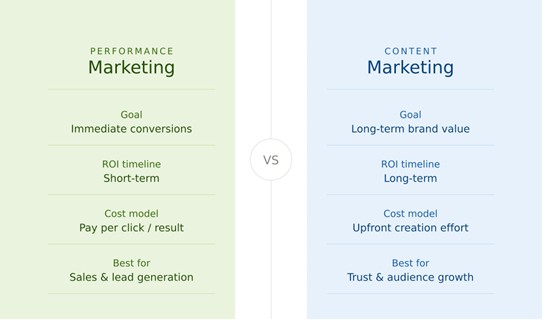
The Core Difference Between Performance Marketing and Content Marketing

While performance marketing services deliver immediate traction, content marketing solutions build long-term defensibility.

At its core, this is not a channel debate. It is a time horizon decision.

  • Performance marketing gives you immediate results but relies on continuous spending
  • Content marketing takes time but builds long-term assets

Here’s how they compare:

Factor Performance Marketing Content Marketing
Speed Fast Slow
Cost Structure Ongoing spend Front-loaded effort
ROI Timeline Immediate Long-term
Scalability Budget dependent Compounding
Trust Building Low to Medium High

If you are thinking short-term revenue, performance marketing wins.

If you are thinking long-term brand equity, content marketing becomes essential.

When Should You Start with Performance Marketing?

Performance marketing is your validation engine.

If you are in the early stages and need answers quickly, this is where you begin.

You should prioritise performance marketing if:

  • You need revenue in the short term
  • You want to test product demand
  • You are experimenting with pricing, creatives, or positioning

Ideal scenarios

  • New product launches
  • Funded brands with aggressive growth targets
  • Highly competitive categories where speed matters

Risks to watch

  • Rising acquisition costs
  • Over-dependence on ad platforms
  • Lack of brand recall

Performance marketing will tell you what sells. But it will not tell you why people stay.

When Should You Start with Content Marketing?

Content marketing is your brand-building engine. If your product needs trust, education, or differentiation, content becomes critical.

You should prioritise content marketing if:

  • Your category is new or complex
  • Your audience needs time to decide
  • You want to build organic traffic and inbound demand

Ideal scenarios

  • Niche products
  • Bootstrapped brands with limited ad budgets
  • Founder-led brands with strong stories

Risks to watch

  • Slow initial traction
  • Inconsistent execution
  • Lack of clear ROI in early stages

Content marketing will not give you instant sales. But it builds the foundation that makes every future sale easier.

Decision Framework for Founders

Brands often start with a performance marketing agency for quick validation, then layer ecommerce content marketing services to reduce CAC over time.

If you are still unsure where to start, ask yourself three simple questions:

  • Do I need revenue immediately, or can I wait?
  • Do I have more budget or more time?
  • Does my product sell instantly or require education?

A simple way to decide

  • Early stage with urgency: Start with performance
  • Early stage with niche product: Start with content
  • Growth stage: Combine both strategically

Brief summary

performance marketing vs content marketing poa

Final Thoughts

If you are starting from zero, performance marketing is usually the fastest way to validate your product and generate initial traction.

But stopping there is where most brands go wrong.

Content should not be delayed. It should start within the first 30 to 60 days once you begin seeing patterns in your ads. Because performance gives you speed, but content gives you stability.

And the brands that scale sustainably are not the ones that choose one over the other.

They are the ones that know when to shift, when to combine, and how to build both into a system.

Ready to turn your content into a real growth engine?

At Sudha Solutions, we deliver content marketing solutions and ecommerce content marketing services designed to drive measurable growth. Whether you need a performance marketing agency to scale fast or a long-term content marketing for ecommerce agency to build authority, we help you build a system that actually compounds. Contact Us TODAY!

Frequently Asked Questions

What is the main difference between performance and content marketing?

Performance marketing focuses on immediate, measurable results through paid campaigns, while content marketing builds long-term organic growth by creating valuable content that attracts and nurtures audiences over time.

Which is better for a new D2C brand: performance or content marketing?

For most new D2C brands, performance marketing is better initially to validate demand and generate quick sales. Content marketing should follow soon after to build long-term sustainability.

How long does content marketing take to show results?

Content marketing typically takes 3 to 6 months to show initial traction and 6 to 12 months for significant results, depending on consistency, competition, and content quality.

Is performance marketing becoming less effective?

Performance marketing is still effective, but rising CAC and declining ROAS mean it’s becoming more expensive. Brands now need to balance it with content marketing for better long-term ROI.

Can performance and content marketing work together?

Yes, the most successful D2C brands use both. Performance marketing drives immediate traffic and insights, while content marketing builds trust and reduces long-term dependence on paid ads.

Categories
Content Strategy UI/UX Design

When Clean-Label Brands Need Content That’s Just as Clean

How Sudha Solutions built the A+ content and PDP strategy for Ecommerce brand like Khetika – across dry fruits, stoneground batters, chutneys, and spices.

TL;DR — What This Article Covers

  • The research process behind Khetika’s A+ content and PDPs; across three product categories
  • How content strategy differs for dry fruits, millet batters, chutneys, and spices
  • The design language and copy principles that make clean-label content convert

What good A+ content actually does for a brand in a trust-deficit category

The Brand That Bets Everything on Honesty

Khetika was built on a single uncomfortable observation: most of the food sitting in Indian kitchens, the spices, the batters, the dry fruits, had been quietly compromised. Adulteration. High-temperature processing that stripped nutrition. Preservatives added because the supply chain was too broken to work without them.

Dr. Prithwi Singh, Darshan Krishnamurthy, and Raghuveer Allada founded Khetika in 2017 not to build a food brand, but to rebuild a food system. Stone-ground spices from named farms in Rajasthan. Ragi and Jowar batters made in nano-plants and delivered within 24 hours. Makhana sourced directly from Bihar’s Mithilanchal belt.

The brand’s real product is trust. The food is just evidence of it.

That’s the context in which Sudha Solutions was brought in to work on Khetika’s A+ content and Product Detail Pages (PDPs); across three distinct product categories: Dry Fruits & Nuts, Stoneground Batters & Chutneys, and Powdered Spices.

This is a detailed account of how we approached that work. The research. The thinking. The design decisions. And the content principles that guided everything we built.

What Is A+ Content – and Why Does It Matter for Food Brands?

A+ content refers to enhanced product page modules available to brands on e-commerce platforms. Beyond a standard product description, A+ content lets brands use rich imagery, comparison charts, feature callouts, and storytelling modules to communicate their product’s value.

For most product categories, A+ content is a conversion tool. For clean-label food brands, it is something more: it is a credibility tool. In a category where ‘natural’, ‘pure’, and ‘preservative-free’ have been co-opted by brands that don’t fully mean them, A+ content is the space where a brand like Khetika can slow the buyer down and show them why this product is actually different.

Research consistently shows A+ content improves conversion rates for food products when it answers the specific questions buyers arrive with; not just describes what’s in the packet.

For Khetika, buyers across all three categories came with questions that standard product descriptions almost never answered:

  • Is this actually stone-ground or is that just branding?
  • What does a 10-day shelf life mean for a batter; does it ferment on its own?
  • Where exactly does this turmeric come from and how is it processed?
  • Why is this makhana priced the way it is; what am I actually paying for?

A+ content, built right, answers these before the buyer has to ask them.

The Research That Came Before a Single Design

Sudha Solutions does not begin content work without a research phase. For Khetika, this meant running four parallel streams of discovery before a brief was written or a wireframe was touched.

Understanding the Brand From the Inside Out

We spent significant time studying Khetika’s operations – not just the brand story, but the functional reality behind it. Their SuperZop platform connecting farmers across 14 Indian states. The nano-plant model: smaller urban facilities that manufacture batters and chutneys within proximity of the customer, enabling a 24-hour production-to-delivery window. The stone-grinding method using authentic red stone sourced from Karoli, Rajasthan; where the stone’s mineral composition, not just its hardness, affects how spices are ground.

We studied their SuperGRT™ AI quality control system, their QR-code traceability (every product links back to harvest date and farm origin), and their decision to operate with IoT-enabled monitoring at manufacturing facilities. These are not brand story embellishments. They are operational facts; and they became the evidentiary backbone of every content module we built.

This is where professional UI UX design and mobile-first UX strategy directly impact ecommerce conversions.

plant is fully automated

Category Analysis – How Competitors Were Positioning

We audited product pages across all three categories on the primary platforms Khetika sells through. Patterns emerged quickly:

  • Dry Fruits & Nuts: Most brands led with quantity and price per gram. Very few communicated sourcing origin or processing method. The clean-label angle was almost entirely absent.
  • Batters & Chutneys: The benchmark was market leaders in the batter category. Their content focuses on convenience and recognisability. Process storytelling is thin. The nutritional case for millet-based batters (versus plain rice batter) was left entirely to the buyer to research.
  • Spices: Post the 2024 MDH and Everest international ban controversy, where both brands faced regulatory action for detected pesticide residues, buyers in this category had become measurably more label conscious. Yet most spice pages still relied on vague purity language (‘100% natural’, ‘no added colour’) with zero process or origin specificity.

The gap Khetika could own was clear: specificity, provenance, and process. These were under-represented across every category; and they were Khetika’s actual strengths.

Consumer Intent Research – What Buyers Were Actually Searching For

We mapped real buyer questions across each category using search intent analysis and review pattern study. This shaped the structure of every PDP and the priority of every A+ module.

The highest-frequency unresolved questions, by category:

  • Makhana: Origin (Mithilanchal sourcing), roasting method, how to tell quality makhana from low-grade, and whether flavoured variants use real ingredients or coating agents.
  • Batters: Whether the batter arrives fermented or raw, how long it takes to ferment at home, what makes ragi batter different from standard batter, and shelf life guidance.
  • Chutneys: Preservative questions, storage post-opening, whether the taste profile is restaurant-style or home-style, and how to pair with specific foods.
  • Spices: Origin specificity, grinding temperature (and why it matters for nutrition and flavour), pesticide testing and certification, and ASTA colour value for red chilli.

Platform & Format Research

We reviewed A+ content performance benchmarks specific to the food and FMCG category on Indian e-commerce and quick-commerce platforms. Key findings: comparison module layouts outperform simple feature grids for considered purchases; lifestyle imagery showing the product in actual use (batter being poured, chutney being served, spices being measured into a dish) significantly reduces return rates; and mobile-first UI/UX design, where the first two modules must do the heavy lifting, is non-negotiable given that quick commerce, Khetika’s fastest-growing channel, is almost entirely a mobile buying experience.

The Content Strategy: Four Principles That Ran Across Every Category

The research gave us the inputs. Strategy gave us the filter. We built the content framework for Khetika around four principles that ran consistently across all three product categories, while allowing for distinct storytelling in each.

Process Is the Product

For most food brands, the product is what’s in the packet. For Khetika, the product is also how it got into the packet. Direct procurement from named farms. No fermentation shortcuts in batters. No colourants in spices. No coating agents on makhana.

We built every A+ content module with the process visible; not buried in fine print, but front and centre. For the spice range, this meant a dedicated module that walked the buyer through the journey from single-origin farm to stone-ground finish, with a visual comparison of conventional industrial grinding versus Khetika’s method. For the batter range, it meant explaining the nano-plant model: why making batter 24 hours away from delivery, rather than in a centralised facility days in advance, produces a product that behaves like homemade.
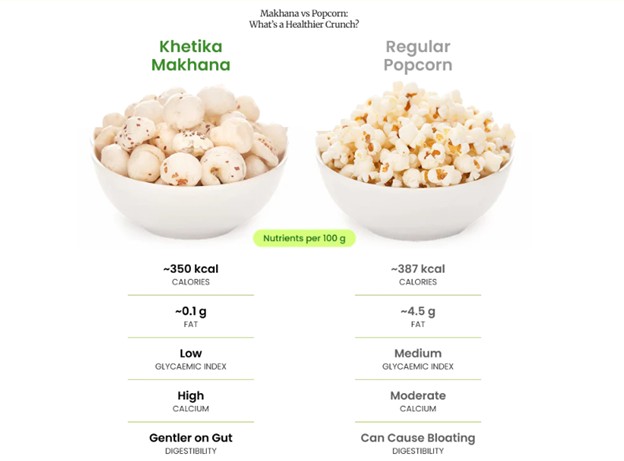
khetika makhana vs regular popcorn


Category-Specific Emotional Register

Each of Khetika’s three categories speaks to a different moment in the consumer’s life – and a different emotional register.

Dry Fruits & Nuts – The buyer here is often health-motivated or gift-motivated. They’re already willing to pay a premium; what they need is confidence that the premium is justified. Content for this category led with provenance, purity, and the story of why Khetika’s makhana from Mithilanchal is categorically different from commoditised alternatives.

Stoneground Batters & Chutneys – This category carries the strongest emotional resonance of the three. Every South Indian household has a grandmother who made batter from scratch. Every family has a memory of coconut chutney made fresh. Our content leaned into this – not nostalgically, but functionally. We built content that explained how Khetika’s stone-ground process actually preserves the texture and fermentation behaviour of a homemade batter, and how their preservative-free chutneys replicate what fresh looks like at scale.

Powdered Spices – Post-2024, the spice category had a trust problem that was industry-wide. Khetika’s content didn’t dance around it. We positioned the spice range as the answer to a real and documented concern: single-origin sourcing, named farms, cold-stone grinding, and transparent quality testing. The emotional register here was not warmth; it was credibility.

Proof-First Copy – Every Claim Earns Its Place

The clean-label food category has been polluted by marketing language that sounds meaningful and means very little. ‘Pure’, ‘natural’, ‘chemical-free’, ‘premium’ – these phrases have been used so often that buyers have learned to look past them.

We applied a strict discipline across all Khetika copy: every claim required a specific, verifiable fact within the same sentence or module. No assertion without evidence.

  • Not ‘pure spices’ – ‘stone-ground’ using red stone from Karoli, Rajasthan, to preserve the spice’s natural essential oils’
  • Not ‘fresh batter’ – ‘prepared in our Mumbai nano-plant and delivered to your door within 24 hours of manufacture’
  • Not ‘premium makhana’ – ‘single-origin from Bihar’s Mithilanchal belt, the largest makhana-producing region in the world, dry-roasted without oil or coating agents’
  • Not ‘preservative-free chutney’ – ‘India’s first clean-label stone-ground chutney at scale, with a long shelf life maintained through refrigerated logistics, not additives’

This is not copywriting as word-choice exercise. It is copywriting as trust architecture.

Mobile-First Design Hierarchy

The majority of Khetika’s quick-commerce buyers make purchase decisions on a phone, scrolling fast. This made mobile-first design hierarchy non-negotiable; not a version of the desktop design, but the primary frame of reference for every module.

In practice, this meant: headlines and sub-headlines that communicate value independently of the body copy (because most buyers won’t read the body on first pass); feature callout icons that work at small scale without losing legibility; lifestyle imagery that reads even as a thumbnail; and benefit language that delivers its most important word in the first three words of the sentence.
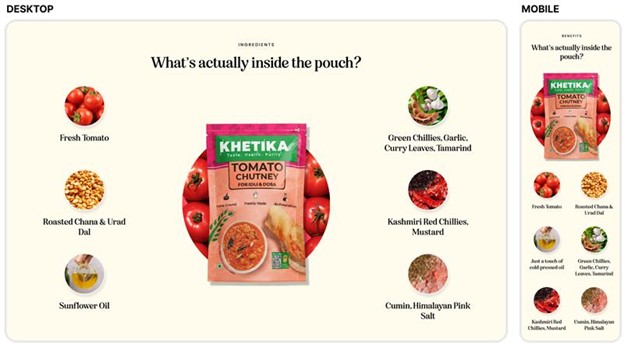
khetika mobile-first design hierarchy

How the Content Was Built – Category by Category

Dry Fruits & Nuts: Makhana and Pistachios

Khetika’s dry fruit range included Naturale Makhana and Premium Roasted Salted Pistachios – two products with premium positioning in a category where most buyers are used to buying from loose bins or unbranded retail packs.

Khetika Naturale Makhana

Makhana has had a well-documented moment in India’s health food market. Demand for this fox nut, traditionally consumed as a fasting food and now embraced as a high-protein, low-calorie snack, has grown sharply. But the market has also grown noisy. Multiple brands entered quickly, and many sell undifferentiated product with only branding as the lever.

The PDP and A+ modules for Khetika’s Makhana were anchored in three proof points: single-origin sourcing from Mithilanchal (named, specific, checkable), the absence of oil and coating agents in the roasting process, and the nutrient case – makhana’s protein and calcium profile compared to conventional snack alternatives. The design used deep cream and earth tones to reinforce the natural credential, with a sourcing story module that placed the product geographically and culturally, not just nutritionally.
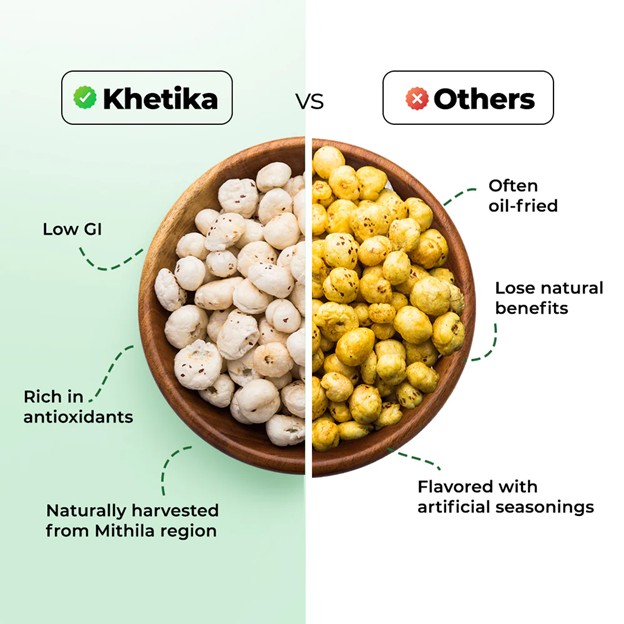
Khetika Naturale Makhana

Khetika Premium Roasted Salted Pistachios

The pistachio PDP content led with the roasting process (dry-roasted, no oil, no flavour enhancers), origin transparency, and snacking occasion positioning. The design language shifted slightly warmer and richer than the makhana range; reflecting the product’s nature as an indulgent-but-responsible snack. The A+ modules included a ‘what makes premium different’ comparison layout and a suggested pairing / occasions section designed to drive repeat purchase frequency.

Khetika Premium Roasted Salted Pistachios

Stoneground Batters & Chutneys – The Category That Carries the Most Weight

This is the category where Khetika holds its most differentiated position; and where the content challenge was most complex. The full range Sudha Solutions worked across:

  • Ragi Idli Dosa Batter
  • Jowar Idli Dosa Batter
  • Fresh Idli Dosa Batter
  • Chilla Batter
  • Coconut Chutney
  • Tomato Chutney
  • Peanut Chutney

The structural challenge: each of these products belongs to a category with deep household familiarity. Every buyer already has a mental reference for what good batter or chutney looks like, tastes like, and behaves like – because they’ve eaten versions of it their whole lives. That familiarity is an asset and a constraint. Content has to meet the buyer’s prior experience and then move them beyond it.

Ragi and Jowar Batters – Selling the Millet Advantage

The millet batter range required a content layer that most food brands skip: category education. Many buyers interested in Ragi or Jowar batter are making a conscious nutritional shift; moving away from plain rice batter toward options that carry higher fibre, calcium (in the case of ragi), and lower glycaemic load. But they often don’t know how that shift manifests in practice: does ragi batter ferment differently? Does it behave the same on a tawa? Does it taste distinctly different to a child who won’t eat ‘health food’?

The A+ content built for these SKUs included a dedicated module addressing each of these questions without it feeling like a FAQ dump. We wove the answers into the product narrative; explaining the stone-grinding method’s role in preserving ragi’s bran layer (the part most industrial milling strips away), and how Khetika’s batter arrives unfermented because it’s made in a nano-plant close to the customer, not pre-fermented in a central facility days ahead.
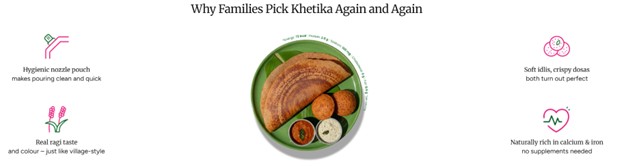
Fresh Idli Dosa Batter

Fresh Idli Dosa Batter – Making the Familiar Exceptional

The Fresh Batter PDP had a different challenge: in a market where the buyer has the most options and the lowest default switching cost (they can always make it at home), the content had to make a case for convenience without sacrificing the quality story. The copy anchored on the nano-plant proximity model, batter made near you, not in a factory three states away, and the stone-grinding difference, which gives the batter a texture and fermentation behaviour closer to home-ground than blade-milled alternatives.

Coconut, Tomato & Peanut Chutneys – A Category That Barely Existed

Khetika’s chutney range is, by their own account, India’s first clean-label stone-ground chutney at commercial scale. There is no real category precedent. Most chutneys available in packaged form either rely on preservatives or taste noticeably different from fresh.

This created both a content opportunity and a content risk: buyers had no existing mental model to map the product to. The A+ content strategy here was to link the product to the memory of fresh, taste notes, texture descriptors, serving suggestions that placed the chutney beside a hot dosa or idli in the reader’s imagination, while making the clean-label proof tangible: A better shelf life maintained through cold supply chain, stone-ground to preserve flavour profile, no vinegar or artificial acid for preservation.
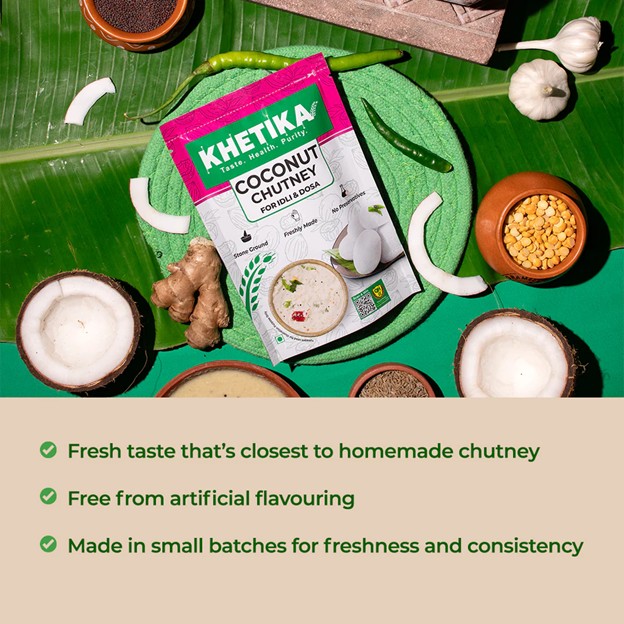
khetika coconut chutney

Powdered Spices: Content in a Trust-Deficit Category

The spice category is the most scrutinised food segment in India following the 2024 international bans on two major Indian spice brands over detected pesticide residues. Consumer trust in spice labelling hit a measurable low. Into this environment, Khetika’s spice range, with its single-origin sourcing, named farms, and cold-stone grinding, was a genuine differentiator. The content had to make that difference impossible to miss.

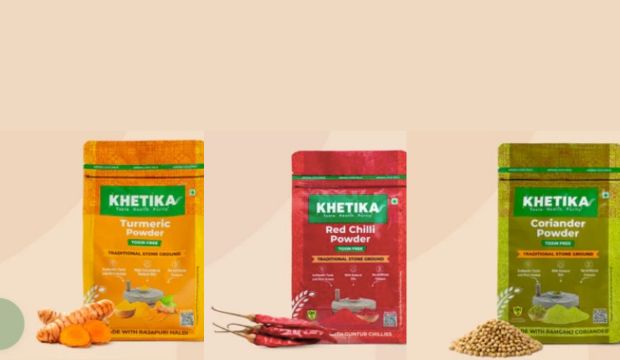
Turmeric – From Sangli, Ground Cold

The Turmeric PDP and A+ content was built around a specific and verifiable claim: Rajapuri Haldi from Sangli, a region known for its naturally elevated curcumin concentration. The grinding temperature ( which preserves curcumin and essential oils that high-temperature industrial grinding degrades) was explained in plain terms, not jargon. A comparison module placed Khetika’s method against conventional processing; making the nutritional and flavour case without requiring the buyer to already understand food science.

Red Chilli – Colour, Heat, and Traceability

For Red Chilli, the content led with ASTA colour value, a measurable industry standard for chilli colour intensity, and positioned Khetika’s sourcing and grinding process as the reason for a higher, more consistent value than commodity alternatives. The origin story (named farm clusters, single-variety sourcing) was the trust anchor. The design used bold, appetite-forward visuals that communicated the product’s quality through colour richness and texture.
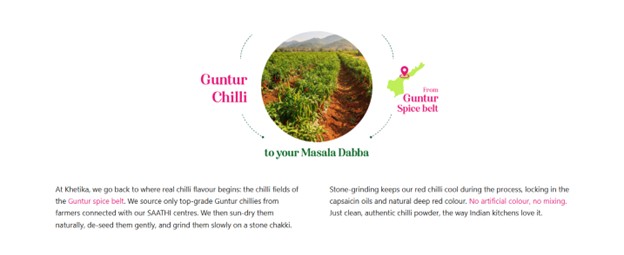
Design Language

The Design Language – What Khetika’s Content Looks Like

Content strategy without design direction is half a job. The visual language of A+ content and PDPs is not decoration; it directly affects whether a buyer pauses or scrolls past, whether they trust the claim being made, and whether the premium positioning feels earned.

Sudha Solutions’ design approach for Khetika’s content was built around four decisions:

Colour: Grounded, Not Clinical

Khetika’s visual palette draws from its ingredients. Turmeric yellows. Ragi and earth browns. Pistachio greens. Chilli reds. Coconut cream. These are not arbitrary colour choices – they are the palette of real, unprocessed food. We used this as the chromatic anchor for every module, avoiding the clinical whites and flat gradients common in health-positioned food brands that look like supplements rather than staples.

Photography Direction: Texture Over Perfection

Studio-perfect product photography achieved with AI, where every grain is equidistant and the surface is artificially even, works against the clean-label positioning. We directed image selection and production guidance toward photography that shows texture, irregularity, and the evidence of minimal processing: the coarse grind of a spice, the visible grain of a batter, and the rustic spread of a chutney. These visual details are proof.

Typography Hierarchy: Built for Skim and Read

Given the mobile-first buying context, we designed typographic hierarchy for two types of readers: the skimmer (who reads only headlines and callouts) and the reader (who reads everything). Headlines had to deliver complete value independently. Body copy had to reward attention with depth. No module was designed where the value only emerged after reading three lines.

Module Structure: Earned Complexity

A+ content can become visual noise when too many module types are stacked without purpose. We applied a ‘minimum sufficient complexity’ principle: every module had to earn its place by answering a specific buyer question or building a specific dimension of trust. Comparison tables appeared only where a genuine comparison was useful. Feature icon grids were used only where individual features warranted independent emphasis. Lifestyle imagery was placed at moments in the scroll where the buyer needed an emotional anchor, not more information.

How Sudha Solutions Ran the Project

A+ content and PDP work across 15+ SKUs in three product categories requires a structure that prevents both bottlenecks and scope drift. Here is how the engagement was run.

Discovery and Brand Brief

The project opened with a structured brand discovery session. Brand voice, buyer personas, existing content pain points, platform specifications, and priority SKU sequencing. The output was a working content brief that both teams could refer to throughout; reducing revision cycles and ensuring alignment before work began.

Research and Strategy Sign-off

Before a single design was created, we presented the category research and content framework to the Khetika team. Alignment at the strategy stage prevents expensive rewrites at the execution stage. This is a step many agencies skip; it is one we consider non-negotiable.

Parallel Content and Design

Sudha Solutions works with content and design in parallel, not in sequence. Copy drafts and design wireframes are developed together, so the module layout flexes around the message rather than the message being retrofitted into a pre-set visual template. This is especially important for A+ content, where the structure of the module should be driven by what needs to be communicated, not by default template selection.

Structured Review Cycles

Two rounds of structured review per category. Feedback captured in annotated design files, not open-ended email threads. Each comment linked to a specific visual element or copy block, with a clear action attached. This approach cut revision time significantly and eliminated the ambiguity that typically inflates timelines on content projects.

Delivery and Handoff

Final assets were delivered in platform-ready formats with clear naming conventions and a per-SKU delivery checklist. A brief content guide was included so Khetika’s team could apply the same framework consistently when adding future SKUs.

What Does Good A+ Content Actually Do for a Clean-Label Brand?

The question worth answering directly: beyond looking better than a generic product page, what does this content work actually achieve?

It converts the undecided buyer without pressure

The buyer who has landed on a Khetika product page already has some awareness – they came from search or quick-commerce browse. What they don’t yet have is confidence. Good A+ content closes that gap with specificity: a named origin, a visible process, a real reason behind the price point. This kind of content converts by informing, not by promoting.

It builds brand memory at the first transaction

The first purchase is not just a transaction – it is a brand experience. A buyer who comes away from a Khetika product page knowing where their turmeric was grown and how it was ground is a different kind of customer than one who simply bought the cheapest option. That knowledge creates the conditions for loyalty.

It sets accurate expectations, which reduces returns

Fresh products with short shelf lives, Khetika’s batters and chutneys especially, carry a higher post-purchase risk if expectations are misaligned. Clear, honest content about shelf life, storage requirements, and product behaviour (batter that ferments in the customer’s kitchen rather than arriving pre-fermented) reduces disappointment and the dissatisfied reviews that follow.

It supports premium pricing with evidence, not assertion

Premium pricing in food is justified by two things: demonstrable quality and trust. Both of these are content problems as much as product problems. When a buyer can see exactly why Khetika’s makhana costs more than the local store alternative, named origin, no coating agents, dry-roasted without oil, the price becomes a feature, not a friction point.

Content That Takes the Brand as Seriously as the Product

There is a version of this project that could have been executed as a production task. Take the product specs. Write clean bullets. Design a respectable-looking layout. Deliver on time.

That version would have been fine. But it would not have served a brand like Khetika.

Khetika has spent years building a supply chain that most brands would consider irrational. Buying authentic stones from Karoli. Teaching farmers IPM practices. Building nano-plants in Mumbai and Delhi so batters don’t spend three days in transit before reaching a kitchen. These decisions are not just operational – they are expressions of what the brand believes.

Content that doesn’t reflect that depth does the brand a disservice. It reduces a thought-through, infrastructure-backed product story to a product description.

That is the standard we hold ourselves to for every brand we work with.
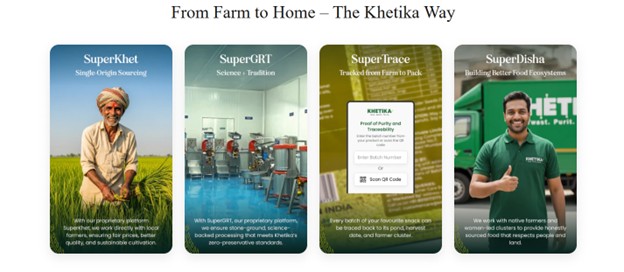
from farm to home - khetika

Working With Sudha Solutions

If you’re looking to improve your product page performance, working with experienced content marketing experts and a professional UI UX design team can significantly increase your conversions.

At Sudha Solutions, we provide UI UX design services and content marketing services tailored for ecommerce and FMCG brands — from A+ content design to complete product detail page optimization.

Sudha Solutions partners with food, wellness, and FMCG brands to build content that earns trust at the point of purchase. If your product has a real story behind it and your content isn’t telling it yet; that’s the problem we exist to solve.

Get in touch: [email protected] | https://www.sudhasolutions.com/ | Linkedin.com/Sudhasolutions

Frequently Asked Questions

What is A+ content for food brands on e-commerce platforms?

A+ content is an enhanced product page format available to brands on e-commerce platforms like Amazon and quick-commerce apps. For food brands, it allows the use of rich imagery, comparison modules, process storytelling, and benefit callouts beyond a standard product description. For clean-label food brands in particular, A+ content is a credibility tool; it answers the specific questions health-conscious buyers arrive with before they can voice them.

What does A+ content actually cost a brand, and is it worth the investment?
A+ content for food brands is a conversion investment. Brands that invest in research-backed, category-specific A+ modules consistently see better add-to-cart rates and lower return rates than those running generic product descriptions. At Sudha Solutions, we build A+ content that pays for itself by making your product’s real story visible at the exact moment a buyer is deciding. If you’re unsure whether your current pages are doing that job, we’re happy to take a look.

How long does it take to build A+ content and PDPs for a product range?
For a range of 5-15 SKUs across one or two product categories, a well-run A+ content and PDP project typically takes 4–6 weeks from discovery to final delivery – covering research, content strategy, copy, design, and review cycles. Rushing this process is where most brands lose value. At Sudha Solutions, our parallel content-and-design process keeps timelines tight without cutting corners on the research that makes the content work.

Can a content agency really understand a niche food category well enough to write about it accurately?
Only if they do the work before they write. Generic content agencies write from templates. We research the supply chain, study the buyer’s real questions, audit how competitors are positioning, and map the specific claims that your product can actually support. Our work with Khetika, across stone-ground spices, millet batters, chutneys, and dry fruits, is an example of what category depth looks like in practice. If your brand is in a specialised food or FMCG category, that depth is exactly what we bring.

How do I know if my existing product pages need to be rebuilt or just refreshed?
A few signals that your pages need more than a refresh: buyers are landing but not converting, you’re getting post-purchase complaints that suggest misaligned expectations, your pages rely heavily on generic claims like ‘natural’ or ‘premium’ without proof, or your A+ modules were built from a template rather than from a buyer and brand brief. If any of these sound familiar, Sudha Solutions offers a content audit as a starting point; so you know exactly where the gaps are before any work begins.

What is the difference between A+ content and a standard product description?

A standard product description is text and a few images. A+ content allows brands to build structured visual modules, comparison charts, feature icon grids, sourcing maps, lifestyle imagery, process diagrams, that tell a product story at depth. For food brands, this additional space is the difference between a buyer who adds to cart and a buyer who bounces to a cheaper alternative.