
Sudha Solutions

Categories
AI Overview LLMS

LLM SEO for B2B Brands: What It Is and Why It Can’t Wait

B2B buying has always been complex. Multiple stakeholders, long cycles, extensive research — that part hasn’t changed. What has changed, faster than most marketing teams have caught up to, is where that research begins. 

Two years ago, 68% of buyers told TrustRadius that generative AI had no impact on their purchase process. Today, according to 6sense’s 2025 global study of nearly 4,000 B2B buyers, 94% use large language models at some point during a software purchase journey. That’s not a gradual shift. That’s a market transformation happening faster than most organisations are equipped to respond to. 

LLM SEO — sometimes called GEO, AEO, or LLMO depending on who’s writing about it — is the discipline that addresses this directly. It’s the practice of structuring content, building authority, and establishing brand presence in ways that make AI systems like ChatGPT, Perplexity, Claude, and Gemini cite and recommend a brand when B2B buyers ask questions about their category. 

This article explains what that means specifically for B2B companies, why the B2B buying journey makes this more urgent than it is for consumer brands, and what an effective strategy actually involves.

Why B2B Is the Highest-Stakes Context for LLM Visibility 
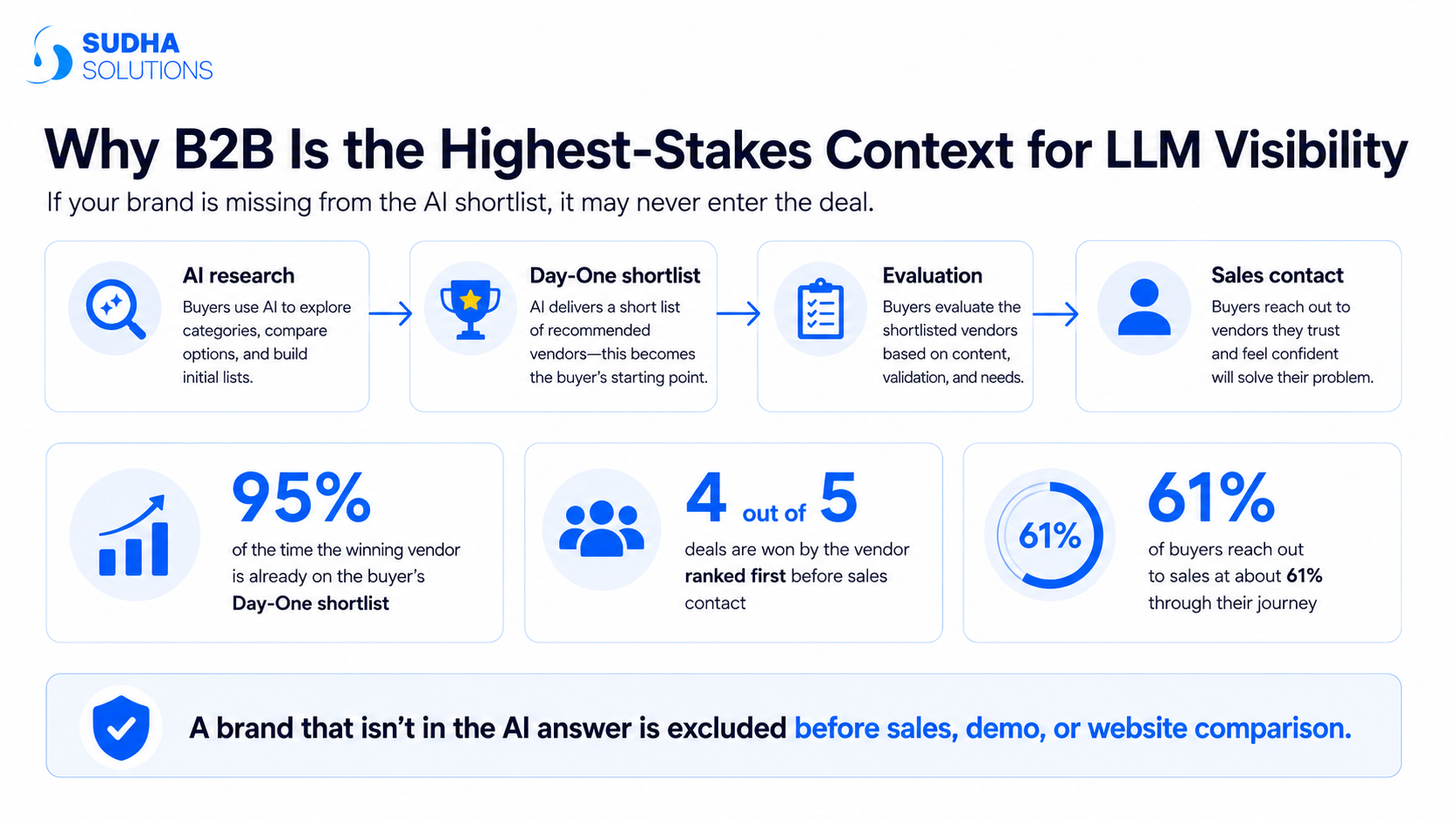
Why B2B Is the Highest-Stakes Context for LLM Visibility

LLM SEO matters for any business trying to get found online. But for B2B companies, the stakes are particularly high — because of what the data shows about how B2B buying decisions actually form. 

According to 6sense’s 2025 Buyer Experience Report, 95% of the time the winning vendor is already on the buyer’s Day One shortlist. Four out of five deals are won by the vendor the buyer ranked first before they ever contacted sales. And buyers don’t reach out until they are approximately 61% through their journey — arriving with AI-driven research, pre-ranked shortlists, and a decision process that is largely formed before a sales conversation begins. 

That shortlist formation — the moment when a buyer decides which vendors are worth evaluating — is happening increasingly inside AI tools. The discovery and shortlisting phase has migrated almost entirely inside the LLM interface, as Forrester’s 2025 B2B Buying Study described it. Buyers ask ChatGPT which vendors solve their problem, get a curated list of three to five options, and use that list as the foundation for everything that follows. 

A brand that isn’t in that AI answer isn’t just losing a ranking. It’s being excluded from the decision entirely — before a sales team, a website, or a product demo ever enters the picture. 

This is the core reason LLM SEO is not optional for B2B companies in 2026. Businesses investing in SEO expert services for B2B AI visibility are increasingly adapting their search strategies for AI-driven buyer journeys. 

The Buying Group Dimension 
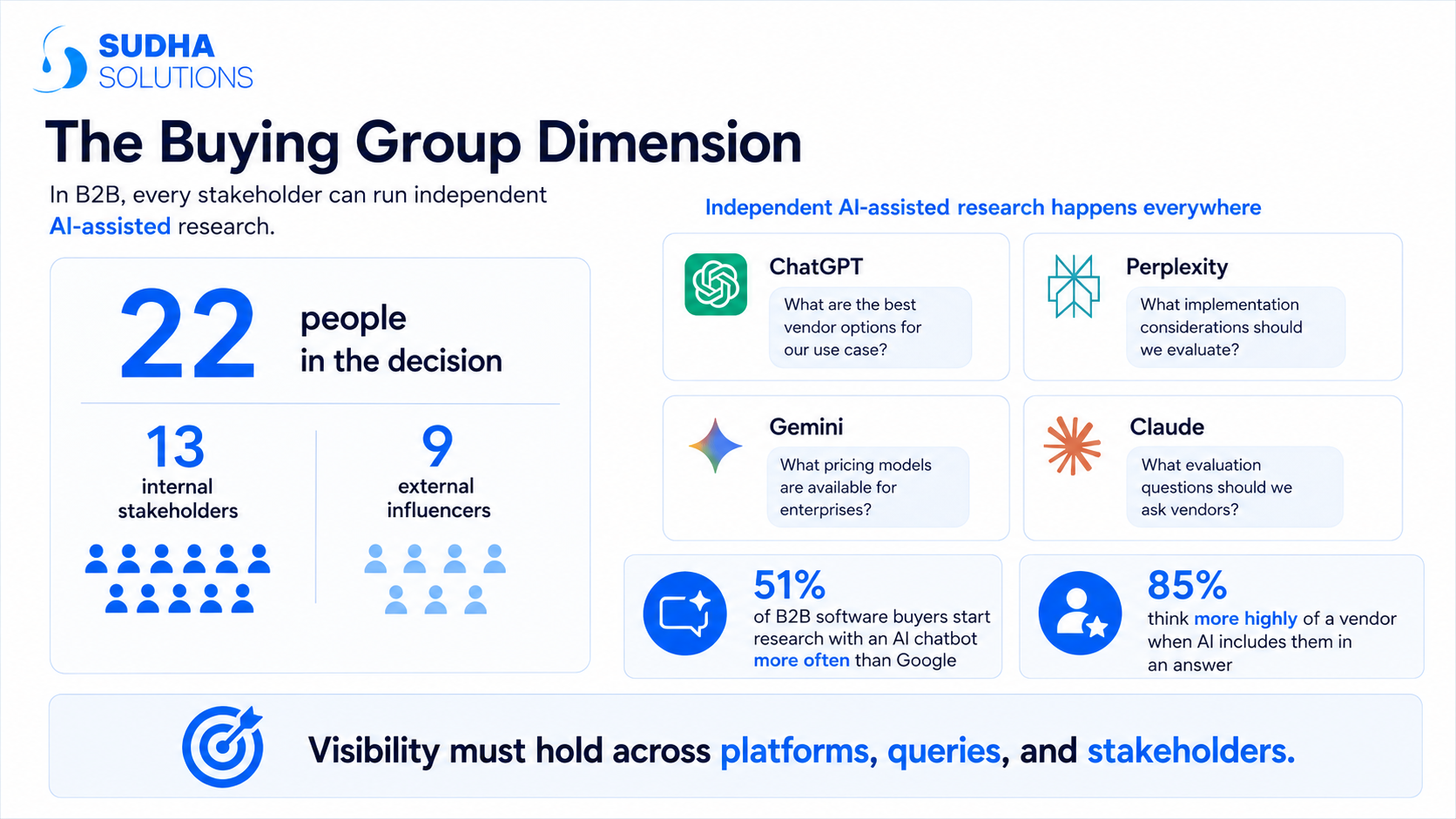
Buying Group Dimension 

B2B deals in 2026 involve an average of 22 people in the decision — 13 internal stakeholders and 9 external influencers, according to Forrester’s State of Business Buying 2026. Each of those people is potentially conducting independent AI-assisted research. 

This creates a compounding effect. One stakeholder might ask ChatGPT about vendor options in the category. Another might ask Perplexity about implementation considerations. A third might ask Gemini about pricing models. If a brand doesn’t appear consistently across those queries and across those platforms, its presence in the buying group’s collective understanding degrades with each additional stakeholder who searches independently. 

51% of B2B software buyers now start their research with an AI chatbot more often than with Google, according to G2’s April 2026 data. And 85% of buyers say they think more highly of a software vendor when AI includes them in an answer. The inverse is also true — being absent when peers appear sends a quiet negative signal about credibility and category standing, even if no one in the buying group verbalises it. 

What Makes LLM SEO Different for B2B
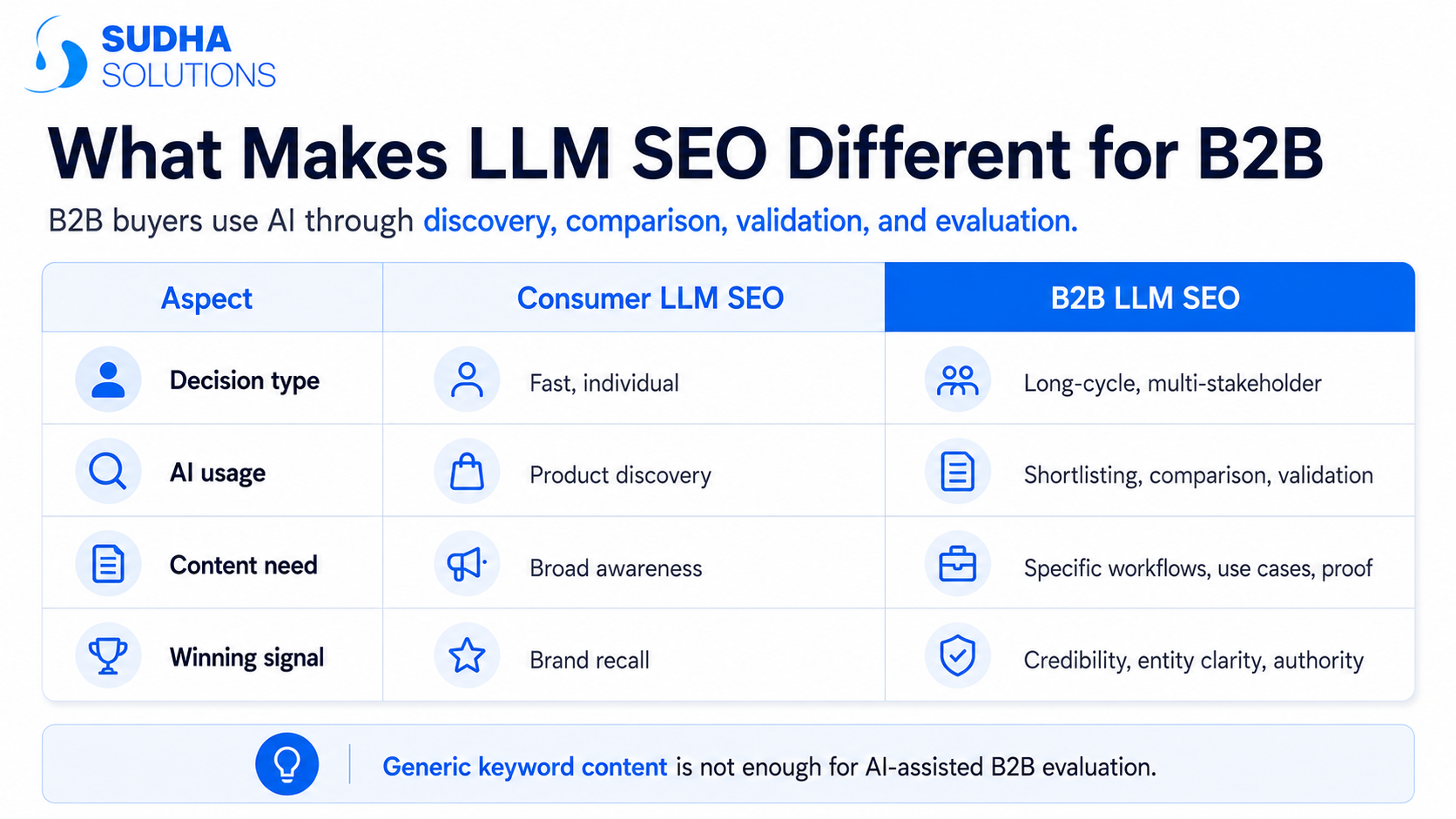
What Makes LLM SEO Different for B2B

Consumer-facing LLM SEO is largely about brand awareness at scale — getting a product mentioned when individuals are making low-complexity decisions quickly. B2B LLM SEO operates differently because the buyer behaviour is different. 

B2B buyers use AI tools not just for discovery but throughout the evaluation process. 6sense’s 2025 Buyer Experience Report found AI features present in 89% of B2B purchases — at shortlisting, at comparative evaluation, at review validation, and at the drafting of evaluation questions. This means a B2B brand needs to be visible and credible at multiple points in the AI-assisted journey, not just the first query. 

The content requirements follow from this. B2B buyers using AI tend to ask more complex, scenario-based questions than consumer buyers: “What are the best platforms for [specific workflow] for a company of our size and industry?” “What do analysts say about [vendor category]?” “What are the known limitations of [competitor]?” The brands that appear in these answers have content — and third-party coverage — that addresses these specific questions with specificity and depth. 

Generic content built for keyword rankings doesn’t serve this well. Buyers arriving via AI recommendations have already completed the initial discovery phase and are in active evaluation mode. The content they find on a brand’s site needs to match that intent — detailed, evidence-based, credible. 

The Four Pillars of a B2B LLM SEO Strategy 

1. Topical Authority Through Depth, Not Volume 

AI systems evaluate B2B brands partly by how consistently and comprehensively their content covers a subject. A single well-ranked article doesn’t establish category authority in the way that a body of interconnected content does. 
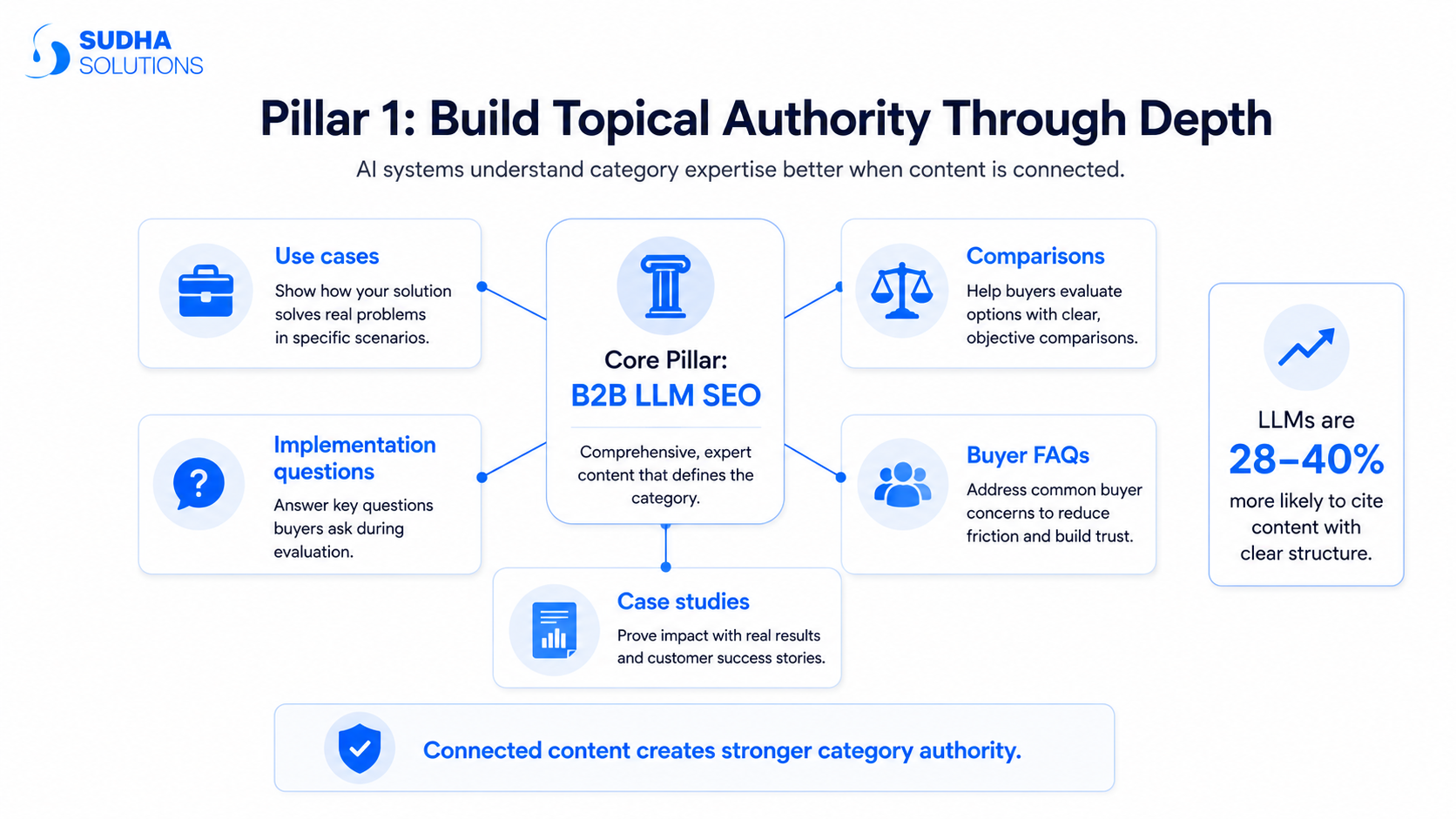
Topical Authority Through Depth, Not Volume

This is why the pillar-cluster content model introduced in What is GEO? A Beginner’s Guide is so directly relevant to B2B LLM SEO. A brand that has a central pillar on its core service area, surrounded by cluster articles covering specific sub-topics, case studies, use cases, and implementation questions, looks fundamentally different to an AI system than a brand with sparse, isolated content — even if the individual articles are technically of similar quality. 

LLMs are 28 to 40% more likely to cite content with clear structural signals: proper heading hierarchy, defined sections, and answer-first formatting, according to research compiled by McKinsey in their September 2025 CMO Survey data. The structure communicates what the content is about as much as the content itself does.

2. Earned Authority Signals Built for AI 

Traditional B2B SEO invested heavily in backlinks as the primary authority signal. LLM SEO requires a different kind of earned presence. 

Brand mentions across the open web — in trade publications, analyst coverage, industry forums, and niche media — carry far more weight in AI citation decisions than link counts. Distributing content to a wide range of publications can increase AI citations by up to 325% compared to publishing only on a brand’s own site, according to Stacker’s December 2025 research. 
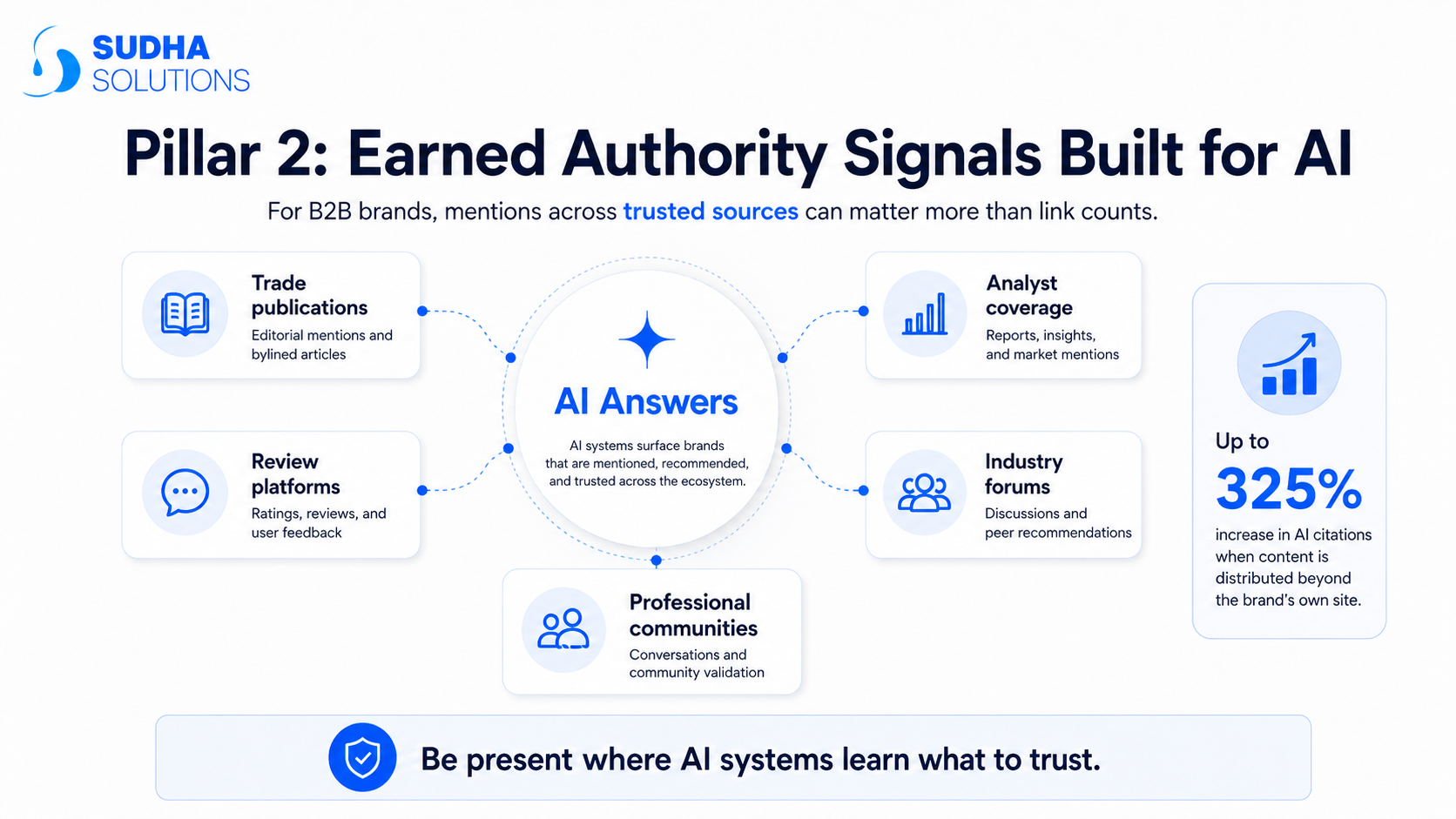
Earned Authority Signals Built for AI 

For B2B companies, the most effective earned media targets are the specific publications, communities, and analyst platforms that AI systems have learned to associate with their category. Industry trade publications in B2B software, services, and technology are cited disproportionately. Analyst firm coverage, third-party review platforms, and professional community discussions carry strong citation signals. These aren’t new channels for B2B marketing — but the strategic rationale for investing in them has changed. 

It used to be about reaching buyers directly. Now it’s equally about being present in the sources AI systems draw on when buyers ask for recommendations.

3. Entity Clarity Across the Web 

In B2B, where buyers are evaluating vendors they may never have heard of before, the way AI describes a brand shapes initial impressions more than any other early touchpoint. 

LLMs don’t just retrieve content — they build internal models of what brands are, what problems they solve, and how credible they appear. A brand with inconsistent positioning across its website, LinkedIn profile, Crunchbase entry, G2 listing, and third-party coverage creates an ambiguous entity model. AI systems, like cautious buyers, default to clearer alternatives when they encounter ambiguity. 
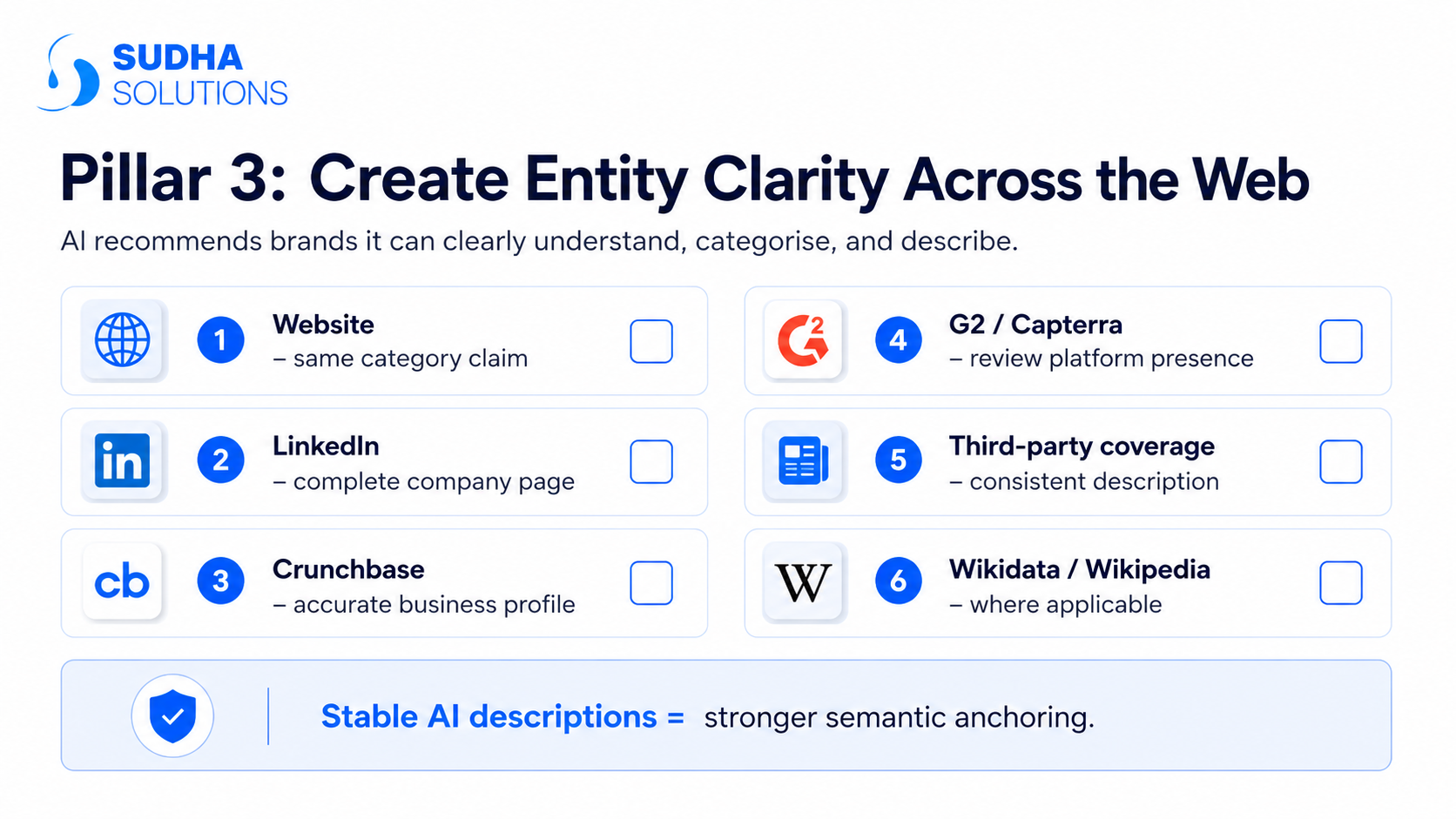
Entity Clarity Across the Web

Entity clarity for B2B means: a consistent, specific description of what the company does and who it serves — not a generic “we help businesses grow” positioning, but a precise category claim that AI can use to match the brand to relevant queries. That positioning needs to appear consistently across every platform where the brand has a presence. 

Search Engine Land’s December 2025 analysis of B2B brand visibility in LLMs found that AI brand signal stability — the consistency of a brand’s presence and positioning across LLM outputs over time — is becoming a core visibility metric alongside traditional share of voice and keyword rankings. Brands whose AI descriptions fluctuate sharply have fragile entity models. Brands with stable, consistent descriptions across platforms have strong semantic anchoring — the model reliably knows which category they belong to.

4. Technical Foundations That Don’t Block AI Access 

Modern LLM-powered search ranking systems increasingly rely on crawlability, structured data, and AI-friendly content rendering. The most consistent finding across LLM SEO research is that a significant proportion of B2B websites create their own barriers to AI visibility through technical configuration. 

73% of websites have technical barriers that block AI crawler access, according to OtterlyAI’s 2026 research. For B2B companies with complex, JavaScript-heavy websites built to impress human visitors, this is a particularly common problem. AI parsing success for static HTML runs at 94%; for JavaScript-rendered content, it drops to 23%. 
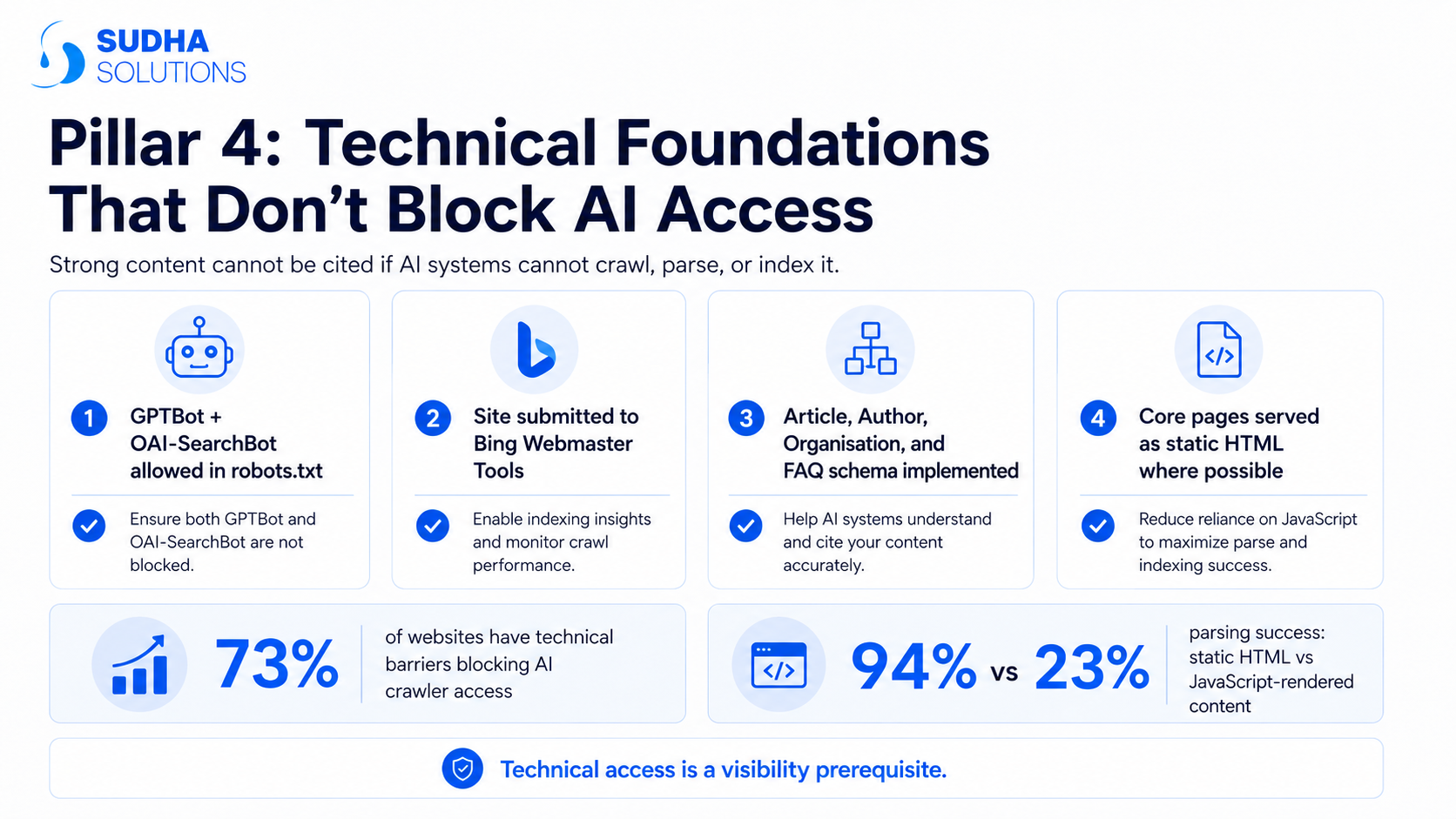
Technical Foundations That Don't Block AI Access 

The practical checklist is straightforward but requires deliberate attention. GPTBot and OAI-SearchBot allowed in robots.txt. Site submitted to Bing Webmaster Tools. Article, Author, Organisation, and FAQ schema implemented. Core pages served as static HTML wherever possible. These changes don’t require a website rebuild — but they do require someone to check them and fix them, which most B2B marketing teams haven’t prioritised yet.

The LLM Perception Drift Problem 

One aspect of LLM SEO that’s specific to how AI systems work deserves particular attention for B2B brands. 

AI models are retrained periodically. When a model retrains, its internal representations of brands can shift, sometimes significantly. Research from Evertune tracking the project management software space between September and October 2025 found meaningful changes in how AI described major enterprise brands within just one month. Tools like Atlassian surged in AI visibility while others posted notable drops, without any apparent corresponding change in those brands’ actual web presence. 

Search Engine Land’s December 2025 analysis described this as “LLM perception drift” — the dynamic and measurable shifts in AI brand perception as models evolve and retraining cycles accelerate. By 2026, AI brand signal stability is solidifying as a new visibility metric that sits alongside traditional share of voice and keyword rankings. 

For B2B brands, this means LLM SEO isn’t a set-and-forget exercise. It requires ongoing monitoring of how the brand appears across AI platforms — using the audit process described in How to Audit Your ChatGPT Visibility — so that perception drift is caught and addressed before it affects buyer consideration.  

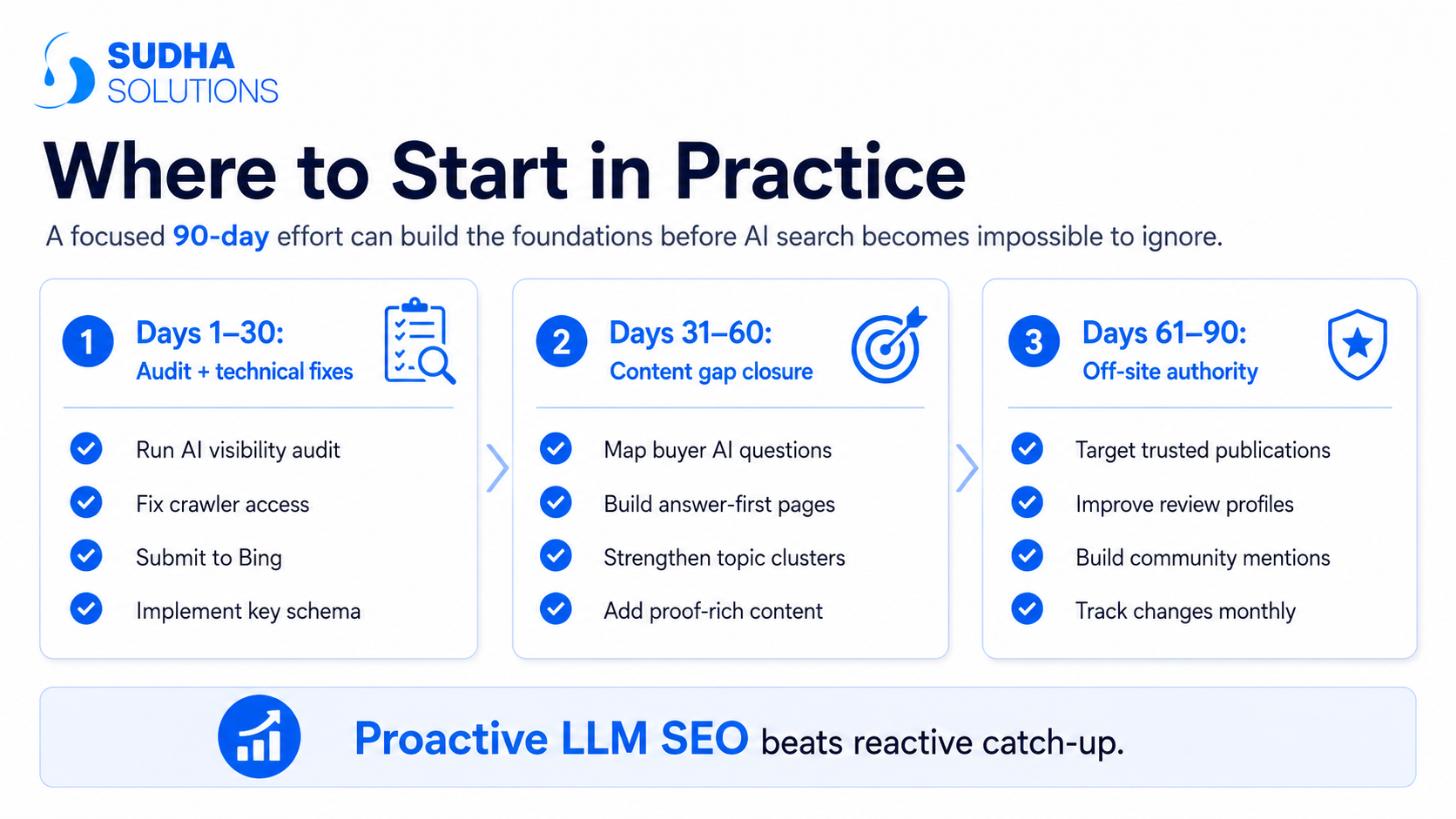
Where to Start in Practice 

The first practical step is understanding where the brand currently stands across the four major AI platforms — ChatGPT, Perplexity, Gemini, and Claude — using the audit process outlined in the previous article in this series. 
Where to Start in Practice 

The second is a content gap analysis: Companies implementing AI-powered answer engine optimization can better align content with AI-assisted buyer research behavior. Mapping the questions B2B buyers in the category are asking AI systems against the content the brand currently has. Where buyers are asking questions the brand’s content doesn’t answer, those are the highest-priority content investments. 

The third is an off-site presence audit: identifying the specific publications, review platforms, and community forums that AI systems draw on when answering category queries, and assessing where the brand is and isn’t represented. 

The businesses gaining the most ground started building LLM visibility 12 to 18 months ago. An experienced AI-powered SEO agency can help organizations improve AI citation visibility and long-term generative search performance. But a focused 90-day effort — starting with technical fixes, the highest-priority content gaps, and the most impactful off-site presence targets — still creates real competitive advantage. The worst move, as the data consistently shows, is waiting for AI search to become undeniable before acting. 

IDC projects companies will spend up to 5 times more on LLM optimization than traditional SEO by 2029. The investment is coming regardless. The question is whether it happens proactively or reactively. 

Sudha Solutions helps businesses build visibility in AI search through content strategy, GEO, and digital marketing. Based in India, working with brands globally. 

Frequently Asked Questions 

Why is LLM SEO important for B2B companies?

LLM SEO is important because B2B buyers increasingly use AI tools like ChatGPT and Perplexity during vendor research, shortlist creation, and purchase evaluation.

What is the difference between SEO and LLM SEO?

Traditional SEO focuses on Google rankings, while LLM SEO focuses on improving visibility inside AI-generated answers and conversational search experiences.

How can B2B brands improve ChatGPT visibility?

B2B brands can improve ChatGPT visibility through entity SEO, GEO optimization, structured content, earned media coverage, and AI-friendly technical SEO.

What are the best platforms for AI search optimization?

Businesses should optimize for ChatGPT, Gemini, Perplexity, Claude, and Google AI Overviews because each platform influences AI-assisted buyer journeys differently.

Does technical SEO affect AI search visibility?

Yes. Crawlability, schema markup, Bing indexing, and AI crawler accessibility significantly impact AI search discoverability and citation visibility.

Categories
AEO Optimization AI Overview General SEO

How to Build an AI-First Marketing Strategy in 2026

You published a blog post last month. It was well-written, well-researched, and ticked every SEO box you knew about. Then you checked your traffic and wondered why nothing moved. 

Here is what is probably happening: your content is being read by AI, summarised for users, and never clicked on. The user got their answer. You got nothing. 

This is the reality of content marketing in 2026, where brands investing in SEO expert services and AEO services must optimize not just for clicks, but for AI-driven visibility. And if your strategy has not caught up to it yet, you are losing ground to competitors who have. 

This post will walk you through what an AI-first marketing strategy actually looks like, why both SEO and AEO now need to sit in your plan together, and the practical steps to get started. 

What is AI-first marketing?  

AI-first marketing is a strategy that combines SEO, AEO, and content optimization to ensure your brand is discoverable, extractable, and citable across traditional search engines and AI-powered answer platforms. 

First, What has Actually Changed? 

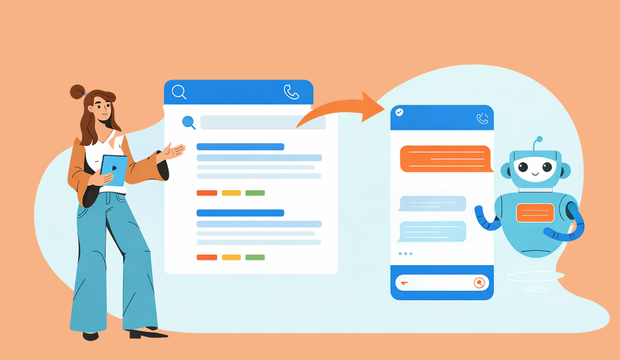
This zero-click shift is reshaping search engine optimization services into a broader AI-first strategy 

Not long ago, ranking on page one of Google meant traffic. People saw your link, clicked it, and landed on your site. That chain still exists, but it is breaking. 

According to Search Engine Journal zero-click searches jumped from 56% in 2024 to 69% in 2025. That means nearly 7 out of 10 Google searches now end without anyone visiting a website. Add to that Google AI Overviews, ChatGPT Search, and Perplexity, all of which answer questions directly, and you start to see the problem. 

But here is the flip side: those AI engines have to cite someone. They are pulling information from somewhere, and that somewhere could be your content. 

That is where AEO comes in. 

What is AEO and why does it matter? 

For businesses adapting early, answer engine optimization is becoming as essential as traditional SEO. 

what is aeo and why does it matter

AEO stands for Answer Engine Optimization. Where SEO helps your content rank in search results, AEO helps your content get cited as the answer inside AI tools like ChatGPT, Google AI Overviews, and Perplexity.

Think of it this way: SEO gets you on the shelf. AEO gets you recommended by the shop assistant.

At HubSpot, traffic from AEO converted at 3x the rate of other sources, because users who arrive after an AI recommendation already trust the source they were sent to. The intent is higher; the scepticism is lower.

The brands winning in 2026 are doing both. This is why SEO and AEO now function best as integrated layers of a modern visibility strategy. They are building content that ranks in traditional search AND gets picked up by AI as the most credible answer.

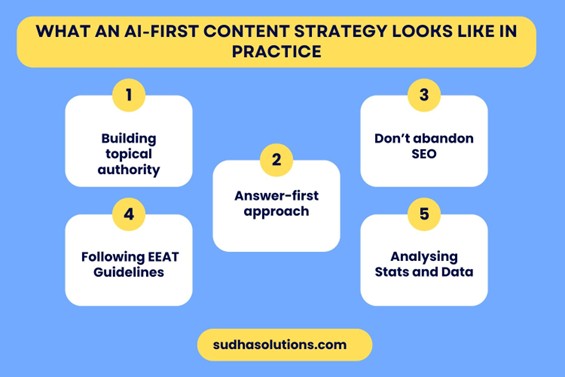
What an AI-First Content Strategy Looks Like in Practice

What an AI-first content strategy looks like in practice

1. Build Topical Authority, not Just Individual Posts

A strong AI-first marketing strategy relies on content ecosystems, not isolated blog posts.

A structured topical authority framework built through pillar pages and clusters significantly improves both rankings and AI citations.

AI engines do not favour brands that wrote one good article on a topic. They favour brands that clearly own a subject area.

If you run a SaaS HR platform, you should not just have a blog post on “how to write a performance review.” You should have a full cluster of content covering reviews, feedback frameworks, one-on-ones, goal setting, and everything in between, all internally linked, all pointing back to a central pillar page.

This tells both Google and AI models: this brand is the authority here.

2. Write Every Piece so the Answer Comes First

This is where answer-led content becomes critical, helping AI systems extract and trust your information faster.

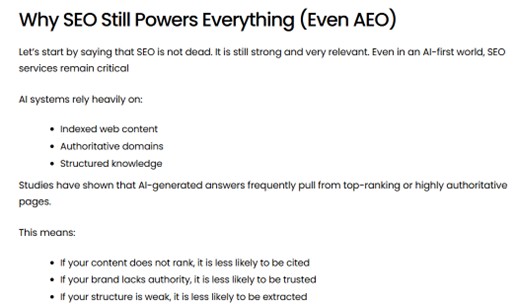
seo still power everything

AI systems scan your content looking for a clear, direct response to a question. If your article spends the first three paragraphs warming up before getting to the point, you will be skipped.

The format that works:

  • Start with a 40 to 60 word paragraph that answers the question directly
  • Use subheadings that are themselves complete questions (“What is topical authority?” not just “Topical authority”)
  • Add an FAQ section at the bottom covering related questions your audience is actually searching for

This structure serves your human reader and gives AI a clean block of text it can quote.

3. Make your Expertise Visible, not just Implied

Effective AI content optimization now requires explicit credibility signals that AI systems can verify.

A strong AI citation strategy depends on visible expertise, third-party trust signals, and content clarity.

AI citations

Google and AI models are trained to look for E-E-A-T signals: Experience, Expertise, Authoritativeness, and Trustworthiness. This is no longer a nice-to-have. It is a ranking and citation requirement.

Practical ways to build this into your content:

  • Every article should have a real author with a bio, credentials, and a LinkedIn link
  • Cite primary sources and original data wherever possible. AI models prefer content that references verifiable evidence over opinion pieces
  • Earn mentions on other credible sites. Being cited by an industry publication is one of the strongest trust signals you can send to an LLM

A useful example: Semrush published an original study on AI Overviews in early 2025. That single piece of research now gets cited by ChatGPT almost every time someone asks about the topic. One well-researched, data-backed post can generate more long-term AI visibility than fifty generic “tips” articles.

4. Do not Abandon Traditional SEO

Your SEO strategy 2026 should still prioritize crawlability, technical performance, and search intent while layering AEO on top.

It might be tempting to pivot entirely to AI optimisation. But this is not possible, yet.

Google still handles the vast majority of searches. Core Web Vitals, backlinks, site structure, and keyword strategy still matter. The brands that will dominate in 2026 treat SEO and AEO as two layers of the same strategy, not competing approaches.

Build the technical foundation with SEO. Make the content citation-ready with AEO. Run both simultaneously.

5. Measure the Right Things

Modern brand mention tracking across AI ecosystems is now essential for measuring visibility beyond traditional traffic.

brand mention tracking

Your analytics need to evolve alongside your strategy. Organic clicks are no longer the only signal that your content is working.

Watch for:

  • AI Overview appearances in Google Search Console
  • Direct traffic lifts (often a sign users found you via AI and came back directly)
  • Brand mention tracking across Perplexity, ChatGPT, and AI Overviews
  • Lead quality from AI-referred traffic, not just volume

The Window to Act is Still Open, but Not for Long

Brands that built dedicated AEO strategies in early 2025 are now capturing 3.4x (340%) more answer engine traffic now than those who waited. That gap will only widen.

Most businesses are still writing content the way they did in 2020. That creates a genuine opportunity for brands willing to restructure their approach now, before the space becomes as competitive as traditional SEO.

The good news is you do not have to start from scratch. If you already have a content library, a lot of it can be restructured and updated to work harder in AI-era search. The bones are often already there.

Where to Start this Week

If you want to begin moving in this direction, here is a simple first step: pick your five most important existing articles and run them through this checklist.

  • Does each article open with a direct, quotable answer in the first paragraph?
  • Does each article have a clear author with visible credentials?
  • Does each article include an FAQ section with question-formatted subheadings?
  • Is each article internally linked to related content on the same topic?
  • Is there FAQ Page or Article schema markup on the page?

If the answer to most of those is no, you have a clear starting point.

An AI-first content strategy is not about throwing out what you know. It is about building on it for the way search works today.

Want to create an AI-First Marketing Strategy in 2026?

We at Sudha Solutions have helped multiple brands get visibility on AI. We follow a effective template, which is loved by AI, helping your brand get mentioned by AI. Visit Sudha Solutions Today.

Frequently Asked Questions

Why are zero-click searches increasing?

AI-generated summaries, featured snippets, and answer engines are providing users direct answers without requiring website clicks.

Can existing content be optimized for AI search?

Yes, updating structure, adding FAQs, schema, and clearer answers can improve AI citation potential significantly.

How do I know if my content is being picked up by AI tools like ChatGPT or Google AI Overviews?

You can track this by monitoring brand mentions in AI-generated responses, checking Google Search Console for AI Overview impressions, and observing increases in direct traffic. These signals often indicate your content is being referenced even if clicks are low.

Should businesses invest more in AEO or traditional SEO right now?

It is not an either-or decision. SEO builds discoverability, while AEO drives credibility and conversions. Businesses that integrate both strategies tend to see stronger long-term performance across search and AI platforms.

What type of content performs best for AI-driven search engines?

Content that is structured, concise, and answer-focused performs best. This includes clear definitions, step-by-step explanations, data-backed insights, and well-organised FAQs that directly match user queries.

How often should existing content be updated for AI relevance?

High-performing or strategic content should be reviewed every 3–6 months. Updates should focus on adding clearer answers, improving structure, strengthening internal links, and incorporating recent data or trends.

Can smaller brands compete with large websites in AI search results?

Yes. AI engines prioritise clarity, authority, and relevance over brand size. A well-structured, niche-focused content strategy can outperform larger competitors if it demonstrates expertise and depth.

Categories
AI Overview

From Rankings to Responses: Why Search Visibility in 2026 Is About Being the Answer

For over two decades, search visibility followed a familiar logic:
rank higher > get more clicks > drive traffic > convert users. 

That logic is no longer reliable. Search in 2026 is no longer about where you rank. It is about whether you are chosen as the answer. 

Across Google, AI Overviews, large language models, and conversational interfaces, search behaviour is shifting from exploration to resolution. Users are no longer scanning ten blue links. They are asking complete questions and expecting complete answers, instantly. 

Businesses adapting to this shift often work with teams offering SEO expert services to transition from ranking-focused strategies to answer-driven visibility models.

At Sudha Solutions, we believe this marks the most fundamental shift in search since the introduction of PageRank. And it demands a different way of thinking about SEO altogether. 

This article explains: 

  • Why rankings alone no longer define visibility 
  • How AI-driven search engines decide who gets surfaced 
  • What “answer readiness” really means in 2026 
  • How businesses and SEO professionals must adapt now 

This is not a prediction built on hype. It is a synthesis of platform changes, industry data, and how modern retrieval systems actually work. 

The Quiet Collapse of Click-Based Visibility 

Search engines are still sending traffic. But they are sending far less of it. Multiple independent studies now confirm what most practitioners are already seeing in analytics dashboards. 

Key findings from the industry data behind zero-click search: 

The implication is not that SEO is dying. The implication is that visibility is being decoupled from traffic. A brand can now: 

  • Influence decisions 
  • Shape understanding 
  • Build authority 

…without ever receiving a click. 

Why Search Engines Are Becoming Answer Engines

To understand where SEO is heading to, we must understand how AI is searching, retrieving, and presenting information. 

From Indexing Pages to Synthesising Knowledge 

Traditional Search  Modern Search 
Indexed documents  Retrieves multiple sources 
Ranked them using signals  Evaluate credibility and relevance 
Let users extract meaning themselves  Synthesis a response 
  Presents a single, confident answer 

This shift is powered by retrieval-augmented generation (RAG), a system where language models pull from trusted sources before generating responses. In this system, your content is no longer competing for a click. It is competing for AI citations. 

Visibility in 2026: Being Cited vs Being Clicked 

Google rankings are not enough in 2026. Your ranking does not automatically translate to AI citations. What matters today is: 

  • Being quoted in an AI Overview 
  • Being referenced in a conversational response 
  • Being recalled when a follow-up question is asked 

This is a fundamentally different type of visibility. 

Traditional SEO vs Answer-Driven Visibility 

Traditional SEO  Answer-Driven SEO 
Rankings-focused  Retrieval-focused 
Optimised for CTR  Optimised for inclusion 
Keyword-first  Question-first 
Page authority  Entity & topic authority 
Traffic as success  Influence as success 

The winners in this environment are not the loudest brands. Rather brands that are clearest and most reliable. 

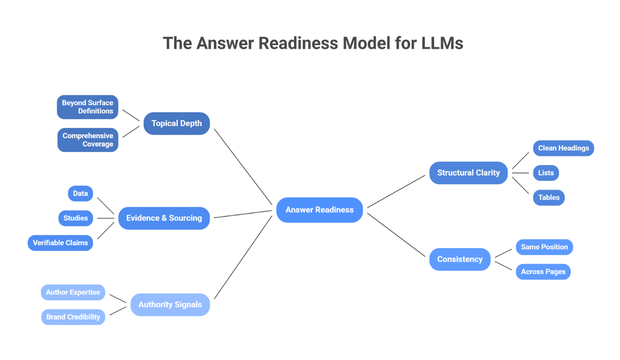
The Answer Readiness Model 

The Answer Model

At Sudha Solutions, our content is a perfect balance of SEO optimisation and answer readiness. When both work in unison, brands grow.  

Answer readiness answers one question: 

If an AI system had to explain a topic to its user, would it trust your content? 

The 5 Pillars of Answer Readiness 

Pillar  What AI systems look for 
Topical depth  Coverage beyond surface definitions 
Structural clarity  Clean headings, lists, tables 
Evidence & sourcing  Data, studies, verifiable claims 
Consistency  Same position across pages 
Authority signals  Author expertise, brand credibility 

This is where EEAT stops being a guideline and becomes a retrieval requirement. 

Why EEAT Now Directly Impacts AI Visibility 

Google never introduced EEAT for writers. It introduced EEAT for evaluation systems. Many organizations strengthen EEAT signals by partnering with content marketing experts who build authority-driven editorial ecosystems across platforms

Large language models and AI checks this before considering your content: 

  • Is this accurate? 
  • Is this widely accepted? 
  • Is this safe to present a as fact? 

EEAT provides those signals. 

What Actually Strengthens EEAT in 2026 

  • First-hand explanations, not summaries 
  • Clear author attribution and expertise 
  • Consistent viewpoints across the site 
  • Alignment with external authoritative sources 
  • Absence of sensational or speculative claims 

This is why thin content, paraphrased blogs, and generic SEO pages are systematically excluded from AI responses. 

Content That Gets Chosen vs Content That Gets Ignored 

Producing structured, authoritative resources at scale often requires collaboration with expert blog writing specialists who understand how AI systems interpret content clarity and evidence.

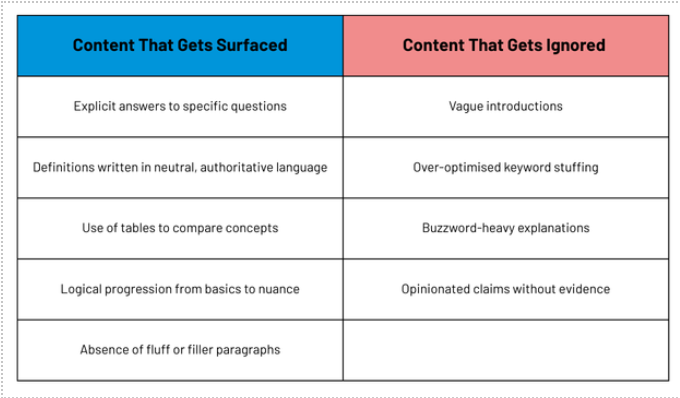
Content That Gets Chosen vs Content That Gets Ignored

Answer engines do not “read” content the way humans do. They check it for clarity, completeness, and confidence. An information dense content which is not structured properly or does not follow EEAT guidelines will not interest AI platforms. 

Characteristics of Content that gets Surfaced 

  • Explicit answers to specific questions 
  • Definitions written in neutral, authoritative language 
  • Use of tables to compare concepts 
  • Logical progression from basics to nuance 
  • Absence of fluff or filler paragraphs 

Content that gets Ignored 

  • Vague introductions 
  • Over-optimised keyword stuffing 
  • Buzzword-heavy explanations 
  • Opinionated claims without evidence 

This is why modern SEO content must feel closer to reference material than marketing copy. 

Measuring Success When Clicks Decline 

For multiple years, traffic and ranking were the metrics we relied on to measure success; however, we are going through a period of transition. This has also led to a shift in how we measure success. 

New metrics that Actually Matter 

Metric  Why it matters 
AI citation presence  Indicates retrieval trust 
Branded search growth  Shows influence, not clicks 
Assisted conversions  Users return later 
Sales cycle shortening  Answers reduce friction 
SERP dominance  Visibility across formats 

SEO teams must now report on influence, not just acquisition. 

Why This Shift Benefits High-Quality Brands 

This transition is a blessing in disguise for genuine brands as it disproportionately rewards: 

  • Specialists over generalists 
  • Experts over aggregators 
  • Brands with conviction over content farms 

For founders and businesses, this is good news. 

Answer engines favour: 

  • Clear positioning 
  • Narrow expertise 
  • Demonstrable experience 

You do not need thousands of pages. You need the right ones, built to be referenced. 

How Sudha Solutions Approaches SEO in an Answer-First World

Since the start of transition from traditional SEO to AI-led modern SEO, our SEO and content team have tried different approaches to find the best strategy to get quoted by AI. Our process no longer starts with just keywords. Our teams combine technical optimization and editorial strategy through integrated SEO expert services designed for AI-driven search ecosystems.

It starts with: 

  • What questions users ask before buying 
  • What confusion exists in the market 
  • What misinformation needs correcting 

Then we build content that: 

  • Resolves uncertainty 
  • Establishes trust 
  • Can be confidently reused by AI systems 

This is why our SEO strategies focus on durable visibility, not temporary rankings. 

The Future: Search as a Conversation, Not a Destination 

Search is becoming: 

  • Continuous 
  • Contextual 
  • Conversational 

Users ask one question, then refine it. Only sources that remain consistent and credible survive that conversation. 

By 2026, the brands that win will not be those who chased algorithms. They will be those who became the reference point. 

Final Thoughts 

SEO in 2026 is no longer about chasing rankings. It is about earning the right to be trusted as the answer. Brands that understand this shift early will not just survive algorithm updates. They will shape how their industry is understood. 

If this article changed how you think about search, explore our other insights. This is only one part of a much larger transformation. 

Frequently Asked Questions

What is Answer Engine Optimisation (AEO)? 

AEO is the practice of structuring content so it can be directly retrieved and cited by AI-powered search engines and assistants, rather than only ranked as a clickable result.  

Does SEO still matter if users do not click?

Yes. SEO now influences decisions earlier in the funnel, shaping perception and trust even without immediate traffic. 

How do I know if my content appears in AI responses?

Monitor branded search growth, SERP features, AI Overviews, and assisted conversion paths rather than only organic clicks. 

Are long-form blogs still relevant? 

Yes, if they follow EEAT guidelines. This includes clear structure, trust factor by experts, some real-life examples or case studies, and question based H2s with clear answers and no fluff.