
Sudha Solutions

Categories
AEO Optimization General SEO

How to Monitor Brand Mentions: Tools, Strategies & SEO Benefits (2026 Guide)

Tracking your brand used to be simple. You’d open Google Search Console, skim through keyword reports, maybe set up a few alerts, and feel reasonably confident you knew where and how your brand was being talked about.

That confidence doesn’t hold up anymore.

In 2026, brand mention monitoring is no longer just a tracking activity, it’s a critical layer of brand mentions SEO visibility across both search engines and AI platforms.

These mentions don’t show up in Search Console. They don’t trigger traditional alerts. And more often than not, they leave no obvious trail.

The result? A massive blind spot.

Your brand could be recommended, summarized, compared, or even misrepresented across AI systems, and you’d have no clear way to see it, measure it, or respond to it. For marketers and SEO professionals, this is not just a visibility problem but a control problem.

So how do you monitor something that isn’t directly visible?

This guide breaks it down. We’ll explore the tools that are adapting to this shift, the strategies for brand mention monitoring, and the SEO benefits of getting this right early, before your competitors do.

Key Takeaways: Things You’ll Learn About in this Article

  • Brand mentions are now a core ranking and AI visibility signal, not just a PR metric.
  • Unlinked mentions are high-conversion link building opportunities.
  • AI systems rely on web-wide brand presence, not just your website.
  • The TRACK framework turns monitoring into a repeatable growth system.
  • Brands that monitor and respond faster build compounding visibility across SEO and AI.

What Are Brand Mentions, and Why Do They Matter in 2026?

Today, brand mentions SEO has evolved beyond backlinks, becoming a core signal for how search engines and AI systems evaluate authority.

A brand mention is any online reference to your brand (your company name, product, services, founder, or domain), regardless of whether or not it includes a hyperlink back to your site.

That mention in a Quora thread? A brand mention. The Forbes article that referenced you without linking? A brand mention. A YouTube review where someone talks about your work? Yes. A brand mention.

However, brand mentions come in two forms that your strategy should treat very differently:

  • Linked mentions: references with an active backlink. These pass direct SEO authority and referral traffic.
  • Unlinked mentions: references without a hyperlink. These don’t pass link equity directly, but they’re far from worthless. They build brand recognition, strengthen entity authority, and critically, they’re reclaiming opportunities. Every unlinked mention is a backlink you simply haven’t claimed yet.

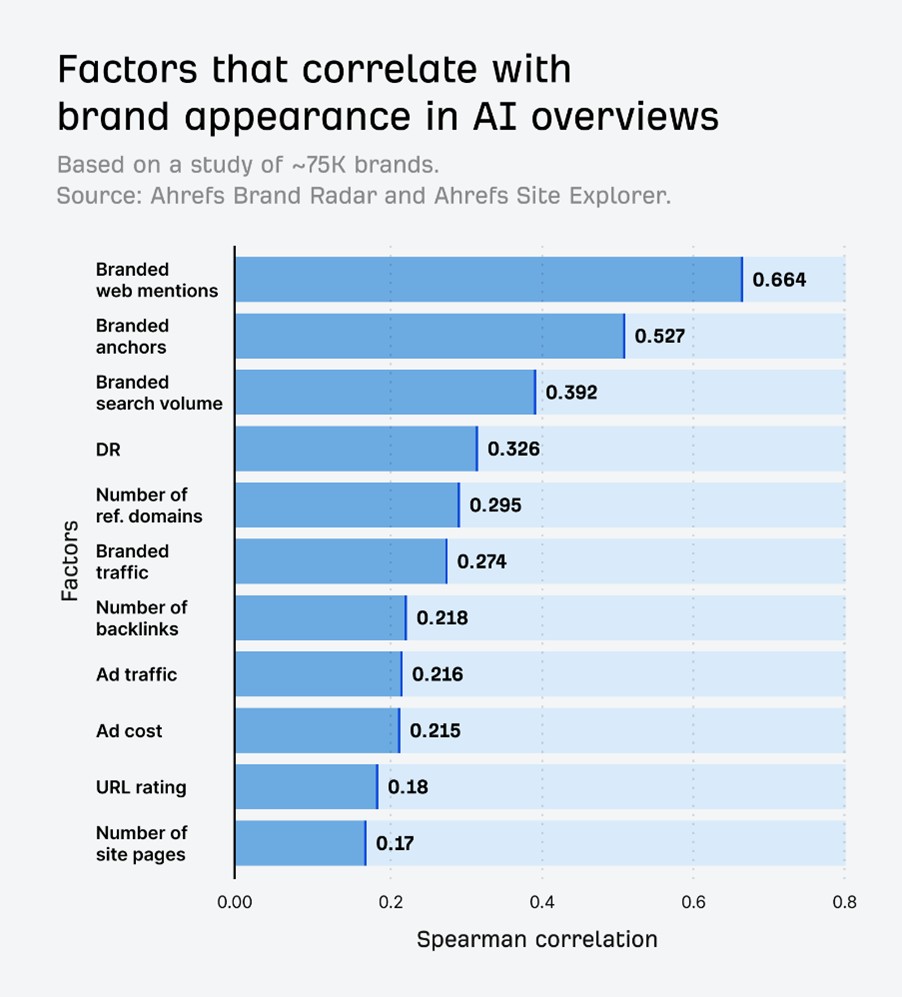
Here’s what makes 2026 a turning point: AI search engines are now trained on and influenced by brand mentions across the web.why brand mentions matters

According to a study by Ahrefs analysing 75,000 brands, branded web mentions show the strongest correlation (0.664) with brand visibility in Google AI Overviews, significantly stronger than backlinks (0.218). The top three correlating factors were all brand signals: web mentions, branded anchors, and branded search volume.

In simpler words, brands that are mentioned more across the web are far more likely to be recommended by AI. Brand mention tracking is no longer a PR nice-to-have. It’s an AI visibility signal you don’t want to miss out on.

While working with brands across e-commerce, D2C, fintech, and B2B at Sudha Solutions, we’ve seen unmonitored mentions quietly erode brand equity and actively monitored ones compound into rankings, citations, and revenue.

Do Brand Mentions Actually Help SEO?

Short answer: yes, and this is where brand mentions SEO plays a significant role in improving rankings, entity authority, and brand mentions SEO visibility across search and AI ecosystems.

1. Co-citation as a ranking signal

Google’s entity recognition systems read billions of web pages and identify brand names, then associate them with topics, categories, and sentiment. Google’s 2014 patent on “implied links” explicitly defines unlinked mentions as ranking factors and the algorithm has only gotten more sophisticated since.

According to SearchAtlas, campaigns integrating brand mention monitoring and entity prominence optimisation increased keyword rankings by an average of 18% compared to link-only strategies.

2. The E-E-A-T multiplier

When authoritative industry publications, review platforms, and community forums mention your brand in relevant contexts, it reinforces your Experience, Expertise, Authoritativeness, and Trustworthiness profile. This is especially critical in competitive or YMYL-adjacent categories.

In Moz’s 2023 Search Ranking Factors study, sites with over 70% positive sentiment mentions received 15% higher average rankings than competitors with similar mention counts but lower sentiment.

3. The AI Visibility Connection

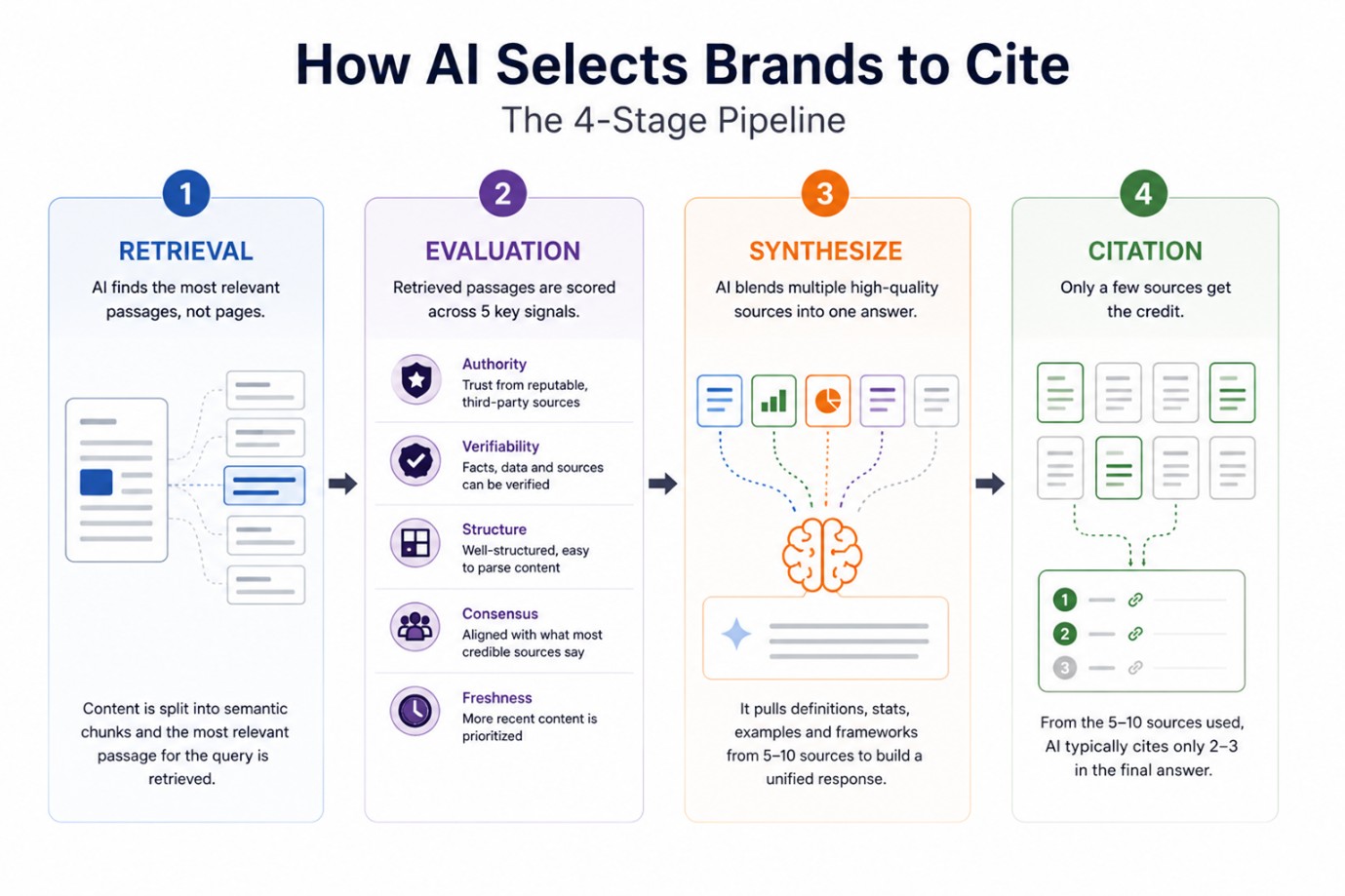
This is where brand mentions SEO visibility becomes critical. AI systems rely heavily on how frequently and where your brand is mentioned across the web.

Ahrefs has already proven that brands earning the most web mentions earn up to 10x more mentions in Google AI Overviews compared to the next closest quartile. Separately, domains with profiles on Trustpilot, G2, Capterra, and Yelp have 3x higher chances of being chosen by ChatGPT as a source compared to sites without such presence (SE Ranking, 2025).

This is where brand mention monitoring feeds directly into our AEO strategy at Sudha Solutions. The mentions you earn today are shaping the AI citations you’ll receive tomorrow.

What Happens When You Don’t Track Brand Mentions?

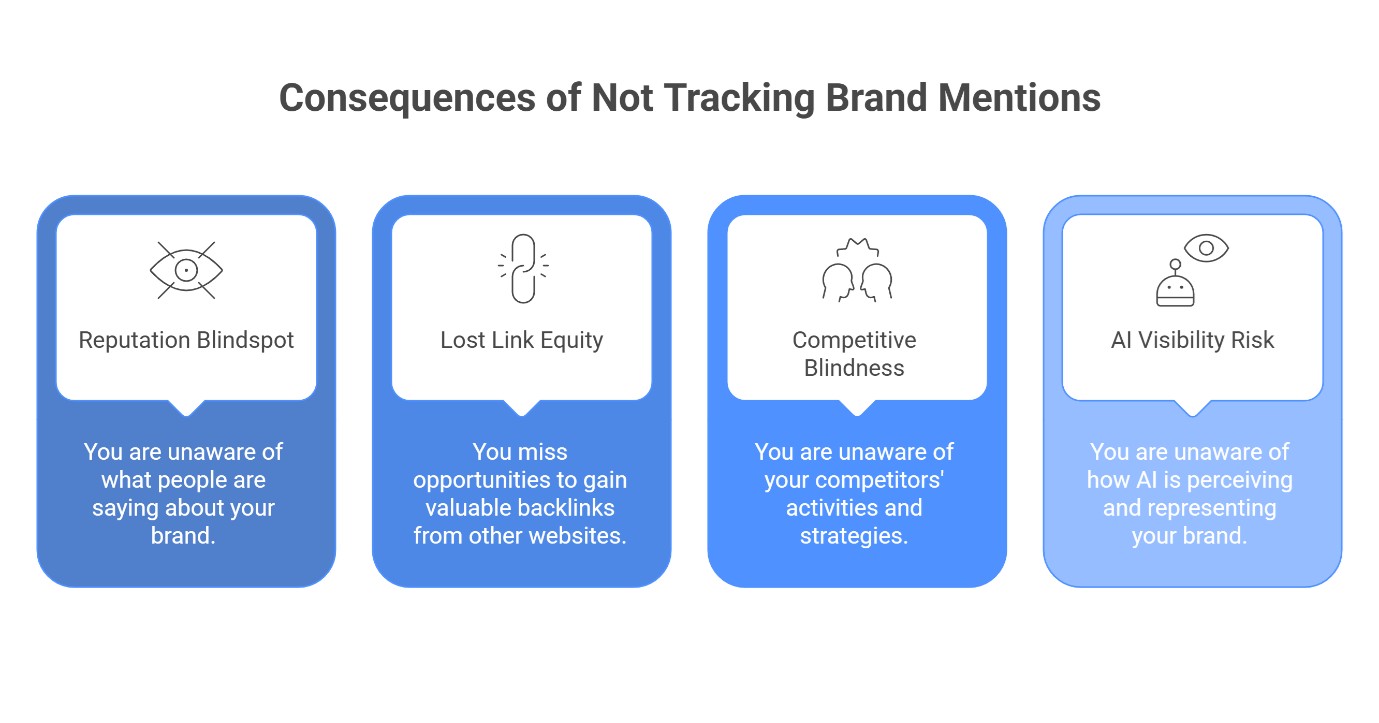
consequences of not tracking brand mentions

A structured approach to brand mention monitoring ensures you’re not just tracking mentions, but actively improving your visibility and authority.

Before the system, there’s the cost. Because most brands only start paying attention after something goes wrong.

  • Reputation blindspot. Negative mentions spread faster than positive ones. A critical Reddit thread, an ignored 2-star review on G2, a misleading comparison article can gain traction long before it reaches your radar. By the time you respond, the narrative is already set.
  • Lost link equity. Every unlinked mention is a missed backlink. If your brand earns consistent press, blog coverage, or community recommendations, you’re leaving significant domain authority on the table every month you don’t run a reclamation campaign.
  • Competitive blindness. Your competitors appear in conversations and comparison articles you’re not even aware of. Customers are choosing between you and them; in threads you can’t see, on platforms you don’t monitor.
  • The AI visibility risk. If AI systems are describing your brand using outdated content, negative sentiment, or competitor framing, you won’t know. Because it doesn’t show up in any standard analytics tool. You can’t fix what you can’t see.

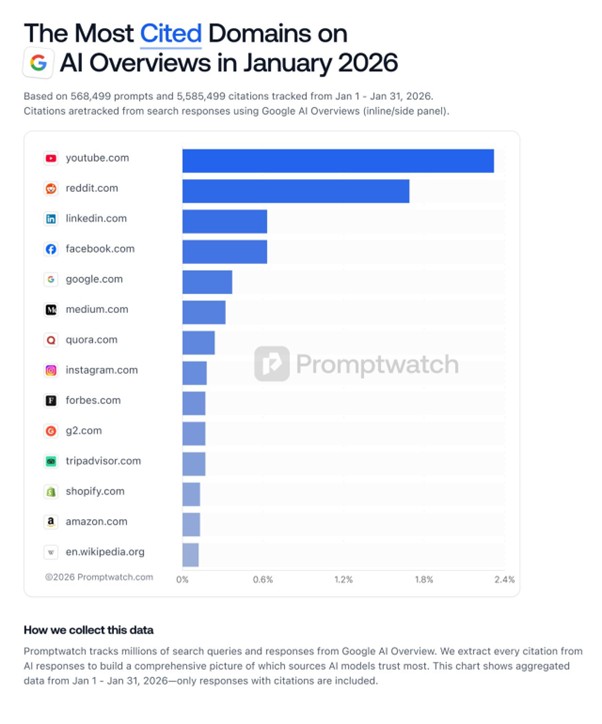
And what’s even more critical? Domains with millions of brand mentions on Quora and Reddit have roughly 4x higher chances of being cited by AI than those with minimal activity. The brands not monitoring are the ones being defined by others.

As Ryan Law, Director of Content Marketing at Ahrefs, put it:

“A big part of how LLMs understand what your brand is about and when it should recommend it is based on where you appear in its training data and where you appear on the web.”

Brand mention monitoring is no longer optional infrastructure in 2026. It’s the earliest warning system your brand has.

How to Monitor Brand Mentions: The Proprietary TRACK Framework we Follow

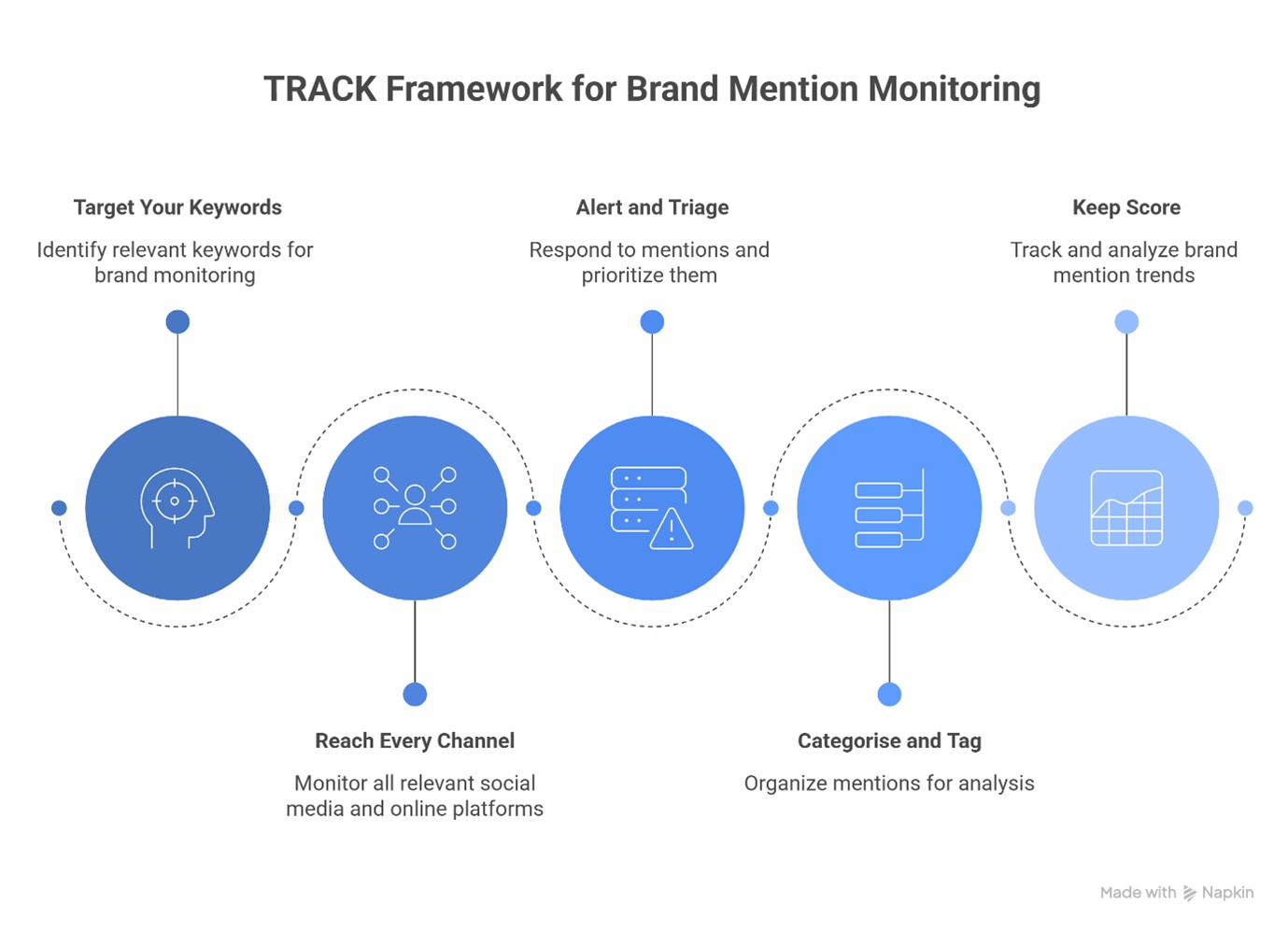
track framework for brand mentions monitoring

Before picking a tool, you need a process, otherwise you’ll drown in noise and never convert data into action. We built the TRACK Framework to turn brand mention monitoring from a passive alert system into an active growth engine.

Here’s how each step works:

T: Target Your Keywords

Define what you’re actually tracking. This goes beyond your exact brand name.

Include:

  • Brand name variations and misspellings
  • Product and service names
  • Founder and key team members
  • Branded hashtags and slogans
  • Competitor names (for comparison and gaps)

If you keep this too narrow, you miss how people actually talk about your brand.

R: Reach Every Channel

Social media monitoring is just one layer. You need coverage across:

  • Web and news publications
  • Blogs and niche sites
  • Review platforms (Google, Trustpilot, G2)
  • Forums and communities (Reddit, Quora)
  • Podcasts and video transcripts
  • AI-generated outputs (what tools like ChatGPT or Perplexity say about you)

Most brands stop at social. The highest-value mentions live elsewhere.

A: Alert and Triage

Set real-time alerts for high-stakes keywords (brand name, key products) and daily digests for broader monitoring. Not every mention demands a response.

So, filter by: is it linked or unlinked? Is the source high or low authority? Is action required now, or should it be logged for the monthly report?

C: Categorise and Tag

Label every mention: positive, neutral, or negative; linked or unlinked; action-required or observe-only. This tagging is what transforms a pile of alerts into a structured information your SEO and content teams can actually use.

K: Keep Score

Monthly reporting disciplines are what separate brands that monitor from brands that improve. Measure consistently:

  • Mention volume (month-over-month trends)
  • Sentiment shifts
  • Links reclaimed
  • AI visibility snapshots (how LLMs currently describe your brand)

This is where monitoring becomes strategy.

Related read: Effective Strategies for Tracking Brand Mentions

Best Tools to Monitor Brand Mentions SEO 2026

These tools are essential for scaling brand mention monitoring and enabling brands to operationalise brand mentions SEO strategies effectively. Here’s the list of tools you can use to track brand mentions online in 2026:

Tool Best For Tracks Unlinked Mentions AI Mentions Price
Google Alerts Basics / Free No No Free
Brand24 SMB all-in-one Yes Partial From $79/mo
Semrush Brand Monitoring SEO + link reclamation Yes Limited From $139/mo
Ahrefs Content Explorer / Ahrefs Brand Radar Backlink reclamation Yes Yes From $129/mo
Mention.com Social + web Partial No From $49/mo
Brandwatch Enterprise sentiment Yes Emerging Custom
Peec AI AI-specific visibility N/A Yes Custom
Profound AI mention depth + competitive N/A Yes Custom

For tracking how ChatGPT, Gemini, and Perplexity describe and recommend your brand tools like Profound and Peec AI are now purpose-built for this layer.

Note: A traditional social listening tool that adds a “ChatGPT mentions tab” is not the same thing.

How to Turn Unlinked Mentions into Backlinks?

An unlinked mention is a backlink that hasn’t been claimed yet. The site already trusts your brand enough to reference it; they just didn’t link. That’s the opportunity.

Outreach Strategy

Start by exporting unlinked mentions from Ahrefs Content Explorer (search “Your Brand Name” – site:yourdomain.com) or Semrush Brand Monitoring.

Filter by Domain Rating 40+ and sort by most recent. Prioritise mentions that are:

  • Topically relevant (same industry or audience)
  • Published within the last 30–60 days
  • From sites with real editorial standards

Find the author or editor via their author bio, LinkedIn, or Hunter.io. Approach as a contributor adding value, not as someone asking for a favour.

Outreach success rates improve significantly within 2-3 days of publication while the article is still “fresh.” Approach with an Email template like this:

Quick note about brand mention emailNo ask. No urgency. No “I noticed you forgot the link.” Always, lead with value, let the request be implicit. You’ll be surprised how often a simple email converts.
Link Building Benefits

This matters for 3 compounding reasons:

  • First, these are genuine editorial backlinks earned on merit, not exchanged or purchased, which carry significantly more ranking weight with Google.
  • Second, they often come from high-authority, topically relevant domains, which are exactly the kind of sources AI models cite.
  • Third, distributing content to a wide range of publications can increase AI citations by up to 325% compared to only publishing on your own site.

Every reclaimed link is a signal multiplier across both traditional and AI search.

The Most Common Brand Mention Monitoring Mistakes to Avoid

  1. Ignoring Negative Mentions

Negative mentions don’t fade; they accumulate.

A single Reddit thread or low-rated review can persist as a signal, influencing how AI systems interpret and describe your brand over time.

What works:

  • Triage within 24 hours
  • Respond publicly where possible
  • Build a steady flow of positive, authoritative mentions

You can’t usually remove negative content. You can dilute its impact.

  1. Not Responding Quickly

Speed is everything in reputation management. A mention that goes unaddressed for a week is a missed opportunity: to turn a neutral writer into a brand advocate, to correct a factual error before it spreads, to engage a potential partner who mentioned you without realising you were listening.

Your benchmarks?

  • Negative mentions → same-day response
  • Positive mentions → within 48 hours

The brands that respond fastest are the ones that build the most organic mention velocity over time.

  1. Tracking Only Social Media

This is the most common and expensive mistake. Social media brand monitoring captures the loudest layer, yes, but not the most influential one. Industry blogs, niche forums, review platforms, podcast transcripts, and AI-generated recommendations are where the mentions that move SEO and AI visibility actually live.


As Tim Soulo, said: “You just need to see where your competitors are mentioned, where your industry is mentioned and get mentions there.”

A brand that only watches a few textbook platforms is optimising for noise, not signal.

Final Thoughts

Brands that invest in structured brand mentions services are not just tracking visibility, they are actively shaping how search engines and AI systems understand and recommend their brand. And brands that monitor consistently are the ones that compound these signals into rankings, reclaimed links, and recommendations from AI engines your competitors haven’t even started thinking about.

Sudha Solutions’ TRACK Framework gives you the right process. The tools give you the data. What you do with that data determines whether brand mentions become passive noise or active growth.

At Sudha Solutions, we connect brand mention monitoring to a full AEO and SEO strategy; turning every signal into action, from AI visibility audits to content engineered to earn citations.

Get a full audit today!

Frequently Asked Questions

How can I track mentions of my brand online?

Use a mix of tools (Google Alerts, Ahrefs, Semrush) and monitor across web, social, forums, review sites, and AI outputs. Define clear keywords and set alerts.
What are the best tools for brand monitoring?

Ahrefs Alerts, Semrush Brand Monitoring, Google Alerts, Brand24, and Mention. Use at least one SEO tool + one real-time monitoring tool.

Are brand mentions important for SEO?

Yes. They contribute to authority, trust, and visibility. Unlinked mentions can be converted into backlinks, and strong mention signals influence AI-generated results.

How do I find unlinked brand mentions?

Search your brand name in Ahrefs Content Explorer or Semrush (“brand name” site “yourdomain.com). Filter results and identify mentions without links.

Categories
AEO Optimization GEO Optimization GEO vs SEO

AEO vs SEO in 2026: What Smart D2C Brands Are Prioritising (And Why It Matters More Than Ever)

For nearly two decades, digital growth followed a predictable playbook.

You invested in SEO services. You ranked on Google. You drove traffic. You converted that traffic into revenue.

But AI-led platforms have fundamentally changed that model. Today, search engine optimization services alone are no longer enough to guarantee visibility.

According to multiple industry analyses, over 60% of Google searches now end without a click. With the rise of AI Overviews, ChatGPT, Gemini, and Perplexity, users are no longer browsing through results. They are consuming final answers.

This shift has given rise to a new layer of strategy: AI search optimization and answer engine optimization (AEO).

“Google is sending less traffic out than ever before, even as search volume increases.” – Rand Fishkin, co-founder of Moz and SparkToro.

This is the paradox founders are facing today. More searches. Less traffic. Higher competition.

So the real strategic question is no longer: “How do we rank higher?

It is: “How do we become the source that AI trusts enough to quote?

SEO in 2026: Still Foundational, But No Longer Sufficient

SEO in 2026

SEO (Search Engine Optimization) has not disappeared. It has matured.

Modern SEO is no longer about inserting keywords into blog posts or building backlinks at scale. It is about building topical authority and trust signals that search engines can validate.

This is where SEO expert services play a critical role, ensuring your website is technically strong, content-rich, and aligned with search intent.

Google’s Helpful Content System and EEAT framework have made one thing clear:

Content is no longer evaluated in isolation. It is evaluated in the context of who created it, why it exists, and how trustworthy the source is.

In practical terms, strong SEO in 2026 involves:

  • Technical SEO services for crawlability and indexing
  • Content SEO strategy built around topical authority
  • Internal linking structures that signal expertise
  • Clear site architecture for both users and search engines

For D2C brands, this means your content cannot just sell. It must educate, guide, and demonstrate expertise.

What is AEO (Answer Engine Optimisation)?

What is AEO

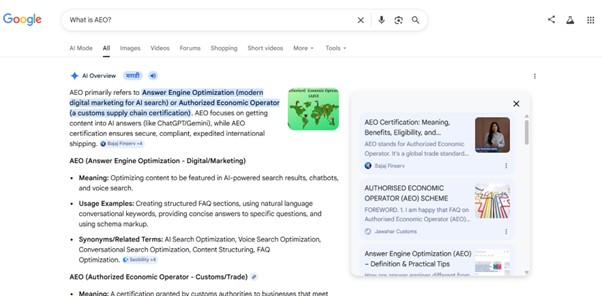
AEO (Answer Engine Optimization) is the practice of optimising your content so AI tools and voice assistants (like ChatGPT, Perplexity, or Siri) directly surface it as the answer to a user’s question, rather than just ranking it in traditional search results.

Unlike traditional SEO, where users compare multiple sources, AEO operates in an environment where one synthesised response dominates the user experience.

“We are reimagining search as a generative experience, where users can understand complex topics faster.” – Sundar Pichai, CEO of Google and Alphabet.

That single sentence captures the entire transition.

Search is no longer about discovery. It is about SOLUTION.

SEO vs AEO: The Strategic Difference Founders Must Understand

The difference between SEO and AEO is not technical. It is behavioural. SEO was built for an era of exploration. AEO is built for an era of decision-making.

Dimension SEO AEO
Goal Rank high on search engine results pages Be the direct answer returned by AI or voice engines
Content Format Long-form, keyword-rich pages Concise, structured, question-answer format
User Interaction User clicks a link and visits your site User gets the answer without clicking anywhere
Success Metric Traffic, rankings, click-through rate Answer appearances, citations, zero-click visibility
Optimisation Target Google’s crawl and ranking algorithm AI models, featured snippets, voice assistants


Also Read: Will AEO Replace SEO? What Marketers Get Wrong About AI Search

Why AEO Is Growing Faster Than Most Brands Realise

The growth of AI search optimization is driven by user behavior  .

Recent trends show:

  • Conversational queries are increasing rapidly (voice + AI inputs)
  • Users prefer summarised insights over long-form exploration
  • Time-to-answer is becoming a critical expectation

Microsoft reported that with AI-powered Bing, users were asking longer, more complex queries, indicating a shift toward intent-rich search behaviour.

At the same time:

  • Optimize for ChatGPT search
  • Optimize for Google AI Overviews
  • Improve AI search visibility

For brands, all of this leads to one conclusion: Search is becoming answer-first, not link-first.

Why SEO Still Powers Everything (Even AEO)

Let’s start by saying that SEO is not dead. It is still strong and very relevant. Even in an AI-first world, SEO services remain critical

AI systems rely heavily on:

  • Indexed web content
  • Authoritative domains
  • Structured knowledge

Studies have shown that AI-generated answers frequently pull from top-ranking or highly authoritative pages.

This means:

  • If your content does not rank, it is less likely to be cited
  • If your brand lacks authority, it is less likely to be trusted
  • If your structure is weak, it is less likely to be extracted

In other words:

SEO builds your eligibility. AEO determines your selection.

Ignoring SEO while chasing AEO is like trying to win a race without training.

The Real Framework: SEO + AEO + GEO

The brands that are winning are not choosing between SEO and AEO.

They are operating across three layers:

  1. SEO: Ensures discoverability and indexation.
  2. AEO: Ensures extractability and selection.
  3. GEO (Generative Engine Optimisation): Ensures your brand exists as a recognised entity across AI ecosystems.

This includes:

  • Consistent brand mentions across platforms
  • Presence in trusted publications
  • Strong knowledge graph signals
  • Cross-platform visibility beyond your website

This is where most D2C brands are currently under-invested.

They focus on content creation, but not on content distribution and entity building.

What High-Performing Brands Are Doing Differently

After analysing multiple high-performing content ecosystems, a clear pattern emerges.

The brands that get cited consistently:

1. Write for Clarity, Not Just Depth

They do not bury answers inside long paragraphs. They surface them early and clearly.

2. Structure for Extraction

They use:

  • Defined sections
  • Direct answers
  • Logical flow

This makes it easier for AI systems to interpret and extract.

3. Build Topical Authority, Not Isolated Content

Instead of writing one blog per keyword, they build clusters that signal expertise.

4. Invest in Brand Mentions Beyond Their Website

They appear in:

  • Industry blogs
  • Publications
  • Directories

This strengthens their entity credibility.

Practical Implementation: Where Most Brands Go Wrong

Most brands focus only on content creation. But real growth comes from optimization:

  • Improving existing high-ranking pages
  • Adding structured answer blocks
  • Strengthening internal linking
  • Building authority beyond the website

Start here:

1. Identify High-Potential Pages

Look for:

  • Pages already ranking on page 1
  • Content answering common questions

These are your best candidates for AEO optimisation.

2. Introduce Answer Blocks

Add:

  • Clear definitions
  • Direct responses to key questions
  • Structured summaries

3. Improve Semantic Coverage

Ensure your content:

  • Covers the full context of the topic
  • Connects related subtopics
  • Reflects real user intent

4. Strengthen Authority Signals

This is often overlooked.

Your content needs to be supported by:

  • External mentions
  • Author credibility
  • Consistent brand positioning


Also Read: SEO Meets LLMs: How Search Algorithms Learn, Rank, and Generate Answers

Case Study

Brand: Satguru’s

Challenge: To get visibility when e-commerce giants like Amazon and Flipkart ranked for similar keywords.

Our Approach:

  1. Conducted a comprehensive technical SEO audit to identify competing external marketplace domains targeting the same keywords.
  2. Crafted high-quality blogs with a format that pleases both human readers and AI engines.
  3. Employed schema markup and structured data to increase the chances of being featured in rich results and AI overview snippets.
  4. Researched AI-driven search trends and optimized website content with conversational language and relevant queries to align with algorithms of AI-powered platforms such as ChatGPT and Google AI Overviews.

Result:

AI Visibility (mentions in ChatGPT/Google AI Overviews) grew by 273% demonstrating robust brand representation in next-gen search interfaces.

AI Visibility for Satgurus

Final Verdict

If you are looking for a simple answer, here it is:

You should not choose between SEO and AEO. You should combine them strategically:

  • Start with search engine optimization services
  • Layer answer engine optimization services
  • Expand into AI search optimization and GEO

Because the future of search is not about who ranks first. It is about who gets referenced when decisions are made.

CTA: Where Most Brands Need Help (And Why It Matters)

This shift sounds strategic. But execution is where most brands struggle.

Especially for D2C founders who are:

  • Investing in content but not seeing conversions
  • Ranking but not getting meaningful traffic
  • Missing out on AI-driven visibility

At Sudha Solutions, we work specifically on bridging this gap.

Not just SEO. Not just content. But how your brand shows up in the new answer-first ecosystem.

At Sudha Solutions, we help brands bridge the gap between traditional SEO and AI-driven visibility.

Whether you need:

  • SEO Expert Services to build authority
  • AEO Services to improve AI visibility

If you want to understand your current position:

  • Which of your pages can be optimised for AEO
  • Where you are losing visibility in AI-driven search
  • How to restructure your content for better lead generation

We can help you audit and map that. Because in 2026, we believe, traffic is optional. Trust, visibility, and selection are not. Contact us TODAY!

FAQs

How do I know if my brand is already showing up in AI-generated answers?

Start by searching your key topics on platforms like ChatGPT, Google AI Overviews, and Perplexity. If your brand or content is not being referenced, it usually means your content lacks structured answers, authority signals, or consistent mentions across the web.

Why is my organic traffic dropping even though my rankings are stable?

This is often due to the rise of zero-click searches and AI summaries. Users are getting their answers directly on search pages without clicking through. In such cases, your content may still be visible but not driving traffic. This is where AEO becomes critical, as it focuses on being part of the answer layer, not just the result page.

What kind of content is more likely to be picked by AI engines?

Content that answers specific questions clearly, is well-structured, and demonstrates real expertise tends to perform better. Pages that include concise summaries, logical flow, and strong topical coverage are easier for AI systems to extract and reference.

Can AEO help improve conversions even if traffic decreases?

Yes. AEO improves the quality of visibility rather than the quantity of traffic. If your brand is consistently cited in AI-generated answers, users are more likely to trust you before even visiting your website, which shortens the decision-making process and can improve conversion rates.

How often should I update my existing content for AEO?

High-performing pages should be reviewed every 3 to 6 months. Instead of rewriting everything, focus on improving clarity, adding direct answers, updating data points, and expanding coverage around user intent.

Categories
AEO Optimization General SEO

AEO for Healthcare, Real Estate & E-commerce: What’s Different in 2026

In 2026 we know that the way we search is not the same. It is evolving and evolving fast. Only ~8% of users click traditional links when AI summaries are shown

But here’s something even more interesting:

This shift is not affecting every industry in the same way.

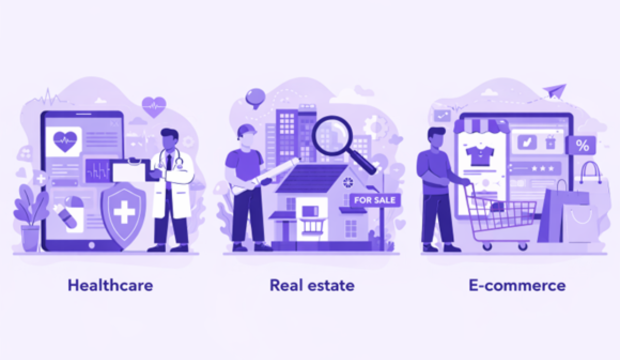
  • In healthcare, users are looking for immediate, trustworthy answers.
  • In real estate, they are evaluating long-term, high-value decisions.
  • In e-commerce, they are comparing options before buying.

And AI is reshaping all three differently.

We are no longer competing for rankings. We are competing to be selected as the answer.

This is where AEO (Answer Engine Optimization) becomes critical.

Many brands are now working with specialised partners offering AI visibility and AEO solutions to adapt to this shift

But treating AEO as a single strategy across industries is where most brands get it wrong.

Because the way people search, trust, and decide in healthcare is fundamentally different from real estate. And what works in e-commerce often fails in both.

Why AEO Looks Different Across Industries: Healthcare vs. Real Estate vs. E-commerce

At a surface level, AEO sounds simple. Structure your content in a way that it is easy for AI to read and extract it. This is exactly what structured AEO strategies aim to achieve across industries.

But in reality, three forces shape everything:

Factor Healthcare Real Estate E-commerce
Intent Urgent, emotional Research-heavy Comparison-driven
Risk High (health impact) Very high (financial) Medium
Trust Dependency Critical High Moderate

AEO is not about formatting content. It is about aligning with how decisions are made in your category.

Let’s break each of these sectors:

AEO in Healthcare: When Answers Need Authority

AEO in Healthcare

AI answered 66% of COVID-related queries in 2025 vs just 1% in 2024, meaning the influence of AI is increase in the healthcare sector.

How Users Search to Get Information in Healthcare

Healthcare queries are rarely casual.

They are urgent, personal, and often anxiety-driven:

  • “Is chest pain serious?”
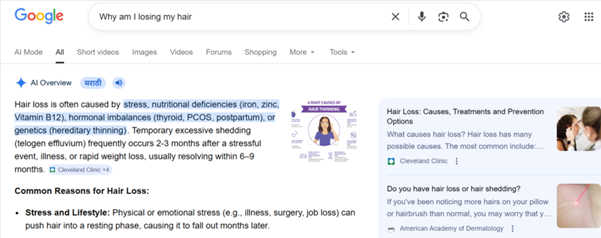
  • “Why am I losing hair suddenly?”
  • “Best dermatologist near me”

These are not content opportunities. They are moments of vulnerability.

How AI is Changing Healthcare Discovery

AI is now capable of:

  • Summarising symptoms
  • Suggesting possible causes
  • Recommending next steps

This reduces the need to browse multiple websites.

But it introduces a new filter:

Only content that is credible enough gets surfaced.

Google’s own search quality framework classifies healthcare under “Your Money or Your Life” (YMYL) where accuracy and trust directly impact rankings.

SEO expert Lily Ray, known for her work on Google’s quality updates, has consistently emphasised: “Google is getting better at identifying true expertise, especially in sensitive industries.

What This Means for Healthcare Brands

Three shifts are already visible:

  • Traffic may decrease, but intent becomes sharper
  • Authority matters more than keyword coverage
  • Visibility is earned through trust, not volume

What Healthcare Brands Must Do for AEO

To be selected as an answer:

  • Create dedicated condition and symptom pages
  • Structure answers clearly (definitions, causes, treatments)
  • Strengthen EEAT signals (credentials, sources, transparency)
  • Build expert-backed content (doctor-reviewed, validated)

Brands often rely on expert-led SEO and AEO services to build credibility and trust signals at scale.

Healthcare Brands

In healthcare, AEO is not about ranking higher. It is about being trusted enough to be cited.

To understand how this works in detail, read our guide on why businesses are becoming invisible to ChatGPT without AEO.

Where Most Healthcare Brands Are Falling Behind

Many health platforms still rely on:

  • Generic symptom blogs
  • Surface-level explanations
  • Poor content structuring

These worked when users explored. Now users expect answers.

AEO in Real Estate: From Discovery to Decision in One Search

AEO in Real Estate

How Users Search in Real Estate

Real estate is not a quick decision.

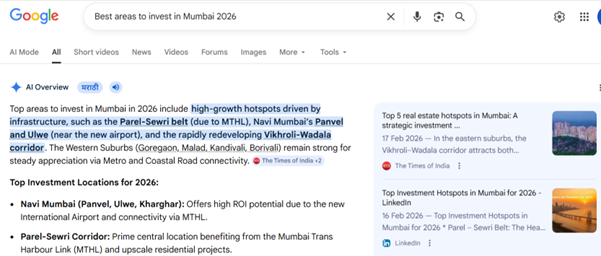
Users search with layered intent:

  • “Best areas to invest in Mumbai 2026”
  • “2 BHK price in Thane”
  • “Is it a good time to buy property in Pune?”

Each query represents a step in a long evaluation journey.

How AI is Changing Property Research

AI compresses that journey.

Instead of reading multiple blogs, this is what you can get in seconds:

  • Area comparisons
  • Price insights
  • Investment summaries

Rand Fishkin, co-founder of SparkToro, has repeatedly pointed out that:

Google is increasingly keeping users within its own ecosystem.

And AI-driven answers promotes this behaviour.

What This Means for Real Estate Brands

The funnel is shifting:

  • Top-of-funnel traffic declines (fewer exploratory clicks)
  • Mid-funnel intent strengthens (users arrive more informed)
  • Decision-stage content becomes the differentiator

What Real Estate Brands Must Do for AEO

To stay visible:

  • Build hyperlocal content (area-specific pages)
  • Create investment-focused guides
  • Structure insights in a way AI can extract

Add price comparisons and trend data

Real Estate Brands

In real estate, the brand that explains the decision becomes the brand that gets the lead.

This is where structured content and SEO strategies play a critical role in influencing buyer decisions.

Where Most Real Estate Brands Are Falling Behind

  • Over-dependence on listings
  • Limited advisory content
  • Weak data structuring

They are optimized for discovery, but users want help with decisions.

AEO in E-commerce: When AI Becomes the New Storefront

AEO in E-commerce

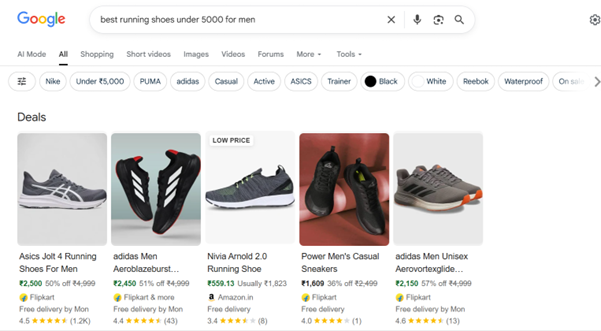
How Users Search in E-commerce

E-commerce queries are direct and intent-heavy:

  • “Best running shoes under 5000”
  • “Which iPhone should I buy”
  • “Best skincare for oily skin”

These are not browsing queries. They are purchase decisions in motion.

How AI is Changing Product Discovery

AI is becoming the first touchpoint:

  • Recommending products
  • Comparing features
  • Highlighting pros and cons

Users no longer need to explore category pages.

What This Means for E-commerce Brands

Three clear shifts:

  • Discovery happens outside your platform
  • Content influences decisions more than listings
  • Brand visibility becomes indirect (via AI recommendations)

Zero-click behaviour reinforces this shift, where a majority of users get answers without visiting websites .

What E-commerce Brands Must Do for AEO

To remain visible:

  • Create buying guides (problem-solving content)
  • Build comparison-driven pages
  • Structure product data clearly
  • Answer “best”, “vs”, and “which should I buy” queries

E-commerce Brands

In e-commerce, AEO rewards brands that guide decisions, not just display products. E-commerce brands are increasingly investing in conversion-focused SEO and AEO solutions to stay visible across AI platforms

Where Most E-commerce Brands Are Falling Behind

Many D2C brands:

  • Focus only on product pages
  • Ignore content-led discovery
  • Do not structure data for AI extraction

Tis only leads to ranking, and ranking does not always translate to AI recommendations.

Also Read: What Is AEO? Why Your Business Is Invisible to ChatGPT in 2026

What 2026 is Teaching Us About AEO

Across industries, a pattern is emerging:

  • Generic content is losing visibility
  • Structured, answer-ready content is winning
  • Authority signals are becoming ranking signals
  • Traffic is no longer the only KPI

The shift is from ranking pages to being selected as answers.

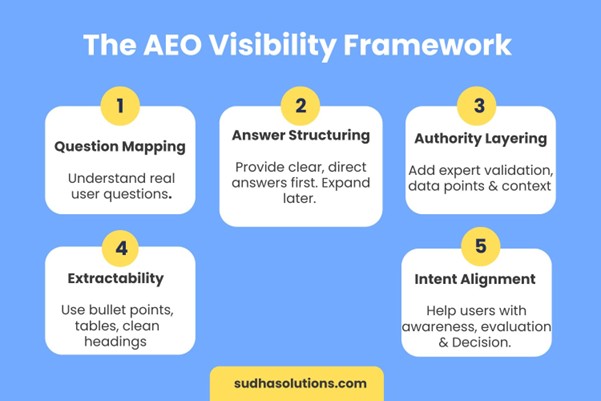
This is the framework we follow when working with brands:

AEO visibility framework

Why AEO Needs a Strategic Approach

This is where most brands get it wrong.

They treat AEO like:

  • SEO 2.0
  • A content formatting exercise

It is neither.

AEO requires:

  • Search intent mapping
  • Content architecture
  • AI visibility planning
  • Continuous optimisation

Brands that treat AEO as a checklist will struggle. Those that treat it as a strategy will lead.

Conclusion: The Future Belongs to Answer-Ready Brands

Search is not disappearing.

It is evolving.

Users are no longer browsing links. They are deciding.

And AI is deciding what they see.

The brand that gets cited is the brand that has the highest probability of being chosen.

So, the real question is no longer:

“Are you ranking?” It is: Are you being selected?

If your organisation is part of healthcare, real estate, or e-commerce sector and you need to improve your visibility, you can contact us at Sudha Solutions. We have worked with clients in all these 3 sectors improving both their google ranking and AI visibility. Visit Sudha Solutions to learn more about our services.

FAQs

What is AEO in digital marketing?

Answer Engine Optimization (AEO) is the process of optimizing content to appear in AI-generated answers, voice search results, and featured snippets rather than just traditional search rankings.

How does AEO work for healthcare websites?

AEO for healthcare relies heavily on high-authority, fact-checked content that aligns with EEAT principles, ensuring accurate answers for sensitive queries.

How can real estate businesses optimize for AI search?

Real estate businesses can optimize for AI search by creating hyper-local, intent-driven content that answers specific buyer and investor queries.

What AEO strategies work best for ecommerce stores?

Ecommerce AEO works best with product-focused FAQs, comparison content, and clear answers to purchase-related queries like pricing, features, and reviews.

Why is AEO important in 2026?

AEO is crucial in 2026 because users increasingly rely on AI tools like ChatGPT and voice assistants for direct answers instead of browsing multiple links. Brands that optimize for AI visibility gain higher trust, visibility, and conversion opportunities.

Categories
AEO Optimization AI Overview General SEO

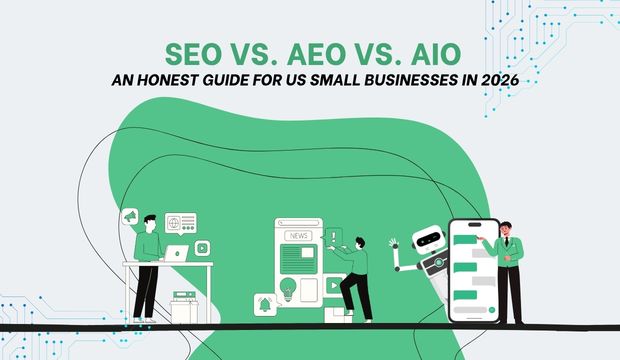
AIO vs SEO vs AEO: An Honest Guide for US Small Businesses in 2026

The Rules of Search Have Changed. Have You?

If you built your website traffic on SEO a few years ago and things feel a little… off lately, you’re not imagining it. The way people search for businesses, products, and answers has shifted drastically and in 2026 your brand can no longer ignore it. To stay competitive, many businesses are now investing in structured SEO strategies and AI visibility optimization services.

Google still processes roughly 8.5 billion searches every day meaning the audience is there but how they search, and how they find you, is a different story. Nearly 60% of all Google searches are now “zero-click”, meaning users get their answer right on the results page and never visit your website at all.

So where does that leave your small business?

In this guide, we will explain you in simple terms about SEO, AEO, and AIO which will help you understand how you can make your business visible in the AI era.

SEO vs. AEO vs. AIO: Basic Definitions

You’ve probably heard SEO your whole digital marketing life. AEO and AIO are newer, and the internet loves to make them sound more complicated than they are. Here’s the simplest version:

What is SEO

According to SEMRush, SEO stands for search engine optimization. It is the process of making your website more visible in search engines like Google without paying for ads. Businesses often rely on professional SEO expert services to improve rankings, technical performance, and long-term visibility.

What is AEO in SEO

Answer Engine Optimization (AEO) is the practice of optimizing content so that it is selected and presented as a direct answer by AI-driven search engines, voice assistants, and conversational platforms like ChatGPT, Perplexity, and Google AI Overviews. To consistently appear in AI-generated answers, brands are increasingly adopting dedicated AEO services

What is AIO in SEO

Artificial Intelligence Optimization (AIO) is the practice of structuring digital content so it can be efficiently crawled, interpreted, and referenced by AI models such as ChatGPT, Gemini, and AI-powered search engines.

Think of it this way:

  • SEO gets you discovered.
  • AEO gets you selected.
  • AIO gets you cited.

SEO in 2026: Still Essential, But No Longer Enough

Organic Keyword Ranking for SEO 2026

Let’s be clear: SEO isn’t dead. Anyone telling you this is trying to sell you something. Your website still needs clean structure, relevant keywords, fast load times, mobile optimisation, and local SEO if you serve a specific area.

What has changed is that SEO alone is no longer enough.

Google’s algorithm in 2026 heavily rewards E-E-A-T (Experience, Expertise, Authoritativeness, and Trustworthiness). That means thin content, keyword stuffing, and link schemes are losing their value fast.

What works now is genuinely helpful, well-organized content written by someone who clearly knows what they’re talking about.

For small businesses, the honest SEO priority list looks like this:

  • Keep your Google Business Profile updated (critical for local search)
  • Make sure your site loads fast on mobile
  • Write content that actually answers your customers’ real questions
  • Build a handful of quality backlinks from local or industry sources

“SEO is the base layer. But it’s no longer the ONLY layer.”

If you want to understand how this shift impacts modern visibility, read our detailed guide on SEO vs AEO and how they work together in 2026.

AEO: Writing to Be the Answer, Not Just the Link

AEO Ranking for Sudha Solutions

Here’s where many small business owners are leaving traffic on the table without realising it.

According to a study by Ahrefs’ featured snippets — those direct answer boxes at the top of Google — now appear on over 12% of all search queries. Voice assistants pull almost exclusively from these.

If your competitor’s page answers a question more clearly than yours, they get read aloud to potential customers while your page sits quietly on page one.

Here’s the fix

The First 40–60 Words Rule

Whenever you address a question in your content, give a clear, direct answer in the first 40–60 words before going into detail. Search engines and AI systems are scanning for that crisp, usable response. If you bury your answer three paragraphs deep, you’re invisible to these systems.

Here’s a practical example. If you run a plumbing business in Austin, instead of a generic “About Our Services” page, consider a FAQ-style blog post: “How much does it cost to fix a leaking pipe in Austin?”  and answer it directly in the first two sentences.

SEO optimizes for rankings. AEO optimizes for selection.

Also Read: What is AEO? Why Your Business is Invisible to ChatGPT in 2026

AIO: Getting AI to Trust (and Cite) Your Business

AIO ranking for sudha solutions

This is the frontier, and if you get ahead of it now, you’ll have a meaningful advantage.

When someone asks ChatGPT or Google’s AI Overview, “What’s the best HVAC company in Charlotte, NC?” how does the AI decide what to say?

It pulls from sources it deems credible, consistent, and well-structured across the web. That means your job is to become that source. This is where structured AEO and AI optimization services play a critical role in helping brands get cited across AI platforms

A few practical ways to build AIO-readiness:

Schema markup is now non-negotiable: Schema is code added to your website that tells search engines (and AI systems) exactly what your business does, where you’re located, what your hours are, and more. If you haven’t implemented schema yet, this is your highest-leverage technical move right now.

Consistency across the web builds AI trust: Make sure your business name, address, phone number, and description are identical on your website, Google Business Profile, Yelp, Facebook, industry directories. AI systems cross-reference these signals to judge credibility.

Earn mentions, not just links: Being cited in local news, industry blogs, or community websites tells AI that real sources recognize your business as legitimate.

Brand visibility in AI tools like ChatGPT and Claude is becoming just as critical as search ranking.

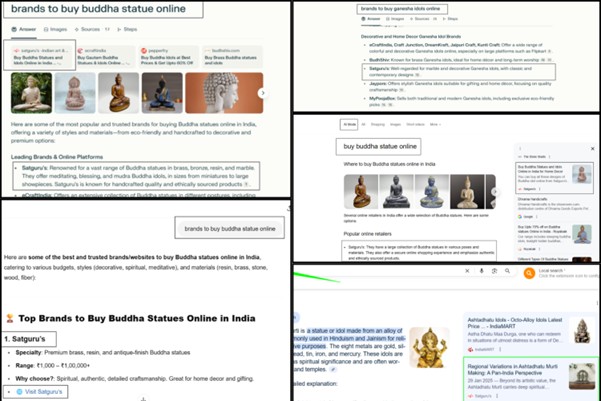
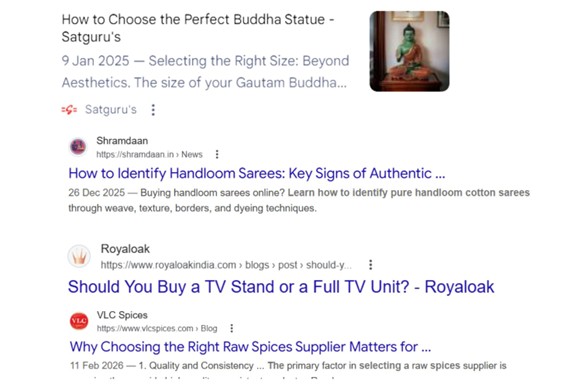
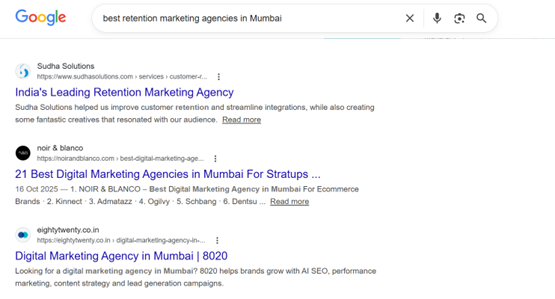
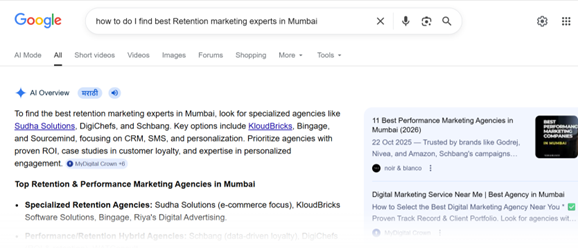
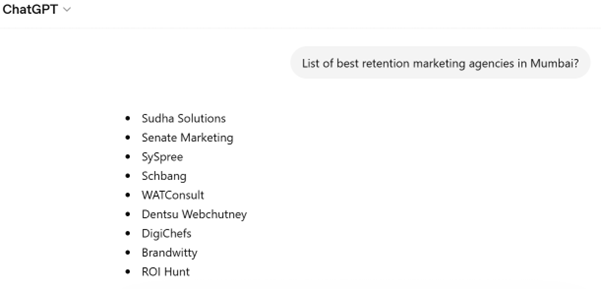
If you closely look at all the 3 examples, Sudha Solutions is ranking 1st in Google ranking while also being mentioned in AI overview and AI listicle. This should be the goal for your brand as well.

Do You Really Need All Three?

Here’s the honest take by our digital marketing expert: “In a nutshell, it’s all just SEO with very negligible differences.” And there’s real truth to that. If you write genuinely helpful content, keep your site technically clean, build real authority, and answer questions clearly, you’re already doing SEO, AEO, and AIO simultaneously.

The acronyms are different. The underlying mission remains the same: be the most helpful, credible, and clear source for your customers’ questions.

That said, being intentional about each layer does make a difference, especially for small businesses competing in crowded local markets.

Your 2026 Action Plan

Here’s a realistic starting point:

This month (SEO hygiene)

  • Audit and update your Google Business Profile
  • Check that your site loads in under 3 seconds on mobile
  • Make sure your NAP (Name, Address, Phone) is consistent everywhere online

Next 60 days (AEO layer)

  • Rewrite your top 3–5 service or product pages in a Q&A format
  • Apply the 40–60-word rule: lead every section with a direct answer
  • Add an FAQ section to your homepage or key landing pages

Ongoing (AIO foundation)

  • Add or update schema markup
  • Start building mentions: local press, guest posts, community sponsorships

Create one piece of genuinely authoritative content per month in your niche

Brief Summary

Aspect SEO AEO AIO
Primary Goal Rank higher on search engines Become the direct answer to a query Get cited and used by AI models
Focus Keywords, backlinks, rankings User intent and direct answers Structured, machine-readable content
Output Website links (SERP listings) Featured snippets, voice answers, AI summaries AI-generated responses (ChatGPT, Gemini, etc.)
Content Style Long-form, keyword-rich Concise, clear, question-based Context-rich, structured, semantically strong
Optimization Method On-page SEO, backlinks, technical SEO FAQs, schema, snippet optimization Entity building, structured data, topical authority
User Interaction Click-driven Zero-click or minimal-click No-click, AI-consumed
Success Metric Rankings, traffic, CTR Featured snippet wins, visibility Citations, mentions in AI responses
Dependency Search engine algorithms Search + AI answer engines AI models and LLM understanding

Also Read: AEO/GEO Optimization Strategy: Best Practices, Tools, and How it Differs from Traditional SEO

The Bottom Line

You don’t have to choose between SEO, AEO, and AIO, you have to evolve. The small businesses that thrive in the next few years won’t be the ones who mastered one acronym. They’ll be the ones who understood that search is changing and adapted before their competitors did.

The audience is still out there, searching every single day. The question is how your customers can find your brand before they find your competitors.

Want to optimise your website for AI visibility? Contact us at Sudha Solutions.

We have helped numerous brands rank on both Google and AI platforms. Here is the data for one of our clients:

Satguru’s is a Mumbai-based e-commerce brand that sells God idols and home decor items. When they contacted us, their biggest challenge was to compete with the likes of Amazon and Flipkart for same similar products.

Our SEO + AEO strategy helped them not only rank above Amazon but also helped them appear on AI platforms like ChatGPT. These were the results

  • 900% increase in organic sessions
  • 273% increase in AI visibility
  • 2x increase in top 3 keywords

Want similar numbers for your brand? Get on a call with us TODAY.

FAQs

Is SEO still relevant in 2026?
Yes, SEO remains essential as it forms the foundation for visibility, indexing, and discoverability across search platforms. However, it now works alongside AEO and AIO to ensure content is not just found but also selected and cited by AI systems.

How do AI search engines like ChatGPT rank websites?
AI engines don’t rank websites in the traditional sense; they prioritize content that is clear, authoritative, and contextually relevant. They select and synthesize information based on credibility, structure, and how well it answers the user’s query.

What is the future of SEO in the AI era?
SEO is evolving from keyword-focused optimization to intent-driven, entity-based, and AI-friendly content strategies. The future lies in creating content that can rank, answer, and be cited across both search engines and AI platforms.

Should businesses focus on SEO or AEO?
Businesses should not choose between SEO and AEO but integrate both into their strategy. SEO drives discovery, while AEO ensures your content becomes the answer users see first.

Categories
AEO Optimization

What Is AEO? Why Your Business Is Invisible to ChatGPT in 2026

Think about the last time you Googled something. Did you actually click a link? Or did you read the answer right there on the results page? 

Search behaviour has undergone one of the biggest shifts in the history of the internet, and most businesses are completely unprepared for it. The Search Landscape Has Fundamentally Changed

The uncomfortable truth is this: a page can rank #1 on Google and still never appear in a single AI-generated answer. At the same time, a page that barely makes page one of organic results can be cited by ChatGPT hundreds of times a day because it is structured the right way.

This is the world of Answer Engine Optimization. And in 2026, it is no longer optional.

TL;DR — What You Need to Know Right Now

Answer Engine Optimization (AEO) is the practice of structuring your content so AI-powered platforms — ChatGPT, Google AI Overviews, Perplexity, and others — select it as the cited answer when users ask questions.

If you are only doing SEO, you are optimising for a world that is already changing. This guide tells you what AEO is, how it works, why it is different from SEO, and exactly what you need to do today.

What Is AEO?

Answer Engine Optimization (AEO) is the practice of creating and structuring content so that AI-powered answer engines like ChatGPT, Google AI Overviews, Perplexity, Microsoft Copilot, and voice assistants can easily find, understand, and cite it as a direct response to user queries.

Where traditional SEO asks: “How do I rank at the top of Google?”

AEO asks: “How do I become the answer that AI delivers to millions of users?”

These are fundamentally different goals. SEO is about winning position on a list of links. AEO is about becoming the source that powers AI-generated responses. One gets you a click. The other makes you the authority.

If your content is not built to be selected by those systems, you simply do not exist in that conversation. That is what we mean when we say a business is “invisible to ChatGPT in 2026.”

How AEO Works: What AI Systems Actually Look For

How AEO Works

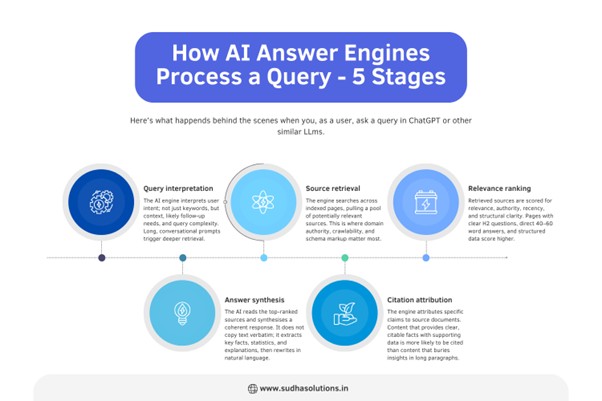
To understand how AEO works, you need to understand how AI answer engines process a query. The process happens in roughly four stages:

Stage 1: Query Decomposition

When a user asks “What is the best sofa for a small living room?”, the AI does not search for that exact phrase. It breaks the question into sub-queries like “best sofa small space“, “sofa buying guide“, “space-saving furniture types” and searches for content that ranks for all of them. Your content needs to address the full topic cluster, not just the surface question.

Stage 2: Source Retrieval

The AI retrieves candidate pages from a search index (ChatGPT uses Google’s index via SerpAPI, for example). This means strong technical SEO is still a crucial for AEO.  If Google cannot crawl and index your pages, no AI will find them either.

Stage 3: Credibility Evaluation

AI systems evaluate the trustworthiness of each source. They look for signals aligned with Google’s E-E-A-T framework (Experience, Expertise, Authoritativeness, and Trustworthiness). Author credentials, citations, backlinks from reputable sources, and schema markup all feed into this evaluation.

Stage 4: Answer Extraction and Citation

Finally, the AI extracts the most answer-ready segment from the page — usually a short paragraph, a definition, a list, or a table — and uses it to construct the response. Pages that lead with a clear, direct answer in 40–60 words are cited far more frequently than those that bury the answer in paragraphs of preamble.

Optimizing content for this extraction layer often requires AEO services that focus on structuring answer-ready content for higher citation probability

Key Insight: AI systems do not read your page the way a human does. They scan for extractable answer units. Every H2, every short paragraph, every FAQ entry, every schema-marked definition is a potential citation target. Structure is not just aesthetics — it is your AEO strategy.

SEO vs AEO: What Is the Difference?

SEO and AEO are not competing strategies. They are complementary layers of modern search visibility. But they have meaningfully different goals, tactics, and success metrics.

Dimension Traditional SEO Answer Engine Optimization (AEO)
Goal Rank in organic search results Be cited in AI-generated answers
Success Metric Rankings, clicks, organic traffic AI citations, brand mentions in AI responses, referral traffic from AI
Content Format Long-form, keyword-rich pages Answer-first structure, FAQs, concise definitions
Technical Focus Core Web Vitals, crawlability, links Schema markup, structured data, entity relationships
Authority Signals Backlinks, domain authority E-E-A-T, citations in authoritative sources, author credentials
Platforms Google, Bing organic results ChatGPT, Google AI Overviews, Perplexity, Copilot, voice
Zero-Click Impact Lost visibility on zero-click searches Gains visibility specifically through zero-click answers
Time to Results 3–6+ months typically Faster citation wins possible alongside slower authority build

The critical point: AEO does not replace SEO. AI models pull answers from pages that are already indexed and ranking. If your SEO is weak, your AEO will fail. Think of technical SEO as the cost of entry without which you are not even in the race. AEO is the layer that converts good rankings into actual citations inside AI responses.

Ensuring proper crawlability and indexing is often achieved with the help of technical SEO services that optimize site structure for both search engines and AI systems.

Why Is Your Business Invisible to ChatGPT Right Now?

Most Indian businesses, even those with solid SEO, are invisible on AI answer engines for one or more of the following reasons:

  • Content is not answer-formatted. Your pages are written to rank on Google, not to be extracted by AI. Long introductions, buried answers, and dense paragraphs make it difficult for an AI to isolate a citable answer unit.
  • No schema markup. Without structured data, FAQ schema, Product schema, How-to schema, AI systems cannot easily identify what type of content your page contains or what question it answers.
  • Weak E-E-A-T signals. AI prioritises sources it can be verified as authoritative. If your site lacks author bios, credentials, citations, and brand mention across the web, you will be deprioritised.
  • Not indexable by Google. ChatGPT uses Google’s search index. If pages are blocked by robots.txt, slow to load, or plagued by JavaScript rendering issues, they will never surface in AI answers.
  • No topical authority. AI favours sources that comprehensively cover a topic. A single page on a topic rarely wins. A content cluster of 10–15 interlinked pages signals deep expertise.
  • Not cited anywhere else. AI systems favour brands that appear frequently across multiple credible sources. If no authoritative website has mentioned or linked to you, AI treats you as unverified.

Real Business Impact

According to Forrester, 89% of B2B buyers have adopted generative AI as a central source for self-directed research across their entire buying journey. If your brand is not present in AI answers, you are absent from the most critical stage of the modern purchase process.

AEO Strategies for Businesses: 8 Proven Tactics

8 Proven AEO Tactics

These are the core AEO strategies that Sudha Solutions has used to drive measurable AI visibility for clients across e-commerce, beauty, and home decor categories. Each one is actionable, regardless of your industry. Let’s understand them in detail

  1. Structure Every Page Around a Direct Answer (Answer-First Format)

Place a clear, 40–60 word answer at the top of every major section. Do not make the AI infer what your content is about. State it plainly, early, and in natural language.

Example:

What is GEO

Pro tip: Mirror the exact phrasing users type into search. “Best wooden dining table” as a heading is good. “What is the best wooden dining table for a 6-seater dining room?” as a subheading is better as it captures the conversational query that AI systems are increasingly processing.

  1. Implement Schema Markup (Structured Data)

Schema.org markup is the technical backbone of AEO. It translates your content into a machine-readable format that AI systems can parse directly.

Priority schema types for AEO:

  • FAQ Schema: Add a dedicated FAQ section to every category, product, and blog page — and mark it up. This is one of the highest-impact AEO tactics available.
  • Product Schema: For e-commerce, mark up every product with name, price, availability, and reviews.
  • How-To Schema: For instructional content, use How-To markup to make each step individually extractable.
  • Article and Author Schema: Establish authorship and publication dates to signal freshness and expertise.
  • Breadcrumb Schema: Helps AI understand your site hierarchy and the context of each page.
  1. Build Topical Authority Through Content Clusters

A single page will rarely dominate AI citations. AI systems favour sources that comprehensively own a topic. The strategy is to build a cluster of 10–20 interlinked pages around your core subjects. This includes a pillar page supported by spoke articles, each addressing a specific sub-question.

Many brands partner with content marketing experts to build structured content clusters that signal deep topical authority to AI systems.

For example, a furniture brand might build a cluster around “recliner sofas” with a pillar page, supporting articles on materials, sizing guides, care instructions, comparison content, and buying guides. Each article links back to the pillar and to the others.

Internal links are not decorative. They signal topic relationships to AI systems. Every spoke article should link to the pillar, and the pillar should link back to all spokes. This architecture tells the AI: this brand understands this topic at depth.

  1. Establish E-E-A-T Across Every Touchpoint

Experience, Expertise, Authoritativeness, and Trustworthiness are the four trust signals that Google and AI systems use to evaluate sources.

  • Add real author bios with credentials and industry experience to every blog post.
  • Cite your sources. When you include statistics, name where they come from.
  • Build backlinks from authoritative publications, industry associations, and respected media.
  • Encourage and display reviews on Google, Trustpilot, and within your own site.
  • Publish original research, case studies, and data that other sites want to reference.
  • Keep content regularly updated as AI systems are known to heavily favour freshness. Leading AEO brands update key content quarterly.
  1. Target Conversational and Question-Based Queries

AI answer engines are built for natural language. Users do not type “best sofa Mumbai” into ChatGPT — they ask “What is the best sofa brand in India for a small flat?”

Your content needs to directly address these conversational queries. Use H2s and H3s that are formatted as questions. Use “People Also Ask” data from Google, Reddit threads, Quora, and Amazon reviews to find the real language your audience uses.

Example:

How AI Uses your Content

  1. Optimise Technical SEO as the Foundation

AEO does not work without solid technical foundations. AI platforms cannot cite content they cannot find or process.

  • Ensure fast load times and Core Web Vitals compliance as AI models are trained on what humans prefer, and humans prefer fast sites.
  • Fix crawlability. This includes robots.txt errors, sitemap gaps, JavaScript rendering problems, and redirect chains.
  • Implement canonical tags correctly to prevent duplicate content from diluting your authority.
  • Use XML image sitemaps, especially if you are in a visual category like fashion, furniture, or beauty.
  • Ensure your site is mobile-first — the majority of AI-driven searches originate on mobile.
  1. Optimise for Each AI Platform Individually

Different AI engines have different citation preferences. A one-size-fits-all approach leaves opportunities on the table.

Platform Primary Index Citation Preference Key Optimisation
ChatGPT Google (via SerpAPI) Comprehensive, well-sourced content cited across multiple web sources Rank on Google, build brand mentions, E-E-A-T
Google AI Overviews Google’s own index Pages that already rank well in organic search Technical SEO + answer-first structure + FAQ schema
Perplexity Multiple web indexes Direct, citable answers with clear source attribution Concise answers, strong domain authority, fresh content
Microsoft Copilot Bing index Microsoft 365 and Bing-indexed content Bing optimisation, structured data, Bing Webmaster Tools


  1. Measure AI Visibility as a Standalone KPI

You cannot manage what you do not measure. AI visibility is now a core business metric alongside organic traffic and keyword rankings.

  • Track how often your brand is cited in ChatGPT, Perplexity, and Google AI Overviews responses for your target queries.
  • Monitor referral traffic from AI platforms in GA4. This is increasingly visible as a distinct traffic source.
  • Use tools like Profound, Semrush’s AI visibility features, or manual prompt sampling to audit your AI presence monthly.
  • Set a baseline “AI Visibility Score” and track improvement over 90-day cycles.

AEO in Action: Real Results Across Three Indian Brands

The following results come from Sudha Solutions’ work with clients across e-commerce, beauty, and home decor categories. Brand names have been anonymised. All metrics are drawn from verified analytics data.

Case Study 1: E-Commerce Furniture Brand — From Zero AI Visibility to 1,100+ Monthly AI Citations

An omnichannel furniture retailer had strong inventory and growing offline presence, but virtually no visibility in AI search results. Despite reasonable organic rankings, their content was not structured for AI extraction, and they had no schema markup on category or product pages.

The AEO implementation included:

  • Answer-first restructuring of all major category pages.
  • FAQ schema on all category and product pages, addressing queries like “What is a recliner sofa?” and “How to choose a wooden dining table?”
  • Technical SEO audit resolving crawlability issues, duplicate content, and lazy-loading JavaScript that was blocking bot access to product images.
  • A structured content calendar targeting informational and transactional queries with interlinked blog content.


Metric Before After Growth
Monthly Organic Clicks 73,984 109,593 +48.2%
Monthly Organic Impressions 2,569,706 13,743,674 +434.9%
Total Keywords Ranking 32,432 53,225 +64.2%
Organic Users 44,655 83,483 +87.0%
AI Visibility (Citations) 300 1,119 +273.0%
Online Orders 63 133 +111.1%


These results were achieved in 9 months. The brand went from near-zero AI visibility to being cited in over 1,100 AI-generated responses per month — including appearances in ChatGPT, Perplexity, and Google AI Overviews. Critically, the 111% increase in orders demonstrates that AEO visibility translates directly to revenue, not just metrics.

Case Study 2: Home Decor Retailer — 900% Organic Growth and 273% AI Visibility Uplift

A Mumbai-based home decor and gifting brand had a strong offline reputation but was fragmented across multiple marketplace domains that competed with each other for the same keywords.

The strategy combined technical consolidation with a comprehensive AEO build:

  • Technical SEO audit identifying competing marketplace domains diluting the brand’s primary domain authority.
  • Comprehensive content gap analysis resulting in new product listing pages, FAQs, and blog posts aligned with searcher intent.
  • Schema markup and structured data implementation.
  • AI-specific content targeting: conversational language, question-formatted headings, and FAQ entries matching queries surfaced in ChatGPT and Google AI Overviews.
  • A dedicated AI Visibility KPI tracking appearances in ChatGPT responses, Perplexity, and Google AI Overviews.


Metric Result Timeframe
Organic Sessions Growth +900% May 2023 to August 2024
AI Visibility (ChatGPT / Google AI Overviews) +273% Tracked from AI visibility baseline
Keywords in Top 10 Substantial uplift across product categories Ongoing
Revenue Measurable increase tied to organic growth Jan–Aug 2024


The 273% improvement in AI visibility was tracked as a standalone KPI — a first for this category in India. The brand went from being invisible in AI-generated answers to appearing regularly in responses across ChatGPT, Perplexity, and Google AI Overviews for high-intent home decor and gifting queries.

The AEO Quick-Start Checklist for 2026

Use this checklist to audit your current AEO readiness. Each item is a lever that, when activated, directly increases the likelihood of your content being cited by AI answer engines.

Technical Foundation

  1. Fix all crawlability issues — robots.txt, sitemap errors, redirect chains, JS rendering
  2. Ensure Core Web Vitals pass — especially Largest Contentful Paint and Cumulative Layout Shift
  3. Implement canonical tags on all pages with duplicate or near-duplicate content
  4. Submit and maintain XML sitemaps (standard + image sitemaps where applicable)
  5. Verify all pages are indexed in Google Search Console

Content Structure

  1. Restructure key pages to lead with a 40–60 word direct answer
  2. Format all H2s and H3s as natural language questions where appropriate
  3. Add a dedicated FAQ section to every major page (minimum 4–6 questions)
  4. Build or expand content clusters around your top 5 topic areas
  5. Ensure internal links connect pillar pages to all supporting spoke content

Schema and Structured Data

  1. Implement FAQ Schema on all content and landing pages
  2. Add Product Schema to all e-commerce pages (with price, availability, reviews)
  3. Mark up How-To content with How-To Schema
  4. Add Article and Author Schema to all blog posts
  5. Implement Organisation and Breadcrumb Schema site-wide

Authority and E-E-A-T

  1. Add detailed author bios with credentials to all blog and editorial content
  2. Cite sources for all statistics and factual claims
  3. Build a backlink profile from authoritative industry and media sources
  4. Publish original research, data, or case studies that earn citations
  5. Set a quarterly content update schedule for all high-value pages

AI Visibility Measurement

  1. Establish a baseline AI Visibility Score using manual prompt sampling or a tool
  2. Monitor referral traffic from AI sources in GA4 monthly
  3. Track target queries in ChatGPT, Perplexity, and Google AI Overviews
  4. Set 90-day review cycles to measure citation growth

What Should You Do Next?

The shift from search to answer is already well underway. Zero-click searches now represent the majority of Google interactions. ChatGPT processes over 2.5 billion prompts daily. And the brands that appear in those answers are compounding an authority advantage that becomes harder to close every month.

The question is not whether AEO matters for your business. It does. The question is whether you act now or spend the next year watching competitors build the AI authority you should already be building.

Get Your AI Visibility Audit

Sudha Solutions offers a full AI Visibility Audit that benchmarks your current presence across ChatGPT, Google AI Overviews, and Perplexity and delivers a prioritised action plan to close the gap. Speak to our team to find out exactly where your business stands in the AI search landscape.

Our Answer Engine Optimization services help businesses improve AI visibility, increase citations, and build authority across AI search platforms.

Contact Sudha Solutions: www.sudhasolutions.com

Frequently Asked Questions

What is AEO in SEO — are they the same thing?

No. SEO (Search Engine Optimization) focuses on ranking your pages in traditional search engine results. AEO (Answer Engine Optimization) focuses on getting your content cited as the answer in AI-generated responses. They are complementary — strong SEO is the foundation AEO is built on — but they have different goals, tactics, and success metrics.

How does AEO work technically?

AI answer engines retrieve content from search indexes, evaluate it for credibility (E-E-A-T signals, schema markup, authority), and extract answer-ready segments (concise definitions, FAQ answers, lists). Pages structured with direct answers, FAQ schema, and clear topic authority are selected significantly more often than unstructured long-form content.

Does AEO replace SEO?

No. AEO builds on top of SEO. If your pages are not indexed and ranking, no AI system will find them. Technical SEO (crawlability, site speed, indexing) remains the entry requirement. AEO adds the content structure and credibility layer that converts good rankings into AI citations.

How long does AEO take to show results?

Schema markup and answer-first content restructuring can influence AI citations within weeks. Topical authority and E-E-A-T building are longer-term plays which typically show significant AI visibility improvement over 3–9 months, consistent with the results seen across Sudha Solutions client cases.

What is the most important AEO tactic for a new website?

Start with FAQ schema and answer-first content structure. These are the highest-impact, lowest-effort AEO changes available. Combine them with a content cluster strategy targeting your top 3–5 topic areas, and you will have the structural foundation AI systems need to begin citing your content.

Which platforms should I optimize for first?

Google AI Overviews first — because optimizing for traditional Google organic search directly feeds AI Overview appearances. Then ChatGPT, as referral traffic from ChatGPT grew 123% in a six-month window to early 2025 and continues to rise. Perplexity is the third priority, particularly for research-oriented and B2B queries.

Categories
AEO Optimization General SEO

WordPress SEO + AEO: How to Optimise Your CMS in 2026

In 2026, search has changed permanently. Ranking on page one of Google isn’t enough. With AI Overviews from Google and conversational responses from platforms like OpenAI and Claude AI, users increasingly get direct answers without clicking through to websites. 

For WordPress businesses, this shift changes everything. 

Traditional SEO still matters. But now, your CMS must also be structured for Answer Engine Optimisation (AEO), so AI systems can extract, understand, and cite your content accurately. To achieve this, businesses are increasingly adopting Answer Engine Optimisation (AEO) services that align content with how AI systems extract and cite information.

This guide explains, clearly and practically, how to optimise your WordPress site for both SEO and AEO in 2026.

What Is the Difference Between SEO and AEO?

SEO (Search Engine Optimization) helps your pages rank in traditional search results. 

AEO (Answer Engine Optimization) ensures your content is structured so AI systems can extract it as a direct answer. 

In short: 

SEO 

AEO 

Optimises for rankings  Optimises for answer extraction 
Focuses on keywords  Focuses on intent & questions 
Measures traffic  Measures visibility & citations 
Page-level authority  Passage-level clarity 


You don’t replace SEO with AEO. You layer AEO on top of strong SEO foundations. 

Why Must WordPress Sites Adapt in 2026?

WordPress powers over 43.2% of the web. Its flexibility makes it powerful but also easy to misconfigure. 

Most WordPress blogs: 

  • Focus only on keywords 
  • Publish long, unstructured articles 
  • Ignore schema markup 
  • Overuse page builders that generate messy HTML 

But in multiple SEO communities on Reddit, marketers report increased impressions after restructuring content into: 

  • Question-based headings 
  • 40–70-word answer blocks 
  • FAQ schema 
  • Clear semantic hierarchy 

A coincidence? Not really. 

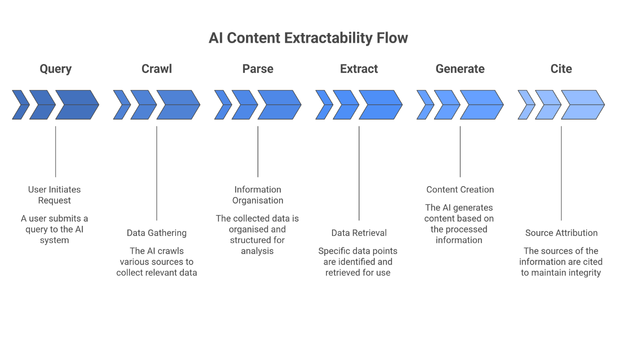
It is seen that AI systems don’t browse content like humans, instead they: 

  1. Crawl 
  2. Parse structure 
  3. Extract relevant passages 
  4. Generate summarised answers 

And if your content isn’t clearly structured, it won’t be cited by AI systems even if it ranks #1 on Google. 

WordPress, fortunately, gives you full control over that structure. Here’s how you can get started: 

Step 1: Strengthen Your SEO Foundation 

Before optimising for AI extraction, your technical SEO must be solid. AEO cannot compensate for weak fundamentals. 

Search engines must be able to crawl, interpret, and trust your site before AI systems built on those indices will surface it. 

For businesses investing in professional SEO services, technical crawlability, schema implementation, and topic clustering are non-negotiable. Without a strong WordPress foundation, even the best optimisation strategy struggles to deliver long-term visibility. 

AI Content Extractability Flow

AEnsure Technical Crawlability

At a minimum, your WordPress site should: 

  • Load quickly and pass Core Web Vitals 
  • Use HTTPS 
  • Have a clean XML sitemap submitted via Search Console 
  • Avoid “noindex” errors on key pages 
  • Maintain logical URL structures 

If search engines struggle to crawl your site, AI systems won’t extract from it. 

Think of SEO as the foundation. Without it, AEO has nothing to build on. 

BBuild Topic Authority Not Just Blog Posts 

In 2026, isolated posts don’t perform as well as structured topic clusters do. This is especially important for brands offering structured content marketing services, where isolated blog posts rarely outperform interconnected pillar ecosystems designed around intent clusters. 

So, instead of publishing isolated articles, structure your content into clusters: 

  • Pillar Page (comprehensive guide) 
  • Supporting Articles (specific subtopics) 
  • Strong internal linking between them 

AI systems prefer structured topical ecosystems over random keyword-driven articles. 

C. Implement Structured Data (Schema Markup) 

Schema helps search engines and AI systems to understand your content. 

For WordPress, focus on: 

  • Article schema 
  • FAQ Page schema 
  • How To schema 
  • Breadcrumb schema 
  • Organisation schema 

Plugins like: 

  • Rank Math for its free schema features. 
  • Yoast for schema and content optimisation. 
  • All in One SEO for its “next-gen” schema generator and site audit tools 

… make implementation easier but always validate your markup using a schema validator tool. 

Without structured data, AI systems rely only on guesswork. 

Step 2: Optimise for AEO (Answer Engine Optimization) 

Now we go deeper. Once your SEO foundation is stable, the next step is structuring content for AI extraction. 

This is where AEO becomes practical. 

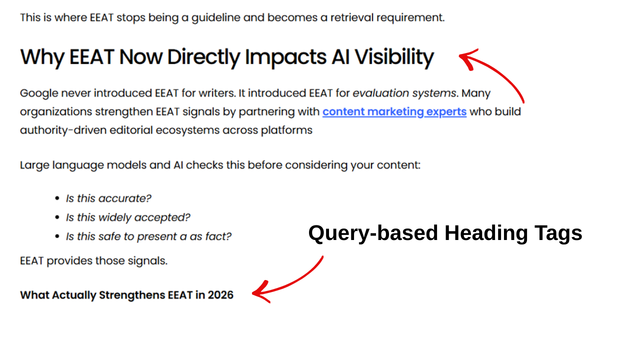
A. Use Question-Based Headings

Question-Based Headings

AI-driven search is conversational. Users ask full questions instead of typing short keywords. 

Your headings should reflect this behaviour. 

Instead of writing: 

“Advanced WordPress Content Strategy” 

Write: 

“How Do You Structure WordPress Content for AI Extraction?” 

This mirrors how users and AI systems frame queries, thereby increasing your chances of being selected. 

B. Apply the 60-Word Answer Rule 

AI systems extract concise passages, not entire articles. 

Immediately below each key heading, include a clear 40–60-word answer block.what is wordpress aeo

After this definition, you can expand further. 

Why? Because this structure improves snippet eligibility and AI citation potential. 

 CImprove Content Extractability 

wordpress extractability

LLMs process structure, not storytelling flair. If your content is buried inside long paragraphs, vague language, or cluttered formatting, it becomes harder for machines to interpret, even if the information itself is valuable.  

Even high-quality blog writing services lose visibility if articles are long, unstructured, and lack clear answer blocks. Formatting determines whether AI systems can extract and cite your expertise. 

That’s why content extractability is critical. 

Extractability refers to how easily a machine can locate, interpret, and lift a passage from your page without confusion or misinterpretation. 

To improve extractability in WordPress, use: 

  • Short paragraphs (2–4 lines) 
  • Bullet lists 
  • Numbered steps 
  • Clear subheadings 
  • Consistent terminology 

And avoid: 

  • Long intros before answering 
  • Hidden content in tabs without schema 
  • Walls of text 
  • Overuse of fluff 

Remember: Clarity wins over cleverness. Especially when your goal is to be extracted, cited, and surfaced in AI-generated results.

D. Optimise for Passage Authority 

Passage authority refers to how effectively a specific section of a page can independently answer a query. In 2026, this matters because AI systems and search engines often extract individual passages, not entire articles, when generating featured snippets or AI-powered responses. 

In other words, your page doesn’t just need overall authority. Each key section must stand strong on its own. 

To strengthen passage authority: 

  • Keep answers context-rich but concise 
  • Avoid vague pronouns 
  • Include the subject naturally in the paragraph 
  • Use descriptive subheadings 

For example, instead of writing: 

“This improves performance.” 

Write: 

“Structured data improves AI answer extraction performance.” 

Specific language improves extractability. 

Step 3: Clean Up Your WordPress Backend 

Many WordPress sites unknowingly sabotage their visibility with bloated code and poor architecture. 

A. Reduce Page Builder Bloat 

Heavy page builders often generate excessive nested HTML. While visually appealing, this clutter can complicate parsing. 

When possible: 

  • Use Gutenberg blocks 
  • Keep HTML clean 
  • Avoid unnecessary scripts 

Clean markup helps both crawlers and AI parsers. 

B. Keep Important Pages Within 3 Clicks 

AI systems evaluate crawl depth. 

Ensure: 

  • Your blog is easily accessible 
  • Pillar pages are linked from the homepage 
  • Internal links are contextually placed 

If a page is buried, it’s less likely to be surfaced. 

C. Strengthen E-E-A-T Signals

AI systems evaluate credibility. And what better than to follow the E-E-A-T Experience, Expertise, Authoritativeness, and Trust guidelines? 

Include: 

  • Detailed author bios 
  • Professional credentials 
  • LinkedIn links 
  • Company information 
  • Updated publication dates 

AI systems weigh credibility signals heavily when selecting answers. 

Step 4: Track the Right Metrics

In 2026, traffic alone no longer tells the full story. For companies running aggressive performance marketing campaigns, structured SEO + AEO ensures that paid traffic lands on pages built for both conversion and AI discoverability — maximising long-term ROI. 

You should monitor: 

  • Featured snippet appearances 
  • AI Overview visibility 
  • Branded search growth 
  • Impression increases 
  • Schema validation health 

Visibility in AI responses may not always produce immediate clicks, but it does build authority. 

Quick WordPress SEO + AEO Checklist 

Before publishing any article, confirm: 

  • Clear heading hierarchy 
  • Question-based subheadings 
  • 60-word answer blocks 
  • Validated schema markup 
  • Clean internal linking 
  • Author information included 
  • Page speed optimised 
  • No unnecessary HTML clutter 

If these elements are present, your content is built for both search engines and AI systems. 

Final Thoughts 

In 2026, digital visibility is no longer just about ranking, it’s about being selected as the answer. 

WordPress gives you full control over structure, schema, and content clarity. When combined with strong technical SEO and intentional AEO formatting, your CMS becomes more than a publishing tool, it becomes an AI-ready authority engine. 

At Sudha Solutions, we help businesses future-proof their WordPress websites for both search engines and AI-driven discovery. 

Ready to make your CMS answer engine ready? Let’s optimise your WordPress site for 2026, and beyond. 

Frequently Asked Questions

1. Can WordPress rank in AI-generated search results? 

Yes. When structured properly with schema, clear answer blocks, and strong topical authority, WordPress sites are frequently cited in AI search outputs. 

2. Is AEO replacing SEO? 

No. AEO enhances SEO. Rankings still matter, but structured clarity determines AI visibility. 

3. Which WordPress plugin is best for AEO?

Plugins like Rank Math and Yoast are strong options because they support structured data, FAQ schema, and advanced metadata control. 

4.  How long should AI-friendly answers be? 

Typically, 40–90 words. Short enough to extract, long enough to provide context. 

Categories
AEO Optimization

Will AEO Replace SEO? What Marketers Get Wrong About AI Search

Short answer: No – AEO will not replace SEO. It builds on it. 

To truly succeed, businesses need a structured approach through Answer Engine Optimisation (AEO) services that align SEO with AI-driven visibility.

As AI-powered search becomes mainstream, marketers everywhere are asking the same question: 

“Is Answer Engine Optimisation (AEO) replacing Search Engine Optimisation (SEO)?” 

With AI Overviews, conversational search, and large language models summarising content instantly, it feels like traditional SEO is becoming obsolete. But that assumption is exactly what marketers are getting wrong. 

AEO doesn’t replace SEO. It depends on it. Let’s break down why; and what brands really need to do if they want visibility inside AI Overviews and LLM-generated answers. 

Quick Summary 

No. AEO doesn’t replace SEO. It builds on it. 

AI search systems pull answers from well-optimised, authoritative websites. Without strong SEO foundations, AEO can’t work. 

To win in AI search, focus on clear answers, structured content, entity clarity, and topical authority. Ranking gets you seen. AEO gets you quoted. 

What Is SEO vs AEO? 

Understanding SEO vs AEO is critical for modern digital strategies, as both work together to improve discoverability across search engines and AI-driven answer platforms.

SEO vs AEO

SEO (Search Engine Optimization) 

Businesses investing in professional SEO services strengthen these foundational signals, improving visibility in both traditional and AI-powered search environments.

SEO focuses on helping web pages rank in organic search results through: 

  • Keyword relevance 
  • Technical optimisation 
  • Backlinks and authority 
  • Page experience 
  • Structured content 

Its goal: rank higher on search engine results pages. 

AEO (Answer Engine Optimization) 

AEO focuses on helping content get directly cited or summarised by AI systems. To effectively optimize for AEO, brands must structure their content clearly, provide direct answers, and maintain strong authority signals across their digital ecosystem. This is where specialised AEO optimization services help structure content for AI extraction and citation.

Its goal: become the source of answers. 

Instead of ranking for keywords, AEO optimises for: 

  • Clear, factual responses 
  • Question-based formatting 
  • Entity recognition 
  • Semantic depth 
  • Machine-readable structure 

Modern answer engines include Google AI OverviewsOpenAI’s ChatGPT, and platforms like Perplexity AI. These systems don’t just crawl pages; they extract meaning.

The Biggest Myth: “AEO Will Kill SEO” 

AEO Will Kill SEO

This is where most marketers go wrong. LLMs – Large Language Models don’t magically invent knowledge. 

They rely on: 

  • Indexed websites 
  • Authoritative domains 
  • Structured content 
  • Consistent entities 
  • High-quality publishing signals 

In other words: AI systems learn from SEO-optimised content. If your site isn’t crawlable, indexed, trusted, and structured properly, AEO simply cannot work. 

SEO is the foundation. AEO is the evolution. 

How AI Overviews Actually Choose Content

AI overviews

To understand this in detail, read our guide on how to optimize your website for Google AI Overviews

AI search systems typically follow this pipeline: 

  1. Crawl trusted websites 
  2. Evaluate topical authority 
  3. Identify entities and relationships 
  4. Extract concise answers 
  5. Combine multiple sources into summaries 

So, when your brand appears inside an AI Overview, it’s because your content already demonstrates: 

  • Expertise 
  • Clarity 
  • Context 
  • Trustworthiness 

Not because you “did AEO instead of SEO.” 

If you’re curious to know more on this topic, read our blog: It’s Not Popularity: How AI Decides Which Brands Deserve Visibility.

Why Ranking Alone Is No Longer Enough? 

Why Ranking Alone Is No Longer Enough

Traditional SEO aimed for clicks. AI search aims for answers. Today, users often get what they need without opening a single link. That changes the game. 

Integrated content marketing services, including structured articles, guides, and knowledge resources, play a key role in building authority that AI systems rely on.

Modern visibility means: 

  • Being quoted by AI 
  • Being referenced as a source 
  • Being included in summaries 
  • Being recognised as an authority 

This is where marketers must shift from traffic thinking to presence thinking. You’re no longer optimising only for humans. You’re optimising for machines that summarise you to humans. 

What Marketers Commonly Get Wrong About AI Search 

  1. Obsessing only over keywords: LLMs care more about concepts than exact phrases. 
  2. Writing fluffy thought leadership: AI prefers precise, structured, and factual content. 
  3. Ignoring entities: Brands, services, locations, and concepts must be clearly defined. 
  4. Brand Promotion Content: Many brands publish content without strategic blog writing services, leading to unstructured pages that AI systems struggle to interpret and extract answers from.
  5. Creating long content with no clear answers: AI extracts snippets; not essays. 
  6. Treating AEO as a separate channel: It must be embedded into your SEO strategy. 

How to Optimise Content for Both SEO + AEO 

How to Optimise Content for SEO + AEO

Here’s what actually works: 

  1. Answer questions directly: Start sections with clear responses before expanding. 
  1. Use semantic structure: Headings, bullet points, and short paragraphs help LLMs parse meaning. 
  1. Build topical depth: Cover related subtopics instead of single keywords. 
  1. Strengthen entity clarity: Define your brand, services, and industry consistently. 
  1. Write for extractability: Create content that can stand alone when quoted. 
  1. Prioritise trust signals: Author bios, internal links, accurate data, and consistent publishing matter more than ever. 

These principles are part of a structured AEO strategy framework designed to maximise AI visibility.

SEO + AEO + GEO: The New Visibility Stack 

When combined with performance marketing and social media services, these strategies help reinforce brand visibility across search, social, and AI-driven discovery channels.

Modern search optimisation now has three layers: 

  • SEO – Get indexed and ranked 
  • AEO – Get extracted and answered 
  • GEO (Generative Engine Optimisation) – Get summarised and cited 

They don’t compete. They compound. Brands that win in AI search treat these as one integrated strategy. 

Why Reddit Visibility Matters in AI Search 

Reddit plays a major role in how LLMs understand real-world discussions. 

AI models frequently learn from: 

  • Reddit Q&A threads 
  • Expert discussions 
  • Community explanations 
  • Comparative debates 

Repeated mentions across Reddit help build: 

  • Entity association 
  • Topical authority 
  • Semantic relevance 

Appearing in Quora and Reddit conversations significantly increases your chances of being remembered by AI systems. 

As per an article from Nextleft, Reddit and Quora have seen explosive traffic growth, with some reports estimating Reddit up 600% and Quora up nearly 380% over recent periods as users seek real answers. 

So… Will AEO Replace SEO? 

No. AEO depends on SEO foundations such as crawlability, authority, and structured content. Without SEO, there is nothing for AI to learn from and without AEO, your SEO content never becomes the answer. 

The future belongs to brands that: 

  • Build authority 
  • Structure knowledge clearly 
  • Write for humans and machines 
  • Think beyond rankings 

Because in the age of AI search, visibility isn’t about position. It’s about being remembered by the model. 

Final Takeaway 

If your strategy is still focused only on ranking pages, you’re already behind. 

Modern marketing requires optimisation for: 

  • Search engines
  • Answer engines
  • Generative systems 

SEO gets you discovered.
AEO gets you quoted.
GEO gets you summarised. 

Together, they determine whether your brand exists inside the AI-driven web.  

Want to See How Visible Your Brand is Inside AI Search?

Whether you need expert SEO services, content marketing services, or guidance to optimize for AEO, building an integrated visibility strategy is essential for success in AI-driven search. Get in touch with Sudha Solutions today and build a strategy designed for the AI-driven web. 

Frequently Asked Questions

Will AEO replace SEO?

No. AEO builds on SEO. Search engines still rely on indexed, authoritative content. AEO simply helps that content become the answer inside AI systems.

What is the difference between SEO and AEO? 

SEO focuses on ranking pages in search results. AEO focuses on structuring content so AI engines can extract clear answers.

Can small businesses appear in AI Overviews? 

Yes. Authority is topical, not brand-size dependent. Clear structure, consistent publishing, and strong entity signals matter more than company scale. 

Do I still need keywords for AI search? 

Yesbut keywords alone are insufficient. AI prioritises topics, context, and relationships over exact phrases. 

How long does it take to appear in AI Overviews? 

There’s no fixed timeline. Most brands see inclusion after building topical depth, improving structure, and strengthening authority signals over several weeks or months. 

What type of content performs best in AI search? 

  • FAQs 
  • Explainers 
  • Comparison guides 
  • How-it-works articles 
  • Clear definitions 
  • Structured lists 
Categories
AEO Optimization AI Overview GEO Optimization

AEO/GEO Optimization Strategy: Best Practices, Tools, and How It Differs from Classic SEO

Search engines have not been the same since the reliance shifted to AI platforms. While the previous guidelines may help with ranking, it might not be translated into traffic generation. SEO is still very much relevant; however, it’s no longer the whole playbook.

Now, Answer Engine Optimization (AEO) and Generative Engine Optimization (GEO) are the new frontiers in search optimization and implementing them requires a shift in strategy; away from keywords and toward intent, context, and clarity.

As AI Overview continues to redefine search, optimizing for how machines understand content is just as important as optimizing for how people find it.

Consider this guide, a handbook for your future AEO and GEO practices. It explores best practices, tools, and strategies for AEO and GEO. Get ready to optimize for the future of search.

Here’s a TL;DR If You’re Pressed on Time

Here we explain how AEO and GEO differ from classic SEO & how to optimize for AI-driven search experiences.

Answer Engine Optimization targets direct, conversational answers for voice assistants using clarity and schema, while Generative Engine Optimization prepares adaptable, context-rich content that generative AI can expand. Both prioritize user intent, context, and local relevance over traditional keyword/link tactics.

You’ll find best practices, tools, local strategies, schema and image optimization, AI Overviews, KPIs, challenges, and future trends.

Understanding AEO and GEO: Definitions and Core Concepts

At the heart of digital evolution are AEO and GEO optimization. Both are pivotal for modern search engine strategies.

But what exactly do they entail?

AEO, or Answer Engine Optimization, is all about showing up when people ask questions out loud. Voice assistants like Siri, Google Assistant, Alexa skip the search results entirely and jump straight to an answer.

To win here, your content has to be clear, contextual, and genuinely helpful, because you’re competing to be the answer, not just one of ten blue links.

Then there’s Generative Engine Optimization (GEO). This is where things get really interesting. AI-driven platforms don’t just retrieve content; they generate it. That means your content needs to be structured in a way AI can understand, remix, and expand on while still keeping your message intact.

Both AEO and GEO demand a mindset shift. Instead of obsessing over keywords and backlinks, the focus moves to intent, context, and usefulness. It’s less about gaming the system and more about aligning with how people and machines actually think.

Understanding these strategies involves grasping their unique elements. Here is a quick breakdown:

AI response strategy

The importance of these approaches grows as AI becomes more integrated. Digital assistants and AI platforms are reshaping how users search. They demand more refined content from websites.

AEO and GEO focus heavily on user interactions. They use contextual data to provide more personalized experiences. This enhances user satisfaction and conversion rates.

Understanding these strategies means recognizing their role in AI and digital evolution. Both are crucial for marketers aiming to stay competitive in this AI-driven era.

SEO vs AEO vs GEO: Key Differences and Overlaps

SEO vs AEO vs GEO

In today’s digital world, understanding SEO, GEO, and AEO is critical. Each has a distinct role, yet they overlap in important ways.

SEO, or Search Engine Optimization, is the foundation. It focuses on keywords, backlinks, and site structure. Its primary goal is to improve site visibility in search engine results.

Answer Engine Optimization (AEO) shifts the focus from keywords to content context. It prioritizes answering direct user queries. This optimization targets voice search and digital assistants.

GEO, on the other hand, caters to AI platforms. These platforms generate content based on user input. Adapting content for these engines is key.

Both AEO and GEO deviate from classic SEO in their approach. They emphasize personalized content and user intent over traditional metrics.

Here’s how they overlap and differ:

  • Overlap:
    • All aim to enhance visibility.
    • Improve user satisfaction.
    • Focus on search engine algorithms.
  • Differences:
    • SEO: Keywords and links are crucial.
    • AEO: Direct response optimization.
    • GEO: Content adaptability for AI.

So, while they share common goals, each method serves a unique purpose. Recognizing these differences enhances AEO SEO strategy effectiveness. Optimizing for various engines results in broader reach and improved engagement.

Why AEO/GEO Matters in the Age of AI-Driven Search

There are three main factors that underscore the importance of AEO and GEO:

  • The rise of voice search
  • The growing presence of AI in everyday life
  • The demand for personalized content.

Together, these shifts mean traditional SEO alone just isn’t enough anymore.

For businesses, adapting is no longer optional. AEO and GEO help ensure your content stays visible as AI-driven search continues to evolve. Embracing these strategies is how brands stay relevant in a search landscape that’s already moved beyond keywords and links.

Core Principles of Answer Engine Optimization (AEO)

Answer Engine Optimization (AEO)

Answer Engine Optimization (AEO) services are changing the way people interact with search. Instead of scrolling through results, users now expect AI-driven assistants to deliver fast, accurate answers, especially through voice search. AEO is all about making sure your content is the one those assistants choose.

Key principles of AEO include:

  1. Understanding User Intent: Anticipate the questions users ask. This means looking beyond keywords and digging into behavior, context, and intent.
  2. Clarity and Brevity: Short, well-structured answers improve usability. Content should be easy to understand and quick to consume.
  3. Schema Markup Usage: Structured data helps AI systems understand the context of your content and surface it more accurately.

Natural language processing still plays a big role in AEO, but it doesn’t have to be complicated. Writing the way people naturally speak, using simple words and direct sentences makes it easier for digital assistants to interpret and deliver your content correctly.

Relevance matters just as much. Content needs to be timely, accurate, and aligned with the situation or question at hand. When those pieces come together, AEO helps your content become the answer users hear first and not just another result they never see.

Generative Engine Optimization (GEO): Adapting for AI Content Creation

Generative Engine Optimization (GEO) is the next big step in digital marketing. Instead of optimizing content only for rankings, GEO focuses on how AI platforms generate content in response to user input and how your content supports that process.

Why GEO matters
AI models like GPT don’t just retrieve information. They interpret context, combine ideas, and generate new content. To stay visible, your content must be easy for AI to understand, adapt, and build upon.

Core principles of GEO

  • Flexible structure: Create modular content that AI can modify or expand without losing clarity.
  • Strong context: Provide clear, accurate foundations so AI can generate reliable and relevant outputs.
  • Layered information: Organize content so AI can pull both high-level insights and deeper details when needed.
  • Multiple perspectives: Including varied angles helps AI generate more balanced and useful responses.

GEO works best when AI is treated as a collaborator, not just a tool. By refining your inputs and learning from AI-generated outputs, brands can improve visibility, engagement, and long-term relevance in AI-driven search environments.

AEO Best Practices: How to Optimize for Answer Engines

Answer Engine Optimization (AEO) aims to provide clear, direct answers to user queries, particularly for platforms like Google Assistant and Siri. This makes understanding user intent crucial.

Key practices for effective AEO include:

  • Using Natural Language: Write in a way that mirrors everyday speech. This aligns well with how people typically pose queries to answer engines.
  • Formatting for Clarity: Structure content with headings, bullet points, and concise paragraphs. This helps answer engines parse and present content efficiently.

Search engines increasingly rely on structured data to interpret content better. Applying schema markup enhances your content’s contextual visibility.

Implementing the FAQ schema can further improve your chances of being featured. This structured approach helps answer engines quickly identify and rank relevant content.

Consider these action points for a stronger AEO:

  1. Identify User Intent: Conduct thorough research to pinpoint what users are truly seeking when they query your key topics.
  2. Continuous Content Updates: Keep content fresh. Regular updates align with evolving search engine algorithms and answer engine requirements.

It’s also helpful to utilize available tools and platforms. Google’s Structured Data Testing Tool can ensure your schema markup is accurate and effective.

AEO Best Practices

GEO Best Practices: Strategies for Generative Engines and AI Platforms

Generative Engine Optimization (GEO) caters to AI platforms that create content, necessitating dynamic strategies. Focus on making your content adaptable and engaging for these generative engines.

To optimize effectively, ensure your content is both flexible and informative. AI platforms thrive on data that’s easy to modify and expand.

Key strategies for successful GEO include:

  • Keyword Contextualization: Go beyond basic keywords. Understand and predict how AI might interpret and use these keywords in diverse contexts.
  • Rich Metadata Utilization: Employ extensive metadata to provide AI with a deeper understanding of content nuances and applicability.

Use structured data formats like JSON-LD for better interoperability. This format helps generative engines better comprehend and interact with your content structures.

Two vital aspects to consider in GEO include:

  • Contextual Clarity: Keep the context clear and consistent, making it easier for AI to repurpose content into various formats or purposes.
  • Interactive Elements: Integrate interactive media or dynamic content that can enhance AI-driven user experiences.

Regularly updating your content is essential in GEO. Dynamic content aligns well with generative engines’ evolving learning patterns and content creation methodologies.

Action steps for effective GEO include:

Here’s how adding different content formats and elements can help you implement GEO


Adding quotes +41%
Statistics +30%
Adding inline citations +30%
Improving readability +22%
Using domain specific terms +21%
Using simple language +15%
Authoritative voice +11%
Keyword Stuffing -9%

GEO Best Practices

Local Search Strategies for AEO/GEO

Local search strategies are vital in the AEO/GEO framework. They ensure that users find location-specific content when needed. The focus should be on optimizing for both general AI and local nuances.

Local Search Strategies for AEO and GEO

Start with the basics

Ensure your business is listed on local directories. Platforms like Google My Business are crucial for local visibility. Maintain accurate and updated information.

Use local language naturally

Include geographic keywords in a way that feels organic. City names, neighborhoods, and phrases like “near me” help connect your content to local intent without sounding forced.

Core strategies for local optimization:

  • Localized Content: Produce articles and blog posts that focus on local events or attractions.
  • Local Backlinks: Engage with local organizations or businesses to build backlinks.
  • Community Engagement: Participate in local forums and social media groups to increase your presence.

Don’t overlook mobile

Most local searches happen on mobile devices. A fast, mobile-friendly site is essential for both user experience and AI-driven results.

Add location-based schema

Using geographic schema markup helps AI engines clearly understand your location, improving how and when your content appears in local responses.

When local signals are clear and consistent, AEO and GEO systems are far more likely to surface your content at the exact moment users need it.

Schema Markup for AI Search: FAQ, How-To, and More

Schema markup is crucial for AEO and GEO. It helps search engines understand your content more deeply.

There are several key types of schema markup to consider:

  • FAQ Schema: Utilizes a list of questions and answers. This is ideal for direct responses in search.
  • How-To Schema: Provides step-by-step instructions, perfect for tasks that users frequently ask about. Let’s understand this in detail

How-To schema can enhance content discoverability. It makes it simple for AI to present your content as featured snippets. Detailed and accurate instructions are vital.

In addition, other helpful schemas include:

  • Product Schema: Displays product information such as price and availability.
  • Article Schema: Enhances article content for better ranking.

To implement schema markup, use tools like Google’s Structured Data Markup Helper. This tool can streamline the process. Ensure your schema is valid by checking with the Structured Data Testing Tool.

Schema markup improves AI algorithm comprehension of your site. This aligns your content with user queries effectively. With schema, you prepare for future AI advancements, strengthening your digital strategy.

Image SEO for AI Search: Optimizing Visual Content

Image SEO for AI Search

Visual content plays a critical role in search visibility. Optimizing images for AI search enhances how your visuals appear in results. This requires specific strategies to ensure images are properly indexed and relevant.

AI platforms rely on more than just image quality. They assess context, which includes alt text and file names. These elements help AI understand what your images represent, improving their search accuracy.

Consider these methods to optimize images for AI:

  1. Descriptive Alt Text: Use relevant keywords naturally in alt text. This explains the image content to search engines.
  2. File Names: Rename image files with descriptive names, avoiding generic terms like “image1.jpg.”
  3. Contextual Relevance: Ensure images align contextually with the surrounding text.
  4. File Type and Size. Compress images to improve load times without sacrificing quality. Fast-loading images contribute positively to user experience and SEO.
  5. Use ImageObject Schema: Structured data can enhance your image SEO. The ImageObject schema informs search engines further about image specifics, such as license or creator.

Incorporating these strategies aids AI in recognizing and displaying images more effectively. This boosts visibility in image search results, benefitting overall content reach. By optimizing images for AI, you adapt proactively to emerging search trends.

Google AI Overviews and AI Overviews Optimization

Google AI Overviews and AI Overviews Optimization

In the realm of AI-driven search, how Google AI Overviews differ from organic results. These summaries provide users with concise and relevant information. They aim to answer queries quickly and precisely, often appearing at the top of search results.

Optimizing for these Overviews involves crafting content that’s easily digestible. Your aim should be to deliver key points effectively, satisfying user intent with speed and accuracy. This requires an understanding of how AI processes and displays content.

Focus on these optimization techniques for AI Overviews:

  • Concise Content: Ensure your content is to the point, emphasizing clarity.
  • Key Phrases: Use relevant phrases that match common user queries.
  • Structured Layouts: Consider using lists or bullet points that simplify information scanning.

To further enhance visibility in AI Overviews, prioritize enriching content contextually. This involves using supportive data elements like images or infographics that summarize complex ideas.

Tools and Platforms for AEO/GEO Optimization

Tools for AEO and GEO Optimization


Optimizing for AEO and GEO requires the right tools and platforms. These help enhance efficiency and effectiveness. They enable you to better understand both engine behaviors and user intent.

A variety of tools are available to streamline your AEO/GEO efforts:

  • Google’s Structured Data Testing Tool: Verifies schema markup accuracy.
  • SEMrush: Offers insights into keyword performance and search engine visibility.
  • AnswerThePublic: Identifies common questions users ask, aiding answer engine optimization.

Generative engines also require a unique set of tools that cater to AI-driven content:

  • OpenAI’s GPT models: Assist in creating AI-friendly text content.
  • MarketMuse: Enhances content strategy by analyzing topic coverage and optimizing AI-readiness.
  • Content Harmony: Focuses on content performance against AI criteria.

Each platform adds a layer of proficiency to your strategy. Google Search Console, for example, provides insights into search performance and engagement metrics. These insights are invaluable for measuring strategy effectiveness and guiding adjustments.

Measuring Success: Metrics and KPIs for AEO/GEO

Tracking the success of AEO and GEO strategies requires specific metrics. It’s crucial to focus on how these impact your digital presence and AI engagement.

Key performance indicators (KPIs) provide a detailed look at your progress. They offer insights into the effectiveness of your optimization efforts.
Essential metrics to monitor include:

  • Visibility: Evaluate how often your content appears in AI-generated answers.
  • Engagement Rates: Assess user interaction with AI-enhanced content.
  • Conversion Rate: Identify how well optimized content leads to desired actions.
  • Bounce Rate: Understand if users find your content relevant and engaging.

Measuring these KPIs consistently can reveal strengths and weaknesses. It helps refine strategies and adapt to evolving search dynamics. By focusing on these metrics, you align more closely with user expectations and AI developments.
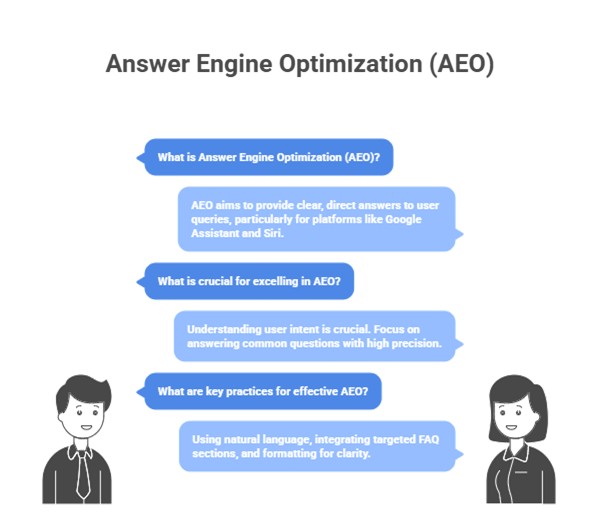
Common AEO/GEO Challenges and How to Overcome Them

How to optimize AEO and GEO

AEO and GEO present unique challenges that diverge from classic SEO. Understanding these hurdles is key to optimizing effectively for AI platforms.

One common issue is adapting to rapidly changing AI algorithms. These updates can affect visibility and ranking. Staying informed about AI trends and making proactive adjustments is crucial.
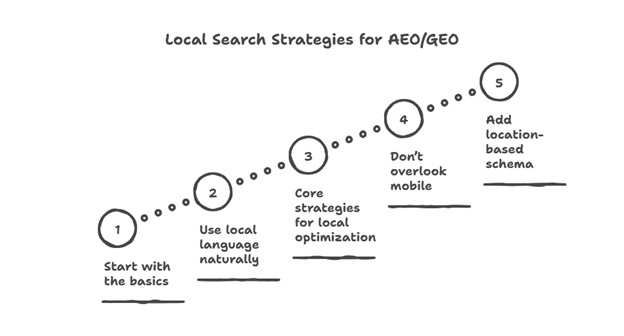
Another challenge is ensuring content fits user intent. Unlike traditional SEO, AEO and GEO require deep comprehension of user queries and context. Misaligned content can reduce performance in answer and generative engines.

Here are some typical challenges and solutions:

  • Frequent AI algorithm changes: Stay updated through AI-focused forums and resources
  • Misalignment with user intent: Conduct regular audience analysis to refine content strategies.
  • Technical implementation of schema: Use tools like Google’s Structured Data Testing Tool to verify and correct.

Overcoming these challenges improves content engagement and optimization. Consistent adaptation and learning are vital in this fast-paced AI landscape. Embrace these strategies to enhance your visibility and effectiveness in AEO and GEO environments.

Future Trends: The Evolving Landscape of AEO/GEO

  • AEO and GEO are evolving rapidly as AI technologies advance.
  • Generative AI tools now create high-quality content with minimal human input, enabling faster content scaling.
  • Voice search is growing, making conversational and natural language optimization
  • Marketers must shift content strategies to match how people speak, not just type.

Key trends to watch:

  • Deeper AI integration across digital marketing tools
  • Rapid growth of voice search and conversational queries
  • More advanced AI-driven content creation systems
  • Personalization is becoming central, with AI delivering tailored content based on user behavior.
  • Brands need dynamic, adaptive content strategies to serve diverse audiences.
  • Agility and innovation will be critical to stay relevant in the AEO and GEO landscape.

Final Thoughts

To thrive in AI-driven search environments, a sustainable AEO/GEO strategy is essential. This involves understanding evolving technologies and user needs. Adapting swiftly can provide a competitive edge in this dynamic landscape.

Key elements of a sustainable strategy include:

  • Continuous learning and adaptation.
  • Effective use of data-driven insights.
  • Collaboration between content creators and tech specialists.

By focusing on these elements, businesses can remain relevant and effective. A proactive approach ensures content remains visible and impactful in AI-dominated search ecosystems. Building resilience and adaptability into your strategy is key to future success.

We at Sudha Solutions have helped multiple top e-commerce brands rank on both Google and AI platforms. If you’re ready to future-proof your visibility across search and generative engines, let’s talk.


Categories
AEO Optimization General SEO

How to Optimize for AEO: Ranking Reddit & Quora Content in AI Search

Notice how Reddit threads and Quora responses are showing up in Google’s AI overviews and even ChatGPT results? It’s not a coincidence. It’s a result of a quiet revolution shaping search engines and AI models to surface information.   

Unlike traditional SEO, where keyword density and backlinks ruled, AEO focuses on clarity, authority, and context.   

In this guide, we’ll explore how to optimize for AEO using Quora and Reddit, understand why AI prefers these platforms, and learn practical optimisation tactics to ensure your content gets picked up, cited, and ranked in the new era of AI search.  


From SEO to AEO: The Shift from Search to Direct Answers 
 

Shift from SEO to AEO

For years, SEO has focused on keywords, backlinks, and technical improvements, but with the rise of AI platforms like Google Overviews, ChatGPT, Perplexity, and more, the rules are being rewritten.  

These pages don’t display top pages; rather, they generate summarised conversational answers by getting information from credible sources across the web. Here’s the data of all the sources along with the percentage. 

Platform  Percentage 
Reddit  40.11% 
Wikipedia  26.33% 
YouTube  23.52% 
Google  23.28%  
Yelp  21.01% 

AEO is the process of making your content easily discoverable and quotable by AI systems that aim to answer user questions directly, rather than just list websites. 


Why Reddit and Quora Are Suddenly Dominating AI Search
 

Reddit and Quora are answer based platforms where users get direct and concise answers for their questions, something AI platforms appreciate. These platforms excel at: 

  • E-E-A-T Signals (Experience, Expertise, Authoritativeness, Trustworthiness) through real voices and firsthand experiences. 
  • Semantic richness, with threads covering long-tail questions in conversational formats. 
  • High engagement, where upvotes and comments serve as credibility indicators. 

In short, the trust and context depth of platforms like Reddit and Quora is well appreciated by AEO. 


What Makes AEO Different from Traditional SEO
 

Think of SEO as visibility optimization and AEO as answer-first content optimization. In SEO, the goal is to make search engines understand your relevance. In AEO, the goal is to make AI models select you as part of their answer.  

Parameters  SEO Focus  AEO Focus 
Goal  Rank on SERPs.  Be quoted in AI-generated answers. 
Optimisation Method  Keywords, backlinks, meta tags.  Semantic depth, clarity, Q&A structure. 
Platforms  Google, Bing  AI overviews, ChatGPT, Perplexity. 
Signal Strength  Crawlability and authority  Contextual accuracy and engagement. 

AEO is not replacing SEO. It’s becoming a parallel specialisation that coexists with SEO and GEO (Geographical Optimisation), extending visibility from links to answers 


How Can Brands Leverage Reddit & Quora for AEO? 
 

Brands that once avoided Reddit or Quora are now realising their strategic value in an AI search. These platforms have become content playgrounds for brand visibility when handled with authenticity.  


Here are some of the best practices for AEO: 


Find Active Conversations in Your Domain 
 

Use tools like AnswerThePublic to identify trending questions related to your niche. Then find corresponding Reddit or Quora threads that already rank or are gaining traction.  

Craft Genuine, Conversational Answers

Please craft your responses with the expertise of a specialist, rather than from a marketing perspective. Provide valuable insights, cite credible sources, and avoid promotions. AI systems prioritise clear, contextual information over promotional tone. Check out Reddit best practices to improve your chances of engagement. 

Optimise the First Two Lines   

Make the opening of your answer self-contained. Use natural language and include primary keywords (e.g., “AEO”, “AI search”, and “optimise for Google AI Overviews”) early for algorithmic detection.  

Link to Authoritative Resources  

Support your answer with backlinks to credible research, white papers, or blogs. This creates a bridge between community engagement and your brand domain, strengthening authority. A PhD thesis found that authoritative links when used properly can contribute to improved trust and hence potential ranking benefits.   

Encourage Engagement  

Ask for opinions, invite follow-ups, or respond to comments. Active engagement tells AI crawlers the discussion is evolving and valuable, increasing its visibility in AI summaries.  


The 4-Step AEO Optimisation Framework 
 

4-Step AEO Optimisation Framework For brands looking to align their overall content strategy with answer engine content strategy, here’s a step-by-step framework:  


Step 1: Identify High-Intent Questions 
 

Use Google’s “People Also Ask”, Reddit’s search, and Perplexity.ai queries to uncover questions users actually ask.  

Step 2: Structure Content for Clarity  

Use question-based headings, bullet points, and short paragraphs. AI systems extract information from structured content more easily.  

Step 3: Layer in Context and Sources  

Don’t just state facts; add reasoning, examples, or user context to make your content stand out in semantic scans.  

Step 4: Leverage UGC and External Mentions  

Repurpose your insights into Quora or Reddit discussions to multiply your presence in the AI-visible ecosystem.  

These 4 steps will increase your chances of visibility on AI platforms.  


Expert Insights: What Google and SEO Thought Leaders Say 
 

Google’s Search Liaison Danny Sullivan has hinted that AI Overviews aim to “connect users with a range of perspectives, not just official sources.” This aligns with how Reddit and Quora provide multi-voice answers, a quality AI models find useful for context diversity.  

Experts like Marie Haynes and Lily Ray also emphasise the growing importance of EEAT and human-first content that feels credible, lived, and personal. That’s exactly the space Reddit and Quora dominate and where brands must learn to contribute meaningfully.  


AEO, GEO, and EEAT: The New Search Trinity 
 

AEO isn’t replacing SEO; it’s expanding it. The future of digital visibility is a combination of:  

  • AEO: Optimising content for AI-generated answers  
  • GEO: Tailoring visibility to geographic and local AI search contexts  
  • EEAT: Ensuring every piece of content demonstrates real expertise, experience, authority and trustworthiness  

Together, they form the new SEO stack for the AI age, where traditional ranking factors merge with conversational intelligence.  


Conclusion 
 

Search is evolving from a list of links to a layer of conversation. The winners won’t be the ones shouting the loudest but those offering the clearest, most contextual answers.
By mastering AEO and using platforms like Reddit and Quora strategically, brands can ensure their expertise becomes part of the world’s digital dialogue—one AI answer at a time.  

If you want your brand to show up in AI platforms, you should check out Sudha Solutions. We have a proven strategy that has helped multiple brands enhance their visibility across AI platforms.   

Along with AEO services, we also provide services like content marketing, retention marketing, UI/UX designs, ecommerce website development, and app development. Contact us TODAY.