You’re still ranking… so why is traffic not moving?
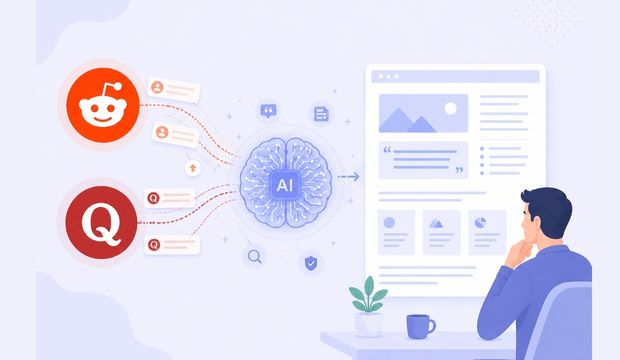
Because, Search behaviour has shifted from click-based discovery to AI-generated answers.
Your rankings are stable, some even improving. But traffic isn’t following.
Rather, it’s flat. In some cases, even declining. Conversions don’t fully align with organic performance.
And yet, most teams are still optimising the same way they did two years ago.
But here’s the disconnect:
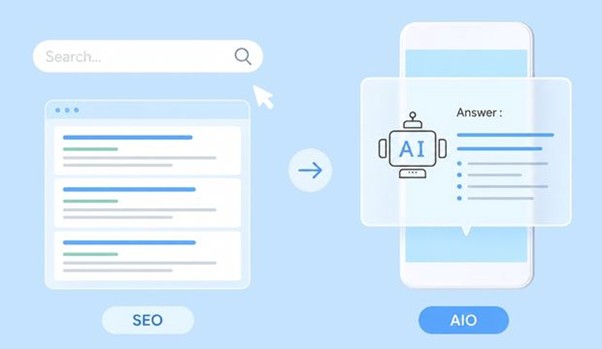
SEO didn’t die, distribution did and brands relying only on traditional search engine optimization services are now missing the AI-driven answer layer reshaping visibility.
A growing share of queries now never lead to a website click. Across Google’s evolving SERP experience, 58% of searches end without a click, as users get answers directly on the results page or within AI-generated summaries.
Visibility is no longer about ranking. It’s about being part of the answer.
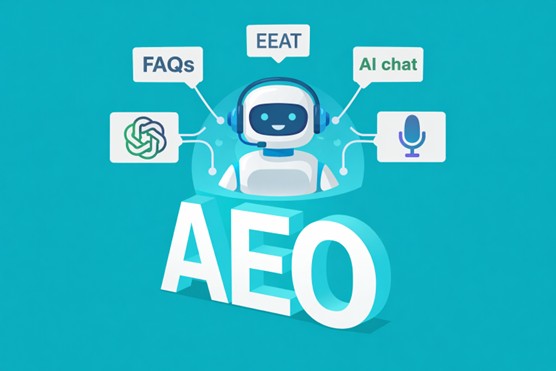
In 2026, SEO expert services alone are no longer enough; brands also need AEO services and AI Overview Optimization to maintain discoverability.
This blog breaks down what’s driving this shift, where your traffic is going, and how leading brands are adapting.
Key Takeaways (read this first if you’re scanning)
- Ranking stability ≠ traffic stability anymore
- AI systems now intercept and synthesise search results before clicks happen
- Visibility is shifting from “position in SERP” → “presence in AI-generated answers”
- Chat-based search (ChatGPT, Perplexity, Gemini) is becoming a parallel discovery layer
- SEO is not obsolete; it’s just no longer the complete system
- Winning now depends on citability, structure, and entity clarity, not just keywords
Where Did Your Search Traffic Actually Go?
The assumption that “search demand is down” is incorrect.
The truth is, demand has redistributed.
A growing portion of research and discovery now happens inside AI systems rather than traditional SERPs.
Data from Depthera’s 2026 State of AI Search report confirms that 25% of organic traffic has permanently migrated from traditional search engines to AI assistants like ChatGPT, Perplexity, Claude, and Gemini.
Did you know:
- ChatGPT now has 900M+ weekly active users and processes ~2.5B prompts daily (2026).
- A large share of prompts (~65–85%) do not map cleanly to traditional keyword databases.
- Voice + conversational search is expanding, with 157M+ users expected by 2026, increasing intent complexity.
And because most AI search sessions end without a click, your website analytics are almost certainly undercounting the influence AI search has on your brand perception.
These buyers are forming opinions about your brand or your competitor’s based on what an AI tells them, not based on your website experience.
And that’s where the blind spot is:
Your analytics show “lost traffic,” but in reality, it has moved into systems you are not tracking.
And the question worth sitting with: What is ChatGPT saying about your brand right now, to the people who matter most?
Is Ranking #1 on Google Still Worth It?
Yes, but it no longer guarantees results. In modern AI search optimization determines whether that ranking converts into traffic.
For years, the model was linear: keyword → ranking → click → conversion
That chain is now consistently breaking at the “click” stage.
The reason? AI Overviews and generative summaries now sit above traditional results and answer the query directly.
Data says:
- Google AI Overviews now appear in ~25.11% of searches (2026), up from 13.14% in 2025.
- For every 100 clicks a #1 ranking once delivered, brands now get 34.5%, with most traffic absorbed by AI Overviews.
- Around 93% of AI search sessions end without a website click.
- Being cited inside the AI Overview increases CTR by ~35%; meaning visibility has shifted from ranking to citation.
Bottom line: Ranking still matters. But without being cited in AI-generated answers, its impact is significantly reduced.
What works in 2026 is:
- SEO for ranking
- AIO/AEO for citation and visibility within AI responses
The new bottleneck is not ranking. It is inclusion in the answer layer. And that’s what makes Artificial Intelligence Optimization (AIO) becomes crucial.
What is AIO, and How Is It Different from SEO?
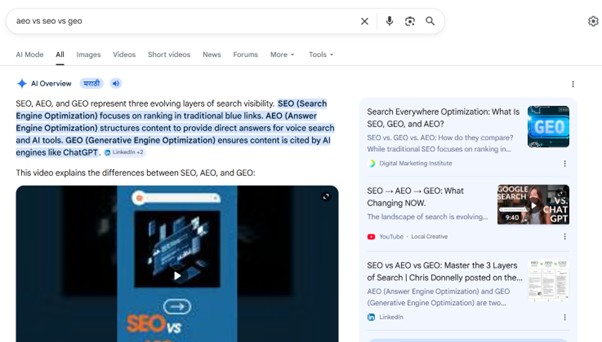
AIO: AI Overview Optimisation (or more broadly, AI Optimisation) is the practice of structuring your content so that AI systems can understand, trust, and cite it when answering user queries. For businesses adapting early, AIO services and answer engine optimization are becoming essential extensions of SEO.
It sits within a wider family of disciplines including AEO (Answer Engine Optimization) and GEO (Generative Engine Optimisation).
The core principle across all of them:
SEO gets you found. AIO gets you chosen; by the machine that’s answering your buyer’s question. This shift is why brands are increasingly adopting an AI-first marketing strategy rather than relying solely on traditional SEO.
Traditional SEO was built around keywords, backlinks, and click-through rates. AI search evaluates content differently. It doesn’t just look for keyword matches — it looks for semantic clarity, direct answers, structured information, and signals of trustworthiness across the wider web.
Quick glance:
| Dimension | SEO | AIO |
| Discovery Model | Keyword → ranking → click | Query → synthesis → answer |
| Content Evaluation | Keywords + backlinks | Clarity, structure, trust signals |
| User Journey | Multiple site visits | Often zero-click, single answer |
| Content Structure | Narrative, depth-first | Answer-first, structured (FAQs, tables, lists) |
| Content Placement Value | Value spread across page | Highest value in first 30% (drives majority of citations) |
According to AirOps’ April 2026 research, the content formats that earn the most AI citations share specific structural characteristics:
- Comparison pages with 3 or more tables earn 25.7% more citations
- Validation pages with 8 or more list sections earn up to 26.9% more citations
- Shortlist pages averaging 10 words or fewer per sentence earn 18.8% more citations
- Early-discovery content that includes 5–7 statistics earns a 20% higher citation likelihood
And perhaps the most actionable single stat: 44.2% of all LLM citations come from the first 30% of a piece of content (Growth Memo, Feb 2026 cited in Digital Applied). Your introduction is now your most strategically important not just for human readers, but for AI systems deciding whether to cite you.
It also means that dense paragraphs, fluffy intros, and keyword-stuffed preambles are actively working against you in AI search. The brands winning citations lead with the answer, then provide depth.
How are Top Brands Winning in AI Search in 2026?
Depthera’s 2026 market analysis paints a clear picture of where the market is right now:
- 31% of companies have fully integrated AEO strategies into their core marketing stack
- 39% are currently building the internal infrastructure (teams, tools, processes) to support it
- 30% remain solely reliant on traditional SEO, facing diminishing returns
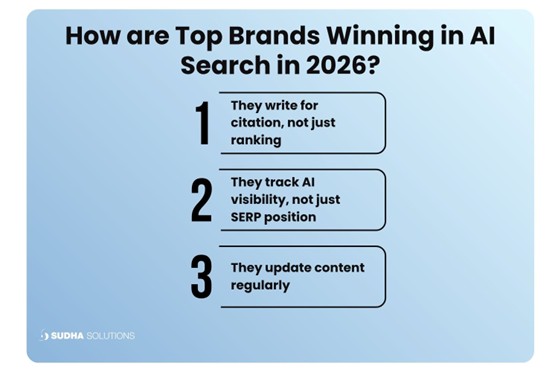
The brands outperforming right now are doing three things consistently:
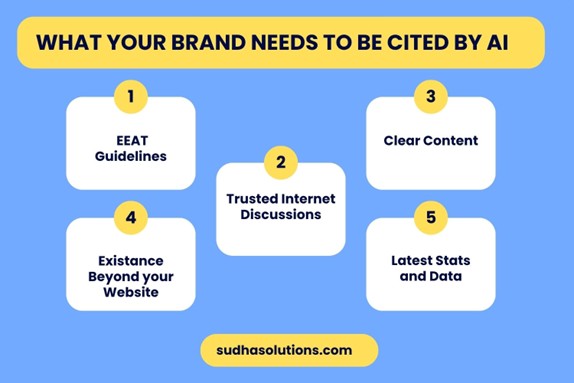
- They write for citation, not just ranking. A strong AI citation strategy depends on structure, trust signals, and semantic clarity. Their content is structured around direct questions, answered concisely in the opening paragraphs, with data and specifics; not vague claims.
- They track AI visibility, not just SERP position. Effective brand mention monitoring helps brands understand how AI systems currently perceive and describe them. They’re monitoring what ChatGPT, Perplexity, and Google AI Overviews say about their brand, not just what position they hold on page one.
- They update content regularly. Pages updated within 2 months earn 28% more AI citations than older content. Content freshness, which was always important for SEO, is even more critical for AI citation.
How Do You Actually Start Optimising for AI Search in 2026?
This is where a structured AI visibility audit becomes the first practical step.
Step 1: Audit your highest-traffic content for AI-readiness
Go to your top 20 pages. Ask: Does this content answer a specific question directly in the first two paragraphs? Does it include concrete data, comparisons, or clear definitions? Is it structured with headers that read like questions? If the answer is no to any of these, you have actionable quick wins.
Step 2: Restructure your content brief
Stop briefing content around keywords. Start briefing it around questions; the exact questions your buyers are typing into ChatGPT or asking Perplexity. Between 65% and 85% of ChatGPT prompts have no matching keyword in Semrush’s database. If your content strategy is purely keyword-driven, it has a blind spot that covers the majority of AI search behaviour.
Step 3: Implement structured data
FAQPage schema, Article schema, and HowTo schema are the most directly relevant for AI citation. These tell AI systems exactly what your content means, who it’s for, and what question it answers. This is not a technical nice-to-have; it’s a baseline for AI visibility.
Step 4: Build your AI visibility baseline
Before you can improve AI visibility, you need to measure it. Ask ChatGPT, Perplexity, and Google AI Overview the 10 questions your ideal buyer is most likely to ask about your category. Note whether your brand appears, which competitors are cited, and how your brand is described. Run this monthly. This gives you a directional benchmark while the tooling market matures.
Step 5: Refresh before you create
Before briefing new content, prioritise updating existing content that’s over three months old. 85% of AI Overview citations go to content published in the last two years, with 44% specifically from 2025.
Final Thoughts
Winning in 2026 is no longer about choosing SEO vs AEO; it’s about integrating both into one visibility system.
The shift from SEO to AIO is the operating reality of 2026. Your buyers are already using AI to research, compare, and shortlist. The question is whether your brand appears in those conversations or your competitor does.
The good news: 70% of the market hasn’t fully made this transition yet. The brands that move now are building moats.
If you’re unsure where your brand currently stands in AI search, or what it would take to start earning citations at scale, talk to us.
At Sudha Solutions, we work with marketing teams to audit AI visibility, identify content gaps, and build the kind of structured, citation-ready content strategy that performs across both traditional search and AI platforms.
The AI has already formed an opinion about your brand. The only question is whether that opinion is helping you or your competitor.