Sudha Solutions

Categories
AI Overview GEO Optimization LLMS

What is Generative Engine Optimization (GEO)? A Beginner’s Guide

Let us ask you something. When was the last time you searched for something on Google and actually clicked on one of the links?

Chances are, you’re doing it less than you used to. And there’s a reason for that. More and more people are just typing their questions directly into ChatGPT, Perplexity, or Google’s AI Overview and getting a full answer right there. No links. No scrolling. No clicking.

This changes everything for businesses trying to get found online.

If you’ve been hearing the term “Generative Engine Optimization” (GEO) lately and wondering what it actually means, and whether you need to care about it, this guide is for you.

First, Let’s Talk About What’s Changing
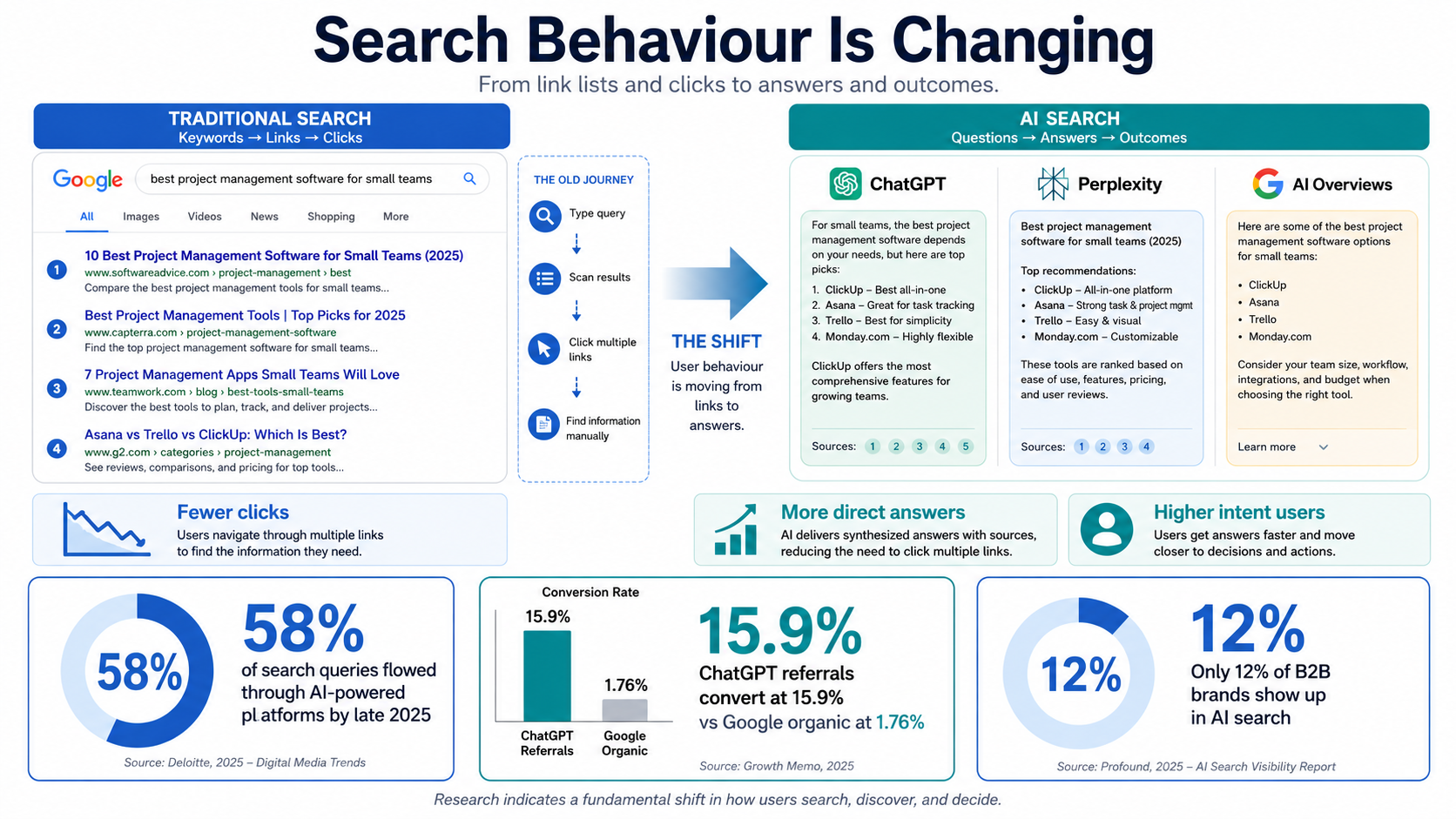
First, Let's Talk About What's Changing

For the past 20 years, getting found online meant one thing: rank on Google. You’d optimize your content for keywords, build backlinks, and hope to land somewhere on the first page. That was the game. And it still matters. Don’t let anyone tell you SEO is dead.

But something significant has shifted in the last two years.

By late 2025, roughly 58% of all search queries were flowing through AI-powered platforms like ChatGPT, Google AI Overviews, and Perplexity. That’s not a small trend. That’s a genuine change in how people find information. And for businesses, it’s a signal worth paying attention to. Businesses investing in SEO services for AI Overview rankings are already adapting their visibility strategies for AI-powered search platforms.

Here’s the part that should really get your attention. ChatGPT referrals convert at around 15.9%, compared to Google organic’s 1.76%. That’s nearly a 9x difference. The people coming from AI search aren’t just browsing. They’re ready to act.

But there’s a catch. Only 12% of B2B brands actually show up when buyers search their category inside these AI tools. The other 88% are completely invisible, not because their product isn’t good, but because nobody optimized their content for how AI thinks.

That’s exactly what GEO is trying to solve.

So, What is Generative Engine Optimization?

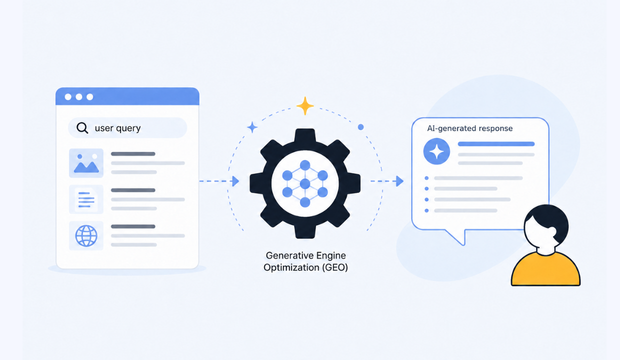
Generative Engine Optimization (GEO) is the practice of structuring and positioning your content so that AI tools like ChatGPT, Perplexity, Google Gemini, and Claude cite, mention, or recommend your brand when someone asks a relevant question.

Think of it this way. When someone types “what’s the best accounting software for small businesses” into ChatGPT, the AI doesn’t show a list of links. It just answers. It picks a few brands, explains why they’re a good fit, and maybe links to them. The brands that appear in that answer? They earned that spot because their content was built in a way that AI systems could trust, understand, and surface.

That’s GEO in action. Many businesses are now combining GEO with answer engine optimization services to improve visibility across ChatGPT, Google AI Overviews, and Perplexity.

It’s not replacing SEO. It’s extending it into a new channel; one that’s growing fast and rewarding brands that understand how it works.

GEO vs. SEO – What’s Actually Different?
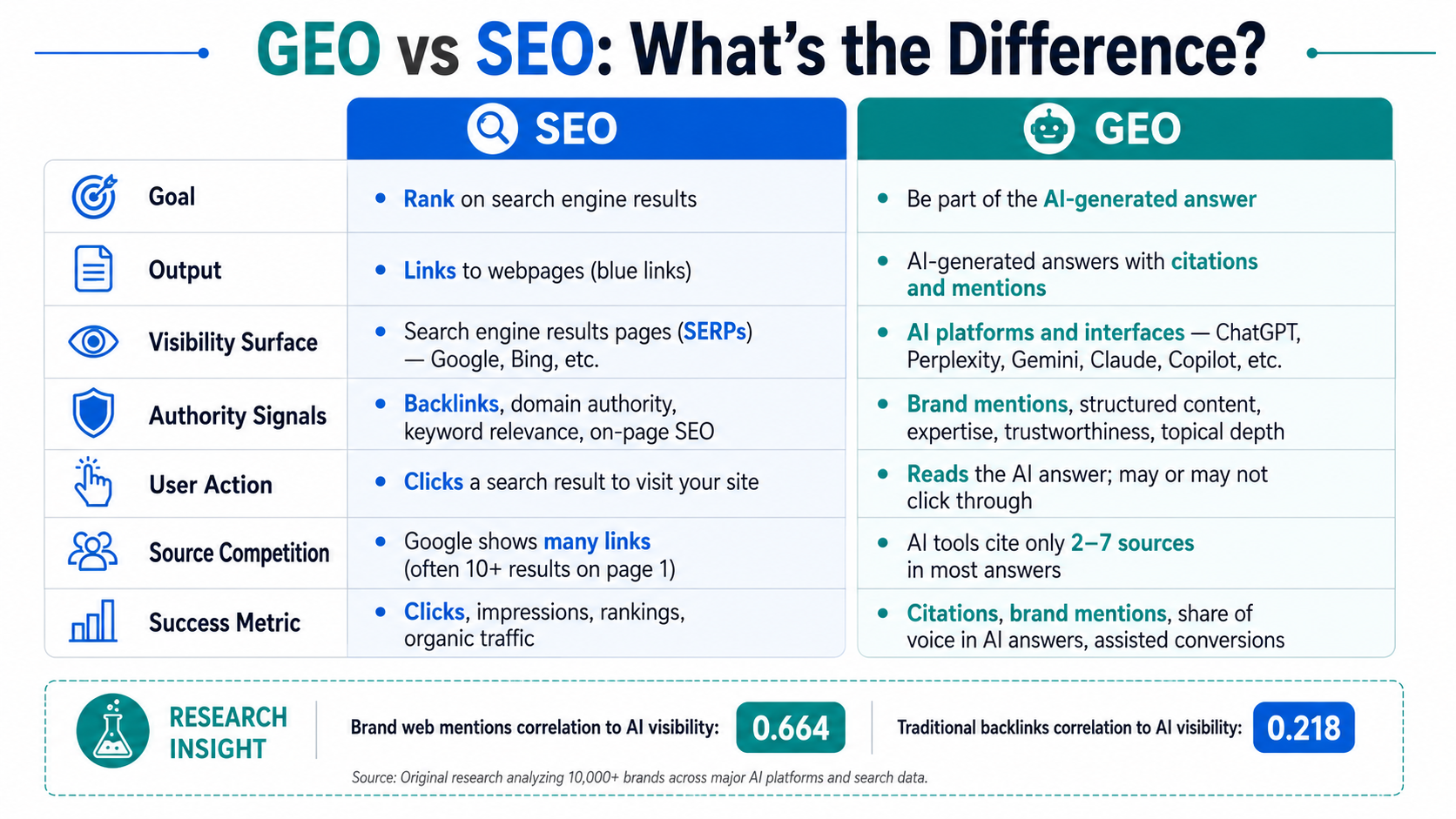
GEO vs. SEO - What's Actually Different?

You might be wondering whether this is just SEO with a new name. It’s not, and here’s why.

Traditional SEO is about ranking your web pages on a search engine results page. You optimize for keywords, earn backlinks, and compete for position one through ten on Google. The goal is to get a click. A user sees your link, clicks it, and lands on your site.

GEO works differently. Understanding the difference between SEO and GEO is essential for brands adapting to AI-generated search experiences. AI tools don’t show you a list of pages to choose from. They synthesize information from multiple sources and give you one answer. Your goal isn’t to get a click. It’s to be part of the answer.

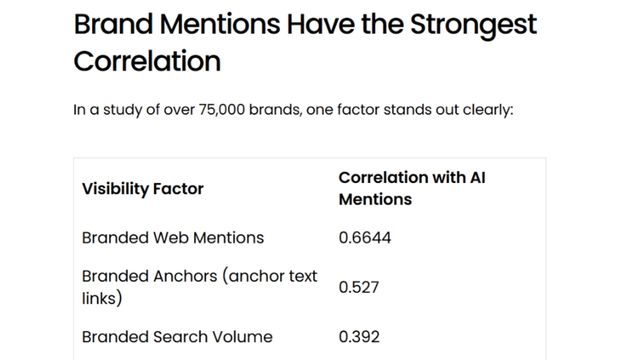
This changes what you optimize for. In SEO, backlinks were the biggest authority signal. In GEO, brand mentions matter more. A study by Ahrefs found that the correlation between brand web mentions and AI visibility is 0.664; while traditional backlinks sit at just 0.218. That’s a meaningful gap.

Another key difference: AI tools cite far fewer sources than Google does. Google shows you ten blue links per search. AI tools typically reference just 2 to 7 domains per response. The competition for those slots is fierce, and the brands winning them aren’t always the ones with the highest domain authority. They’re the ones whose content is clear, structured, trustworthy, and genuinely useful.

Why This Matters Especially for B2B Brands

If you’re selling a product or service to other businesses, you need to know this: 90% of B2B buyers now use AI tools during their purchasing journey. And a large portion of them start their research inside ChatGPT or a similar platform rather than Google.

This is happening before they ever visit your website. They’re asking AI, “What are the best options for X?” or “Which company should I use for Y?” and AI is giving them a shortlist. If your brand isn’t on that list, you don’t get a second chance. You were never even considered.

The decision-making window has compressed. What used to take days of research now takes minutes of conversation with an AI. The brands that show up in those minutes earn disproportionate mindshare – and eventually, revenue.

How Does AI Decide What to Cite?

This is the question everyone wants answered, and honestly, there’s no single definitive formula. But research is starting to paint a clear picture.

Content quality and structure matter a lot. AI systems don’t read content the way humans browse websites. They scan for clarity, directness, and factual accuracy. Content that answers questions in plain, structured language is far more likely to be cited. Pages with clear headings are 2.8 times more likely to earn citations in AI search results.

Brand mentions across the web are huge. The more your brand is talked about on third-party platforms, Reddit, Quora, YouTube, industry publications, the more signals AI systems have that you’re a legitimate, authoritative source. YouTube mentions specifically showed the strongest single correlation to AI visibility in recent research.

Third-party validation counts. For B2B brands especially, being listed on platforms like G2, Capterra, or Trustpilot makes a real difference. Domains with profiles on these platforms have a 3x higher chance of being cited by ChatGPT. It’s not about the number of reviews. It’s about being recognized by platforms that AI systems treat as trusted validators.

Content freshness plays a role too. AI tools prefer recent, up-to-date information. Regularly refreshing your key pages signals relevance and keeps you in contention.

We go much deeper on this in our article on How ChatGPT Decides Which Sources to Cite. If you’re curious about the specific mechanics, that’s a good place to start.

The Core Components of a GEO Strategy


GEO isn’t a single tactic. It’s a way of thinking about your entire content presence. Here’s what it covers, at a high level.

  1. Topical authority. You want AI to see you as a reliable expert on a specific subject. That means publishing a consistent body of content around a topic, not one great article, but many interconnected pieces that together show depth and breadth of knowledge.
  2. Content structure. Your content needs to be easy for AI to understand. Clear headings, direct answers near the top of articles, factual accuracy, and logical flow all contribute to whether an AI will choose to cite you.
  3. Off-site presence. Your website alone isn’t enough. Your brand needs to show up in conversations happening on other platforms – in forums, review sites, YouTube, podcasts, and publications your audience already reads.
  4. Technical foundations. This is the part most people overlook. If AI crawlers can’t properly access and understand your site, none of the content work matters. Clean site structure, schema markup, and proper indexing all feed into this.
  5. Measurement. You can’t improve what you don’t track. And right now, as of late 2025, only 16% of brands are systematically tracking their AI search performance. That gap is an opportunity. We cover exactly how to do this in our guide on How to Audit Your ChatGPT Visibility.

A Practical Way to Think About It

Here’s how we would frame GEO for anyone just getting started.

Imagine a highly trusted advisor that your ideal customer talks to before making any big decision. That advisor has read a huge amount of content from across the internet and remembers what it found reliable, credible, and helpful. When your customer asks for a recommendation, the advisor mentions the brands it knows well and trusts.

Your job with GEO is to become one of those trusted brands in the advisor’s memory. You do that by being genuinely present, consistently useful, and clearly credible across the internet – not just on your own website.

It’s not unlike how word-of-mouth worked before the internet. The brands people heard about the most, in the most trusted contexts, were the ones that got recommended. GEO is word-of-mouth at scale, filtered through AI. Businesses working with an experienced AI search visibility agency are often able to build stronger brand authority across emerging AI discovery platforms.

What GEO Doesn’t Mean

It’s worth clearing up a common misconception here.

GEO is not about tricking AI systems. You won’t find a loophole or a shortcut that suddenly makes ChatGPT recommend you. AI tools are increasingly good at identifying content that’s been stuffed with keywords or written primarily to manipulate an algorithm rather than genuinely help a reader.

The brands that win in GEO are the ones that would have earned recommendations the old-fashioned way too by being genuinely good at what they do and building a credible presence around it. GEO just formalizes that into a strategy.

Where to Go From Here

If you’re new to this topic, here’s our honest suggestion: don’t try to do everything at once.

Start by understanding where your brand currently stands in AI search. Ask ChatGPT and Perplexity a few questions that your ideal customer would ask. See if you come up. If you don’t, that’s your baseline. And that’s okay – most brands don’t, yet.

Then, work through the sub-topics in this cluster to build your understanding and your strategy piece by piece.

Here’s what we cover across this topic area: 

GEO is still early. The brands that take it seriously now will have a significant head start over competitors who wait until it becomes obvious. And if you’d like help thinking through what a GEO strategy looks like for your specific business, that’s exactly what we do at Sudha Solutions. Get in touch and let’s talk.

Sudha Solutions helps businesses build visibility in AI search through content strategy, GEO, and digital marketing. Based in India, working with brands globally.

Frequently Asked Questions

Why is GEO important for businesses in 2026?

As more users rely on AI tools instead of traditional search engines, GEO helps businesses improve visibility inside AI-generated search experiences.

How do AI platforms decide which brands to cite?

AI systems prioritize structured content, topical authority, brand mentions, trusted third-party references, and clear factual information.

What are GEO optimization services?

GEO optimization services help businesses improve AI visibility through content structuring, authority building, technical optimization, and AI-focused search strategies.

Can GEO replace traditional SEO?

No. GEO complements traditional SEO by expanding visibility into AI-powered search and generative answer engines.
Categories
GEO Optimization GEO vs SEO

Best GEO Practices: How to Write Content AI Can Use and Reuse

You can write a well-researched, 3000-word blog, only for it to be never seen by any AI platforms.  

In the past, some keywords and backlinks would be enough to get google ranking in the first couple of pages along with decent views. However, times have changed.  

With AI, people are not looking for blog links, they want direct answers either from Google overview or chatbots like ChatGPT, Claude, Grok and more. Therefore, your goal as a brand should be to get mentioned by AI platforms 

Any content you write must be easy for AI platforms to understand, extract, and reuse. But how can a brand achieve that? The answer: GEO Optimisation. 

GEO is not “SEO 2.0”. It is a content standard that makes your pages easier for AI to retrieve and safer for AI to summarise. And the good news is: most GEO wins come from clear writing and structure, not complex technical work. 

TL;DR: The GEO content standard:

If you remember only one thing, make it this: 

  • SEO helps you get found. GEO helps you get understood.  
  • GEO works best when you lead with the answer in the first 100 words, not halfway down the page. 
  • AI prefers accurate information over long intros and fluffy storytelling. 
  • Your content structure must include headings, lists, and tables are signals AI can parse quickly.  
  • Your biggest advantage is the human layer: experience, specific examples, case studies and original data points that cannot be copied.  
  • GEO success is increasingly about being cited and reused, not only about clicks. 

What is GEO? 

GEO or generative engine optimisation is the process of crafting or updating your website content to boost its AI visibility, across tools like ChatGPT-style assistants and AI search experiences.

GEO vs SEO: Teammates, not Rivals

Every year we get questions from our clients asking if SEO is still relevant. Our answer remains the same every year, Yes, it is. GEO, AEO and all other new AI terms are all part of SEO, not different from it.  

Businesses investing in structured SEO services often find that their GEO efforts perform significantly better because the technical and content foundations are already strong.

A simple way to think about it especially for founders and marketing heads: 

  • SEO is about being found in search results. 
  • GEO is about being understood and reused in AI-generated answers.  

GEO does not replace SEO. In practice, GEO usually performs best when your SEO foundations are already solid. 

Here is a quick comparison:

PARAMETERS  SEO  GEO 
Primary goal  Rank and win clicks.  Be extracted, summarised, cited. 
Best-performing intro  Hooks and curiosity.  Direct answer upfront. 
What gets rewarded  Relevance + authority + UX.  Clarity + extractable structure + information gain. 
Best page formats  Blog posts, category pages.  FAQs, how-to pages, definitions, comparisons, policies. 
Success metrics  Rankings, CTR, sessions.  Citations, share of voice in answers, accurate brand representation. 

How AI Uses your Content (and why that changes how you write)

AI systems are not as patient as humans when it comes to reading your content. 

When someone asks an AI tool a question, that tool often pulls from multiple pages across the web and builds a single answer. How your content is structured affects whether it is even considered in that process.  

A practical way to think about it: 

  1. Retrieval: Can the system find a relevant page? 
  2. Extraction: Can it isolate the right section quickly? 
  3. Synthesis: Can it summarise without misrepresenting you? 

If your page is a wall of text, AI has to work harder to extract. If your page is cleanly structured, it becomes an easy building block.

Best GEO practice #1: Use an Answer-First Approach (BLUF) 

Many marketers and writers were taught to “build mystery” to improve time on page. AI-driven discovery flips that incentive. AI citation patterns and modern content guidance increasingly push in the opposite direction: make the answer obvious early. 

The BLUF rule

BLUF means: Bottom Line Up Front. 

In your first 100 words, include: 

  • A plain-English definition (or the direct answer) 
  • Who it is for 
  • The result or takeaway 

Example opening 

“Generative Engine Optimisation (GEO) is how you write and structure content so AI tools can accurately summarise and cite it. It works best when your pages lead with direct answers, use clear headings, and include high-information elements like lists, tables, and examples.” 

The Q&A Header Format

This is one of the simplest, highest-leverage tactics: 

  • Put a real question in an H2 or H3. You can use tools like Answer The Public to find genuine questions. 
  • Answer it immediately in the first sentence. 
  • Then expand with details, stats, and case studies. 

AI Ranking calls this the “capsule” approach, with question-style headings and immediate answers before elaborating it further.

Best GEO practice #2: Increase Information Density

Cut Fluff, Add Data

AI systems tend to reward content like the one mentioned above that offers more “useful information per paragraph”. The more your page contains  

  • Unique facts  
  • Clear definitions  
  • Concrete examples 

… the more it becomes a reliable source. 

This is where strategic content marketing services and structured blog writing services play a critical role — turning generic blogs into high-information, AI-extractable assets.

A simple test: If your content could be rewritten by anyone in your category with the same outcome, it is probably not dense enough.

Replace Vague Claims with Specific Signals

Instead of: “It is important to maximise visibility.” 

Try: “In our audits, pages with a clear definition block and a comparison table improved inclusion in AI answers for ‘X vs Y’ style queries.” 

Even when you do not have proprietary numbers, you can increase density by adding: 

  • Clear criteria (what “good” means and how to judge it) 
  • Constraints (time, cost, sequence, prerequisites) 
  • Examples (what it looks like in the real world)

Use Data-Backed Patterns Where You Can 

If you do want to use external benchmarks, cite them cleanly and avoid over-claiming. 

For example, Analyse AI reports insights from a large citation dataset and discusses factors correlated with being cited in Perplexity results, including page-level attributes and structure.

Best GEO practice #3: Structure is a signal (write in extractable blocks)

Brittany Lieu (Heinz Marketing) makes the core point plainly: formatting helps humans read, but structure helps AI retrieve.  

Here is the practical checklist our content team follows: 

1. Headings that Mirror Real Questions 

  • One H1 (blog headline) that states exactly what the page delivers 
  • H2s that match what people actually ask 
  • H3s for follow-ups and “it depends” cases 

Pro Tip: If your H2s look like vague topics (“Benefits”, “Overview”, “More info”), rewrite them as questions (“What are the benefits of…?”, “When should you use…?”). 

2. Short Paragraphs and “One Idea Per Block” 

  • 2–4 lines per paragraph (especially in the first half) 
  • One claim per paragraph, supported immediately (no fluff, strictly.) 

3. Use Listicles and Bullet Points Smartly

Use numbered lists for:  

  1. Steps  
  2. Sequences  
  3. Workflows 

Use bullets for: 

  • Attributes  
  • Requirements  
  • Pros and cons 
  • Pitfalls

4. Tables when Comparison Matters

Tables make your content easier to extract for: 

Sr. No 

Comparison Type 

1 

“Best X” lists 

2 

“X vs Y” comparisons 

3 

Pricing and packaging 

4 

Feature differences 

5 

Requirements and eligibility 


You can read our blog to learn more about adding bullet points, listicles, and tables accordingly. 

Best GEO practice #4: Use EEAT Format

According to SEMrush ‘E-E-A-T (Experience, Expertise, Authoritativeness, and Trustworthiness) is a framework that Google’s human reviewers use to assess content quality. 

This is where the adding a human touch helps: experience, expertise, and trust cues that make your page feel like it comes from a real operator. 

Even GEO commentary in the space emphasises that fundamentals still matter and that content must be trustworthy and properly structured.

The “Micro Case Study” Format (Fast, Credible, not Fluffy) 

Use 4 lines: 

  • Context: who/what the situation was 
  • Change: what you did 
  • Result: what improved (ideally with a number) 
  • Reason: why that change worked 

Add Basic Trust Cues that AI can Pick Up

These are not only for Google or traditional SEO. They help AI interpret your content’s reliability: 

  • Author name and role 
  • Publish date and last updated date 
  • Clear definitions 
  • Sources for important claims 

Lieu explicitly calls out author names and publishes dates as helpful context for discoverability and comprehension.  

Also Read: How We Helped a Legacy Brand Win 300% AI Visibility 

List of New GEO KPIs (What to Measure Instead of Obsessing Over Clicks?) 

AI discovery shifts the scoreboard. Even AI Ranking explicitly talks about a “citation economy” and highlights that being cited changes outcomes even when clicks change.  

Modern performance marketing strategies must now consider AI citation visibility alongside traditional click-based metrics.

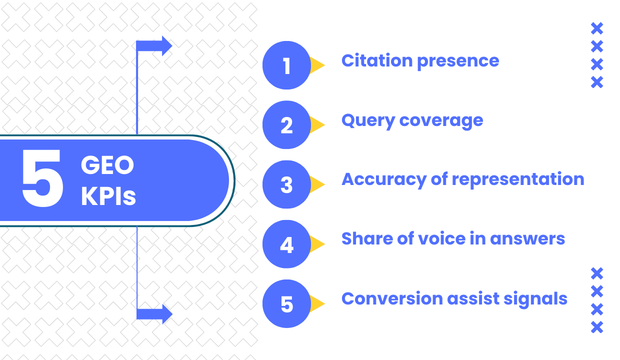
For founders and marketing heads, consider these GEO-friendly KPIs: 

  • Citation presence: Are you being cited in AI answers for your core topics? 
  • Query coverage: How many meaningful questions include you as a source? 
  • Accuracy of representation: Does AI describe your offering correctly? 
  • Share of voice in answers: How often you appear compared to competitors (even without a click) 
  • Conversion assist signals: Leads that mention “I found you via ChatGPT / an AI summary”

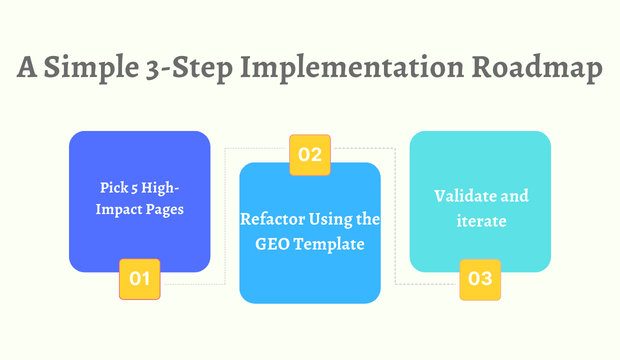
A Simple 3-Step Implementation Roadmap (No Tools Needed)

If you want this to be operational, not theoretical, include a roadmap teams can follow: 

Step 1: Pick 5 High-Impact Pages 

Start with pages that already get intent-driven traffic or answer common questions: 

  • FAQ page 
  • “How it works” 
  • Pricing or packages 
  • “X vs Y” comparison 
  • A core category or service page 

Step 2: Refactor Using the GEO Template 

For each page: 

  • Add a TL;DR block near the top 
  • Add a definition block under an H2 
  • Convert one key section into a table 
  • Rewrite 3–6 headings as questions with immediate answers 
  • Add one micro case study or specific example 

Step 3: Validate and iterate 

Revisit in 2–3 weeks: 

  • Did citations/mentions improve? 
  • Are you being described accurately? 
  • Which questions still skip your brand? 

A GEO Checklist We Follow

Answer-first 

  • Direct answer in first 100 words 
  • TL;DR in the first 20% of the page 
  • Each major section starts with a clear “first sentence answer” 

Information density

  • Every section includes at least one of: definition, criteria, example, constraint, number, or a mini case study 
  • Fluff removed (no long “in this article we will…” intros) 

Structure 

  • H2s written as questions where possible 
  • Short paragraphs, lists for logic, tables for comparisons 
  • Clear labels in tables and consistent terms across headings 

Trust 

  • Sources cited for key claims 
  • Experience included via micro case studies

Final Thoughts 

GEO is not about chasing a new acronym. It is about earning a new kind of visibility: being the source that AI systems can safely reuse.  

Do you want your brand to get cited by AI platforms? Schedule a call with us TODAY. We at Sudha Solutions have helped: 

  • A home decor brand rank above Amazon and Flipkart 
  • A cosmetic brand gets cited by both Google and ChatGPT 
  • A sustainable brand gets cited by both Google and ChatGPT 

These results are not fluke, rather a proof of our expertise in the new gen SEO which is less about clicks and more about AI citations. Contact Us Today! 

Frequently Asked Questions

1. Does word count matter for GEO?

Less than you think. A shorter page with clear structure and unique information can outperform a long page full of fluff. This aligns with the broader GEO idea of information gain over volume.

2. Will writing for AI make my content boring?

Not if you do it right. Clarity, summaries, tables, and examples usually improve human experience too.

3. Is SEO dead?

No. GEO builds on SEO foundations like structure, metadata, and clean internal linking. 

4. Do I need to rebuild mywhole site?

No. Start with high-impact pages first, then expand gradually.