Sudha Solutions

Categories
AI Overview chatgpt citations

ChatGPT vs Google – Where Should Your Business Focus in 2026?


This is one of the most debated questions in digital marketing right now. And it’s usually framed the wrong way. 

Most conversations about ChatGPT vs Google are structured as a competition; as if a business has to pick a side, bet on a winner, and shift all its energy accordingly. The data doesn’t support that framing. What it actually shows is two platforms doing fundamentally different jobs, attracting buyers at different points in the decision process, and requiring different but overlapping strategies to win on each. 

The smarter question isn’t “which one should we focus on?” It’s “what is each platform actually doing for our business, and are we showing up on both?” 

This article looks at what the data says about each platform’s real role in the buyer journey; and what that means for where to put effort in 2026. 

Start With the Volume Reality 
Start With the Volume Reality

Google still dominates search by a wide margin. It processes over 5 trillion searches annually, according to Google’s own internal data published in January 2025. ChatGPT processed approximately 2.5 billion prompts daily as of July 2025 – significant in absolute terms, but roughly one-eighth of Google’s daily query volume when filtered for traditional search-like queries. 

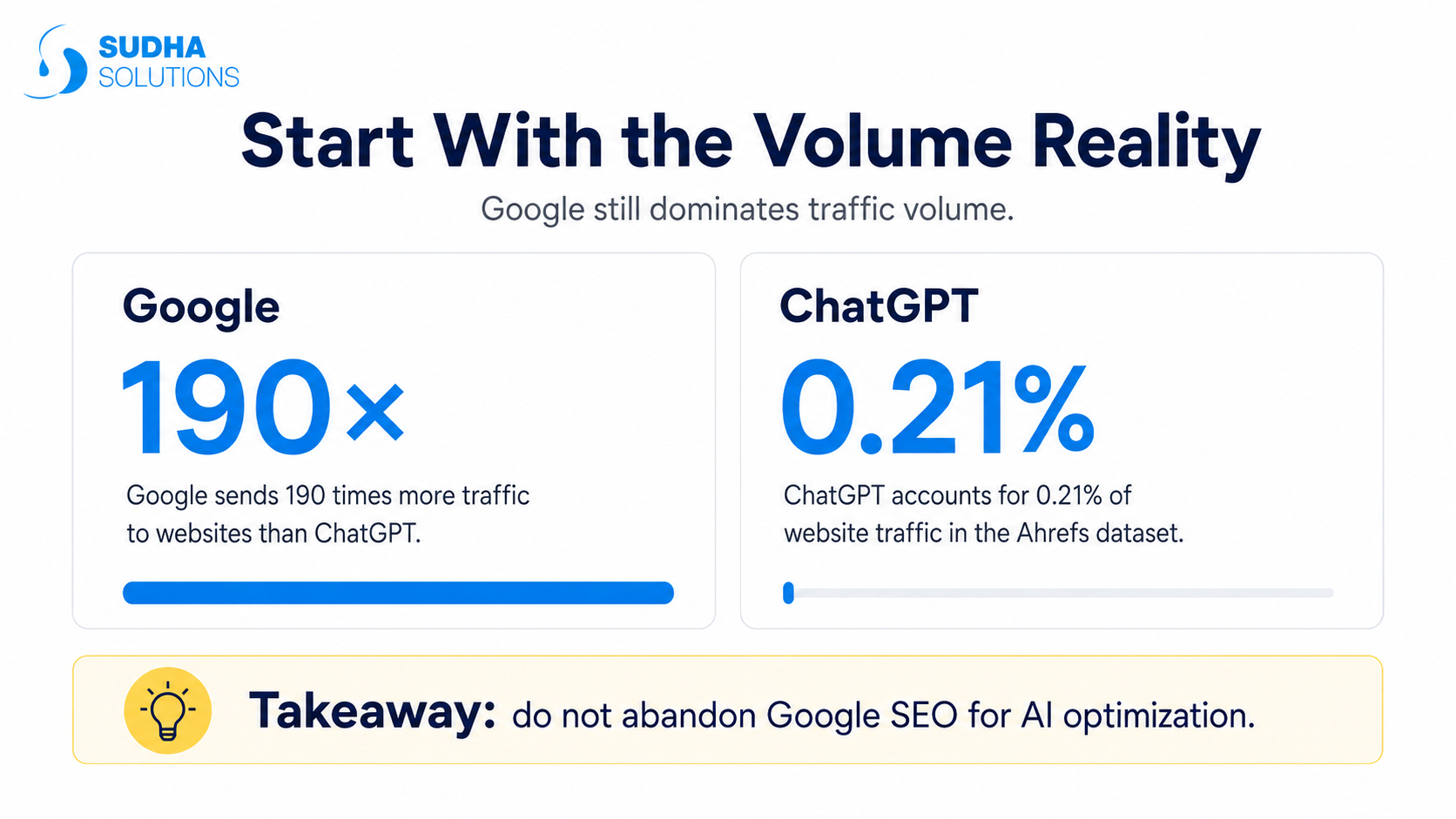
When it comes to traffic sent to websites, the gap is even more dramatic. Ahrefs’ research published in February 2026, based on data from 76,000 websites, found that Google sends 190 times more traffic to websites than ChatGPT. Google accounts for nearly 40% of all website traffic. ChatGPT accounts for 0.21%. 

For any business that relies on website visits to generate leads, this gap matters enormously. Abandoning Google SEO in favour of AI optimisation right now would be a serious mistake. 

But that’s only half the picture. 


The Conversion Rate Story Changes the Calculation 
The Conversion Rate Story Changes the Calculation

Here’s where things get more nuanced. While ChatGPT sends far less traffic than Google, the visitors it does send often behave differently – and convert at meaningfully higher rates. 

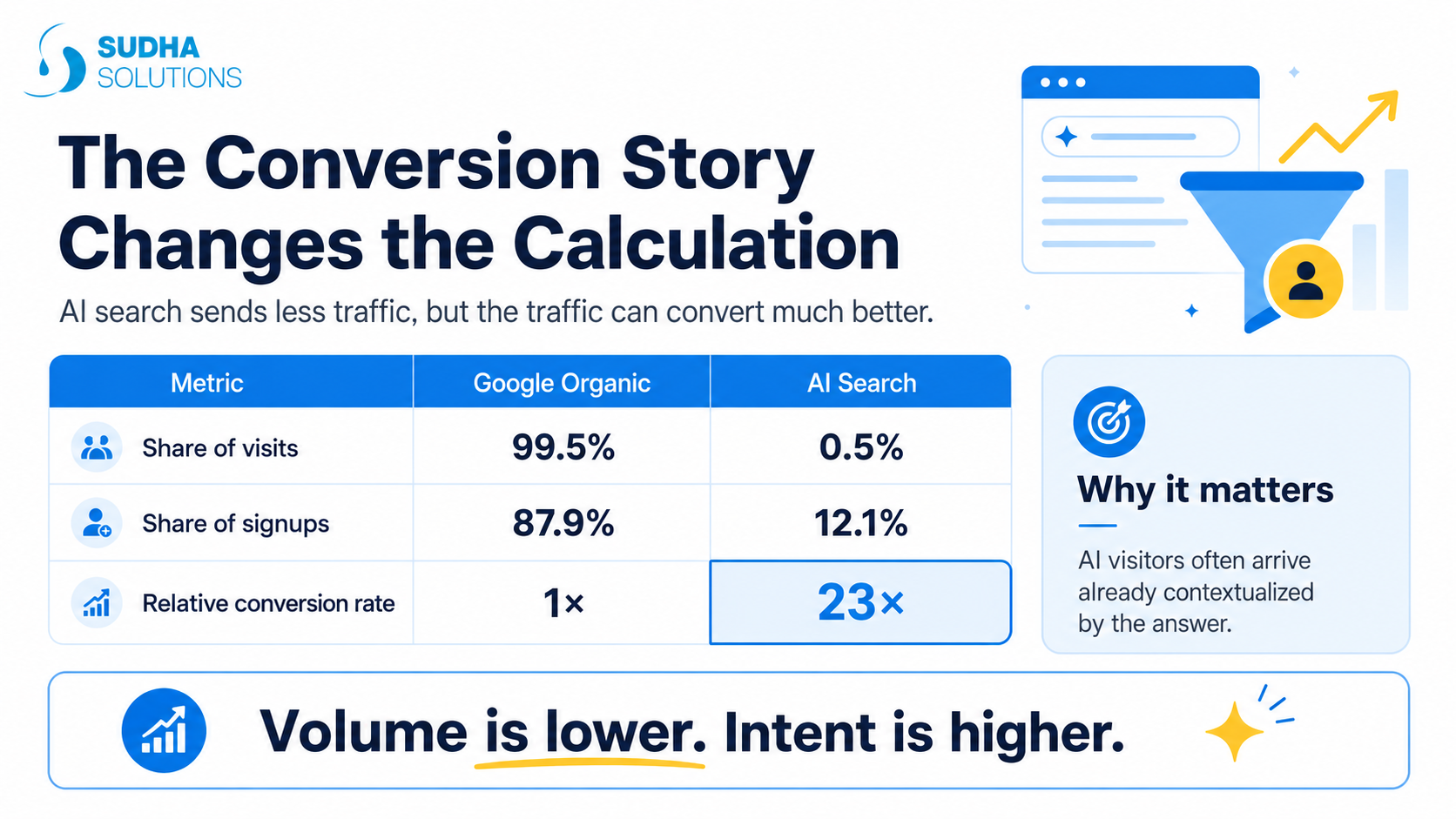
Ahrefs tracked conversion behaviour across its own platform and found that AI search traffic accounted for just 0.5% of visits but drove 12.1% of signups. That translates to AI search visitors converting at 23 times the rate of traditional organic search visitors. 

Ahrefs is one data point, but the pattern holds across other sources. Cross-industry data from 2025 and 2026 consistently shows AI referral conversion rates running 4 to 5 times higher than standard organic search traffic, with the strongest advantage in B2B SaaS and professional services. 

The reason isn’t complicated. When ChatGPT recommends a brand, it typically explains what the brand does and why it’s relevant to the query. The visitor arrives already contextualised – they’re not browsing, they’re evaluating. That’s a fundamentally different kind of traffic than someone clicking a Google result to read a blog post. 

The volume is lower. The intent is higher. Both things are true. Businesses partnering with an experienced AI search optimization agency are increasingly focusing on high-intent AI traffic and conversion-driven visibility strategies. 

What Each Platform Is Actually Used For 
What Each Platform Is Actually Used For

Understanding why this conversion gap exists requires looking at how users actually use each platform. 

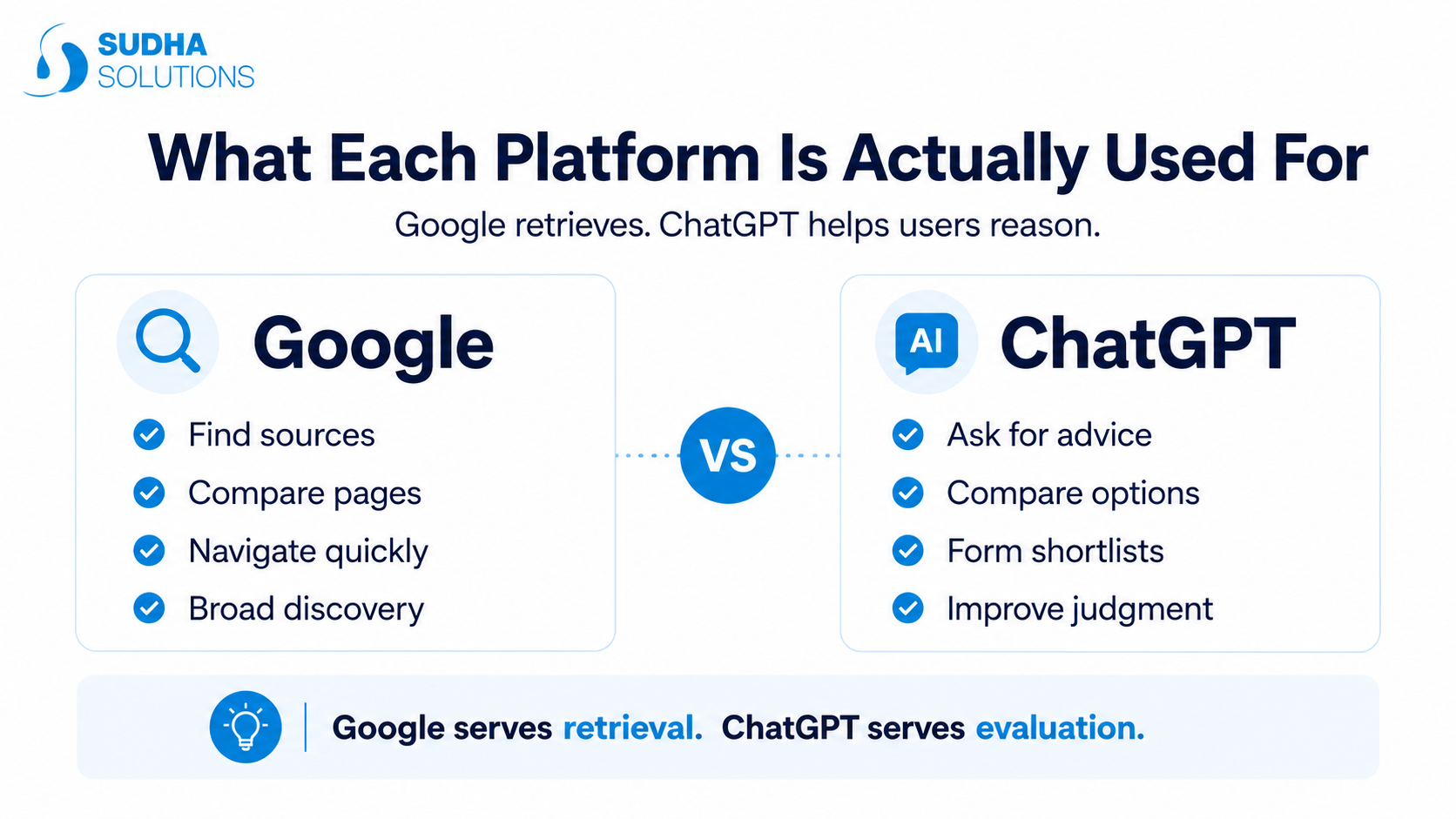
Research from OpenAI and Harvard, analysing 1.5 million conversations, found that 24% of ChatGPT usage is pure search behaviour and 51.6% is what researchers called “asking intent” – where users seek advice, perspective, or information to improve judgment. Users aren’t just looking something up. They’re trying to work something out. 

Google, by contrast, remains primarily a retrieval engine. People go there knowing what they want to find and looking for the right source to find it. The intent is more transactional and more varied – from quick factual lookups to product comparisons to content consumption. 

For B2B buying journeys specifically, research has found that generative AI tools were the single most cited meaningful interaction type for researching purchases in 2025. And 29% of B2B buyers now start their research journey with an AI tool rather than a Google search – a number that has grown three times faster among B2B buyers than consumers. 

That 29% is the part of the funnel happening before a buyer ever types anything into Google. If a brand isn’t present in AI answers, it’s invisible during a growing portion of early-stage vendor consideration; even if its Google rankings are strong. 

The Overlap Is Lower Than Most People Expect 
The Overlap Is Lower Than Most People Expect

One of the most important findings for businesses trying to manage both channels is how little the two platforms share in terms of which sources they cite. 

Ahrefs’ Brand Radar research, which analyzed 76.7 million AI Overviews, 957,000 ChatGPT prompts, and 953,500 Perplexity prompts, found that Google shows a strong correlation between branded web mentions and visibility – consistent with how Google has always favoured established brands. ChatGPT showed a much weaker correlation with the same signals. Perplexity weaker still. 

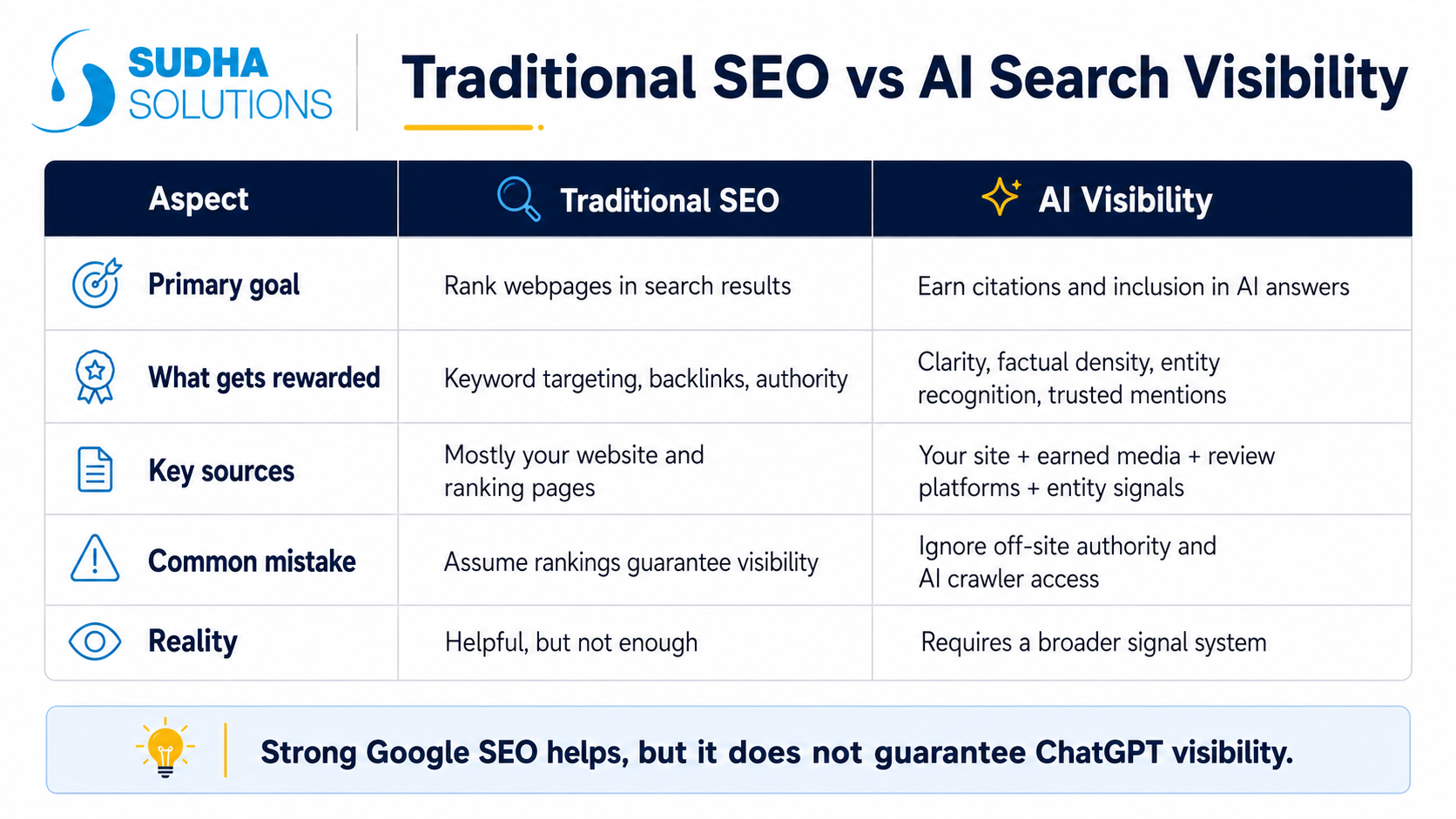
This matters because it means winning on Google does not automatically translate to winning on ChatGPT. The two platforms use overlapping but distinct signals to decide what to surface. Understanding how AI search engines rank content is becoming increasingly important for businesses investing in GEO and AI visibility strategies. 

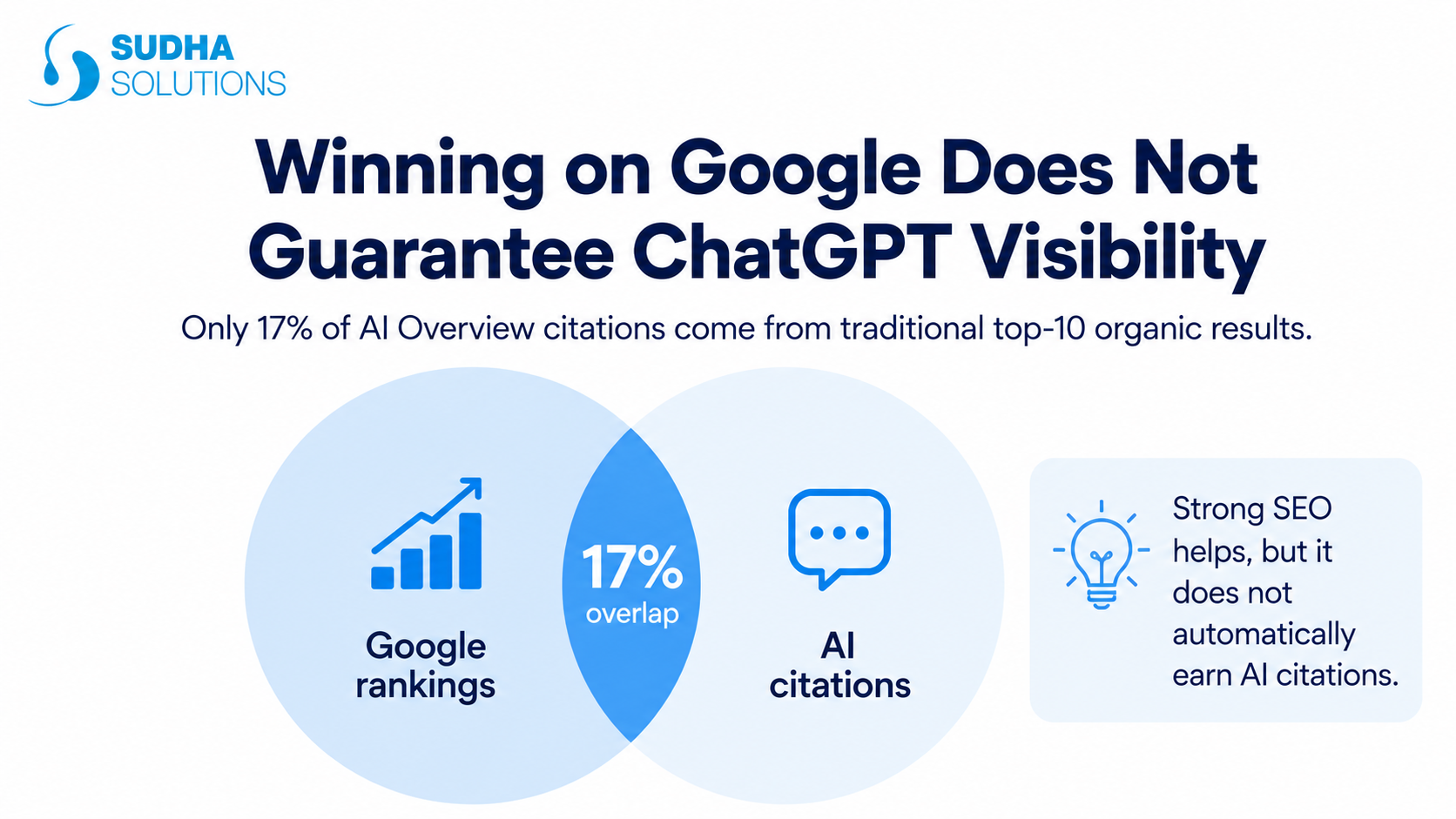
Separately, only 17% of AI Overview citations come from content ranking in the traditional top 10 organic results, according to BrightEdge’s February 2026 research reported in Search Engine Journal. The majority of AI citations pull from content ranking lower; or from entirely different sources that organic rankings don’t predict. 

A brand can be performing well on Google and still be largely invisible to AI search. And vice versa. 

How the Platforms Are Evolving Differently 
How the Platforms Are Evolving Differently

Neither platform is standing still, and the trajectory of each shapes where to invest now. 

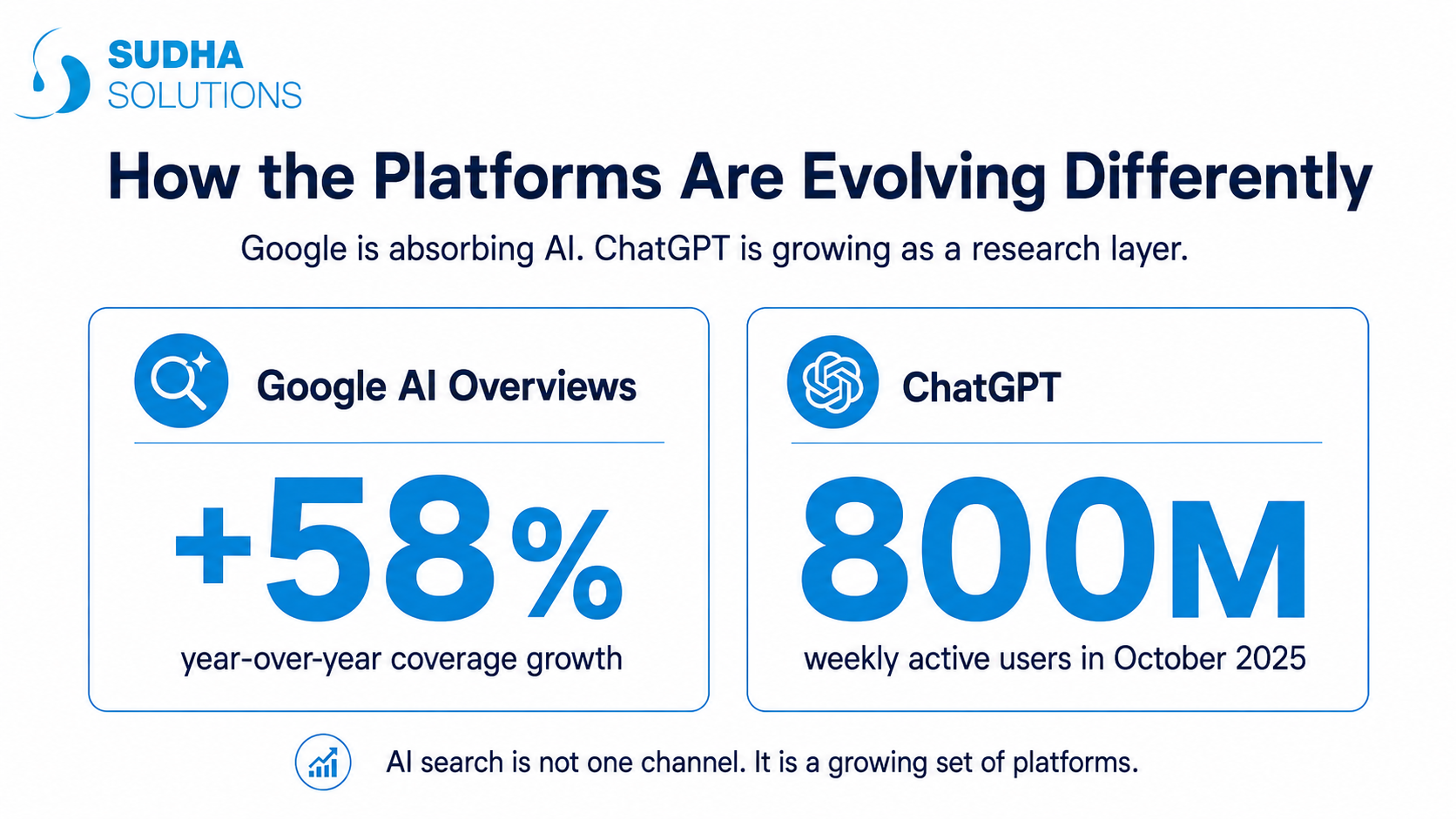
Google’s primary response to the rise of AI search has been to bring AI directly into its own product. AI Overviews coverage grew 58% year-over-year between February 2025 and February 2026, per BrightEdge’s Generative Parser data. In B2B technology, the proportion of queries triggering AI search results grew from 36% to 82% in that same twelve-month window. Google isn’t being displaced by AI search; it’s absorbing it. 

But that shift has a direct cost for websites. Ahrefs’ research found that AI Overviews have reduced click-through rates by 34.5% on queries where they appear. Impressions are up; clicks are down. Google is serving more queries while sending less traffic to the websites that feed its answers. 

ChatGPT, meanwhile, is growing its user base aggressively – reaching 800 million weekly active users in October 2025, doubled from 400 million just eight months prior. But within the AI chatbot category itself, ChatGPT’s share of web traffic dropped from 87.2% to 68% in twelve months as Gemini and other platforms gained ground rapidly. The AI search market is not a single channel; it’s a diversifying set of platforms with meaningfully different citation behaviours. 

Gartner’s 2024 prediction that traditional search volume would drop 25% by 2026 due to AI has become a benchmark for how the industry tracks disruption. Whether that specific figure proves accurate or not, the directional shift is not in question. AI is capturing a portion of queries that previously would have ended with a Google click. 

A Practical Way to Think About Allocation 
A Practical Way to Think About Allocation

Given all of this, here is a practical framework for thinking about where to put effort. 

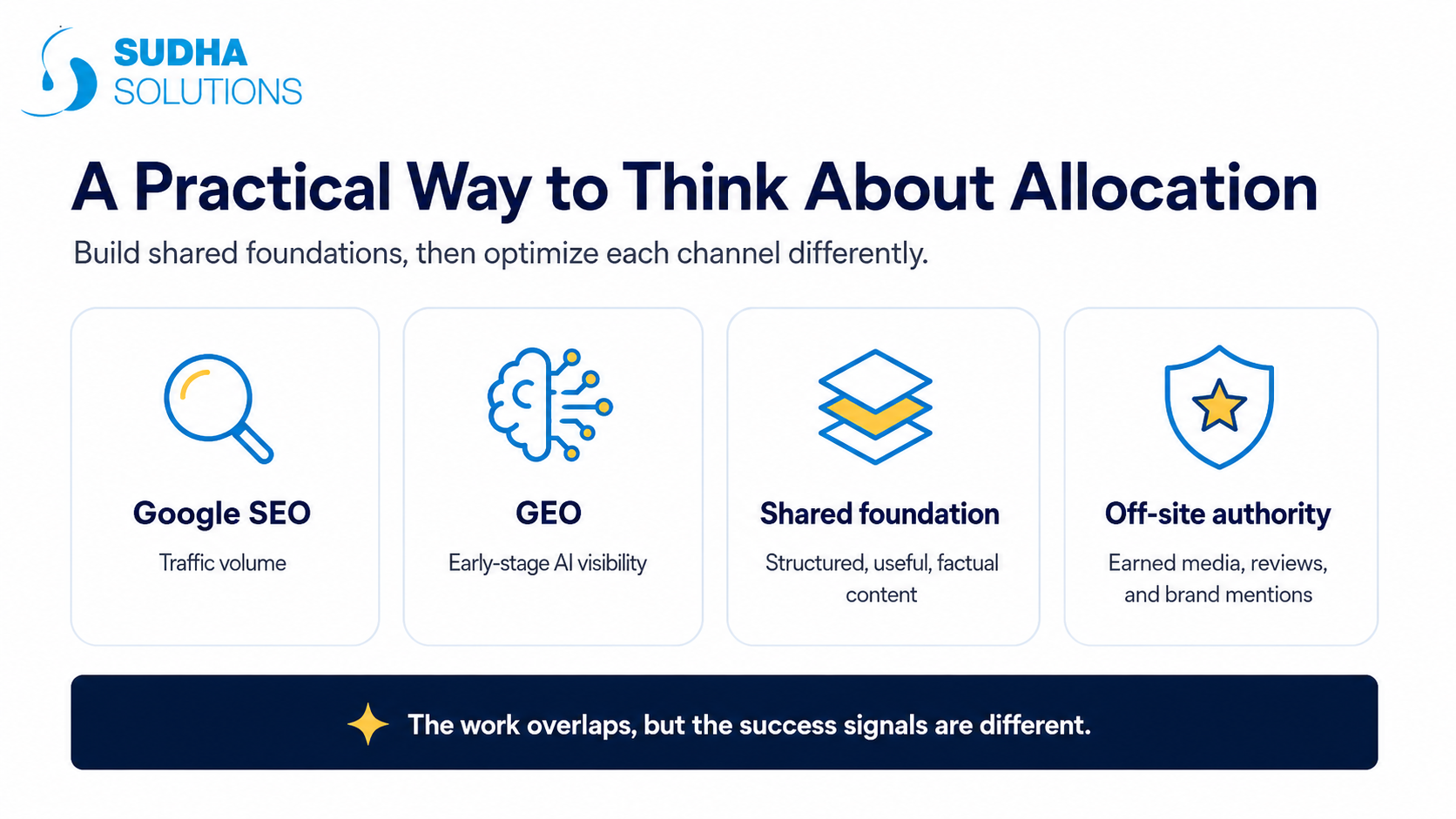
Google SEO remains non-negotiable for traffic volume. It drives the overwhelming majority of website visits and will continue to do so for the foreseeable future. Any strategy that deprioritises it entirely in favour of GEO is misallocating resources. 

GEO is non-negotiable for early-stage B2B visibility. The portion of the buying journey happening inside AI tools, before buyers ever search Google or visit a website, is growing. Being absent from AI answers during that phase means being absent from shortlist consideration entirely. This is why many businesses are now investing in answer engine optimization services to improve discoverability across ChatGPT, Gemini, and Google AI Overviews. 

The good news is that the foundations overlap significantly. High-quality, structured, factually dense content that demonstrates genuine topical expertise serves both channels. Earned media presence, getting featured and mentioned across credible third-party sources, builds authority signals that benefit both Google and AI citation patterns. Technical hygiene, content freshness, and entity clarity all contribute to performance on both platforms. Strong technical SEO services for AI search help businesses improve crawlability, structured data implementation, and Bing indexing for AI visibility. 

The work is not a binary choice. It’s a matter of building on the same foundations while understanding which specific signals each platform weighs most heavily. 

Where the strategies diverge is in off-site presence. Google’s visibility continues to be heavily influenced by traditional backlink signals, domain authority, and on-page SEO. ChatGPT citation is more influenced by brand mentions, earned media coverage, third-party reviews, and entity recognition across the web. A comprehensive strategy invests in both; not because they’re the same, but because the target audiences are using both platforms. 


One Number Worth Keeping in Mind 

AI referral traffic grew 975% year-over-year for B2B technology firms in Opollo’s January 2026 dataset. It represents a small absolute percentage of total traffic today. But the growth rate is the signal worth watching. 

The brands investing in GEO now are building the citation infrastructure, content depth, and entity signals that will compound as that growth rate continues. The brands waiting until AI traffic becomes unmissable in their analytics are building from behind, against competitors who started earlier. 

Google and ChatGPT are not competitors to choose between. They are channels to optimise for in parallel – with the understanding that the balance of their importance to any specific business will shift gradually, and then quickly, over the next few years. 

The next article in this series, How to Audit Your ChatGPT Visibility, covers the practical process of measuring where a brand currently stands in AI search – which is the right starting point before any strategy can be built. 

This article is part of Sudha Solutions’ ChatGPT Optimization series. Read the full series: 

Sudha Solutions helps businesses build visibility in AI search through content strategy, GEO, and digital marketing. Based in India, working with brands globally. 

Frequently Asked Questions 

Is ChatGPT replacing Google search?

ChatGPT is not replacing Google entirely, but AI-powered search platforms are increasingly influencing how users research products, services, and business solutions.

What is the difference between Google SEO and GEO?

Google SEO focuses on improving search rankings in traditional SERPs, while GEO focuses on improving visibility inside AI-generated answers and AI search engines.

Why is AI search important for B2B companies?

AI search is important because many B2B buyers now use ChatGPT and AI tools during early-stage vendor research and shortlist creation.

How can businesses improve AI search visibility?

Businesses can improve AI search visibility through GEO optimization, entity SEO, technical AI crawlability, structured content, and third-party authority signals.

Does traditional SEO still matter in 2026?

Yes. Traditional SEO still drives the majority of website traffic, while AI optimization helps improve discoverability inside AI-generated search experiences.
Categories
AI Overview LLMS

Why Most B2B Brands Are Invisible in AI Search (And How to Fix It)

There’s a buyer researching your category right now. They’ve opened ChatGPT, typed in something like “what’s the best solution for [problem your business solves],” and they’re reading the answer. 

Your brand almost certainly isn’t in it. 

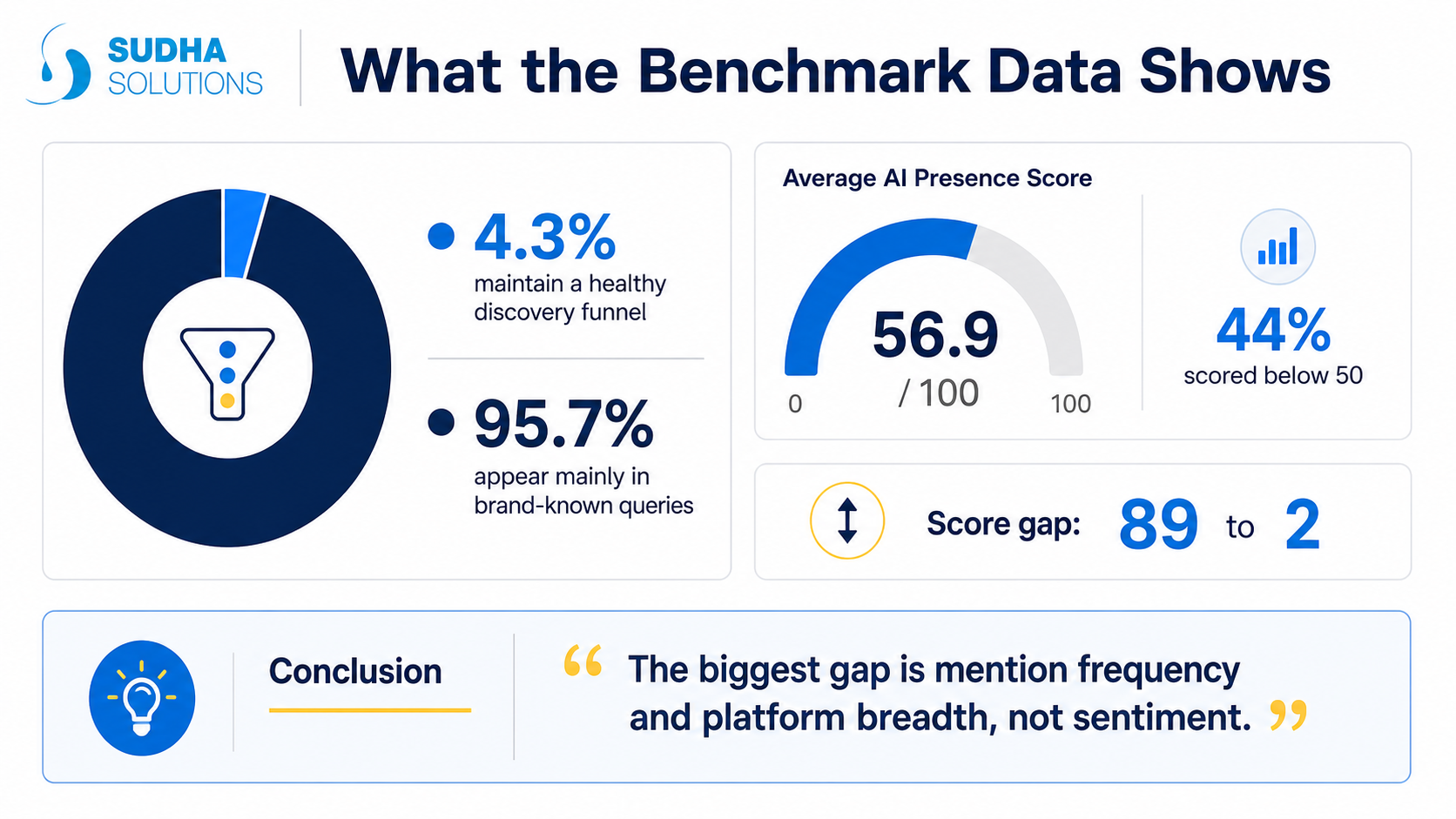
That’s not a guess. A 2026 study by 2X, a B2B go-to-market research organisation, analysed 70 B2B companies across generative AI platforms and found that only 4.3% of companies maintain a healthy discovery funnel – meaning their brands appear in early-stage buyer questions. The remaining 95.7% appear primarily in queries where buyers already know the company name. They’re invisible during the moment buyers are actually forming shortlists. (Demand Gen Report, April 2026) 

That number is worth sitting with. 95.7% of B2B companies; not small, underfunded, or poorly marketed ones. Companies with active marketing teams, established websites, and real budgets. Invisible, right when it matters most. 

This article looks at why that’s happening and what actually fixes it. 

The Scale of What’s Changed 

The Scale of What's Changed

Before getting into the why, it helps to understand just how fast this shift has happened. 

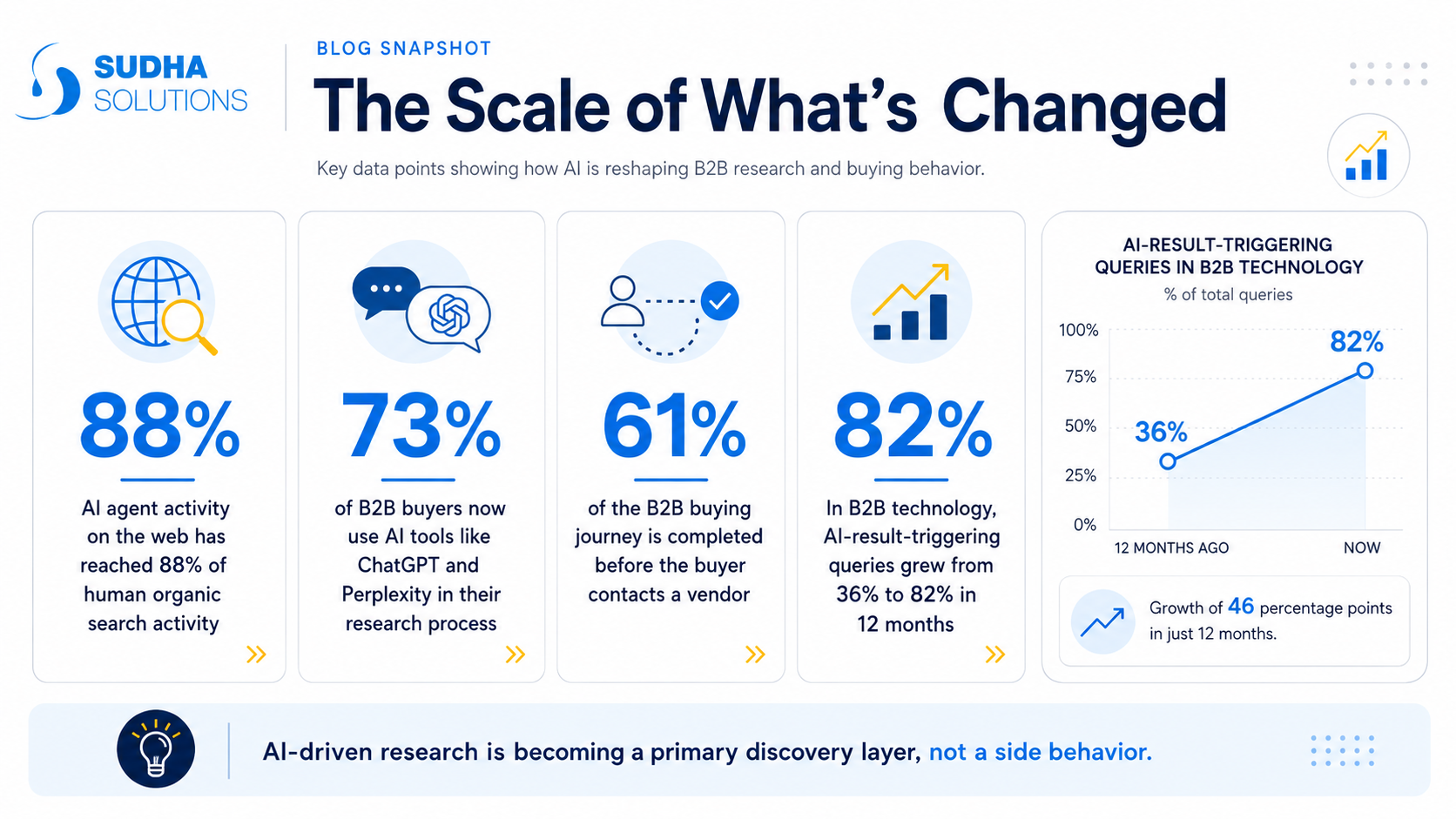
AI agent activity on the web has now reached 88% of human organic search activity, according to BrightEdge’s April 2026 data. Based on current growth trends, BrightEdge projects that AI agent activity will surpass human-driven search entirely by the end of 2026. (BrightEdge, April 2026) 

For B2B specifically, 73% of buyers now use AI tools like ChatGPT and Perplexity in their research process, based on a multi-source analysis of 680 million citations published in April 2026. And Forrester’s research found that 61% of the B2B buying journey now completes before the buyer ever contacts a vendor; a figure that keeps climbing as AI tools provide synthesised comparisons that previously required hours of independent research. 

In B2B technology specifically, the shift has been dramatic. Queries in that category that triggered AI search results grew from 36% to 82% in just twelve months, between February 2025 and February 2026, according to BrightEdge’s Generative Parser data published in Search Engine Journal. 

The pace is not slowing down. Businesses partnering with an experienced AI search optimization agency are adapting faster to changes in AI-driven search behavior. 

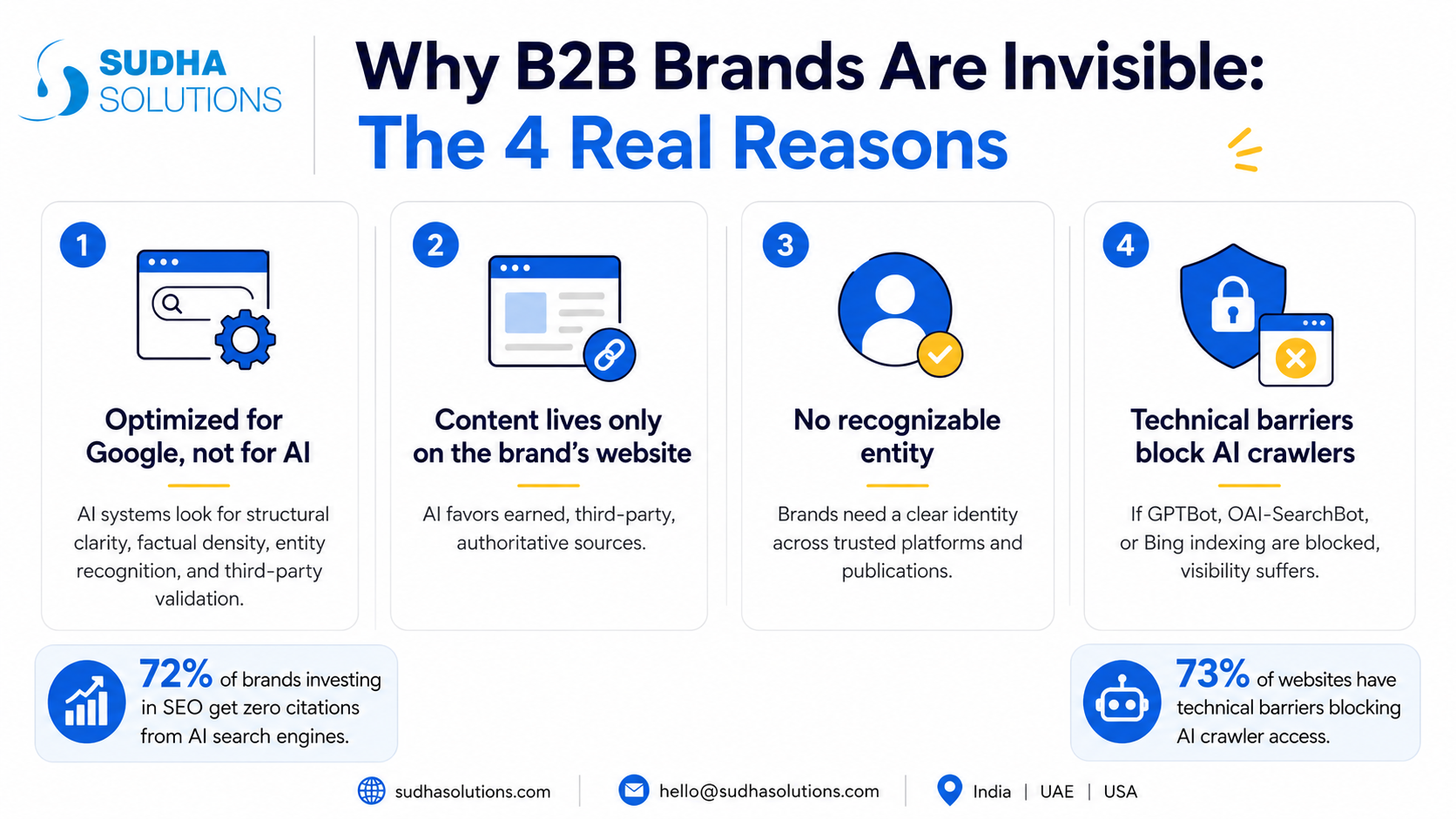
Why B2B Brands Are Invisible – The Four Real Reasons 

Why B2B Brands Are Invisible - The Four Real Reasons

Most B2B companies assume that if their website ranks on Google, they’re covered. The data says otherwise. Only 17% of AI search citations come from content ranking in the traditional top 10 organic results, according to BrightEdge’s February 2026 research. The other 83% pull from content that ranks lower — or from entirely different sources that Google ranking doesn’t predict at all. 

Here are the four most common reasons B2B brands don’t show up in AI search. 

  1. They’re Optimized for Google, Not for AI 

They're Optimized for Google, Not for AI

Traditional SEO and AI visibility require different things. Traditional SEO rewards keyword optimization, backlink volume, and page authority signals that Google’s algorithm is built to read. AI search systems evaluate content differently – This is why many companies are now investing in answer engine optimization services to improve visibility across ChatGPT, Gemini, and AI Overviews. They look for structural clarity, factual density, earned third-party mentions, and entity recognition across the web. 

72% of brands actively investing in SEO receive zero citations from AI search engines, according to BrightEdge research. That means most brands are building the wrong foundation entirely, and not even realising it. 

Google rankings are still a contributing factor – pages ranking in position one on Google are cited more frequently by ChatGPT than pages outside the top 20. But 44% of B2B brands with strong Google rankings have no ChatGPT visibility at all. Strong Google SEO creates a signal. It doesn’t guarantee a citation. 

  1. Their Content Lives Only on Their Own Website

Their Content Lives Only on Their Own Website

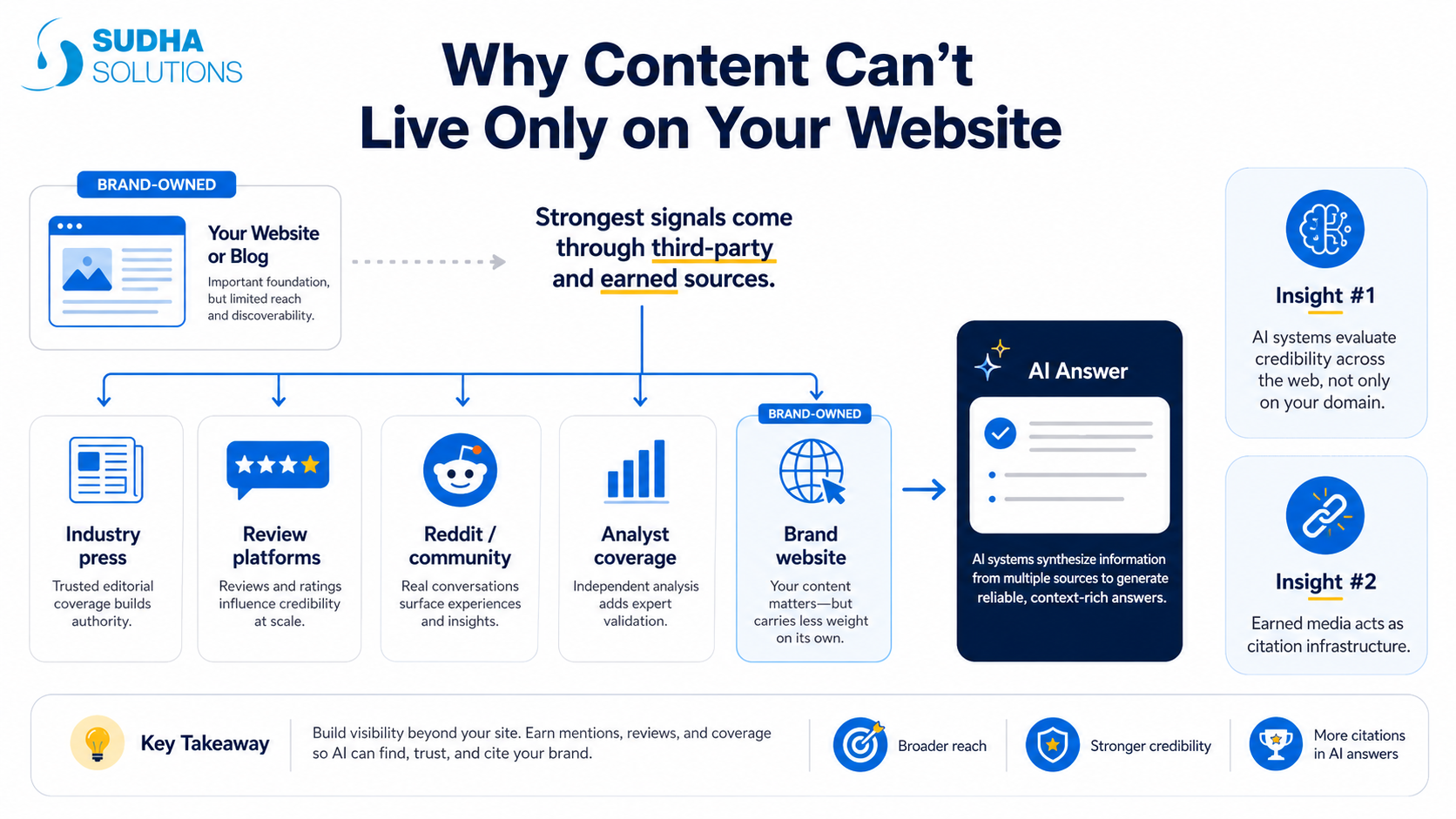
This is the single biggest structural mistake most B2B brands make. AI systems evaluate credibility by looking across the entire web, not just at a brand’s own domain. 

Research from the University of Toronto, published in September 2025, found that AI search exhibits a systematic and overwhelming bias toward earned media, third-party, authoritative sources, over brand-owned content. Social media content was almost entirely absent from AI answers. The contrast with Google’s more balanced citation mix was described as stark. 

A brand whose expertise exists exclusively on its own blog is, from an AI system’s perspective, a brand that has not yet been validated by anyone else. 

  1. They Haven’t Built a RecognisableEntity 

They Haven't Built a Recognisable Entity

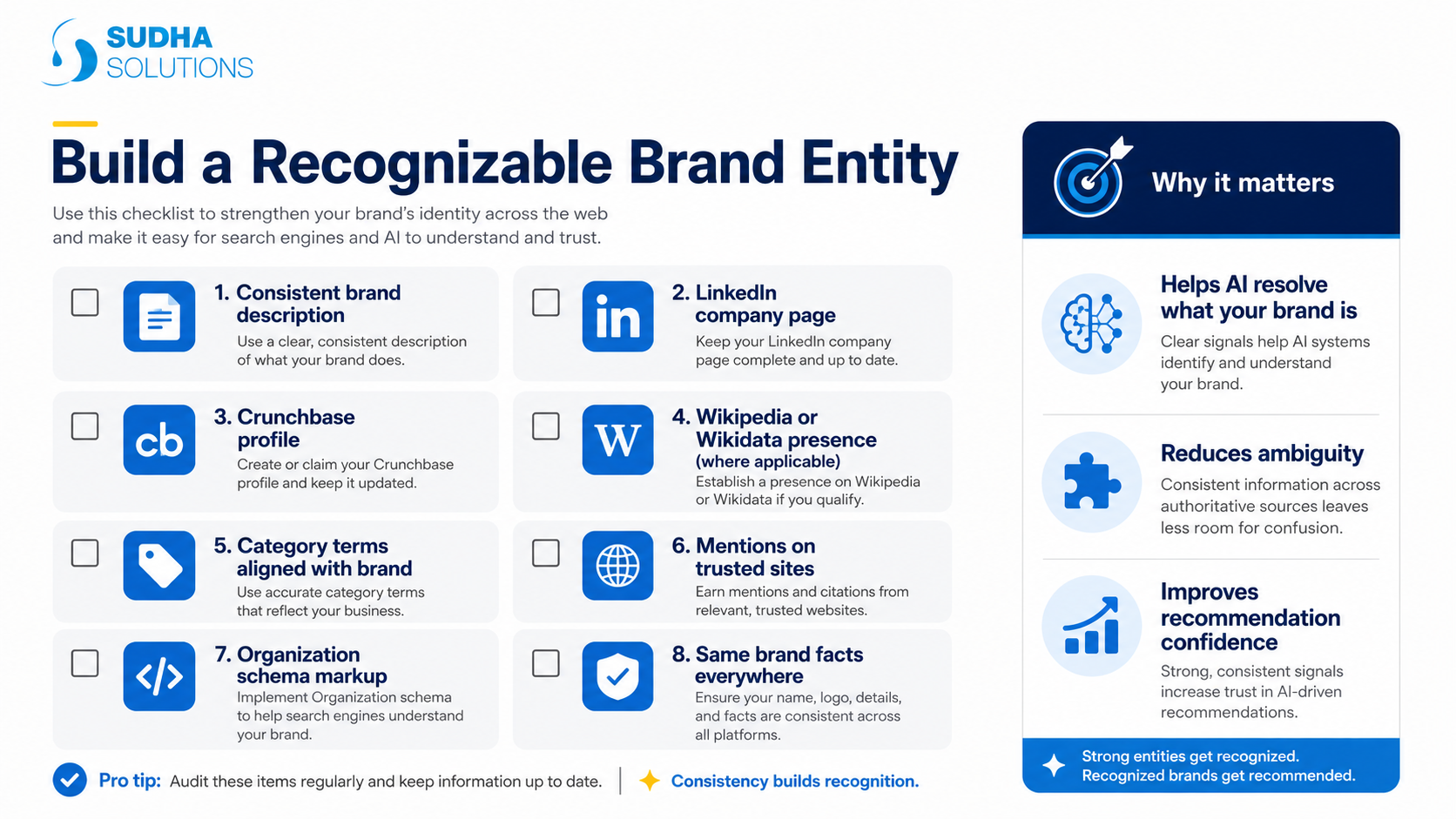
AI systems don’t just retrieve pages. They build internal representations, called entity models, of what a brand is, what it does, and how credible it appears across independent sources. If the AI can’t cleanly resolve a brand’s identity from multiple third-party references, the brand doesn’t get confidently recommended regardless of how good its products are. 

A brand that exists only on its own domain, without third-party coverage from publishers AI engines recognise as credible, is effectively absent from the citation layer regardless of its domain authority or search rankings. 

Entity clarity requires more than a well-written About page. It requires consistent, coherent presence across the platforms and publications that AI systems have learned to trust. 

  1. They Have Technical Barriers Blocking AI Crawlers

They Have Technical Barriers Blocking AI Crawlers

Even when a brand has strong content and some earned media presence, it often fails a basic technical test: AI crawlers can’t access the site properly. 

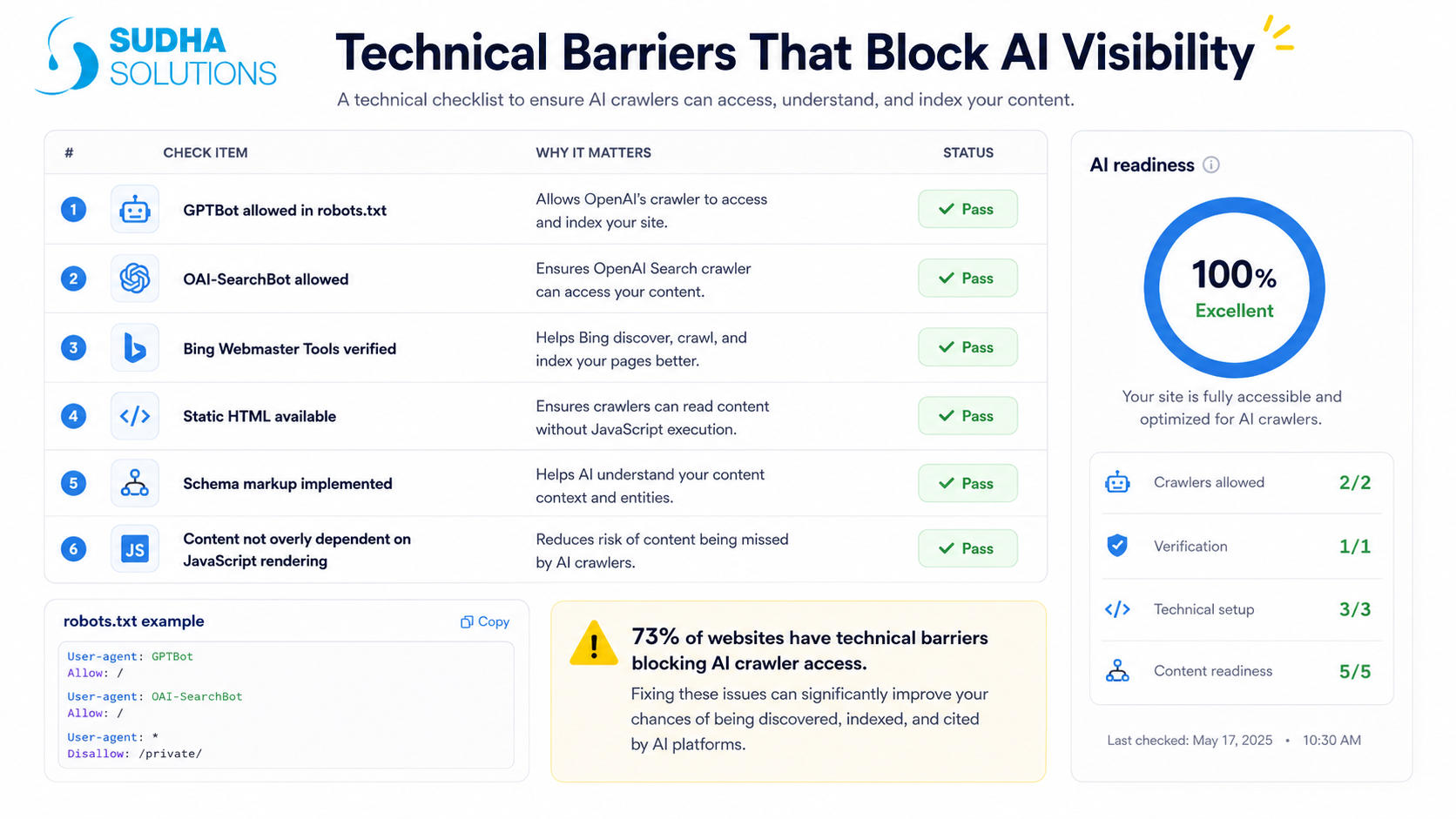
73% of websites have technical barriers that block AI crawler access, according to the OtterlyAI 2026 AI Citations Report. This includes sites that block GPTBot or OAI-SearchBot via robots.txt, sites that rely heavily on JavaScript rendering (which AI systems parse at far lower rates than static HTML), and sites that haven’t been submitted to Bing Webmaster Tools – the index ChatGPT’s browsing mode actually runs on. 

Brands that fix these technical barriers immediately remove a handicap that’s entirely self-inflicted. 

What the Benchmark Data Shows 

What the Benchmark Data Shows

The gap between the most and least visible B2B brands in AI search is enormous – and it’s not driven by brand size or marketing budget. 

A benchmark study by DerivateX, published in April 2026, analysed 50 B2B SaaS companies across ChatGPT, Perplexity, Claude, and Gemini, running 1,400 buyer-intent prompts. The average AI Presence Score across all companies was 56.9 out of 100, and 44% scored below 50. The gap between the highest-scoring brand (89 out of 100) and the lowest (2 out of 100) was 87 points; despite both operating in established categories with active marketing teams. (Demand Gen Report, April 2026) 

The study also found that the visibility gap is driven entirely by mention frequency and platform breadth; not by how AI perceives the brand once mentioned. Sentiment scores were nearly uniform across companies. The brands at the bottom aren’t being poorly rated. They’re simply not being mentioned at all. 

Why This Problem Compounds Over Time 

Here’s what makes AI invisibility more serious than a temporary SEO dip: the brands showing up in AI answers today are building a structural advantage that becomes harder to displace as time goes on. 

AI systems build entity models from accumulated signals across training data and live web retrieval. Brands that have been consistently mentioned, covered, reviewed, and cited across the web are more deeply embedded in those models than brands just starting to build their presence. The gap between a brand that started building AI visibility in 2024 and one starting in 2026 is meaningful – and it grows every quarter. 

95% of the time, the winning vendor was already on the buyer’s Day-One shortlist, according to 6sense’s 2025 Buyer Experience Report. And increasingly, that shortlist is being formed inside AI tools, before the buyer ever visits a website. 

The brands that aren’t in the AI answer aren’t losing late in the sales process. They’re never entering it. 

What the Fix Actually Looks Like 

What the Fix Actually Looks Like

The good news is that AI visibility isn’t determined by factors that only large enterprises can access. The brands winning in AI search aren’t always the biggest or the best-funded. They’re the ones that have built the right signals deliberately. 

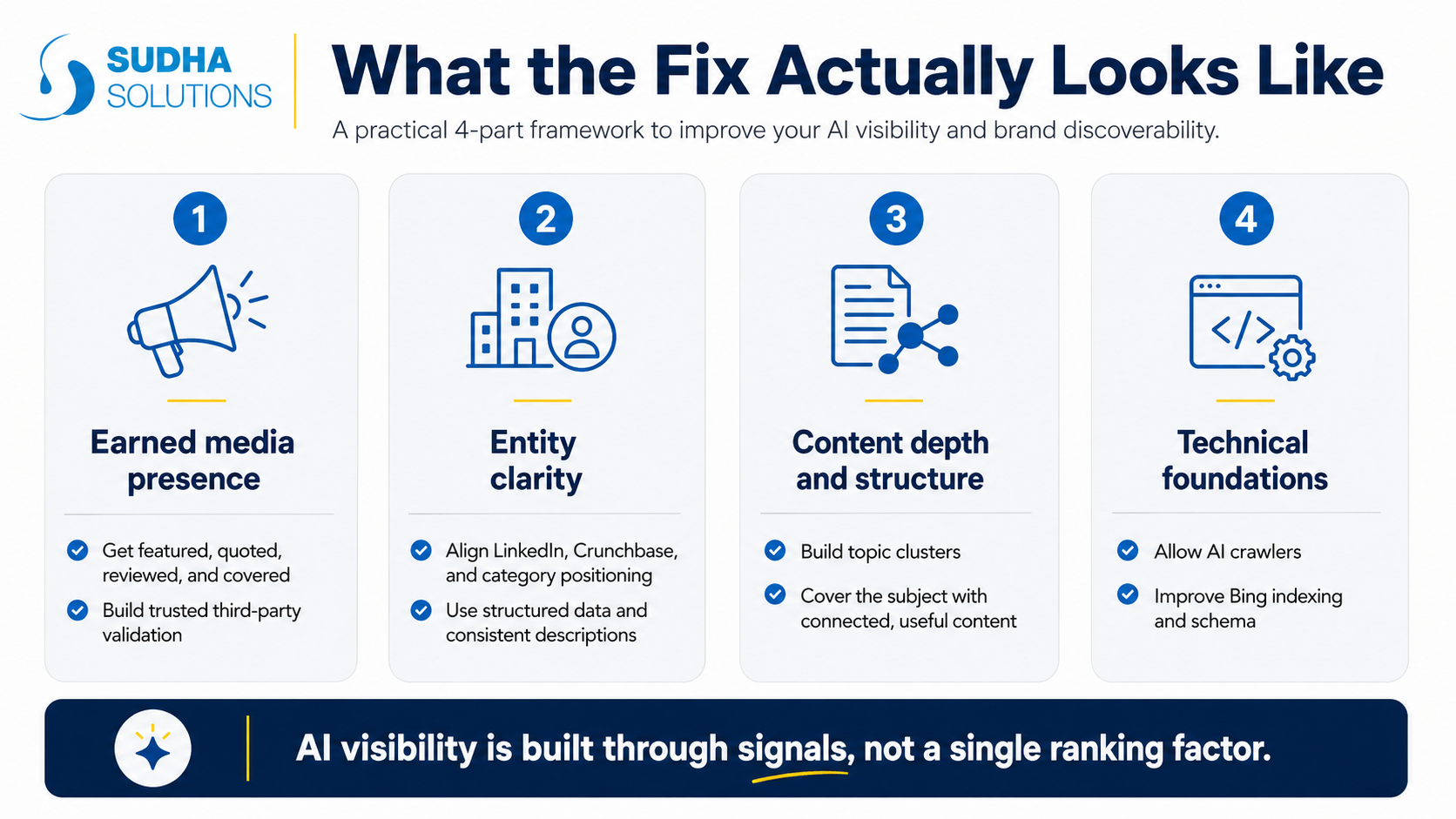
The fix works across four areas. 

Earned media presence. Getting featured, quoted, reviewed, and covered in third-party publications that AI systems trust. Industry trade publications, niche media, analyst coverage – these create the external validation that AI systems use to assess credibility. This isn’t traditional PR for the sake of brand awareness. It’s citation infrastructure. 

Entity clarity. Making the brand’s identity legible and consistent across the web. This means Wikipedia or Wikidata presence where applicable, complete profiles on Crunchbase and LinkedIn, consistent category positioning across every platform, and structured data on the brand’s own site that clearly communicates what the company is and does. 

Content depth and structure. Building a body of content that demonstrates genuine topical authority – not a handful of broad posts, but a connected cluster of content that covers a subject comprehensively. The pillar-cluster content model described in the ‘How to Get Your Brand Cited by ChatGPT’ blog in this series is directly relevant here. AI systems evaluate brands based on the depth and consistency of their published knowledge, not just individual pages. Businesses exploring how large language models affect SEO are increasingly investing in entity-driven content strategies. 

Technical foundations. Fixing the access problems that prevent AI crawlers from reading the site at all. Strong SEO expert services for AI search visibility help businesses improve Bing indexing, schema implementation, and AI crawler accessibility. Verifying on Bing Webmaster Tools, allowing GPTBot and OAI-SearchBot, implementing Article, Author, and FAQ schema, and ensuring content is served as static HTML rather than relying on JavaScript rendering. 

None of these are quick wins. But the first and third items on this list can show measurable progress within weeks, while the longer-term work on entity and earned media builds the durable advantage. 

One More Shift Worth Understanding 

The audience for this problem is broader than most B2B marketers currently realise. AI search isn’t just a marketing concern – it’s a sales pipeline concern. 

Buyers referred from AI search tools spend up to 3x more time on-page than visitors from traditional search, according to Forrester research reported by Digital Commerce 360. And 80% of ChatGPT users use the tool for work-related queries – high-intent, business decision-making searches, not casual browsing. 

The buyer asking ChatGPT about solutions in a category is not a curious researcher. They’re likely actively evaluating options and shortlisting vendors. Being in that answer, or not being in it, isn’t a branding question. It’s a revenue question. 

The next article in this series, ChatGPT vs Google: Where Should Your Business Focus in 2026?, tackles the strategic question of how to allocate between the two channels because the answer is more nuanced than most people expect. 

This article is part of Sudha Solutions’ ChatGPT Optimization series. Read the full series: 

Sudha Solutions helps businesses build visibility in AI search through content strategy, GEO, and digital marketing. Based in India, working with brands globally. 


Frequently Asked Questions

Why do B2B brands fail to appear in ChatGPT answers?

B2B brands often fail to appear in ChatGPT answers because AI systems prioritize entity authority, third-party validation, structured content, and AI crawlability over traditional keyword rankings.

What is AI search optimization for B2B companies?

AI search optimization helps B2B companies improve visibility across AI platforms like ChatGPT, Gemini, Claude, and Google AI Overviews through structured content and entity authority.

How does GEO differ from traditional SEO?

GEO focuses on optimizing brands for AI-generated answers and citations, while traditional SEO primarily focuses on ranking webpages in search engine result pages.

Why is earned media important for AI visibility?

AI systems rely heavily on trusted third-party mentions and authoritative publications to determine which brands deserve citation visibility.

How can companies improve AI search discoverability?

Businesses can improve AI discoverability through GEO optimization, AI-focused technical SEO, structured content, entity building, and off-site authority signals.