





Not long ago, the goal of every digital marketer was simple: rank on page one of Google. Today, brands investing in SEO services, strategic content marketing, and advanced AEO services must now optimize not just for rankings, but for AI-driven visibility. Millions of people are skipping the search results page entirely and asking AI assistants like ChatGPT, Perplexity, Gemini, Copilot for direct answers. And those AI assistants don’t just list links. They name brands. They recommend products. They cite sources.
So, the question every marketer should be asking in 2026 is: How do AI assistants decide which brands to mention, and how do you make sure yours is one of them?
This guide breaks it all down. How AI generates answers, what signals influence which sources get cited, and the exact strategies you need to build visibility in the age of AI search.
What Is AEO & Why Does It Matter in 2026?
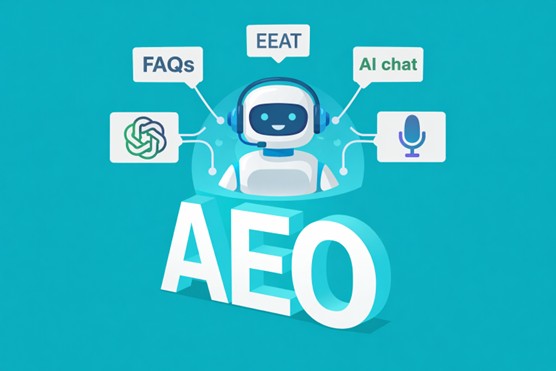
For businesses adopting AEO services in Mumbai, this means structuring content for AI citations while building on strong SEO and authority foundations.
The scale of this shift is hard to overstate.
ChatGPT alone now has 883 million monthly users and processes 2 billion queries every day.
Google’s AI Overviews reach 2 billion monthly users across 200 countries.
Gartner predicted that by 2026, traditional search engine volume would drop 25% as users turn to generative AI; and the data suggests that trajectory is very much on course.
If your brand isn’t showing up in AI answers, you’re already invisible to a rapidly growing segment of your audience.
How AI Assistants Generate Answers
Training Data vs Real-Time Retrieval
When you ask an AI assistant a question, the answer doesn’t come from a single source. It comes from multiple places or a combination of all.
The first is parametric knowledge: Everything the model learned during training. This is static information baked into the model at the time it was built. Brands and entities mentioned frequently across authoritative sources during training develop stronger “neural associations,” making them more likely to be recalled automatically.
The second is real-time retrieval, also known as RAG (Retrieval-Augmented Generation). When a query requires up-to-date or specific information, AI systems fetch content from the live web and use it to construct an answer. An Ahrefs research shows that 88% of the URLs that end up cited by ChatGPT are pulled directly from that search.
Role of Large Language Models (LLMs)
Large Language Models like GPT-4, Gemini, and Claude are the engines powering these AI assistants. They don’t retrieve and rank pages the way Google does. Instead, they synthesise information from multiple sources and generate a new, coherent response, citing the sources they found most useful.
This means visibility in AI search is not about a position on a results page. It’s about being the source the model trusts enough to reference. And that trust is built very differently from traditional SEO.
How AI Actually Decides Which Sources to Cite
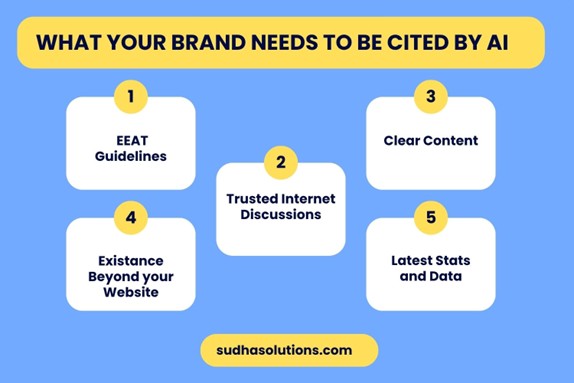
Most people think AI citations work like Google rankings. They don’t.
AI systems are not “ranking pages” — they are building answers. And while doing that, they look for sources that feel trustworthy, useful, and easy to extract from.
Let’s break this down in a way that actually helps you act on it.
1. Trust Matters More Than Traffic (E-E-A-T in Action)
AI doesn’t just pick the most popular page. It looks for signals that answer:
- Does this content come from someone who knows the topic?
- Is it based on real experience or just generic writing?
- Can this be trusted without double-checking?
This is where E-E-A-T (Experience, Expertise, Authority, Trust) comes in.
What this looks like in reality:
- A fintech blog written by a CA or financial analyst
- A healthcare article authored by a doctor or practitioner
- A SaaS comparison written by someone who has actually used the tools
For example, if someone asks:
“What is the best way to send money abroad from India?”
AI is more likely to cite:
- A guide written by someone who explains real transfer scenarios, fees, and timelines
Instead of:
- A generic blog repeating definitions like “international remittance is…”
100% of content that earns consistent AI citations demonstrates clear E-E-A-T signals, including visible author credentials and transparent sourcing.
2. AI Trusts What the Internet Agrees On (Not Just What You Say)
Earlier, your website could build authority on its own. Now, your credibility is distributed across the web.
AI looks for patterns like:
- Is this brand discussed on Reddit?
- Are people recommending it on Quora?
- Does it appear in comparisons or discussions?
Example:
If multiple Reddit threads say:
- “Tool X is best for freelancers”
- “Tool X has lower fees than competitors”
Even if your website doesn’t rank #1 AI may still say: “Tool X is commonly recommended for freelancers…”
That insight didn’t come from your website. It came from conversations.
3. Content That Answers Clearly Gets Picked Faster
AI is not reading your entire blog like a human. It scans and extracts.
So naturally, it prefers content that is:
- Direct
- Structured
- Easy to summarise
What works best:
- Clear headings that match questions
- Direct answers in the first few lines
- Bullet points and comparisons
Example:
Weak content: “International money transfers have evolved over the years…”
Strong content: “The cheapest way to send money abroad is through fintech platforms like X because they offer lower FX margins and faster processing.”
Insight: If AI can copy your answer in one clean snippet, you win.
4. AI Prefers Brands That Exist Beyond Their Own Website
One of the biggest shifts in SEO right now:
Your brand is no longer defined by your website.
It is defined by:
- Where it appears
- How often it is mentioned
- What people say about it
Example:
Two brands:
- Brand A: Great website, no external mentions
- Brand B: Mentioned in blogs, Reddit, Quora, comparisons
AI is more likely to cite Brand B. Why? Because it sees independent validation.
5. Freshness Signals That You’re Still Relevant
AI systems don’t want outdated answers. They prioritise content that feels:
- Updated
- Active
- Relevant to current context
Example:
If you write about: “Best study abroad options”
And your content still talks about policies from 2022, AI may ignore it completely.
But if you:
- Update visa rules
- Add current fees
- Reflect recent trends
Your chances of being cited increase significantly.
Insight: AI prefers living content, not static blogs.
How AI Chooses Between Brands (Real Decision Logic)
Here’s how AI actually thinks when generating answers:
Step 1: Find all relevant information
Step 2: Check which sources appear repeatedly
Step 3: Validate with trusted formats (forums, structured content, expert blogs)
Step 4: Build one combined answer
Example in action:
Query: “Best tools for email marketing for small businesses”
AI might combine:
- A blog explaining features
- A Reddit thread comparing tools
- A Quora answer listing pros and cons
And then say: “Tools like Mailchimp, Brevo, and ConvertKit are commonly recommended…”
That recommendation is not coming from one source. It is coming from consensus across sources.
AI Search vs Google Search
Traditional SEO services in Mumbai still build discoverability, but AI search now requires deeper content marketing strategies that improve trust, extractability, and brand mentions across the web.
|
Traditional SEO |
AI SEO |
| Rank on page 1 | Get mentioned in answers |
| Focus on keywords | Focus on context |
| Backlinks matter most | Mentions + trust matter more |
| User clicks links | User reads answers |
What this means for you:
You are no longer competing for rankings. You are competing to be part of the answer.
So What Should You Actually Do?
This is where integrated SEO services in Mumbai, authority-led content marketing, and structured AEO services in Mumbai become essential for brands competing in AI search.
- Build Authority, not Just Content
Write like an expert, not a content writer.
- Be Present where Conversations Happen
Reddit, Quora, forums, communities.
- Answer Real Questions
Think:
- “Is X worth it?”
- “X vs Y”
- “Best option for…”
- Make your Content Extractable
Clear structure = higher chances of being picked.
- Stay Updated
If your content feels outdated, AI ignores it.
Final Thoughts
AI does not “rank” your brand. It decides whether to trust and include you.
And that decision is based on:
- What you say
- What others say about you
- How clearly you say it
If your brand is part of meaningful conversations across the internet,
you are already closer to being cited.
Frequently Asked Questions
How do AI assistants decide which brands to recommend?
AI assistants analyse patterns across multiple sources, including blogs, forums, and expert content. They prioritise brands that appear consistently across trusted and relevant discussions.
Can small brands get mentioned in AI-generated answers?
Yes, smaller brands can be cited if they provide high-quality, experience-driven content and appear in relevant discussions across platforms like blogs, forums, and communities.
What role does content format play in AI citations?
Content that is easy to scan, clearly structured, and directly answers questions is more likely to be picked by AI systems for citations.
How important is brand consistency across platforms for AI visibility?
Very important. Consistent messaging and mentions across websites, forums, and third-party platforms help AI systems recognise and trust your brand.
Is ranking on Google still important for AI visibility?
While rankings help with discoverability, AI visibility depends more on trust, relevance, and how widely your content is referenced across the web.