
In 2026 we know that the way we search is not the same. It is evolving and evolving fast. Only ~8% of users click traditional links when AI summaries are shown
But here’s something even more interesting:
This shift is not affecting every industry in the same way.
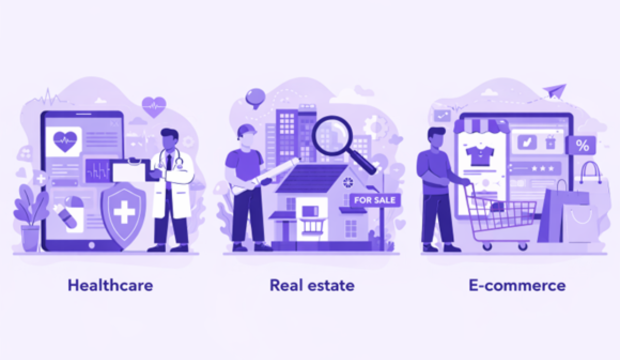
- In healthcare, users are looking for immediate, trustworthy answers.
- In real estate, they are evaluating long-term, high-value decisions.
- In e-commerce, they are comparing options before buying.
And AI is reshaping all three differently.
We are no longer competing for rankings. We are competing to be selected as the answer.
This is where AEO (Answer Engine Optimization) becomes critical.
Many brands are now working with specialised partners offering AI visibility and AEO solutions to adapt to this shift
But treating AEO as a single strategy across industries is where most brands get it wrong.
Because the way people search, trust, and decide in healthcare is fundamentally different from real estate. And what works in e-commerce often fails in both.
Why AEO Looks Different Across Industries: Healthcare vs. Real Estate vs. E-commerce
At a surface level, AEO sounds simple. Structure your content in a way that it is easy for AI to read and extract it. This is exactly what structured AEO strategies aim to achieve across industries.
But in reality, three forces shape everything:
| Factor | Healthcare | Real Estate | E-commerce |
| Intent | Urgent, emotional | Research-heavy | Comparison-driven |
| Risk | High (health impact) | Very high (financial) | Medium |
| Trust Dependency | Critical | High | Moderate |
AEO is not about formatting content. It is about aligning with how decisions are made in your category.
Let’s break each of these sectors:
AEO in Healthcare: When Answers Need Authority
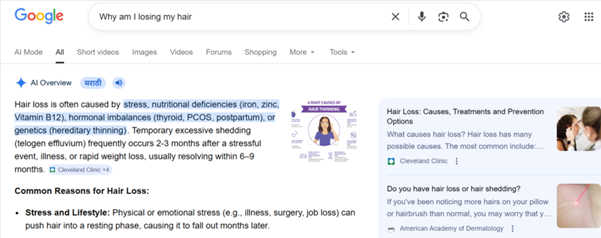
AI answered 66% of COVID-related queries in 2025 vs just 1% in 2024, meaning the influence of AI is increase in the healthcare sector.
How Users Search to Get Information in Healthcare
Healthcare queries are rarely casual.
They are urgent, personal, and often anxiety-driven:
- “Is chest pain serious?”
- “Why am I losing hair suddenly?”
- “Best dermatologist near me”
These are not content opportunities. They are moments of vulnerability.
How AI is Changing Healthcare Discovery
AI is now capable of:
- Summarising symptoms
- Suggesting possible causes
- Recommending next steps
This reduces the need to browse multiple websites.
But it introduces a new filter:
Only content that is credible enough gets surfaced.
Google’s own search quality framework classifies healthcare under “Your Money or Your Life” (YMYL) where accuracy and trust directly impact rankings.
SEO expert Lily Ray, known for her work on Google’s quality updates, has consistently emphasised: “Google is getting better at identifying true expertise, especially in sensitive industries.”
What This Means for Healthcare Brands
Three shifts are already visible:
- Traffic may decrease, but intent becomes sharper
- Authority matters more than keyword coverage
- Visibility is earned through trust, not volume
What Healthcare Brands Must Do for AEO
To be selected as an answer:
- Create dedicated condition and symptom pages
- Structure answers clearly (definitions, causes, treatments)
- Strengthen EEAT signals (credentials, sources, transparency)
- Build expert-backed content (doctor-reviewed, validated)
Brands often rely on expert-led SEO and AEO services to build credibility and trust signals at scale.

In healthcare, AEO is not about ranking higher. It is about being trusted enough to be cited.
To understand how this works in detail, read our guide on why businesses are becoming invisible to ChatGPT without AEO.
Where Most Healthcare Brands Are Falling Behind
Many health platforms still rely on:
- Generic symptom blogs
- Surface-level explanations
- Poor content structuring
These worked when users explored. Now users expect answers.
AEO in Real Estate: From Discovery to Decision in One Search
How Users Search in Real Estate
Real estate is not a quick decision.
Users search with layered intent:
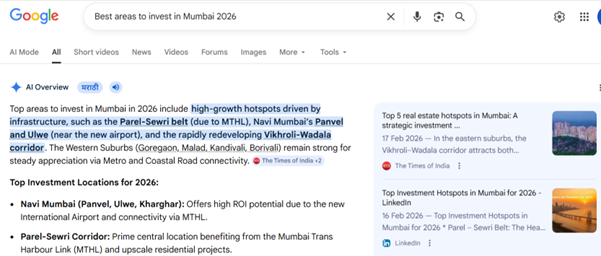
- “Best areas to invest in Mumbai 2026”
- “2 BHK price in Thane”
- “Is it a good time to buy property in Pune?”
Each query represents a step in a long evaluation journey.
How AI is Changing Property Research
AI compresses that journey.
Instead of reading multiple blogs, this is what you can get in seconds:
- Area comparisons
- Price insights
- Investment summaries
Rand Fishkin, co-founder of SparkToro, has repeatedly pointed out that:
“Google is increasingly keeping users within its own ecosystem.”
And AI-driven answers promotes this behaviour.
What This Means for Real Estate Brands
The funnel is shifting:
- Top-of-funnel traffic declines (fewer exploratory clicks)
- Mid-funnel intent strengthens (users arrive more informed)
- Decision-stage content becomes the differentiator
What Real Estate Brands Must Do for AEO
To stay visible:
- Build hyperlocal content (area-specific pages)
- Create investment-focused guides
- Structure insights in a way AI can extract
Add price comparisons and trend data

In real estate, the brand that explains the decision becomes the brand that gets the lead.
This is where structured content and SEO strategies play a critical role in influencing buyer decisions.
Where Most Real Estate Brands Are Falling Behind
- Over-dependence on listings
- Limited advisory content
- Weak data structuring
They are optimized for discovery, but users want help with decisions.
AEO in E-commerce: When AI Becomes the New Storefront
How Users Search in E-commerce
E-commerce queries are direct and intent-heavy:
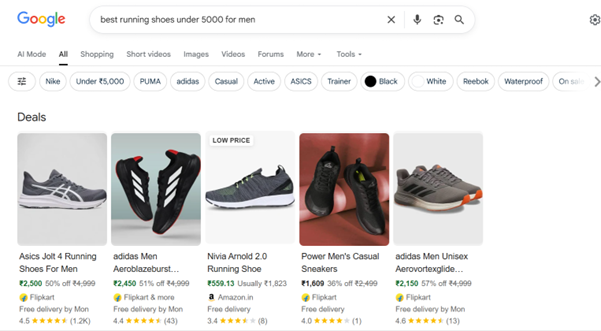
- “Best running shoes under 5000”
- “Which iPhone should I buy”
- “Best skincare for oily skin”
These are not browsing queries. They are purchase decisions in motion.
How AI is Changing Product Discovery
AI is becoming the first touchpoint:
- Recommending products
- Comparing features
- Highlighting pros and cons
Users no longer need to explore category pages.
What This Means for E-commerce Brands
Three clear shifts:
- Discovery happens outside your platform
- Content influences decisions more than listings
- Brand visibility becomes indirect (via AI recommendations)
Zero-click behaviour reinforces this shift, where a majority of users get answers without visiting websites .
What E-commerce Brands Must Do for AEO
To remain visible:
- Create buying guides (problem-solving content)
- Build comparison-driven pages
- Structure product data clearly
- Answer “best”, “vs”, and “which should I buy” queries
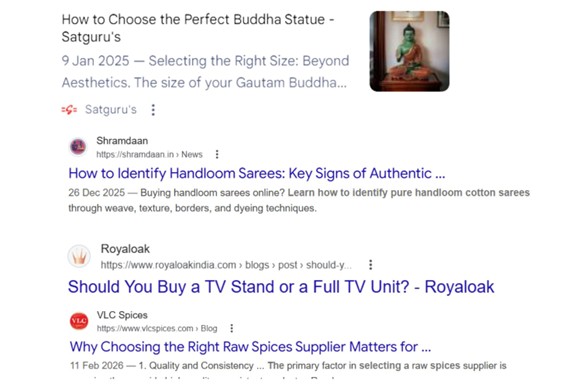
In e-commerce, AEO rewards brands that guide decisions, not just display products. E-commerce brands are increasingly investing in conversion-focused SEO and AEO solutions to stay visible across AI platforms
Where Most E-commerce Brands Are Falling Behind
Many D2C brands:
- Focus only on product pages
- Ignore content-led discovery
- Do not structure data for AI extraction
Tis only leads to ranking, and ranking does not always translate to AI recommendations.
Also Read: What Is AEO? Why Your Business Is Invisible to ChatGPT in 2026
What 2026 is Teaching Us About AEO
Across industries, a pattern is emerging:
- Generic content is losing visibility
- Structured, answer-ready content is winning
- Authority signals are becoming ranking signals
- Traffic is no longer the only KPI
The shift is from ranking pages to being selected as answers.
This is the framework we follow when working with brands:
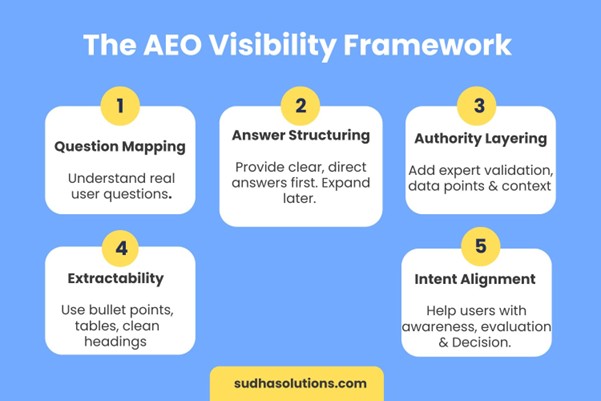
Why AEO Needs a Strategic Approach
This is where most brands get it wrong.
They treat AEO like:
- SEO 2.0
- A content formatting exercise
It is neither.
AEO requires:
- Search intent mapping
- Content architecture
- AI visibility planning
- Continuous optimisation
Brands that treat AEO as a checklist will struggle. Those that treat it as a strategy will lead.
Conclusion: The Future Belongs to Answer-Ready Brands
Search is not disappearing.
It is evolving.
Users are no longer browsing links. They are deciding.
And AI is deciding what they see.
The brand that gets cited is the brand that has the highest probability of being chosen.
So, the real question is no longer:
“Are you ranking?” It is: Are you being selected?
If your organisation is part of healthcare, real estate, or e-commerce sector and you need to improve your visibility, you can contact us at Sudha Solutions. We have worked with clients in all these 3 sectors improving both their google ranking and AI visibility. Visit Sudha Solutions to learn more about our services.
FAQs
What is AEO in digital marketing?
Answer Engine Optimization (AEO) is the process of optimizing content to appear in AI-generated answers, voice search results, and featured snippets rather than just traditional search rankings.
How does AEO work for healthcare websites?
AEO for healthcare relies heavily on high-authority, fact-checked content that aligns with EEAT principles, ensuring accurate answers for sensitive queries.
How can real estate businesses optimize for AI search?
Real estate businesses can optimize for AI search by creating hyper-local, intent-driven content that answers specific buyer and investor queries.
What AEO strategies work best for ecommerce stores?
Ecommerce AEO works best with product-focused FAQs, comparison content, and clear answers to purchase-related queries like pricing, features, and reviews.
Why is AEO important in 2026?
AEO is crucial in 2026 because users increasingly rely on AI tools like ChatGPT and voice assistants for direct answers instead of browsing multiple links. Brands that optimize for AI visibility gain higher trust, visibility, and conversion opportunities.