Tracking your brand used to be simple. You’d open Google Search Console, skim through keyword reports, maybe set up a few alerts, and feel reasonably confident you knew where and how your brand was being talked about.
That confidence doesn’t hold up anymore.
In 2026, brand mention monitoring is no longer just a tracking activity, it’s a critical layer of brand mentions SEO visibility across both search engines and AI platforms.
These mentions don’t show up in Search Console. They don’t trigger traditional alerts. And more often than not, they leave no obvious trail.
The result? A massive blind spot.
Your brand could be recommended, summarized, compared, or even misrepresented across AI systems, and you’d have no clear way to see it, measure it, or respond to it. For marketers and SEO professionals, this is not just a visibility problem but a control problem.
So how do you monitor something that isn’t directly visible?
This guide breaks it down. We’ll explore the tools that are adapting to this shift, the strategies for brand mention monitoring, and the SEO benefits of getting this right early, before your competitors do.
Key Takeaways: Things You’ll Learn About in this Article
- Brand mentions are now a core ranking and AI visibility signal, not just a PR metric.
- Unlinked mentions are high-conversion link building opportunities.
- AI systems rely on web-wide brand presence, not just your website.
- The TRACK framework turns monitoring into a repeatable growth system.
- Brands that monitor and respond faster build compounding visibility across SEO and AI.
What Are Brand Mentions, and Why Do They Matter in 2026?
Today, brand mentions SEO has evolved beyond backlinks, becoming a core signal for how search engines and AI systems evaluate authority.
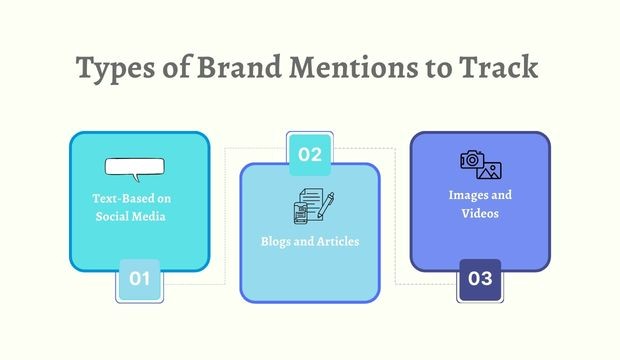
A brand mention is any online reference to your brand (your company name, product, services, founder, or domain), regardless of whether or not it includes a hyperlink back to your site.
That mention in a Quora thread? A brand mention. The Forbes article that referenced you without linking? A brand mention. A YouTube review where someone talks about your work? Yes. A brand mention.
However, brand mentions come in two forms that your strategy should treat very differently:
- Linked mentions: references with an active backlink. These pass direct SEO authority and referral traffic.
- Unlinked mentions: references without a hyperlink. These don’t pass link equity directly, but they’re far from worthless. They build brand recognition, strengthen entity authority, and critically, they’re reclaiming opportunities. Every unlinked mention is a backlink you simply haven’t claimed yet.
Here’s what makes 2026 a turning point: AI search engines are now trained on and influenced by brand mentions across the web.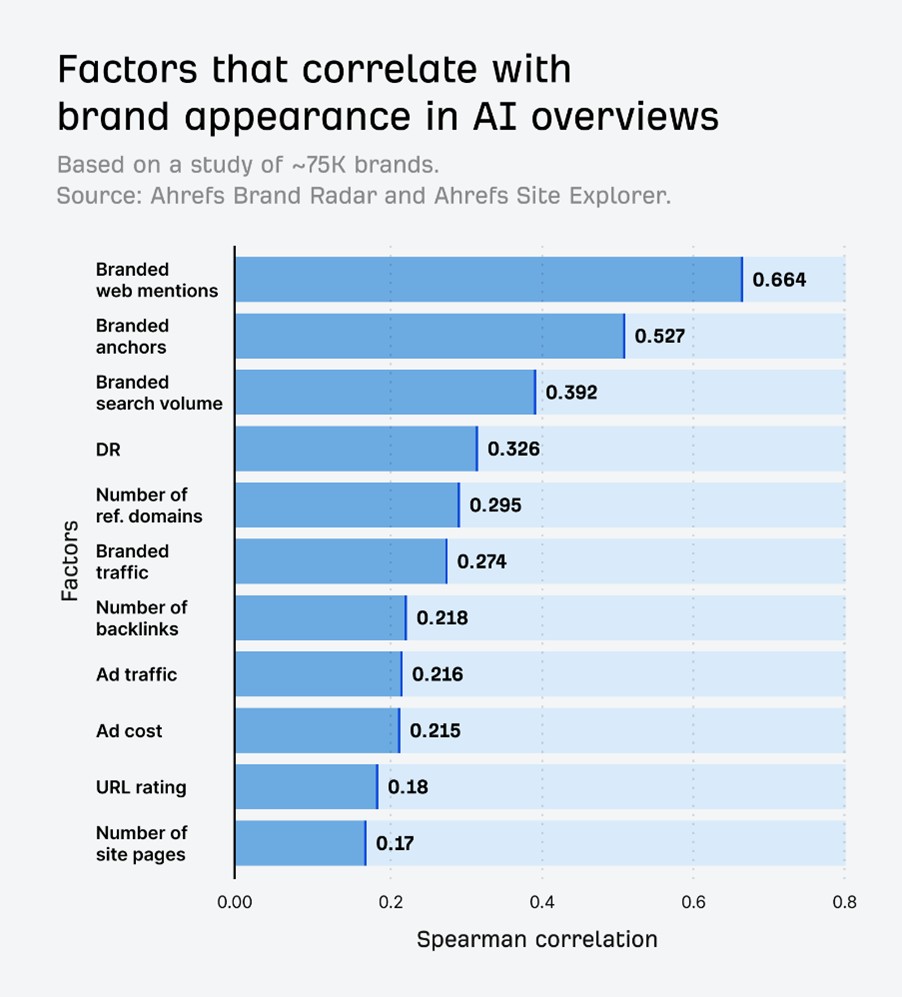
According to a study by Ahrefs analysing 75,000 brands, branded web mentions show the strongest correlation (0.664) with brand visibility in Google AI Overviews, significantly stronger than backlinks (0.218). The top three correlating factors were all brand signals: web mentions, branded anchors, and branded search volume.
In simpler words, brands that are mentioned more across the web are far more likely to be recommended by AI. Brand mention tracking is no longer a PR nice-to-have. It’s an AI visibility signal you don’t want to miss out on.
While working with brands across e-commerce, D2C, fintech, and B2B at Sudha Solutions, we’ve seen unmonitored mentions quietly erode brand equity and actively monitored ones compound into rankings, citations, and revenue.
Do Brand Mentions Actually Help SEO?
Short answer: yes, and this is where brand mentions SEO plays a significant role in improving rankings, entity authority, and brand mentions SEO visibility across search and AI ecosystems.
1. Co-citation as a ranking signal
Google’s entity recognition systems read billions of web pages and identify brand names, then associate them with topics, categories, and sentiment. Google’s 2014 patent on “implied links” explicitly defines unlinked mentions as ranking factors and the algorithm has only gotten more sophisticated since.
According to SearchAtlas, campaigns integrating brand mention monitoring and entity prominence optimisation increased keyword rankings by an average of 18% compared to link-only strategies.
2. The E-E-A-T multiplier
When authoritative industry publications, review platforms, and community forums mention your brand in relevant contexts, it reinforces your Experience, Expertise, Authoritativeness, and Trustworthiness profile. This is especially critical in competitive or YMYL-adjacent categories.
In Moz’s 2023 Search Ranking Factors study, sites with over 70% positive sentiment mentions received 15% higher average rankings than competitors with similar mention counts but lower sentiment.
3. The AI Visibility Connection
This is where brand mentions SEO visibility becomes critical. AI systems rely heavily on how frequently and where your brand is mentioned across the web.
Ahrefs has already proven that brands earning the most web mentions earn up to 10x more mentions in Google AI Overviews compared to the next closest quartile. Separately, domains with profiles on Trustpilot, G2, Capterra, and Yelp have 3x higher chances of being chosen by ChatGPT as a source compared to sites without such presence (SE Ranking, 2025).
This is where brand mention monitoring feeds directly into our AEO strategy at Sudha Solutions. The mentions you earn today are shaping the AI citations you’ll receive tomorrow.
What Happens When You Don’t Track Brand Mentions?
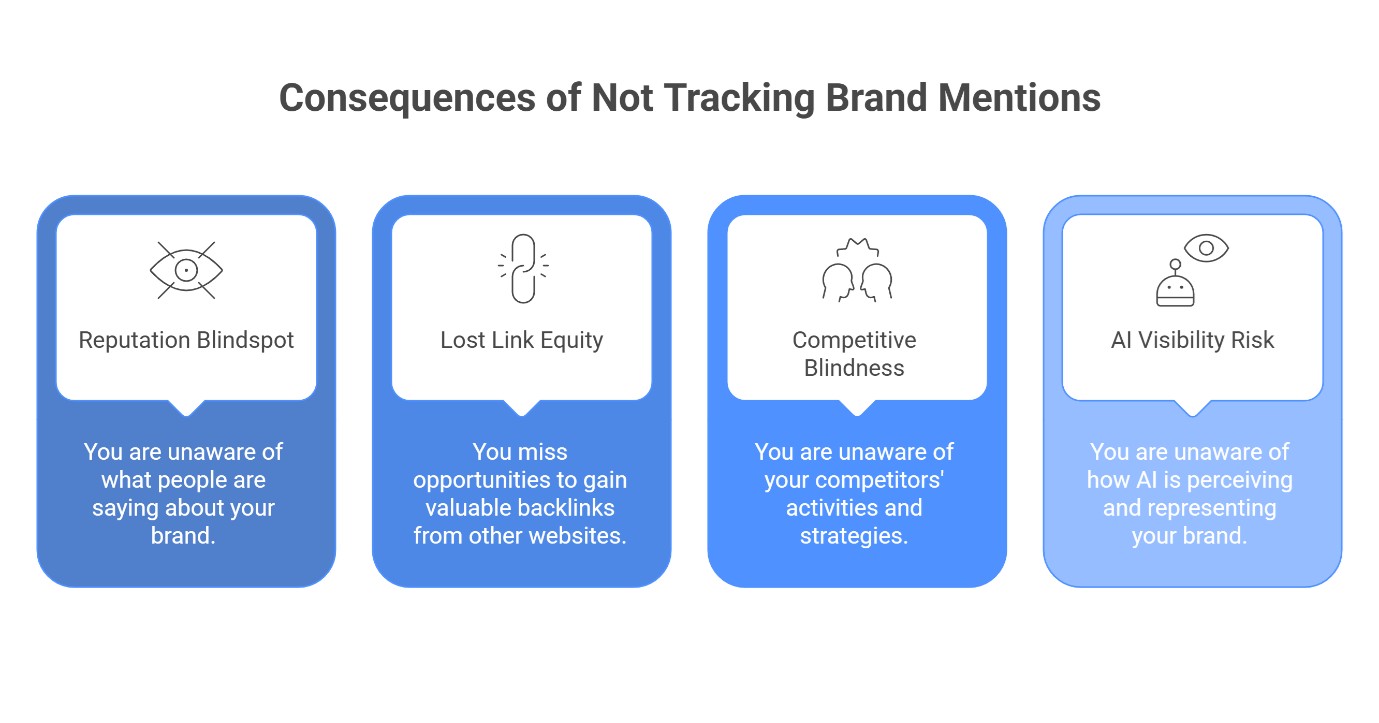
A structured approach to brand mention monitoring ensures you’re not just tracking mentions, but actively improving your visibility and authority.
Before the system, there’s the cost. Because most brands only start paying attention after something goes wrong.
- Reputation blindspot. Negative mentions spread faster than positive ones. A critical Reddit thread, an ignored 2-star review on G2, a misleading comparison article can gain traction long before it reaches your radar. By the time you respond, the narrative is already set.
- Lost link equity. Every unlinked mention is a missed backlink. If your brand earns consistent press, blog coverage, or community recommendations, you’re leaving significant domain authority on the table every month you don’t run a reclamation campaign.
- Competitive blindness. Your competitors appear in conversations and comparison articles you’re not even aware of. Customers are choosing between you and them; in threads you can’t see, on platforms you don’t monitor.
- The AI visibility risk. If AI systems are describing your brand using outdated content, negative sentiment, or competitor framing, you won’t know. Because it doesn’t show up in any standard analytics tool. You can’t fix what you can’t see.
And what’s even more critical? Domains with millions of brand mentions on Quora and Reddit have roughly 4x higher chances of being cited by AI than those with minimal activity. The brands not monitoring are the ones being defined by others.
| As Ryan Law, Director of Content Marketing at Ahrefs, put it:
“A big part of how LLMs understand what your brand is about and when it should recommend it is based on where you appear in its training data and where you appear on the web.” |
Brand mention monitoring is no longer optional infrastructure in 2026. It’s the earliest warning system your brand has.
How to Monitor Brand Mentions: The Proprietary TRACK Framework we Follow
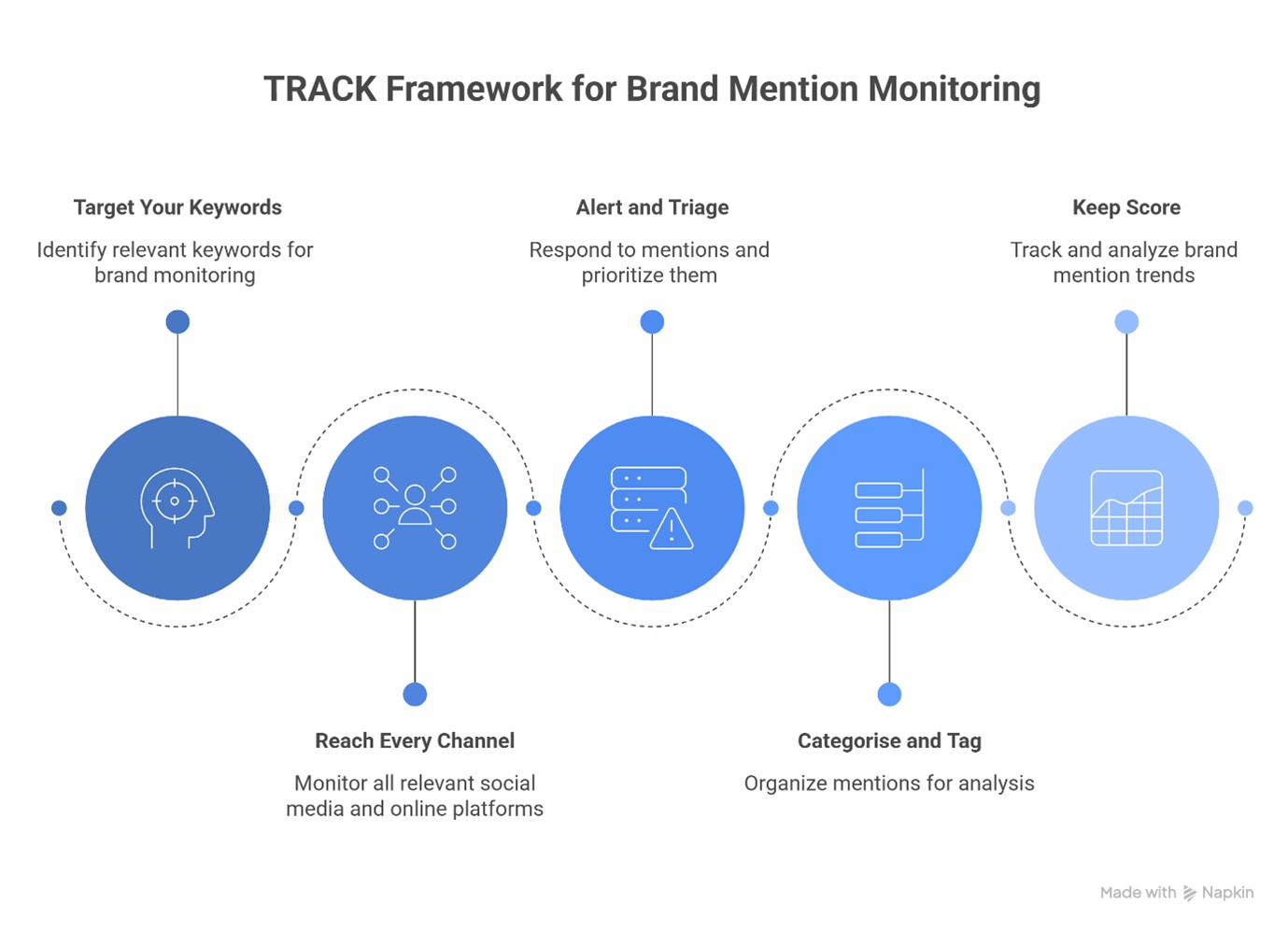
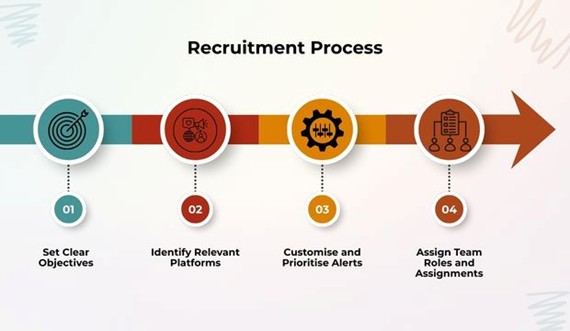
Before picking a tool, you need a process, otherwise you’ll drown in noise and never convert data into action. We built the TRACK Framework to turn brand mention monitoring from a passive alert system into an active growth engine.
Here’s how each step works:
T: Target Your Keywords
Define what you’re actually tracking. This goes beyond your exact brand name.
Include:
- Brand name variations and misspellings
- Product and service names
- Founder and key team members
- Branded hashtags and slogans
- Competitor names (for comparison and gaps)
If you keep this too narrow, you miss how people actually talk about your brand.
R: Reach Every Channel
Social media monitoring is just one layer. You need coverage across:
- Web and news publications
- Blogs and niche sites
- Review platforms (Google, Trustpilot, G2)
- Forums and communities (Reddit, Quora)
- Podcasts and video transcripts
- AI-generated outputs (what tools like ChatGPT or Perplexity say about you)
Most brands stop at social. The highest-value mentions live elsewhere.
A: Alert and Triage
Set real-time alerts for high-stakes keywords (brand name, key products) and daily digests for broader monitoring. Not every mention demands a response.
So, filter by: is it linked or unlinked? Is the source high or low authority? Is action required now, or should it be logged for the monthly report?
C: Categorise and Tag
Label every mention: positive, neutral, or negative; linked or unlinked; action-required or observe-only. This tagging is what transforms a pile of alerts into a structured information your SEO and content teams can actually use.
K: Keep Score
Monthly reporting disciplines are what separate brands that monitor from brands that improve. Measure consistently:
- Mention volume (month-over-month trends)
- Sentiment shifts
- Links reclaimed
- AI visibility snapshots (how LLMs currently describe your brand)
This is where monitoring becomes strategy.
Related read: Effective Strategies for Tracking Brand Mentions
Best Tools to Monitor Brand Mentions SEO 2026
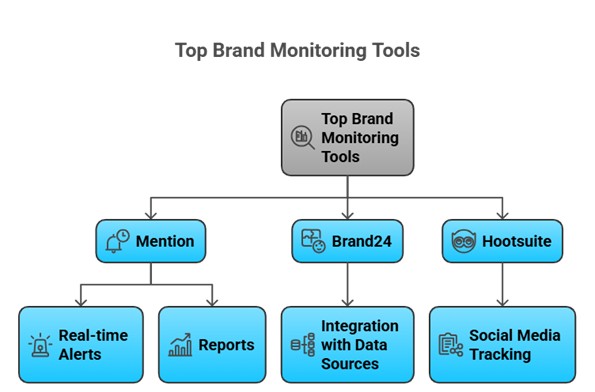
These tools are essential for scaling brand mention monitoring and enabling brands to operationalise brand mentions SEO strategies effectively. Here’s the list of tools you can use to track brand mentions online in 2026:
| Tool | Best For | Tracks Unlinked Mentions | AI Mentions | Price |
| Google Alerts | Basics / Free | No | No | Free |
| Brand24 | SMB all-in-one | Yes | Partial | From $79/mo |
| Semrush Brand Monitoring | SEO + link reclamation | Yes | Limited | From $139/mo |
| Ahrefs Content Explorer / Ahrefs Brand Radar | Backlink reclamation | Yes | Yes | From $129/mo |
| Mention.com | Social + web | Partial | No | From $49/mo |
| Brandwatch | Enterprise sentiment | Yes | Emerging | Custom |
| Peec AI | AI-specific visibility | N/A | Yes | Custom |
| Profound | AI mention depth + competitive | N/A | Yes | Custom |
For tracking how ChatGPT, Gemini, and Perplexity describe and recommend your brand tools like Profound and Peec AI are now purpose-built for this layer.
Note: A traditional social listening tool that adds a “ChatGPT mentions tab” is not the same thing.
How to Turn Unlinked Mentions into Backlinks?
An unlinked mention is a backlink that hasn’t been claimed yet. The site already trusts your brand enough to reference it; they just didn’t link. That’s the opportunity.
Outreach Strategy
Start by exporting unlinked mentions from Ahrefs Content Explorer (search “Your Brand Name” – site:yourdomain.com) or Semrush Brand Monitoring.
Filter by Domain Rating 40+ and sort by most recent. Prioritise mentions that are:
- Topically relevant (same industry or audience)
- Published within the last 30–60 days
- From sites with real editorial standards
Find the author or editor via their author bio, LinkedIn, or Hunter.io. Approach as a contributor adding value, not as someone asking for a favour.
Outreach success rates improve significantly within 2-3 days of publication while the article is still “fresh.” Approach with an Email template like this:
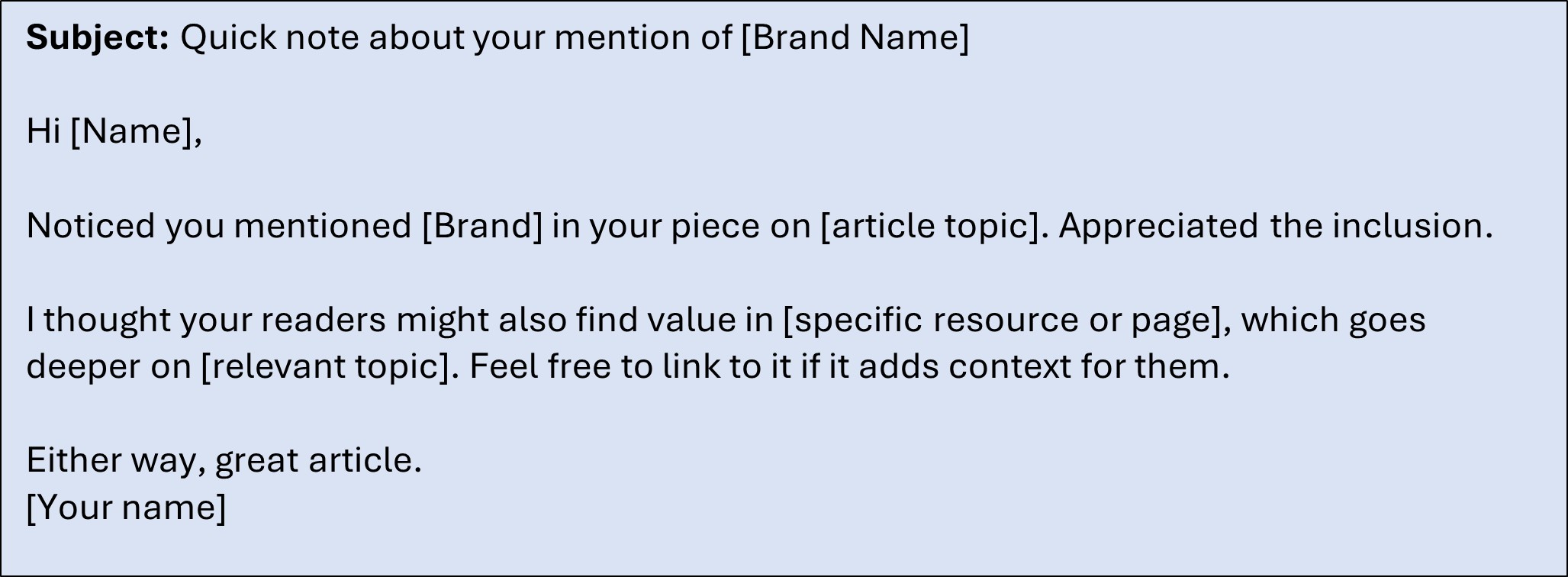 No ask. No urgency. No “I noticed you forgot the link.” Always, lead with value, let the request be implicit. You’ll be surprised how often a simple email converts.
Link Building Benefits
This matters for 3 compounding reasons:
- First, these are genuine editorial backlinks earned on merit, not exchanged or purchased, which carry significantly more ranking weight with Google.
- Second, they often come from high-authority, topically relevant domains, which are exactly the kind of sources AI models cite.
- Third, distributing content to a wide range of publications can increase AI citations by up to 325% compared to only publishing on your own site.
Every reclaimed link is a signal multiplier across both traditional and AI search.
The Most Common Brand Mention Monitoring Mistakes to Avoid
- Ignoring Negative Mentions
Negative mentions don’t fade; they accumulate.
A single Reddit thread or low-rated review can persist as a signal, influencing how AI systems interpret and describe your brand over time.
What works:
- Triage within 24 hours
- Respond publicly where possible
- Build a steady flow of positive, authoritative mentions
You can’t usually remove negative content. You can dilute its impact.
- Not Responding Quickly
Speed is everything in reputation management. A mention that goes unaddressed for a week is a missed opportunity: to turn a neutral writer into a brand advocate, to correct a factual error before it spreads, to engage a potential partner who mentioned you without realising you were listening.
Your benchmarks?
- Negative mentions → same-day response
- Positive mentions → within 48 hours
The brands that respond fastest are the ones that build the most organic mention velocity over time.
- Tracking Only Social Media
This is the most common and expensive mistake. Social media brand monitoring captures the loudest layer, yes, but not the most influential one. Industry blogs, niche forums, review platforms, podcast transcripts, and AI-generated recommendations are where the mentions that move SEO and AI visibility actually live.
| As Tim Soulo, said: “You just need to see where your competitors are mentioned, where your industry is mentioned and get mentions there.” |
A brand that only watches a few textbook platforms is optimising for noise, not signal.
Final Thoughts
Brands that invest in structured brand mentions services are not just tracking visibility, they are actively shaping how search engines and AI systems understand and recommend their brand. And brands that monitor consistently are the ones that compound these signals into rankings, reclaimed links, and recommendations from AI engines your competitors haven’t even started thinking about.
Sudha Solutions’ TRACK Framework gives you the right process. The tools give you the data. What you do with that data determines whether brand mentions become passive noise or active growth.
At Sudha Solutions, we connect brand mention monitoring to a full AEO and SEO strategy; turning every signal into action, from AI visibility audits to content engineered to earn citations.
Frequently Asked Questions
How can I track mentions of my brand online?
Use a mix of tools (Google Alerts, Ahrefs, Semrush) and monitor across web, social, forums, review sites, and AI outputs. Define clear keywords and set alerts.
What are the best tools for brand monitoring?
Ahrefs Alerts, Semrush Brand Monitoring, Google Alerts, Brand24, and Mention. Use at least one SEO tool + one real-time monitoring tool.
Are brand mentions important for SEO?
Yes. They contribute to authority, trust, and visibility. Unlinked mentions can be converted into backlinks, and strong mention signals influence AI-generated results.
How do I find unlinked brand mentions?
Search your brand name in Ahrefs Content Explorer or Semrush (“brand name” site “yourdomain.com). Filter results and identify mentions without links.