
Sudha Solutions

Categories
AI Overview

From Rankings to Responses: Why Search Visibility in 2026 Is About Being the Answer

For over two decades, search visibility followed a familiar logic:
rank higher > get more clicks > drive traffic > convert users. 

That logic is no longer reliable. Search in 2026 is no longer about where you rank. It is about whether you are chosen as the answer. 

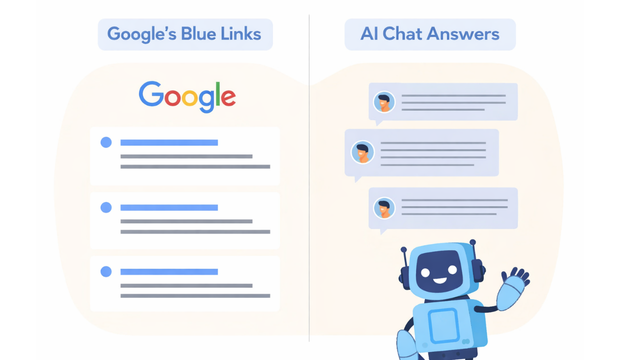
Across Google, AI Overviews, large language models, and conversational interfaces, search behaviour is shifting from exploration to resolution. Users are no longer scanning ten blue links. They are asking complete questions and expecting complete answers, instantly. 

Businesses adapting to this shift often work with teams offering SEO expert services to transition from ranking-focused strategies to answer-driven visibility models.

At Sudha Solutions, we believe this marks the most fundamental shift in search since the introduction of PageRank. And it demands a different way of thinking about SEO altogether. 

This article explains: 

  • Why rankings alone no longer define visibility 
  • How AI-driven search engines decide who gets surfaced 
  • What “answer readiness” really means in 2026 
  • How businesses and SEO professionals must adapt now 

This is not a prediction built on hype. It is a synthesis of platform changes, industry data, and how modern retrieval systems actually work. 

The Quiet Collapse of Click-Based Visibility 

Search engines are still sending traffic. But they are sending far less of it. Multiple independent studies now confirm what most practitioners are already seeing in analytics dashboards. 

Key findings from the industry data behind zero-click search: 

The implication is not that SEO is dying. The implication is that visibility is being decoupled from traffic. A brand can now: 

  • Influence decisions 
  • Shape understanding 
  • Build authority 

…without ever receiving a click. 

Why Search Engines Are Becoming Answer Engines

To understand where SEO is heading to, we must understand how AI is searching, retrieving, and presenting information. 

From Indexing Pages to Synthesising Knowledge 

Traditional Search  Modern Search 
Indexed documents  Retrieves multiple sources 
Ranked them using signals  Evaluate credibility and relevance 
Let users extract meaning themselves  Synthesis a response 
  Presents a single, confident answer 

This shift is powered by retrieval-augmented generation (RAG), a system where language models pull from trusted sources before generating responses. In this system, your content is no longer competing for a click. It is competing for AI citations. 

Visibility in 2026: Being Cited vs Being Clicked 

Google rankings are not enough in 2026. Your ranking does not automatically translate to AI citations. What matters today is: 

  • Being quoted in an AI Overview 
  • Being referenced in a conversational response 
  • Being recalled when a follow-up question is asked 

This is a fundamentally different type of visibility. 

Traditional SEO vs Answer-Driven Visibility 

Traditional SEO  Answer-Driven SEO 
Rankings-focused  Retrieval-focused 
Optimised for CTR  Optimised for inclusion 
Keyword-first  Question-first 
Page authority  Entity & topic authority 
Traffic as success  Influence as success 

The winners in this environment are not the loudest brands. Rather brands that are clearest and most reliable. 

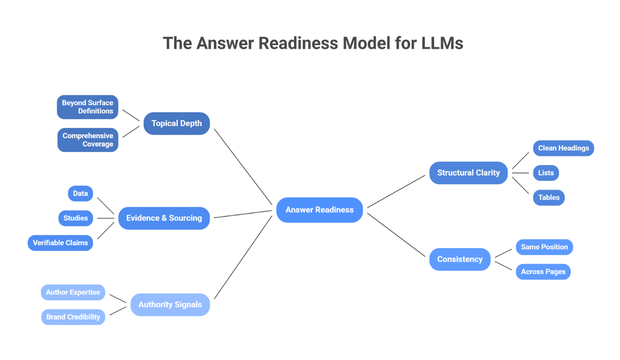
The Answer Readiness Model 

The Answer Model

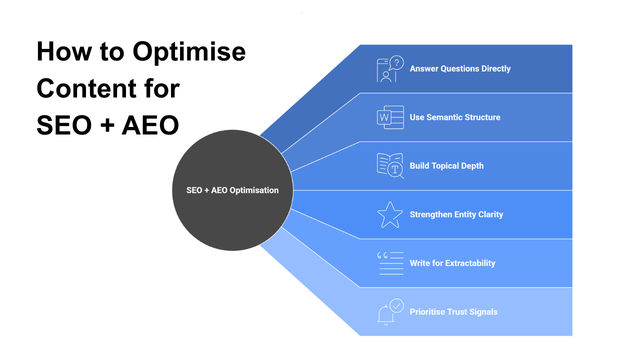
At Sudha Solutions, our content is a perfect balance of SEO optimisation and answer readiness. When both work in unison, brands grow.  

Answer readiness answers one question: 

If an AI system had to explain a topic to its user, would it trust your content? 

The 5 Pillars of Answer Readiness 

Pillar  What AI systems look for 
Topical depth  Coverage beyond surface definitions 
Structural clarity  Clean headings, lists, tables 
Evidence & sourcing  Data, studies, verifiable claims 
Consistency  Same position across pages 
Authority signals  Author expertise, brand credibility 

This is where EEAT stops being a guideline and becomes a retrieval requirement. 

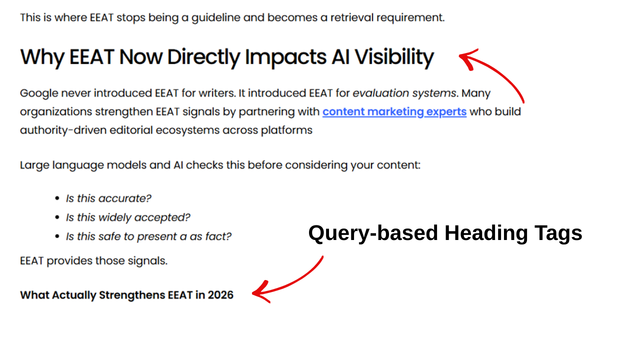
Why EEAT Now Directly Impacts AI Visibility 

Google never introduced EEAT for writers. It introduced EEAT for evaluation systems. Many organizations strengthen EEAT signals by partnering with content marketing experts who build authority-driven editorial ecosystems across platforms

Large language models and AI checks this before considering your content: 

  • Is this accurate? 
  • Is this widely accepted? 
  • Is this safe to present a as fact? 

EEAT provides those signals. 

What Actually Strengthens EEAT in 2026 

  • First-hand explanations, not summaries 
  • Clear author attribution and expertise 
  • Consistent viewpoints across the site 
  • Alignment with external authoritative sources 
  • Absence of sensational or speculative claims 

This is why thin content, paraphrased blogs, and generic SEO pages are systematically excluded from AI responses. 

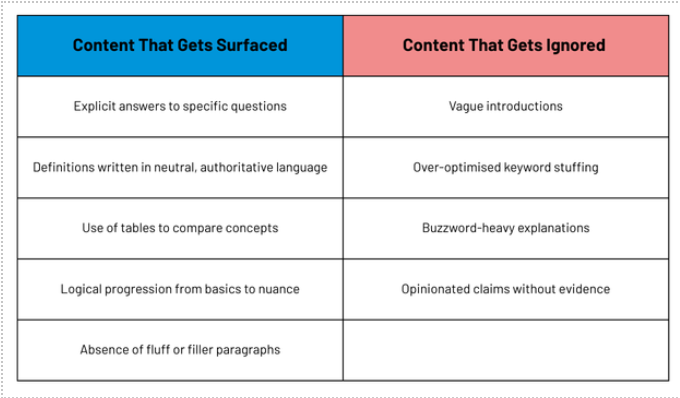
Content That Gets Chosen vs Content That Gets Ignored 

Producing structured, authoritative resources at scale often requires collaboration with expert blog writing specialists who understand how AI systems interpret content clarity and evidence.

Content That Gets Chosen vs Content That Gets Ignored

Answer engines do not “read” content the way humans do. They check it for clarity, completeness, and confidence. An information dense content which is not structured properly or does not follow EEAT guidelines will not interest AI platforms. 

Characteristics of Content that gets Surfaced 

  • Explicit answers to specific questions 
  • Definitions written in neutral, authoritative language 
  • Use of tables to compare concepts 
  • Logical progression from basics to nuance 
  • Absence of fluff or filler paragraphs 

Content that gets Ignored 

  • Vague introductions 
  • Over-optimised keyword stuffing 
  • Buzzword-heavy explanations 
  • Opinionated claims without evidence 

This is why modern SEO content must feel closer to reference material than marketing copy. 

Measuring Success When Clicks Decline 

For multiple years, traffic and ranking were the metrics we relied on to measure success; however, we are going through a period of transition. This has also led to a shift in how we measure success. 

New metrics that Actually Matter 

Metric  Why it matters 
AI citation presence  Indicates retrieval trust 
Branded search growth  Shows influence, not clicks 
Assisted conversions  Users return later 
Sales cycle shortening  Answers reduce friction 
SERP dominance  Visibility across formats 

SEO teams must now report on influence, not just acquisition. 

Why This Shift Benefits High-Quality Brands 

This transition is a blessing in disguise for genuine brands as it disproportionately rewards: 

  • Specialists over generalists 
  • Experts over aggregators 
  • Brands with conviction over content farms 

For founders and businesses, this is good news. 

Answer engines favour: 

  • Clear positioning 
  • Narrow expertise 
  • Demonstrable experience 

You do not need thousands of pages. You need the right ones, built to be referenced. 

How Sudha Solutions Approaches SEO in an Answer-First World

Since the start of transition from traditional SEO to AI-led modern SEO, our SEO and content team have tried different approaches to find the best strategy to get quoted by AI. Our process no longer starts with just keywords. Our teams combine technical optimization and editorial strategy through integrated SEO expert services designed for AI-driven search ecosystems.

It starts with: 

  • What questions users ask before buying 
  • What confusion exists in the market 
  • What misinformation needs correcting 

Then we build content that: 

  • Resolves uncertainty 
  • Establishes trust 
  • Can be confidently reused by AI systems 

This is why our SEO strategies focus on durable visibility, not temporary rankings. 

The Future: Search as a Conversation, Not a Destination 

Search is becoming: 

  • Continuous 
  • Contextual 
  • Conversational 

Users ask one question, then refine it. Only sources that remain consistent and credible survive that conversation. 

By 2026, the brands that win will not be those who chased algorithms. They will be those who became the reference point. 

Final Thoughts 

SEO in 2026 is no longer about chasing rankings. It is about earning the right to be trusted as the answer. Brands that understand this shift early will not just survive algorithm updates. They will shape how their industry is understood. 

If this article changed how you think about search, explore our other insights. This is only one part of a much larger transformation. 

Frequently Asked Questions

What is Answer Engine Optimisation (AEO)? 

AEO is the practice of structuring content so it can be directly retrieved and cited by AI-powered search engines and assistants, rather than only ranked as a clickable result.  

Does SEO still matter if users do not click?

Yes. SEO now influences decisions earlier in the funnel, shaping perception and trust even without immediate traffic. 

How do I know if my content appears in AI responses?

Monitor branded search growth, SERP features, AI Overviews, and assisted conversion paths rather than only organic clicks. 

Are long-form blogs still relevant? 

Yes, if they follow EEAT guidelines. This includes clear structure, trust factor by experts, some real-life examples or case studies, and question based H2s with clear answers and no fluff. 

Categories
AEO Optimization AI Overview GEO Optimization

AEO/GEO Optimization Strategy: Best Practices, Tools, and How It Differs from Classic SEO

Search engines have not been the same since the reliance shifted to AI platforms. While the previous guidelines may help with ranking, it might not be translated into traffic generation. SEO is still very much relevant; however, it’s no longer the whole playbook.

Now, Answer Engine Optimization (AEO) and Generative Engine Optimization (GEO) are the new frontiers in search optimization and implementing them requires a shift in strategy; away from keywords and toward intent, context, and clarity.

As AI Overview continues to redefine search, optimizing for how machines understand content is just as important as optimizing for how people find it.

Consider this guide, a handbook for your future AEO and GEO practices. It explores best practices, tools, and strategies for AEO and GEO. Get ready to optimize for the future of search.

Here’s a TL;DR If You’re Pressed on Time

Here we explain how AEO and GEO differ from classic SEO & how to optimize for AI-driven search experiences.

Answer Engine Optimization targets direct, conversational answers for voice assistants using clarity and schema, while Generative Engine Optimization prepares adaptable, context-rich content that generative AI can expand. Both prioritize user intent, context, and local relevance over traditional keyword/link tactics.

You’ll find best practices, tools, local strategies, schema and image optimization, AI Overviews, KPIs, challenges, and future trends.

Understanding AEO and GEO: Definitions and Core Concepts

At the heart of digital evolution are AEO and GEO optimization. Both are pivotal for modern search engine strategies.

But what exactly do they entail?

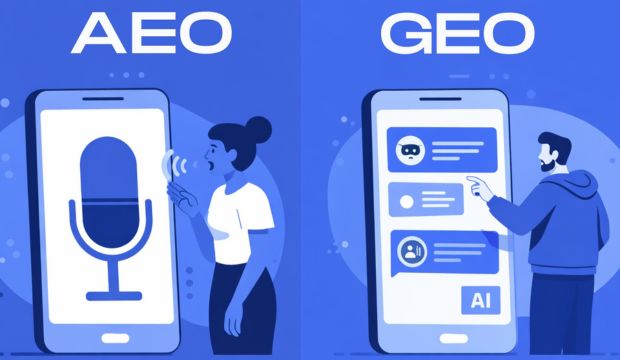
AEO, or Answer Engine Optimization, is all about showing up when people ask questions out loud. Voice assistants like Siri, Google Assistant, Alexa skip the search results entirely and jump straight to an answer.

To win here, your content has to be clear, contextual, and genuinely helpful, because you’re competing to be the answer, not just one of ten blue links.

Then there’s Generative Engine Optimization (GEO). This is where things get really interesting. AI-driven platforms don’t just retrieve content; they generate it. That means your content needs to be structured in a way AI can understand, remix, and expand on while still keeping your message intact.

Both AEO and GEO demand a mindset shift. Instead of obsessing over keywords and backlinks, the focus moves to intent, context, and usefulness. It’s less about gaming the system and more about aligning with how people and machines actually think.

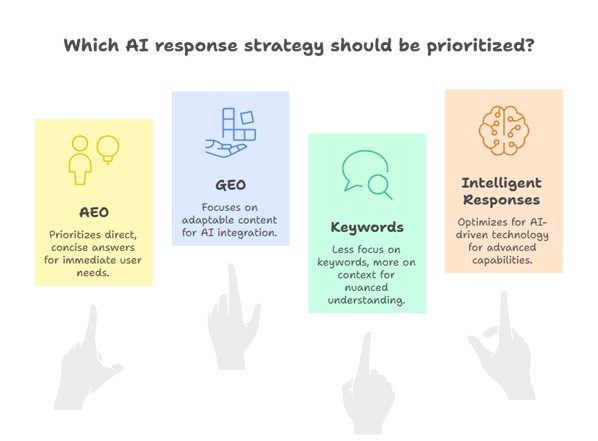
Understanding these strategies involves grasping their unique elements. Here is a quick breakdown:

AI response strategy

The importance of these approaches grows as AI becomes more integrated. Digital assistants and AI platforms are reshaping how users search. They demand more refined content from websites.

AEO and GEO focus heavily on user interactions. They use contextual data to provide more personalized experiences. This enhances user satisfaction and conversion rates.

Understanding these strategies means recognizing their role in AI and digital evolution. Both are crucial for marketers aiming to stay competitive in this AI-driven era.

SEO vs AEO vs GEO: Key Differences and Overlaps

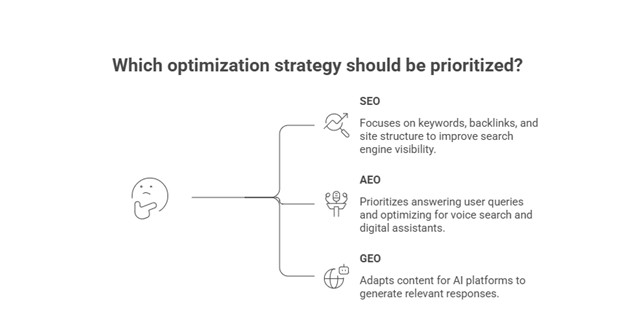
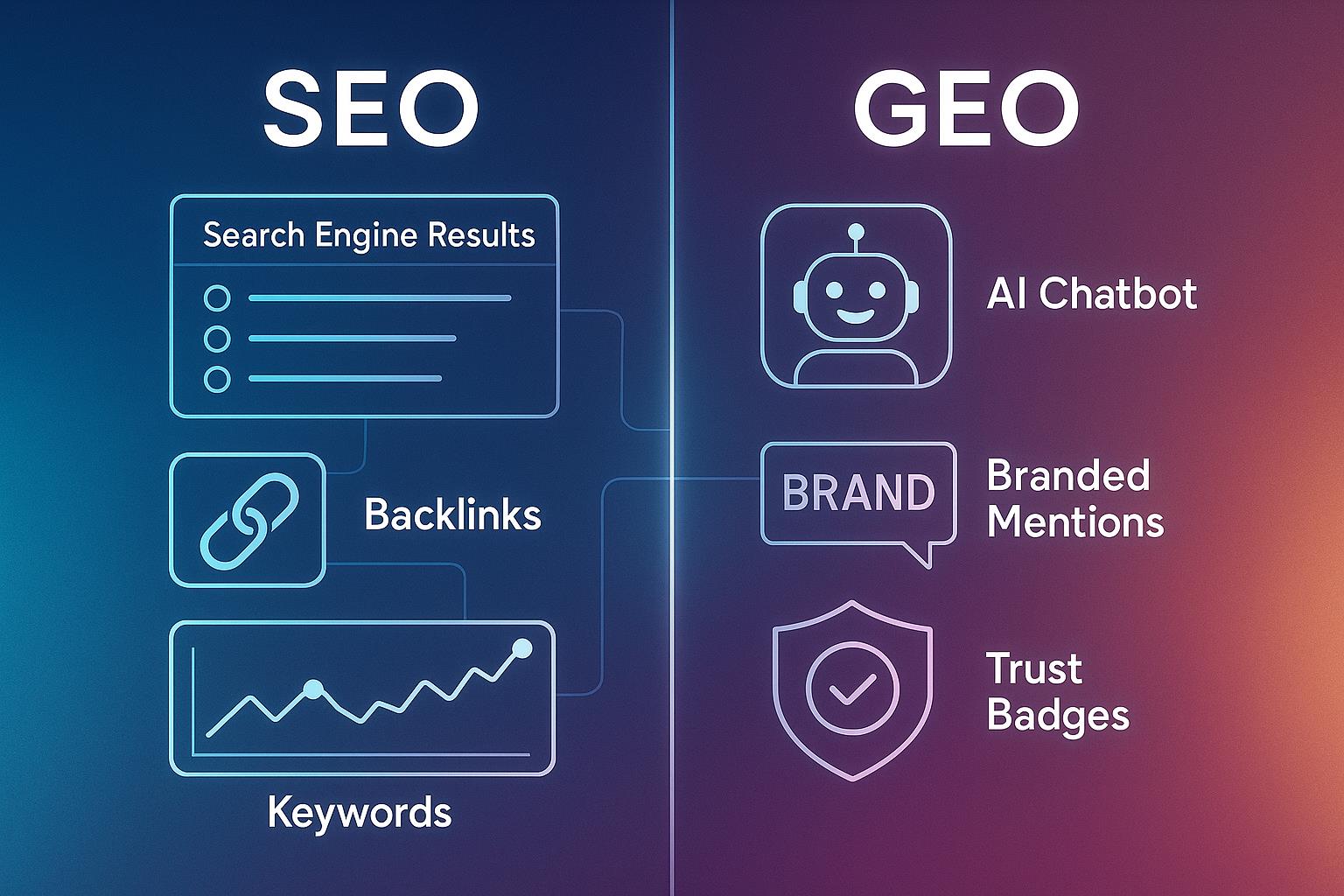
SEO vs AEO vs GEO

In today’s digital world, understanding SEO, GEO, and AEO is critical. Each has a distinct role, yet they overlap in important ways.

SEO, or Search Engine Optimization, is the foundation. It focuses on keywords, backlinks, and site structure. Its primary goal is to improve site visibility in search engine results.

Answer Engine Optimization (AEO) shifts the focus from keywords to content context. It prioritizes answering direct user queries. This optimization targets voice search and digital assistants.

GEO, on the other hand, caters to AI platforms. These platforms generate content based on user input. Adapting content for these engines is key.

Both AEO and GEO deviate from classic SEO in their approach. They emphasize personalized content and user intent over traditional metrics.

Here’s how they overlap and differ:

  • Overlap:
    • All aim to enhance visibility.
    • Improve user satisfaction.
    • Focus on search engine algorithms.
  • Differences:
    • SEO: Keywords and links are crucial.
    • AEO: Direct response optimization.
    • GEO: Content adaptability for AI.

So, while they share common goals, each method serves a unique purpose. Recognizing these differences enhances AEO SEO strategy effectiveness. Optimizing for various engines results in broader reach and improved engagement.

Why AEO/GEO Matters in the Age of AI-Driven Search

There are three main factors that underscore the importance of AEO and GEO:

  • The rise of voice search
  • The growing presence of AI in everyday life
  • The demand for personalized content.

Together, these shifts mean traditional SEO alone just isn’t enough anymore.

For businesses, adapting is no longer optional. AEO and GEO help ensure your content stays visible as AI-driven search continues to evolve. Embracing these strategies is how brands stay relevant in a search landscape that’s already moved beyond keywords and links.

Core Principles of Answer Engine Optimization (AEO)

Answer Engine Optimization (AEO)

Answer Engine Optimization (AEO) services are changing the way people interact with search. Instead of scrolling through results, users now expect AI-driven assistants to deliver fast, accurate answers, especially through voice search. AEO is all about making sure your content is the one those assistants choose.

Key principles of AEO include:

  1. Understanding User Intent: Anticipate the questions users ask. This means looking beyond keywords and digging into behavior, context, and intent.
  2. Clarity and Brevity: Short, well-structured answers improve usability. Content should be easy to understand and quick to consume.
  3. Schema Markup Usage: Structured data helps AI systems understand the context of your content and surface it more accurately.

Natural language processing still plays a big role in AEO, but it doesn’t have to be complicated. Writing the way people naturally speak, using simple words and direct sentences makes it easier for digital assistants to interpret and deliver your content correctly.

Relevance matters just as much. Content needs to be timely, accurate, and aligned with the situation or question at hand. When those pieces come together, AEO helps your content become the answer users hear first and not just another result they never see.

Generative Engine Optimization (GEO): Adapting for AI Content Creation

Generative Engine Optimization (GEO) is the next big step in digital marketing. Instead of optimizing content only for rankings, GEO focuses on how AI platforms generate content in response to user input and how your content supports that process.

Why GEO matters
AI models like GPT don’t just retrieve information. They interpret context, combine ideas, and generate new content. To stay visible, your content must be easy for AI to understand, adapt, and build upon.

Core principles of GEO

  • Flexible structure: Create modular content that AI can modify or expand without losing clarity.
  • Strong context: Provide clear, accurate foundations so AI can generate reliable and relevant outputs.
  • Layered information: Organize content so AI can pull both high-level insights and deeper details when needed.
  • Multiple perspectives: Including varied angles helps AI generate more balanced and useful responses.

GEO works best when AI is treated as a collaborator, not just a tool. By refining your inputs and learning from AI-generated outputs, brands can improve visibility, engagement, and long-term relevance in AI-driven search environments.

AEO Best Practices: How to Optimize for Answer Engines

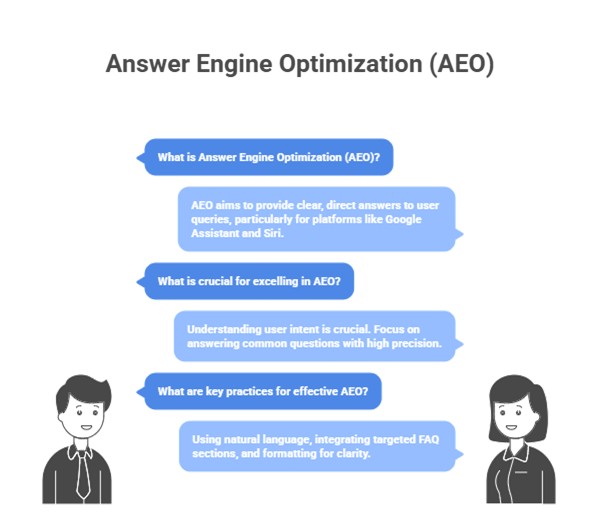
Answer Engine Optimization (AEO) aims to provide clear, direct answers to user queries, particularly for platforms like Google Assistant and Siri. This makes understanding user intent crucial.

Key practices for effective AEO include:

  • Using Natural Language: Write in a way that mirrors everyday speech. This aligns well with how people typically pose queries to answer engines.
  • Formatting for Clarity: Structure content with headings, bullet points, and concise paragraphs. This helps answer engines parse and present content efficiently.

Search engines increasingly rely on structured data to interpret content better. Applying schema markup enhances your content’s contextual visibility.

Implementing the FAQ schema can further improve your chances of being featured. This structured approach helps answer engines quickly identify and rank relevant content.

Consider these action points for a stronger AEO:

  1. Identify User Intent: Conduct thorough research to pinpoint what users are truly seeking when they query your key topics.
  2. Continuous Content Updates: Keep content fresh. Regular updates align with evolving search engine algorithms and answer engine requirements.

It’s also helpful to utilize available tools and platforms. Google’s Structured Data Testing Tool can ensure your schema markup is accurate and effective.

AEO Best Practices

GEO Best Practices: Strategies for Generative Engines and AI Platforms

Generative Engine Optimization (GEO) caters to AI platforms that create content, necessitating dynamic strategies. Focus on making your content adaptable and engaging for these generative engines.

To optimize effectively, ensure your content is both flexible and informative. AI platforms thrive on data that’s easy to modify and expand.

Key strategies for successful GEO include:

  • Keyword Contextualization: Go beyond basic keywords. Understand and predict how AI might interpret and use these keywords in diverse contexts.
  • Rich Metadata Utilization: Employ extensive metadata to provide AI with a deeper understanding of content nuances and applicability.

Use structured data formats like JSON-LD for better interoperability. This format helps generative engines better comprehend and interact with your content structures.

Two vital aspects to consider in GEO include:

  • Contextual Clarity: Keep the context clear and consistent, making it easier for AI to repurpose content into various formats or purposes.
  • Interactive Elements: Integrate interactive media or dynamic content that can enhance AI-driven user experiences.

Regularly updating your content is essential in GEO. Dynamic content aligns well with generative engines’ evolving learning patterns and content creation methodologies.

Action steps for effective GEO include:

Here’s how adding different content formats and elements can help you implement GEO


Adding quotes +41%
Statistics +30%
Adding inline citations +30%
Improving readability +22%
Using domain specific terms +21%
Using simple language +15%
Authoritative voice +11%
Keyword Stuffing -9%

GEO Best Practices

Local Search Strategies for AEO/GEO

Local search strategies are vital in the AEO/GEO framework. They ensure that users find location-specific content when needed. The focus should be on optimizing for both general AI and local nuances.

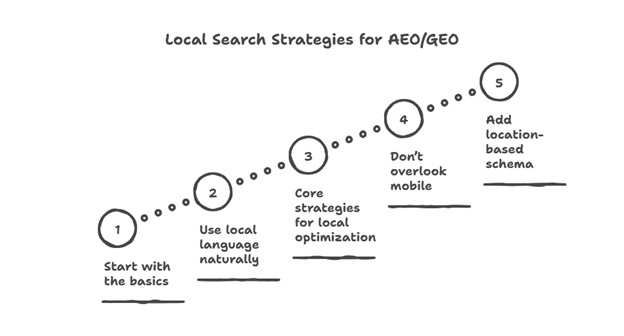
Local Search Strategies for AEO and GEO

Start with the basics

Ensure your business is listed on local directories. Platforms like Google My Business are crucial for local visibility. Maintain accurate and updated information.

Use local language naturally

Include geographic keywords in a way that feels organic. City names, neighborhoods, and phrases like “near me” help connect your content to local intent without sounding forced.

Core strategies for local optimization:

  • Localized Content: Produce articles and blog posts that focus on local events or attractions.
  • Local Backlinks: Engage with local organizations or businesses to build backlinks.
  • Community Engagement: Participate in local forums and social media groups to increase your presence.

Don’t overlook mobile

Most local searches happen on mobile devices. A fast, mobile-friendly site is essential for both user experience and AI-driven results.

Add location-based schema

Using geographic schema markup helps AI engines clearly understand your location, improving how and when your content appears in local responses.

When local signals are clear and consistent, AEO and GEO systems are far more likely to surface your content at the exact moment users need it.

Schema Markup for AI Search: FAQ, How-To, and More

Schema markup is crucial for AEO and GEO. It helps search engines understand your content more deeply.

There are several key types of schema markup to consider:

  • FAQ Schema: Utilizes a list of questions and answers. This is ideal for direct responses in search.
  • How-To Schema: Provides step-by-step instructions, perfect for tasks that users frequently ask about. Let’s understand this in detail

How-To schema can enhance content discoverability. It makes it simple for AI to present your content as featured snippets. Detailed and accurate instructions are vital.

In addition, other helpful schemas include:

  • Product Schema: Displays product information such as price and availability.
  • Article Schema: Enhances article content for better ranking.

To implement schema markup, use tools like Google’s Structured Data Markup Helper. This tool can streamline the process. Ensure your schema is valid by checking with the Structured Data Testing Tool.

Schema markup improves AI algorithm comprehension of your site. This aligns your content with user queries effectively. With schema, you prepare for future AI advancements, strengthening your digital strategy.

Image SEO for AI Search: Optimizing Visual Content

Image SEO for AI Search

Visual content plays a critical role in search visibility. Optimizing images for AI search enhances how your visuals appear in results. This requires specific strategies to ensure images are properly indexed and relevant.

AI platforms rely on more than just image quality. They assess context, which includes alt text and file names. These elements help AI understand what your images represent, improving their search accuracy.

Consider these methods to optimize images for AI:

  1. Descriptive Alt Text: Use relevant keywords naturally in alt text. This explains the image content to search engines.
  2. File Names: Rename image files with descriptive names, avoiding generic terms like “image1.jpg.”
  3. Contextual Relevance: Ensure images align contextually with the surrounding text.
  4. File Type and Size. Compress images to improve load times without sacrificing quality. Fast-loading images contribute positively to user experience and SEO.
  5. Use ImageObject Schema: Structured data can enhance your image SEO. The ImageObject schema informs search engines further about image specifics, such as license or creator.

Incorporating these strategies aids AI in recognizing and displaying images more effectively. This boosts visibility in image search results, benefitting overall content reach. By optimizing images for AI, you adapt proactively to emerging search trends.

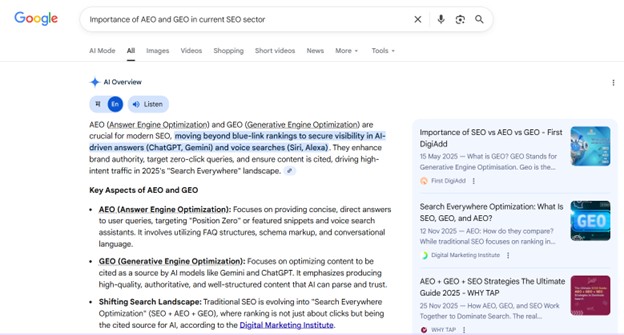
Google AI Overviews and AI Overviews Optimization

Google AI Overviews and AI Overviews Optimization

In the realm of AI-driven search, how Google AI Overviews differ from organic results. These summaries provide users with concise and relevant information. They aim to answer queries quickly and precisely, often appearing at the top of search results.

Optimizing for these Overviews involves crafting content that’s easily digestible. Your aim should be to deliver key points effectively, satisfying user intent with speed and accuracy. This requires an understanding of how AI processes and displays content.

Focus on these optimization techniques for AI Overviews:

  • Concise Content: Ensure your content is to the point, emphasizing clarity.
  • Key Phrases: Use relevant phrases that match common user queries.
  • Structured Layouts: Consider using lists or bullet points that simplify information scanning.

To further enhance visibility in AI Overviews, prioritize enriching content contextually. This involves using supportive data elements like images or infographics that summarize complex ideas.

Tools and Platforms for AEO/GEO Optimization

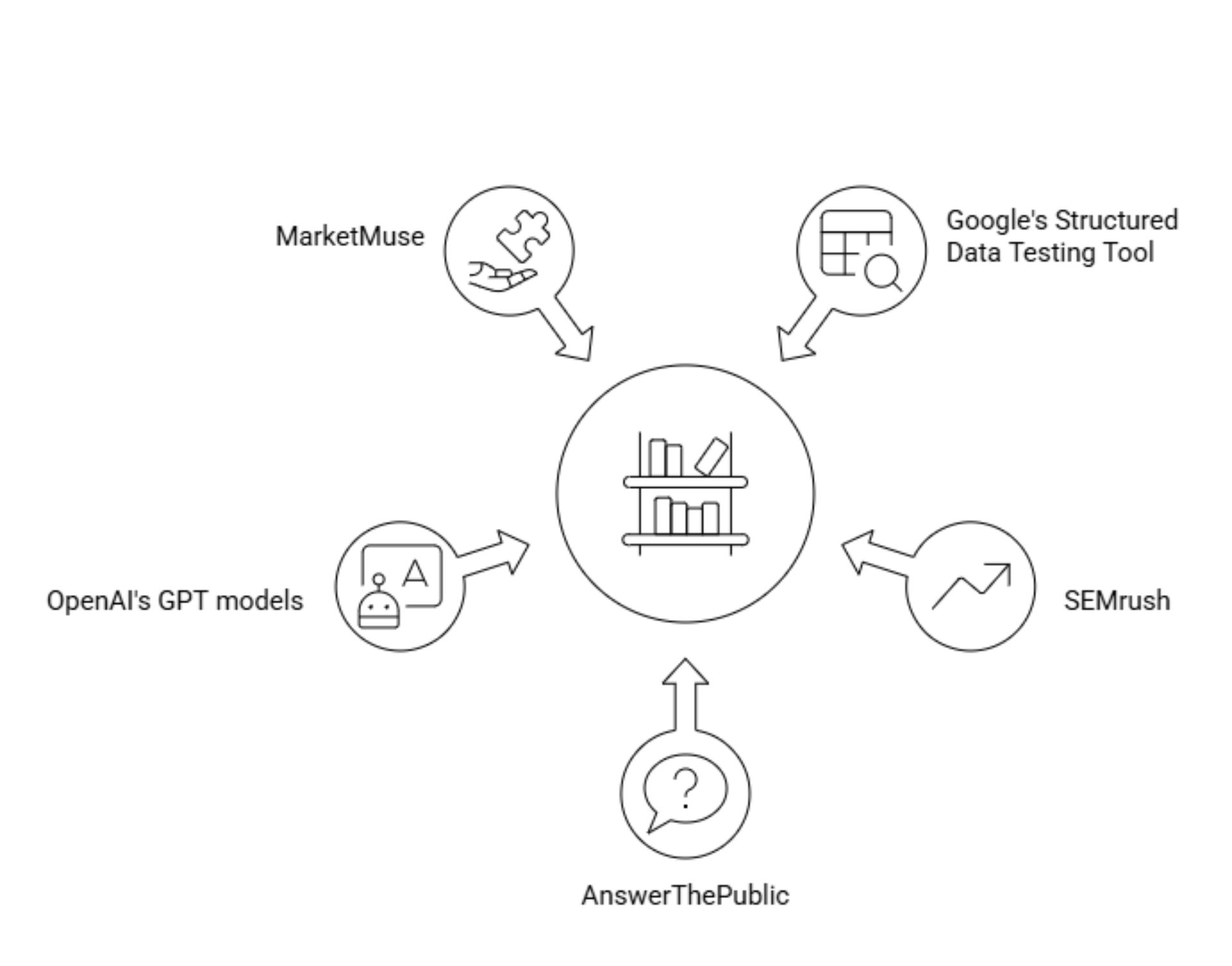
Tools for AEO and GEO Optimization


Optimizing for AEO and GEO requires the right tools and platforms. These help enhance efficiency and effectiveness. They enable you to better understand both engine behaviors and user intent.

A variety of tools are available to streamline your AEO/GEO efforts:

  • Google’s Structured Data Testing Tool: Verifies schema markup accuracy.
  • SEMrush: Offers insights into keyword performance and search engine visibility.
  • AnswerThePublic: Identifies common questions users ask, aiding answer engine optimization.

Generative engines also require a unique set of tools that cater to AI-driven content:

  • OpenAI’s GPT models: Assist in creating AI-friendly text content.
  • MarketMuse: Enhances content strategy by analyzing topic coverage and optimizing AI-readiness.
  • Content Harmony: Focuses on content performance against AI criteria.

Each platform adds a layer of proficiency to your strategy. Google Search Console, for example, provides insights into search performance and engagement metrics. These insights are invaluable for measuring strategy effectiveness and guiding adjustments.

Measuring Success: Metrics and KPIs for AEO/GEO

Tracking the success of AEO and GEO strategies requires specific metrics. It’s crucial to focus on how these impact your digital presence and AI engagement.

Key performance indicators (KPIs) provide a detailed look at your progress. They offer insights into the effectiveness of your optimization efforts.

Essential metrics to monitor include:

  • Visibility: Evaluate how often your content appears in AI-generated answers.
  • Engagement Rates: Assess user interaction with AI-enhanced content.
  • Conversion Rate: Identify how well optimized content leads to desired actions.
  • Bounce Rate: Understand if users find your content relevant and engaging.

Measuring these KPIs consistently can reveal strengths and weaknesses. It helps refine strategies and adapt to evolving search dynamics. By focusing on these metrics, you align more closely with user expectations and AI developments.

Common AEO/GEO Challenges and How to Overcome Them

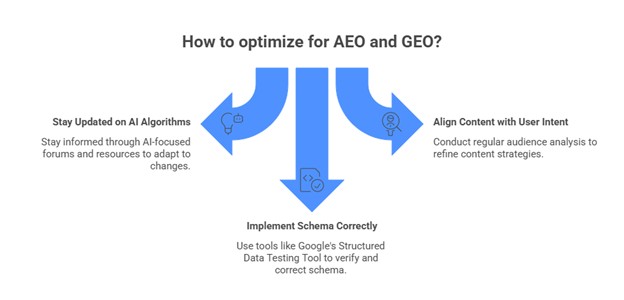
How to optimize AEO and GEO

AEO and GEO present unique challenges that diverge from classic SEO. Understanding these hurdles is key to optimizing effectively for AI platforms.

One common issue is adapting to rapidly changing AI algorithms. These updates can affect visibility and ranking. Staying informed about AI trends and making proactive adjustments is crucial.

Another challenge is ensuring content fits user intent. Unlike traditional SEO, AEO and GEO require deep comprehension of user queries and context. Misaligned content can reduce performance in answer and generative engines.

Here are some typical challenges and solutions:

  • Frequent AI algorithm changes: Stay updated through AI-focused forums and resources
  • Misalignment with user intent: Conduct regular audience analysis to refine content strategies.
  • Technical implementation of schema: Use tools like Google’s Structured Data Testing Tool to verify and correct.

Overcoming these challenges improves content engagement and optimization. Consistent adaptation and learning are vital in this fast-paced AI landscape. Embrace these strategies to enhance your visibility and effectiveness in AEO and GEO environments.

Future Trends: The Evolving Landscape of AEO/GEO

  • AEO and GEO are evolving rapidly as AI technologies advance.
  • Generative AI tools now create high-quality content with minimal human input, enabling faster content scaling.
  • Voice search is growing, making conversational and natural language optimization
  • Marketers must shift content strategies to match how people speak, not just type.

Key trends to watch:

  • Deeper AI integration across digital marketing tools
  • Rapid growth of voice search and conversational queries
  • More advanced AI-driven content creation systems
  • Personalization is becoming central, with AI delivering tailored content based on user behavior.
  • Brands need dynamic, adaptive content strategies to serve diverse audiences.
  • Agility and innovation will be critical to stay relevant in the AEO and GEO landscape.

Final Thoughts

To thrive in AI-driven search environments, a sustainable AEO/GEO strategy is essential. This involves understanding evolving technologies and user needs. Adapting swiftly can provide a competitive edge in this dynamic landscape.

Key elements of a sustainable strategy include:

  • Continuous learning and adaptation.
  • Effective use of data-driven insights.
  • Collaboration between content creators and tech specialists.

By focusing on these elements, businesses can remain relevant and effective. A proactive approach ensures content remains visible and impactful in AI-dominated search ecosystems. Building resilience and adaptability into your strategy is key to future success.
We at Sudha Solutions have helped multiple top e-commerce brands rank on both Google and AI platforms. If you’re ready to future-proof your visibility across search and generative engines, let’s talk.


Categories
General SEO LLMS

SEO Meets LLMs: How Search Algorithms Learn, Rank, and Generate Answers

Search used to be about finding links. Now it is about getting an answer you can act on. That shift is not because Google redesigned the results page. It is because large language models, or LLMs, changed how information is understood, ranked, and delivered.   

For years, SEO teams played a known game. Get crawled. Get indexed. Earn backlinks. Be relevant to the keywords. Appear in the top ten. Now we are in the next shift. Users are not always being handed a list of blue links. In many cases they are being given a synthesized, conversational answer. In this blog, we will talk about LLMs in SEO, how our search engines learn and generate conversational answers.  

How LLMs Learn to Talk About your Category 

LLMsLet’s start with what are LLMs. 

LLMs pr Large Language Models are trained on huge text datasets. Think trillions of tokens from websites, books, documentation, forums, product pages, Q&A content, and more. The core task during training is very simple to describe. Predict the next word. Then the next. Then the next. Repeating this task at a massive scale teaches the model patterns in how humans explain ideas, argue, recommend, compare, and answer.  

Knowing how LLM works is important. It does not just memorize isolated facts the way a spreadsheet does. It learns statistical structure. It sees how experts talk about “cross-border payment compliance” or “sustainability claims in fashion sourcing” or “how to improve Core Web Vitals for eCommerce SEO,” and then it learns how those ideas tend to be framed. So, when the model answers, it is not quoting. It is generating a likely and useful continuation.  

How AI-Powered Search Ranks What to Trust  

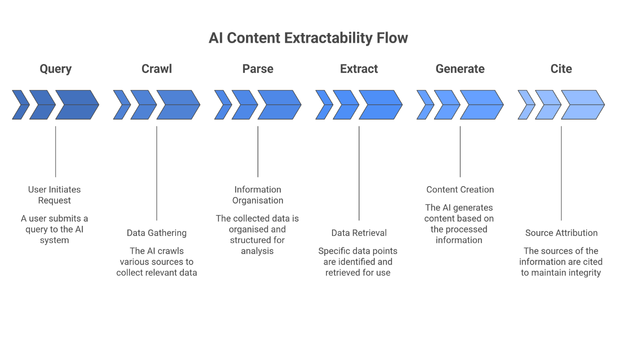
Here is what most people misunderstand. AI-generated answers are not created in a vacuum. When you ask an AI system a question like “What is the best way for LLM optimization in search results?”, the model does not instantly start typing from pure memory. First, it retrieves. Then, it generates.  

This pattern is known as retrieval augmented generation (RAG). The system first pulls information from search engine results, knowledge bases, policy docs, product pages, or any other trusted source. Only after it has pulled in those candidate sources does the model start writing the answer.  

The content they and AI models trust are usually ones with good SEO ranking. Content pieces that are up to date, well structured, and have FAQs, tables, and price breakdowns are given priority.  

What Happens When an AI System Answers  

After retrieval, the model begins synthesis. It looks at the retrieved sources, scores them for relevance, freshness, and confidence, and then composes a final narrative-style answer. A recent arXiv analysis of generative search describes how these systems score for citability, which is the likelihood that the system can safely attribute a claim to a given source. That is why AI search-style answers often include source callouts or language like “according to.”  

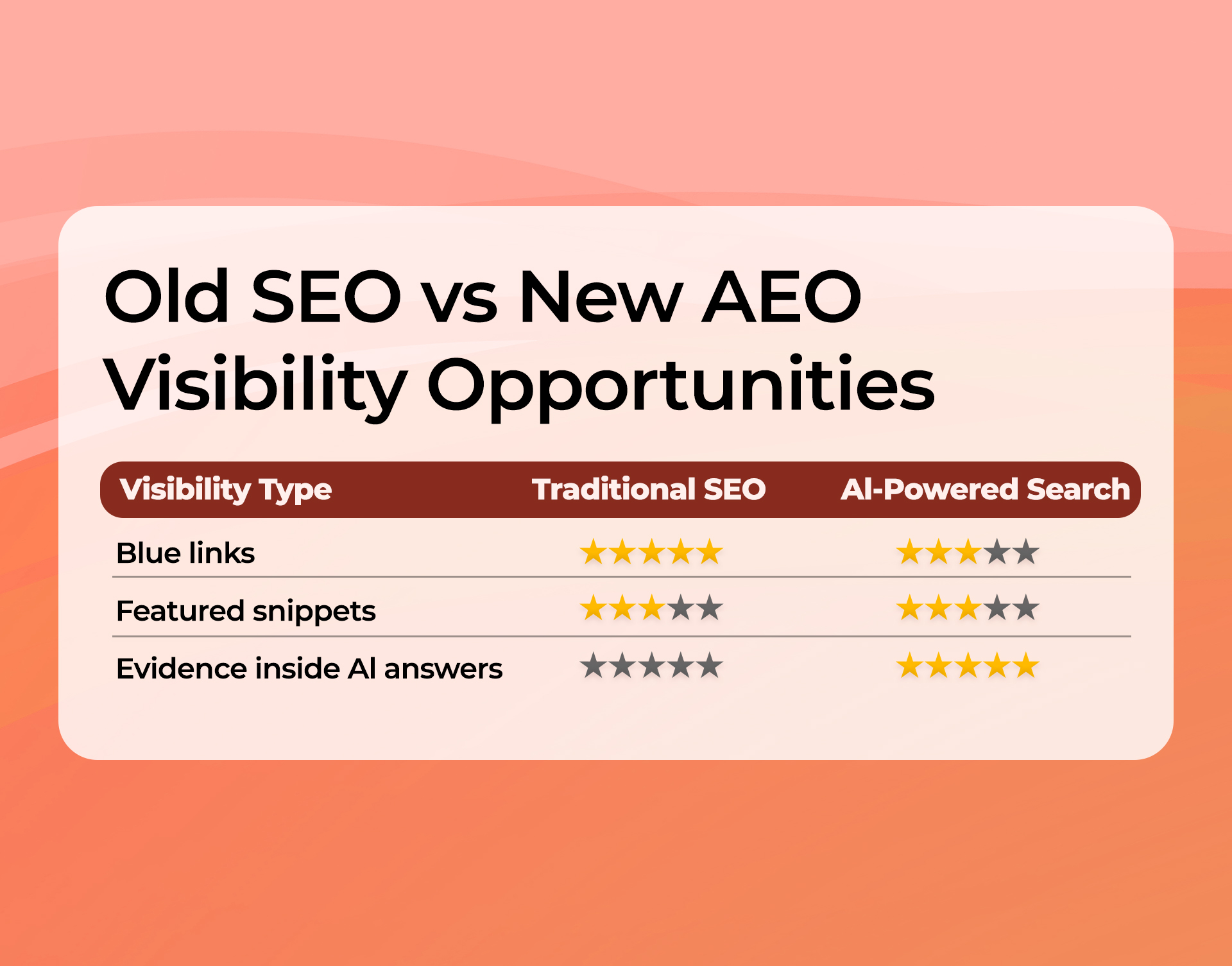
For brands, this is the real takeaway. Visibility is not limited to the blue links section anymore. Visibility now includes being used as evidence inside the answer itself. If the AI answer cites you or uses your language, you are winning mindshare before the click.  

Old seo vs new seoHow LLM-Based Ranking Reshapes SEO Strategy 

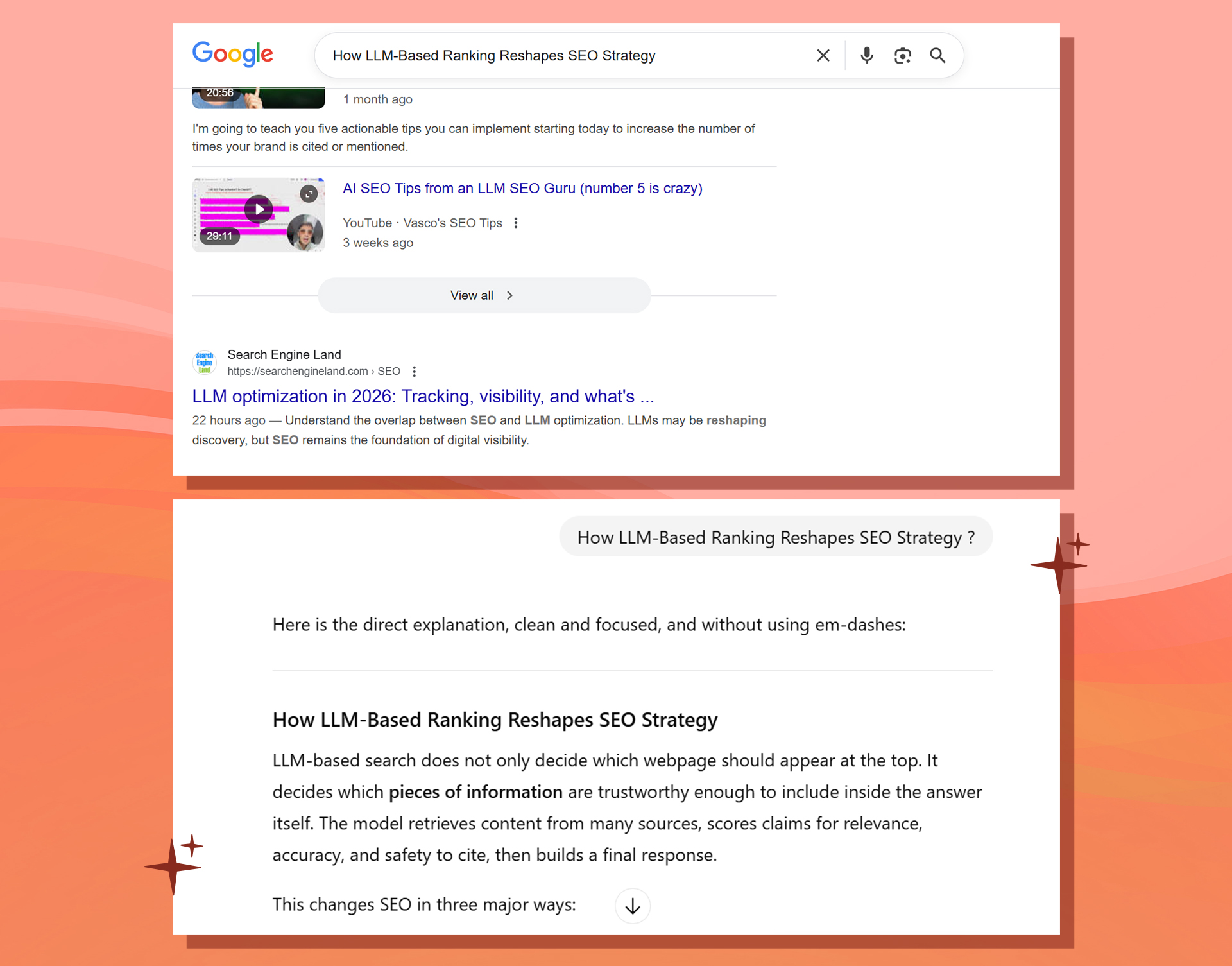
how LLM rankings reshape seo strategy

Search optimization used to focus on one outcome: visibility on Google’s first page. That goal is still valid, but the path to it is now shared with AI systems that evaluate far more than backlinks and keywords. The rise of answer-first search means that visibility can come in two ways: ranking as a source and appearing as a cited reference inside an AI-generated summary.  

This change creates a new layer of competition. Content is no longer fighting only for clicks. It is fighting for inclusion inside the models that shape what users read and trust. A 2025 analysis published on arXiv explains that modern ranking pipelines now blend retrieval, confidence scoring, and summarization to determine which passages appear inside generated answers. That blend favors clarity, context, and structural precision.  

This means the new SEO strategy must evolve into what specialists call Answer Engine Optimization (AEO) and Generative Engine Optimization (GEO).  

Building an LLM-Friendly Content Ecosystem 

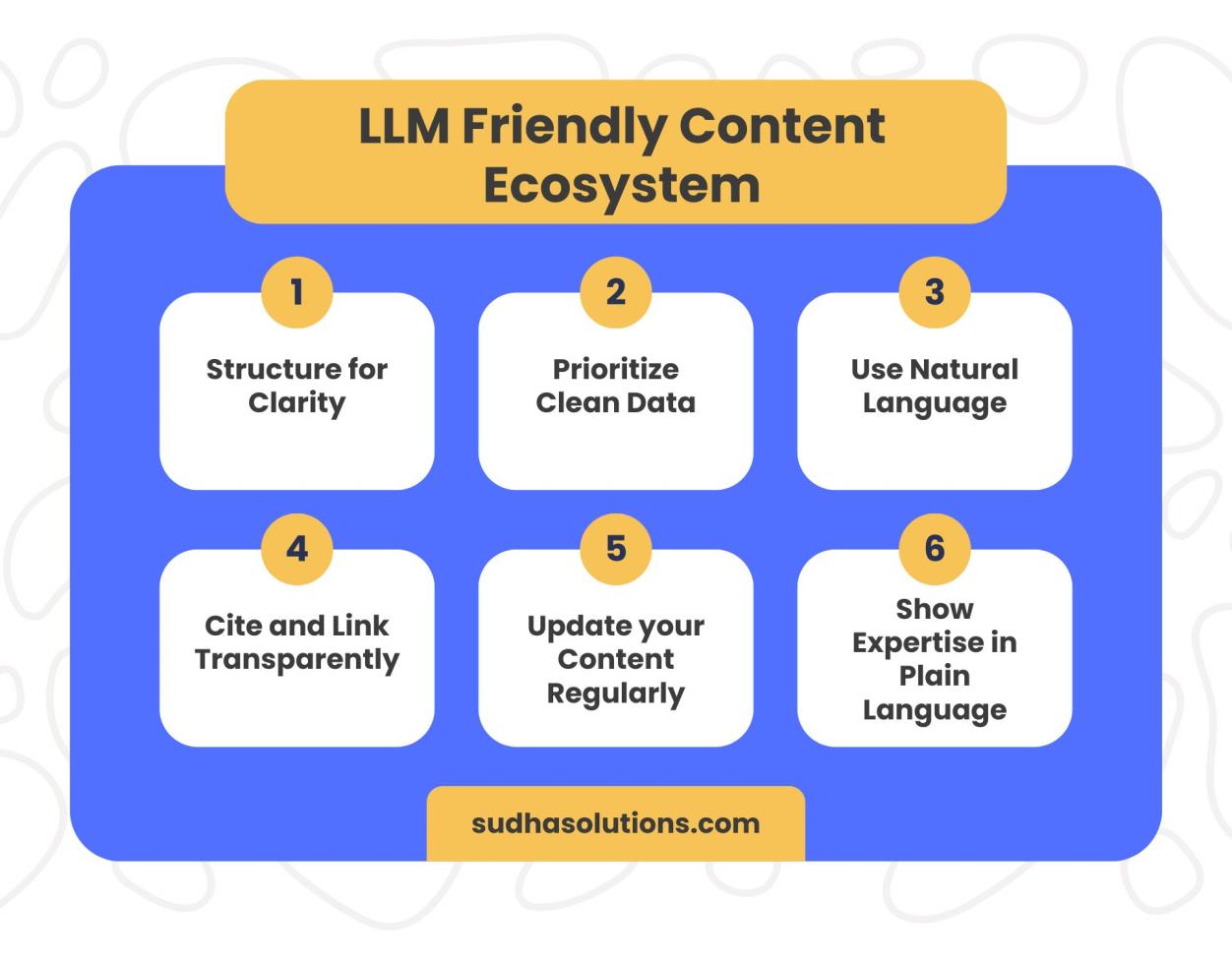
LLM-Friendly Content Ecosystem

Now that we know how LLMs generate answers in search, let’s understand how you can incorporate LLM friendly features in your content. The following principles emerge from multiple SEO + AI studies and align closely with Google’s own guidance.  

Structure for clarity   

Use logical headings, question-style subheads, and short introductory answers. These help retrieval systems map your page sections to specific user intents.  

Prioritize clean data  

Schema markup, FAQ blocks, and product metadata allow AI systems to parse relationships without guessing. Structured data is the new sitemap.  

Write with semantic depth  

Include variations of related terms, not just primary keywords. LLMs work through embeddings that connect related ideas. When your content reflects natural language variety, it earns stronger semantic signals.  

Cite and link transparently  

Outbound citations to credible sources increase the model’s confidence score. AI models show a measurable bias toward pages that provide supporting evidence.  

Refresh frequently  

Freshness is a trust signal. Both search crawlers and AI retrievers favor recently updated pages because recency suggests reliability.  

Show expertise in plain language  

LLMs value explainability. When an expert’s knowledge is expressed in clear, direct terms, it becomes easier to reuse and quote inside generated output.  

Measuring Performance in the New Landscape 

Traditional metrics like impressions and click-through rates still matter, but they no longer tell the whole story. Visibility now includes presence in AI-generated results, summarized citations, and conversational mentions.  

Here are practical indicators to monitor:  

  • Citation frequency: How often your domain appears as a source in AI summaries or answer boxes. 
  • Semantic coverage: The range of related queries for which your content appears in generative search results.    
  • Engagement depth: Time on page and scroll depth remain relevant because they signal that users value the content models are quoting. 
  • Brand recall in generated answers: Track whether your brand name appears inside generated responses on platforms like Perplexity or ChatGPT when your topic is queried.  

These signals reveal whether your brand is being recognized as an authoritative contributor inside the AI knowledge graph, not just the organic SERP.  

The Changing Mindset for Brands 

For brands, this transformation is less about tactics and more about mindset. SEO can no longer be treated as a mechanical checklist. It is an evolving system of influence inside a network of intelligent models.  

Brands need to ensure that their teams approach content as structured knowledge assets rather than marketing copy. They must coordinate SEO, content, and data teams to maintain alignment between technical markup, brand narrative, and audience search intent.   

The brands that succeed in this environment will be the ones that treat every article, product page, and insight as something a machine can understand, not just a human can read.  

Conclusion 

Search and AI are converging into a single ecosystem where learning, ranking, and answering happen together. LLMs are not replacing SEO. They are redefining what optimization means. Authority now extends beyond backlinks into semantics, clarity, and consistency.  

If your content can help an AI system explain something clearly, it can help your audience understand it too. That alignment between human readability and machine interpretability is where the next decade of digital visibility will be won. 

Want your brand to appear on AI platforms like ChatGPT, Perplexity, and Grok? We at Sudha Solutions have a proven plan that has helped multiple brands rank on both Google Overview AI platforms.  

Our experienced team of SEO and content marketing experts ensures your brand becomes the preferred source that AI systems retrieve, score, and cite in their answers. From strategic content optimization to citation-driven authority building, we help you win visibility where users make decisions. Contact us Today 

Categories
GEO Optimization GEO vs SEO

The Rise of Branded Mentions – Why GEO Is About Authority, Not Just Keywords

In the digital arena of late 2025, where AI-driven searches are reshaping consumer journeys across India, understanding what GEO search is has become crucial for e-commerce leaders and marketing visionaries. 

As per a recent report, 95% of Indian consumers use AI for purchase decisions in urban India, underscoring why GEO vs SEO debates are heating up. 

This blog unpacks the essence of GEO, shares GEO optimization tips and strategy tailored for Indian brands, blending authority-building with localised GEO-based marketing strategies

Key Takeaways:

GEO: Crafts content AI engines cite directly; prioritising branded authority over traditional keyword rankings.

GEO vs SEO: While SEO hunts for clicks, GEO secures narrative control in zero-click environments.

Practical Tips: Leverage schema, statistics, and multilingual content for Indian markets.

Challenges and Opportunities: Evidence suggests GEO boosts visibility by 30–35%, though measuring citations remains tricky. Balance it with hybrid approaches.

Demystifying What is GEO Search 

GEO Search At its core, Generative Engine Optimisation (GEO) refers to the deliberate enhancement of online content to amplify brand visibility within AI tools like Perplexity, Gemini, and ChatGPT. 

Unlike conventional search, where users click through links, GEO ensures your brand’s voice is woven into the fabric of the answer itself; think cited statistics, quoted insights, or direct attributions. 

In 2025, with India’s internet users hitting 900 million, GEO’s rise is propelled by the shift to conversational queries, where AI engines synthesise information from authoritative sources. 

Research highlights that GEO transforms search into a “system of record” for brands, tracking mentions across LLMs to gauge influence. For e-commerce players in Mumbai or Bengaluru, this means optimising product narratives not just for Google ranks, but seamless integration into AI recommendations during festive shopping spikes.

GEO vs SEO: Navigating the New Divide 

GEO VS SEOThe perennial question of GEO vs SEO boils down to intent and outcome. 

SEO, the bedrock of digital visibility since the early 2000s, excels at driving traffic through keyword-optimised pages and backlinks, measurable via clicks and conversions. 

GEO, however, thrives in the AI era, focusing on entity recognition and citation frequency to embed your brand in generative outputs, often reducing the need for site visits yet amplifying trust.

Key contrasts include: 

  1. Metrics: SEO tracks rankings and CTR; GEO monitors branded mentions and sentiment in AI responses.
  2. Content Style: Keyword density for SEO; authoritative, quotable elements like stats and expert quotes for GEO.
  3. User Journey: SEO funnels users to your site; GEO delivers your message inline, ideal for quick-decision markets like India’s Tier-2 cities.
    Studies show that hybrid strategies (GEO + SEO) deliver 30-40% visibility gains in AI-generated answers, as AI engines still reference top SEO pages. 
  1. Controversy lingers: some experts decry GEO as “unpredictable” due to opaque algorithms, but evidence leans toward its superiority for brand recall, especially in multilingual Indian contexts.
    With the differences clear, the next step is building a strategy that positions your brand where AI looks for credible answers.

How to Craft a Winning GEO Optimization Strategy 

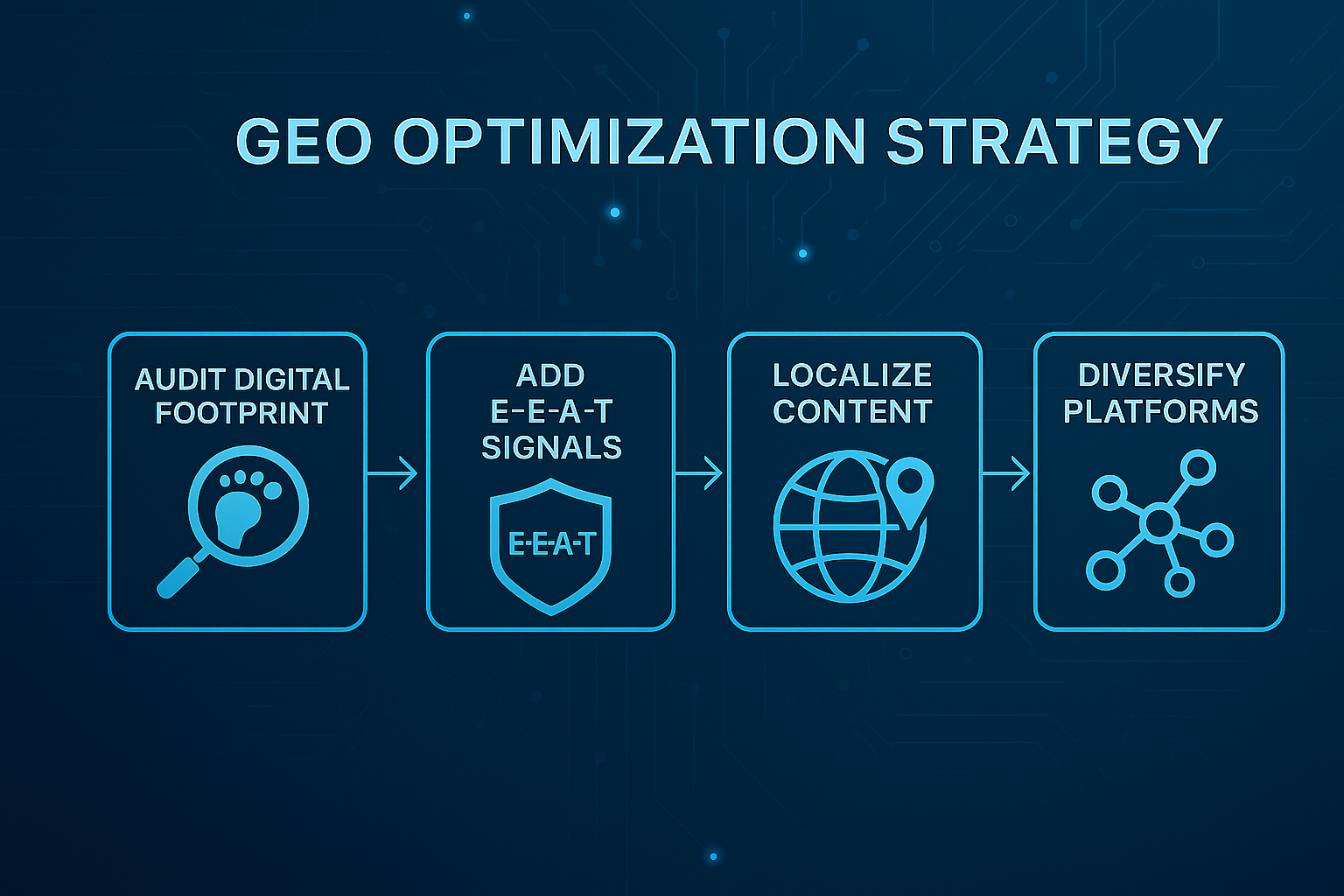
GEO Optimization Strategy

This is a reference image.  

A solid GEO optimization strategy makes your brand a go-to source for AI crawlers. Here’s what you need to do: 

  1. Start by auditing your digital footprint: Identify gaps in entity coverage using tools like Google’s Entity Explorer.
  2. Infuse content with E-E-A-T markers: Drive experience via case studies, expertise through bylined articles, authoritativeness with third-party endorsements, and trustworthiness via transparent sourcing.
  3. Integrate GEO-based marketing strategies by localising: For Indian brands, create Hindi-English dual-language guides on topics like “sustainable fashion trends in India,” enriched with regional stats.
  4. Diversify across platforms: Utilise TikTok Reels for visual mentions, LinkedIn for B2B citations to feed AI’s multi-source appetite.

Essential GEO Optimization Tips for Everyday Wins 

Here are battle-tested GEO optimization tips to elevate your branded mentions: 

  • Embed Quotable Gems: Pepper content with unique statistics (e.g., “India’s e-commerce market to hit ₹10 lakh crore by 2026”) and expert pull-quotes. AI loves citing these more often. 
  • Foster Branded Mentions: Encourage UGC on socials and partner with influencers for co-created content. You can track this via tools like Brandwatch for AI pickup. 
  • Narrative Fluency: Write in conversational tones, anticipating queries like “best eco-friendly brands in Delhi,” to align with natural language processing. 
  • Freshness Factor: Update evergreen assets quarterly with yearly timestamps; stale content declines in AI relevance. 

Sudha Solutions has guided Delhi-based retailers to a 50% surge in AI-cited mentions using these tips, turning authority into tangible sales lifts.

GEO vs SEO Tactics at a Glance 

Aspect  SEO Focus (Traditional)  GEO Focus (AI-Driven)  India-Specific Twist 
Core Goal  High rankings & traffic  Branded citations & authority  Local entity recognition (e.g., Hinglish queries) 
Content Elements  Keywords, meta tags  Stats, quotes, schema  Bilingual stats from RBI/NITI Aayog 
Measurement  CTR, bounce rate  Mention frequency, sentiment  Regional conversion via Google Analytics Geo-reports 
Platforms  Google SERPs  Google’s AI Overviews, ChatGPT  JioMart integrations for voice search 
Risks  Algorithm penalties  Citation dilution  Cultural nuance misses in AI training 
Quick Win  Backlink building  Expert roundups  Festive campaign tie-ins (Diwali UGC) 

Advanced Horizons: GEO in a Branded Ecosystem 

Looking ahead, GEO’s potency lies in ecosystem plays: Integrate with voice assistants like Alexa for geo-targeted audio mentions, or leverage Web3 for verifiable brand credentials. 

Reports also warn about “GEO fatigue” from over-optimisation, advocating ethical practices like human-curated content to sidestep AI biases. For Indian e-commerce, this means piloting GEO-based marketing strategies around sustainability (e.g., optimising for “zero-waste brands in India”) to tap Gen Z’s values. 

Metrics evolve too: Beyond citations, gauge “influence score” via LLM analytics tools, revealing a 20% uplift in trust for authority-rich brands.

Sudha Solutions: Your GEO Ally in India’s Digital Surge 

 As Mumbai’s vanguard in e-commerce transformation, Sudha Solutions crafts bespoke GEO optimisation strategies that harness branded mentions for exponential growth. Our clients in Hyderabad and Chennai have witnessed 45% higher AI visibility, fuelling Diwali sales booms. 

Keen to audit your GEO readiness?
Drop us a line at [email protected] or explore https://www.sudhasolutions.com/ for a no-obligation consultation. 

In this authority-first landscape, GEO is not a trend but your brand’s enduring legacy. Let’s build it together.  

Categories
AEO Optimization General SEO

How to Optimize for AEO: Ranking Reddit & Quora Content in AI Search

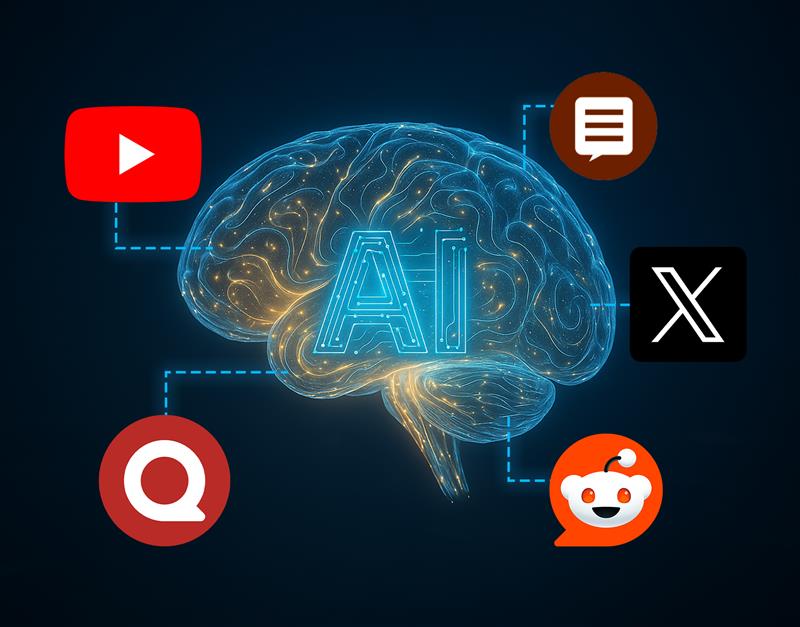
Notice how Reddit threads and Quora responses are showing up in Google’s AI overviews and even ChatGPT results? It’s not a coincidence. It’s a result of a quiet revolution shaping search engines and AI models to surface information.   

Unlike traditional SEO, where keyword density and backlinks ruled, AEO focuses on clarity, authority, and context.   

In this guide, we’ll explore how to optimize for AEO using Quora and Reddit, understand why AI prefers these platforms, and learn practical optimisation tactics to ensure your content gets picked up, cited, and ranked in the new era of AI search.  


From SEO to AEO: The Shift from Search to Direct Answers 
 

Shift from SEO to AEO

For years, SEO has focused on keywords, backlinks, and technical improvements, but with the rise of AI platforms like Google Overviews, ChatGPT, Perplexity, and more, the rules are being rewritten.  

These pages don’t display top pages; rather, they generate summarised conversational answers by getting information from credible sources across the web. Here’s the data of all the sources along with the percentage. 

Platform  Percentage 
Reddit  40.11% 
Wikipedia  26.33% 
YouTube  23.52% 
Google  23.28%  
Yelp  21.01% 

AEO is the process of making your content easily discoverable and quotable by AI systems that aim to answer user questions directly, rather than just list websites. 


Why Reddit and Quora Are Suddenly Dominating AI Search
 

Reddit and Quora are answer based platforms where users get direct and concise answers for their questions, something AI platforms appreciate. These platforms excel at: 

  • E-E-A-T Signals (Experience, Expertise, Authoritativeness, Trustworthiness) through real voices and firsthand experiences. 
  • Semantic richness, with threads covering long-tail questions in conversational formats. 
  • High engagement, where upvotes and comments serve as credibility indicators. 

In short, the trust and context depth of platforms like Reddit and Quora is well appreciated by AEO. 


What Makes AEO Different from Traditional SEO
 

Think of SEO as visibility optimization and AEO as answer-first content optimization. In SEO, the goal is to make search engines understand your relevance. In AEO, the goal is to make AI models select you as part of their answer.  

Parameters  SEO Focus  AEO Focus 
Goal  Rank on SERPs.  Be quoted in AI-generated answers. 
Optimisation Method  Keywords, backlinks, meta tags.  Semantic depth, clarity, Q&A structure. 
Platforms  Google, Bing  AI overviews, ChatGPT, Perplexity. 
Signal Strength  Crawlability and authority  Contextual accuracy and engagement. 

AEO is not replacing SEO. It’s becoming a parallel specialisation that coexists with SEO and GEO (Geographical Optimisation), extending visibility from links to answers 


How Can Brands Leverage Reddit & Quora for AEO? 
 

Brands that once avoided Reddit or Quora are now realising their strategic value in an AI search. These platforms have become content playgrounds for brand visibility when handled with authenticity.  


Here are some of the best practices for AEO: 


Find Active Conversations in Your Domain 
 

Use tools like AnswerThePublic to identify trending questions related to your niche. Then find corresponding Reddit or Quora threads that already rank or are gaining traction.  

Craft Genuine, Conversational Answers

Please craft your responses with the expertise of a specialist, rather than from a marketing perspective. Provide valuable insights, cite credible sources, and avoid promotions. AI systems prioritise clear, contextual information over promotional tone. Check out Reddit best practices to improve your chances of engagement. 

Optimise the First Two Lines   

Make the opening of your answer self-contained. Use natural language and include primary keywords (e.g., “AEO”, “AI search”, and “optimise for Google AI Overviews”) early for algorithmic detection.  

Link to Authoritative Resources  

Support your answer with backlinks to credible research, white papers, or blogs. This creates a bridge between community engagement and your brand domain, strengthening authority. A PhD thesis found that authoritative links when used properly can contribute to improved trust and hence potential ranking benefits.   

Encourage Engagement  

Ask for opinions, invite follow-ups, or respond to comments. Active engagement tells AI crawlers the discussion is evolving and valuable, increasing its visibility in AI summaries.  


The 4-Step AEO Optimisation Framework 
 

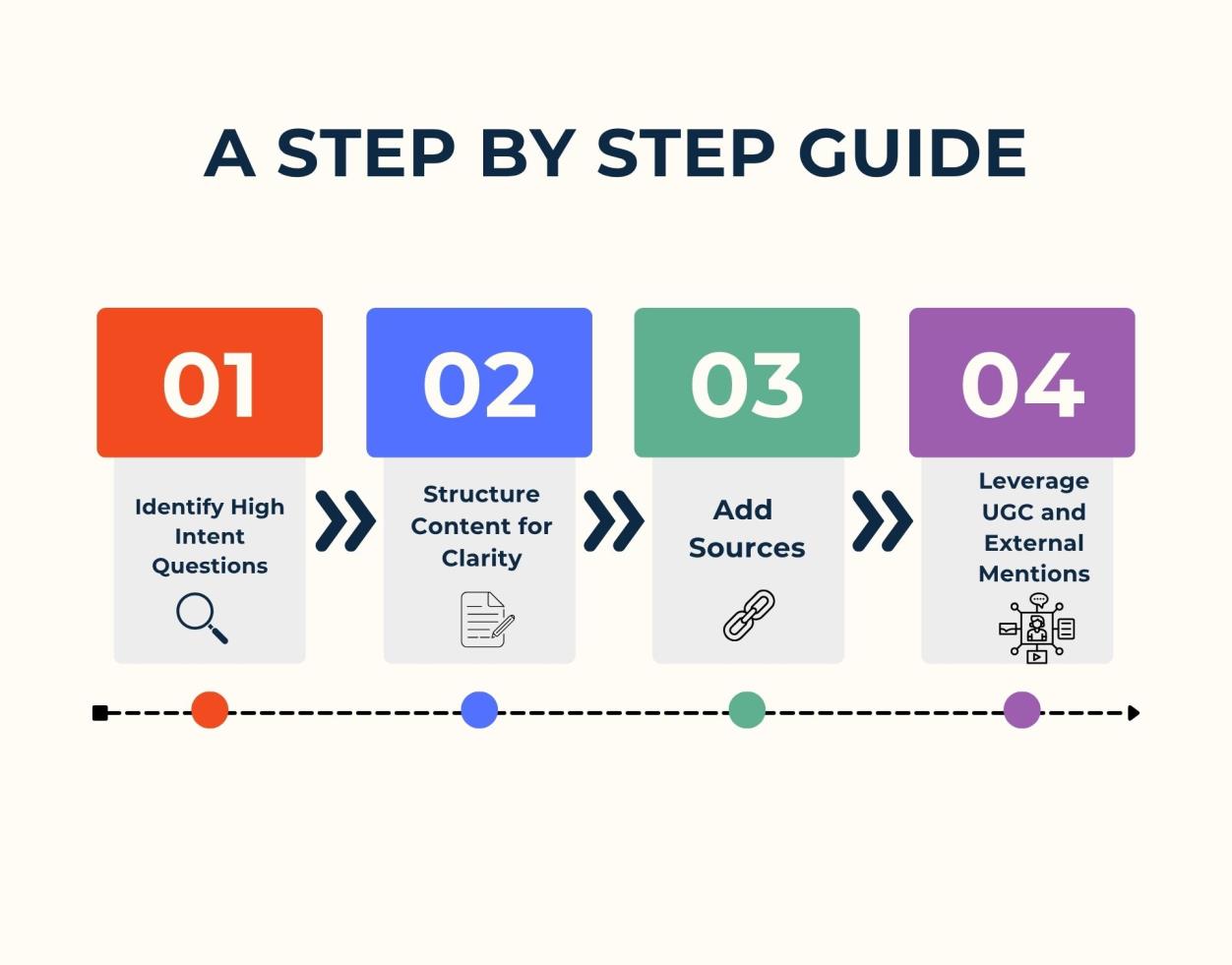
4-Step AEO Optimisation Framework For brands looking to align their overall content strategy with answer engine content strategy, here’s a step-by-step framework:  


Step 1: Identify High-Intent Questions 
 

Use Google’s “People Also Ask”, Reddit’s search, and Perplexity.ai queries to uncover questions users actually ask.  

Step 2: Structure Content for Clarity  

Use question-based headings, bullet points, and short paragraphs. AI systems extract information from structured content more easily.  

Step 3: Layer in Context and Sources  

Don’t just state facts; add reasoning, examples, or user context to make your content stand out in semantic scans.  

Step 4: Leverage UGC and External Mentions  

Repurpose your insights into Quora or Reddit discussions to multiply your presence in the AI-visible ecosystem.  

These 4 steps will increase your chances of visibility on AI platforms.  


Expert Insights: What Google and SEO Thought Leaders Say 
 

Google’s Search Liaison Danny Sullivan has hinted that AI Overviews aim to “connect users with a range of perspectives, not just official sources.” This aligns with how Reddit and Quora provide multi-voice answers, a quality AI models find useful for context diversity.  

Experts like Marie Haynes and Lily Ray also emphasise the growing importance of EEAT and human-first content that feels credible, lived, and personal. That’s exactly the space Reddit and Quora dominate and where brands must learn to contribute meaningfully.  


AEO, GEO, and EEAT: The New Search Trinity 
 

AEO isn’t replacing SEO; it’s expanding it. The future of digital visibility is a combination of:  

  • AEO: Optimising content for AI-generated answers  
  • GEO: Tailoring visibility to geographic and local AI search contexts  
  • EEAT: Ensuring every piece of content demonstrates real expertise, experience, authority and trustworthiness  

Together, they form the new SEO stack for the AI age, where traditional ranking factors merge with conversational intelligence.  


Conclusion 
 

Search is evolving from a list of links to a layer of conversation. The winners won’t be the ones shouting the loudest but those offering the clearest, most contextual answers.
By mastering AEO and using platforms like Reddit and Quora strategically, brands can ensure their expertise becomes part of the world’s digital dialogue—one AI answer at a time.  

If you want your brand to show up in AI platforms, you should check out Sudha Solutions. We have a proven strategy that has helped multiple brands enhance their visibility across AI platforms.   

Along with AEO services, we also provide services like content marketing, retention marketing, UI/UX designs, ecommerce website development, and app development. Contact us TODAY.   

Categories
AI Overview General SEO

How to Optimize for AI-Powered Search: Strategies for Google, ChatGPT, & Perplexity

AI-powered search engines are reshaping how users discover information, with tools like Google’s AI Overviews, ChatGPT, and Perplexity leading the charge. For e-commerce businesses and decision-makers in India, mastering how to optimize for AI-powered search is essential for maintaining visibility and driving conversions.  

Research suggests that AI-driven searches could surpass traditional queries by 2028, potentially reducing organic clicks by up to 25% while boosting high-intent traffic. This guide outlines practical strategies to help your brand rank higher in these ecosystems, drawing on the latest SEO guidelines that prioritise E-E-A-T (Experience, Expertise, Authoritativeness, Trustworthiness), structured data, and user-centric content. 


Understanding AI’s Impact on Traditional Search
 

AI integration in Google Search, via features like AI Overviews and AI Mode, is transforming rankings. As of 2025, these summaries appear in 19% of results, pulling from top-ranking pages but prioritising concise, helpful answers. It seems likely that how AI affects Google search rankings involves a shift from keywords to entity-based Optimization, where AI identifies key concepts and relationships.  

For instance, pages with strong domain authority and backlinks still feed into AI selections, but low-quality content risks being sidelined. Indian businesses should note that mobile-first indexing and Core Web Vitals remain critical, as AI favours fast, accessible sites


Quick Wins for AI-Powered Webpage Optimization
 

  • Enhance Page Structure: Use clear headings, bullet points, and FAQs to aid AI parsing. 
  • Incorporate Multimedia: Add alt-text-optimised images and videos, as Perplexity and ChatGPT increasingly cite visual content. 
  • Build Backlinks Thoughtfully: Focus on quality links from niche Indian sites to boost trustworthiness. 
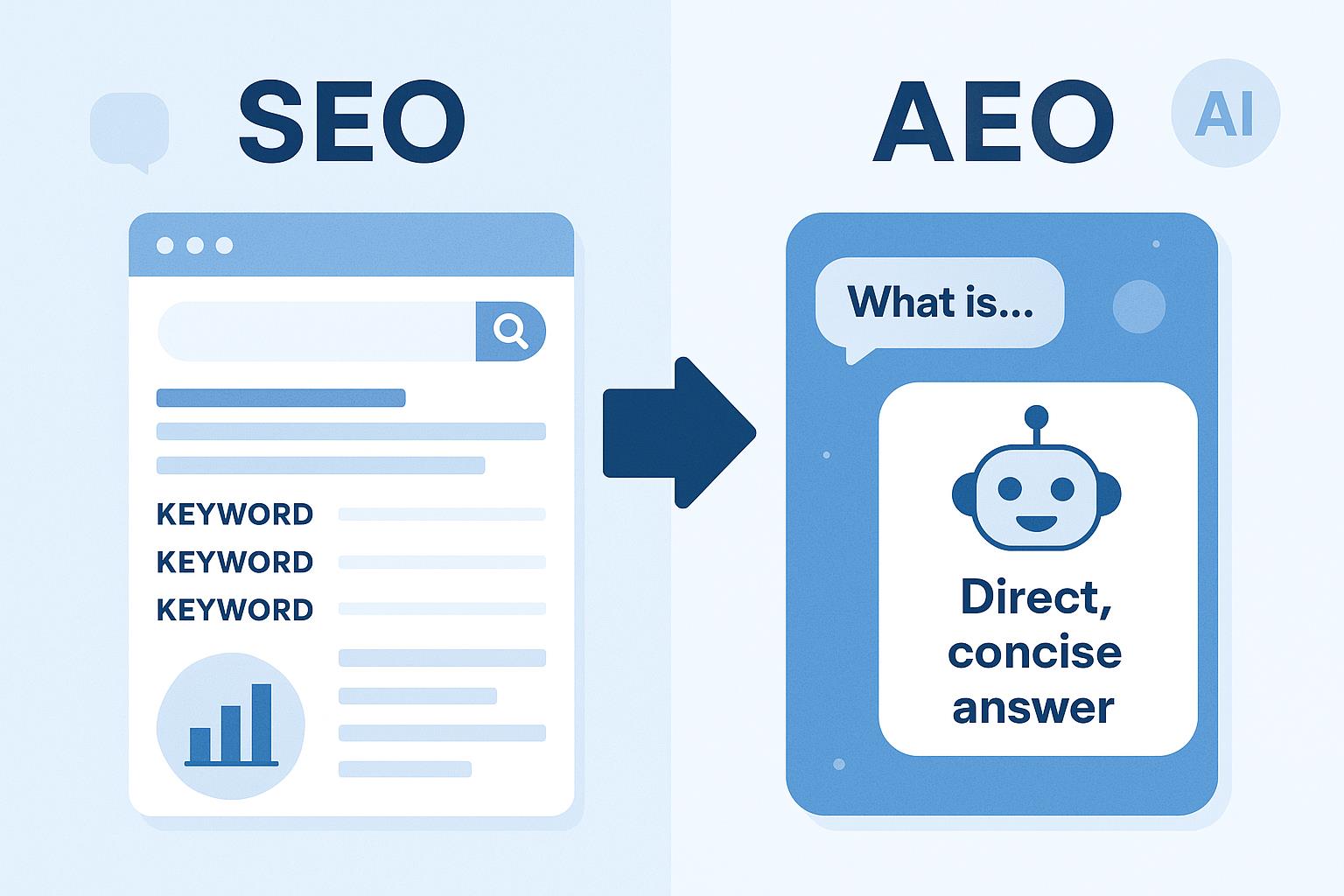
At Sudha Solutions, we’ve helped e-commerce clients globally adapt these tactics, resulting in an average 40% increase in AI-cited traffic. Ready to future-proof your site? Reach out for a free audit. 

In the bustling digital marketplace of 2025, where over 70% of Indian internet users rely on search for product discovery, the rise of AI-powered engines demands a rethink of traditional SEO playbooks. This comprehensive exploration delves into how to optimize for AI-powered search, with tailored strategies for Google, ChatGPT, and Perplexity. Drawing from authoritative sources like Google’s developer guidelines and recent studies on generative engine Optimization (GEO), we’ll unpack the nuances of optimization in AI, AI optimization, how to rank in AI search results, AI-powered webpage Optimization, and how AI affects Google search rankings. Our aim is to equip decision-makers—be they e-commerce founders, marketing heads, or CXOs—with actionable insights to not just survive but thrive in this AI-driven era. 



The Shifting Sands of Search: AI’s Profound Influence
 

Influence of AISource: Freepik 

The integration of artificial intelligence into search isn’t merely an upgrade; it’s a paradigm shift. Google’s AI Overviews, launched in expanded form by mid-2025, now generates dynamic summaries for complex queries, often drawing from the top 10-12 organic results.  

Similarly, AI tools like ChatGPT and Perplexity bypass traditional blue links, synthesising answers from web crawls, and real-time data. A Pew Research analysis from July 2025 reveals that users encountering AI summaries click external links 15-20% less frequently, yet those clicks carry 4.4 times higher value due to refined intent.  

For Indian brands, this means how AI affects Google search rankings is twofold: it amplifies authoritative voices while penalising weak content, with AI visitors converting at rates up to 30% above average. 

Controversy swirls around AI’s democratising potential—critics argue it favours big publishers, but evidence from Semrush’s 2025 study shows smaller, niche sites with strong E-E-A-T can punch above their weight by focusing on local relevance, such as Hindi-English bilingual content for the Indian market. At its core, AI optimization hinges on making your content “AI-friendly”: scannable, factual, and intent-aligned. 


Core Principles of How to Rank in AI Search Results
 

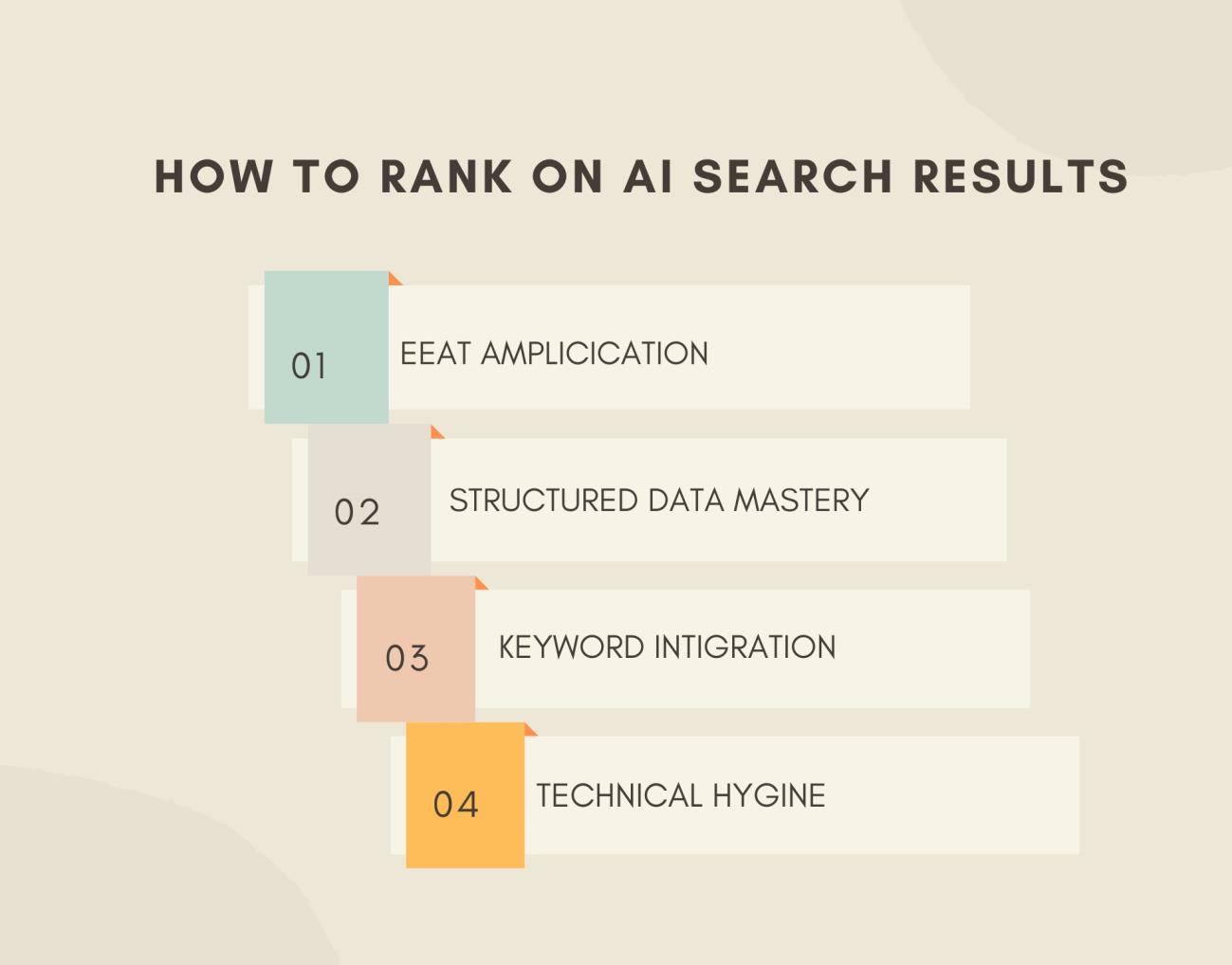
Principles to rank on AI search results

Before platform-specific tactics, grasp the foundational pillars that underpin success across ecosystems. Google’s May 2025 blog emphasises creating “unique, non-commodity content” that satisfies both humans and machines. Key elements include: 

  • E-E-A-T Amplification: Showcase expertise through author bios, case studies, and citations. For e-commerce, include real customer testimonials and product demos to build trust. 
  • Structured Data Mastery: Implement schema.org markup (e.g., FAQ Page, How Tos) to help AI extract entities. Tools like Google’s Structured Data Testing Tool can validate this. 
  • Conversational Keyword Integration: Blend primary terms like “how to optimise for AI-powered search” with long-tail variants, such as “AI Optimization tips for Indian e-commerce.” 
  • Technical Hygiene: Ensure mobile responsiveness, fast load times (under 2.5 seconds), and HTTPS—Core Web Vitals now influence AI selection by 15%. 

A 2025 Salesforce report highlights that AI algorithms analyse user intent via advanced NLP, rewarding content that anticipates follow-up questions. For decision-makers, this translates to ROI: sites optimised for AI see 25% more qualified leads. 


Platform-Specific Strategies: Tailoring Your Approach
 

Each AI tool has unique quirks. Here’s how to navigate them: 


1. Optimizing for Google AI Overviews: Visibility in the Spotlight

Google’s generative features prioritise brevity and relevance, citing sources in 60% of overviews. To secure a spot: 

  • Aim for Top Organic Ranks: AI pulls from high-CTR pages; maintains strong backlinks and on-page SEO. 
  • Format for Snippets: Use numbered lists, tables, and bolded key facts—e.g., “Top 5 AI SEO Tools for 2025.” 
  • Question-Led Content: Target queries like “What is AI-powered webpage optimization?” With direct answers in the first 100 words. 

A Search Engine Land blueprint recommends four technical tweaks: entity extraction via NLP-friendly language, internal linking clusters, and video schema for multimedia boosts. For Indian audiences, localize with geo-specific examples, like optimizing for “best Diwali e-commerce deals via AI search.” 


2. Strategies for ChatGPT: Conversational Mastery

ChatGPT, powered by OpenAI’s models, relies on web-indexed data up to its last training cut-off, but plugins like SearchGPT enhance real-time pulls. Optimization in AI here means: 

  • Narrative Depth: Write in-depth guides (2,000+ words) with storytelling—AI favours comprehensive responses. 
  • Source Credibility: Include hyperlinks to primary data; ChatGPT cites trusted domains 80% more often. 
  • Prompt Engineering Alignment: Structure content as Q&A threads, mirroring user prompts like “Explain AI Optimization for beginners.” 

Insights from a LinkedIn analysis show that GEO—optimizing generative engines—yields 2x visibility in ChatGPT outputs when combined with traditional SEO. 


3. Excelling in Perplexity: Precision and Engagement

Perplexity’s answer-engine model emphasises cited, up-to-date info, with a focus on user follow-ups. Tactics include: 

  • High-Engagement Topics: Choose evergreen queries with low competition; use tools like SEMrush for Perplexity-specific tracking. 
  • Visual and Interactive Elements: Optimise for cited images/videos—Perplexity surfaces multimedia 40% more than text-only. 
  • Freshness Signals: Update content quarterly with timestamps; AI penalizes stale pages. 

A Reddit thread from August 2025 notes that CSS-minimal, readable pages rank higher, as Perplexity strips styling for core text evaluation. 


Comparative Strategies: A Quick Reference Table
 

To streamline implementation, here’s a table comparing Optimization tactics across platforms: 

Aspect  Google AI Overviews  ChatGPT  Perplexity 
Content Length  800-1,500 words (concise summaries)  2,000+ words (in-depth narratives)  1,000-2,000 words (precise answers) 
Key Focus  E-E-A-T & structured data  Conversational Q&A & hyperlinks  Citations & multimedia engagement 
Keyword Style  Question-based, entity-rich  Long-tail prompts  High-intent, fresh topics 
Technical Priority  Core Web Vitals & schema markup  NLP-friendly language  Mobile-readable, timestamped updates 
Measurement Metric  Citation frequency in overviews  Response inclusion rate  Follow-up query visibility 
India-Specific Tip  Local schema for Hindi queries  Bilingual storytelling  Geo-targeted visuals for events 


Advanced Tactics: Elevating Your AI-Powered Webpage Optimization 

For deeper dives, consider these emerging practices: 

  • Entity Optimization: Use tools like Google’s Natural Language API to map concepts—e.g., linking “e-commerce SEO” to entities like “Shopify integration.” 
  • AEO/GEO Hybrid: Answer Engine Optimization complements SEO by targeting voice/AI queries; a Substack guide predicts 50% of searches will be zero-click by 2026. 
  • Analytics Integration: Track AI performance via Google Analytics 4’s AI insights or third-party tools like the Schema App. 
  • Ethical Considerations: Avoid AI-generated fluff; Google’s guidelines stress human oversight to prevent hallucinations. 

In India, where e-commerce grew 25% YoY in 2025, these strategies can unlock untapped markets like Tier-2 cities via localised AI responses. 


Brief Summery
 

  • Prioritise E-E-A-T: Build content that demonstrates real expertise to appear in AI summaries, as algorithms favour authoritative sources over generic material.
  • Leverage Structured Data: Use schema markup to make your pages machine-readable, increasing citation chances in generative responses.
  • Target Conversational Queries: Optimise for natural language questions, as AI tools like ChatGPT thrive on intent-driven searches.  
  • Monitor and Adapt: AI impacts Google rankings by compressing the marketing funnel—focus on top 12 positions for visibility but diversify beyond clicks.  
  • Potential Challenges: While AI enhances discovery, it may lower direct traffic; the evidence leans toward higher conversion rates from AI-referred visitors, though controversy exists around over-reliance on one platform. 


Partnering for the Future: Sudha Solutions’ Expertise
 

At Sudha Solutions, Mumbai’s go-to for e-commerce innovation, we specialise in how to optimise for AI-powered search through bespoke audits, content overhauls, and schema implementations. Our clients have seen 35% boosts in AI-driven conversions. Whether you’re scaling on Shopify or enhancing UX, let’s collaborate to make your brand AI-ready. Contact us at [email protected] or visit www.sudhasolutions.com for a complimentary strategy session. 

This isn’t just about ranking—it’s about redefining relevance in an AI-first world.