





You didn’t get here by accident. You built something real, but scaling now requires more than founder instinct. It requires a structured go-to-market strategy, supported by SEO expert services, performance marketing services, and systems that consistently generate qualified growth.
You built something people actually wanted. You closed your first deals. Hit your first million. Maybe your second or third. And for a while, it felt like things were working.
But lately? It’s different.
You’re doing more, more outreach, more campaigns, more hiring, and the results aren’t keeping up. Deals are taking longer. Your team is stretched. And somewhere in the back of your mind, there’s a question you haven’t said out loud yet:
Are we doing this right?
That question is worth taking seriously. Because at the stage you’re at, somewhere between proving the idea and actually scaling the business, the way you go to market matters more than almost anything else.
Here’s What Nobody Tells You When You Cross $1M ARR
The thing that got you here was probably you.
Your relationships. Your hustle. Your ability to explain the product better than anyone else and convince people to take a chance on it. That’s real, and it worked.
But it doesn’t scale.
You can’t be in every sales conversation. You can’t personally follow up with every lead. And the customers who found you early, the ones who were already half-convinced before they even spoke to you, aren’t the ones coming in now.
The new pipeline is colder. Slower. More skeptical. And your team is trying to sell to them the same way you sold to the early ones – which is why it’s not working.
This isn’t a team problem. It’s a system problem. And the system is called your go-to-market.
What “Go-To-Market” Actually Means (Without the Jargon)
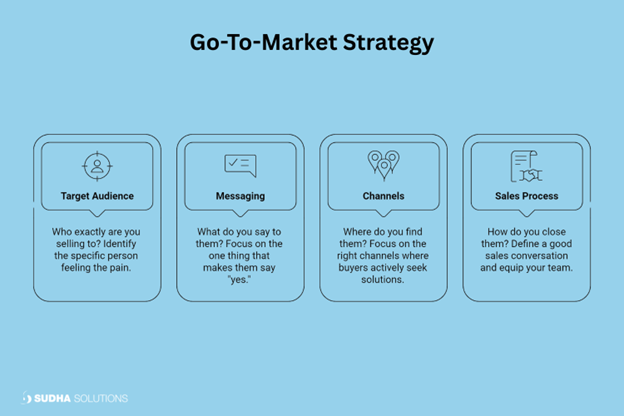
Today, effective go-to-market execution often combines content marketing strategy, professional UI UX design, and lead generation strategy to ensure every customer touchpoint reinforces trust.
Strip away all the buzzwords and a go-to-market strategy answers four simple questions:
Who exactly are you selling to? Not “businesses with 50–500 employees.” That’s not specific enough. Who is the actual person feeling the actual pain your product solves – and what’s happening in their world right now that makes them ready to buy?
What do you say to them? Not a list of features. Not a category claim. What’s the one thing that makes someone think “yes, this is exactly what I’ve been looking for” – and are you actually saying that, clearly, everywhere they encounter you?
In 2026, that visibility increasingly depends on answer engine optimization, ensuring your brand is not only discoverable in search, but also trusted enough to be cited by AI assistants.
Where do you find them? Not every channel. The right channel. Where does your buyer go when they’re actively trying to solve this problem? That’s where you should be. Everywhere else is noise.
How do you close them? What does a good sales conversation look like? What does a bad one look like? Does your team know the difference – and do they have the tools to run it well without you in the room?
If you have clear, honest answers to all four; great. Most companies at your stage don’t. And that gap is quietly costing them.
The Signs Your Go-To-Market Is Leaking
You don’t always know it’s broken. It shows up in smaller ways.
- Leads come in, but they don’t convert the way early customers did. Your first buyers already believed in the problem. They were easy. The ones coming in now need more convincing; and your funnel wasn’t built for that.
- Your sales team is busy, but the pipeline doesn’t show it. This usually means messaging. When what you say is vague, every salesperson compensates differently. One over-explains. One discounts. One just talks more. None of it is consistent, and none of it scales.
- Marketing and sales aren’t really aligned. They’re in the same company, maybe even the same room. But marketing is building one thing and sales is saying something different. Leads come in that sales doesn’t trust. Sales closes deals that marketing didn’t plan for. And both teams feel like the other one doesn’t get it.
- You’re everywhere, but nothing is compounding. Google. Events. Cold email. A newsletter. It’s a lot of activity. Without structural systems like a pillar page SEO strategy, even strong marketing activity can remain fragmented instead of compounding authority over time. But if none of it is connected, if there’s no common thread pulling someone from “I found you” to “I’m ready to buy”, you’re spending energy without building momentum.
- Deals are taking longer than they used to. Sometimes this is the market. But often it’s that your buyers need more reassurance before they commit, and you’re not giving it to them between conversations.
If two or more of these sound familiar, your go-to-market needs work.
What Fixing It Actually Looks Like
You don’t need to rebuild everything. You need to find where it’s breaking and fix that first.
1. Start with who you’re really selling to
Go back to your best customers – the ones who stuck around, paid on time, maybe even sent you referrals. What do they have in common?
Not just their industry or company size. Go deeper. What was going wrong in their business before they found you? Who made the decision to buy? How long did it take them?
That pattern is more valuable than any market research report. It tells you exactly who you should be targeting – and just as importantly, who you should stop spending time on.
2. Then look at what you’re saying
This is where content marketing experts become critical, aligning your website, sales narrative, and brand positioning into one strategic growth message.
In practice, this often means building content that ranks and converts, messaging that not only attracts the right audience but also moves them toward a decision.
Ask three people on your sales team this question: “Why do customers choose us over other options?”
If you get three different answers, that’s your problem right there. Because if your own team can’t articulate it clearly and consistently, imagine what it sounds like to a buyer who’s also talking to your competitors.
Clear messaging doesn’t mean a better tagline. It means everyone, your website, your sales team, your proposals, your follow-up emails, is saying the same thing. A thing that’s true, specific, and actually matters to the person reading it.
3. Then fix your channels
Whether through performance marketing agency execution, seo services in mumbai, or AI-first discoverability, channel depth matters more than channel quantity.
The bigger question is whether your current mix reflects the right balance of performance marketing vs content marketing, so you’re not just generating traffic but building sustainable pipeline momentum. Deeper presence on the right channels usually is.
The right channel is wherever your buyer goes when they’re actively looking to solve the problem you solve. If you don’t know where that is, ask your best customers how they found you. The answer is usually in that conversation.
4. Then build a sales process that works without you
Document what a good sales conversation looks like. What questions get asked. What objections come up. What a good fit looks and sounds like versus a bad one.
When that knowledge lives only in your head, your team is guessing. When it’s written down and practised, it becomes a system – and systems scale in a way that individuals don’t.
The Honest Truth About This Stage
Scaling from $1M to $10M ARR is genuinely hard. Not because the market isn’t there, and not because your product isn’t good enough.
It’s hard because the rules change.
What got you to $1M, speed, instinct, founder energy, starts working against you as you try to grow. You need structure now. That structure increasingly includes a strong brand authority strategy, where how your business is discussed across search, AI, and digital ecosystems directly impacts growth. Not the kind that slows you down, but the kind that lets other people carry the weight alongside you.
The founders who get through this stage well aren’t the ones with the biggest budgets or the most aggressive targets. They’re the ones who got honest, early, about what was actually breaking; and fixed it at the root instead of patching over it.
Where Sudha Solutions Comes In
We work with founders at exactly this stage; businesses that have proven the idea and are now trying to scale it properly.
What we do is full-funnel: strategy and execution together. Because a great strategy that nobody executes is just a document. And execution without strategy is just expensive trial and error.
We help you figure out what’s breaking, build the system to fix it, and run it with you; so growth stops feeling like something that happens to you and starts feeling like something you’re in control of.
If this piece made you think about your own business, we’d love to hear what you’re working through.
Just a real conversation about where you are and what might help.
Frequently Asked Questions
What is a go-to-market strategy?
A go-to-market strategy is a clear plan for who you’re selling to, what you’re saying to them, where you reach them, and how you convert them into customers in a way that can scale beyond the founder.
How do you know if your go-to-market strategy is broken?
You’ll usually see signs like declining conversion rates, longer sales cycles, inconsistent messaging across your team, and growing effort that doesn’t translate into proportional revenue.
Why are my leads not converting like they used to?
Because early customers were already problem-aware and easier to convince, while newer leads are colder, more skeptical, and require clearer positioning, stronger messaging, and more structured nurturing.
How do I define my ideal customer profile (ICP) more precisely?
Look at your best existing customers and identify shared patterns in their problems, buying triggers, decision-makers, and outcomes, then focus your efforts on finding more of those specific profiles.
How do I align marketing and sales teams effectively?
Alignment comes from shared definitions of the ideal customer, consistent messaging, agreed qualification criteria, and regular feedback loops so both teams work toward the same revenue outcomes instead of separate goals.