Sudha Solutions

Categories
AI Overview chatgpt citations

ChatGPT vs Google – Where Should Your Business Focus in 2026?


This is one of the most debated questions in digital marketing right now. And it’s usually framed the wrong way. 

Most conversations about ChatGPT vs Google are structured as a competition; as if a business has to pick a side, bet on a winner, and shift all its energy accordingly. The data doesn’t support that framing. What it actually shows is two platforms doing fundamentally different jobs, attracting buyers at different points in the decision process, and requiring different but overlapping strategies to win on each. 

The smarter question isn’t “which one should we focus on?” It’s “what is each platform actually doing for our business, and are we showing up on both?” 

This article looks at what the data says about each platform’s real role in the buyer journey; and what that means for where to put effort in 2026. 

Start With the Volume Reality 
Start With the Volume Reality

Google still dominates search by a wide margin. It processes over 5 trillion searches annually, according to Google’s own internal data published in January 2025. ChatGPT processed approximately 2.5 billion prompts daily as of July 2025 – significant in absolute terms, but roughly one-eighth of Google’s daily query volume when filtered for traditional search-like queries. 

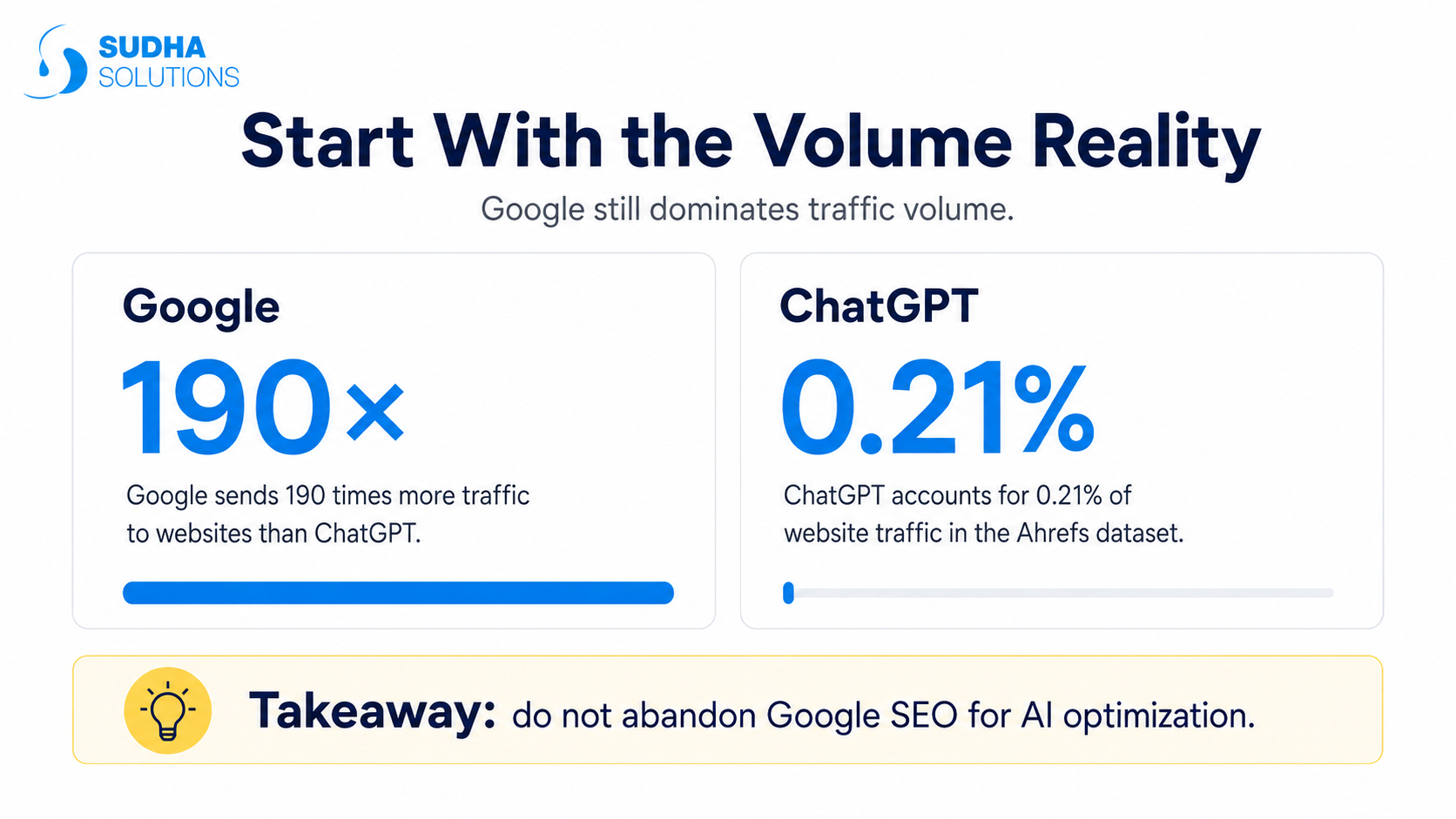
When it comes to traffic sent to websites, the gap is even more dramatic. Ahrefs’ research published in February 2026, based on data from 76,000 websites, found that Google sends 190 times more traffic to websites than ChatGPT. Google accounts for nearly 40% of all website traffic. ChatGPT accounts for 0.21%. 

For any business that relies on website visits to generate leads, this gap matters enormously. Abandoning Google SEO in favour of AI optimisation right now would be a serious mistake. 

But that’s only half the picture. 


The Conversion Rate Story Changes the Calculation 
The Conversion Rate Story Changes the Calculation

Here’s where things get more nuanced. While ChatGPT sends far less traffic than Google, the visitors it does send often behave differently – and convert at meaningfully higher rates. 

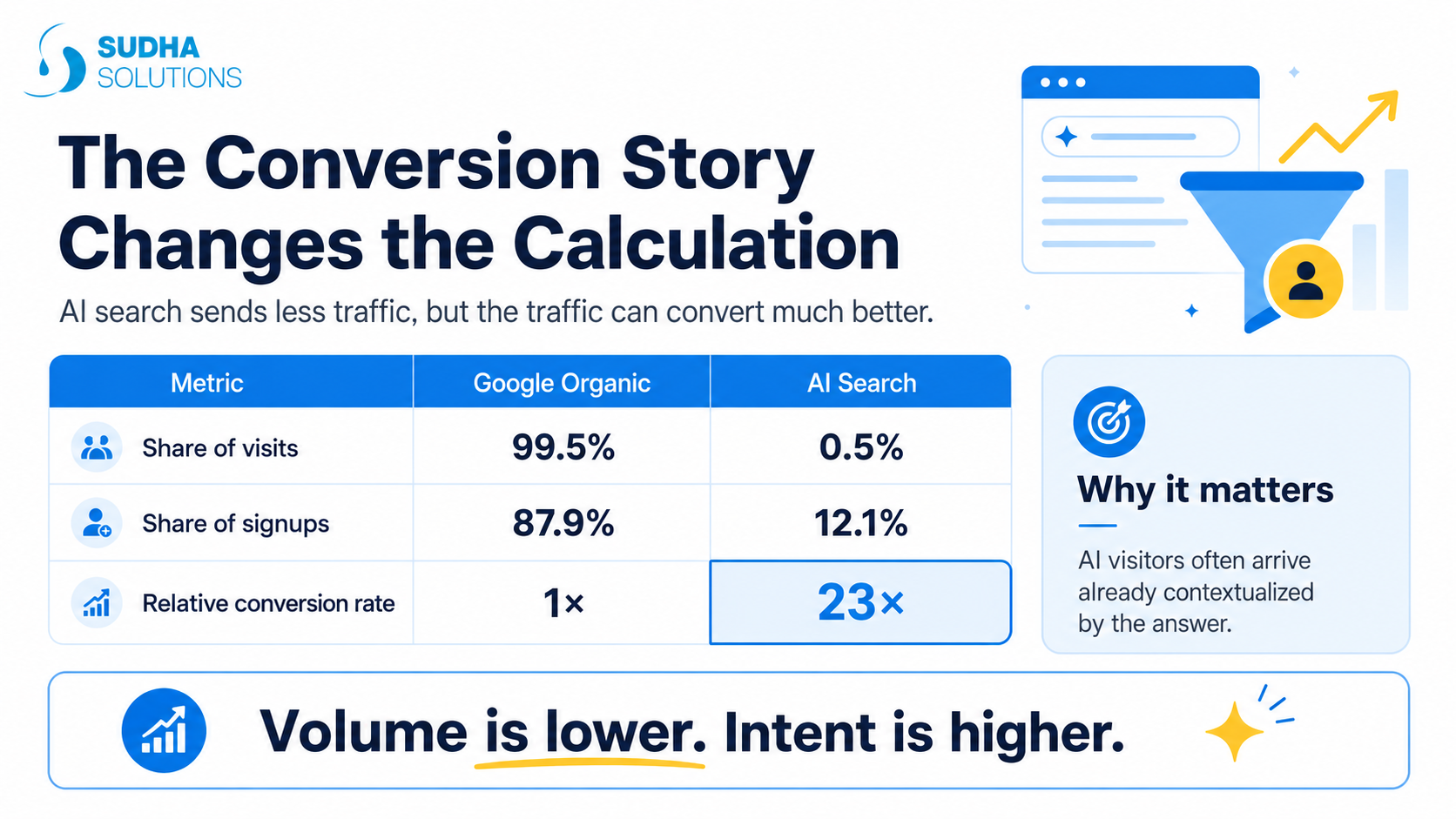
Ahrefs tracked conversion behaviour across its own platform and found that AI search traffic accounted for just 0.5% of visits but drove 12.1% of signups. That translates to AI search visitors converting at 23 times the rate of traditional organic search visitors. 

Ahrefs is one data point, but the pattern holds across other sources. Cross-industry data from 2025 and 2026 consistently shows AI referral conversion rates running 4 to 5 times higher than standard organic search traffic, with the strongest advantage in B2B SaaS and professional services. 

The reason isn’t complicated. When ChatGPT recommends a brand, it typically explains what the brand does and why it’s relevant to the query. The visitor arrives already contextualised – they’re not browsing, they’re evaluating. That’s a fundamentally different kind of traffic than someone clicking a Google result to read a blog post. 

The volume is lower. The intent is higher. Both things are true. Businesses partnering with an experienced AI search optimization agency are increasingly focusing on high-intent AI traffic and conversion-driven visibility strategies. 

What Each Platform Is Actually Used For 
What Each Platform Is Actually Used For

Understanding why this conversion gap exists requires looking at how users actually use each platform. 

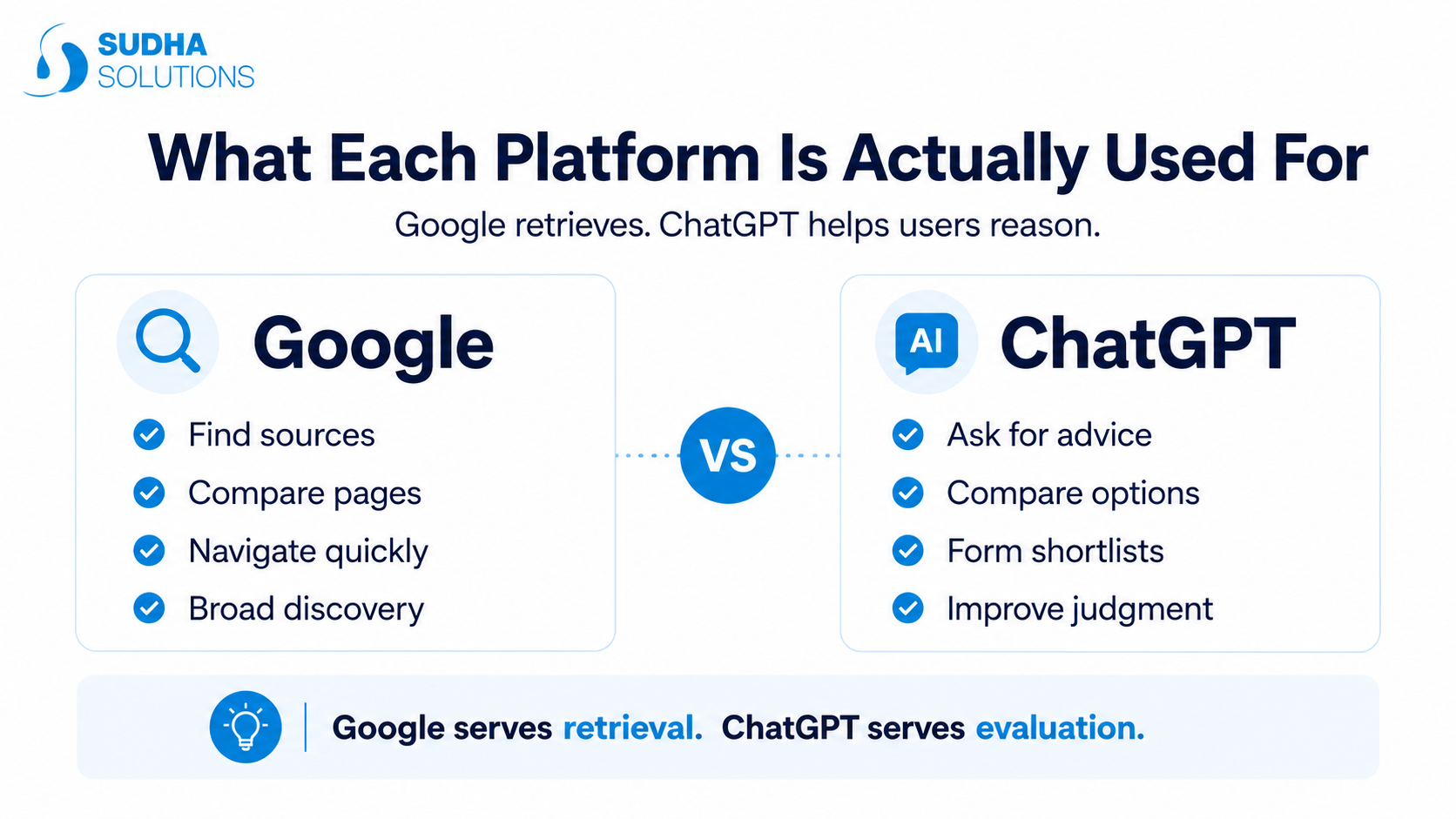
Research from OpenAI and Harvard, analysing 1.5 million conversations, found that 24% of ChatGPT usage is pure search behaviour and 51.6% is what researchers called “asking intent” – where users seek advice, perspective, or information to improve judgment. Users aren’t just looking something up. They’re trying to work something out. 

Google, by contrast, remains primarily a retrieval engine. People go there knowing what they want to find and looking for the right source to find it. The intent is more transactional and more varied – from quick factual lookups to product comparisons to content consumption. 

For B2B buying journeys specifically, research has found that generative AI tools were the single most cited meaningful interaction type for researching purchases in 2025. And 29% of B2B buyers now start their research journey with an AI tool rather than a Google search – a number that has grown three times faster among B2B buyers than consumers. 

That 29% is the part of the funnel happening before a buyer ever types anything into Google. If a brand isn’t present in AI answers, it’s invisible during a growing portion of early-stage vendor consideration; even if its Google rankings are strong. 

The Overlap Is Lower Than Most People Expect 
The Overlap Is Lower Than Most People Expect

One of the most important findings for businesses trying to manage both channels is how little the two platforms share in terms of which sources they cite. 

Ahrefs’ Brand Radar research, which analyzed 76.7 million AI Overviews, 957,000 ChatGPT prompts, and 953,500 Perplexity prompts, found that Google shows a strong correlation between branded web mentions and visibility – consistent with how Google has always favoured established brands. ChatGPT showed a much weaker correlation with the same signals. Perplexity weaker still. 

This matters because it means winning on Google does not automatically translate to winning on ChatGPT. The two platforms use overlapping but distinct signals to decide what to surface. Understanding how AI search engines rank content is becoming increasingly important for businesses investing in GEO and AI visibility strategies. 

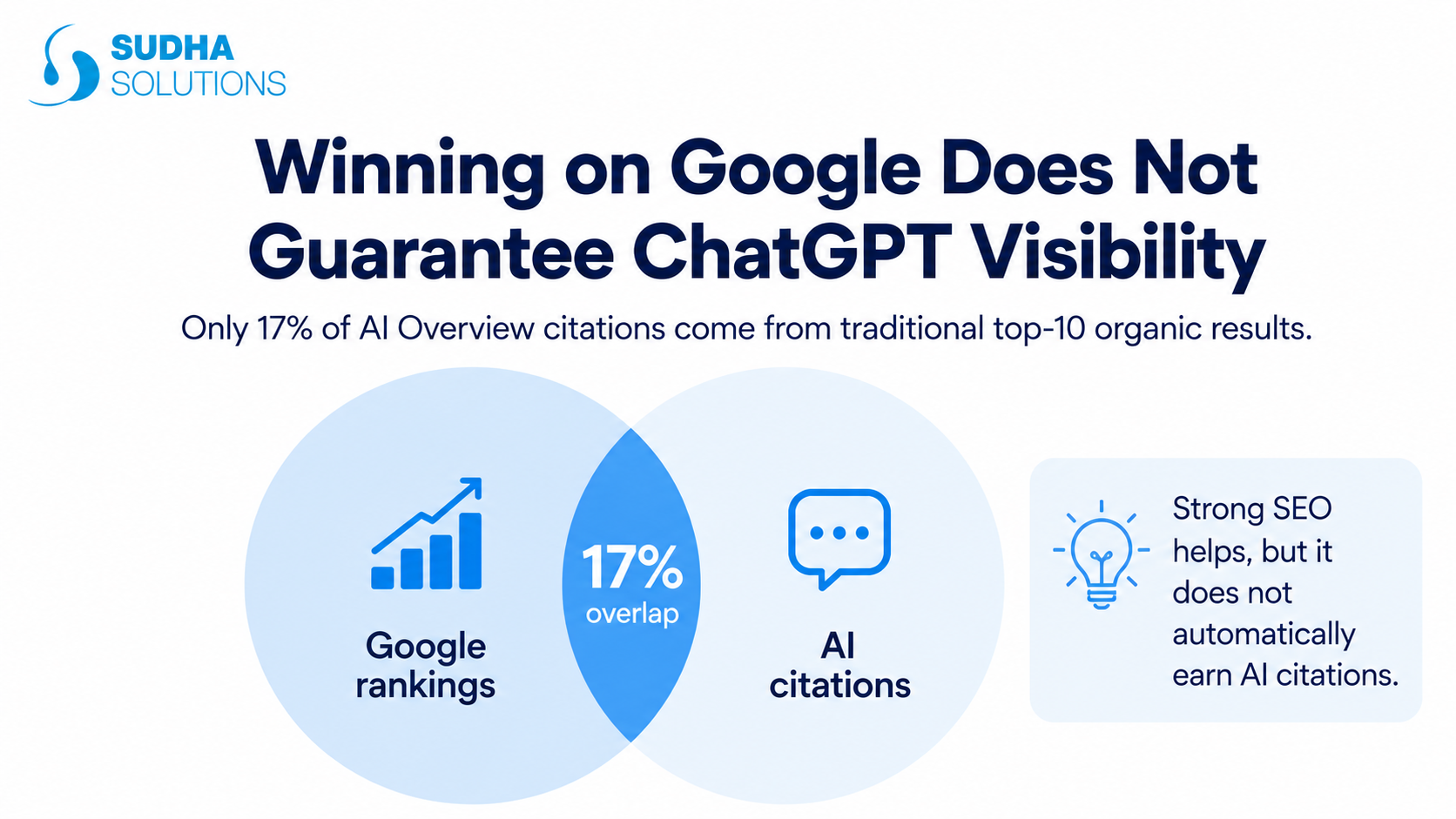
Separately, only 17% of AI Overview citations come from content ranking in the traditional top 10 organic results, according to BrightEdge’s February 2026 research reported in Search Engine Journal. The majority of AI citations pull from content ranking lower; or from entirely different sources that organic rankings don’t predict. 

A brand can be performing well on Google and still be largely invisible to AI search. And vice versa. 

How the Platforms Are Evolving Differently 
How the Platforms Are Evolving Differently

Neither platform is standing still, and the trajectory of each shapes where to invest now. 

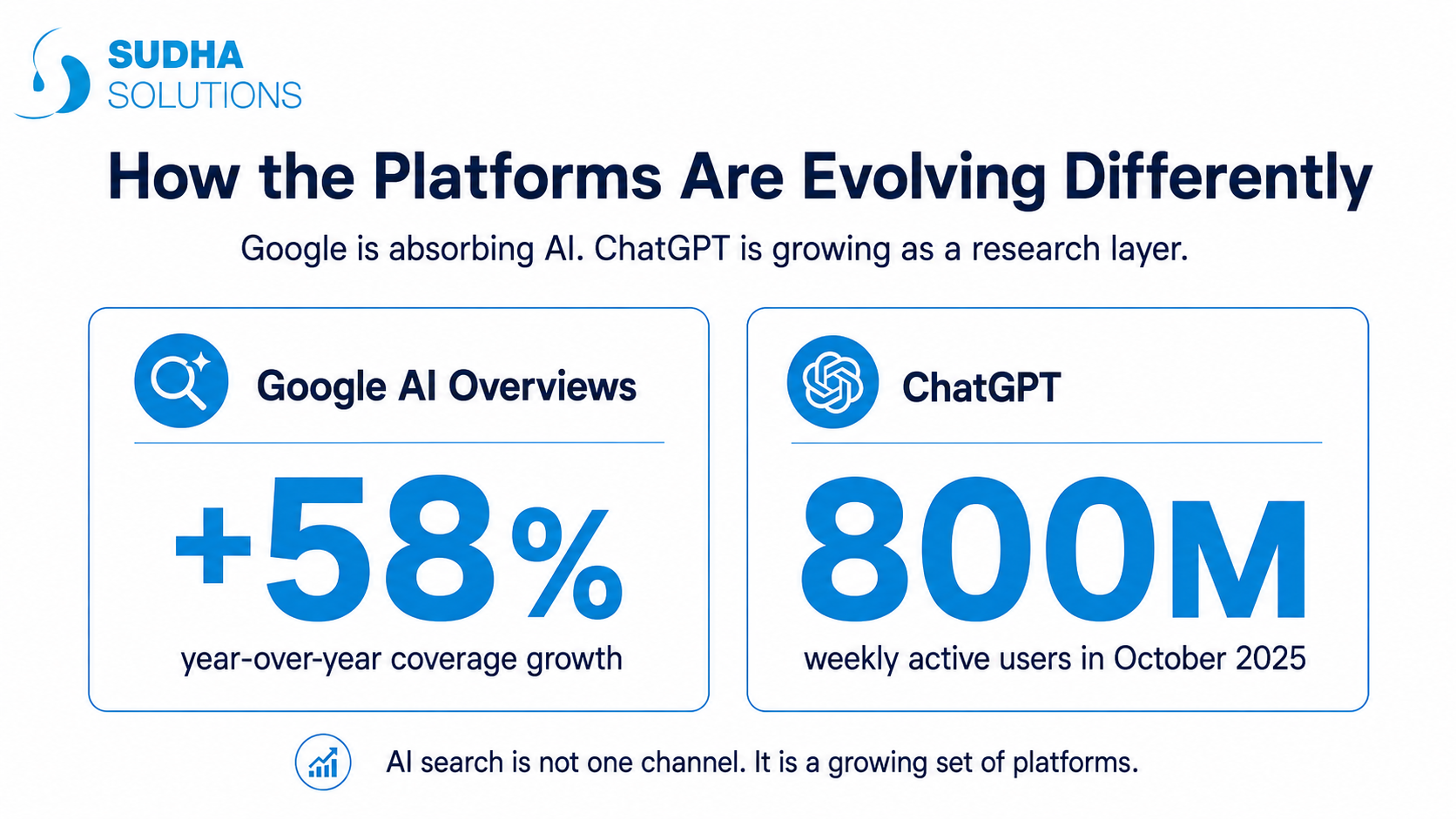
Google’s primary response to the rise of AI search has been to bring AI directly into its own product. AI Overviews coverage grew 58% year-over-year between February 2025 and February 2026, per BrightEdge’s Generative Parser data. In B2B technology, the proportion of queries triggering AI search results grew from 36% to 82% in that same twelve-month window. Google isn’t being displaced by AI search; it’s absorbing it. 

But that shift has a direct cost for websites. Ahrefs’ research found that AI Overviews have reduced click-through rates by 34.5% on queries where they appear. Impressions are up; clicks are down. Google is serving more queries while sending less traffic to the websites that feed its answers. 

ChatGPT, meanwhile, is growing its user base aggressively – reaching 800 million weekly active users in October 2025, doubled from 400 million just eight months prior. But within the AI chatbot category itself, ChatGPT’s share of web traffic dropped from 87.2% to 68% in twelve months as Gemini and other platforms gained ground rapidly. The AI search market is not a single channel; it’s a diversifying set of platforms with meaningfully different citation behaviours. 

Gartner’s 2024 prediction that traditional search volume would drop 25% by 2026 due to AI has become a benchmark for how the industry tracks disruption. Whether that specific figure proves accurate or not, the directional shift is not in question. AI is capturing a portion of queries that previously would have ended with a Google click. 

A Practical Way to Think About Allocation 
A Practical Way to Think About Allocation

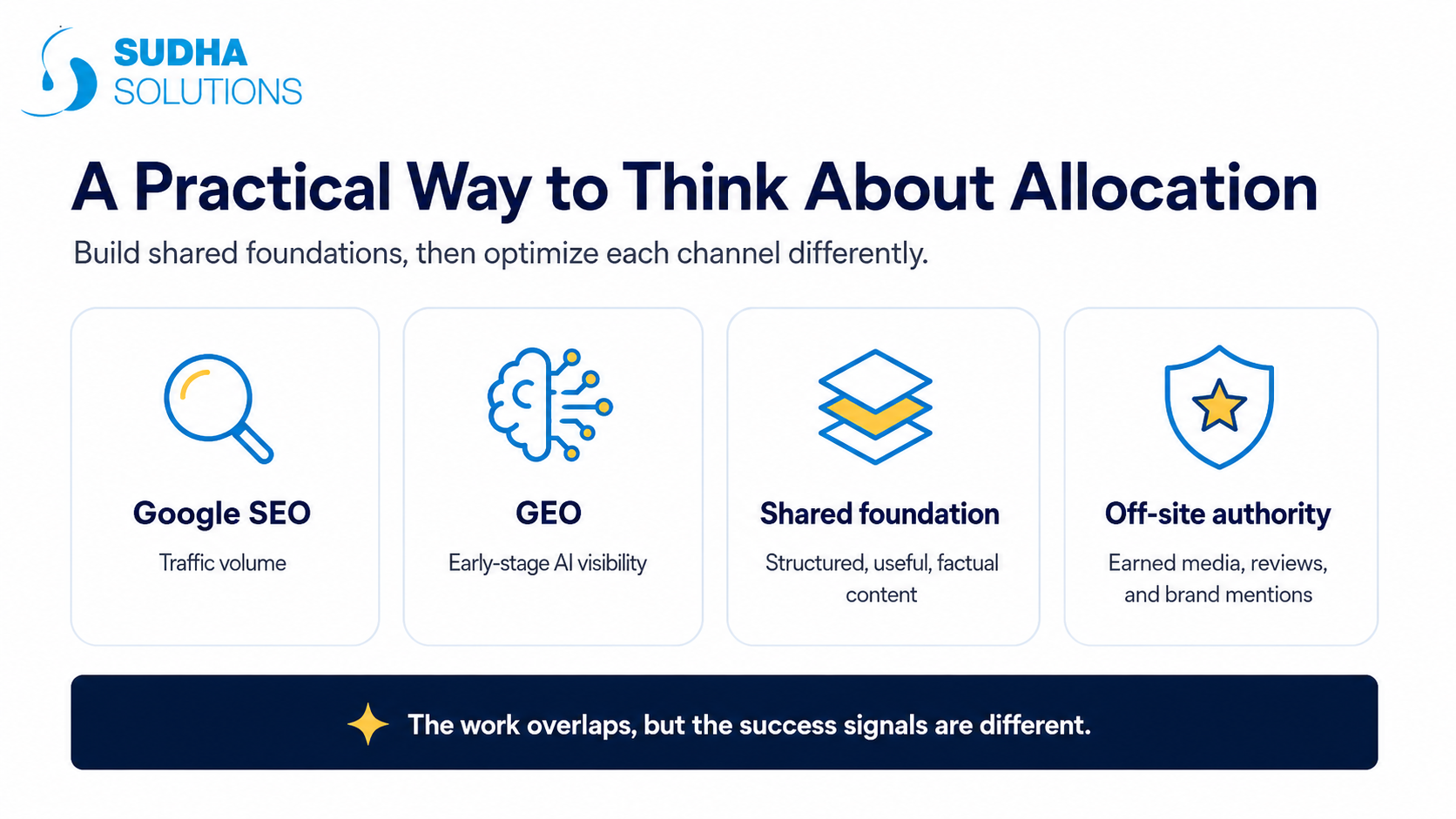
Given all of this, here is a practical framework for thinking about where to put effort. 

Google SEO remains non-negotiable for traffic volume. It drives the overwhelming majority of website visits and will continue to do so for the foreseeable future. Any strategy that deprioritises it entirely in favour of GEO is misallocating resources. 

GEO is non-negotiable for early-stage B2B visibility. The portion of the buying journey happening inside AI tools, before buyers ever search Google or visit a website, is growing. Being absent from AI answers during that phase means being absent from shortlist consideration entirely. This is why many businesses are now investing in answer engine optimization services to improve discoverability across ChatGPT, Gemini, and Google AI Overviews. 

The good news is that the foundations overlap significantly. High-quality, structured, factually dense content that demonstrates genuine topical expertise serves both channels. Earned media presence, getting featured and mentioned across credible third-party sources, builds authority signals that benefit both Google and AI citation patterns. Technical hygiene, content freshness, and entity clarity all contribute to performance on both platforms. Strong technical SEO services for AI search help businesses improve crawlability, structured data implementation, and Bing indexing for AI visibility. 

The work is not a binary choice. It’s a matter of building on the same foundations while understanding which specific signals each platform weighs most heavily. 

Where the strategies diverge is in off-site presence. Google’s visibility continues to be heavily influenced by traditional backlink signals, domain authority, and on-page SEO. ChatGPT citation is more influenced by brand mentions, earned media coverage, third-party reviews, and entity recognition across the web. A comprehensive strategy invests in both; not because they’re the same, but because the target audiences are using both platforms. 


One Number Worth Keeping in Mind 

AI referral traffic grew 975% year-over-year for B2B technology firms in Opollo’s January 2026 dataset. It represents a small absolute percentage of total traffic today. But the growth rate is the signal worth watching. 

The brands investing in GEO now are building the citation infrastructure, content depth, and entity signals that will compound as that growth rate continues. The brands waiting until AI traffic becomes unmissable in their analytics are building from behind, against competitors who started earlier. 

Google and ChatGPT are not competitors to choose between. They are channels to optimise for in parallel – with the understanding that the balance of their importance to any specific business will shift gradually, and then quickly, over the next few years. 

The next article in this series, How to Audit Your ChatGPT Visibility, covers the practical process of measuring where a brand currently stands in AI search – which is the right starting point before any strategy can be built. 

This article is part of Sudha Solutions’ ChatGPT Optimization series. Read the full series: 

Sudha Solutions helps businesses build visibility in AI search through content strategy, GEO, and digital marketing. Based in India, working with brands globally. 

Frequently Asked Questions 

Is ChatGPT replacing Google search?

ChatGPT is not replacing Google entirely, but AI-powered search platforms are increasingly influencing how users research products, services, and business solutions.

What is the difference between Google SEO and GEO?

Google SEO focuses on improving search rankings in traditional SERPs, while GEO focuses on improving visibility inside AI-generated answers and AI search engines.

Why is AI search important for B2B companies?

AI search is important because many B2B buyers now use ChatGPT and AI tools during early-stage vendor research and shortlist creation.

How can businesses improve AI search visibility?

Businesses can improve AI search visibility through GEO optimization, entity SEO, technical AI crawlability, structured content, and third-party authority signals.

Does traditional SEO still matter in 2026?

Yes. Traditional SEO still drives the majority of website traffic, while AI optimization helps improve discoverability inside AI-generated search experiences.
Categories
AI Overview chatgpt citations

How ChatGPT Decides Which Sources to Cite


Every time someone asks ChatGPT a question, the AI quietly makes a decision that most people never think about. It picks a handful of sources to cite, sometimes two, sometimes six, out of thousands of pages it could theoretically reference. And if your brand’s content isn’t among them, you simply don’t exist in that answer.

Understanding how that selection actually works is one of the most useful things a marketer or business owner can learn right now. It’s not mysterious, and it’s not random. There are patterns, and there’s research. This article walks through what the data says.

If you’re new to this topic, it helps to first read What is Generative Engine Optimization (GEO)? for the bigger picture context. But if you already understand GEO and want to know the mechanics behind citations specifically, you’re in the right place.

ChatGPT Doesn’t Work the Way Most People Think

ChatGPT Doesn't Work the Way Most People Think

There’s a common assumption that ChatGPT “searches the internet” the way Google does, reads everything, and then picks the best pages. That’s not quite right.

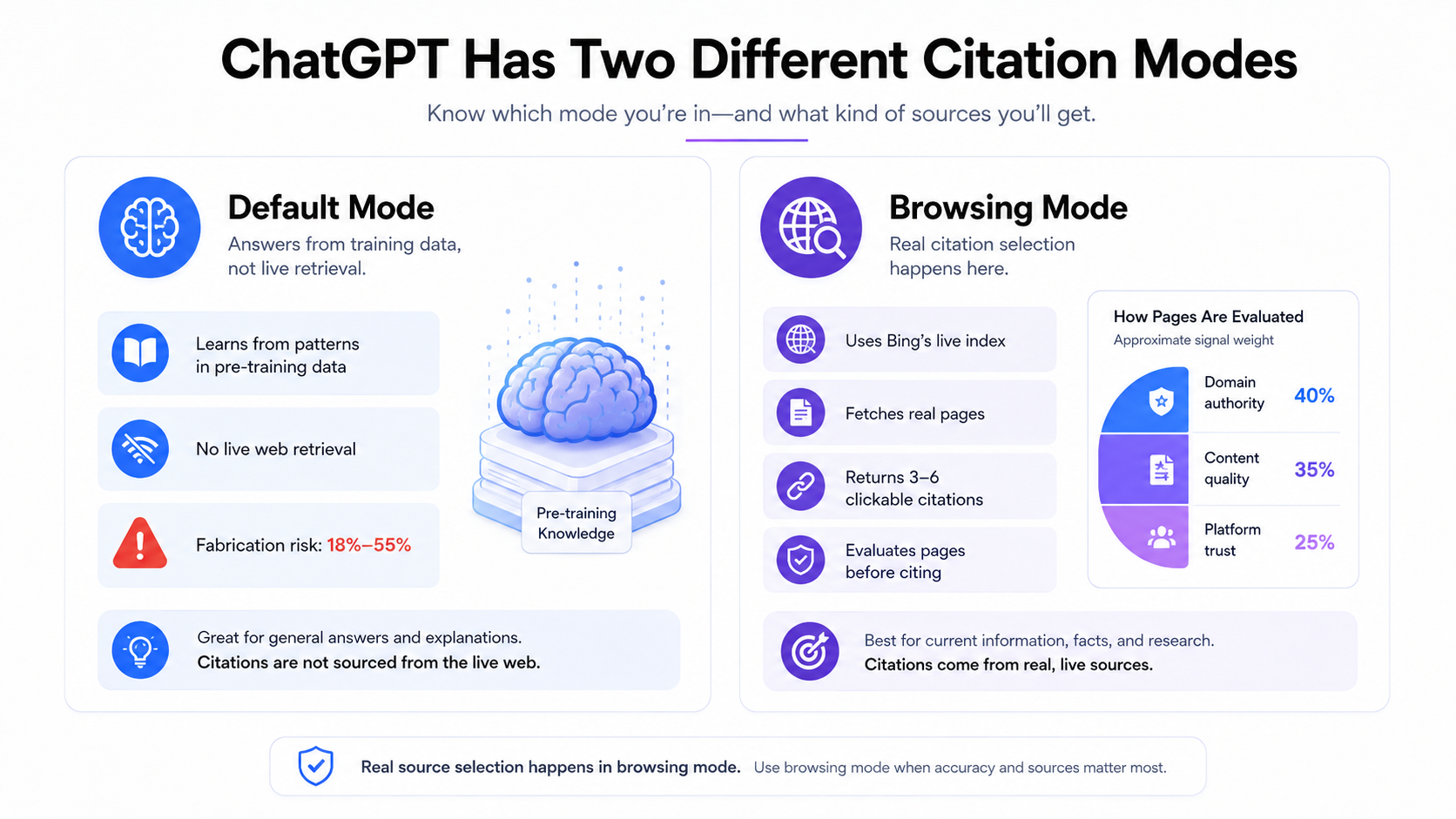
ChatGPT actually operates in two distinct modes, and which mode is active determines everything about how sources get selected.

In its default mode, ChatGPT generates responses from statistical patterns in its training data; roughly 570 GB of text collected before its training cutoff. In this mode, it isn’t retrieving any live sources at all. When it appears to “cite” something in this mode, it’s constructing a plausible-sounding reference from memory, not from real-time retrieval. This is why fabrication rates in this default mode range from 18% to 55%, according to research cited by ZipTie.dev

Browsing mode is where real citation selection happens. When ChatGPT’s browsing feature is active, it uses Bing’s search index to fetch live pages. It returns 3 to 6 clickable, real citations per response. And the selection process in this mode is governed by specific, measurable factors that brands can actually influence.

According to the same analysis from ZipTie.dev, ChatGPT in browsing mode evaluates pages based on three weighted signals: domain authority (roughly 40%), content quality (roughly 35%), and platform trust (roughly 25%).

Those aren’t the only factors at play. But they’re a useful starting frame.

The Selection Process, Step by Step

The Selection Process, Step by Step

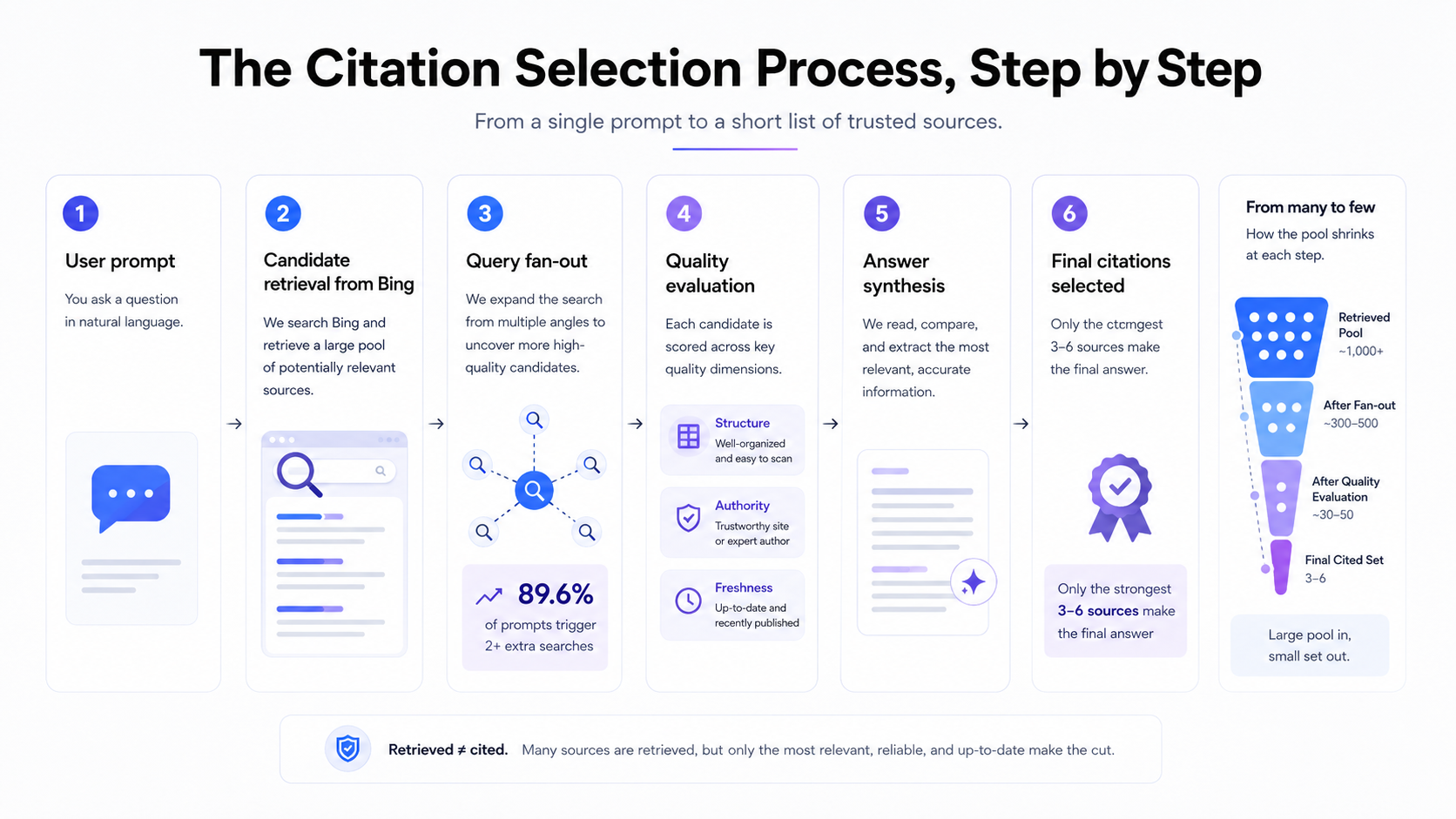
Before any citation appears in a ChatGPT response, the content goes through a multi-stage process. A study by Sellm.io that analysed more than 400,000 URLs across 10,000 different queries mapped this process clearly.

First, ChatGPT retrieves candidate pages from Bing for the query. Then it expands that query into additional sub-questions, a process called “fan-out”, and retrieves pages for those too. Erlin.ai’s ChatGPT search optimization guide found that 89.6% of prompts trigger two or more additional searches before an answer is returned.

After retrieval, ChatGPT evaluates structural quality, authority signals, and content freshness. Then it synthesises an answer and selects only the pages it considers most trustworthy to cite in the final output.

The gap between “retrieved” and “cited” is where most brands fall short. Your content might be pulled into the consideration pool. But if it doesn’t pass the final quality check, it won’t make the cut.

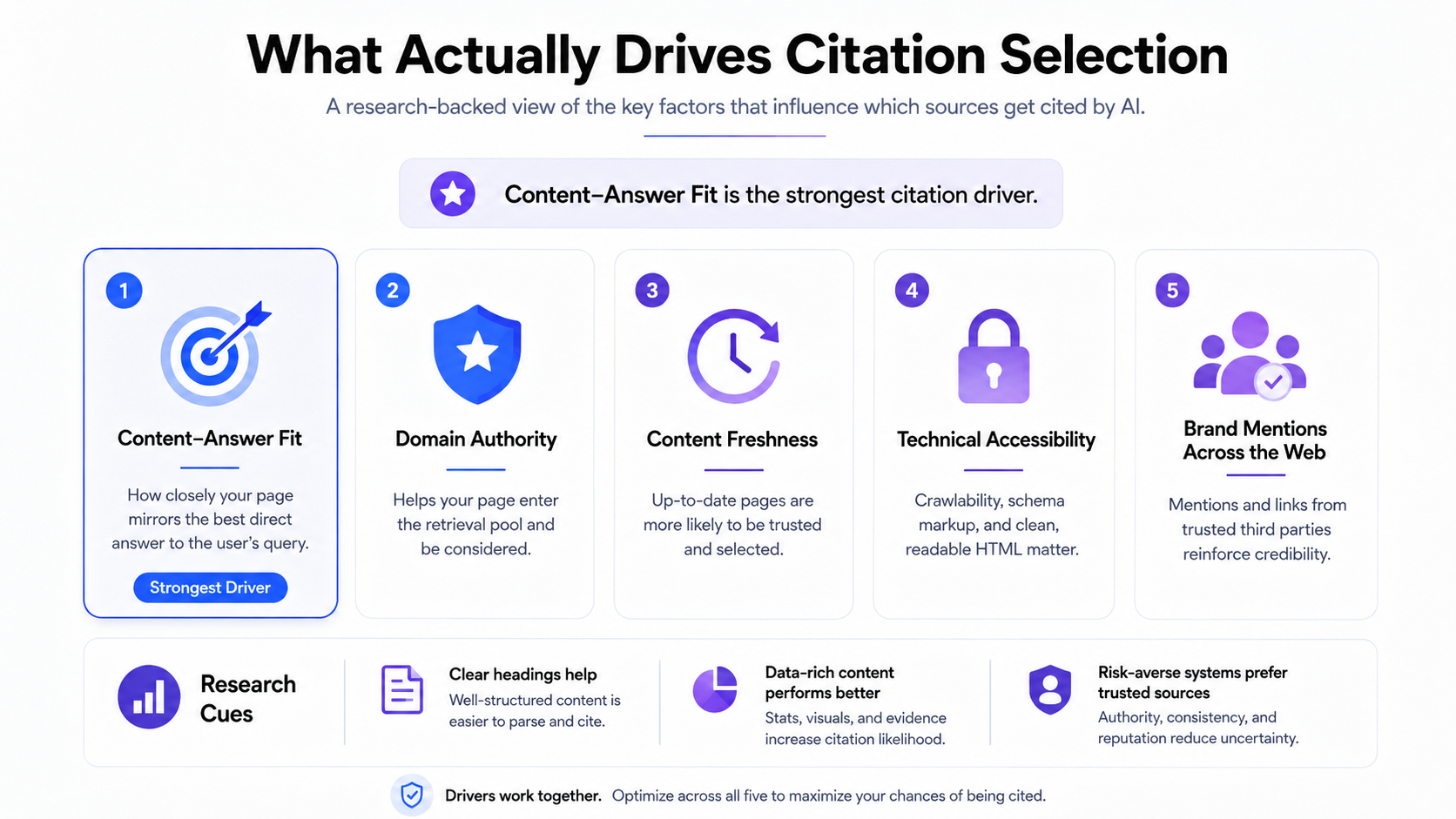
What Actually Drives Citation Selection

Content Structure and Answer Fit

Content Structure and Answer Fit

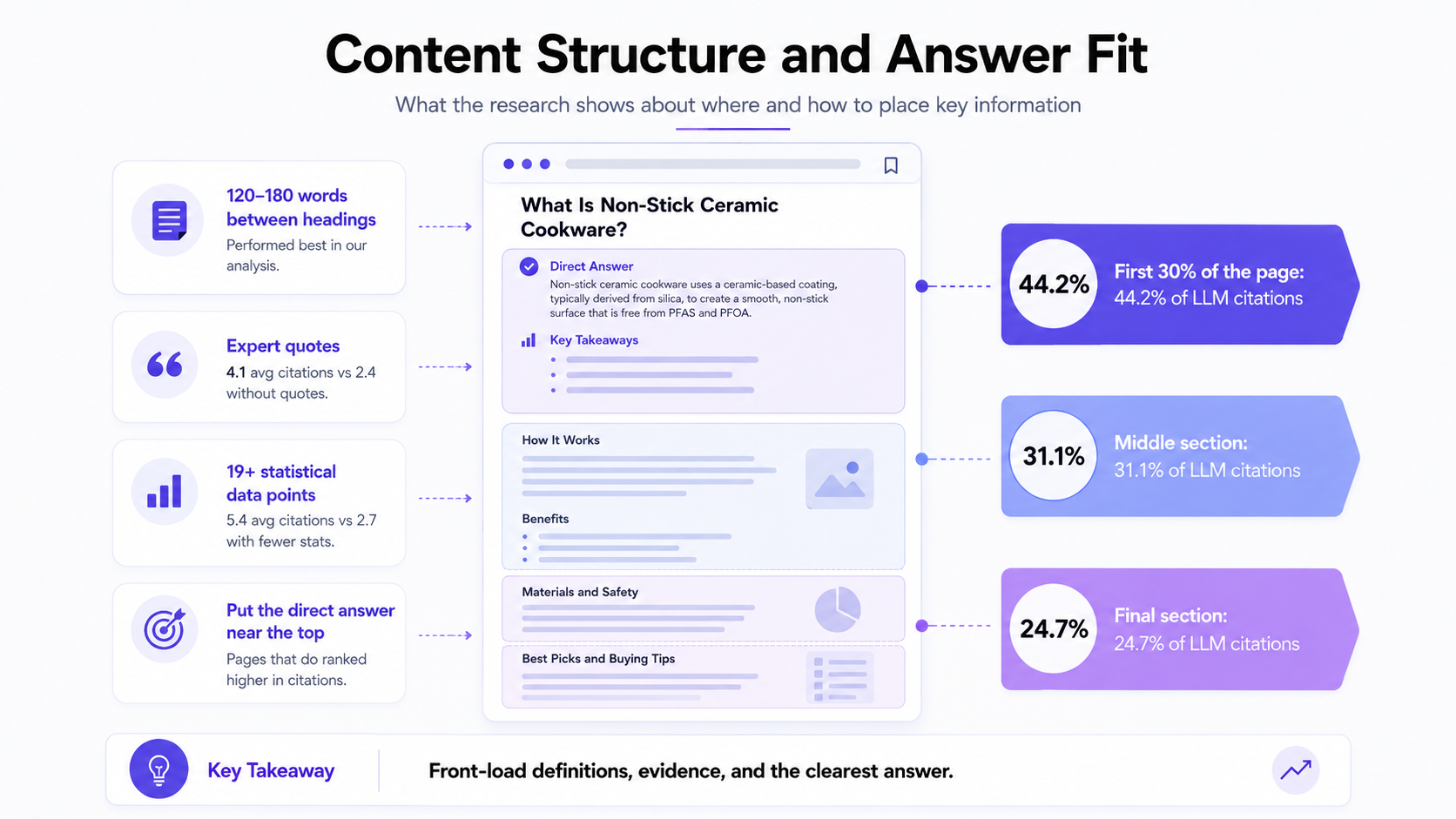
The single strongest factor in whether a page gets cited, according to Sellm.io’s analysis of 400,000+ URLs, is what researchers call “Content-Answer Fit.” That means how closely your content mirrors the way ChatGPT itself would explain a topic. The logic, the tone, the paragraph lengths; all of it matters.

There’s also a positional bias worth knowing about. Research from a renowned source which analysed thousands of ChatGPT citations, found that the first 30% of a page accounts for 44.2% of all LLM citations. The middle section contributes 31.1%. The final section, 24.7%.

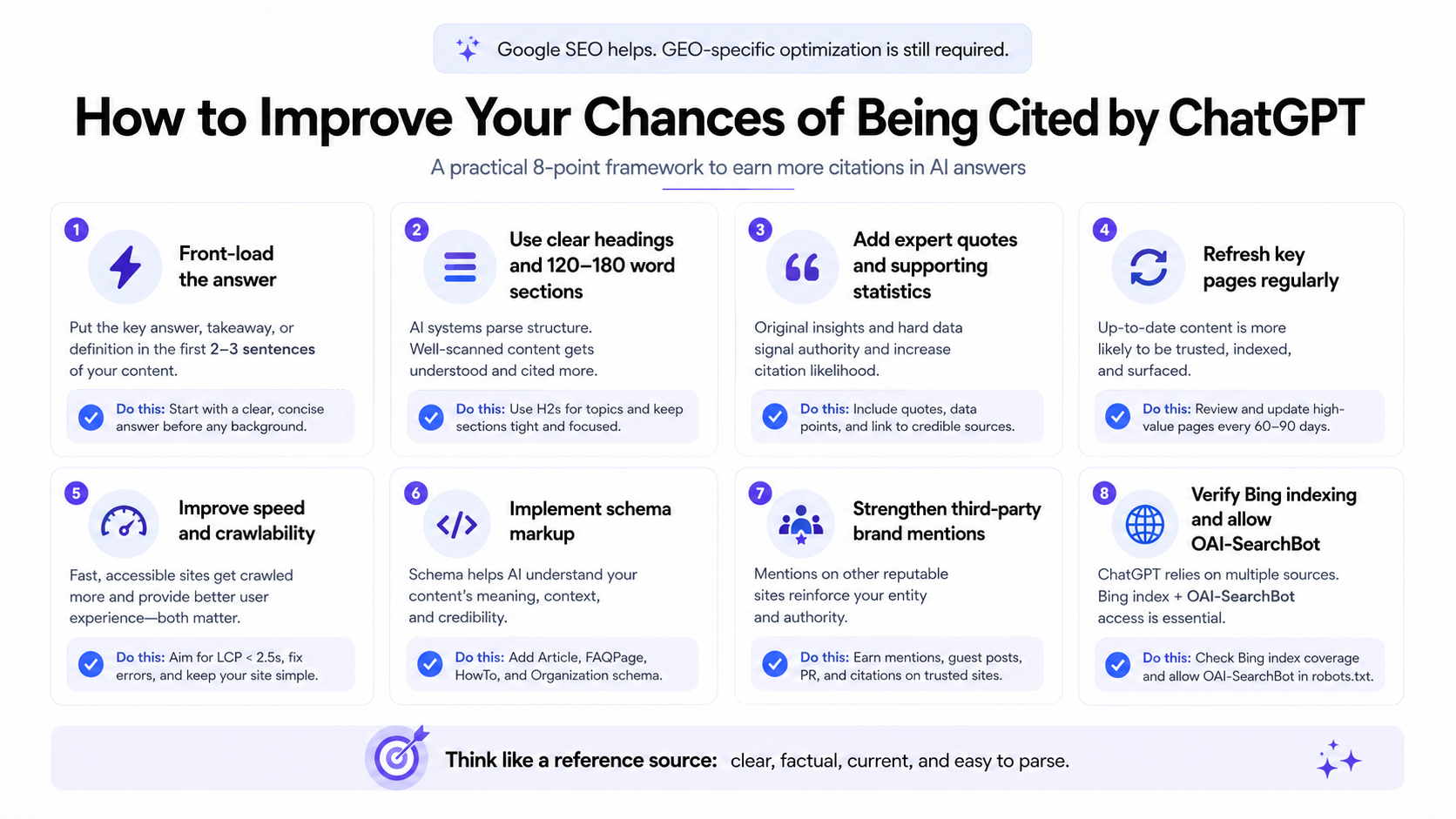
Put the most important facts and the direct answer to the query at the top. Not halfway down the page, not after a lengthy introduction. Right at the start.

Content length also plays a role. Articles under 800 words averaged 3.2 citations in Search Engine Journal’s analysis of the top 20 citation factors. Articles over 2,900 words averaged 5.1. But raw length isn’t the point. The same study found that section length mattered too; pages with 120 to 180 words between headings performed best, averaging 4.6 citations. Sections under 50 words averaged 2.7.

Pages that included expert quotes averaged 4.1 citations versus 2.4 for those without. And content with 19 or more statistical data points averaged 5.4 citations, compared to 2.8 for pages with minimal data.

Domain Authority and Referring Domains

Domain Authority and Referring Domains

Authority still matters in AI search, but it works a bit differently than in traditional SEO.

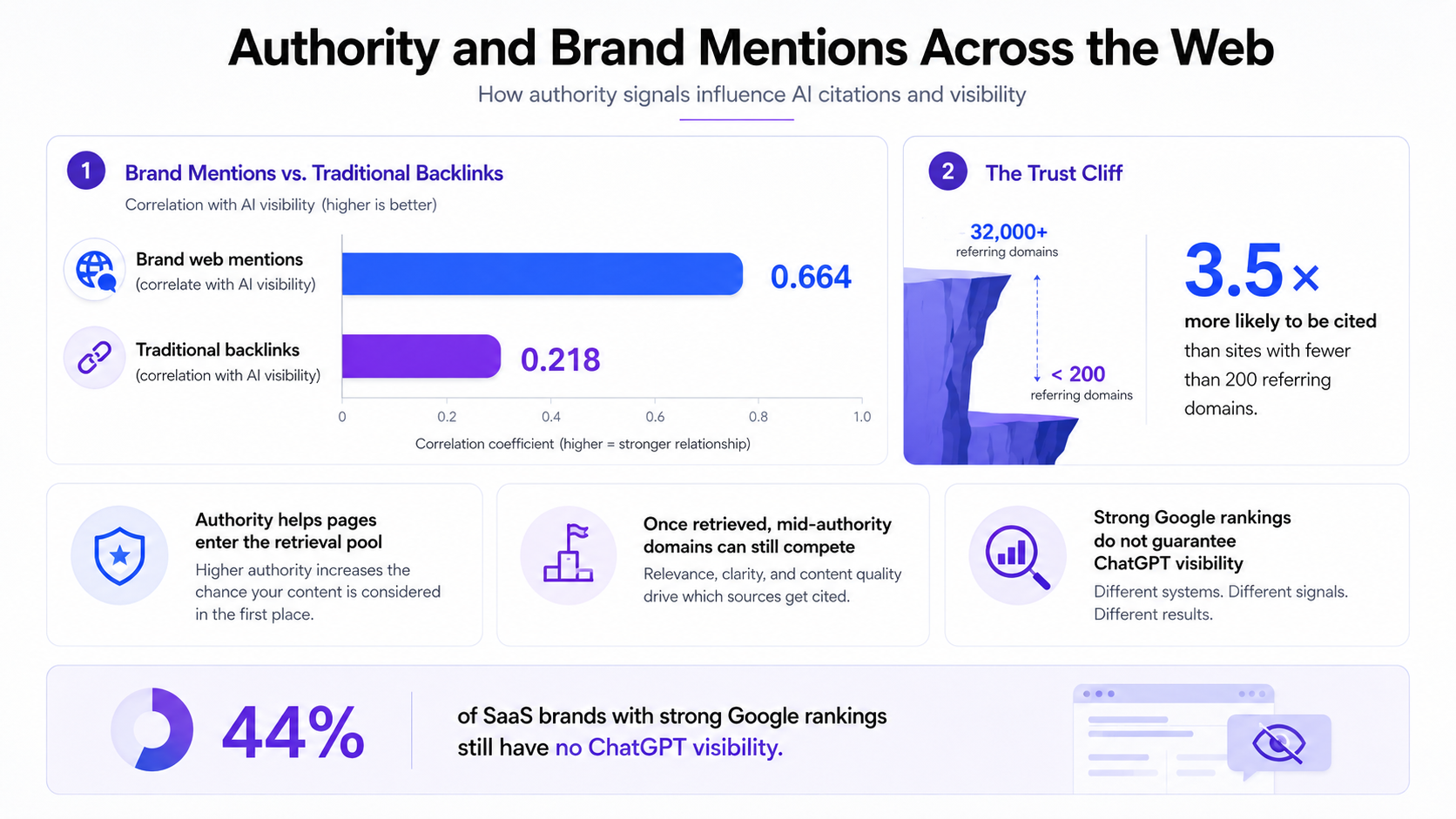
SE Ranking’s November 2025 research found that sites with over 32,000 referring domains are 3.5x more likely to be cited by ChatGPT than sites with fewer than 200 referring domains. Researchers describe this as an authority “trust cliff.” Unlike Google, where a mid-authority site could still rank for the right long-tail keyword, ChatGPT is risk-averse. It prefers sources it can confidently attribute.

That said, domain authority matters more for getting into the retrieval pool than for winning citations within it. Once retrieved, pages in the domain authority range of 40 to 80 show citation rates comparable to higher-authority domains, according to Erlin.ai’s 2026 guide. Getting through the door is the hard part.

Also worth noting: pages ranking in Position 1 on Google are cited by ChatGPT 3.5x more often than pages outside the top 20. But only 12% of URLs cited by ChatGPT also rank in Google’s top 10. Strong Google rankings help, but they’re not a pass. 44% of SaaS brands with strong Google rankings have no ChatGPT visibility at all, according to EMGI Group data from April 2026 cited in Erlin.ai’s guide.

Content Freshness

Content Freshness

This is one of the clearest and most actionable signals of all.

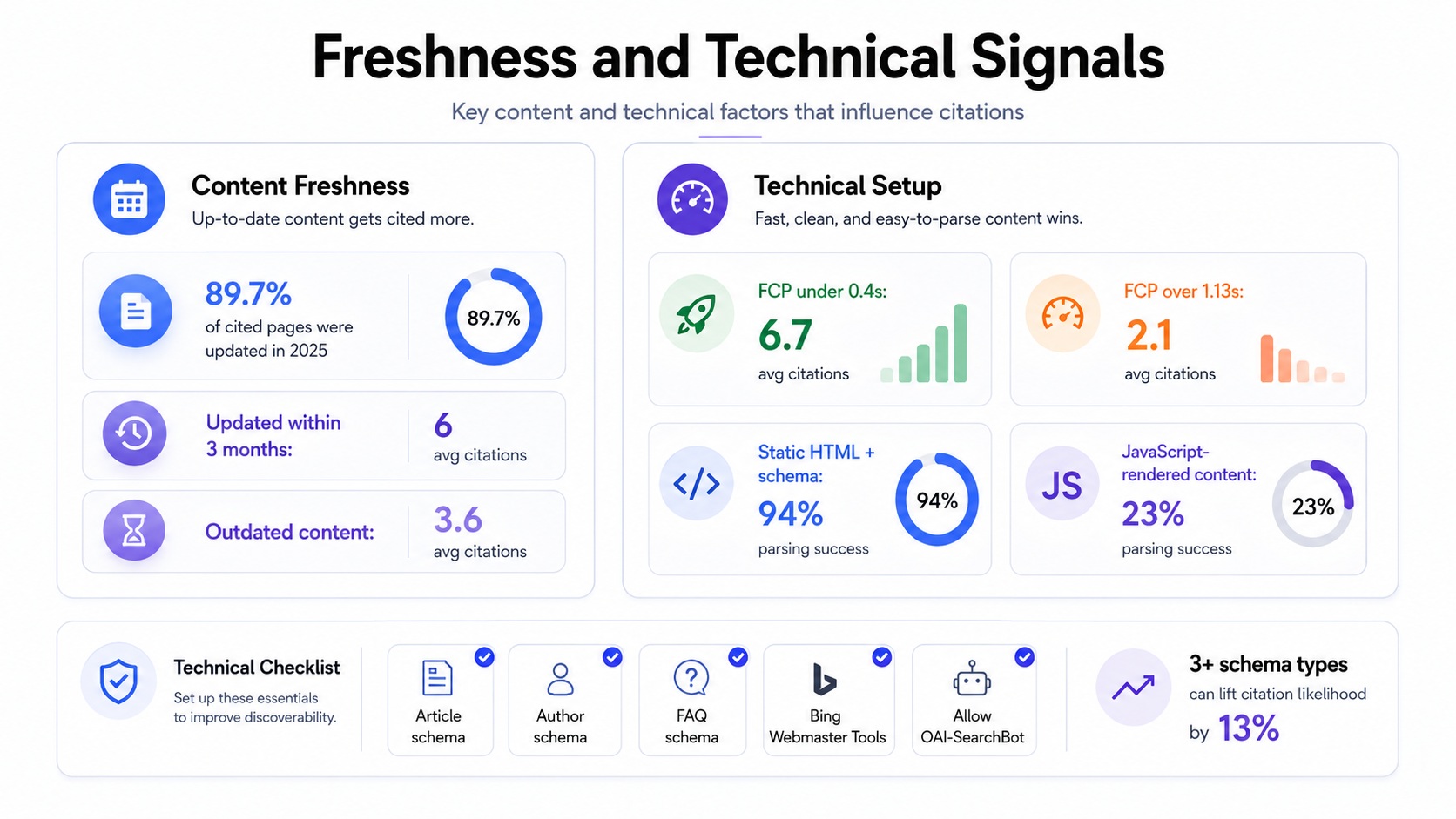
An Ahrefs analysis, referenced in ZipTie.dev’s source selection guide, found that 89.7% of cited pages had been updated in 2025, and 60.5% were published within the last two years. A high-quality page that hasn’t been updated in six months faces a meaningful citation disadvantage compared to a comparable page with recent edits.

The Search Engine Journal study backs this up with specific numbers. Pages updated within three months averaged 6 citations. Outdated content averaged 3.6.

Freshness is also one of the fastest factors to act on. Improving domain authority takes years. Building referring domains takes sustained effort. But updating a key article can happen this week.

Page Speed and Technical Setup

This one surprises a lot of people.

SERanking, in its November 2025 Analysis, also found that pages with a First Contentful Paint under 0.4 seconds averaged 6.7 citations. Pages loading in over 1.13 seconds averaged 2.1 citations. That’s a 3x difference based purely on how fast the page loads.

JavaScript-rendered content creates an even bigger problem. AI parsing success for static HTML with schema runs at 94%. For JavaScript-rendered content, it drops to 23%.

And according to research from Erlin.ai, pages with three or more schema types have a 13% higher likelihood of being cited by LLMs. Businesses investing in technical SEO services for AI search are often better positioned to improve crawlability, schema implementation, and AI citation visibility. At minimum, Article schema, Author schema, and FAQ schema are worth implementing.

One more technical note: ChatGPT’s browsing mode runs on Bing’s index. If your site hasn’t been submitted to Bing Webmaster Tools, or if your robots.txt is blocking OAI-SearchBot, you’re invisible to ChatGPT by default regardless of how good your content is.

Brand Mentions Across the Web

Off-site presence contributes to how AI systems assess your credibility, not just your content.

Ahrefs’ December 2025 study of 75,000 brands, referenced across multiple GEO research summaries, found that the correlation between brand web mentions and AI visibility is 0.664. The correlation for traditional backlinks? 0.218.

Brands that show up consistently in discussions on Reddit, Quora, YouTube, and industry publications give AI systems a clearer picture of who they are and whether they’re worth recommending. Strong AI citation optimization services focus heavily on improving brand authority signals across trusted third-party platforms.

Related read: Effective Strategies for Tracking Brand Mentions


One Thing ChatGPT Has a Clear Preference For

One Thing ChatGPT Has a Clear Preference For

Across the research, one content format comes up repeatedly as a reference point for how ChatGPT selects sources.

Profound’s citation analysis, which tracked 680 million citations across ChatGPT, Google AI Overviews, and Perplexity between August 2024 and June 2025, found that Wikipedia accounts for 47.9% of citations among ChatGPT’s top ten most-cited sources.

That tells you something important about what ChatGPT trusts. It prefers content that reads like a reference source; clear definitions, specific claims, supporting data, and factual accuracy. Not promotional copy. Not vague thought leadership. Definitive, citable information.

If the content on a page could theoretically appear in an encyclopedia entry, ChatGPT finds it far easier to cite.

A Common Misconception Worth Addressing

Some businesses assume that because they rank well on Google, they’ll automatically show up in ChatGPT. The data says otherwise.

A January 2026 platform comparison study found that Google AI Overviews maintain a 54% overlap with traditional organic rankings. ChatGPT’s overlap is significantly lower. It applies its own selection criteria, and the brands winning in ChatGPT are not always the same brands winning on Google.

The practical takeaway: Google SEO and GEO need to be treated as related but separate disciplines. The content structure, freshness practices, and off-site signals that drive ChatGPT citations require deliberate attention – not just a hope that Google rankings carry over.

What to Do With This Information

What to Do With This Information

Understanding how ChatGPT selects sources leads naturally to a set of practical priorities.

Start with the content already on the site. Are the most important pages front-loading their answers? Are they being updated regularly? Are they long enough and data-rich enough to compete? Is the site loading fast and built on static HTML rather than JavaScript rendering?

Then look at the off-site picture. Where does the brand appear across the web beyond the company’s own pages? What would ChatGPT find if it searched for the brand name on Bing right now?

And finally, check the technical foundations. Is the site verified on Bing Webmaster Tools? Is OAI-SearchBot allowed to crawl? Is schema markup in place?

These aren’t complicated questions. Businesses working with an experienced AI search visibility agency are often able to identify technical and content gaps much faster across AI-driven search platforms. But most businesses haven’t asked them yet, because most businesses haven’t started thinking about ChatGPT as a search channel at all.

That gap is exactly the opportunity. 

This article is part of Sudha Solutions’ ChatGPT Optimization series. Read the full series: 

Sudha Solutions helps businesses build visibility in AI search through content strategy, GEO, and digital marketing. Based in India, working with brands globally.

Frequently Asked Questions

How does ChatGPT select websites to cite?

ChatGPT evaluates factors such as content clarity, domain authority, structured formatting, freshness, technical SEO, and trusted brand mentions before citing websites.

Does ranking on Google guarantee ChatGPT visibility?

No. Many websites ranking well on Google still fail to appear in ChatGPT because AI systems use different citation and authority signals.

What is AI citation optimization?

AI citation optimization is the process of improving content structure, authority signals, technical SEO, and brand visibility so AI tools are more likely to cite your content.

Why is content freshness important for ChatGPT citations?

AI systems prefer updated and recently refreshed content because it signals relevance, accuracy, and current expertise.

How can businesses improve visibility in ChatGPT?

Businesses can improve ChatGPT visibility through structured content, schema markup, topical authority, AI-focused SEO, answer engine optimization, and third-party brand mentions.