




Most brands treat customer retention marketing like an email problem, when real retention depends on the full post-purchase experience across email, SMS, support, and loyalty systems. Open rates are down? A/B test the subject line. Repeat purchases are slow? Add another flow. But if your customers are not coming back, a better email sequence is rarely the fix.
Retention is not a channel. Effective retention marketing services require a connected customer lifecycle, not just isolated campaigns. It’s the sum of every experience a customer has with your brand after the first purchase. Email is one part of that. A small part.
The Real Cost of Getting This Wrong
This is exactly why acquisition without retention becomes one of the most expensive growth mistakes brands make.
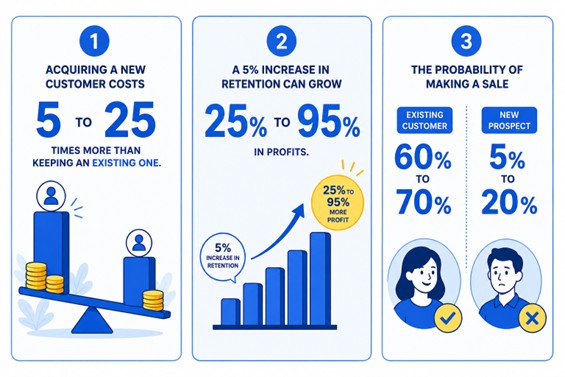
Here is the business case, plainly:
- According to Harvard Business Review acquiring a new customer costs 5 to 25 times more than keeping an existing one.
- A 5% increase in retention can grow profits by anywhere from 25% to 95%.
- According to the book ‘Marketing Metrics’, the probability of selling to an existing customer is 60 to 70%. For a new prospect, it drops to 5 to 20%.
So, you already have the more convertible, more profitable audience. The question is: what experience are you giving them after they buy?
Where Most Brands Are Leaving Money Behind
Many brands invest in ecommerce email marketing solutions but neglect broader customer lifecycle marketing. If you have email flows set up, you are ahead of many brands. But if that is all you have, you are missing most of the picture. Strong email marketing automation matters, but it should support a wider retention ecosystem.
The post-purchase dead zone: A customer buys. They get an order confirmation. Then nothing until a promotional email three weeks later. That silence is a retention problem. The moment right after a purchase is when trust is highest, and most brands waste it.
Generic messaging: Sending the same “we miss you” email to a first-time buyer and a customer who has purchased six times is a mistake. They are in completely different places in their relationship with your brand. Treating them the same signals that you are not paying attention.
Support friction: A customer who has a bad support experience will not come back, no matter how good your email is. One poor interaction undoes months of nurture. According to American Express, 33% of consumers consider switching after just one instance of poor service.
No recognition of loyalty: Repeat buyers who are treated the same as new customers notice. If there is nothing that acknowledges their history with you, you are not building a relationship. You are just transacting.
What Experience-Led Retention Actually Looks Like
Look at Starbucks. Their retention rate is 44%, nearly double the industry average of 25%. That is not because of email. It is because they built a system where every touchpoint reinforces loyalty.
The app lets you order ahead, track your Stars, get a birthday reward, and receive offers based on what you actually buy.
- A customer who orders oat milk lattes sees offers for oat milk drinks.
- A customer who buys food with their coffee gets food pairings.
The experience feels personal because it is built on real behaviour data, not segments.
Starbucks Rewards has over 75 million global members, with 57% of U.S. sales coming from loyalty members. That is not email doing the heavy lifting. That is a connected experience doing it.
Amazon is another example. Amazon Prime has a 93% renewal rate after year one, and 98% after year two. The reason is not reminders. It is because Prime is built into daily life.
Fast shipping, personalised recommendations, Prime Video, early access to deals. Every touchpoint adds value. Amazon’s recommendation engine alone influences 35% of total sales.
Both of these brands run email. But email is a layer on top of a retention experience, not the experience itself.
The Touchpoints That Actually Drive Retention
This is where sms marketing services and post-purchase engagement outperform email-only strategies.
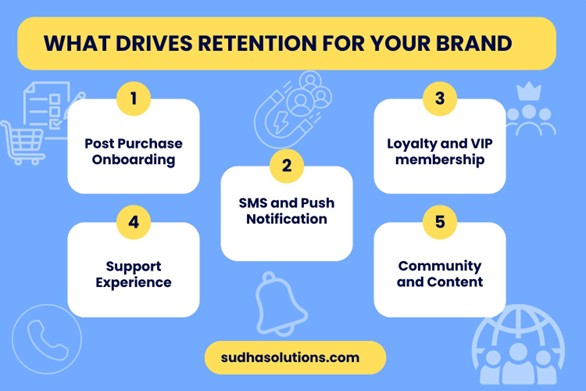
Here is where retention is won or lost, beyond email:
- Post-purchase onboarding: What happens in the first 7 days after a purchase? A simple check-in, a how-to guide, or a packaging insert can set the tone for the entire relationship.
- SMS and push notifications: Time-sensitive, high-open-rate channels that most brands underuse. Restock alerts, shipping updates, and personalized nudges outperform promotional emails.
- Loyalty and VIP programs: Not just points. Access, early drops, and recognition. Customers want to feel like insiders, not just collectors.
- Support experience: Speed, tone, and resolution. A great support interaction can actually increase loyalty more than a discount.
- Community and content: Brands like Gymshark and Glossier built retention through community before they had sophisticated email programs. People come back because they feel part of something. Community-led content that converts often strengthens retention more effectively than discount-only campaigns.
A Quick Self-Check for Your Brand
Ask yourself:
- Do first-time and repeat buyers receive different messaging?
- Is there a planned touchpoint in the first 7 days post-purchase?
- Are you present on more than one channel after the sale?
- Do loyal customers receive any form of recognition?
- Is your support experience consistent with your brand promise?
If you answered no to two or more of these, your retention is running on a weaker foundation than it should be.
The Shift That Changes Everything
When brands stop asking “how do we improve our email metrics” and start asking “what experience are we creating for customers who already trust us,” the numbers move differently.
LTV goes up. Repeat purchase rate improves. Word-of-mouth increases. And the pressure to constantly acquire new customers to hit revenue targets starts to ease.
Email is a tool. Experience is the strategy. If your retention program is mostly a series of automated emails, you are not doing retention marketing. You are doing lifecycle email. Those are not the same thing.
Brands balancing performance marketing vs content marketing often outperform because they invest in both acquisition and retention.
If you want to build a retention engine that compounds, the work starts with the full customer experience, not the inbox.
At Sudha Solutions, we build retention systems that go beyond email. From post-purchase journeys to loyalty programmes and cross-channel messaging, we handle the full experience that keeps customers coming back.
If your retention is mostly emailing flows and discount codes, there is a better way. Book a call with Sudha Solutions today and let’s show you exactly where your customer experience is losing repeat revenue.
Frequently Asked Questions
Is email enough for customer retention?
No. Email is one retention channel, but strong retention also depends on SMS, support, loyalty, onboarding, and customer experience.
What does a retention marketing agency actually do beyond email campaigns?
A retention marketing agency builds a complete post-purchase experience across channels like email, SMS, loyalty programs, and customer support. The goal is to increase repeat purchases, customer lifetime value, and long-term engagement.
How do I know if my brand has a retention problem?
If your repeat purchase rate is low, customer lifetime value is stagnant, or you rely heavily on new customer acquisition to grow revenue, your retention strategy likely needs improvement.
What is the ideal retention marketing strategy for eCommerce brands?
A strong strategy includes post-purchase onboarding, personalised communication, multi-channel engagement (email, SMS, push), loyalty programs, and a seamless customer support experience.
How long does it take to see results from retention marketing?
Most brands start seeing early improvements in engagement and repeat purchases within 30–60 days, while meaningful revenue impact typically becomes visible within 3–6 months.
What KPIs should we track for retention marketing success?
Key metrics include repeat purchase rate, customer lifetime value (LTV), churn rate, retention rate, average order value (AOV), and revenue from returning customers.