





The uncomfortable truth: your SEO expert services may not be the issue, your user experience, page structure, and AI-ready website strategy might be what’s holding rankings and conversions back.
You’re ranking. Traffic is coming in. But conversions? Not moving the same way.
Or worse, rankings fluctuate despite doing “everything right.”
Sound familiar? Your immediate response would be to double down on keywords, backlinks, or content volume. But that’s not where the problem lies.
The real issue is: users are landing on your page, but poor website user experience design is weakening both conversions and your broader seo performance optimization.
And in 2026, that’s not just a UX problem. It becomes a ranking problem.
What does this blog talk about
- Core Web Vitals are the baseline, not the advantage. In 2026, they act as a tie-breaker signal between pages with similar content and authority; not a primary ranking driver.
- Behavioural signals (dwell time, pogo-sticking, scroll depth, and rage clicks) now form a composite “quality score” for your page in Google’s AI-driven ranking systems.
- The March 2026 Core Update was the most volatile on record: nearly 80% of top-three results shifted positions. UX was a central differentiator between winners and losers.
- 88% of users won’t return to a site after a poor UX experience and Google knows this before you do.
Isn’t Core Web Vitals Enough?
In 2026, core web vitals optimization is only the technical baseline; true SEO expert services now require deeper UX performance.
Not quite. Google itself states that beyond Core Web Vitals, other page experience aspects don’t directly help a website rank higher but they do make a website more satisfying to use, which is what its ranking systems seek to reward.
This means that Google is telling you directly to pass the technical test, but then go a step further.
After the March 2026 Core Update, sites with Interaction to Next Paint (INP) above 200ms saw measurable ranking drops averaging 0.8 positions, and those above 500ms on competitive queries dropped 2–4 positions. Yes, this makes the thresholds got tighter. But clearing them still only puts you in the game; it doesn’t win it.
What Does Google Actually Watch Post-Click?
This is where professional UI UX design directly impacts search engine optimization services.
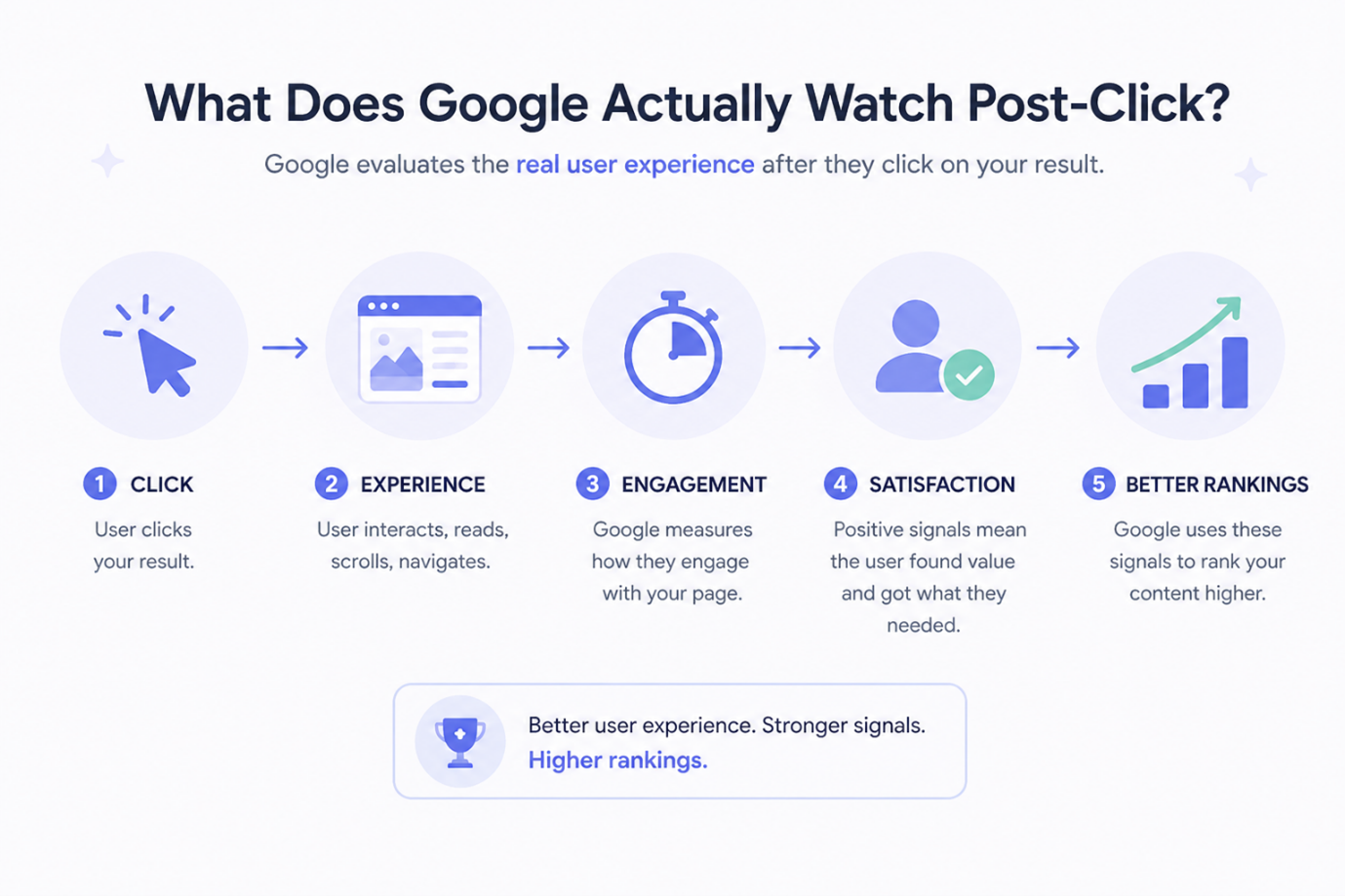
This is where it gets interesting and a little uncomfortable if your site hasn’t been designed with the user’s actual journey in mind.
Because, Google evaluates UX signals using real-world field data from the Chrome User Experience Report (CrUX) combined with AI-simulated browsing.
It measures “journey frustration”; detecting rage clicks, excessive scrolling without engagement, and pogo-sticking (returning to the SERP immediately). These behavioural patterns create a composite “quality score” for the page. And if your score is subpar, you lose.
Think about what pogo-sticking communicates to Google: “I clicked, nothing useful happened, I’m leaving.” Repeated across thousands of sessions, that signal quietly erodes your ranking, even if your content is technically excellent.
After the March 2026 update, user engagement metrics like dwell time, scroll depth, and return visits carried significantly greater weight. Sites with poor UX metrics suffered disproportionate ranking losses.
Why Navigation, Layout & Content Structure Are Now Ranking Signals
Strong conversion-focused web design improves both rankings and usability.
Here’s what most brands overlook entirely. It’s not just about page speed; it’s about whether users can find what they came for.
1. Structure Is Now a Performance Lever
Sites with flat, transparent architectures; where any page is reachable within three clicks consistently perform better. Why?
Because that clarity does two things at once:
- It improves user flow (less effort, faster access)
- It increases crawl efficiency, helping search engines index pages and understand how they relate to each other (ClickRank).
2. Confusion Is a Measurable Signal
Poor navigation creates what analysts call “navigation bounce” (the user lands, gets confused, and leaves). Google tracks this.
And it’s happening more often than teams expect: 67% of users abandon a site if it takes too many steps to complete a simple action.
It’s a measurable drop in engagement and a signal that feeds directly into rankings.
3. Internal Linking: The Missed Multiplier
Most teams treat internal linking as a technical SEO task. It’s not. It’s structural proof.
If your most important pages are isolated, search engines see less evidence of depth, relevance, and authority on a topic.
Strong internal linking changes that by:
- Reinforcing relationships between topics
- Building authority clusters
- Signaling which pages are foundational (your “cornerstones”)
Mobile UX Is No Longer a “Nice to Have”
Modern mobile UX optimization is now essential for both visibility and revenue.
If you’re still treating mobile as a secondary design pass, you’re actively losing ground both in rankings and in revenue.
Search engines aren’t guessing anymore. When evaluating mobile UX, Google places significant weight on touch-friendly navigation and mobile-specific performance metrics.
And the user behaviour data makes this even harder to ignore:
- 53% of mobile users abandon sites that take longer than 3 seconds to load
- Mobile users are ~5× more likely to leave if a site isn’t mobile-friendly
Now layer this against traffic reality:
- Mobile drives 83% of landing page visits
- Yet desktop still converts 8% more efficiently
Why does this gap exist? Because mobile UX is still being treated as an afterthought, despite being the primary way users experience your site.
If this scenario sounds familiar to your brand, you have a mobile experience bottleneck.
And until that’s fixed, more SEO effort just means more users hitting the same friction and leaving.
The UX–Ranking–Conversion Flywheel
This is the same principle behind building content that ranks and converts — traffic without usability rarely compounds.
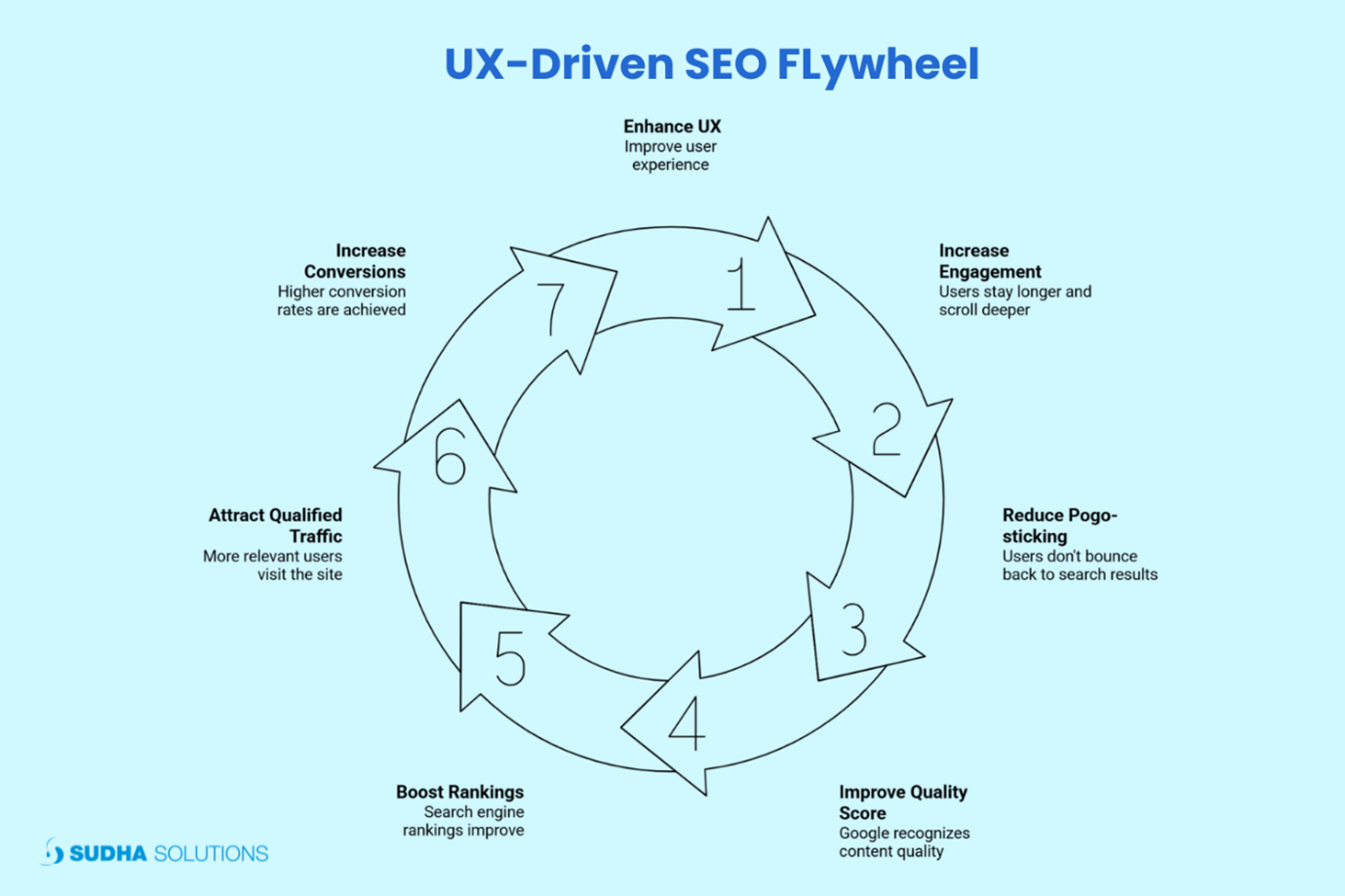
Improving UX is not a one-time fix. It’s a system, a loop that either compounds growth or compounds loss.
What most teams underestimate:
Better UX → users stay longer, scroll deeper, don’t pogo-stick → Google reads those signals as quality → rankings stabilize or improve → more qualified traffic arrives → that traffic converts at a higher rate.
And once that starts, it reinforces itself.
But the reverse is just as real and far more common.
Ignore UX → users bounce faster → engagement signals weaken → rankings slowly decline → traffic quality drops → conversion costs rise → competitors who invested in UX quietly take your position.
The financial case is stark:
- Poor UX costs businesses an estimated $1.4 trillion annually
- Every $1 invested in UX can return up to $100
- Well-designed UX can increase conversion rates by as much as 400%
What this means:
You’re either building momentum or fighting a slow, expensive decline.
And most teams don’t realise which side they’re on until the gap is already visible in both rankings and revenue.
What are the Most Important UX Fixes for SEO in 2026?
In a broader AI-first marketing strategy, UX directly affects whether users stay long enough for AI systems to interpret your content as valuable.
Don’t try to do everything at once. Here’s a prioritised sequence that addresses ranking signals and conversion efficiency simultaneously:
- Meet the 2026 CWV thresholds. LCP under 2.5 seconds, INP under 200 milliseconds, CLS under 0.1. These are non-negotiable baselines now.
- Audit your mobile navigation.
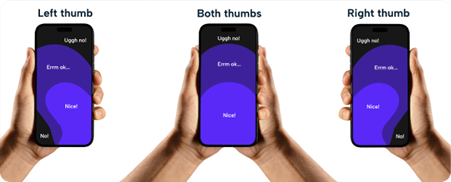
Are buttons thumb-friendly? Can a user reach your most important page in 3 taps? Test it on a real device, not just in Chrome DevTools.
- Fix above-the-fold clarity. Within 3 seconds of landing, does your visitor know exactly where they are, what you offer, and what to do next? Larger CTA buttons (minimum 44×44px) boost mobile click-through rate by 28%. Combining strong UX with answer-led content improves both human engagement and AI extractability.
- Strengthen internal linking. Every important page should connect to and from related content. This isn’t just good UX; it’s a topical authority signal search and answer engines are looking for in 2026.
- Remove friction aggressively. Intrusive pop-ups, forced sign-ups before value delivery, and broken links are annoyances for your visitors and active ranking liabilities for you. Removing these barriers keeps the user on your website a bit longer and bit more engaged. Remember, high engagement and dwell time tell Google the page is valuable? This step actually rewards.
Related read: 10 Ecommerce Website Features That Will Boost Your Conversions in 2026
Final Thoughts
This UX shift is also part of the larger SEO to AIO transition, where usability influences both rankings and AI citations.
UX and SEO used to be separate conversations. One lived in the design brief, the other in the keyword spreadsheet. That separation is over.
Google now evaluates your website the way your best visitor would: Can I find what I need? Does this feel trustworthy? Is it worth my time?
When the answer is yes, consistently, across thousands of sessions, rankings follow. When the answer is no, no amount of link building or content publishing will hold your position for long.
The brands winning in search right now aren’t just publishing more. They’re building better experiences.
Ready to improve rankings, user engagement, and conversions? Sudha Solutions combines SEO expert services with professional UI UX design to build websites that rank better and convert faster.
Frequently Asked Questions
Is UX officially a Google ranking factor?
Google doesn’t publish a clean list of “ranking factors,” but its own documentation confirms that page experience signals including Core Web Vitals, mobile usability, and site structure, influence rankings.
Does bounce rate affect SEO?
Not directly. Bounce rate is a UX hint, not a direct Google ranking lever. Some pages are supposed to be one-and-done answers, and a high bounce there can mean success.
Check whether your users are pogo-sticking or leaving satisfied. Focus on intent match and content clarity, not on chasing a lower bounce number.