



Most business owners don’t wake up one morning and decide their website is outdated. It happens quietly. Slightly fewer enquiries each month. A bounce rate that’s crept up. A prospect who mentioned they found the site confusing. None of it feels dramatic enough to act on.
But between 2021 and 2026, three things changed simultaneously: how users behave on websites, how AI crawlers read them, and what Google rewards in rankings. Businesses that haven’t adopted an AI-ready SEO strategy for modern search engines are already falling behind. A website built for 2021 is competing against 2026 sites on all three fronts and losing ground on all three at once.
10 Signs You Need a Better Website
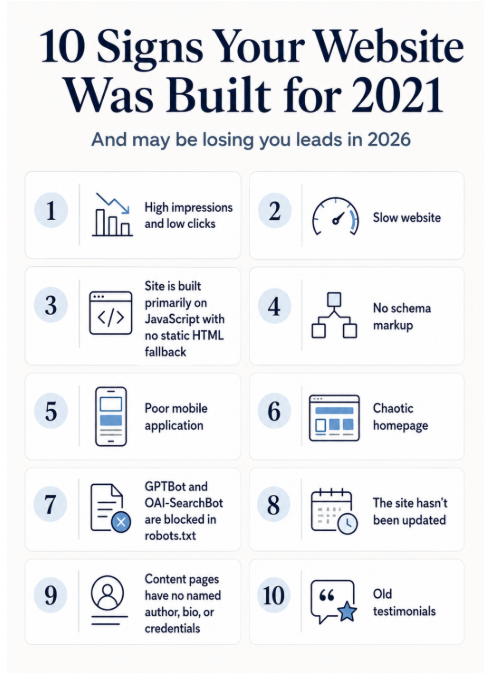
- Impressions in Search Console are growing, but clicks aren’t.
This is the most common sign that a site’s content structure isn’t working for AI search. BrightEdge’s twelve-month analysis found AI Overviews now trigger on nearly half of all tracked queries – a 58% year-over-year increase. Sites whose content can’t be extracted into a clear, citable answer show up in impressions but don’t earn clicks. This is why businesses are now investing in AI SEO and Google AI Overview optimization. Structure and answer-first formatting are the fix, not better keywords. - The site loads in more than 2.5 seconds on mobile.
Google’s own Core Web Vitals documentation sets Largest Contentful Paint (LCP) under 2.5 seconds as the threshold for a “good” page experience; and this metric directly influences Google search rankings. Sites built on older frameworks with unoptimised images and accumulated plugins routinely fail this benchmark. A refresh won’t fix it; a structural rebuild will. - The site is built primarily on JavaScript with no static HTML fallback.
Google’s Search Central documentation on JavaScript SEO explains that JavaScript-rendered content requires a second crawl pass to index – meaning crawlers may miss content entirely on slower, resource-limited crawl budgets. AI crawlers face the same constraint. A visually impressive JavaScript-built site that AI systems can’t parse is invisible in AI search regardless of how good the content is. - There’s no schema markup on any page.
BrightEdge research found that sites implementing structured data and FAQ blocks saw a 44% increase in AI search citations. Schema markup tells both Google and AI systems exactly what a page is about and plays a major role in Answer Engine Optimization (AEO) implementation, who wrote it, and what questions it answers. Sites built before schema became standard practice, which is most sites built before 2023, typically have none at all. - The mobile experience is a scaled-down version of the desktop site.
Google switched to mobile-first indexing as its default in 2019. By 2026, Google’s own data confirms mobile contributes the majority of global search traffic. A site designed desktop-first, then adapted for mobile, creates friction at every touchpoint. Mobile-first design is the baseline expectation now; not an upgrade. - The homepage is trying to say everything at once.
Older sites were built on the assumption that visitors would scroll, explore, and self-navigate. Research from Pew Research Center consistently shows that digital attention windows have compressed. If a homepage has multiple competing headlines, unclear primary CTAs, or a hero section that prioritises aesthetics over immediate clarity about what the business does and who it’s for, it’s losing visitors before they engage. - GPTBot and OAI-SearchBot are blocked in robots.txt.
Google’s Search Central guidance on crawlers explains how crawler access controls work. The same principle applies to AI crawlers: if a site’s robots.txt inadvertently blocks GPTBot or OAI-SearchBot, OpenAI’s web crawlers, the site is structurally absent from ChatGPT’s live search results regardless of content quality. A one-line robots.txt check can reveal this problem in minutes. - The site hasn’t been updated substantively in more than 12 months.
Ahrefs’ research on AI citations found that 89.7% of pages cited by AI platforms had been updated in 2025, and 60.5% were published within the last two years. A site with static, unchanged pages faces a disadvantage because AI search favors fresh and regularly updated content, even well-written ones, faces a meaningful citation disadvantage against equivalent pages with recent edits and updated information. - Content pages have no named author, bio, or credentials.
Google’s Search Quality Evaluator Guidelines place heavy weight on EEAT – Experience, Expertise, Authoritativeness, and Trustworthiness. Anonymous content, pages with no author attribution, and sites with no verifiable expertise signals are treated as lower-trust sources. Most sites built before 2022 weren’t designed with EEAT in mind. - The latest testimonial or case study is more than two years old. Buyers evaluate social proof as part of their decision process, while AI platforms increasingly use brand authority and trust signals for AI citations. An outdated portfolio, stale testimonials from 2021, and a blog that stopped publishing signal to a visiting prospect, and to AI systems evaluating brand credibility across the web, that the business may no longer be active or relevant. This is one of the quietest but most consistent conversion killers on older sites.
The Honest Assessment
If four or more of these apply, the site is actively costing the business leads; not dramatically, but consistently. One missed enquiry at a time.
Some of these are technical fixes that happen quickly. Others require rethinking how content is structured, or rebuilding on a more AI-readable framework. The right starting point is conducting a comprehensive AI SEO website audit before planning technical or content improvements.
Want to improve your brand visibility in 2026? Check out Sudha Solutions. For more than a decade, we have helped numerous brands improve their visibility and generate more leads. Along with SEO and content marketing, our AEO strategy has also helped brands get visibility in AI platforms like ChatGPT, Perplexity and others. Contact us TODAY
FAQs
- How do I know if my website is outdated?
Your website may be outdated if it loads slowly, performs poorly on mobile, has unclear messaging, lacks schema markup, has old content, or is not visible in AI search results.
- Why does an outdated website reduce leads?
An outdated website creates friction for users. Slow speed, confusing navigation, weak CTAs, and poor mobile experience can make visitors leave before they enquire or convert, even if you have the best product.
- What is an AI-ready website?
An AI-ready website is structured so search engines and
AI crawlers can easily understand, extract, and cite its content. This includes clear headings, answer-first content, schema markup, updated pages, and crawlable HTML.
- Is website speed still important for SEO in 2026?
Yes. Website speed is still important because users expect fast mobile experiences, and Google considers page experience signals such as Core Web Vitals when evaluating search performance.
- Should I redesign my website or just fix SEO issues?
If only a few issues exist, SEO and technical fixes may be enough. But if the website has poor mobile UX, slow performance, weak content structure, no schema, and outdated design, a full rebuild may be better.