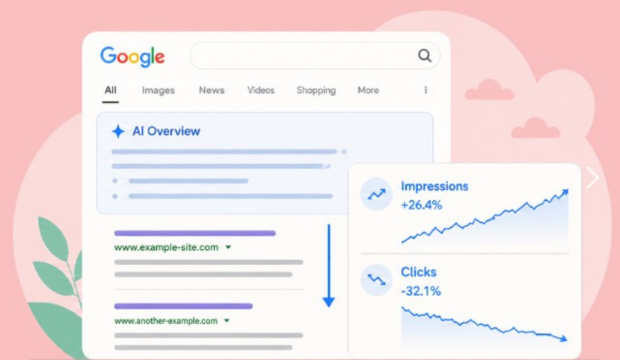




Something strange is happening in Google Search Console dashboards across the world right now, especially for businesses that haven’t yet adopted an AI SEO strategy for Google AI Overviews.
Impressions are up. Rankings are holding. And clicks are quietly, steadily falling.
If this looks familiar, it’s not a bug in the tracking. It’s not a penalty. It’s not something a technical audit will fix. It’s a structural shift in how Google now works—and it has a name: AI Overviews. Understanding how AI Overviews differ from traditional organic search is now essential for every SEO team.
The Number That Explains Everything
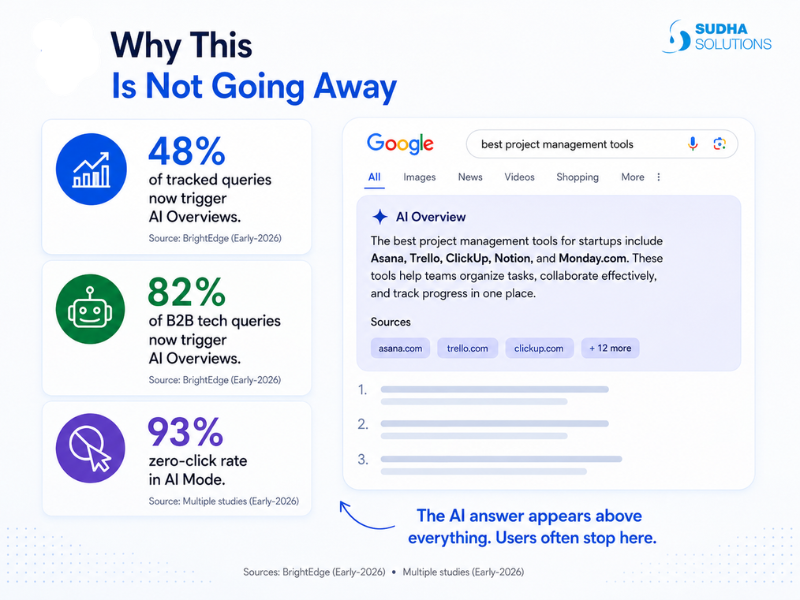
Google AI Overviews now appear on approximately 48% of tracked search queries, making AI search optimization for businesses more important than ever; a 58% year-over-year increase from February 2025, according to BrightEdge’s twelve-month analysis covered by Search Engine Journal.
When an AI Overview appears for a query, Google places a synthesized AI-generated answer at the very top of the page; above all organic results, above featured snippets, above ads. The user reads the answer and, in many cases, never scrolls down to the blue links below.
The click-through impact is severe, which is why businesses are increasingly investing in SEO expert services for AI-driven search visibility. Ahrefs’ February 2026 study of 300,000 keywords found that organic CTR on the top-ranking page drops 58% when an AI Overview is present; an effect that has intensified as AIO rollout has matured. A page holding position one for a query that now triggers an AI Overview loses more than half its clicks – not because its ranking dropped, but because the click no longer reaches it.
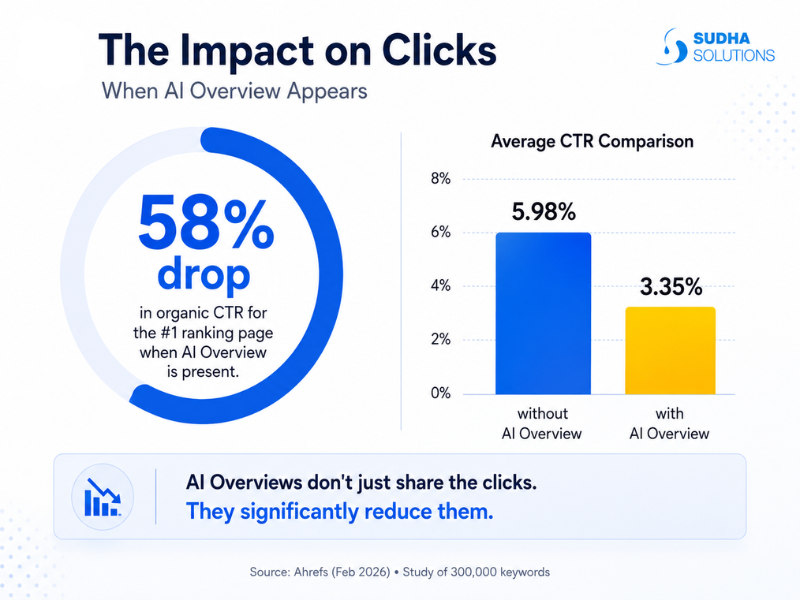
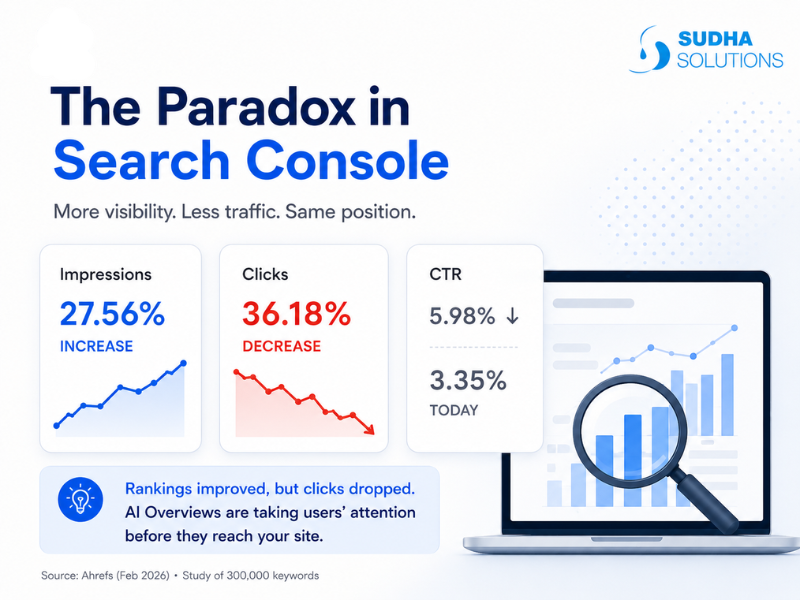
That’s the pattern in Search Console: impressions stable or growing, clicks in free fall. Ahrefs documented one case where impressions grew 27.56% year-over-year while clicks dropped 36.18% and CTR fell from 5.98% to 3.35% – despite rankings actually improving. More visibility. Less traffic. Same position.
Rankings and Citations Are Now Two Separate Competitions
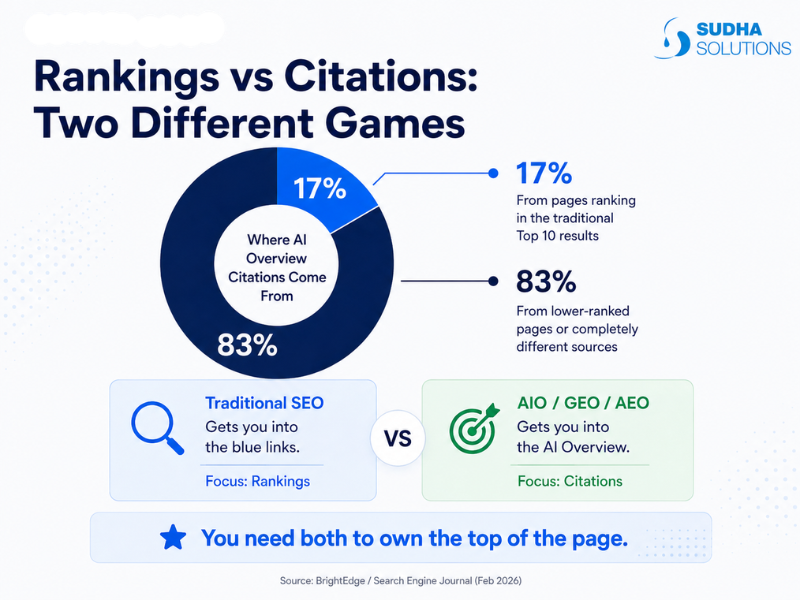
Rankings and citations are now two separate competitions, requiring brands to build an AEO and GEO optimization strategy alongside traditional SEO.
Here’s what makes this more than a temporary dip.
Only 17% of AI Overview citations come from content ranking in the traditional top 10 organic results, according to BrightEdge’s February 2026 research reported by Search Engine Journal. The remaining 83% pull from content ranking lower – or from entirely different sources that organic rankings don’t predict at all.
Traditional SEO gets a page into the organic blue links, while LLM SEO and AI citation optimization help brands appear directly inside AI-generated answers. AIO optimisation – structuring content so Google’s AI can extract, trust, and synthesize it – is what gets a brand into the AI Overview itself. Doing one without the other means competing in a game where the top of the page has already been given to someone else.
And the gap between the two disciplines is widening. B2B technology queries went from triggering AI Overviews 36% of the time to 82% in a single year, per the same BrightEdge data. For businesses operating in that space, more than 80% of the search landscape now has an AI answer sitting above their organic result.
This Is Not Going Away
At Google I/O 2026, Google described this overhaul as the biggest change to Search in 25 years. AI Mode – a more immersive version of AI Overviews that turns the entire search interface into a conversational AI experience – produces a 93% zero-click rate, according to multiple independent studies published in early 2026. It launched to all US users in June 2025 and is expanding globally through the rest of 2026.
The brands growing despite this shift share one thing in common: they’re cited inside AI Overviews, not just ranking beneath them. Brands that earn citations inside AI Overviews see meaningfully more organic clicks per impression than uncited competitors for the same queries – even though both still trail pre-AIO click volumes. Being in the answer is now worth more than being below it.
What to Actually Do
The instinct most businesses have is to check their rankings and their site speed. Both are worth maintaining. But neither addresses the core problem here.
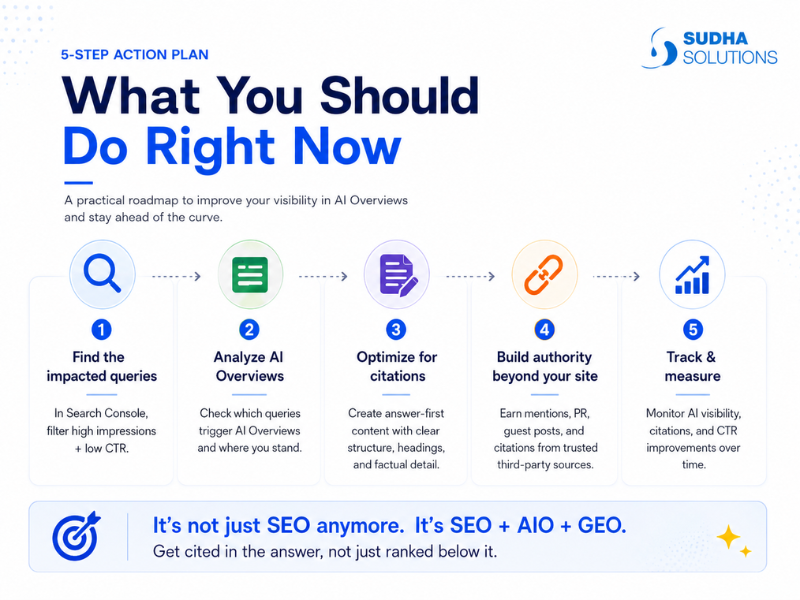
The right question is not “why did my rankings drop,” but whether your content is optimized for AI search visibility and Google AI citations – because they probably didn’t. The question is “which of my most important queries now trigger an AI Overview, and am I being cited in those answers?”
Opening Google Search Console and filtering for the highest-impression, lowest-CTR queries will reveal which pages are experiencing AIO cannibalization. Those are the pages to prioritise first. Restructuring their content so Google’s AI can extract clear, citable answers – through answer-first formatting, structured headings, and factual precision – is where the recovery begins.
That’s a different discipline from the SEO most businesses are currently running. It combines traditional SEO with AI SEO, AEO, and GEO services to improve visibility across both search engines and AI assistants. But it’s the one that determines whether the traffic being lost to AI Overviews stays lost, or gets recaptured.
FAQs
- Why is my website traffic falling even though my Google rankings are stable?
Your traffic may be falling because Google AI Overviews are answering user queries directly on the search results page. Even if your page still ranks well, users may get the answer from the AI Overview and not click through to your website.
- Do AI Overviews affect organic click-through rates?
Yes. AI Overviews can reduce organic click-through rates because they appear above traditional search results. When users find the answer in the AI-generated summary, they may not scroll down or click on the ranking pages.
- What is AIO optimisation?
AIO optimisation means improving your content so it can be selected, understood, and cited by Google AI Overviews. It focuses on clear answers, structured headings, factual content, schema markup, and source-worthy information.
- Is ranking on page one still important for SEO?
Yes, ranking on page one is still important, but it is no longer enough. Businesses also need to focus on being cited inside AI Overviews, AI search results, and answer engines to protect visibility and traffic.
- What is the difference between traditional SEO and AI SEO?
Traditional SEO focuses on ranking in organic search results. AI SEO focuses on making your content useful for AI-generated answers, AI Overviews, answer engines, and large language models. Both are now important for search visibility.
- How can businesses improve visibility in AI Overviews?
Businesses can improve visibility by writing answer-first content, using clear headings, adding factual data, improving topical depth, using schema markup, building authority, and regularly updating content for accuracy.