



Quick Answer: AI search can send traffic to websites, but clicks alone no longer capture its full value. Research shows that AI-generated search answers can reduce click-through behaviour, while 2026 data also indicates that visitors who do arrive through AI referrals can be highly engaged. Brands therefore need to measure AI visibility across citations, mentions, impressions, referral traffic, engagement and conversions; not traffic alone.
For years, organic search had a fairly straightforward value chain:
Ranking → Click → Website Visit → Conversion
AI search is disrupting the middle of that journey.
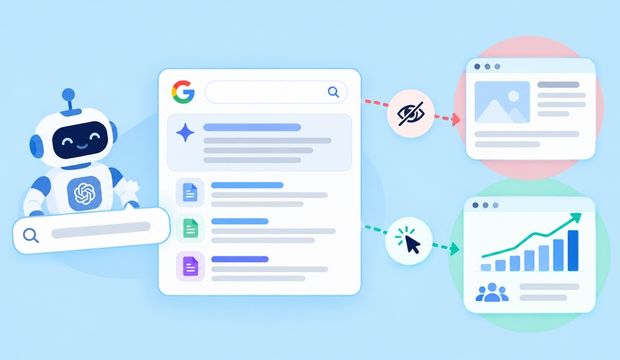
A user can ask a question, receive a synthesized answer, compare options and learn about several brands; all without visiting a website.
So, if AI cites your brand but sends no click, did that visibility have any value?
The answer is becoming increasingly important for marketers.
AI Answers Can Reduce the Need to Click
There is now clear evidence of this behaviour in Google Search.
Pew Research Center analysed 68,879 Google searches from 900 U.S. adults. When an AI summary appeared, users clicked a traditional search result in 8% of visits, compared with 15% when no AI summary appeared.
Clicks on sources directly cited inside the AI summary were even rarer – they occurred in just 1% of visits containing an AI summary.
This doesn’t mean every AI search experience behaves identically, or that AI Overviews caused every difference observed in the study.
But it demonstrates a significant behavioural change:
A search experience can deliver information from websites without requiring the user to visit those websites.
Similarweb’s June 2026 analysis estimates that 68% of Google searches now end without a click and reports substantially lower referral rates from Google AI Mode than from traditional Google search.
For publishers and marketers accustomed to equating visibility with sessions, that’s a major shift
Learn how AI search affects SEO visibility?
But “Zero Click” Doesn’t Mean “Zero Visibility”
Imagine someone asks an AI assistant: “Which cybersecurity firms should a mid-sized financial company consider?”
The answer mentions five companies.
The user doesn’t click any of them.
Traditionally, analytics would record: 0 website visits.
But the user may now know five brands they didn’t know before.
That creates a different journey:
AI Answer → Brand Exposure → Familiarity → Later Search → Website Visit → Conversion
The problem is that conventional attribution may record the later visit as organic search or direct traffic; not connect it to the AI interaction that introduced the brand.
This is why Sudha Solutions believes AI visibility needs to be evaluated as both a discovery channel and a traffic channel, rather than forcing it into traditional SEO reporting.
The Traffic AI Does Send May Be Valuable
There’s another side to the story.
AI referrals are not disappearing.
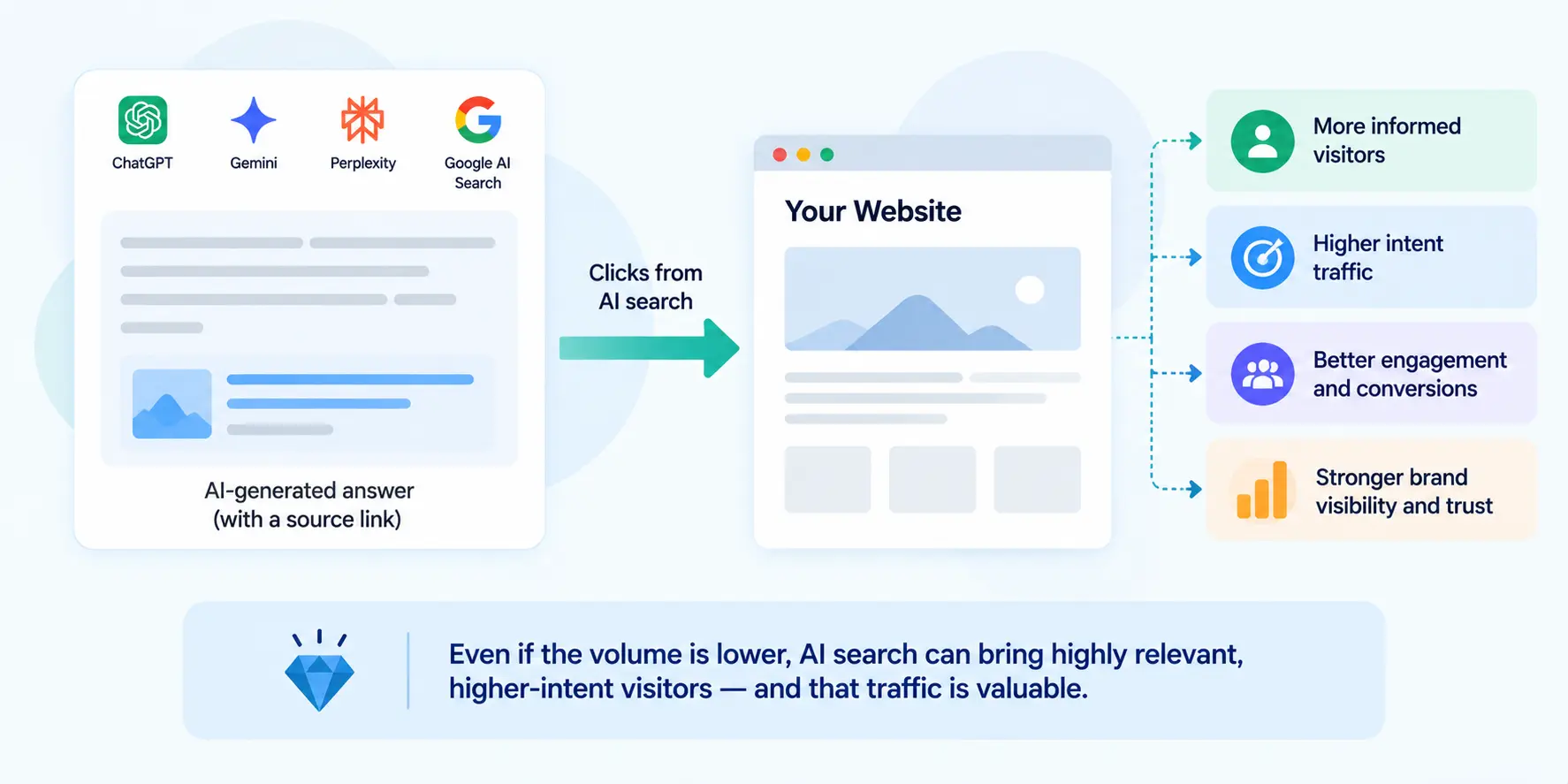
Adobe’s Q2 2026 research, based on analysis spanning more than one trillion visits across sectors including retail, travel, financial services and technology, reports rapid growth in AI-sourced traffic and stronger engagement and conversion behaviour from AI-referred visitors.
In U.S. retail specifically, Adobe reported that AI-referred traffic in March 2026 converted 42% better than non-AI traffic. Those visitors also showed a 12% higher engagement rate, spent 48% longer on sites and viewed 13% more pages per visit.
Google has made a similar, though less quantified, observation about its own AI experiences: it says users who click through from search-result pages containing AI Overviews tend to spend more time on destination sites.
So, we may be seeing two changes simultaneously:
AI answers can reduce the need for clicks.
But:
Users who do click may arrive with more context and stronger intent.
That makes traffic quality increasingly important alongside traffic volume.
AI Visibility Therefore Needs More Than a Traffic Metric
If we measure AI search only through website sessions, we risk ignoring much of what happens before the click.
A better framework is:
Visibility → Engagement → Business Impact
Under Visibility, track:
- AI mentions
- citations
- citation share of voice
- prompt coverage
- generative-search impressions where available
Under Engagement, track:
- AI referral traffic
- landing pages
- engaged sessions
- time spent
- return visits
Under Business Impact, track:
- conversions
- assisted conversions
- qualified leads
- revenue
- branded-search growth
Importantly, measurement capabilities are improving. In June 2026, Google announced dedicated Search Generative AI performance reports in Search Console for a subset of sites, providing separate visibility into impressions within features such as AI Overviews and AI Mode.
Adobe now similarly supports analysis of AI referrals alongside engagement and conversion metrics through analytics integrations.
This means AI visibility measurement is beginning to move beyond screenshots and manually checking whether a brand appears.
Explore ways to get your brand cited by ChatGPT
Don’t Replace SEO Traffic With a Vanity “Citation” Metric
There is an equally important warning here.
If traffic alone is insufficient, that does not mean every AI citation should automatically be treated as valuable.
A citation that nobody notices, remembers or acts upon may have limited commercial impact.
The goal should therefore not be:
Get as many AI citations as possible.
It should be:
Become visible during the questions and decisions that matter to your customers; and determine whether that visibility contributes to business outcomes.
That requires connecting AI-search visibility with analytics, brand demand and eventually revenue.
The Search Funnel Isn’t Disappearing. It’s Changing
The traditional funnel looked like this: Search → Result → Click → Website → Decision
AI search can look more like:
Question → AI Answer → Brand Discovery → Further Research → Click or Later Search → Decision
Sometimes there will be an immediate click.
Sometimes there won’t.
That is why the future of search measurement cannot be reduced to either extreme:
“Traffic is all that matters.”
or:
“Traffic no longer matters.”
Both are too simplistic.
Traffic still matters enormously.
But AI search creates a layer of answer-level visibility before the website visit that marketers increasingly need to understand.
The better question isn’t simply:
“How much traffic did AI send us?”
It is:
“Where did AI introduce or influence our brand in the customer’s journey; and what happened afterwards?”
Answering that question will give brands a much more realistic picture of what AI visibility is actually worth.
Sources
Pew Research Center — Google users are less likely to click when an AI summary appears
Google Search Central — Generative AI performance reports in Search Console
Google Search Central — AI features and your website
Adobe — 2026 Q2 AI Traffic Report
Adobe — AI traffic and retail engagement research
Similarweb — Zero-Click Marketing: 2026 data