
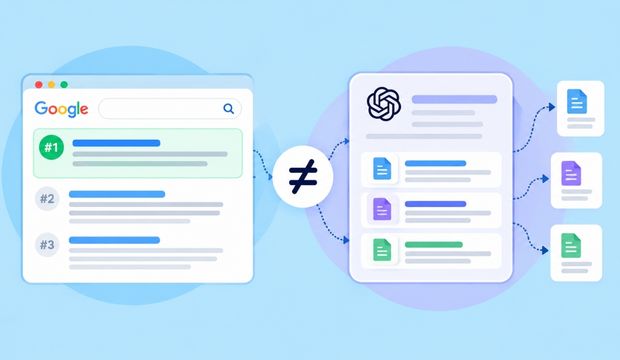




Quick Answer: Ranking highly in traditional Google Search does not guarantee that your page will be selected as a source in an AI-generated answer. AI search introduces additional stages between ranking and citation, including query expansion, retrieval, source selection and synthesis. Emerging research also shows that traditional search and generative search can surface substantially different source sets.
For years, search visibility had a relatively familiar logic:
Rank higher → Get seen → Earn clicks.
AI search complicates that equation.
A page could rank prominently in traditional search results and still be absent from an AI-generated answer. Another source that ranks less prominently could potentially be retrieved and cited instead.
This doesn’t mean Google rankings have stopped mattering. It means ranking and AI retrieval are not the same thing.
Ranking vs Retrieval – What’s the Difference?
Traditional search primarily retrieves and ranks webpages so users can choose which result to visit. AI-powered search can introduce more steps.
Google says AI Overviews and AI Mode may use query fan-out, conducting multiple related searches across subtopics and data sources. As the response is generated, Google’s systems identify supporting webpages that may help answer different parts of the question.
So instead of:
Query → Ranking → Click
the journey can look more like:
Prompt → Multiple searches → Retrieval → Source selection → Synthesis → Citation
That distinction matters.
Imagine someone asks:
“What’s the best project management software for a remote creative agency with fewer than 50 employees?”
A traditional search might rank pages targeting “best project management software.”
But an AI system could need information about several aspects of that question:
- project management tools;
- remote collaboration;
- creative workflows;
- team size;
- pricing;
- integrations;
- product limitations.
The page that ranks highest for one broad keyword isn’t automatically the best source for every part of that information need.
Check our guide on why answer-led content matters
The Research Is Starting to Show the Difference
A 2026 academic study provides particularly interesting evidence.
Researchers analysed 11,500 real-user queries and compared sources surfaced by traditional Google Search, Google AI Overviews and Gemini.
Their finding?
The source sets were substantially different, with average Jaccard similarity below 0.2 across the systems. The researchers also found differences in the types of websites surfaced by traditional and generative search.
This does not prove that traditional rankings are irrelevant to AI retrieval. It demonstrates something more useful:
We should not assume that the sources appearing in conventional search results will simply be reproduced inside generative answers.
Google itself says AI Mode and AI Overviews can use different models and techniques, meaning the responses and links they show can vary.
Think Beyond “Ranking” to the AI Visibility Funnel
For marketers, a better model may be:
Discoverable → Retrieved → Selected → Cited → Influential
Each stage asks a different question.
Discoverable: Can the system access and understand the page?
Retrieved: Does the page surface when the system searches for information relevant to the prompt?
Selected: Is it useful enough to survive among other candidate sources?
Cited: Does the final response attribute information to it?
Influential: Does information from the source meaningfully shape the answer?
This is what we call the AI Visibility Funnel. And a brand can lose visibility at any stage.
Does Traditional SEO Still Matter?
Absolutely.
Google explicitly says that existing SEO fundamentals continue to apply to AI Overviews and AI Mode. A page must be indexed and eligible to appear in Google Search with a snippet before it can appear as a supporting link in these AI experiences. Google also recommends crawlability, internal linking, people-first content and making important information available in textual form.
OpenAI makes a similar point about accessibility: websites that want to be discoverable in ChatGPT Search should allow OAI-SearchBot to crawl them. OpenAI also states that no publisher can guarantee top placement because ranking depends on multiple factors intended to surface reliable and relevant information.
So, SEO isn’t being replaced. It is becoming one layer of a larger visibility system.
Check out our guide on how traditional SEO is evolving into AIO
What Should Content Teams Do Differently?
The answer isn’t to abandon keywords or chase supposed “AI ranking hacks.”
Start by asking a broader question: If an AI system were researching this topic on behalf of our customer, what information would it need?
Then make that information genuinely useful.
Cover important subtopics. Answer specific questions. Make comparisons explicit. Support factual claims with credible sources. Publish original evidence where possible. Keep important information current. Build strong internal links between related resources.
Google’s own guidance for its AI experiences remains remarkably straightforward – create unique, valuable content for people rather than commodity content designed primarily to manipulate a system.
The Bigger Shift – From Search Visibility to Retrieval Visibility
For two decades, marketers have largely asked:
“Where do we rank?”
AI search introduces another question:
“When an AI system researches this subject, are we one of the sources it finds useful?”
Those questions overlap.
But they aren’t identical.
And that gap between being visible in traditional search and being retrieved, selected and cited by AI systems is becoming one of the most important areas for marketers to understand.
At Sudha Solutions, we call this the Visibility Gap:
Search Visibility ≠ Retrieval Visibility ≠ AI Visibility
Ranking still matters.
But in AI search, ranking may only be the beginning of the journey
Sources
Google Search Central — AI Features and Your Website
Google Search Central — Succeeding in AI Search
OpenAI — ChatGPT Search Documentation
Research: How Generative AI Disrupts Search — 11,500-query study