





Most businesses react to AI Overviews the same way. They notice their traffic dropping, check their rankings, and find nothing wrong. The rankings are intact. So is the content. But the AI Overview at the top of the page is citing someone else, and nobody knows why.
The answer isn’t in rankings. It’s in understanding how Google AI Overviews choose websites to cite and why traditional SEO signals alone are no longer enough. And that selection process works very differently from how traditional search ranking does.
Retrieval, Not Ranking
The most important thing to understand is this – Google AI Overviews don’t rank pages. They retrieve passages.
Traditional search evaluates pages against each other using signals like backlinks, domain authority, and keyword relevance, whereas AI SEO optimization focuses on citation-ready content. AI Overviews use a different mechanism entirely. When a query triggers an AI Overview, Google’s system identifies extractable passages across multiple pages that can support a synthesised answer; and then builds that answer from the most credible sources it finds.
A page can hold position one for a query and still not appear in the AI Overview. That’s why businesses are increasingly investing in Generative Engine Optimization (GEO) strategies. That’s not a contradiction. It’s just two different processes selecting for two different things.
The evidence makes this concrete. In mid-2025, roughly three out of four pages cited in AI Overviews also ranked in the organic top ten for the same keyword. By February 2026, Ahrefs’ analysis of 863,000 keywords reported in Search Engine Journal found that overlap had dropped to 38%. A separate BrightEdge study put it as low as 17%. Either way, the message is clear – being ranked well no longer reliably translates into being cited.
How the Selection Process Actually Works
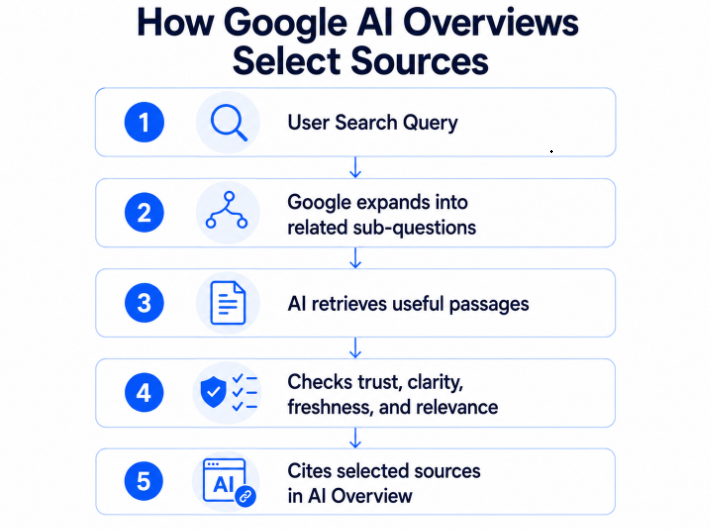
When a query is submitted and triggers an AI Overview, Google’s system expands it into a cluster of related sub-questions – a process Ahrefs researchers describe as “fan-out.” If someone searches for “best project management approach for remote teams,” the system might internally generate sub-queries around team communication tools, async workflows, accountability structures, and platform options.
It then retrieves content that answers those sub-questions individually. Pages that perform consistently across multiple related sub-queries, not just the original keyword, are far more likely to be pulled into the final answer. As Search Engine Journal’s March 2026 analysis of the Ahrefs data noted, this fan-out process may now play a larger role in source selection than single-keyword ranking.
Google upgraded AI Overviews to run on Gemini 3 globally in January 2026. This shift deepened the model’s ability to evaluate semantic completeness, whether a piece of content answers a question in full, without requiring the reader to go elsewhere for supporting context.
What Google Is Actually Evaluating
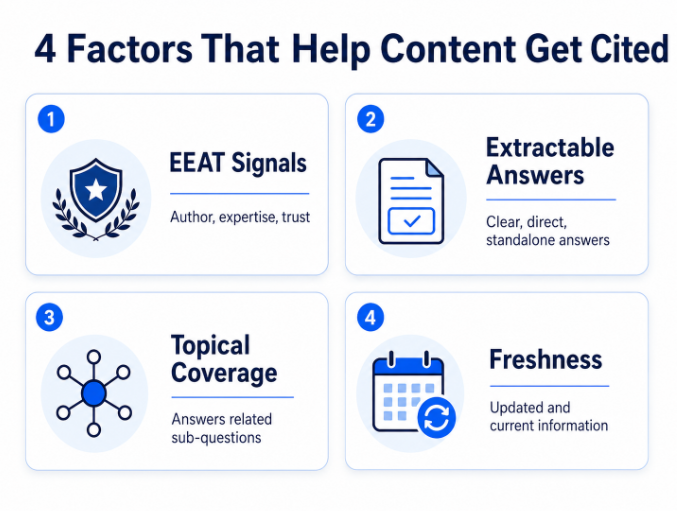
Research from BrightEdge and corroborating studies consistently identify four factors that determine whether content earns a citation in an AI Overview.
EEAT signals. Google’s own Search Quality Evaluator Guidelines describe Experience, Expertise, Authoritativeness, and Trustworthiness as the core credibility framework. For AI Overviews, this operates at two levels – the page level (named authors, original research, specific verifiable claims) and the domain level (does Google trust this site’s overall coverage of related topics). Content without clear authorship and expertise signals is filtered out early.
Extractable answers. AI Overviews pull specific passages, not entire pages. For a passage to be extracted, it needs to stand alone – a self-contained statement that answers a specific question without requiring the surrounding context. Content buried in long narrative paragraphs, or structured around storytelling rather than direct answers, is harder to extract. Content with clear headings, direct opening sentences, and specific claims near the top of each section is significantly more extractable.
Topical coverage, not single-keyword depth. Because of the fan-out process, pages that cover a subject across multiple related angles are better positioned than pages targeting a single keyword tightly. A piece that answers the core question but also addresses connected sub-questions gives the AI more usable passages and creates more opportunities to be pulled across multiple sub-queries.
Freshness. BrightEdge data shows that content freshness directly affects AIO citation rates. Regularly updated pages outperform equivalent pages because fresh content is more likely to be cited by AI search engines. AI Overviews prioritise current, verified information — especially in categories where facts evolve quickly.
The Source Pool Is Smaller Than Most People Think
Google AI Overviews now reach more than 2 billion monthly users across 200 countries, as Google CEO Sundar Pichai confirmed in the Q2 2025 earnings call. But the pool of domains that actually appear in those answers is extremely small, making AI search visibility for businesses increasingly competitive.
Only 274,455 domains have ever appeared in AI Overviews out of 18.4 million domains in Google’s index. That’s less than 1.5% of indexed domains earning any AIO citation at all. The brands appearing consistently aren’t necessarily the largest or best funded; but they all have one thing in common: content that is clearly structured, credibly authored, and regularly maintained.
YouTube is also worth flagging separately. BrightEdge research identifies YouTube as the most frequently cited source in AI Overviews for queries involving explanation or demonstration. Google’s AI systems select YouTube for step-by-step and instructional content at a rate that no other video platform comes close to. For brands that create explanatory video content, this creates an additional citation surface that operates independently from website optimisation.
What This Means Practically
Chasing AI Overview citations by optimizing single pages for single keywords doesn’t reflect how selection actually works. The brands consistently appearing in AI Overviews have built something broader: a body of content that covers a topic across multiple angles, authored credibly, updated regularly, and structured so that Google’s AI can extract clean, specific, standalone answers from it.
The businesses missing from AI Overviews typically have the opposite profile: solid rankings on targeted keywords, but sparse topic coverage, thin authorship signals, and content structured for human browsing rather than machine extraction.
The gap between those two profiles is what AI Overview optimisation is actually about.
Want your brand to show up on Google Overview and other AI platforms? Check out Sudha Solutions. Our AEO strategy has helped numerous brands rank in Google Overviews. Contact us TODAY!
FAQ
- How does Google AI Overviews choose which sources to feature?Google AI Overviews selects sources based on how well content answers the query, how credible the source is, how clearly the information is structured, and whether the page provides fresh, useful, and extractable information.
2. Can a page rank first on Google and still not appear in AI Overviews?
Yes. A page can rank in the top organic position and still not be cited in AI Overviews. Traditional rankings and AI Overview citations are now different visibility opportunities.3. What type of content is more likely to be cited in AI Overviews?
Content that gives direct answers, uses clear headings, covers related subtopics, includes factual claims, shows author expertise, and is regularly updated is more likely to be used as an AI Overview source.4. Why is EEAT important for AI Overview citations?
EEAT helps Google understand whether a page is trustworthy. Pages with named authors, expert insights, original information, references, and strong brand authority are more likely to be considered reliable sources.5. How can businesses improve their chances of appearing in AI Overviews?
Businesses can improve their chances by building topic clusters, updating old content, adding schema markup, writing answer-first sections, strengthening author profiles, and creating content that answers multiple related questions clearly.