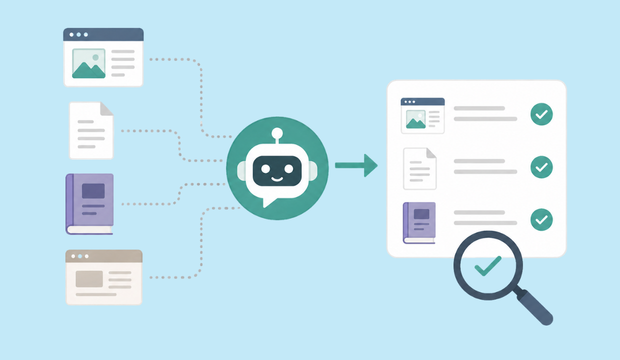




Every time someone asks ChatGPT a question, the AI quietly makes a decision that most people never think about. It picks a handful of sources to cite, sometimes two, sometimes six, out of thousands of pages it could theoretically reference. And if your brand’s content isn’t among them, you simply don’t exist in that answer.
Understanding how that selection actually works is one of the most useful things a marketer or business owner can learn right now. It’s not mysterious, and it’s not random. There are patterns, and there’s research. This article walks through what the data says.
If you’re new to this topic, it helps to first read What is Generative Engine Optimization (GEO)? for the bigger picture context. But if you already understand GEO and want to know the mechanics behind citations specifically, you’re in the right place.
ChatGPT Doesn’t Work the Way Most People Think
There’s a common assumption that ChatGPT “searches the internet” the way Google does, reads everything, and then picks the best pages. That’s not quite right.
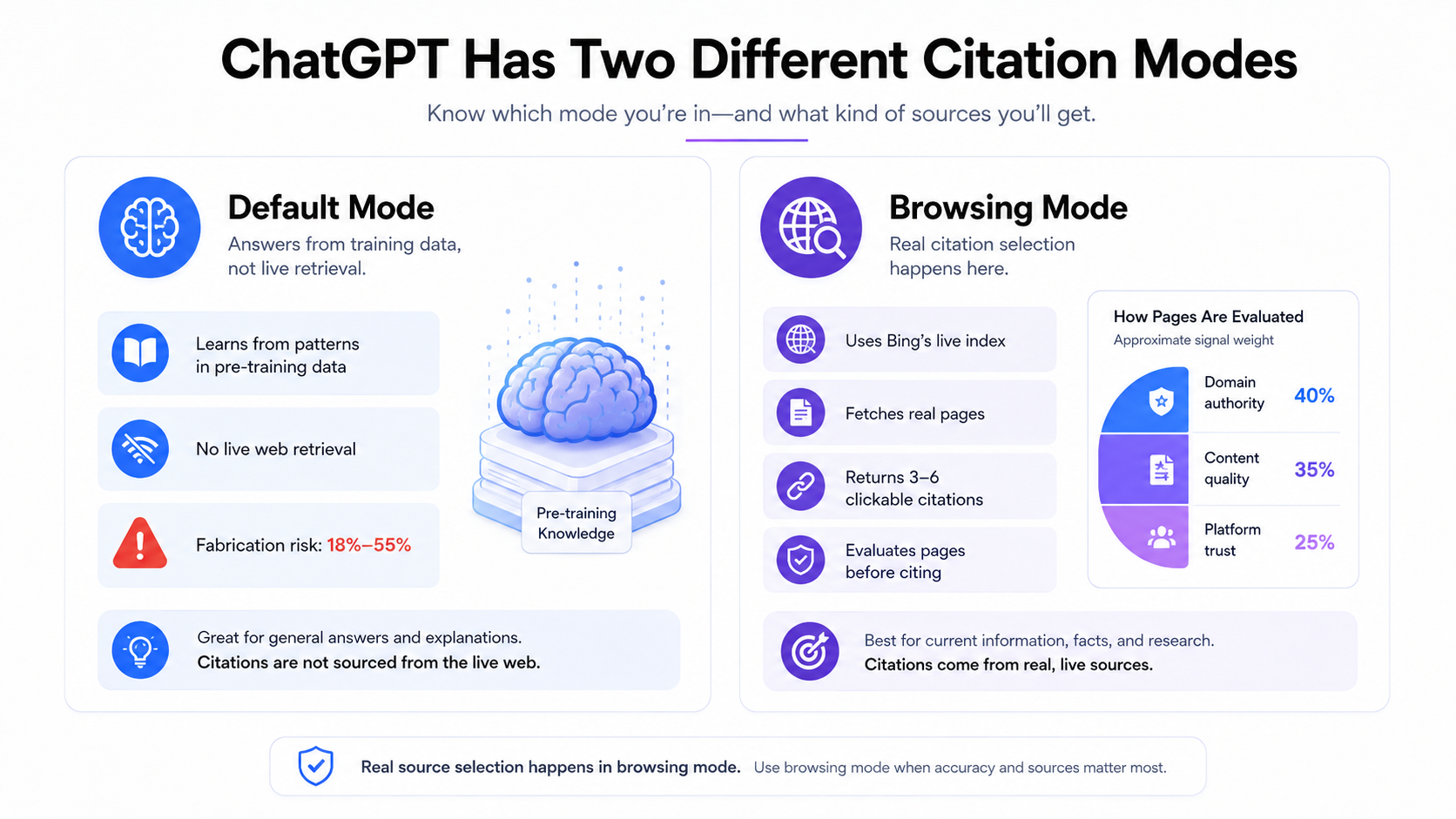
ChatGPT actually operates in two distinct modes, and which mode is active determines everything about how sources get selected.
In its default mode, ChatGPT generates responses from statistical patterns in its training data; roughly 570 GB of text collected before its training cutoff. In this mode, it isn’t retrieving any live sources at all. When it appears to “cite” something in this mode, it’s constructing a plausible-sounding reference from memory, not from real-time retrieval. This is why fabrication rates in this default mode range from 18% to 55%, according to research cited by ZipTie.dev
Browsing mode is where real citation selection happens. When ChatGPT’s browsing feature is active, it uses Bing’s search index to fetch live pages. It returns 3 to 6 clickable, real citations per response. And the selection process in this mode is governed by specific, measurable factors that brands can actually influence.
According to the same analysis from ZipTie.dev, ChatGPT in browsing mode evaluates pages based on three weighted signals: domain authority (roughly 40%), content quality (roughly 35%), and platform trust (roughly 25%).
Those aren’t the only factors at play. But they’re a useful starting frame.
The Selection Process, Step by Step
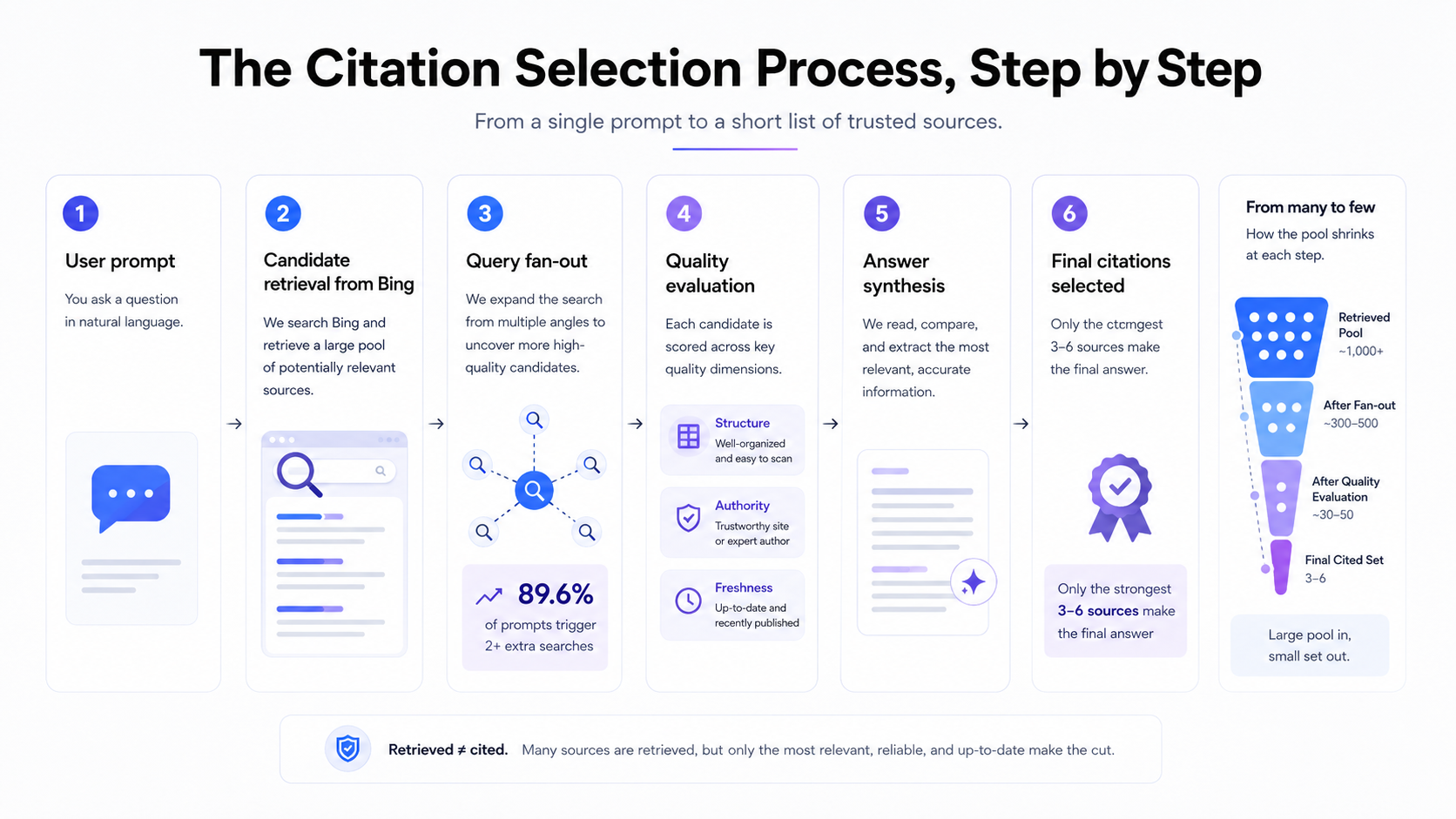
Before any citation appears in a ChatGPT response, the content goes through a multi-stage process. A study by Sellm.io that analysed more than 400,000 URLs across 10,000 different queries mapped this process clearly.
First, ChatGPT retrieves candidate pages from Bing for the query. Then it expands that query into additional sub-questions, a process called “fan-out”, and retrieves pages for those too. Erlin.ai’s ChatGPT search optimization guide found that 89.6% of prompts trigger two or more additional searches before an answer is returned.
After retrieval, ChatGPT evaluates structural quality, authority signals, and content freshness. Then it synthesises an answer and selects only the pages it considers most trustworthy to cite in the final output.
The gap between “retrieved” and “cited” is where most brands fall short. Your content might be pulled into the consideration pool. But if it doesn’t pass the final quality check, it won’t make the cut.
What Actually Drives Citation Selection
Content Structure and Answer Fit
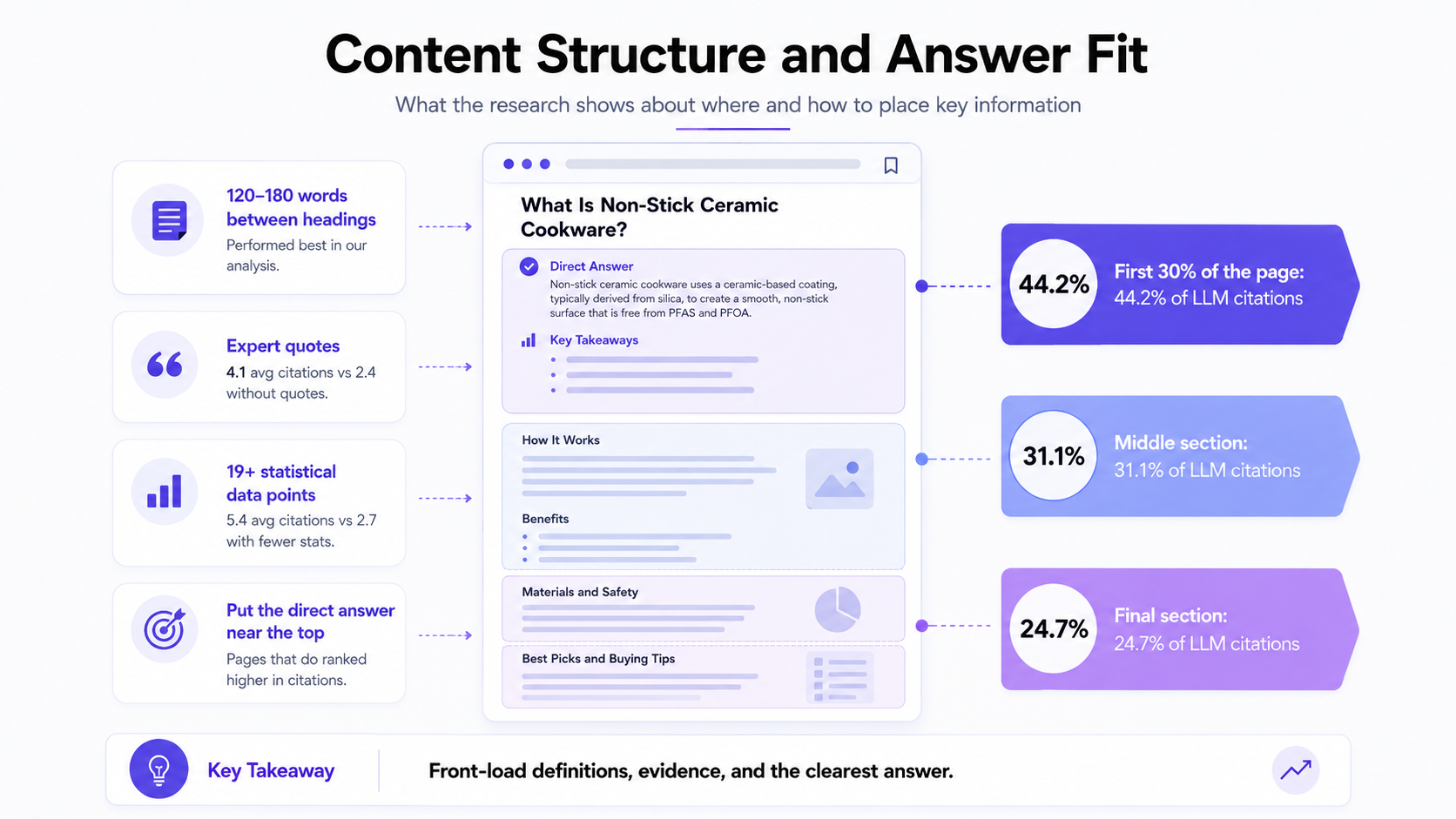
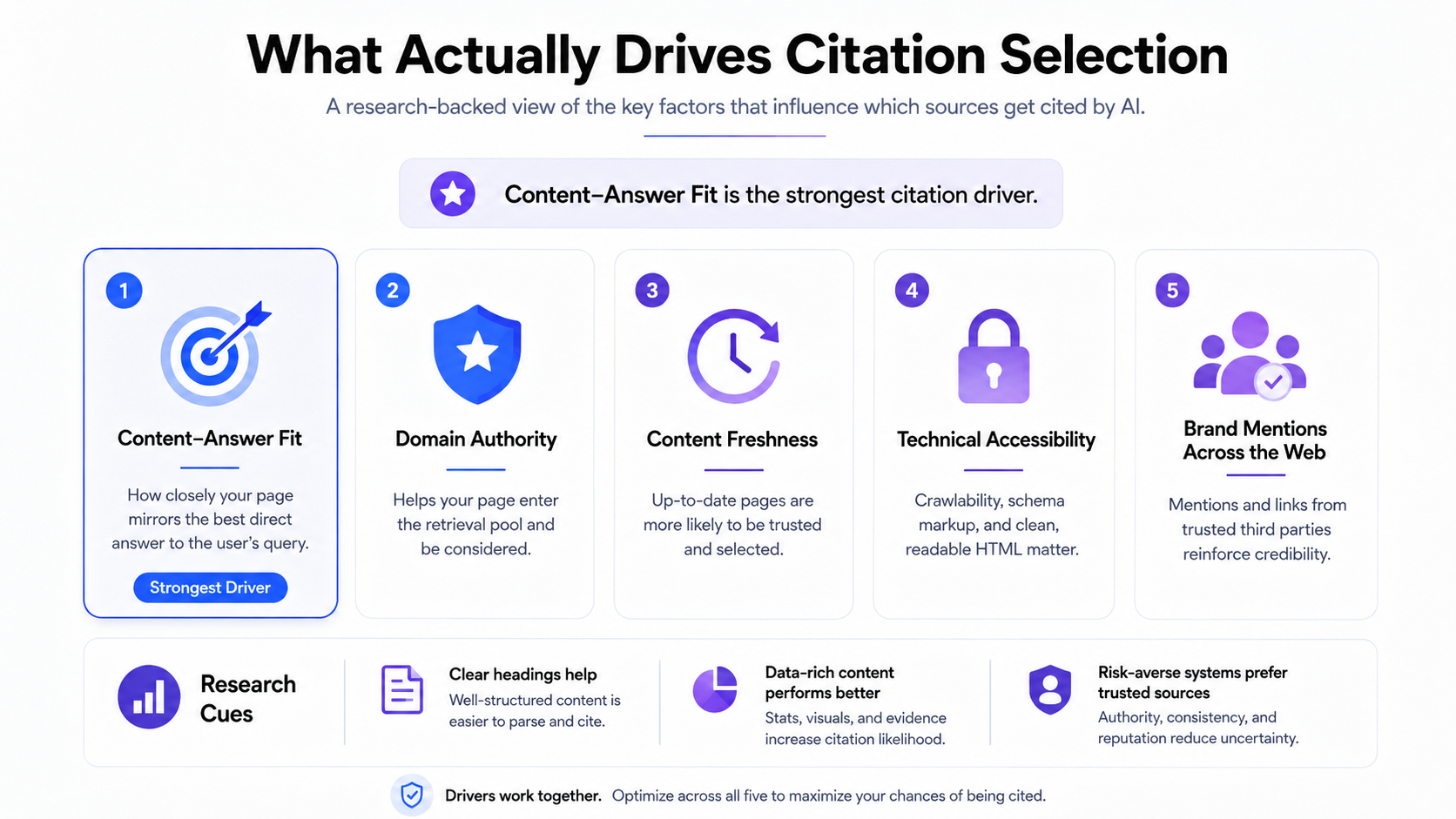
The single strongest factor in whether a page gets cited, according to Sellm.io’s analysis of 400,000+ URLs, is what researchers call “Content-Answer Fit.” That means how closely your content mirrors the way ChatGPT itself would explain a topic. The logic, the tone, the paragraph lengths; all of it matters.
There’s also a positional bias worth knowing about. Research from a renowned source which analysed thousands of ChatGPT citations, found that the first 30% of a page accounts for 44.2% of all LLM citations. The middle section contributes 31.1%. The final section, 24.7%.
Put the most important facts and the direct answer to the query at the top. Not halfway down the page, not after a lengthy introduction. Right at the start.
Content length also plays a role. Articles under 800 words averaged 3.2 citations in Search Engine Journal’s analysis of the top 20 citation factors. Articles over 2,900 words averaged 5.1. But raw length isn’t the point. The same study found that section length mattered too; pages with 120 to 180 words between headings performed best, averaging 4.6 citations. Sections under 50 words averaged 2.7.
Pages that included expert quotes averaged 4.1 citations versus 2.4 for those without. And content with 19 or more statistical data points averaged 5.4 citations, compared to 2.8 for pages with minimal data.
Domain Authority and Referring Domains
Authority still matters in AI search, but it works a bit differently than in traditional SEO.
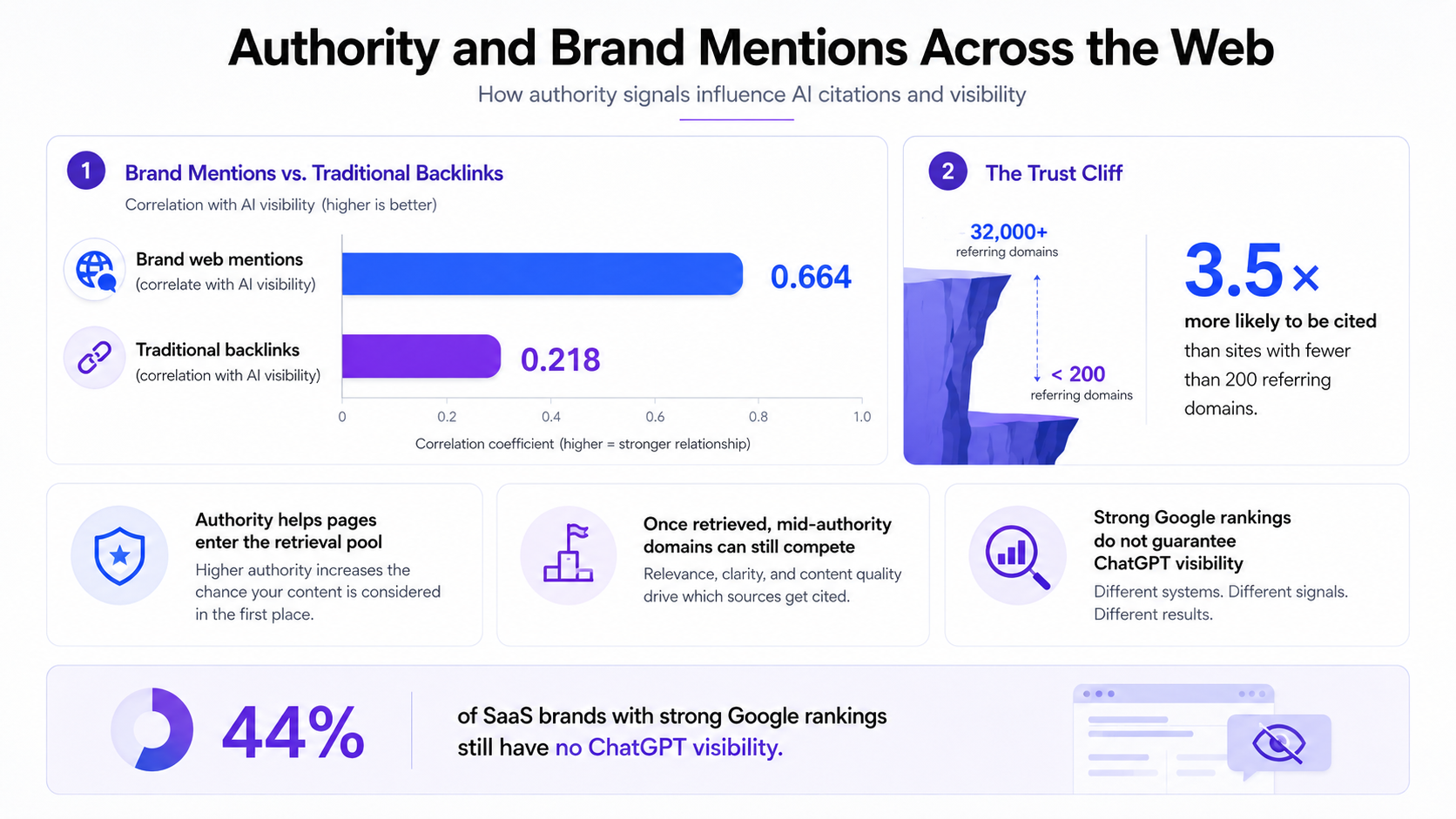
SE Ranking’s November 2025 research found that sites with over 32,000 referring domains are 3.5x more likely to be cited by ChatGPT than sites with fewer than 200 referring domains. Researchers describe this as an authority “trust cliff.” Unlike Google, where a mid-authority site could still rank for the right long-tail keyword, ChatGPT is risk-averse. It prefers sources it can confidently attribute.
That said, domain authority matters more for getting into the retrieval pool than for winning citations within it. Once retrieved, pages in the domain authority range of 40 to 80 show citation rates comparable to higher-authority domains, according to Erlin.ai’s 2026 guide. Getting through the door is the hard part.
Also worth noting: pages ranking in Position 1 on Google are cited by ChatGPT 3.5x more often than pages outside the top 20. But only 12% of URLs cited by ChatGPT also rank in Google’s top 10. Strong Google rankings help, but they’re not a pass. 44% of SaaS brands with strong Google rankings have no ChatGPT visibility at all, according to EMGI Group data from April 2026 cited in Erlin.ai’s guide.
Content Freshness
This is one of the clearest and most actionable signals of all.
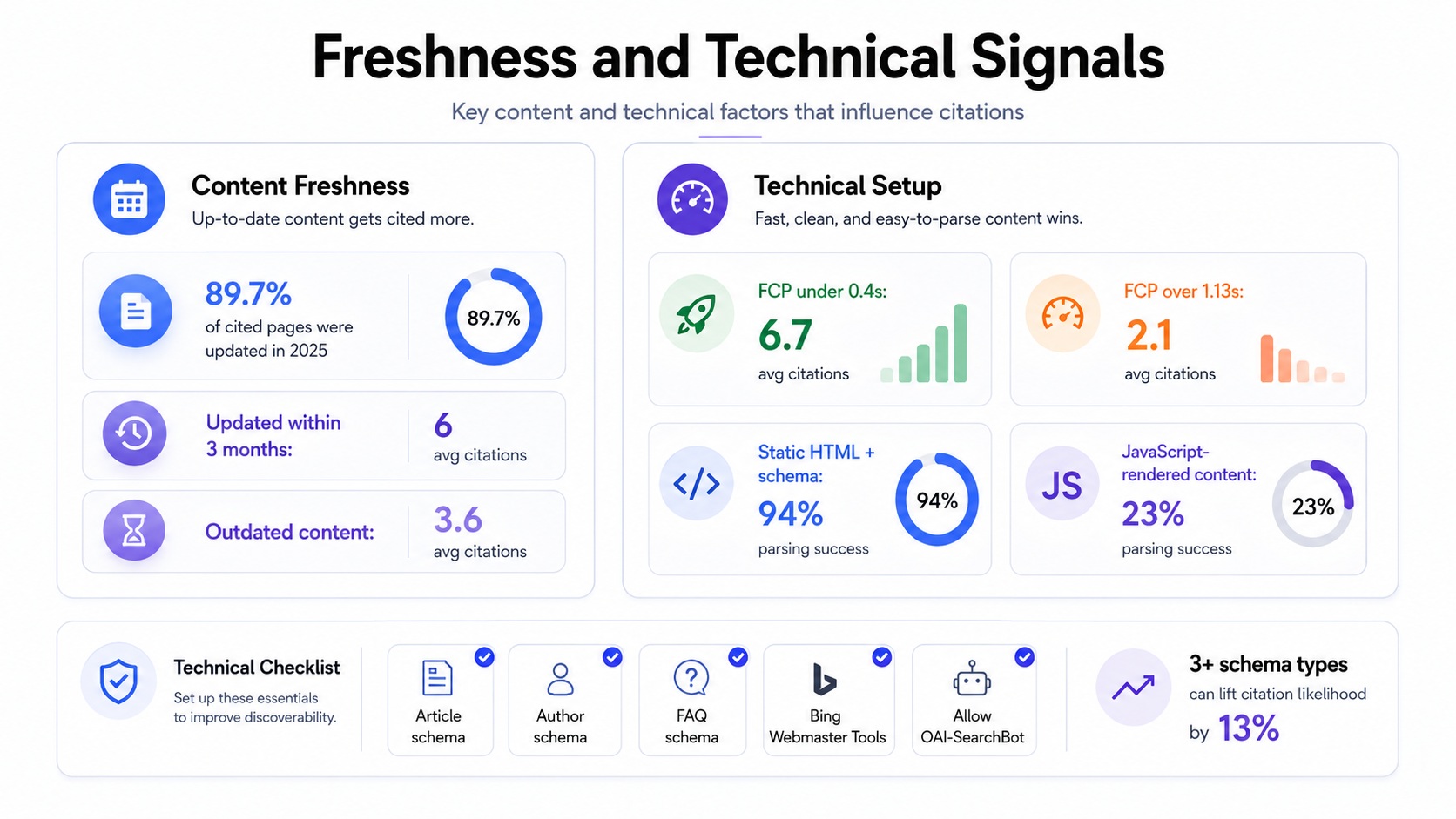
An Ahrefs analysis, referenced in ZipTie.dev’s source selection guide, found that 89.7% of cited pages had been updated in 2025, and 60.5% were published within the last two years. A high-quality page that hasn’t been updated in six months faces a meaningful citation disadvantage compared to a comparable page with recent edits.
The Search Engine Journal study backs this up with specific numbers. Pages updated within three months averaged 6 citations. Outdated content averaged 3.6.
Freshness is also one of the fastest factors to act on. Improving domain authority takes years. Building referring domains takes sustained effort. But updating a key article can happen this week.
Page Speed and Technical Setup
This one surprises a lot of people.
SERanking, in its November 2025 Analysis, also found that pages with a First Contentful Paint under 0.4 seconds averaged 6.7 citations. Pages loading in over 1.13 seconds averaged 2.1 citations. That’s a 3x difference based purely on how fast the page loads.
JavaScript-rendered content creates an even bigger problem. AI parsing success for static HTML with schema runs at 94%. For JavaScript-rendered content, it drops to 23%.
And according to research from Erlin.ai, pages with three or more schema types have a 13% higher likelihood of being cited by LLMs. Businesses investing in technical SEO services for AI search are often better positioned to improve crawlability, schema implementation, and AI citation visibility. At minimum, Article schema, Author schema, and FAQ schema are worth implementing.
One more technical note: ChatGPT’s browsing mode runs on Bing’s index. If your site hasn’t been submitted to Bing Webmaster Tools, or if your robots.txt is blocking OAI-SearchBot, you’re invisible to ChatGPT by default regardless of how good your content is.
Brand Mentions Across the Web
Off-site presence contributes to how AI systems assess your credibility, not just your content.
Ahrefs’ December 2025 study of 75,000 brands, referenced across multiple GEO research summaries, found that the correlation between brand web mentions and AI visibility is 0.664. The correlation for traditional backlinks? 0.218.
Brands that show up consistently in discussions on Reddit, Quora, YouTube, and industry publications give AI systems a clearer picture of who they are and whether they’re worth recommending. Strong AI citation optimization services focus heavily on improving brand authority signals across trusted third-party platforms.
Related read: Effective Strategies for Tracking Brand Mentions
One Thing ChatGPT Has a Clear Preference For
Across the research, one content format comes up repeatedly as a reference point for how ChatGPT selects sources.
Profound’s citation analysis, which tracked 680 million citations across ChatGPT, Google AI Overviews, and Perplexity between August 2024 and June 2025, found that Wikipedia accounts for 47.9% of citations among ChatGPT’s top ten most-cited sources.
That tells you something important about what ChatGPT trusts. It prefers content that reads like a reference source; clear definitions, specific claims, supporting data, and factual accuracy. Not promotional copy. Not vague thought leadership. Definitive, citable information.
If the content on a page could theoretically appear in an encyclopedia entry, ChatGPT finds it far easier to cite.
A Common Misconception Worth Addressing
Some businesses assume that because they rank well on Google, they’ll automatically show up in ChatGPT. The data says otherwise.
A January 2026 platform comparison study found that Google AI Overviews maintain a 54% overlap with traditional organic rankings. ChatGPT’s overlap is significantly lower. It applies its own selection criteria, and the brands winning in ChatGPT are not always the same brands winning on Google.
The practical takeaway: Google SEO and GEO need to be treated as related but separate disciplines. The content structure, freshness practices, and off-site signals that drive ChatGPT citations require deliberate attention – not just a hope that Google rankings carry over.
What to Do With This Information
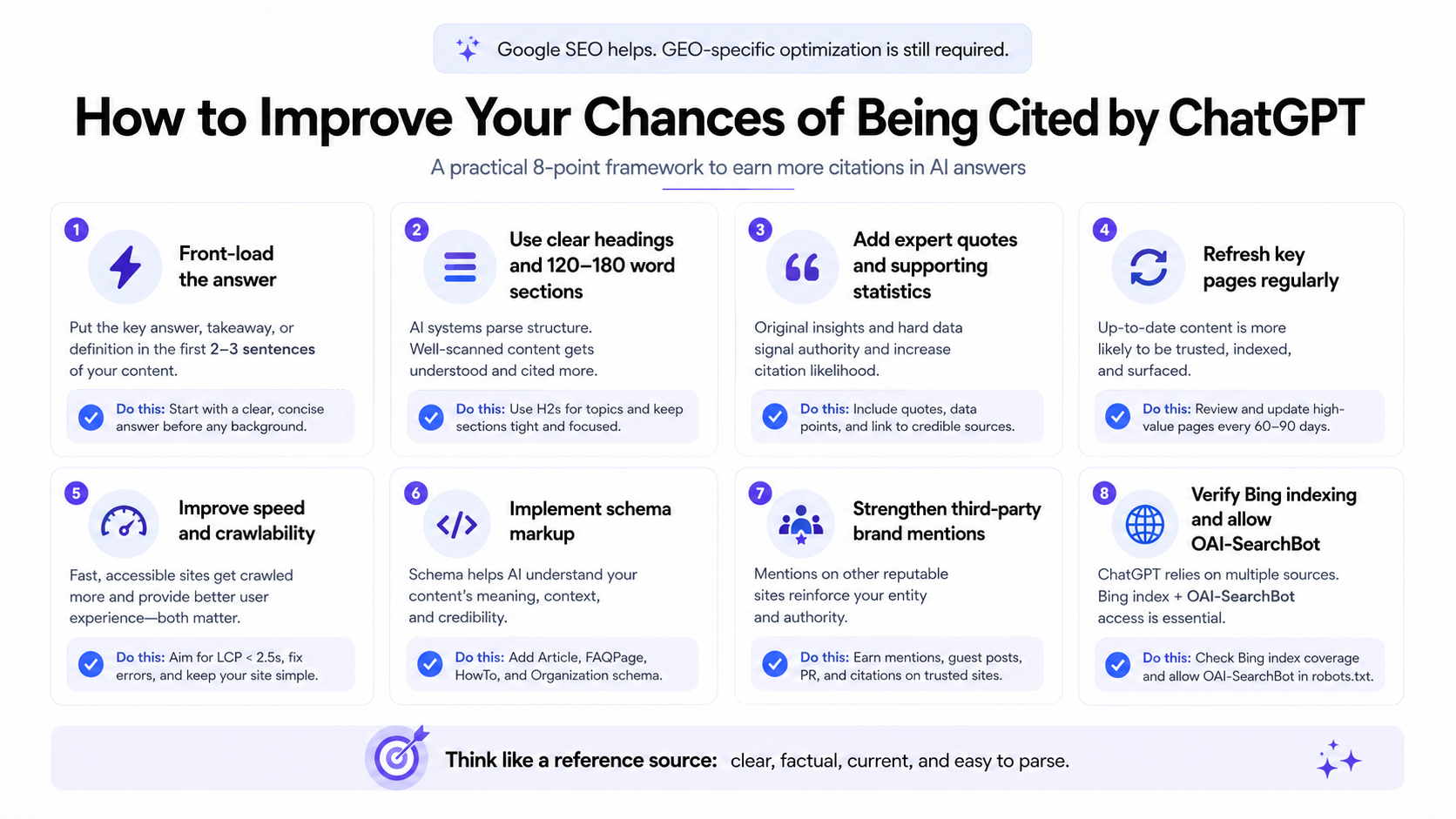
Understanding how ChatGPT selects sources leads naturally to a set of practical priorities.
Start with the content already on the site. Are the most important pages front-loading their answers? Are they being updated regularly? Are they long enough and data-rich enough to compete? Is the site loading fast and built on static HTML rather than JavaScript rendering?
Then look at the off-site picture. Where does the brand appear across the web beyond the company’s own pages? What would ChatGPT find if it searched for the brand name on Bing right now?
And finally, check the technical foundations. Is the site verified on Bing Webmaster Tools? Is OAI-SearchBot allowed to crawl? Is schema markup in place?
These aren’t complicated questions. Businesses working with an experienced AI search visibility agency are often able to identify technical and content gaps much faster across AI-driven search platforms. But most businesses haven’t asked them yet, because most businesses haven’t started thinking about ChatGPT as a search channel at all.
That gap is exactly the opportunity.
This article is part of Sudha Solutions’ ChatGPT Optimization series. Read the full series:
- What is Generative Engine Optimization (GEO)? A Beginner’s Guide – Start here if you’re new to GEO
- How to Get Your Brand Cited by ChatGPT
- Why 88% of B2B Brands Are Invisible in AI Search
- ChatGPT vs Google: Where Should Your Business Focus in 2026?
- How to Audit Your ChatGPT Visibility
- LLM SEO for B2B Brands
Sudha Solutions helps businesses build visibility in AI search through content strategy, GEO, and digital marketing. Based in India, working with brands globally.
Frequently Asked Questions
How does ChatGPT select websites to cite?
ChatGPT evaluates factors such as content clarity, domain authority, structured formatting, freshness, technical SEO, and trusted brand mentions before citing websites.
Does ranking on Google guarantee ChatGPT visibility?
No. Many websites ranking well on Google still fail to appear in ChatGPT because AI systems use different citation and authority signals.
What is AI citation optimization?
AI citation optimization is the process of improving content structure, authority signals, technical SEO, and brand visibility so AI tools are more likely to cite your content.
Why is content freshness important for ChatGPT citations?
AI systems prefer updated and recently refreshed content because it signals relevance, accuracy, and current expertise.
How can businesses improve visibility in ChatGPT?
Businesses can improve ChatGPT visibility through structured content, schema markup, topical authority, AI-focused SEO, answer engine optimization, and third-party brand mentions.