





There is a quiet but significant shift happening in digital publishing, and businesses investing in SEO expert services, content marketing experts, and expert blog writing are already seeing how answer-first content is replacing outdated blogging models. But if you have been publishing content for your business for a while now, you may have already felt it: the sense that what once worked no longer does, and that the rules have changed.
This piece is about understanding that shift, why it is happening, and what it means for your business.
The Way People Search Has Changed
This shift is why AEO services and AI search optimization are becoming critical extensions of traditional SEO.
Think about how you search for information today versus five years ago. The odds are you are no longer typing two or three keywords and scrolling through blue links. You are:
- Typing full questions into Google
- Asking your phone out loud
- Getting AI-generated summaries before you even click on anything
This is not anecdotal. In 2024, 59.7% of EU Google searches and 58.5% of US Google searches resulted in zero clicks, meaning users found what they needed directly on the search results page without visiting a single website. For every 1,000 searches on Google in the United States, only 360 clicks reach an external website.
Search engines have quietly transformed from directories that pointed people to content into answer engines that deliver content directly. This is exactly why answer engine optimization is becoming essential for brands that want visibility beyond traditional rankings. Google’s AI Overviews, voice search, knowledge panels, and featured snippets have collectively rewritten what it means to be “found online.”
What this means for your blog:
- Readers arrive with a specific question already in mind
- They expect an answer quickly, in plain language
- Blogs that open with long preambles before getting to the point are not just outdated, they are functionally invisible
What Answer-Led Content Actually Means
At its core, answer-led content reflects a smarter blog writing service approach, one that prioritises search intent, clarity, and conversion.
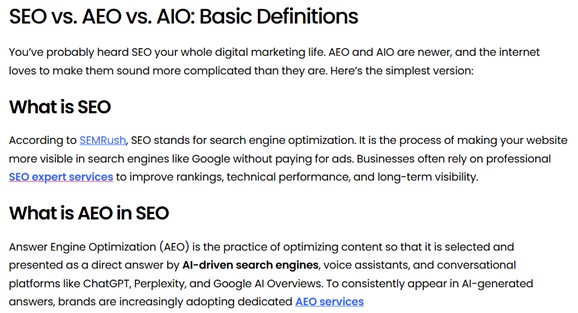
Answer-led content is not a format or a template. It is a philosophy rooted in one simple idea: the reader’s time matters more than the writer’s comfort.
Traditional blogging was built around a narrative structure:
- Set the scene
- Explore the topic broadly
- Arrive at something useful, eventually
Answer-led content flips that structure entirely:
- Lead with the most important information first
- Build context and depth around it
- Design for how people actually read online
And how do people read online? According to a statistic blog post by S Q Magazine 73% of readers skim blog posts, while only 27% read them fully. Answer-led content is built for the skimmer, without short-changing the reader who wants depth.
Why this matters for your business:
- A reader who finds your answer immediately earns you trust
- A reader who must hunt for the answer leaves, and usually does not come back
Why Is There a Shift in Content Marketing?
For brands investing in strategic content marketing, this means content must now rank, engage, and qualify for AI-generated answers simultaneously.
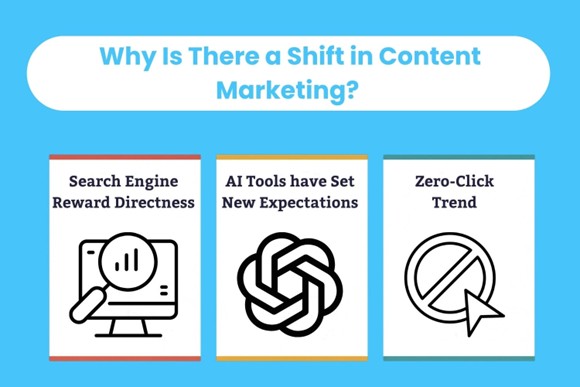
Three things converged to create the current content environment:
1. Search engines began rewarding directness
- Google has spent years refining its ability to separate content that answers a query from content that merely contains the right keywords
- Content structured around clear, specific answers consistently earns better placement, including featured snippet positions at the very top of the page
2. AI tools have recalibrated reader expectations
- When someone can ask ChatGPT a question and receive a concise answer in seconds, their tolerance for content that buries the lead shrinks considerably
- This is not a threat to good content. It is a filter that removes mediocre content from consideration
3. Zero-click behaviour is now the norm, not the exception
- The majority of searches now end without a click to any website
- Readers who do click have already passed through AI summaries and featured snippets
- They are coming to you for something those could not provide: nuance, specificity, or a perspective grounded in real experience
The businesses that recognized this early and restructured their content accordingly have built meaningful advantages in visibility and credibility. Those still publishing in the old mold are quietly losing ground.
The Problem with How Most Blogs Are Still Written
Visit almost any business blog today and you will find a familiar pattern:
- A broad opening observation about the topic
- An explanation of what the article will cover
- A slow circle toward something useful
- By the 400-word mark, the reader who came with a specific question has already left
This structure was not designed for readers. It was designed for search engine crawlers in an era when word count and keyword density drove rankings. That era is over, but the habits it created have persisted.
The consequences for businesses are real:
- According to a study, after 7 minutes of reading time, engagement on most websites falls off sharply, and reading time tends to drop below 10 seconds if your post takes 14 minutes or more to finish.
- A slow-starting blog post does not just fail to engage, it actively signals readers to look elsewhere
- Content padded with vague generalisations makes your business look like it does not have much to say, but knows it needs to publish something
Readers can sense this, even if they cannot articulate exactly why they clicked away.
What Good Answer-Led Content Looks Like
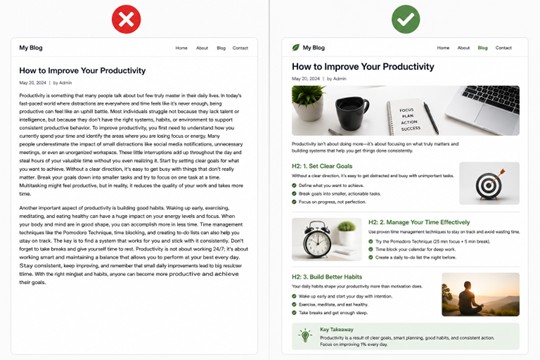
The clearest way to understand this is through contrast.
Old approach: An influencer talking about how to increase productivity in a blog with no formatting, spending a lot of time on unnecessary paragraphs and jargons.
New approach: The same blog opens with a direct answer, clear inforgragics and answers that are easy to skim through.
The hallmarks of good answer-led content:
- Leads with the answer: Context can be built later.
- Matches format to the question: Not every topic need 1,500 words; a comparison question warrants a structured comparison, not a long essay
- Uses headings and structure: This helps readers to scan and still walk away informed. A strong SEO content strategy often uses pillar pages and topic clusters to make content easier for both users and AI systems to understand.
- Prioritise specificity over volume: a 600-word post that answers one question precisely outperforms a 2,000-word post that gestures at ten questions without resolving any of them
- Demonstrates expertise: Your expertise should be demonstrated by your knowledge in the field and not the wordcount of the blog
Why This Matters for Your Business Specifically
Your blog is often the first meaningful encounter a potential client has with your business. Not your homepage, which tends to be polished and promotional. Your blog, where someone lands when they have a real question and want a real answer.
What a well-structured blog communicates to a reader:
- We understand your problem
- We know what we are talking about
- We are not going to waste your time
That is a powerful first impression, and it is one that answer-led content delivers consistently.
Consider this example: A financial advisory firm whose blog consistently answers specific questions their target clients are already searching:
- “Do I need a will if I have a small business?”
- “How much should I set aside for taxes as a freelancer?”
- “When should I start thinking about succession planning?”
Each of those posts is a low-pressure introduction to the firm’s expertise. No sales pitch required. The content earns trust simply by being genuinely useful.
The compounding effect:
- A single well-structured post can attract readers and generate enquiries for years.
- The most effective content that ranks also connects readers naturally to conversion-focused assets.
- It does not require ongoing promotion to keep working
- Compare that to a promotional post with a short shelf life, and the case for this approach becomes straightforward
The SEO Payoff
At its core, SEO has always been about one thing: demonstrating to search engines that your content is the most useful result for a given query. Answer-led content does this structurally.
Businesses using SEO blog writing services structured around EEAT and answer-led frameworks are significantly better positioned for featured snippets and AI overviews.
How it earns better search placement:
- Directly addresses a specific question
- Uses clear headings that signal structure to search engines
- Provides specific information rather than vague observations
- Aligns with what Google is trying to serve its users
Google’s E-E-A-T framework rewards content that is:
- Written by people with genuine knowledge and real-world experience
- Published on sites that have earned credibility over time
- Specific, informed, and direct, not fluffy or generalist
The AI Overview dimension: Research by SEMrush found that 91.3% of queries triggering Google’s AI Overviews are informational in nature, which is precisely the kind of content most business blogs publish. Being cited in those overviews is the new version of ranking on page one, and it rewards the same qualities: clarity, specificity, and genuine expertise.
Increasing AI citations now depends not just on rankings, but also on structured expertise and wider brand trust signals.
Where Human Voice and Storytelling Still Matter

Answer-led does not mean robotic. In fact, the opposite is true.
What AI-generated content can do:
- Summarise
- Define
- List
- Produce competent, interchangeable content at scale
What it cannot do:
- Bring a genuine point of view
- Draw on lived professional experience
- Make unexpected connections that come from years of thinking about a problem
- Create the kind of content that makes a reader feel like they are in conversation with someone who truly understands their situation
The best content strategy today is not a choice between answering clearly and writing with humanity. The future of content for AI search lies in combining extractable answers with genuine human expertise. It is both.
- Answer the question first
- Then add the insight, the nuance, or the example that only you can offer
- That combination is what earns a loyal reader, not just a satisfied one
Conclusion
The content landscape has not just shifted. It has restructured, and the restructuring is not temporary.
Today’s readers are:
- More informed than ever
- More impatient than ever
- Already passing through layers of AI-generated answers before they reach your content
They are not looking for an introduction to a topic. They are looking for the specific thing those other sources could not give them: real expertise, expressed clearly, by a business that understands their situation.
The blogs that will drive real business results are the ones that:
- Answer the reader’s actual question, not a broader version of it
- Demonstrate expertise through specificity, not word count
- Combine clear structure with a distinct human voice
- Treat the reader’s time as their most valuable asset
For businesses thinking seriously about their content strategy, the question to ask is simple: does your blog serve your reader, or your word count? The answer to that question will increasingly determine whether your content earns you clients or quietly fades from view.
Want your content to rank and get cited by AI?
Contact us at Sudha Solutions. We follow a fixed content writing format, that has helped several of our brand rank on both Google overview and AI platforms like ChatGPT and Perplexity.
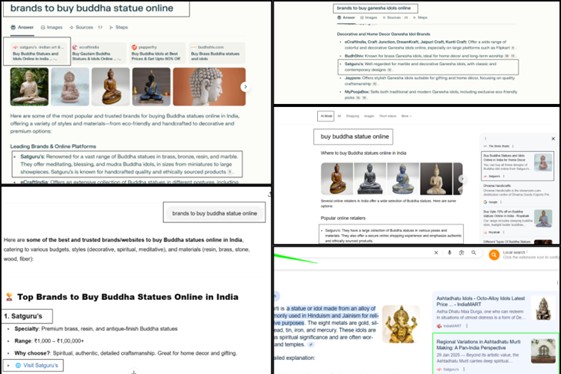
Example: Satguru’s.
We worked with Satguru’s a home decor brand based in Mumbai. We implemented a full content marketing strategy combining expert blog writing, SEO expert services, and AEO services, resulting in a 273% increase in AI visibility that included:
- Writing new blogs
- Optimising already published blogs with relevant keywords
- Adding relevant FAQs
- Optimising website content
This significantly boosted their AI citation. They witnessed a staggering 273% increase in AI visibility.
Contact us TODAY to optimise your content marketing strategy.
Frequently Asked Questions
What is answer-led content?
Answer-led content is a content strategy that prioritises answering a user’s question immediately, clearly, and structurally before expanding into broader context, improving SEO, AEO, and user trust.
Why is traditional blogging becoming less effective?
Traditional blogs often start with long introductions and delay the main answer. With AI summaries, featured snippets, and zero-click searches, users expect immediate value. If they do not find it quickly, they leave.
How does answer-led content improve SEO?
Answer-led content aligns with search engine priorities by:
- Directly addressing user queries
- Improving chances of featured snippets
- Increasing dwell time and engagement
- Matching AI Overview requirements
This makes it more likely to rank and get cited.
What are zero-click searches?
Zero-click searches happen when users find their answers directly on search engine results pages without clicking on any website. This is now the majority of searches, making it crucial for content to be concise and structured.
How should I structure an answer-led blog?
A strong answer-led blog should:
- Start with a clear, direct answer
- Use headings for easy scanning
- Keep paragraphs short and specific
- Add depth only after addressing the main question