





You’ve spent months publishing blog posts as part of your content marketing strategy. Traffic is climbing, your SEO expert services are driving rankings, and Google is rewarding you with page-one visibility.
And then you look at your leads dashboard.
Nothing.
Or maybe it’s the opposite. You have a beautifully written services page that explains exactly what you do, why you’re different, and why clients should work with you. The people who find it love it. The problem? Almost no one finds it.
Both situations are more common than most businesses admit. And both come down to the same misunderstanding: Ranking and converting are not the same goal, but they need each other.
Let’s break down what each type of content actually does, why treating them as separate work is quietly costing your business, and how to connect them into something that works from end to end.
What Is “Content That Ranks”?
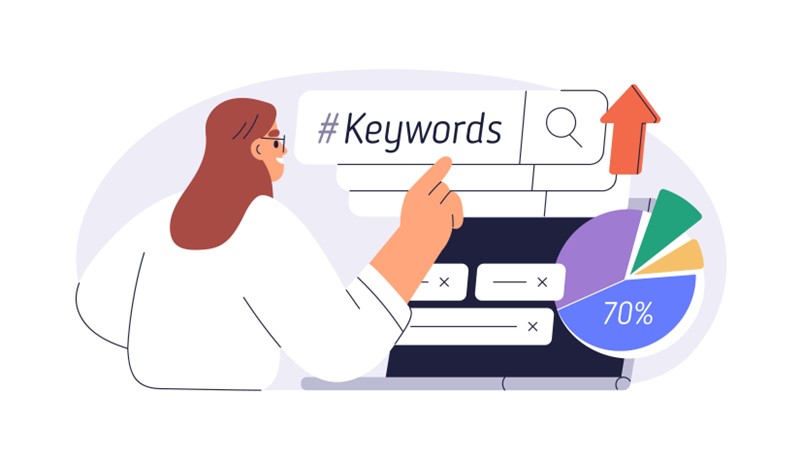
Content that ranks is built for search engines and the people using them. Its primary job is to be found.
This is where seo services in mumbai and strategic search engine optimization services play a critical role helping businesses create discoverable assets that generate sustainable organic traffic growth.
When someone types “how to reduce employee turnover” or “best project management tools for small teams” into Google, they’re not looking for a sales pitch. They want information. Content that ranks meets them there. It answers their question clearly, earns their attention, and builds familiarity with your brand.
This type of content typically includes:
- Informational blog posts: “What is [topic]”, “How does [process] work”, “X ways to [solve a problem]”
- Industry guides and explainers: Long-form resources that cover a subject in depth
- Statistics roundups and research summaries: Content that earns links because it’s genuinely useful as a reference
- Tutorials and how-to content: Step-by-step walkthroughs of a specific task
This is also where a strong pillar page SEO strategy becomes powerful, allowing brands to build topical authority instead of publishing disconnected blogs.
The SEO mechanics behind it, such as keyword research, internal linking, page structure, and backlinks, exist to help this content get discovered. But the content itself wins or loses based on how well it serves the reader’s intent.
A useful way to think about it: Ranking content is a lighthouse. It doesn’t close the deal. It gets people to your website.
What Is “Content That Converts”?

Content that converts is built for decisions. Its job is to take someone who already knows they have a problem and help them choose you as the solution.
This is where content marketing experts and conversion-led content marketing services become essential, because traffic alone does not build revenue unless content is designed to drive decisions.
This is the content your sales team wishes existed. It speaks directly to the doubts, comparisons, and questions that come up right before someone commits.
This type of content typically includes:
- Service and product pages: What you offer, who it’s for, and what makes it different
- Case studies: Real client results told as a story
- Comparison pages: How you stack up against competitors
- Proof pages: Social proof that reduces risk in the buyer’s mind
- Sales emails and nurture sequences: One-to-one persuasion at scale
The mechanics here are different too. Think clear value propositions, specific outcomes, strong calls to action, and trust signals like client logos or accreditations.
Why Most Businesses Treat These as Two Different Things (And Why That’s a Problem)
Here’s what typically happens.
Many brands invest in SEO without a structured content marketing strategy, while others build persuasive pages without discoverability—creating a disconnect between rankings and revenue.
The marketing team focuses on SEO. They publish regularly, traffic grows, and they celebrate the wins in monthly reports. Meanwhile, the website’s service pages were written three years ago by someone who’s no longer at the company. The case studies section has two entries. The main CTA is “Contact Us.”
On the other side, some businesses invest heavily in a polished website. Every page is beautifully designed and persuasively written. But there’s no blog, no educational content, and no reason for Google (or anyone else) to send new visitors there. The only people who see it are the ones who already know to look.
Both teams are doing real work. But neither is building a system.
| Content That Ranks | Content That Converts | |
| Primary goal | Get discovered by new audiences | Turn interested visitors into leads or clients |
| Reader mindset | “I have a question or a problem” | “I’m comparing options or ready to decide” |
| Typical format | Blog posts, guides, tutorials | Service pages, case studies, comparison pages |
| Success metric | Organic traffic, rankings, time on page | Conversion rate, leads, demo requests |
| When it fails alone | Visitors arrive but don’t take action | Great page, but no one sees it |
The table above makes the gap obvious. Each type of content has a job it’s genuinely good at. The mistake is expecting one to do the other’s job.
Also Read: Performance Marketing vs Content Marketing: Where Should a D2C Brand Invest First
The Real Issue: Intent

The reason high traffic doesn’t always lead to conversions comes down to one word, and that word is intent.
Every person who lands on your content is at a different stage of their decision. Someone reading “what is content marketing” is curious. They’re learning. They’re nowhere near ready to hire an agency. Someone reading “content marketing agency for B2B SaaS” is actively looking. They want options.
This is the difference between informational intent and commercial intent, and it should shape everything: the format of the content, the language, the CTA, and where it links.
Here’s a simple way to map it:
| Funnel stage | What the reader wants | Content type | Right CTA |
| Top (Awareness) | To understand a problem or topic | Blog posts, guides | Download a free resource, read a related post |
| Middle (Consideration) | To compare options and evaluate solutions | Case studies, comparison posts | Book a call, get a sample |
| Bottom (Decision) | To choose and commit | Service pages, testimonials, pricing | Start now, request a proposal |
Most content lives at the top of this table and never connects to the bottom. That’s where the revenue gap hides.
What “Connected Content” Actually Looks Like

A true seo content strategy connects ranking content with conversion-focused assets through strategic internal linking, building a complete lead generation content system.
Here’s a real-world example of how these two types of content work together when they’re treated as a system rather than separate tasks.
The chain:
- A business owner searches “how to improve my company’s online visibility.” They find a well-written blog post that answers the question thoroughly and ranks on page one. That’s ranking content doing its job.
- Halfway through the post, there’s a natural mention: “If you’re a service business trying to grow organic traffic without a full-time content team, here’s how we helped a logistics company triple their blog traffic in 8 months.” That links to a case study.
- The case study is specific. It names the challenge, walks through the approach, and shares the results. At the end, it says: “Want to see if this approach would work for your business? Let’s talk.” That’s a CTA that matches where the reader is right now.
- The reader books a discovery call.
No hard sell. No disconnected experience. Just a clear path from a search query to a conversation.
That’s what connected content looks like. Each piece does one job well and hands the reader to the next piece naturally.
The Mistakes That Break the Chain
Even when businesses have both ranking content and conversion content, they often break the connection in one of these ways.
- Generic CTAs at the end of every post
“Want to learn more? Contact us.” This tells the reader nothing. A CTA should reflect where the reader is in their thinking. An educational post about content strategy should link to a relevant case study, not a generic contact form.
- No internal linking strategy
Your top-performing blog post gets thousands of visits a month. Your best case study has been seen by 47 people, all of whom you personally sent the link to. These two pieces of content have never met. A single contextual link from one to the other could change that.
- Measuring ranking content only on traffic
If your monthly report only shows sessions and page views for blog posts, you’re missing the full picture. Blog content that contributes to a conversion three weeks later won’t show up in last-click attribution. When you track assisted conversions, you’ll often find that your “lowest performing” posts are doing more work than you realised.
- Writing for the algorithm, not the reader
Ranking content written to hit a keyword density or satisfy a content brief, but not to actually help the reader, won’t convert even when someone reads it all the way through. The quality of the content is part of the conversion path.
What E-E-A-T Has to Do With This
Strong strategic content marketing supports E-E-A-T by combining expertise-driven blog content with trust-building service pages.
Google’s quality guidelines use a framework called E-E-A-T: Experience, Expertise, Authoritativeness, and Trustworthiness. It was designed to evaluate the credibility of content, but it’s also a useful lens for thinking about whether your content does both jobs well.
In 2026, this authority model extends beyond traditional SEO into a broader SEO + AEO + GEO strategy, where discoverability, extractability, and AI visibility all work together.
Here’s why it matters for ranking and converting:
Experience means your content reflects first-hand knowledge, not just researched summaries. A case study written from your own client work signals experience. A blog post that shares a genuine lesson from a campaign you ran signals experience. Readers and Google can both tell the difference.
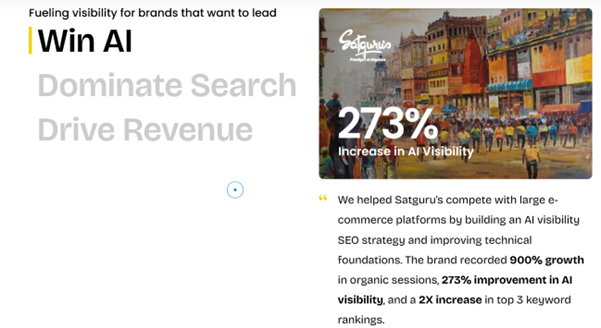
Expertise means the depth and accuracy of what you share. If your content answers the question a reader actually has, not a watered-down version of it, it earns time on page, return visits, and links. These are the signals that build authority over time.
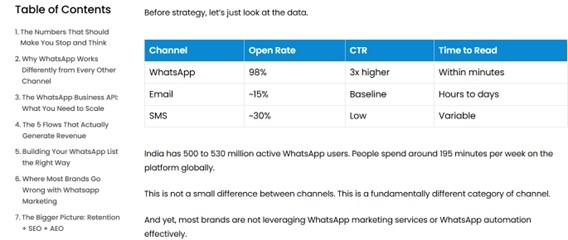
Authoritativeness means being a recognised voice in your space. This comes from consistent publishing, earning mentions and links from credible sources, and having a clear point of view rather than covering every topic shallowly.
Active brand mention monitoring also plays a critical role here, helping brands understand where they are being discussed, cited, and trusted across both search engines and AI platforms.
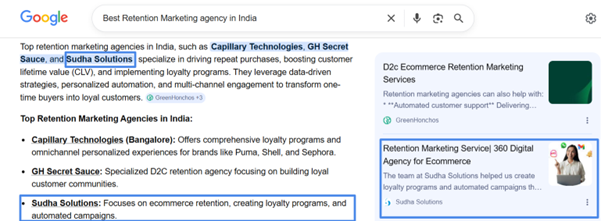
Trustworthiness is what makes someone act. Real client names. Specific numbers. An actual human behind the content. A privacy policy and a professional design. These aren’t extras. They’re part of what converts a reader into an enquiry.
Content that genuinely meets the E-E-A-T standard tends to rank better and convert better. Because what Google rewards and what buyers respond to are, at their core, the same thing: content that’s clearly written by someone who knows what they’re talking about, and has the proof to back it up.
How to Start Connecting Your Content
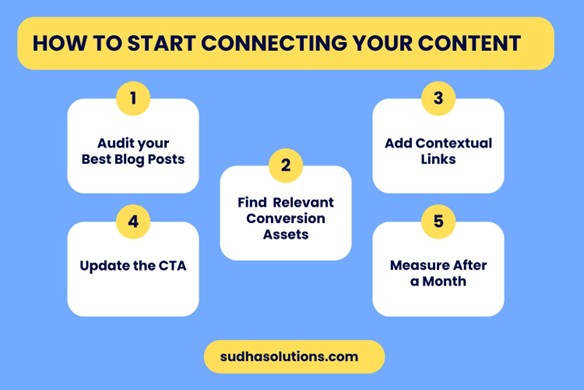
You don’t need to rebuild your entire content strategy. Start with one fix that has an immediate impact.
Step 1: Audit your highest-traffic blog post. Where does a reader go when they finish it? If the answer is “back to Google,” you have a leaking funnel. That post is earning attention you’re not capturing.
Step 2: Find the most relevant conversion asset you already have. A case study, a comparison page, a service page. Something that takes a reader a step closer to working with you.
Step 3: Add one contextual internal link. Not a banner. Not a sidebar widget. A sentence in the body of the post that says, in plain language, “here’s the next relevant thing for someone who found this useful.”
Step 4: Update the CTA. Match it to where the reader actually is. If the post is educational, the CTA should offer something educational, like a related guide, a free template, or a relevant case study. Save the direct pitch for the pages where the reader has already self-selected.
Step 5: Measure over 30 days. Look at assisted conversions, not just traffic. Did more people reach your service pages from that post? Did any of them convert?
That’s one post, one link, one updated CTA. It’s not a strategy overhaul. It’s a proof of concept. Once you see it work, you do it again.
Final Thougths
Ranking and converting aren’t competing priorities. They’re two parts of the same job.
Content that ranks without converting is a cost centre dressed up as a marketing win. Content that converts without ranking is a well-kept secret. Neither one alone builds a business.
The brands that get this right aren’t publishing more. They’re publishing with intention. Every piece of content knows its job, knows where it sits in the reader’s journey, and knows where to hand off to the next piece.
If your content strategy is built around one or the other right now, you’re not failing. You just have half the system. The other half is closer than you think.
At Sudha Solutions, our seo expert services and content marketing experts work together to build systems that drive both visibility and conversions.
From seo services in mumbai to strategic content marketing services, we help businesses create content that ranks, converts, and compounds long-term growth.
Frequently Asked Questions
How do you turn blog traffic into actual leads?
Turning blog traffic into leads requires strategic internal linking, relevant CTAs, and guiding users to high-intent pages like case studies or service pages instead of generic contact forms.
What is the biggest mistake in content marketing strategies?
The biggest mistake is treating SEO content and sales content as separate efforts, instead of building a connected journey that moves users from awareness to decision.
How important are CTAs in blog content?
CTAs are critical. A well-placed, context-driven CTA can significantly improve conversions, while generic CTAs often fail to engage readers or move them forward.
Can informational content directly generate sales?
Not usually. Informational content builds trust and attracts traffic, but it needs to be connected to conversion-focused content to influence purchasing decisions.
How often should you update your existing blog content?
High-performing blogs should be reviewed every 3–6 months to improve internal links, update CTAs, and align with current search intent and business goals.