
Sudha Solutions

Categories
AI Overview

Common Custom Software Mistakes (Solved by AI Tools)

Nowadays, most brands have a customised software. It is flexible, aligns with business requirement and gives a unique identity to the brand. But this advantage comes with a cost. 

When initial decisions are rushed the same software that was meant to enable growth quietly and give your brand an identity becomes a constraint. 

The challenge is no longer just building software that works. The real question is whether the system is designed to evolve. Automation, intelligent features, and AI-driven insights demand a different level of discipline. 

Many projects fail to reach that stage not because of ambition, but because of avoidable mistakes made early on. In this blog, we will look at the most common custom software mistakes and how modern AI tools can help prevent them. 

Why Custom Software Projects Fail 

Custom software often fails not because of poor development, but because of rushed early decisions. 

Common mistakes include: 

  • Building features without clear business outcomes 
  • Vague requirements and uncontrolled scope 
  • Treating AI and security as add-ons instead of core capabilities 
  • Accumulating technical debt and delaying testing 
  • Poor communication and treating launch as the finish line 

When used correctly, AI tools help teams: 

  • Clarify requirements and priorities early 
  • Detect risks, security gaps, and code issues sooner 
  • Improve testing, documentation, and ongoing maintenance 
  • Build systems that can adapt to automation and intelligent features 

The real goal isn’t software that simply works today, but software designed to scale, evolve, and stay relevant tomorrow.

8 Common Custom Software Mistakes and How AI Can Solve Them 

1. Building Software Without a Clear Business Outcome

One of the most common mistakes is starting development with a feature list instead of a business objective. Teams often know what they want to build, but not what success actually looks like. 

For example, companies investing in SEO services often struggle to measure impact if their custom software lacks structured analytics, clean data architecture, or scalable content management capabilities. 

This leads to software that technically functions but fails to deliver measurable value or even reflect companies’ identity.  

Common symptoms 

  • Cool and trendy features that are rarely used 
  • Dashboards that do not inform decisions 
  • Automation that adds complexity instead of efficiency 

How AI tools help 

AI-driven analytics and discovery tools can: 

  • Analyse existing workflows to identify real bottlenecks 
  • Highlight patterns in usage and operational data 
  • Support clearer prioritisation before development begins 

AI does not define strategy, but it helps validate assumptions early and reduces guesswork. 

2. Vague Requirements and Uncontrolled Scope 

Starting development without well-defined requirements is one of the fastest ways to derail a project. Ambiguity leads to frequent changes, conflicting expectations, and budget overruns. 

This problem becomes more expensive in enterprise environments where multiple stakeholders are involved. 

What usually goes wrong 

  • Requirements are captured informally 
  • Edge cases are missed 
  • Decisions are documented late or not at all 

How AI tools help 

AI-assisted requirement tools can: 

  • Convert stakeholder discussions into structured documentation 
  • Detect conflicting or unclear requirements 
  • Summarise decisions and changes consistently over time 

This improves clarity without adding process overhead. 

3. Treating AI as a Feature Instead of a Capability

AI can’t be an afterthought. Trying to integrate AI later in the development stage is not ideal. This often results in fragile integrations or features that are difficult to scale. 

The mistake is not using AI. The mistake is not designing for it. 

Examples 

  • Data pipelines not designed for future learning or automation 
  • Rigid architectures that cannot support intelligent workflows 
  • Manual processes that should have been automated from the start 

This becomes especially limiting for brands scaling content marketing services or structured blog writing services, where automation, tagging systems, and search visibility depend on clean architecture. 

As AI researcher Andrej Karpathy (director of AI at Tesla and co-founder of OpenAI) has often pointed out, AI works best as a copilot. It augments human decision-making rather than replacing it. Software architecture needs to reflect that mindset. 

As AI becomes more integrated into search experiences, businesses must also consider how automation impacts digital visibility. We recently explored this in detail in our article on whether AI Overviews will kill SEO traffic. 

4. Treating Security as a Final Checklist 

Security issues rarely come from a single failure. They emerge from small oversights that compound over time. 

When security is addressed only at the end of development, the fixes are reactive, expensive, and risky. 

According to research published by IBM on the cost of data breaches, the impact of late-stage security failures extends far beyond technical recovery. It affects trust, compliance, and long-term operational stability. 

How AI tools help 

AI-powered security tools can: 

  • Scan code continuously for vulnerabilities 
  • Detect unusual system behaviour in real time 
  • Surface risks earlier in the development lifecycle 

This supports a security by design approach instead of patch-based fixes. 

5. Accumulating Technical Debt Too Early 

Technical debt is often introduced unintentionally. Tight deadlines, unclear ownership, or inconsistent standards gradually reduce code quality. 

Over time, even small changes become risky. 

Common indicators 

  • Poor documentation 
  • Inconsistent coding standards 
  • Increasing time to implement minor updates 

How AI tools help 

AI-assisted code review and documentation tools: 

  • Flag maintainability issues early 
  • Suggest refactoring opportunities 
  • Automatically generate clear documentation from code 

GitHub’s research on AI assisted development shows that these tools are most effective when used to support disciplined engineering, not replace it. 

6. Weak Testing and Late Validation 

Testing is often deprioritised in favour of speed. This usually leads to bugs surfacing late, when fixes are more disruptive. 

Why this becomes a problem 

  • Bugs affect multiple systems 
  • Releases are delayed 
  • Confidence in the system drops 

How AI tools help 

AI driven testing tools can: 

  • Generate test cases based on code changes 
  • Prioritise high risk areas automatically 
  • Reduce regression testing effort 

This allows teams to move faster without compromising stability. 

7. Communication Gaps and Misalignment 

Even strong engineering teams struggle when communication is fragmented. In corporate environments, this is a common failure point. 

Typical issues 

  • Stakeholders receive inconsistent updates 
  • Decisions are made in isolation 
  • Teams work with outdated information 

How AI tools help 

AI assisted project management tools can: 

  • Summarise meetings and decisions 
  • Highlight delivery risks early 
  • Provide consistent visibility across teams 

This improves alignment without increasing reporting overhead. 

8. Treating Launch as the Finish Line

Custom software is not a one-time delivery. It is a living system that needs ongoing attention. 

For brands running aggressive performance marketing campaigns, software instability or delayed data reporting can significantly increase acquisition costs and reduce ROI. 

When maintenance and evolution are ignored, software becomes obsolete quickly. 

Common consequences 

  • Performance issues under increased load 
  • Compatibility problems with new systems 
  • Delayed adoption of automation and AI features 

AI powered monitoring and predictive maintenance tools help teams detect issues before they escalate. This supports long term stability and scalability. 

Conclusion 

Most custom software failures are not caused by lack of skill or effort. They are the result of early decisions that limit flexibility and increase risk over time. 

AI tools offer a powerful advantage when used correctly. They improve visibility, reduce manual effort, and support better decision making across planning, development, and maintenance. 

For brands, the goal is not to build software that simply works today. It is to build systems that are ready for automation, intelligent features, and growth tomorrow. 

If you want to develop a custom software for your brand that scales with time, you should check out Sudha Solutions. We have a team of experienced developers and AI experts that will develop software that align with your business ideas. Our software are not just aesthetically pleasing but also functional, easy to navigate, efficient, and user-centric. Contact us today. 

Frequently Asked Questions

1. Why do so many custom software projects struggle after launch? 

Most issues surface after launch because early decisions prioritise speed over scalability. Architecture, documentation, and processes that seem “good enough” initially often cannot support growth, integrations, or automation later. 

2. Is custom software always riskier than using off-the-shelf tools? 

Not necessarily. Custom software becomes risky when it lacks long-term planning. When designed with scalability, security, and evolution in mind, custom systems can outperform off-the-shelf tools in flexibility and ROI. 

3. Do small and mid-sized businesses really need AI in their software?

AI is not mandatory for every product, but AI-assisted tools can significantly improve planning, testing, documentation, and monitoring even for smaller teams. The benefit is efficiency and foresight, not complexity. 
Categories
AI Overview

From Rankings to Responses: Why Search Visibility in 2026 Is About Being the Answer

For over two decades, search visibility followed a familiar logic:
rank higher > get more clicks > drive traffic > convert users. 

That logic is no longer reliable. Search in 2026 is no longer about where you rank. It is about whether you are chosen as the answer. 

Across Google, AI Overviews, large language models, and conversational interfaces, search behaviour is shifting from exploration to resolution. Users are no longer scanning ten blue links. They are asking complete questions and expecting complete answers, instantly. 

Businesses adapting to this shift often work with teams offering SEO expert services to transition from ranking-focused strategies to answer-driven visibility models.

At Sudha Solutions, we believe this marks the most fundamental shift in search since the introduction of PageRank. And it demands a different way of thinking about SEO altogether. 

This article explains: 

  • Why rankings alone no longer define visibility 
  • How AI-driven search engines decide who gets surfaced 
  • What “answer readiness” really means in 2026 
  • How businesses and SEO professionals must adapt now 

This is not a prediction built on hype. It is a synthesis of platform changes, industry data, and how modern retrieval systems actually work. 

The Quiet Collapse of Click-Based Visibility 

Search engines are still sending traffic. But they are sending far less of it. Multiple independent studies now confirm what most practitioners are already seeing in analytics dashboards. 

Key findings from the industry data behind zero-click search: 

The implication is not that SEO is dying. The implication is that visibility is being decoupled from traffic. A brand can now: 

  • Influence decisions 
  • Shape understanding 
  • Build authority 

…without ever receiving a click. 

Why Search Engines Are Becoming Answer Engines

To understand where SEO is heading to, we must understand how AI is searching, retrieving, and presenting information. 

From Indexing Pages to Synthesising Knowledge 

Traditional Search  Modern Search 
Indexed documents  Retrieves multiple sources 
Ranked them using signals  Evaluate credibility and relevance 
Let users extract meaning themselves  Synthesis a response 
  Presents a single, confident answer 

This shift is powered by retrieval-augmented generation (RAG), a system where language models pull from trusted sources before generating responses. In this system, your content is no longer competing for a click. It is competing for AI citations. 

Visibility in 2026: Being Cited vs Being Clicked 

Google rankings are not enough in 2026. Your ranking does not automatically translate to AI citations. What matters today is: 

  • Being quoted in an AI Overview 
  • Being referenced in a conversational response 
  • Being recalled when a follow-up question is asked 

This is a fundamentally different type of visibility. 

Traditional SEO vs Answer-Driven Visibility 

Traditional SEO  Answer-Driven SEO 
Rankings-focused  Retrieval-focused 
Optimised for CTR  Optimised for inclusion 
Keyword-first  Question-first 
Page authority  Entity & topic authority 
Traffic as success  Influence as success 

The winners in this environment are not the loudest brands. Rather brands that are clearest and most reliable. 

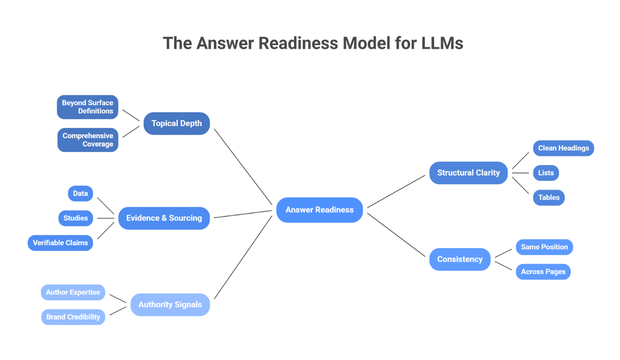
The Answer Readiness Model 

The Answer Model

At Sudha Solutions, our content is a perfect balance of SEO optimisation and answer readiness. When both work in unison, brands grow.  

Answer readiness answers one question: 

If an AI system had to explain a topic to its user, would it trust your content? 

The 5 Pillars of Answer Readiness 

Pillar  What AI systems look for 
Topical depth  Coverage beyond surface definitions 
Structural clarity  Clean headings, lists, tables 
Evidence & sourcing  Data, studies, verifiable claims 
Consistency  Same position across pages 
Authority signals  Author expertise, brand credibility 

This is where EEAT stops being a guideline and becomes a retrieval requirement. 

Why EEAT Now Directly Impacts AI Visibility 

Google never introduced EEAT for writers. It introduced EEAT for evaluation systems. Many organizations strengthen EEAT signals by partnering with content marketing experts who build authority-driven editorial ecosystems across platforms

Large language models and AI checks this before considering your content: 

  • Is this accurate? 
  • Is this widely accepted? 
  • Is this safe to present a as fact? 

EEAT provides those signals. 

What Actually Strengthens EEAT in 2026 

  • First-hand explanations, not summaries 
  • Clear author attribution and expertise 
  • Consistent viewpoints across the site 
  • Alignment with external authoritative sources 
  • Absence of sensational or speculative claims 

This is why thin content, paraphrased blogs, and generic SEO pages are systematically excluded from AI responses. 

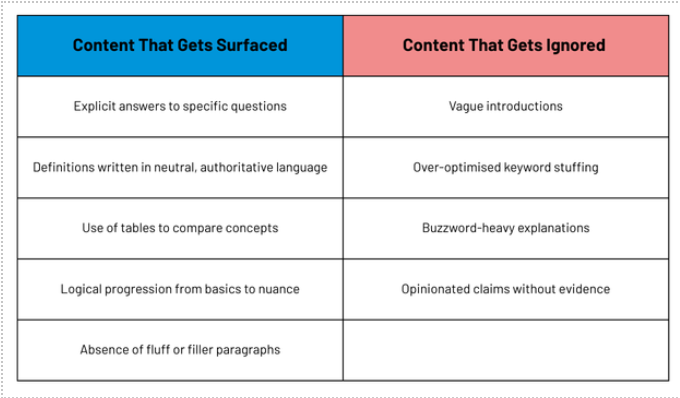
Content That Gets Chosen vs Content That Gets Ignored 

Producing structured, authoritative resources at scale often requires collaboration with expert blog writing specialists who understand how AI systems interpret content clarity and evidence.

Content That Gets Chosen vs Content That Gets Ignored

Answer engines do not “read” content the way humans do. They check it for clarity, completeness, and confidence. An information dense content which is not structured properly or does not follow EEAT guidelines will not interest AI platforms. 

Characteristics of Content that gets Surfaced 

  • Explicit answers to specific questions 
  • Definitions written in neutral, authoritative language 
  • Use of tables to compare concepts 
  • Logical progression from basics to nuance 
  • Absence of fluff or filler paragraphs 

Content that gets Ignored 

  • Vague introductions 
  • Over-optimised keyword stuffing 
  • Buzzword-heavy explanations 
  • Opinionated claims without evidence 

This is why modern SEO content must feel closer to reference material than marketing copy. 

Measuring Success When Clicks Decline 

For multiple years, traffic and ranking were the metrics we relied on to measure success; however, we are going through a period of transition. This has also led to a shift in how we measure success. 

New metrics that Actually Matter 

Metric  Why it matters 
AI citation presence  Indicates retrieval trust 
Branded search growth  Shows influence, not clicks 
Assisted conversions  Users return later 
Sales cycle shortening  Answers reduce friction 
SERP dominance  Visibility across formats 

SEO teams must now report on influence, not just acquisition. 

Why This Shift Benefits High-Quality Brands 

This transition is a blessing in disguise for genuine brands as it disproportionately rewards: 

  • Specialists over generalists 
  • Experts over aggregators 
  • Brands with conviction over content farms 

For founders and businesses, this is good news. 

Answer engines favour: 

  • Clear positioning 
  • Narrow expertise 
  • Demonstrable experience 

You do not need thousands of pages. You need the right ones, built to be referenced. 

How Sudha Solutions Approaches SEO in an Answer-First World

Since the start of transition from traditional SEO to AI-led modern SEO, our SEO and content team have tried different approaches to find the best strategy to get quoted by AI. Our process no longer starts with just keywords. Our teams combine technical optimization and editorial strategy through integrated SEO expert services designed for AI-driven search ecosystems.

It starts with: 

  • What questions users ask before buying 
  • What confusion exists in the market 
  • What misinformation needs correcting 

Then we build content that: 

  • Resolves uncertainty 
  • Establishes trust 
  • Can be confidently reused by AI systems 

This is why our SEO strategies focus on durable visibility, not temporary rankings. 

The Future: Search as a Conversation, Not a Destination 

Search is becoming: 

  • Continuous 
  • Contextual 
  • Conversational 

Users ask one question, then refine it. Only sources that remain consistent and credible survive that conversation. 

By 2026, the brands that win will not be those who chased algorithms. They will be those who became the reference point. 

Final Thoughts 

SEO in 2026 is no longer about chasing rankings. It is about earning the right to be trusted as the answer. Brands that understand this shift early will not just survive algorithm updates. They will shape how their industry is understood. 

If this article changed how you think about search, explore our other insights. This is only one part of a much larger transformation. 

Frequently Asked Questions

What is Answer Engine Optimisation (AEO)? 

AEO is the practice of structuring content so it can be directly retrieved and cited by AI-powered search engines and assistants, rather than only ranked as a clickable result.  

Does SEO still matter if users do not click?

Yes. SEO now influences decisions earlier in the funnel, shaping perception and trust even without immediate traffic. 

How do I know if my content appears in AI responses?

Monitor branded search growth, SERP features, AI Overviews, and assisted conversion paths rather than only organic clicks. 

Are long-form blogs still relevant? 

Yes, if they follow EEAT guidelines. This includes clear structure, trust factor by experts, some real-life examples or case studies, and question based H2s with clear answers and no fluff.