

Search used to be about finding links. Now it is about getting an answer you can act on. That shift is not because Google redesigned the results page. It is because large language models, or LLMs, changed how information is understood, ranked, and delivered.
For years, SEO teams played a known game. Get crawled. Get indexed. Earn backlinks. Be relevant to the keywords. Appear in the top ten. Now we are in the next shift. Users are not always being handed a list of blue links. In many cases they are being given a synthesized, conversational answer. In this blog, we will talk about LLMs in SEO, how our search engines learn and generate conversational answers.
How LLMs Learn to Talk About your Category
 Let’s start with what are LLMs.
LLMs pr Large Language Models are trained on huge text datasets. Think trillions of tokens from websites, books, documentation, forums, product pages, Q&A content, and more. The core task during training is very simple to describe. Predict the next word. Then the next. Then the next. Repeating this task at a massive scale teaches the model patterns in how humans explain ideas, argue, recommend, compare, and answer.
Knowing how LLM works is important. It does not just memorize isolated facts the way a spreadsheet does. It learns statistical structure. It sees how experts talk about “cross-border payment compliance” or “sustainability claims in fashion sourcing” or “how to improve Core Web Vitals for eCommerce SEO,” and then it learns how those ideas tend to be framed. So, when the model answers, it is not quoting. It is generating a likely and useful continuation.
How AI-Powered Search Ranks What to Trust
Here is what most people misunderstand. AI-generated answers are not created in a vacuum. When you ask an AI system a question like “What is the best way for LLM optimization in search results?”, the model does not instantly start typing from pure memory. First, it retrieves. Then, it generates.
This pattern is known as retrieval augmented generation (RAG). The system first pulls information from search engine results, knowledge bases, policy docs, product pages, or any other trusted source. Only after it has pulled in those candidate sources does the model start writing the answer.
The content they and AI models trust are usually ones with good SEO ranking. Content pieces that are up to date, well structured, and have FAQs, tables, and price breakdowns are given priority.
What Happens When an AI System Answers
After retrieval, the model begins synthesis. It looks at the retrieved sources, scores them for relevance, freshness, and confidence, and then composes a final narrative-style answer. A recent arXiv analysis of generative search describes how these systems score for citability, which is the likelihood that the system can safely attribute a claim to a given source. That is why AI search-style answers often include source callouts or language like “according to.”
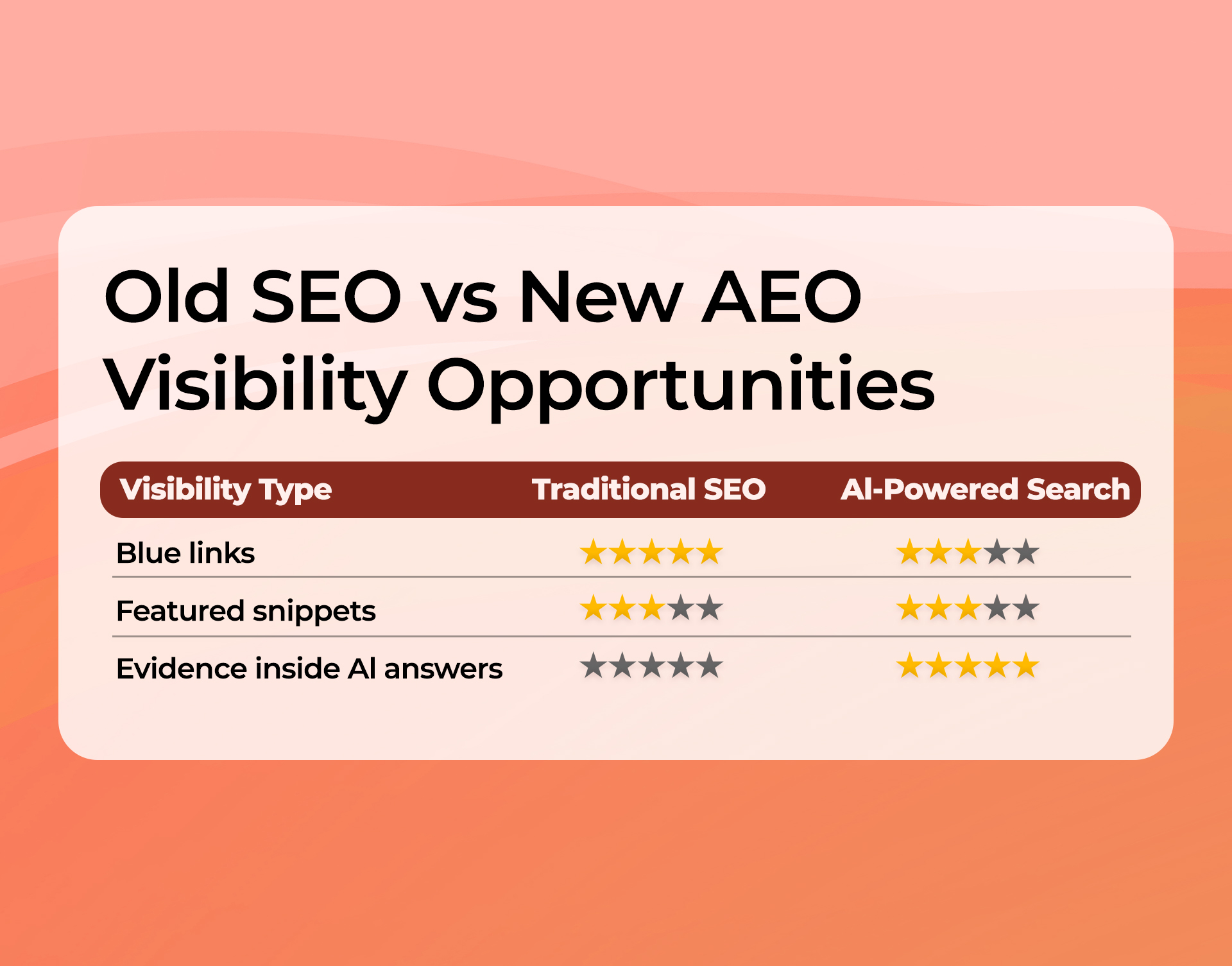
For brands, this is the real takeaway. Visibility is not limited to the blue links section anymore. Visibility now includes being used as evidence inside the answer itself. If the AI answer cites you or uses your language, you are winning mindshare before the click.
 How LLM-Based Ranking Reshapes SEO Strategy
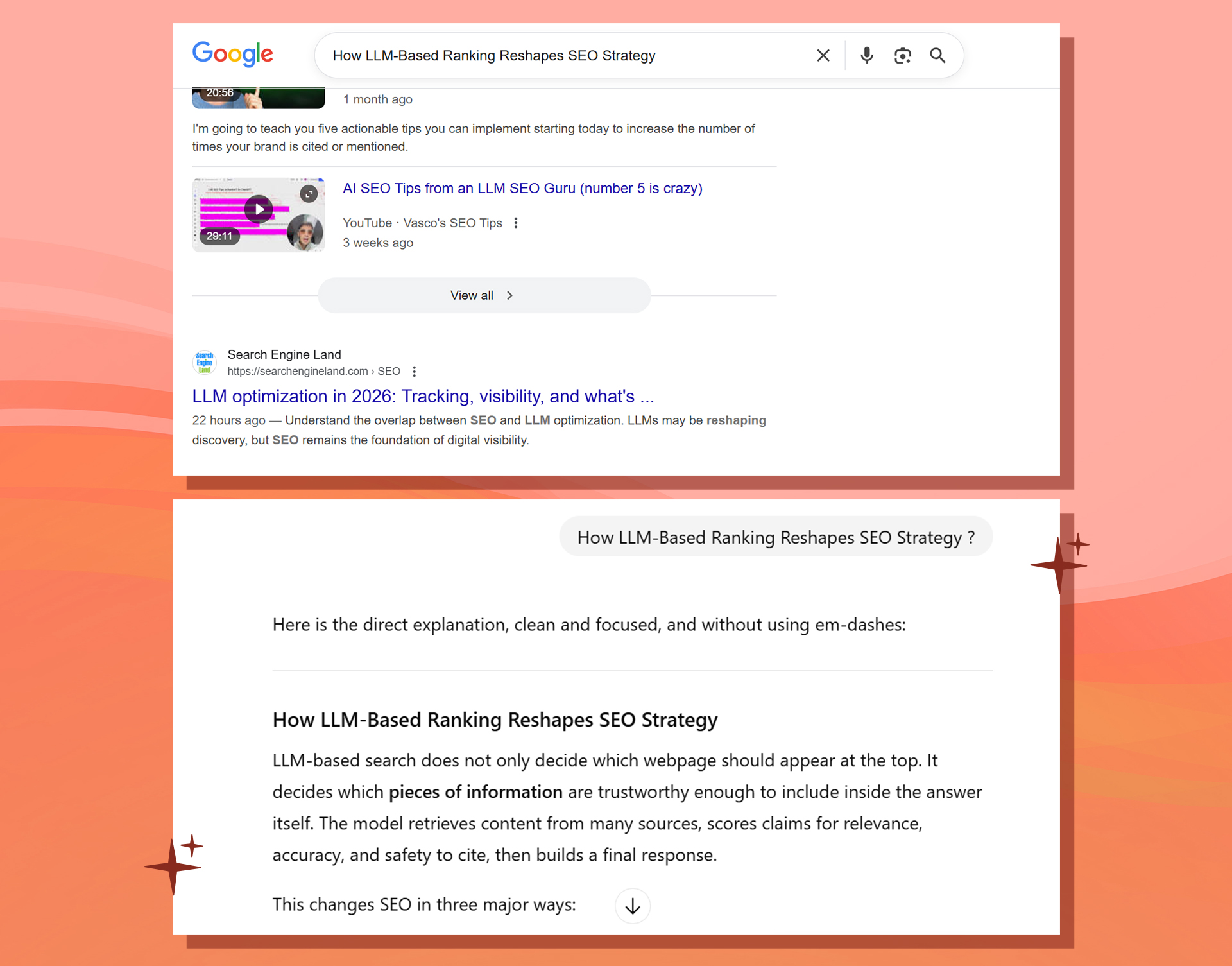
Search optimization used to focus on one outcome: visibility on Google’s first page. That goal is still valid, but the path to it is now shared with AI systems that evaluate far more than backlinks and keywords. The rise of answer-first search means that visibility can come in two ways: ranking as a source and appearing as a cited reference inside an AI-generated summary.
This change creates a new layer of competition. Content is no longer fighting only for clicks. It is fighting for inclusion inside the models that shape what users read and trust. A 2025 analysis published on arXiv explains that modern ranking pipelines now blend retrieval, confidence scoring, and summarization to determine which passages appear inside generated answers. That blend favors clarity, context, and structural precision.
This means the new SEO strategy must evolve into what specialists call Answer Engine Optimization (AEO) and Generative Engine Optimization (GEO).
Building an LLM-Friendly Content Ecosystem
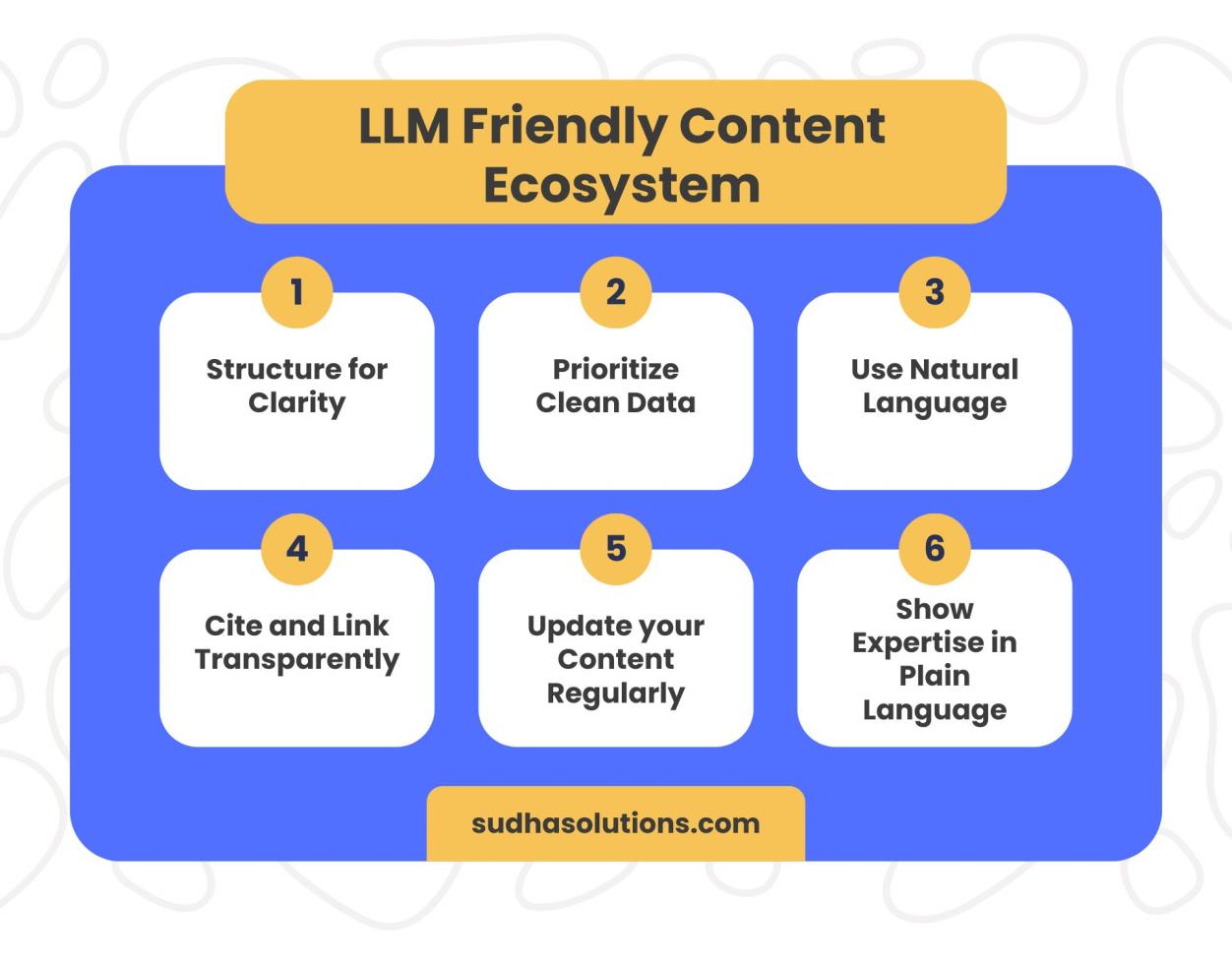
Now that we know how LLMs generate answers in search, let’s understand how you can incorporate LLM friendly features in your content. The following principles emerge from multiple SEO + AI studies and align closely with Google’s own guidance.
Structure for clarity
Use logical headings, question-style subheads, and short introductory answers. These help retrieval systems map your page sections to specific user intents.
Prioritize clean data
Schema markup, FAQ blocks, and product metadata allow AI systems to parse relationships without guessing. Structured data is the new sitemap.
Write with semantic depth
Include variations of related terms, not just primary keywords. LLMs work through embeddings that connect related ideas. When your content reflects natural language variety, it earns stronger semantic signals.
Cite and link transparently
Outbound citations to credible sources increase the model’s confidence score. AI models show a measurable bias toward pages that provide supporting evidence.
Refresh frequently
Freshness is a trust signal. Both search crawlers and AI retrievers favor recently updated pages because recency suggests reliability.
Show expertise in plain language
LLMs value explainability. When an expert’s knowledge is expressed in clear, direct terms, it becomes easier to reuse and quote inside generated output.
Measuring Performance in the New Landscape
Traditional metrics like impressions and click-through rates still matter, but they no longer tell the whole story. Visibility now includes presence in AI-generated results, summarized citations, and conversational mentions.
Here are practical indicators to monitor:
- Citation frequency: How often your domain appears as a source in AI summaries or answer boxes.
- Semantic coverage: The range of related queries for which your content appears in generative search results.
- Engagement depth: Time on page and scroll depth remain relevant because they signal that users value the content models are quoting.
- Brand recall in generated answers: Track whether your brand name appears inside generated responses on platforms like Perplexity or ChatGPT when your topic is queried.
These signals reveal whether your brand is being recognized as an authoritative contributor inside the AI knowledge graph, not just the organic SERP.
The Changing Mindset for Brands
For brands, this transformation is less about tactics and more about mindset. SEO can no longer be treated as a mechanical checklist. It is an evolving system of influence inside a network of intelligent models.
Brands need to ensure that their teams approach content as structured knowledge assets rather than marketing copy. They must coordinate SEO, content, and data teams to maintain alignment between technical markup, brand narrative, and audience search intent.
The brands that succeed in this environment will be the ones that treat every article, product page, and insight as something a machine can understand, not just a human can read.
Conclusion
Search and AI are converging into a single ecosystem where learning, ranking, and answering happen together. LLMs are not replacing SEO. They are redefining what optimization means. Authority now extends beyond backlinks into semantics, clarity, and consistency.
If your content can help an AI system explain something clearly, it can help your audience understand it too. That alignment between human readability and machine interpretability is where the next decade of digital visibility will be won.
Want your brand to appear on AI platforms like ChatGPT, Perplexity, and Grok? We at Sudha Solutions have a proven plan that has helped multiple brands rank on both Google Overview AI platforms.
Our experienced team of SEO and content marketing experts ensures your brand becomes the preferred source that AI systems retrieve, score, and cite in their answers. From strategic content optimization to citation-driven authority building, we help you win visibility where users make decisions. Contact us Today.