In e-commerce, growth rarely hinges on traffic alone. You can spend aggressively on ads, rank for competitive keywords, and drive thousands of visitors to your store, yet still struggle with sales.
Why?
Because revenue doesn’t come from traffic. It comes from experience.
Even the most effective SEO services or aggressive performance marketing campaigns will underperform if the onsite experience fails to convert visitors into buyers.
UI/UX design, meaning, how your store looks (UI) and how it works (UX), directly influences whether a visitor browses, trusts, buys, and comes back for more. And the data has consistently shown how small improvements in layout, speed, clarity, and usability can lead to measurable, compounding growth over time.
Let’s break down exactly how better UI/UX design turns into real ecommerce ROI.
Quick Summary
- UX design can increase conversion rates by up to 400% when optimised strategically.
- The average global cart abandonment rate is ~70%.
- 48% of shoppers abandon carts due to unexpected costs.
- A 1-second page delay can reduce conversions by ~7%
- 78% of the digital population shops via mobile phones
Better UX → Less friction → Higher trust → More completed purchases → Greater revenue.
Understanding UI/UX in Ecommerce
Before diving into revenue impact, clarity matters.
- UI, or user interface, is all about the visuals: the buttons, colours, and layouts that make your site pop.
- UX, user experience, is the bigger picture: how smoothly does the journey feel from landing page to purchase?
UI earns attention. UX earns trust. Together, they earn revenue.
The E-commerce Revenue Equation
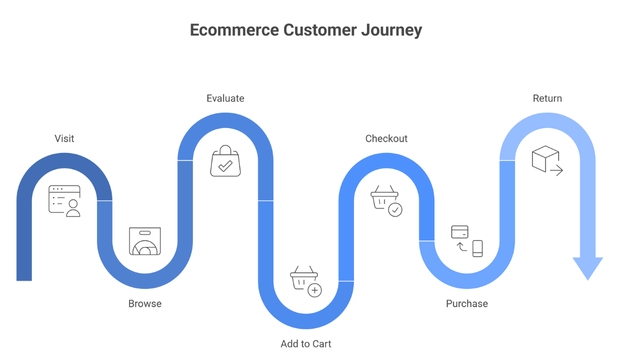
In e-commerce, every site follows a predictable behavioural journey:
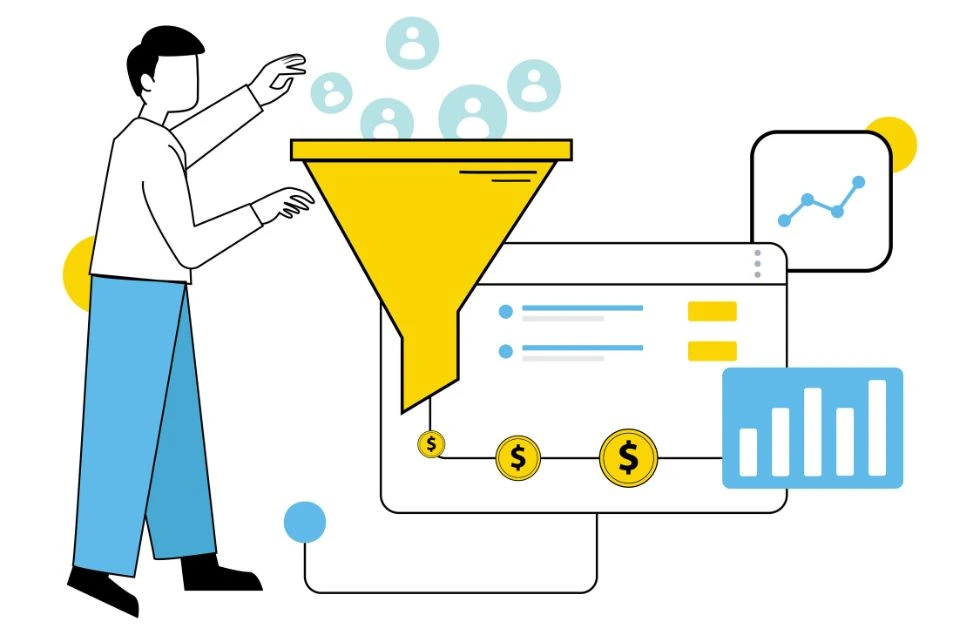
Visit → Browse → Evaluate → Add to Cart → Checkout → Purchase → Return
At each stage, friction reduces conversion probability. UX design either removes friction or amplifies it.
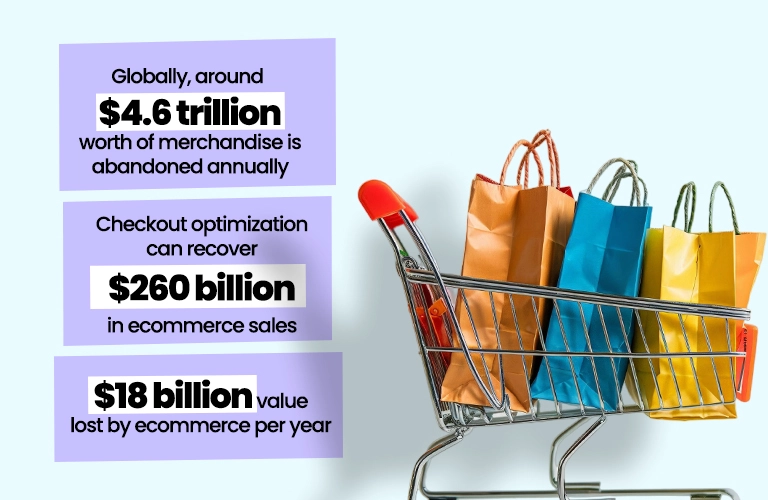
According to the Baymard Institute, the average cart abandonment rate sits at approximately 70%. That means 7 out of 10 potential buyers walk away before purchasing.
Brands investing in content marketing services and structured blog writing services often drive high-intent traffic, but without optimised UX, that traffic rarely translates into measurable ROI.
On the flip side, when UI/UX is spot-on, it builds trust, reduces frustration, and nudges users towards that ‘Buy Now’ button. It’s like having a friendly shop assistant guiding you, but online.
1. First Impressions: Trust Is Formed in Milliseconds
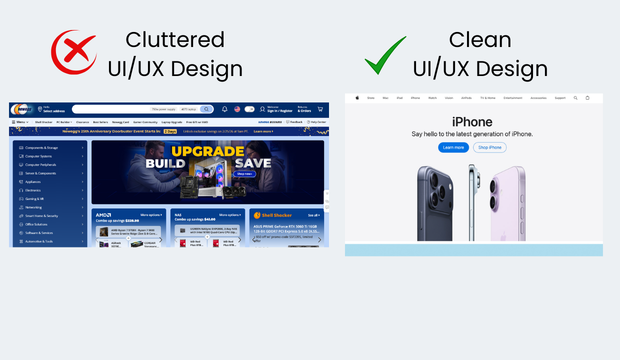
Research from Google indicates users form aesthetic judgments about a website in as little as 50 milliseconds. In other words, trust begins before reading a single product description.
A cluttered layout, outdated typography, inconsistent spacing, or poor image quality immediately trigger doubt. And doubt kills conversion.
Professional UI design signals:
- Legitimacy
- Security
- Stability
- Brand confidence
Even subtle improvements such as cleaner spacing, consistent design systems, modern typography can materially impact bounce rate and engagement.
Trust isn’t built through copy alone. It’s built visually, instantly.
2. Speed: The Invisible Revenue Driver

Speed is UX at its purest form.
According to Akamai, a 1-second delay in page load time can reduce conversions by approximately 7%. Amazon has also reported that milliseconds of delay impact revenue at scale.
Why does this happen?
Because online shoppers operate with low patience and high choice availability. If your store hesitates, a competitor is one tab away.
Fast-loading pages reduce bounce rate, increase session depth, and preserve purchase intent.
Performance optimisation isn’t technical maintenance; it’s revenue protection.
3. Navigation & Cognitive Ease: Making Buying Feel Effortless
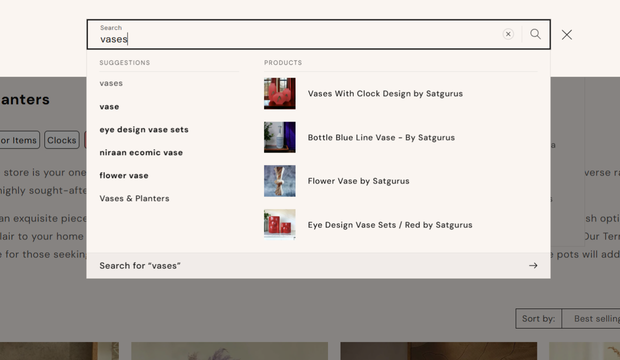
Confusion is conversion’s silent enemy.
If users cannot quickly find what they’re looking for, they do not explore alternatives. They leave. According to multiple UX usability studies, intuitive navigation significantly improves engagement time and reduces bounce rates.
Effective e-commerce UX includes:
- Clear category hierarchies
- Predictive search functionality
- Filter and sorting systems
- Logical product grouping
- Breadcrumb navigation
The goal is cognitive ease. The less mental effort required, the higher the likelihood of purchase.
Good UX removes decision fatigue. Great UX makes buying feel inevitable.
4. Product Pages: Where Desire Meets Decision
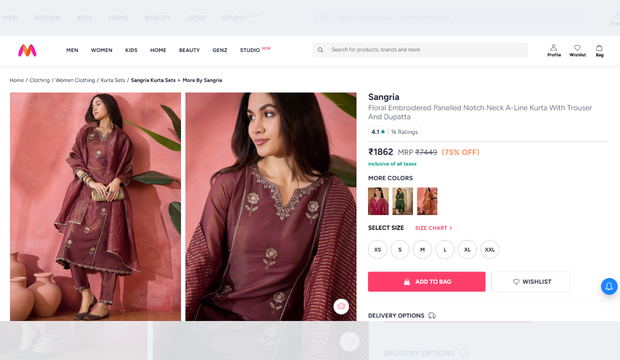
Product pages are conversion battlegrounds.
Strong UI/UX here must answer three buyer questions:
- Is this right for me?
- Can I trust it?
- What happens if I buy?
High-performing product pages typically include:
- High-resolution multi-angle images
- Clear pricing
- Clear product USPs
- Transparent shipping details
- Scannable bullet descriptions
- Reviews and ratings
- Prominent “Add to Cart” buttons
According to Baymard research, unexpected costs account for 48% of cart abandonment. This means that the extra costs, such as shipping, tax, and fees, were too high, making pricing transparency completely strategic.
Clarity converts. Ambiguity repels.
5. Checkout Flow: Where Revenue Is Won or Lost
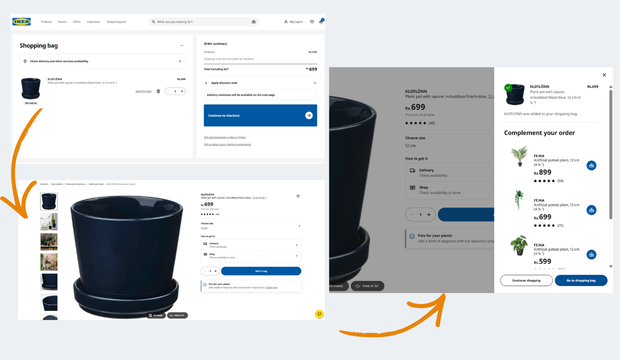
Checkout optimization is one of the highest ROI UX interventions available.
- 24% abandon due to forced account creation
- 22% abandon due to slow delivery timelines
- 17% abandon due to complicated or long checkout process
UX improvements that measurably increase conversions include:
- Guest checkout options
- Auto-fill capabilities
- Reduced form fields
- Clear progress indicators
- Upfront shipping calculations
Even modest checkout redesigns can increase conversions significantly. Industry analyses consistently show checkout simplification leading to measurable sales recovery.
Checkout isn’t where persuasion happens. It’s where cognitive load must disappear.
6. Mobile-First Design: Non-Negotiable in 2026

Did you know 78% of the digital population globally shops via mobile phones as of 2026, choosing mobile apps, digital wallets, and social media platforms as their primary choice?
With social commerce growing rapidly, social media services that drive mobile traffic must be supported by frictionless mobile UX to protect ad spend and maximize conversion value.
Yet mobile UX remains one of the most common failure points.
Common issues:
- Buttons too small for thumbs
- Forms difficult to complete
- Slow image loading
- Cluttered layouts
Instead, mobile UX should prioritise:
- Spacious tap targets
- Sticky “Add to Cart” CTAs
- Easy navigation
- Wallet payment integration
If desktop UX is convenience, mobile UX is survival.
7. The ROI of Good UI/UX
Forrester Research found that every $1 invested in UX returns up to $100 in ROI in certain contexts.
Additionally, well-executed UX design has been shown to increase conversion rates by up to 400% when aligned with usability best practices.
While results vary by industry and execution quality, the direction is consistent: optimised UX compounds revenue over time.
UX is not an expense. It is a multiplier.
The Impact of UI/UX on E-commerce
|
UX Improvement |
Business Outcome |
Revenue Effect |
| Faster load speed | Lower bounce rate | Higher conversions |
| Transparent pricing | Reduced abandonment | More completed checkouts |
| Mobile-first design | Higher engagement | Increased sales volume |
| Simplified checkout | Reduced friction | Higher conversion rate |
| Strong visual design | Increased trust | Improved purchase confidence |
Each improvement compounds the others.
How to Measure UI/UX Impact?
To connect design with revenue, monitor:
- Conversion Rate (Primary KPI)
- Cart Abandonment Rate
- Bounce Rate
- Average Order Value (AOV)
- Customer Lifetime Value (CLV)
- Session Duration & Pages per Session
UI/UX without measurement is aesthetics. UX with measurement is growth strategy.
How Sudha Solutions Approaches Ecommerce UX?
We do not design pages. We design decision paths.
Our UX process starts with:
- Understanding user intent at each funnel stage
- Identifying friction points that block revenue
- Aligning design decisions with business outcomes
Every UI choice must answer one question: “Does this make buying easier, clearer, or safer?”
The Future of Ecommerce Sales Is Experience-Led
E-commerce is no longer about who shouts the loudest.
It is about who feels easiest to buy from.
As attention becomes scarcer, UX becomes the strongest growth lever brands control internally.
Final Thoughts
If you’re scaling an ecommerce brand, traffic alone won’t save you.
Better UX will.
UI/UX design improves ecommerce sales by:
- Reducing friction
- Increasing trust
- Speeding decisions
- Simplifying checkout
- Optimising mobile experiences
It turns existing traffic into higher revenue.
Sustainable ecommerce growth happens when UX optimisation works alongside strong SEO services, strategic content marketing services, and data-driven performance marketing.
If you’d like to understand exactly where your store is losing conversions, we at Sudha Solutions can help you create a consumer-first platform with our UI/UX expertise.
Because in e-commerce, design isn’t decoration. It’s conversion strategy.
Frequently Asked Questions
1. Does better UX always increase sales?
When aligned with usability research and customer data, yes. Poor UX creates friction; improved UX removes it. Reduced friction statistically increases conversions.
2. What is the fastest UX fix for e-commerce growth?
Checkout simplification and load speed optimization often deliver the fastest measurable gains.
3. How much should ecommerce brands invest in UX?
Serious ecommerce brands treat UX as a revenue driver, not a one-time design cost. Investment depends on scale, but the returns are typically compounding.