





Quick Answer: AI search visibility is not necessarily fixed. The same or slightly modified prompt can produce different answers and sources across repeated searches. Emerging 2026 research has documented this variability across generative search systems, which means brands should avoid measuring AI visibility from a single prompt run. A more reliable approach is to track groups of relevant prompts repeatedly, across multiple AI platforms and over time.
You search ChatGPT for:
“What are the best wealth management companies in India?”
Your company appears.
You take a screenshot.
You run the question again a few days later.
Your company is gone.
So, did your AI visibility suddenly decline?
Not necessarily.
One of the most important differences between traditional and generative search is that AI-generated answers can be probabilistic rather than perfectly repeatable.
That changes how marketers should think about “ranking” in AI search.
AI Search Is Not a Fixed Results Page
Traditional search results aren’t perfectly static either. Rankings can vary because of location, personalisation, freshness, algorithm updates and other factors.
But generative search introduces another layer of variability because the system is constructing an answer.
It may need to:
Interpret the prompt → Rewrite or expand it → Retrieve information → Select sources → Synthesize the answer
OpenAI, for example, says ChatGPT Search can rewrite a user’s prompt into one or more targeted searches and conduct additional searches after reviewing initial results.
Google says AI Mode and AI Overviews can use query fan-out, generating multiple related queries to retrieve information across different subtopics and data sources.
That means there are several stages at which the information retrieved for an answer can potentially differ.
What Does the Research Show?
A 2026 study specifically investigated this problem across Perplexity, OpenAI’s search experience and Google Gemini.
Researchers repeatedly submitted queries over different time periods and found substantial variability in which domains were cited.
Their conclusion is important for marketers – a citation-share figure calculated from one run can create a misleading impression of precision. AI visibility is better treated as a distribution that needs repeated sampling rather than as one fixed observation.
Another 2026 study involving 11,500 queries compared traditional Google Search, Gemini and Google AI Overviews.
Researchers found that AI Overviews were less consistent across two runs of the same query and were also sensitive to small changes in query wording.
So this isn’t merely – “AI sometimes gives weird answers.” It is a measurement problem.
Small Prompt Changes Can Create Different Retrieval Journeys
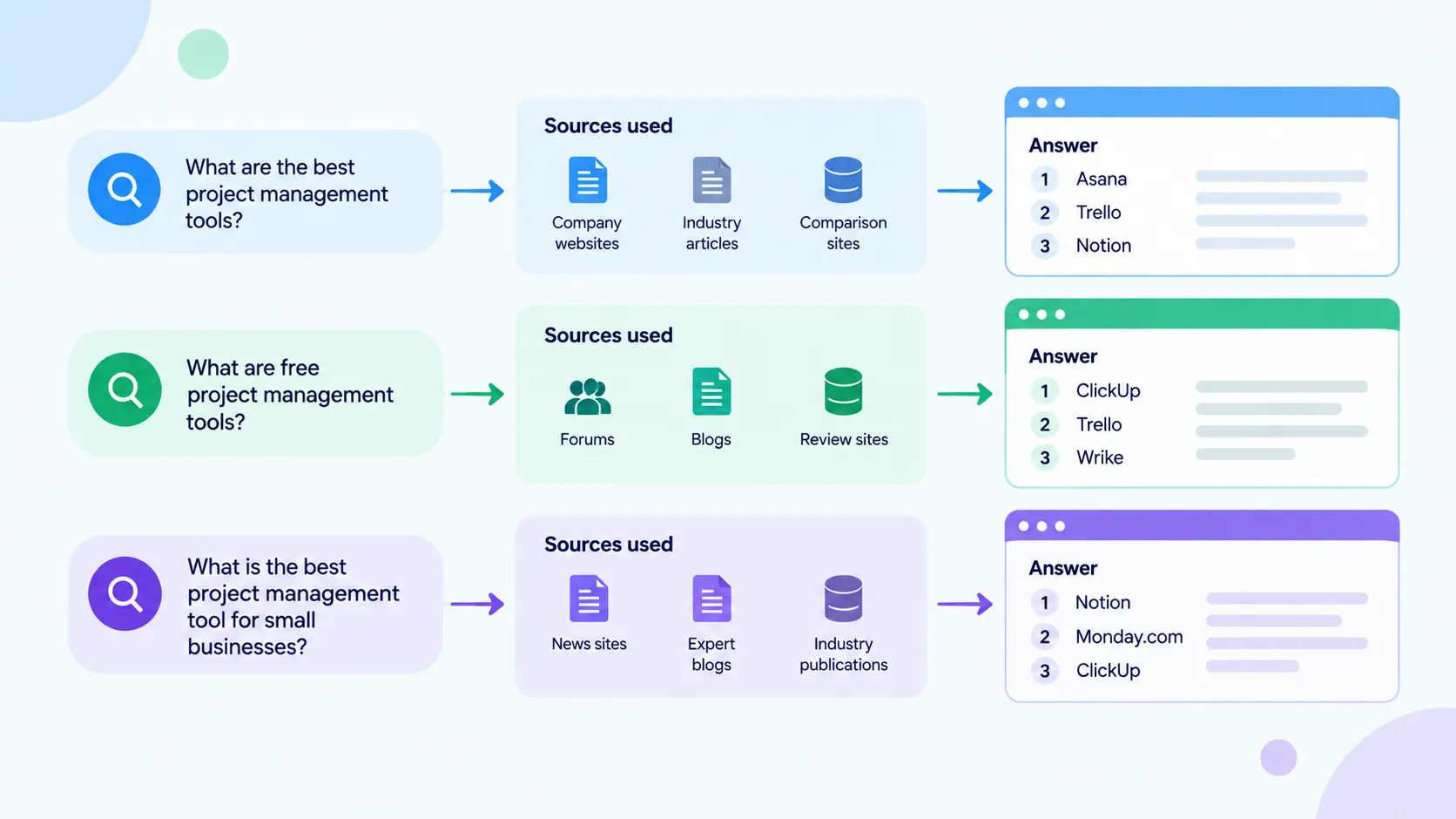
Consider these questions:
Prompt A:
“What are the best CRM platforms for small businesses?”
Prompt B:
“What CRM should a 30-person B2B company use?”
Prompt C:
“Best affordable CRM for a small sales team?”
A human may consider them variations of roughly the same requirement.
But they contain different signals around:
- company size;
- price;
- B2B use;
- sales-team requirements;
- recommendation criteria.
Those differences can influence how an AI system interprets the request and what information it searches for.
Google’s latest guidance gives a useful example of this process. A question about fixing a lawn full of weeds might generate fan-out queries around herbicides, chemical-free weed removal and preventing future weeds.
One prompt can therefore open several retrieval paths.
Stop Treating One Screenshot as Proof of AI Visibility
This has an immediate implication for AI visibility reporting.
Suppose an agency runs ten prompts once and finds its client mentioned in six.
It would be tempting to report:
60% AI Visibility
But what happens if the same ten prompts are run tomorrow?
Or phrased differently?
Or tested on another AI engine?
That 60% may move.
At Sudha Solutions, this is why we believe AI visibility measurement needs to move beyond isolated screenshots and one-time prompt checks.
A better model is:
Prompt Cluster × Multiple Runs × Multiple Platforms × Time
Instead of asking one question once, identify a group of prompts representing the actual ways customers research your category.
Then measure them repeatedly.
Measure Patterns, Not Positions
Imagine you’re a cybersecurity company.
Instead of monitoring only:
“Best cybersecurity companies in India”
your prompt cluster might include:
- Which cybersecurity company is best for mid-sized businesses?
- Best cybersecurity firms for BFSI companies
- Cybersecurity companies for cloud security
- Alternatives to [competitor]
- Which cybersecurity firm offers managed SOC services?
- Who are the leading cybersecurity providers in India?
Then track:
- Was the brand mentioned?
- Was it cited?
- Which URL was cited?
- Which competitors appeared?
- How frequently did the brand appear across repeated runs?
- Did visibility change by AI platform?
Now you’re measuring visibility patterns, rather than celebrating or panicking over one response.
Does This Mean AI Visibility Cannot Be Improved?
No.
Probabilistic does not mean random.
Search accessibility, relevance, useful content and strong information architecture still matter. Google explicitly says established SEO fundamentals remain applicable to AI Mode and AI Overviews.
OpenAI similarly says ChatGPT Search ranking considers multiple factors intended to surface reliable and relevant information, while making clear that top placement cannot be guaranteed.
The goal therefore isn’t to make your brand appear 100% of the time for one carefully selected prompt.
A more meaningful goal is to increase the probability that your brand is discovered, retrieved, mentioned or cited across the set of questions that influence your customer’s decision.
That is a very different definition of visibility.
And it requires a different measurement mindset.
Traditional SEO taught us to monitor positions.
AI search may require us to monitor probability, coverage and consistency.
Because the real question isn’t:
“Did ChatGPT mention us today?”
It’s:
“How consistently does our brand appear across the AI-assisted journeys our customers actually take?”
That is a much stronger measure of AI visibility.