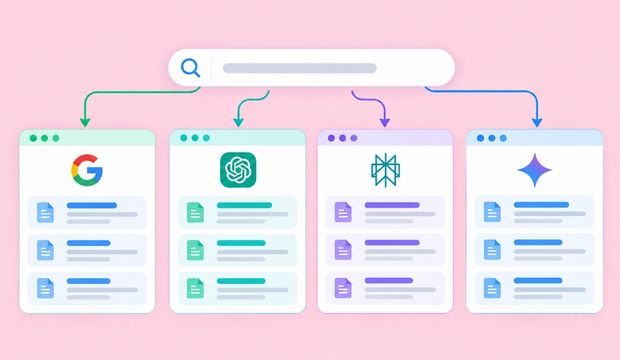




Quick Answer: Two AI search engines can receive the same question and still produce different answers and citations. That is because ChatGPT, Perplexity, Gemini and Google’s AI search experiences do not operate as one shared search system. They can differ in how they interpret a prompt, retrieve information, access search indexes and data sources, select supporting evidence, and generate the final response. For brands, this means AI visibility should be measured across platforms; not inferred from performance on a single enpgine.
Ask the same question on ChatGPT, Perplexity, Gemini and Google AI Search and you may notice something interesting.
The answers can look similar. The sources often do not.
One platform may cite a company’s website directly. Another may use a publisher or review site. A third might cite several sources that did not appear in the first answer at all.
This isn’t necessarily an error or inconsistency. It tells us something important about AI search: –
There is no single universal source-selection system behind every AI answer.
Why Can the Same Prompt Produce Different Sources?
The simplest explanation is that these platforms have different search and retrieval architectures.
ChatGPT Search
OpenAI says ChatGPT can search the web when a question would benefit from current information. Importantly, ChatGPT may rewrite a user’s prompt into one or more targeted search queries before sending them to search providers.
It can also conduct additional searches based on the information it initially retrieves.
So the user’s original prompt isn’t necessarily the only query involved in finding the final sources.
Google AI Search
Google has described a different mechanism called query fan-out.
AI Mode and AI Overviews can issue multiple related searches across subtopics and data sources to explore a question more deeply than a single traditional query might.
Google can also draw on its existing information systems, including web content, the Knowledge Graph and other real-time or structured sources.
Explore ChatGPT vs Google: why they choose different sources
Perplexity
Perplexity describes its product as an answer engine that searches the web, identifies relevant sources and synthesizes information into a cited response.
Its more advanced search modes can perform multiple searches and reason across different types of sources.
Gemini
Gemini can use Google Search to ground responses in current web information. But that does not mean a Gemini answer must simply reproduce Google’s traditional search rankings.
The retrieval and generation process can still produce a different collection of supporting sources.
Put simply:
Same question ≠ Same retrieval process ≠ Same sources.
Research Shows How Large the Difference Can Be
This isn’t merely a theoretical distinction.
A 2026 study examined 11,500 real-world queries and compared the sources surfaced by traditional Google Search, Google AI Overviews and Gemini.
In other words, generative search was not simply taking conventional Google results and presenting them in paragraph form.
The study also found that small changes to queries and repeated AI Overview runs could alter the sources surfaced.
That should make marketers cautious about thinking of AI visibility as another fixed ranking table.
A Brand Can Therefore Have Different Visibility on Different Engines
Imagine a cybersecurity company tracking 100 commercially relevant questions.
Its visibility might look something like this:
| Platform |
Illustrative result |
|
ChatGPT |
Strong |
|
Perplexity |
Strong |
|
Gemini |
Moderate |
|
Google AI Mode |
Weak |
Those labels are only an example, but the underlying situation is entirely plausible.
The company hasn’t suddenly become more or less authoritative depending on which tab a customer opens.
Different systems may simply be finding, evaluating and assembling information differently.
This creates what we can call platform-specific AI visibility.
The Source Type Can Differ Too
There is another important question beyond whether your brand appears:
Which source represents your brand in the answer?
Suppose someone asks:
“What are the best payroll platforms for small businesses?”
An AI answer might learn about Brand A from:
Brand’s website → Product page
Another engine might retrieve:
Industry publication → Brand A review
And another:
Comparison site → Brand A vs Brand B
Your website therefore isn’t the only place influencing how AI systems encounter your brand.
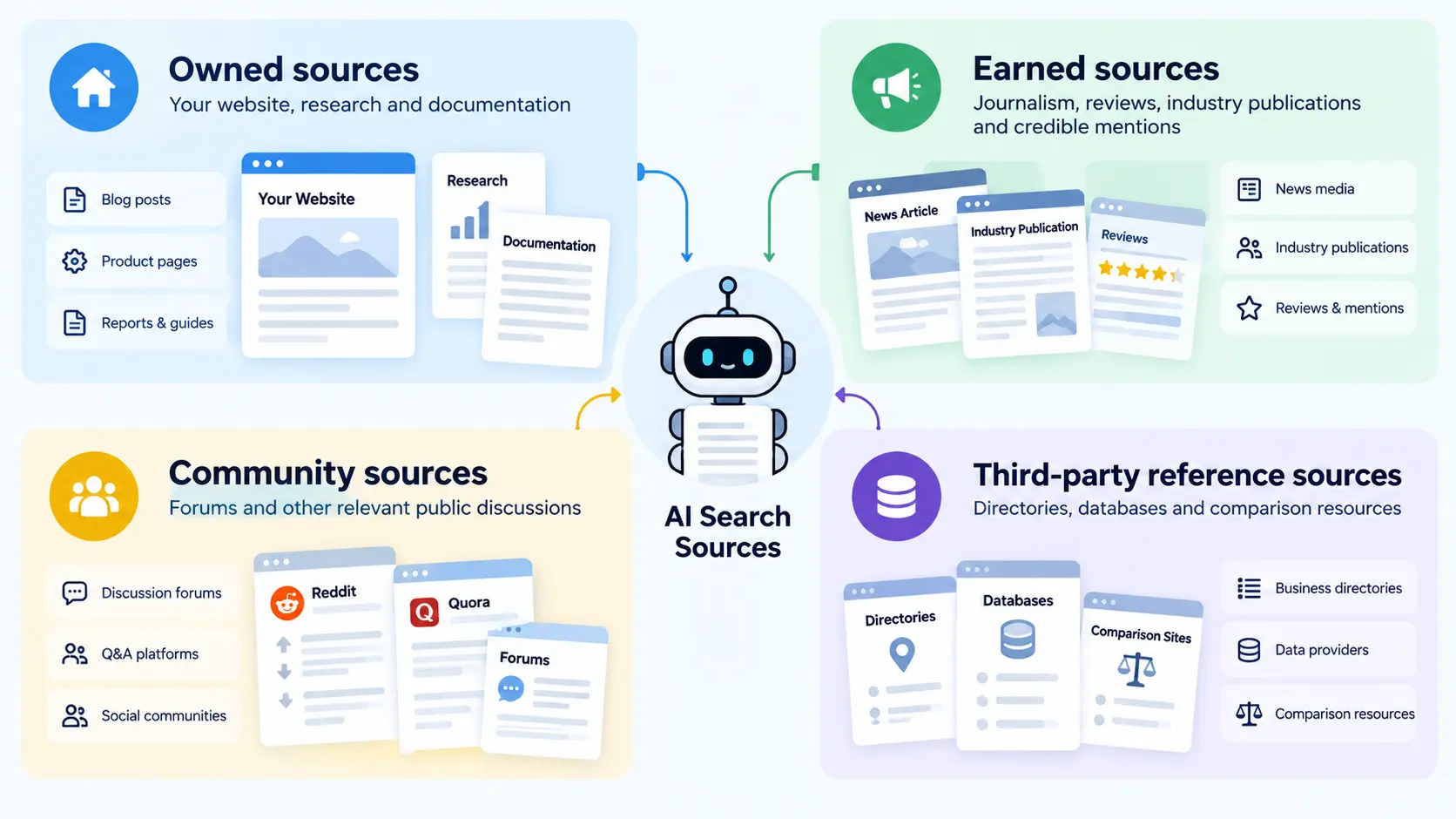
This expands AI visibility beyond owned content.
A useful model is:
- Owned sources – your website, research and documentation
- Earned sources – journalism, reviews, industry publications and credible mentions
- Community sources – forums and other relevant public discussions
- Third-party reference sources – directories, databases and comparison resources
The exact importance of each will vary by platform and query, and we should avoid claiming that any one source type is universally preferred.
But the strategic implication is clear – your brand’s information footprint extends beyond your own domain.
Don’t Measure AI Visibility With One Prompt on One Platform
This is where the practical mistake happens.
A marketer asks ChatGPT:
“What are the best wealth management companies in India?”
Their brand appears.
Screenshot.
Success.
But what happens if:
- the question is phrased differently?
- the user asks Gemini?
- the user uses Perplexity?
- ChatGPT runs the query again next week?
- the question becomes more specific?
A single screenshot tells you that you appeared once.
It does not tell you that you have durable AI visibility.
A better measurement approach is: Prompt cluster × Multiple platforms × Repeated observations × Time
For example, instead of tracking one “best CRM” prompt, track questions around comparisons, recommendations, use cases, pricing, alternatives and problems across several AI systems.
That produces a far more meaningful picture of where a brand is actually visible.
Explore our guide on how to audit ChatGPT visibility
This Changes the Goal of AI Visibility
The goal shouldn’t be:
“Rank #1 on ChatGPT.”
There may be no stable, universal equivalent of a traditional #1 position to own.
The better goal is:
Build enough relevant, reliable and accessible information that your brand consistently enters the discovery and retrieval ecosystem across the questions that matter to your customers.
That means creating strong first-party content.
But it also means building credible third-party presence, publishing original research, maintaining accurate product and company information, earning relevant mentions, and understanding which sources different AI systems surface around your category.
Because the future of search visibility may not be one ranking on one results page.
It may be a network of visibility across engines, prompts, sources and answers.
And the brands that measure that network, not just isolated citations, will have a much clearer understanding of whether AI search is actually discovering them.