




Let us ask you something. When was the last time you searched for something on Google and actually clicked on one of the links?
Chances are, you’re doing it less than you used to. And there’s a reason for that. More and more people are just typing their questions directly into ChatGPT, Perplexity, or Google’s AI Overview and getting a full answer right there. No links. No scrolling. No clicking.
This changes everything for businesses trying to get found online.
If you’ve been hearing the term “Generative Engine Optimization” (GEO) lately and wondering what it actually means, and whether you need to care about it, this guide is for you.
First, Let’s Talk About What’s Changing
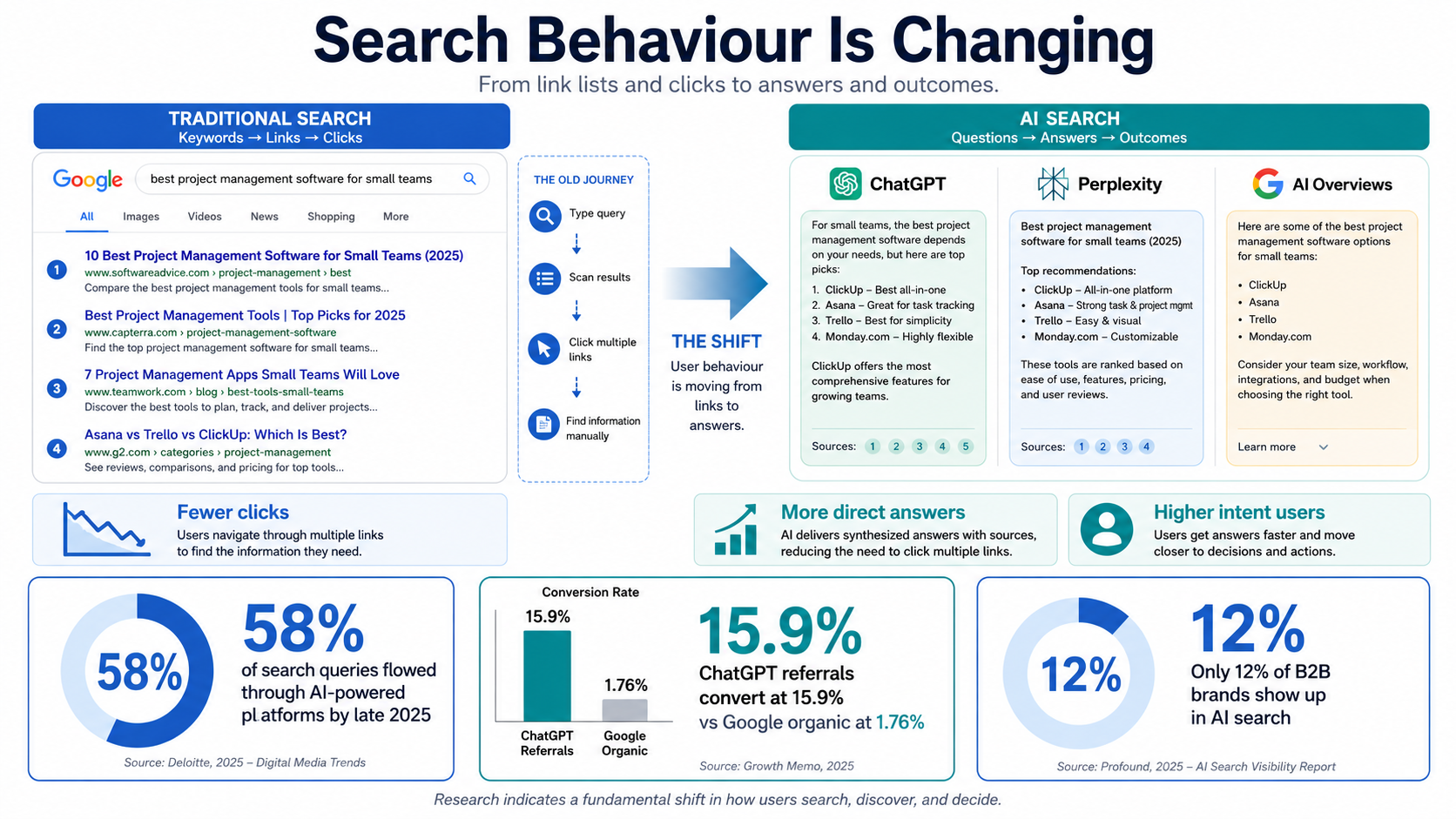
For the past 20 years, getting found online meant one thing: rank on Google. You’d optimize your content for keywords, build backlinks, and hope to land somewhere on the first page. That was the game. And it still matters. Don’t let anyone tell you SEO is dead.
But something significant has shifted in the last two years.
By late 2025, roughly 58% of all search queries were flowing through AI-powered platforms like ChatGPT, Google AI Overviews, and Perplexity. That’s not a small trend. That’s a genuine change in how people find information. And for businesses, it’s a signal worth paying attention to. Businesses investing in SEO services for AI Overview rankings are already adapting their visibility strategies for AI-powered search platforms.
Here’s the part that should really get your attention. ChatGPT referrals convert at around 15.9%, compared to Google organic’s 1.76%. That’s nearly a 9x difference. The people coming from AI search aren’t just browsing. They’re ready to act.
But there’s a catch. Only 12% of B2B brands actually show up when buyers search their category inside these AI tools. The other 88% are completely invisible, not because their product isn’t good, but because nobody optimized their content for how AI thinks.
That’s exactly what GEO is trying to solve.
So, What is Generative Engine Optimization?
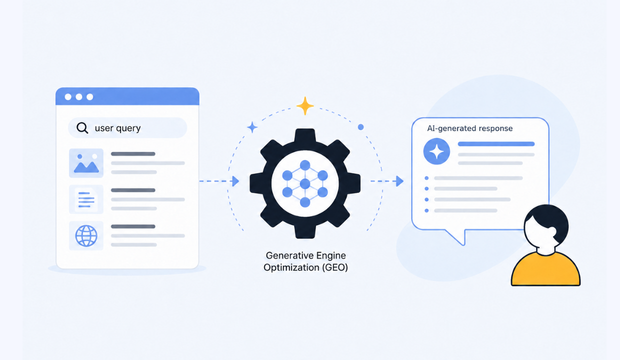
Generative Engine Optimization (GEO) is the practice of structuring and positioning your content so that AI tools like ChatGPT, Perplexity, Google Gemini, and Claude cite, mention, or recommend your brand when someone asks a relevant question.
Think of it this way. When someone types “what’s the best accounting software for small businesses” into ChatGPT, the AI doesn’t show a list of links. It just answers. It picks a few brands, explains why they’re a good fit, and maybe links to them. The brands that appear in that answer? They earned that spot because their content was built in a way that AI systems could trust, understand, and surface.
That’s GEO in action. Many businesses are now combining GEO with answer engine optimization services to improve visibility across ChatGPT, Google AI Overviews, and Perplexity.
It’s not replacing SEO. It’s extending it into a new channel; one that’s growing fast and rewarding brands that understand how it works.
GEO vs. SEO – What’s Actually Different?
You might be wondering whether this is just SEO with a new name. It’s not, and here’s why.
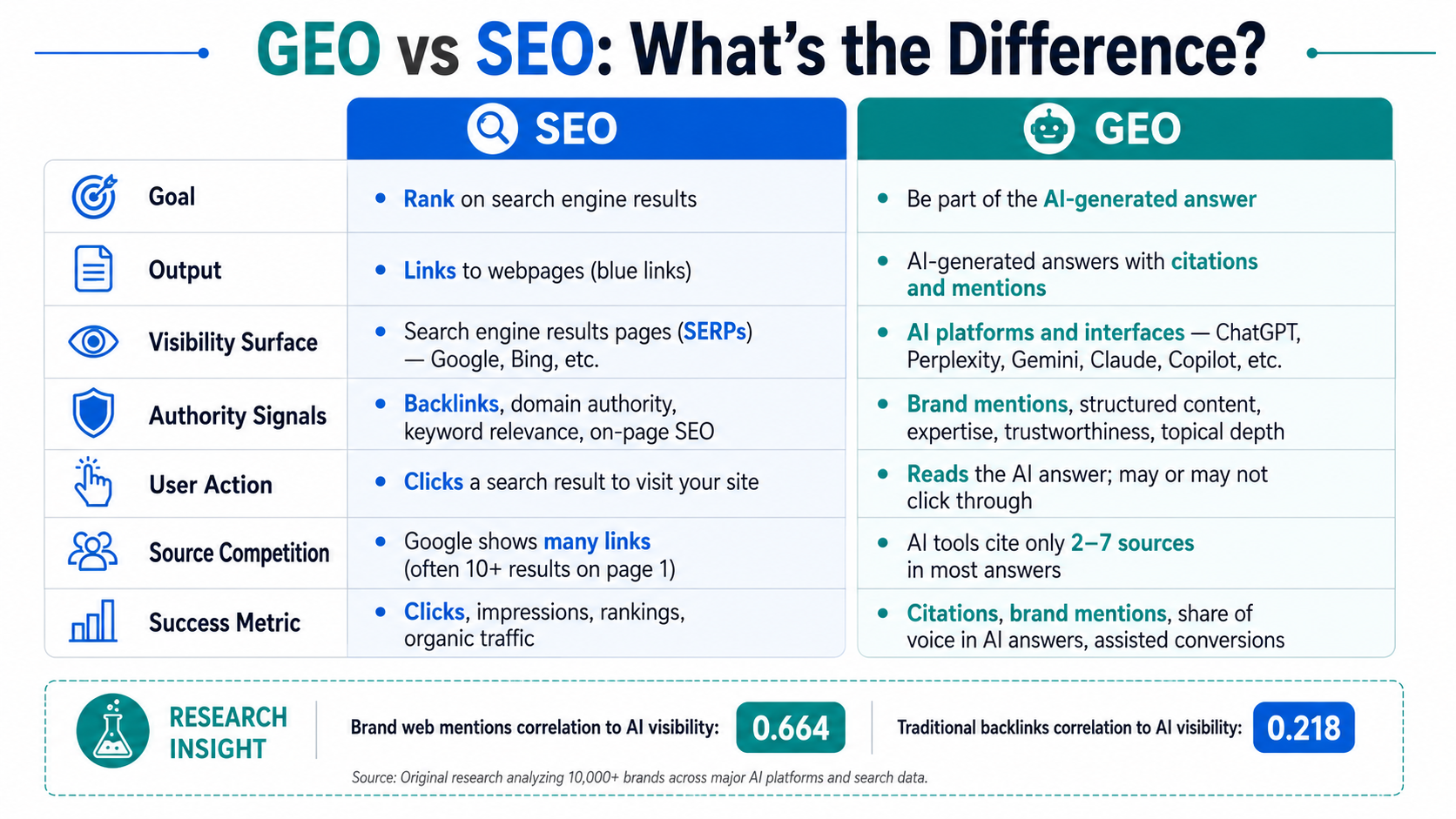
Traditional SEO is about ranking your web pages on a search engine results page. You optimize for keywords, earn backlinks, and compete for position one through ten on Google. The goal is to get a click. A user sees your link, clicks it, and lands on your site.
GEO works differently. Understanding the difference between SEO and GEO is essential for brands adapting to AI-generated search experiences. AI tools don’t show you a list of pages to choose from. They synthesize information from multiple sources and give you one answer. Your goal isn’t to get a click. It’s to be part of the answer.
This changes what you optimize for. In SEO, backlinks were the biggest authority signal. In GEO, brand mentions matter more. A study by Ahrefs found that the correlation between brand web mentions and AI visibility is 0.664; while traditional backlinks sit at just 0.218. That’s a meaningful gap.
Another key difference: AI tools cite far fewer sources than Google does. Google shows you ten blue links per search. AI tools typically reference just 2 to 7 domains per response. The competition for those slots is fierce, and the brands winning them aren’t always the ones with the highest domain authority. They’re the ones whose content is clear, structured, trustworthy, and genuinely useful.
Why This Matters Especially for B2B Brands
If you’re selling a product or service to other businesses, you need to know this: 90% of B2B buyers now use AI tools during their purchasing journey. And a large portion of them start their research inside ChatGPT or a similar platform rather than Google.
This is happening before they ever visit your website. They’re asking AI, “What are the best options for X?” or “Which company should I use for Y?” and AI is giving them a shortlist. If your brand isn’t on that list, you don’t get a second chance. You were never even considered.
The decision-making window has compressed. What used to take days of research now takes minutes of conversation with an AI. The brands that show up in those minutes earn disproportionate mindshare – and eventually, revenue.
How Does AI Decide What to Cite?
This is the question everyone wants answered, and honestly, there’s no single definitive formula. But research is starting to paint a clear picture.
Content quality and structure matter a lot. AI systems don’t read content the way humans browse websites. They scan for clarity, directness, and factual accuracy. Content that answers questions in plain, structured language is far more likely to be cited. Pages with clear headings are 2.8 times more likely to earn citations in AI search results.
Brand mentions across the web are huge. The more your brand is talked about on third-party platforms, Reddit, Quora, YouTube, industry publications, the more signals AI systems have that you’re a legitimate, authoritative source. YouTube mentions specifically showed the strongest single correlation to AI visibility in recent research.
Third-party validation counts. For B2B brands especially, being listed on platforms like G2, Capterra, or Trustpilot makes a real difference. Domains with profiles on these platforms have a 3x higher chance of being cited by ChatGPT. It’s not about the number of reviews. It’s about being recognized by platforms that AI systems treat as trusted validators.
Content freshness plays a role too. AI tools prefer recent, up-to-date information. Regularly refreshing your key pages signals relevance and keeps you in contention.
We go much deeper on this in our article on How ChatGPT Decides Which Sources to Cite. If you’re curious about the specific mechanics, that’s a good place to start.
The Core Components of a GEO Strategy
GEO isn’t a single tactic. It’s a way of thinking about your entire content presence. Here’s what it covers, at a high level.
- Topical authority. You want AI to see you as a reliable expert on a specific subject. That means publishing a consistent body of content around a topic, not one great article, but many interconnected pieces that together show depth and breadth of knowledge.
- Content structure. Your content needs to be easy for AI to understand. Clear headings, direct answers near the top of articles, factual accuracy, and logical flow all contribute to whether an AI will choose to cite you.
- Off-site presence. Your website alone isn’t enough. Your brand needs to show up in conversations happening on other platforms – in forums, review sites, YouTube, podcasts, and publications your audience already reads.
- Technical foundations. This is the part most people overlook. If AI crawlers can’t properly access and understand your site, none of the content work matters. Clean site structure, schema markup, and proper indexing all feed into this.
- Measurement. You can’t improve what you don’t track. And right now, as of late 2025, only 16% of brands are systematically tracking their AI search performance. That gap is an opportunity. We cover exactly how to do this in our guide on How to Audit Your ChatGPT Visibility.
A Practical Way to Think About It
Here’s how we would frame GEO for anyone just getting started.
Imagine a highly trusted advisor that your ideal customer talks to before making any big decision. That advisor has read a huge amount of content from across the internet and remembers what it found reliable, credible, and helpful. When your customer asks for a recommendation, the advisor mentions the brands it knows well and trusts.
Your job with GEO is to become one of those trusted brands in the advisor’s memory. You do that by being genuinely present, consistently useful, and clearly credible across the internet – not just on your own website.
It’s not unlike how word-of-mouth worked before the internet. The brands people heard about the most, in the most trusted contexts, were the ones that got recommended. GEO is word-of-mouth at scale, filtered through AI. Businesses working with an experienced AI search visibility agency are often able to build stronger brand authority across emerging AI discovery platforms.
What GEO Doesn’t Mean
It’s worth clearing up a common misconception here.
GEO is not about tricking AI systems. You won’t find a loophole or a shortcut that suddenly makes ChatGPT recommend you. AI tools are increasingly good at identifying content that’s been stuffed with keywords or written primarily to manipulate an algorithm rather than genuinely help a reader.
The brands that win in GEO are the ones that would have earned recommendations the old-fashioned way too by being genuinely good at what they do and building a credible presence around it. GEO just formalizes that into a strategy.
Where to Go From Here
If you’re new to this topic, here’s our honest suggestion: don’t try to do everything at once.
Start by understanding where your brand currently stands in AI search. Ask ChatGPT and Perplexity a few questions that your ideal customer would ask. See if you come up. If you don’t, that’s your baseline. And that’s okay – most brands don’t, yet.
Then, work through the sub-topics in this cluster to build your understanding and your strategy piece by piece.
Here’s what we cover across this topic area:
- How ChatGPT Decides Which Sources to Cite – The mechanics behind AI citations, and what signals actually matter
- How to Get Your Brand Cited by ChatGPT – Practical tactics for showing up in AI-generated answers
- Why 88% of B2B Brands Are Invisible in AI Search – What’s keeping most businesses out of the conversation
- ChatGPT vs Google: Where Should Your Business Focus in 2026? – A strategic look at where to put your energy
- How to Audit Your ChatGPT Visibility – A step-by-step process for measuring your current AI search performance
- LLM SEO for B2B Brands – A deeper look at AI search optimization for business-to-business companies
GEO is still early. The brands that take it seriously now will have a significant head start over competitors who wait until it becomes obvious. And if you’d like help thinking through what a GEO strategy looks like for your specific business, that’s exactly what we do at Sudha Solutions. Get in touch and let’s talk.
Sudha Solutions helps businesses build visibility in AI search through content strategy, GEO, and digital marketing. Based in India, working with brands globally.
Frequently Asked Questions
Why is GEO important for businesses in 2026?
As more users rely on AI tools instead of traditional search engines, GEO helps businesses improve visibility inside AI-generated search experiences.
How do AI platforms decide which brands to cite?
AI systems prioritize structured content, topical authority, brand mentions, trusted third-party references, and clear factual information.
What are GEO optimization services?
GEO optimization services help businesses improve AI visibility through content structuring, authority building, technical optimization, and AI-focused search strategies.
Can GEO replace traditional SEO?
No. GEO complements traditional SEO by expanding visibility into AI-powered search and generative answer engines.