
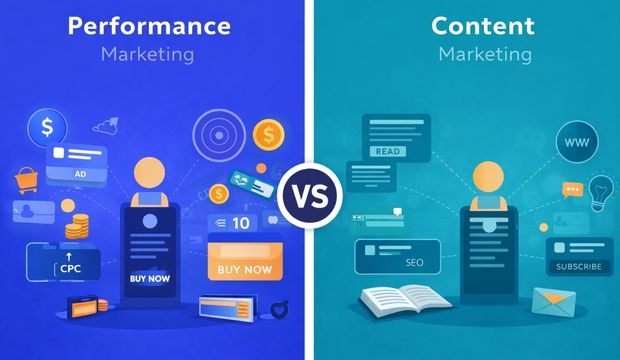




Every growth marketer at a D2C brand has faced this conversation. The founder wants customers every day. The finance team wants CAC to go down. And marketers are sitting in the middle trying to decide: do we pour budget into Meta and Google through a performance marketing agency, or invest in long-term content marketing solutions that compound over time?
On one side, performance marketing promises quick wins through launch campaigns on platforms like Google Ads or Instagram and start driving measurable sales almost instantly.
On the other, content marketing focuses on creating blogs, videos, and organic channels that compound over time, building trust and reducing your dependence on paid ads.
The honest answer isn’t a channel. It’s a sequence.
In this blog, we’ll break down both approaches in detail and help you decide where your D2C brand should invest first.
First, Let’s Understand What Each Channel Actually Does
Before comparing the two, it helps to be precise about what you’re actually buying when you invest in each.
Performance marketing is any channel where you pay for a measurable outcome. Meta Ads, Google Ads, affiliate programs, paid influencer partnerships. The feedback loop is tight. You spend, you track, you optimize. The moment the budget stops, the results stop too.
Content marketing is the long game. SEO, blogs, organic social, email newsletters, YouTube, UGC programs. The feedback loop is slow, but the asset lives on. A well-ranking article written today keeps generating leads two years from now without an additional dollar spent.
Neither is inherently better. They solve different problems at different stages of a brand’s life.
The D2C Growth Problem: You’re Paying More, Getting Less
The D2C market is genuinely one of the most exciting spaces in retail. Global Insight Services projects the global D2C market to grow from about $225.5 billion in 2024 to $880.1 billion by 2034. But entering that growth race has never been more expensive.
The average ecommerce CAC sits between $68 and $84, and that number has climbed roughly 40% in just the last two years. It’s not just a macro trend; it’s structural. Google’s ad costs have been rising steadily, with CPCs up 12.88% year-over-year in 2025 and 87% of industries seeing increases. Overall ROAS declined 10.03% in 2025, meaning brands are paying more and getting less back.
Customer acquisition costs have increased 60% over the past five years a compound problem that every growth marketer now has to build a strategy around.
The implication is clear: a pure performance marketing playbook is no longer a sustainable foundation for a D2C brand. It’s a starting point, not a long-term moat.
What is Performance Marketing
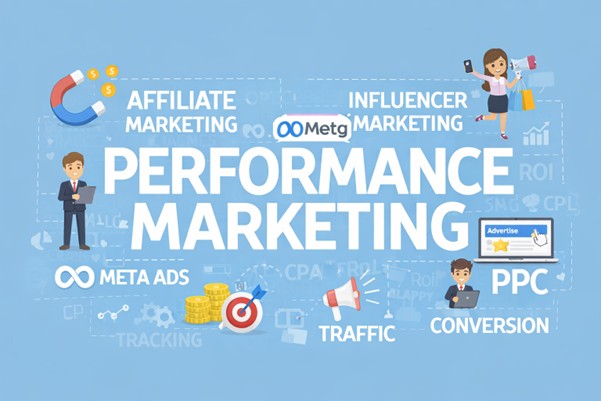
Performance marketing is the fastest way to answer one simple question. Will people buy this?
Most brands today rely on specialised performance marketing services or a dedicated performance marketing agency to manage campaigns, optimise creatives, and scale revenue efficiently.
It includes channels like Meta Ads, Google Ads, influencer collaborations, and marketplace promotions. The goal is straightforward. Drive traffic, generate conversions, and track return on investment in real time.
For founders, this is often the first lever to pull.
Why it works
- You can generate traffic instantly
- You can test multiple creatives and offers quickly
- You get clear data on what works and what doesn’t
When it works best
- You already have product-market fit
- Your website converts well
- Your messaging is sharp and differentiated
Performance marketing gives you speed. But it comes with a catch. The moment you stop spending; the growth stops too.
A brand like Dollar Shave Club built its early customer base almost entirely through viral performance-style content and paid amplification. The famous launch video was a performance asset first, not a long-form content play. It drove immediate conversions at scale.
Although, the structural risk of leaning entirely on performance marketing is well-documented. According to an article by Amra and Elma, over-investing in performance advertising can dip your ROI by 20–50%, while a balanced mix of brand-building and performance advertising can increase ROI by 25–100%.
That’s not an argument to abandon performance marketing. It’s an argument to treat it as a discovery and validation engine, not your entire growth strategy.
What is Content Marketing (Beyond Just Posting)
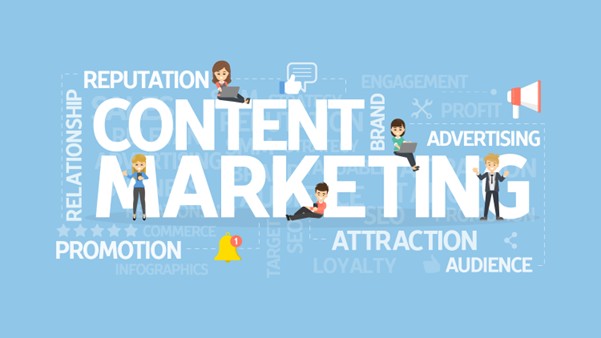
Content marketing is not about posting on Instagram or writing occasional blogs. It is about creating a system that attracts, educates, and converts your audience over time.
Today, brands are moving beyond basic blogging toward structured content marketing services for ecommerce, where every piece of content is mapped to customer intent, SEO visibility, and conversion outcomes. The goal is not just traffic but predictable revenue through scalable ecommerce content marketing services.
This includes SEO blogs, social media storytelling, YouTube content, email flows, and even community building.
Unlike ads, content does not interrupt the user. It meets them where they are searching, scrolling, or learning.
Why it works
- Builds trust and credibility
- Compounds over time
- Reduces dependency on paid channels
When it works best
- Your product needs explanation or education
- You are building a brand, not just selling a product
- You want long-term, sustainable growth
Content marketing generates $3 for every $1 invested, compared to just $1.80 for paid advertising. Content marketing also costs 62% less than traditional marketing while generating 3x more leads.
This is a classic example of what a strong content marketing for ecommerce agency approach looks like building demand before selling.
The most iconic example of content-first D2C is Glossier. Glossier founder Emily Weiss started her blog “Into the Gloss” in 2010, growing it to 1.5 million unique monthly views before launching a single product. When Glossier did launch, it already had a built-in audience of engaged, loyal readers who felt ownership over the brand. The blog helped Glossier grow its year-on-year revenue by 600%. That’s the compounding power of content done before the brand even existed as a brand.
The Core Difference Between Performance Marketing and Content Marketing
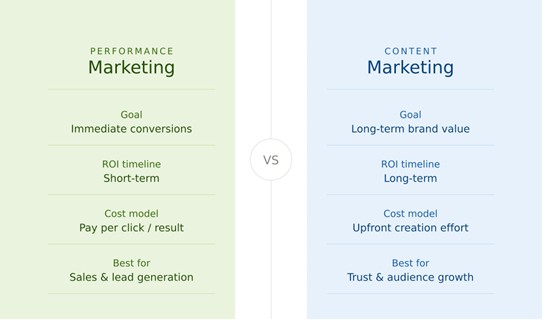
While performance marketing services deliver immediate traction, content marketing solutions build long-term defensibility.
At its core, this is not a channel debate. It is a time horizon decision.
- Performance marketing gives you immediate results but relies on continuous spending
- Content marketing takes time but builds long-term assets
Here’s how they compare:
| Factor | Performance Marketing | Content Marketing |
| Speed | Fast | Slow |
| Cost Structure | Ongoing spend | Front-loaded effort |
| ROI Timeline | Immediate | Long-term |
| Scalability | Budget dependent | Compounding |
| Trust Building | Low to Medium | High |
If you are thinking short-term revenue, performance marketing wins.
If you are thinking long-term brand equity, content marketing becomes essential.
When Should You Start with Performance Marketing?
Performance marketing is your validation engine.
If you are in the early stages and need answers quickly, this is where you begin.
You should prioritise performance marketing if:
- You need revenue in the short term
- You want to test product demand
- You are experimenting with pricing, creatives, or positioning
Ideal scenarios
- New product launches
- Funded brands with aggressive growth targets
- Highly competitive categories where speed matters
Risks to watch
- Rising acquisition costs
- Over-dependence on ad platforms
- Lack of brand recall
Performance marketing will tell you what sells. But it will not tell you why people stay.
When Should You Start with Content Marketing?
Content marketing is your brand-building engine. If your product needs trust, education, or differentiation, content becomes critical.
You should prioritise content marketing if:
- Your category is new or complex
- Your audience needs time to decide
- You want to build organic traffic and inbound demand
Ideal scenarios
- Niche products
- Bootstrapped brands with limited ad budgets
- Founder-led brands with strong stories
Risks to watch
- Slow initial traction
- Inconsistent execution
- Lack of clear ROI in early stages
Content marketing will not give you instant sales. But it builds the foundation that makes every future sale easier.
Decision Framework for Founders
Brands often start with a performance marketing agency for quick validation, then layer ecommerce content marketing services to reduce CAC over time.
If you are still unsure where to start, ask yourself three simple questions:
- Do I need revenue immediately, or can I wait?
- Do I have more budget or more time?
- Does my product sell instantly or require education?
A simple way to decide
- Early stage with urgency: Start with performance
- Early stage with niche product: Start with content
- Growth stage: Combine both strategically
Brief summary
Final Thoughts
If you are starting from zero, performance marketing is usually the fastest way to validate your product and generate initial traction.
But stopping there is where most brands go wrong.
Content should not be delayed. It should start within the first 30 to 60 days once you begin seeing patterns in your ads. Because performance gives you speed, but content gives you stability.
And the brands that scale sustainably are not the ones that choose one over the other.
They are the ones that know when to shift, when to combine, and how to build both into a system.
Ready to turn your content into a real growth engine?
At Sudha Solutions, we deliver content marketing solutions and ecommerce content marketing services designed to drive measurable growth. Whether you need a performance marketing agency to scale fast or a long-term content marketing for ecommerce agency to build authority, we help you build a system that actually compounds. Contact Us TODAY!
Frequently Asked Questions
What is the main difference between performance and content marketing?
Performance marketing focuses on immediate, measurable results through paid campaigns, while content marketing builds long-term organic growth by creating valuable content that attracts and nurtures audiences over time.
Which is better for a new D2C brand: performance or content marketing?
For most new D2C brands, performance marketing is better initially to validate demand and generate quick sales. Content marketing should follow soon after to build long-term sustainability.
How long does content marketing take to show results?
Content marketing typically takes 3 to 6 months to show initial traction and 6 to 12 months for significant results, depending on consistency, competition, and content quality.
Is performance marketing becoming less effective?
Performance marketing is still effective, but rising CAC and declining ROAS mean it’s becoming more expensive. Brands now need to balance it with content marketing for better long-term ROI.
Can performance and content marketing work together?
Yes, the most successful D2C brands use both. Performance marketing drives immediate traffic and insights, while content marketing builds trust and reduces long-term dependence on paid ads.