




In 2026, search has changed permanently. Ranking on page one of Google isn’t enough. With AI Overviews from Google and conversational responses from platforms like OpenAI and Claude AI, users increasingly get direct answers without clicking through to websites.
For WordPress businesses, this shift changes everything.
Traditional SEO still matters. But now, your CMS must also be structured for Answer Engine Optimisation (AEO), so AI systems can extract, understand, and cite your content accurately. To achieve this, businesses are increasingly adopting Answer Engine Optimisation (AEO) services that align content with how AI systems extract and cite information.
This guide explains, clearly and practically, how to optimise your WordPress site for both SEO and AEO in 2026.
What Is the Difference Between SEO and AEO?
SEO (Search Engine Optimization) helps your pages rank in traditional search results.
AEO (Answer Engine Optimization) ensures your content is structured so AI systems can extract it as a direct answer.
In short:
|
SEO |
AEO |
| Optimises for rankings | Optimises for answer extraction |
| Focuses on keywords | Focuses on intent & questions |
| Measures traffic | Measures visibility & citations |
| Page-level authority | Passage-level clarity |
You don’t replace SEO with AEO. You layer AEO on top of strong SEO foundations.
Why Must WordPress Sites Adapt in 2026?
WordPress powers over 43.2% of the web. Its flexibility makes it powerful but also easy to misconfigure.
Most WordPress blogs:
- Focus only on keywords
- Publish long, unstructured articles
- Ignore schema markup
- Overuse page builders that generate messy HTML
But in multiple SEO communities on Reddit, marketers report increased impressions after restructuring content into:
- Question-based headings
- 40–70-word answer blocks
- FAQ schema
- Clear semantic hierarchy
A coincidence? Not really.
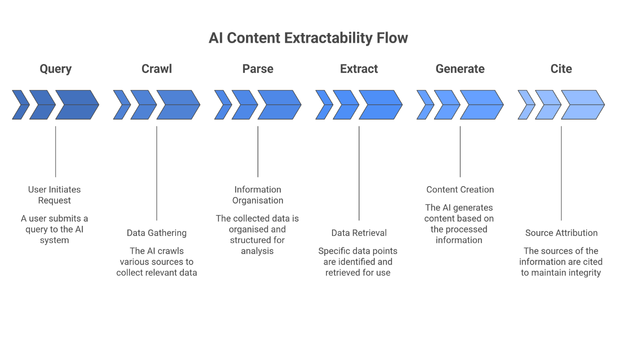
It is seen that AI systems don’t browse content like humans, instead they:
- Crawl
- Parse structure
- Extract relevant passages
- Generate summarised answers
And if your content isn’t clearly structured, it won’t be cited by AI systems even if it ranks #1 on Google.
WordPress, fortunately, gives you full control over that structure. Here’s how you can get started:
Step 1: Strengthen Your SEO Foundation
Before optimising for AI extraction, your technical SEO must be solid. AEO cannot compensate for weak fundamentals.
Search engines must be able to crawl, interpret, and trust your site before AI systems built on those indices will surface it.
For businesses investing in professional SEO services, technical crawlability, schema implementation, and topic clustering are non-negotiable. Without a strong WordPress foundation, even the best optimisation strategy struggles to deliver long-term visibility.
A. Ensure Technical Crawlability
At a minimum, your WordPress site should:
- Load quickly and pass Core Web Vitals
- Use HTTPS
- Have a clean XML sitemap submitted via Search Console
- Avoid “noindex” errors on key pages
- Maintain logical URL structures
If search engines struggle to crawl your site, AI systems won’t extract from it.
Think of SEO as the foundation. Without it, AEO has nothing to build on.
B. Build Topic Authority Not Just Blog Posts
In 2026, isolated posts don’t perform as well as structured topic clusters do. This is especially important for brands offering structured content marketing services, where isolated blog posts rarely outperform interconnected pillar ecosystems designed around intent clusters.
So, instead of publishing isolated articles, structure your content into clusters:
- Pillar Page (comprehensive guide)
- Supporting Articles (specific subtopics)
- Strong internal linking between them
AI systems prefer structured topical ecosystems over random keyword-driven articles.
C. Implement Structured Data (Schema Markup)
Schema helps search engines and AI systems to understand your content.
For WordPress, focus on:
- Article schema
- FAQ Page schema
- How To schema
- Breadcrumb schema
- Organisation schema
Plugins like:
- Rank Math for its free schema features.
- Yoast for schema and content optimisation.
- All in One SEO for its “next-gen” schema generator and site audit tools
… make implementation easier but always validate your markup using a schema validator tool.
Without structured data, AI systems rely only on guesswork.
Step 2: Optimise for AEO (Answer Engine Optimization)
Now we go deeper. Once your SEO foundation is stable, the next step is structuring content for AI extraction.
This is where AEO becomes practical.
A. Use Question-Based Headings
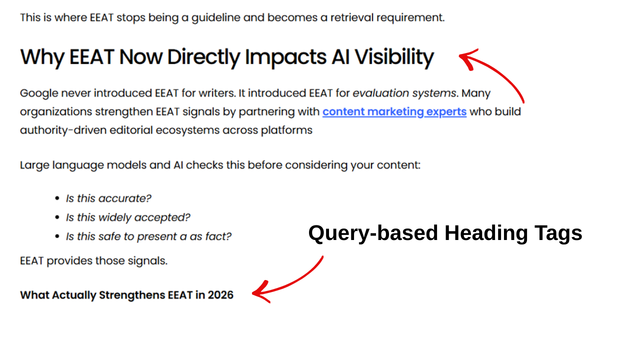
AI-driven search is conversational. Users ask full questions instead of typing short keywords.
Your headings should reflect this behaviour.
Instead of writing:
“Advanced WordPress Content Strategy”
Write:
“How Do You Structure WordPress Content for AI Extraction?”
This mirrors how users and AI systems frame queries, thereby increasing your chances of being selected.
B. Apply the 60-Word Answer Rule
AI systems extract concise passages, not entire articles.
Immediately below each key heading, include a clear 40–60-word answer block.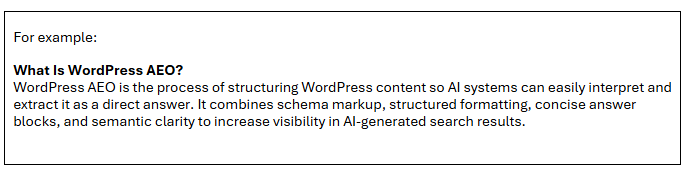
After this definition, you can expand further.
Why? Because this structure improves snippet eligibility and AI citation potential.
C. Improve Content Extractability
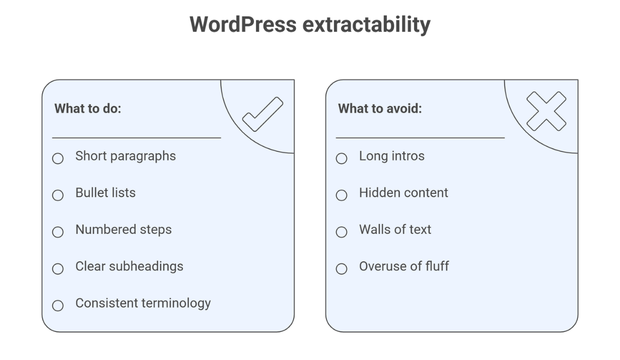
LLMs process structure, not storytelling flair. If your content is buried inside long paragraphs, vague language, or cluttered formatting, it becomes harder for machines to interpret, even if the information itself is valuable.
Even high-quality blog writing services lose visibility if articles are long, unstructured, and lack clear answer blocks. Formatting determines whether AI systems can extract and cite your expertise.
That’s why content extractability is critical.
Extractability refers to how easily a machine can locate, interpret, and lift a passage from your page without confusion or misinterpretation.
To improve extractability in WordPress, use:
- Short paragraphs (2–4 lines)
- Bullet lists
- Numbered steps
- Clear subheadings
- Consistent terminology
And avoid:
- Long intros before answering
- Hidden content in tabs without schema
- Walls of text
- Overuse of fluff
Remember: Clarity wins over cleverness. Especially when your goal is to be extracted, cited, and surfaced in AI-generated results.
D. Optimise for Passage Authority
Passage authority refers to how effectively a specific section of a page can independently answer a query. In 2026, this matters because AI systems and search engines often extract individual passages, not entire articles, when generating featured snippets or AI-powered responses.
In other words, your page doesn’t just need overall authority. Each key section must stand strong on its own.
To strengthen passage authority:
- Keep answers context-rich but concise
- Avoid vague pronouns
- Include the subject naturally in the paragraph
- Use descriptive subheadings
For example, instead of writing:
“This improves performance.”
Write:
“Structured data improves AI answer extraction performance.”
Specific language improves extractability.
Step 3: Clean Up Your WordPress Backend
Many WordPress sites unknowingly sabotage their visibility with bloated code and poor architecture.
A. Reduce Page Builder Bloat
Heavy page builders often generate excessive nested HTML. While visually appealing, this clutter can complicate parsing.
When possible:
- Use Gutenberg blocks
- Keep HTML clean
- Avoid unnecessary scripts
Clean markup helps both crawlers and AI parsers.
B. Keep Important Pages Within 3 Clicks
AI systems evaluate crawl depth.
Ensure:
- Your blog is easily accessible
- Pillar pages are linked from the homepage
- Internal links are contextually placed
If a page is buried, it’s less likely to be surfaced.
C. Strengthen E-E-A-T Signals
AI systems evaluate credibility. And what better than to follow the E-E-A-T Experience, Expertise, Authoritativeness, and Trust guidelines?
Include:
- Detailed author bios
- Professional credentials
- LinkedIn links
- Company information
- Updated publication dates
AI systems weigh credibility signals heavily when selecting answers.
Step 4: Track the Right Metrics
In 2026, traffic alone no longer tells the full story. For companies running aggressive performance marketing campaigns, structured SEO + AEO ensures that paid traffic lands on pages built for both conversion and AI discoverability — maximising long-term ROI.
You should monitor:
- Featured snippet appearances
- AI Overview visibility
- Branded search growth
- Impression increases
- Schema validation health
Visibility in AI responses may not always produce immediate clicks, but it does build authority.
Quick WordPress SEO + AEO Checklist
Before publishing any article, confirm:
- Clear heading hierarchy
- Question-based subheadings
- 60-word answer blocks
- Validated schema markup
- Clean internal linking
- Author information included
- Page speed optimised
- No unnecessary HTML clutter
If these elements are present, your content is built for both search engines and AI systems.
Final Thoughts
In 2026, digital visibility is no longer just about ranking, it’s about being selected as the answer.
WordPress gives you full control over structure, schema, and content clarity. When combined with strong technical SEO and intentional AEO formatting, your CMS becomes more than a publishing tool, it becomes an AI-ready authority engine.
At Sudha Solutions, we help businesses future-proof their WordPress websites for both search engines and AI-driven discovery.
Ready to make your CMS answer engine ready? Let’s optimise your WordPress site for 2026, and beyond.
Frequently Asked Questions
1. Can WordPress rank in AI-generated search results?
Yes. When structured properly with schema, clear answer blocks, and strong topical authority, WordPress sites are frequently cited in AI search outputs.
2. Is AEO replacing SEO?
No. AEO enhances SEO. Rankings still matter, but structured clarity determines AI visibility.
3. Which WordPress plugin is best for AEO?
Plugins like Rank Math and Yoast are strong options because they support structured data, FAQ schema, and advanced metadata control.
4. How long should AI-friendly answers be?
Typically, 40–90 words. Short enough to extract, long enough to provide context.