




Search is no longer the only front door to the internet. Today, millions of people discover tools, products, services, and companies through AI search engines like ChatGPT, Claude, Gemini, Perplexity, and AI Overviews in Google Search. These systems summarise, recommend, and explain, and in doing so, they choose which brands are worth mentioning. And that’s where frustration begins.
Marketers, founders, and SEOs often ask:
- Why does AI always mention the same brands?
- Why are smaller or newer companies ignored, even when they’re objectively good?
- Is AI biased toward big brands?
The common assumption is popularity. But that’s not quite right. AI visibility is not driven by hype, ad spend, or even classic SEO alone. It’s driven by data representation, entity confidence, and statistical certainty.
Here we break down how AI systems decide which brands deserve visibility, why some brands are consistently surfaced while others remain invisible and what this shift means for SEO, marketing, and brand building going forward.
Quick Takeaway for Busy Readers
AI systems tend to cite brands that:
- Have strong third-party corroboration (press, reviews, Wikipedia, industry sites)
- Are easy to retrieve and parse (indexable pages, clean structure, clear entities)
- Minimize hallucination risk (consistent facts across many sources)
- Already appears in high-ranking pages for the query class
For Google AI Overviews specifically, Ahrefs found that 76.10% of AI Overview citations come from pages ranking in the top 10 organic results.
The Biggest Misconception: “AI Mentions Popular Brands”
At first glance, AI tools may feel like they “pick favourites.” You ask a question, and the same brands show up again and again, while equally capable competitors are invisible.
But that still feels intuitive, isn’t it? If a brand is widely known, AI would naturally mention it, right? Not quite.
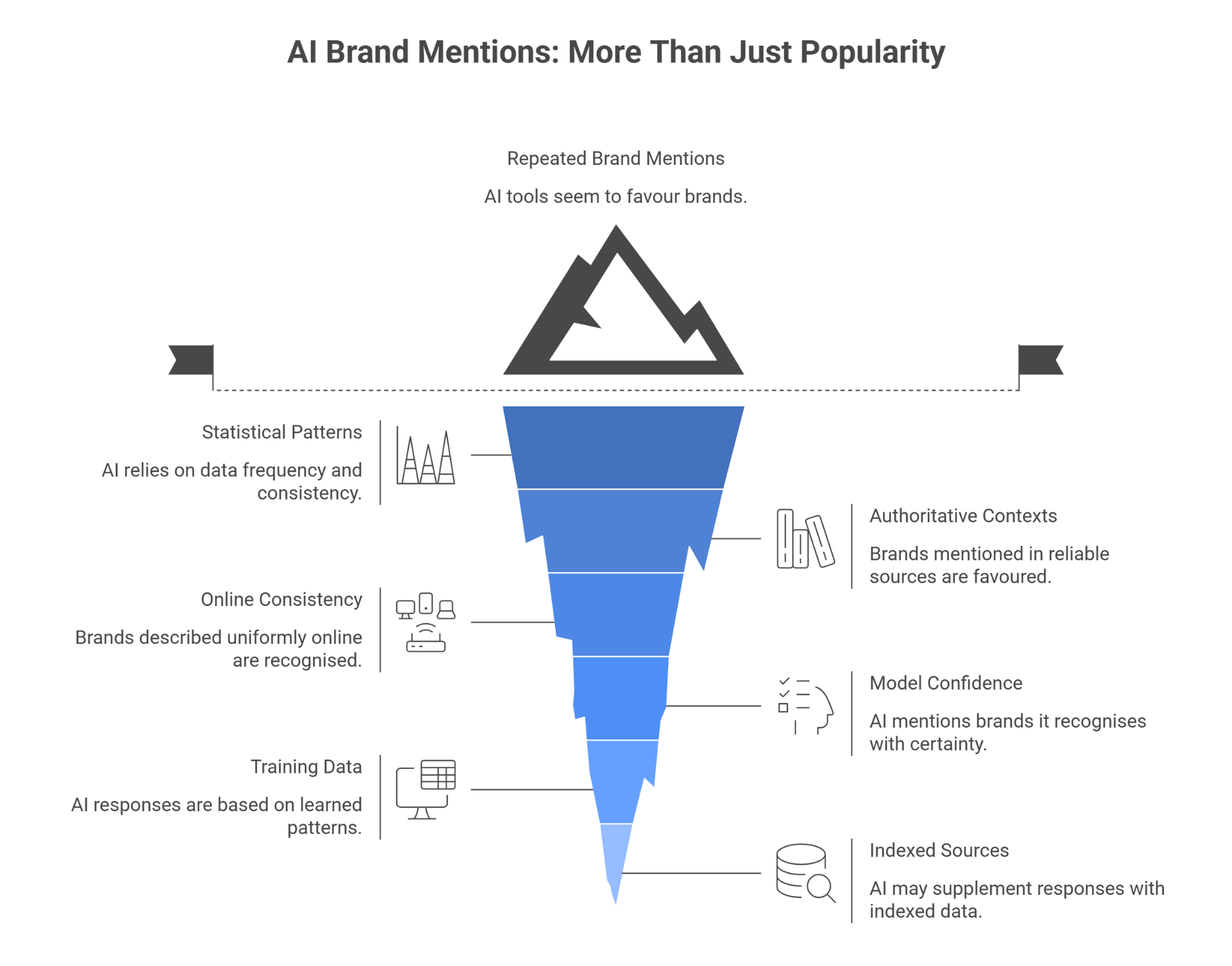
AI doesn’t “select” brands like a human does. Instead, it decides based on statistical patterns in data:
- How often a brand appears in authoritative contexts
- How consistently it’s described online, and
- Whether the model recognises it with confidence.
At a fundamental level, many AI tools don’t search the web in real time. Instead, they generate responses based on patterns learned during training and then may supplement those with retrieval from indexed sources.
This means AI doesn’t favour popular brands, it only mentions brands that exist clearly and consistently in its “data universe.”
What the Data Shows: Brand Mentions Beat Traditional SEO
Here’s what data reveals about how AI picks sources:
1) AI Overviews strongly overlap with top Google results
Ahrefs analysed 1.9 million citations from 1 million AI Overviews and found that 76% of citations came from pages in the top 10 organic results. Businesses strengthening their organic visibility often rely on SEO expert services to ensure their pages remain discoverable and eligible for AI citation sources.”
That has two implications:
- If you are not visible in search, you are often not even in the candidate set.
- Traditional SEO still feeds AI visibility, especially for Google AI Overviews.
2) Top Brands Capture Most AI Citations
- The Top 50 brands account for nearly 28.9% of all AI citations.
- 26% of brands have zero mentions in AI Overview results.
- AI systems often use encyclopedic or forum sources like Wikipedia and Reddit with high frequency.
This clearly indicates a visibility winner-takes-most pattern. Not because big brands are inherently superior, but because they are well-represented in training and retrieval data.
3) Source Diversity Matters
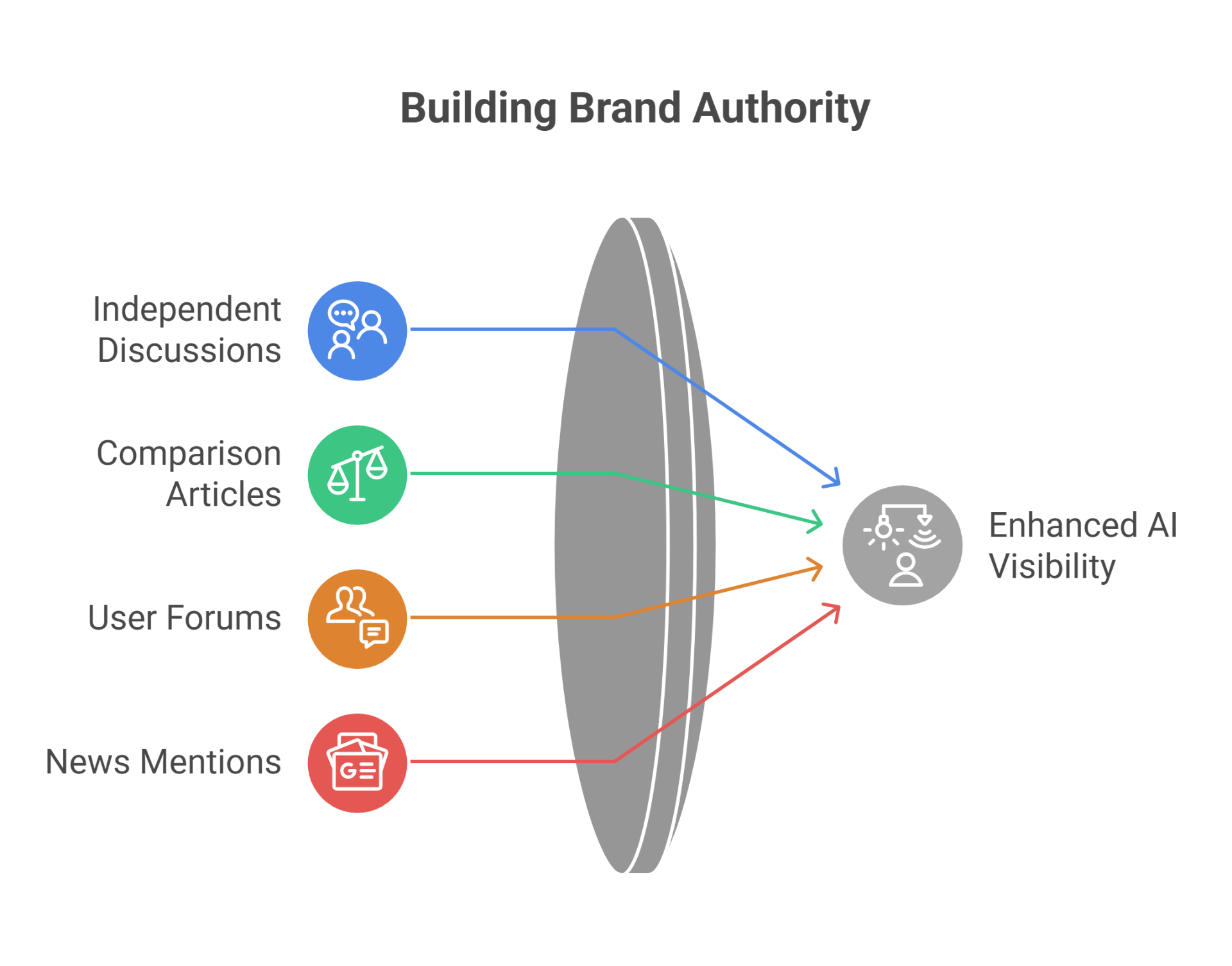
A brand appearing only on its own website isn’t enough. AI engines value third-party mentions like independent discussions on industry sites, comparison articles, user forums, and news. Nearly 6.5x more AI citations come from third-party sources than from self-hosted content.
Together, this data suggests that AI visibility is less about outperforming competitors and more about being consistently recognised across the web.
AI Doesn’t Rank Brands. It Recognises Them
What’s really happening here is not a new version of SEO. It’s a different system entirely. AI visibility behaves far more like knowledge graph inclusion than traditional search rankings.
Large language models (LLM) don’t think in terms of “best page wins.” They organise information as entities and relationships.
- Brands become entities.
- Topics become nodes.
- Mentions, descriptions, and repeated associations become edges connecting them.
The stronger and more consistent these connections are, the safer it is for AI to reference that brand. And this is why co-occurrence matters so much.
When a brand repeatedly appears near the same concepts, problems, and solutions across independent sources, it becomes anchored in the model’s internal knowledge structure. From an AI’s perspective, mentioning such a brand isn’t a recommendation; it’s a factual completion.
Understand that:
Ranking determines whether content is discoverable.
>And, entity inclusion determines whether a brand is quotable.
And because AI systems are fundamentally risk-averse, they default to entities that already exist clearly within this knowledge graph: brands that are well-defined, consistently described, and corroborated across the wider web.
And this is why many brands that rank well still fail to appear in AI answers. They rank as pages, but they don’t exist as entities.
The Two Pillars of AI Brand Visibility
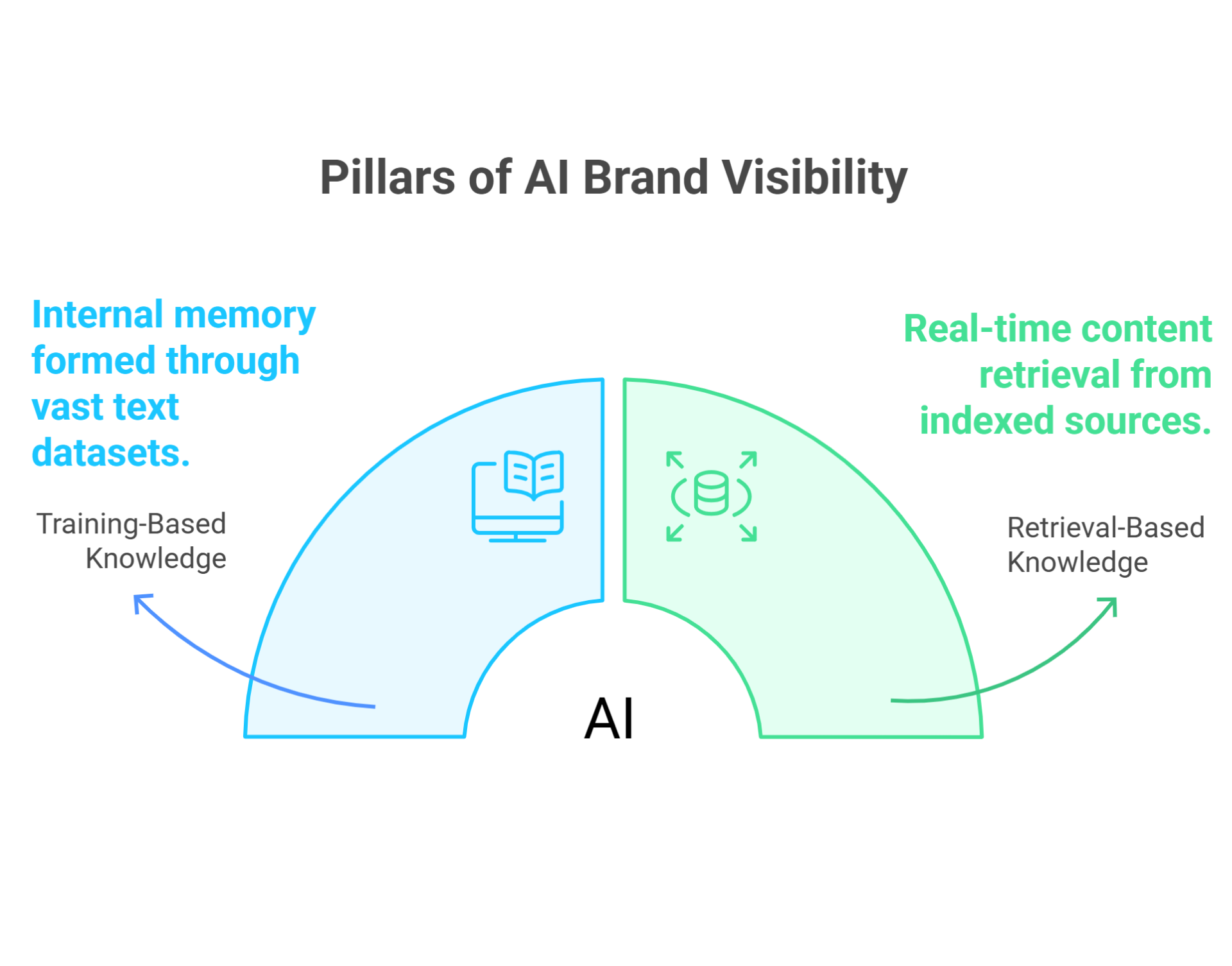
1) Training-Based Knowledge (Internal Memory)
Large language models such as ChatGPT are trained on vast collections (precisely, 570GB of datasets) of publicly available text: websites, articles, documentation, forums, encyclopedias, and books.
During training, the model learns:
- Which words commonly appear together
- Which entities are repeatedly mentioned in reliable contexts
- How concepts, brands, and categories relate to one another
If a brand appears frequently and consistently in high-quality contexts, the model forms a stable internal representation of that brand. If a brand appears rarely, inconsistently, or only on its own website, the representation is weak or non-existent.
In practical terms:
If the model hasn’t seen enough credible mentions of a brand, it cannot confidently mention it later. Researchers call this problem the “Existence Gap,” where brands absent from training data remain invisible to AI outputs.
2) Retrieval-Based Knowledge (Live or Indexed Sources)
Many AI systems use retrieval-augmented generation (RAG), pulling content from search indexes and selected sources in real time.
These systems look for:
- Well-structured content (which AI can interpret easily)
- Clear entity identification (WHOIS data, consistent brand name usage, schema markup)
- Third-party credibility (trusted publications, industry sites)
- Context-specific relevance (how strongly a brand is associated with the user’s query)
When these signals are strong and clear, brands become eligible for selection. However, if the signals are weak or inconsistent, AI often skips them entirely.
What Does AI Actually Look for In Your Brand Content?
Through many studies, a clear pattern has emerged. AI visibility correlates strongest with brand legitimacy signals, not marketing signals.
These signals consistently appear across multiple independent studies:
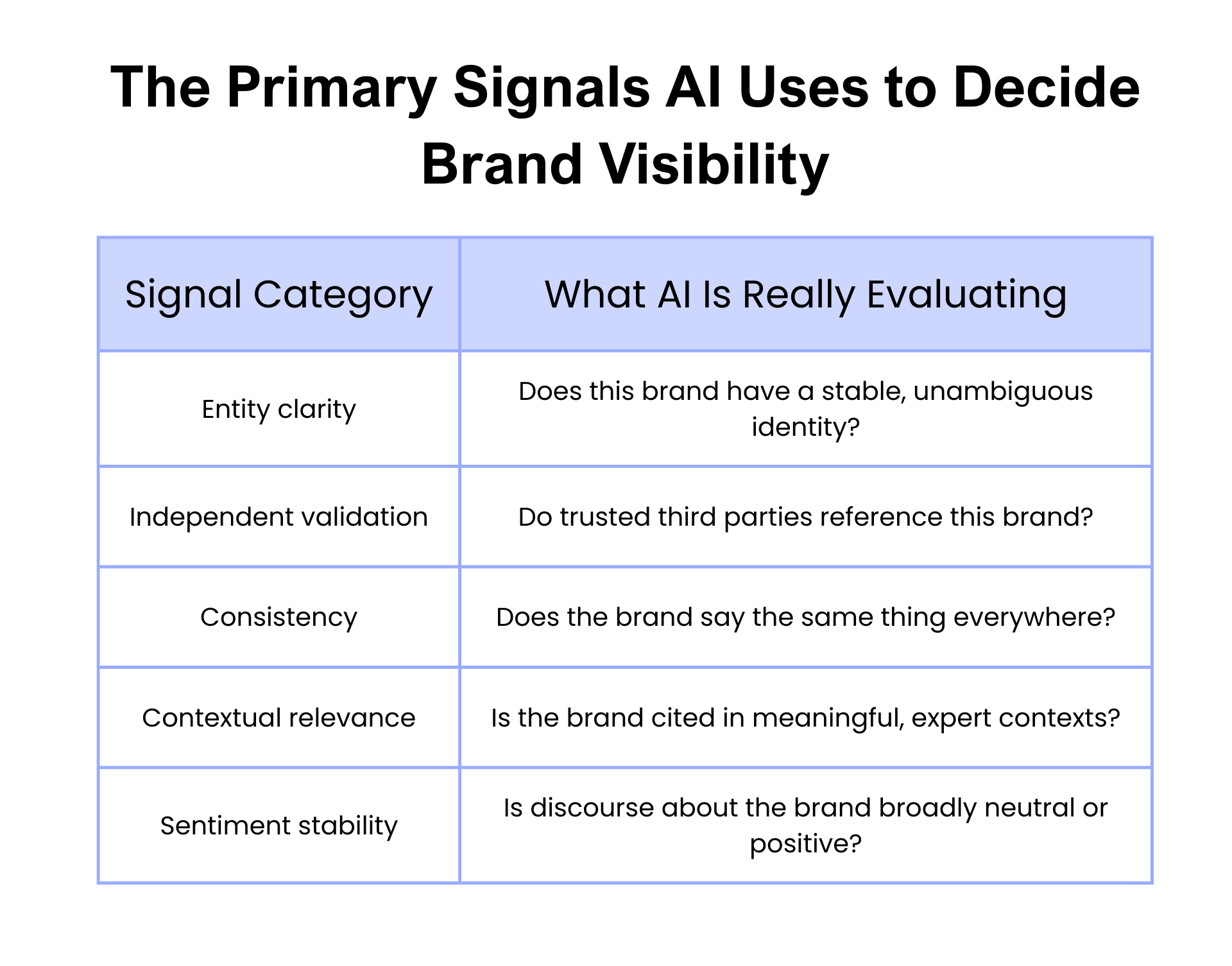 But notice what’s missing from the list?
- Keyword density
- Posting frequency
- Social engagement metrics
Those still matter but indirectly. They are no longer decisive.
Entity Authority: The Foundation Most Brands Ignore
Entity confidence answers a simple question:
“Are we sure this brand is real, distinct, and stable?”
AI gains confidence when a brand:
- Is mentioned consistently with the same name
- Has a clear category association
- Appears across multiple independent sources
- Is described similarly in different contexts
Inconsistent branding, such as variations in name, positioning, or description, weakens entity confidence.
From an AI’s perspective, uncertainty is a risk. And risk is better avoided.
Contextual Relevance: How Brand Associations are Built
AI doesn’t just track whether a brand is mentioned, it tracks where and why. A brand mentioned repeatedly in discussions about a specific topic becomes statistically tied to that topic.
You might’ve noticed the pattern:
- whenever “secure phones” are discussed Apple surfaces.
- Whenever, CRM Platforms are discussed Hubspot is mentioned.
These associations are built through cooccurrence, meaning, how often a brand appears near certain keywords, concepts, and questions. So, if a brand is rarely discussed in meaningful topical contexts, AI has no reason to surface it.
Brand Mentions Have the Strongest Correlation
In a study of over 75,000 brands, one factor stands out clearly:
| Visibility Factor | Correlation with AI Mentions |
| Branded Web Mentions | 0.6644 |
| Branded Anchors (anchor text links) | 0.527 |
| Branded Search Volume | 0.392 |
| Domain Authority | 0.137 |
| Backlinks | 0.056 |
Source: AI Brand Visibility Studies (useomnia.com)
In short,
- Brand mentions correlate more strongly with AI visibility than backlinks
- The context of the mention matters more than the source’s raw authority
AI cares more about brand mentions in context than traditional SEO metrics like backlinks or domain authority. Brands that show up across authoritative conversations and not just ranking pages, win visibility.
E-E-A-T Is Not a Guideline. It’s a Filtering System
EEAT: Publishing research-driven articles through expert blog writing helps demonstrate the experience, expertise, and trust signals that AI systems prioritise.
But AI evaluates EEAT differently.
How AI Interprets EEAT Signals
- Experience: Is the brand discussed by real users and practitioners?
- Expertise: Is the brand associated with technical or indepth explanations?
- Authority: Do reputable sources reference the brand?
- Trust: Is the information consistent across sources?
Brands That Win AI Visibility Do This Well:
- Attribute content to real experts
- Publish first-hand experience
- Reference primary sources
- Maintain historical consistency
- Avoid exaggerated claims
This is not about “optimising for Google,” it’s about being safe for AI to quote.
Why Many “SEO-Successful” Brands Are Becoming Invisible
Here’s the uncomfortable truth:
Many brands that mastered SEO between 2015–2022 optimised for exploitation, not credibility.
They:
- Scaled content faster than expertise
- Optimised keywords instead of knowledge
- Prioritised volume over clarity
AI systems answer this with irrelevance. They ignore you. If AI cannot confidently summarise what you stand for, it simply chooses someone else over you. This is because AI visibility is no longer a ranking outcome. It’s an editorial decision.
AI behaves like a conservative editor asking:
- Is this claim consistent with the wider knowledge base?
- Does referencing this brand reduce or increase uncertainty?
Brands that lose visibility behave like:
- Content farms
- Growth hackers
- Overextended platforms
Brands that win visibility behave like:
- Reference works
- Trusted advisors
- Domain specialists
In an AI-first ecosystem, visibility isn’t earned by publishing more, it’s earned by being clear, consistent, and safe to reference.
How Brands Can Increase AI Visibility?
1. Narrow Your Narrative
Define what you are known for, not everything you sell.
2. Structure Your Content
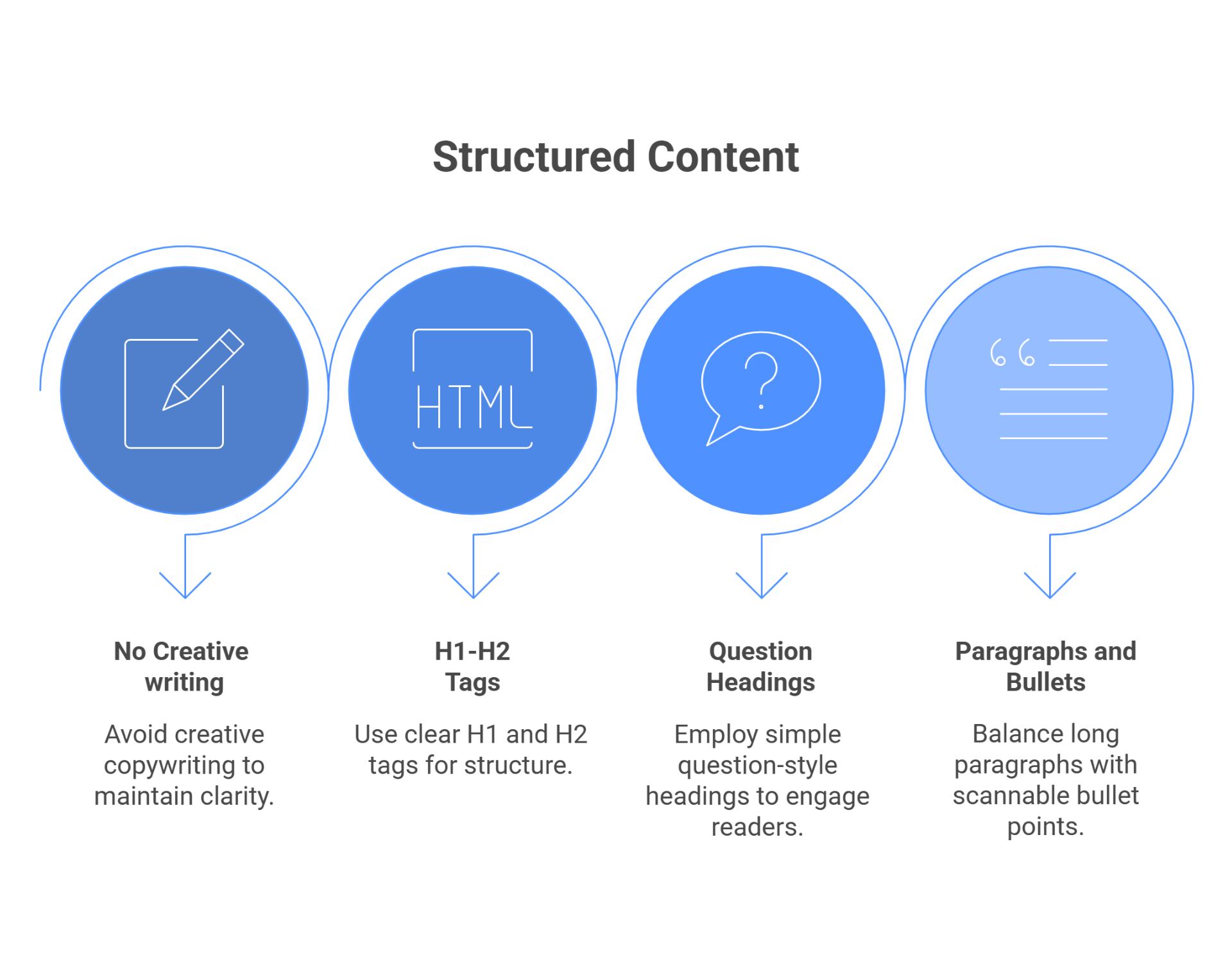
AI engines struggle with chaos. The more structured, clear and consistent your content is, the higher the chances of AI picking your brand.
- Avoid overly creative copywriting that obscures meaning
- Clear H1-H2 Tags
- Simple Question-style Headings
- Perfect balance of long-detailed paragraphs and scannable bullet pointers
AI loves content that’s easy to skim, summarise, and reuse. Organizations aiming to improve AI readability often invest in expert blog writing services to ensure their content is clearly structured for both search engines and generative AI systems.
3. Invest in Attribution
Make expertise visible:
- Authors
- Credentials
- Case studies
First-party research
4. Engineer Consistency
Your About page, PR quotes, profiles, and content should sound like the same organisation.
5. Earn Mentions
Prioritise being referenced in:
- Editorial mentions
- Industry comparisons
- Community discussions
- Reviews and case studies
6. Diversify Across Contexts and Platforms
Being cited on a blog, a YouTube review, and a Wikipedia page dramatically increases the chance AI draws from your brand.
7. Measure the Right Thing
Track:
- AI mentions
- Citation frequency
- Brand sentiment in generated answers
Traffic alone is no longer a sufficient signal.
Final Thoughts
AI doesn’t “choose” brands the way humans do. It calculates probability, forming links between topics and entities based on evidence in training data and indexed sources.
So, while popularity helps, it’s not the root factor. Instead:
- AI prefers brands with strong data representation
- Consistent, contextual mentions matter more than links
- Authority is built through third-party visibility
- Structured, unambiguous information helps AI understand your brand
To succeed in the AI era, marketers must evolve beyond classic SEO and embrace GEO, optimising not just for rankings, but for recognition in the neural fabric of AI systems.
If you want a deeper breakdown of how GEO and AEO work in practice, including strategies, tools, and how they differ from classic SEO, read our detailed guide on AEO & GEO optimization.
At Sudha Solutions, our content marketing experts help brands strengthen entity authority, earn credible mentions, and improve AI-driven visibility. Is your brand struggling with AI citations, too? Get in touch with us today!