





For over two decades, search visibility followed a familiar logic:
rank higher > get more clicks > drive traffic > convert users.
That logic is no longer reliable. Search in 2026 is no longer about where you rank. It is about whether you are chosen as the answer.
Across Google, AI Overviews, large language models, and conversational interfaces, search behaviour is shifting from exploration to resolution. Users are no longer scanning ten blue links. They are asking complete questions and expecting complete answers, instantly.
Businesses adapting to this shift often work with teams offering SEO expert services to transition from ranking-focused strategies to answer-driven visibility models.
At Sudha Solutions, we believe this marks the most fundamental shift in search since the introduction of PageRank. And it demands a different way of thinking about SEO altogether.
This article explains:
- Why rankings alone no longer define visibility
- How AI-driven search engines decide who gets surfaced
- What “answer readiness” really means in 2026
- How businesses and SEO professionals must adapt now
This is not a prediction built on hype. It is a synthesis of platform changes, industry data, and how modern retrieval systems actually work.
The Quiet Collapse of Click-Based Visibility
Search engines are still sending traffic. But they are sending far less of it. Multiple independent studies now confirm what most practitioners are already seeing in analytics dashboards.
Key findings from the industry data behind zero-click search:
- 60% of Google searches end without a click
- Informational queries saw the steepest CTR decline
- Pages cited in AI Overviews often lose traditional clicks
The implication is not that SEO is dying. The implication is that visibility is being decoupled from traffic. A brand can now:
- Influence decisions
- Shape understanding
- Build authority
…without ever receiving a click.
Why Search Engines Are Becoming Answer Engines
To understand where SEO is heading to, we must understand how AI is searching, retrieving, and presenting information.
From Indexing Pages to Synthesising Knowledge
| Traditional Search | Modern Search |
| Indexed documents | Retrieves multiple sources |
| Ranked them using signals | Evaluate credibility and relevance |
| Let users extract meaning themselves | Synthesis a response |
| Presents a single, confident answer |
This shift is powered by retrieval-augmented generation (RAG), a system where language models pull from trusted sources before generating responses. In this system, your content is no longer competing for a click. It is competing for AI citations.
Visibility in 2026: Being Cited vs Being Clicked
Google rankings are not enough in 2026. Your ranking does not automatically translate to AI citations. What matters today is:
- Being quoted in an AI Overview
- Being referenced in a conversational response
- Being recalled when a follow-up question is asked
This is a fundamentally different type of visibility.
Traditional SEO vs Answer-Driven Visibility
| Traditional SEO | Answer-Driven SEO |
| Rankings-focused | Retrieval-focused |
| Optimised for CTR | Optimised for inclusion |
| Keyword-first | Question-first |
| Page authority | Entity & topic authority |
| Traffic as success | Influence as success |
The winners in this environment are not the loudest brands. Rather brands that are clearest and most reliable.
The Answer Readiness Model
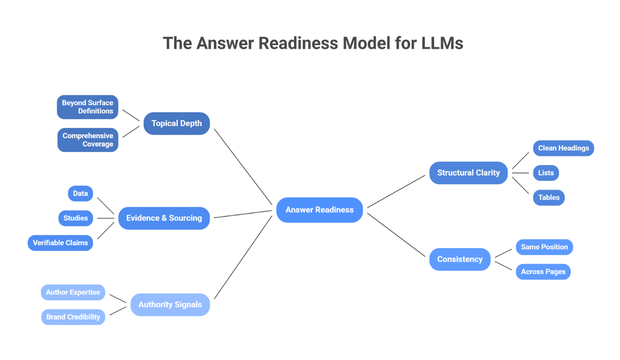
At Sudha Solutions, our content is a perfect balance of SEO optimisation and answer readiness. When both work in unison, brands grow.
Answer readiness answers one question:
If an AI system had to explain a topic to its user, would it trust your content?
The 5 Pillars of Answer Readiness
| Pillar | What AI systems look for |
| Topical depth | Coverage beyond surface definitions |
| Structural clarity | Clean headings, lists, tables |
| Evidence & sourcing | Data, studies, verifiable claims |
| Consistency | Same position across pages |
| Authority signals | Author expertise, brand credibility |
This is where EEAT stops being a guideline and becomes a retrieval requirement.
Why EEAT Now Directly Impacts AI Visibility
Google never introduced EEAT for writers. It introduced EEAT for evaluation systems. Many organizations strengthen EEAT signals by partnering with content marketing experts who build authority-driven editorial ecosystems across platforms
Large language models and AI checks this before considering your content:
- Is this accurate?
- Is this widely accepted?
- Is this safe to present a as fact?
EEAT provides those signals.
What Actually Strengthens EEAT in 2026
- First-hand explanations, not summaries
- Clear author attribution and expertise
- Consistent viewpoints across the site
- Alignment with external authoritative sources
- Absence of sensational or speculative claims
This is why thin content, paraphrased blogs, and generic SEO pages are systematically excluded from AI responses.
Content That Gets Chosen vs Content That Gets Ignored
Producing structured, authoritative resources at scale often requires collaboration with expert blog writing specialists who understand how AI systems interpret content clarity and evidence.
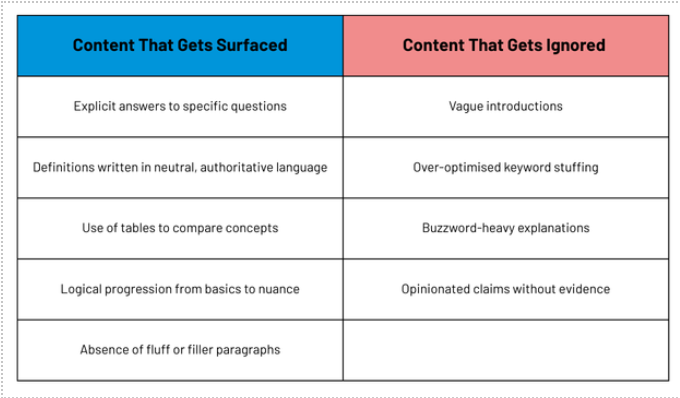
Answer engines do not “read” content the way humans do. They check it for clarity, completeness, and confidence. An information dense content which is not structured properly or does not follow EEAT guidelines will not interest AI platforms.
Characteristics of Content that gets Surfaced
- Explicit answers to specific questions
- Definitions written in neutral, authoritative language
- Use of tables to compare concepts
- Logical progression from basics to nuance
- Absence of fluff or filler paragraphs
Content that gets Ignored
- Vague introductions
- Over-optimised keyword stuffing
- Buzzword-heavy explanations
- Opinionated claims without evidence
This is why modern SEO content must feel closer to reference material than marketing copy.
Measuring Success When Clicks Decline
For multiple years, traffic and ranking were the metrics we relied on to measure success; however, we are going through a period of transition. This has also led to a shift in how we measure success.
New metrics that Actually Matter
| Metric | Why it matters |
| AI citation presence | Indicates retrieval trust |
| Branded search growth | Shows influence, not clicks |
| Assisted conversions | Users return later |
| Sales cycle shortening | Answers reduce friction |
| SERP dominance | Visibility across formats |
SEO teams must now report on influence, not just acquisition.
Why This Shift Benefits High-Quality Brands
This transition is a blessing in disguise for genuine brands as it disproportionately rewards:
- Specialists over generalists
- Experts over aggregators
- Brands with conviction over content farms
For founders and businesses, this is good news.
Answer engines favour:
- Clear positioning
- Narrow expertise
- Demonstrable experience
You do not need thousands of pages. You need the right ones, built to be referenced.
How Sudha Solutions Approaches SEO in an Answer-First World
Since the start of transition from traditional SEO to AI-led modern SEO, our SEO and content team have tried different approaches to find the best strategy to get quoted by AI. Our process no longer starts with just keywords. Our teams combine technical optimization and editorial strategy through integrated SEO expert services designed for AI-driven search ecosystems.
It starts with:
- What questions users ask before buying
- What confusion exists in the market
- What misinformation needs correcting
Then we build content that:
- Resolves uncertainty
- Establishes trust
- Can be confidently reused by AI systems
This is why our SEO strategies focus on durable visibility, not temporary rankings.
The Future: Search as a Conversation, Not a Destination
Search is becoming:
- Continuous
- Contextual
- Conversational
Users ask one question, then refine it. Only sources that remain consistent and credible survive that conversation.
By 2026, the brands that win will not be those who chased algorithms. They will be those who became the reference point.
Final Thoughts
SEO in 2026 is no longer about chasing rankings. It is about earning the right to be trusted as the answer. Brands that understand this shift early will not just survive algorithm updates. They will shape how their industry is understood.
If this article changed how you think about search, explore our other insights. This is only one part of a much larger transformation.
Frequently Asked Questions
What is Answer Engine Optimisation (AEO)?
AEO is the practice of structuring content so it can be directly retrieved and cited by AI-powered search engines and assistants, rather than only ranked as a clickable result.
Does SEO still matter if users do not click?
Yes. SEO now influences decisions earlier in the funnel, shaping perception and trust even without immediate traffic.
How do I know if my content appears in AI responses?
Monitor branded search growth, SERP features, AI Overviews, and assisted conversion paths rather than only organic clicks.
Are long-form blogs still relevant?
Yes, if they follow EEAT guidelines. This includes clear structure, trust factor by experts, some real-life examples or case studies, and question based H2s with clear answers and no fluff.